Copyright © 1999, American Society for Microbiology. All Rights Reserved.
Polyvalent Rev Decoys Act as Artificial
Rev-Responsive Elements
TONIA L. SYMENSMA,
1SCOTT BASKERVILLE,
1AMY YAN,
2 ANDANDREW D. ELLINGTON
2*
Department of Microbiology, Indiana University, Bloomington, Indiana 47405,
1and
Department of Chemistry, University of Texas at Austin, Austin, Texas 78712
2Received 9 October 1998/Accepted 18 January 1999
Interactions between Rev and the Rev-responsive element (RRE) control the order, rate, and extent of gene
expression in human immunodeficiency virus type 1. Rev decoys may therefore prove to be useful RNA
therapeutics for the treatment of AIDS. To improve upon the current generation of Rev decoys that bind single
Rev molecules, it would be useful to generate polyvalent Rev decoys that could bind multiple Rev molecules.
J. Kjems and P. A. Sharp (J. Virol. 67:4769–4776, 1993) originally constructed functional polyvalent Rev
decoys, but the structural context of these polyvalent decoys remains unclear, and it has been argued that the
individual decoys were either structurally discrete (Kjems and Sharp, J. Virol. 67:4769–4776, 1993) or were
part of an extended helix (R. W. Zemmel et al., Mol. Biol. 258:763–777, 1996). To resolve the differences
between these models, we have designed and synthesized concatemers of Rev-binding elements (RBEs) that
fold to form multiple, discrete, high-affinity Rev-binding sites. We find that the concatenated RBEs can
facilitate the cytoplasmic transport of viral mRNAs and therefore likely bind multiple Rev molecules. These
artificial RREs may simultaneously sequester Rev and hinder access to the cellular transport machinery.
The Rev protein of human immunodeficiency virus type 1
(HIV-1) interacts with a Rev-responsive element (RRE) on
retroviral mRNAs to regulate the expression of viral proteins
(reviewed in references 5 and 43). Early in the HIV-1 life cycle,
fully spliced (;2-kb) viral messages accumulate in the
cyto-plasm and produce regulatory proteins such as Rev, Tat, and
Nef. Rev then enters the nucleus and facilitates the
nucleocy-toplasmic transport of incompletely spliced (;4-kb) and
un-spliced (;9-kb) viral messages that encode viral structural
proteins (33; reviewed in reference 20).
The mechanism of Rev-dependent mRNA transport has
been elucidated in some detail. An N-terminal arginine-rich
motif (ARM) within a single Rev protein first interacts with a
30-nucleotide Rev-binding element (RBE) (4, 23, 28) on a
234-nucleotide RRE. The RRE is in turn located within an
intron that spans the env gene (14, 34, 56). An oligomerization
domain that flanks and overlaps the ARM guides the
forma-tion of Rev tetramers and higher-order Rev oligomers (42, 57).
After Rev binds to the RBE, additional Rev molecules
accu-mulate on the RRE (6, 36, 57). The specific RNA-protein
complex interacts with the nuclear export machinery to promote
the transport of incompletely spliced mRNAs that contain the
RRE (7, 9, 37, 49). A C-terminal leucine-rich activation
do-main has been shown to be critical for nucleocytoplasmic
trans-port (33, 36), to act as a nuclear extrans-port signal (8, 53; reviewed
in reference 11), and to bind to proteins involved in the nuclear
pore complex (3, 10). The Rev activation domain redirects
RRE-containing mRNAs to the non-mRNA export pathway
used by 5S rRNA and U snRNAs (8, 46, 47; reviewed in
reference 20). The Rev ARM includes a nuclear localization
signal that allows Rev to reenter the nucleus and transport
additional mRNA molecules (18). Rev thus shuttles between
the nucleus and cytoplasm and regulates the timing and level of
structural protein expression by kinetically competing with the
splicing machinery (40, 45).
Rev and the RBE have both been targets for the
develop-ment of antiviral therapies. Mutants of the Rev protein that
inhibit oligomerization can transdominantly disrupt Rev
func-tion and inhibit viral replicafunc-tion (19, 37, 42, 57). Antisense
oligonucleotides (26, 48) and ribozymes (59) directed against
the RRE have also been used to interrupt the viral life cycle.
Rev decoys based on the RBE have been shown to inhibit
RNA-protein interactions and viral replication (30, 31, 54, 55).
Similarly, aptamers that can bind tightly and selectively to the
Rev protein have been selected from random sequence nucleic
acid population (2, 12, 51). These anti-Rev aptamers have also
been shown to bind Rev in vivo (50) and to inhibit viral
rep-lication (13, 22).
Just as single Rev molecules bind to the RBE whereas
mul-tiple Rev molecules accumulate on the RRE, the efficacies of
individual Rev decoys can potentially be augmented by
build-ing polyvalent Rev decoys in which multiple Rev-bindbuild-ing sites
are present on a single RNA transcript. However, it is unclear
how polyvalent Rev decoys should be constructed. Kjems and
Sharp have suggested that simple concatenation of multiple
high-affinity sites may successfully sequester multiple Rev
mol-ecules (29). In contrast, Zemmel and coworkers have
sug-gested that Rev accumulates on extended helices adjacent to a
single high-affinity site (38, 58). Although these models are not
necessarily mutually exclusive, Zemmel et al. (58) have argued
that the constructs originally designed by Kjems and Sharp
(29) did not in fact fold to form discrete high-affinity sites but
instead formed an extended helix. To clearly distinguish
be-tween these different structural models, we designed a
polyva-lent Rev decoy in which multiple, high-affinity Rev-binding
sites were presented in a nonhelical structural context. The
polyvalent decoy functions as an artificial RRE and efficiently
supports mRNA transport in tissue culture cells. These
find-ings have important implications not only for the design of
antiviral therapies but also for understanding the mechanism
of Rev-dependent viral mRNA transport.
* Corresponding author. Mailing address: Department of
Chemis-try, ICMB A4800, University of Texas at Austin, Austin, TX 78712.
Phone: (512) 471-6445. Fax: (512) 471-7014. E-mail: andy.ellington
@mail.utexas.edu.
4341
on November 9, 2019 by guest
http://jvi.asm.org/
MATERIALS AND METHODS
Materials.Plasmids pDM128 (17, 18), pDM138 (21), and pRSVRev (17) were generous gifts from T. Hope. Plasmids pDM128 and pDM138 contain the HIV-1 intron that splits the rev gene and flanking exonic sequences; a chloramphenicol acetyltransferase (CAT) reporter gene has been inserted into the intron. The HIV-1 intron and CAT gene are under the control of the simian virus 40 promoter and enhancer (44). In pDM138, a unique ClaI restriction site was introduced into pDM128 in place of the RRE. Plasmid pRSVbgal (2), generously supplied by M. Zapp, contains theb-galactosidase gene under the control of the strong Rous sarcoma virus (RSV) promoter. Plasmids to be used in cellular transfection experiments were purified by using Qiagen (Chatsworth, Calif.) columns. Media, reduced-serum media, supplements, phosphate-buffered saline, and Lipofectamine were purchased from Gibco BRL (Gaithersburg, Md.). Fetal bovine serum was purchased from Summit Biotechnologies (Fort Collins, Colo.). Cell lines.African green monkey kidney (CV-1) cells were grown according to standard procedures in high-glucose Dulbecco’s modified Eagle medium supple-mented with fetal bovine serum (11%), penicillin (2.5 U/ml), streptomycin (2.5 mg/ml), andL-glutamine (2 mM) in 24-well cell culture plates (Costar, Cam-bridge, Mass.).
Construction of RBE concatemers.A modular synthesis scheme was devised for the construction of RBE concatemers. Three overlapping pairs of oligonu-cleotides encoded a 59T7 RNA polymerase promoter, an RBE-linker monomer, and a 39 cap, respectively. The paired oligonucleotides corresponding to the RBE-linker monomer contained overhangs that facilitated their oligomerization. These overhangs also facilitated addition of a T7 RNA polymerase promoter to the 59end of RBE concatemers and a constant sequence cap to the 39end. Both constant sequences also contained ClaI restriction sites to facilitate cloning. The sequences of the oligonucleotides are shown in Table 1.
All oligonucleotides were phosphorylated by using T4 polynucleotide kinase (New England Biolabs, Beverly, Mass.) for 30 min at room temperature. The oligonucleotides encoding the RBE linker monomers were denatured for 1 min at 95°C, annealed for 3 min at 45°C, and incubated at room temperature for at least 10 min. The oligonucleotide concatemers that were formed were ligated with T4 DNA ligase (New England Biolabs). The T7 promoter and 39cap were then ligated to the RBE concatemers. PCR amplification yielded a mixture of
products which served as templates for Ampliscribe in vitro transcription reac-tions (Epicentre Technologies, Madison, Wis.). Transcribed RNAs were treated with DNase I and gel purified on a 6% polyacrylamide denaturing gel. Individual bands were eluted from the gel, ethanol precipitated, and reverse transcribed by using avian myeloblastosis virus reverse transcriptase (Seikagaku America, Ijamsville, Md.) for 1 h at 42°C. The reverse transcription reaction products corresponding to individual concatemers were then PCR amplified and cloned into the pCRII vector from the TA cloning kit (Invitrogen, San Diego, Calif.). Individual colonies were screened for the presence of RBE-linker inserts. Clones containing concatemers corresponding to one to five tandem copies of the RBE (T1 to T5) were identified, and the sequences of the concatemers were confirmed by standard dideoxy sequencing methods. The RBE concatemers were PCR amplified from the pCRII vector, digested with ClaI, and cloned into ClaI-digested pDM138 to generate plasmids pDM138-T1 to pDM138-T5. The se-quences and orientations of the concatemers in pDM138 were verified by dideoxy sequencing. The insert in plasmid pDM138-T5 contained point muta-tions in two of the linker regions (one linker lacked a U, while the second had an additional C).
Nuclease mapping.A DNA template corresponding to T5 was transcribed in vitro by using an Ampliscribe transcription kit according to the manufacturer’s directions. The transcribed RNA was purified on a 6% denaturing polyacryl-amide gel, ethanol precipitated, and dephosphorylated with alkaline phosphatase (Boehringer Mannheim, Indianapolis, Ind.). The dephosphorylated RNA was phenol-chloroform extracted and treated with T4 polynucleotide kinase (New England Biolabs) in the presence of 5 fmol of [g-32P]ATP (7,000 Ci/mmol; ICN, Costa Mesa, Calif.). The radiolabeled RNA was again purified on a 6% poly-acrylamide gel and precipitated. Radiolabeled T5 was digested with various amounts of RNase A (1, 0.1, 0.01, 0.001, and 0.0001 U) or RNase T1(10, 5, 2.5, 1.25, 0.63, and 0.31 U) in 6ml of Hanks balanced salt solution (1) at 37°C for 5 min. The digestion reactions were quenched with 2mg of yeast tRNA (Gibco Life Technologies, Gaithersburg, Md.) in 4ml of 0.5 M EDTA, immediately phenol-chloroform extracted, and precipitated. To determine the spacings between hydrolysis products, 0.5 mg of radiolabeled T5 RNA was hydrolyzed in the presence of 25 mM sodium bicarbonate, 1 mM EDTA, and 10mg of yeast tRNA. This alkaline hydrolysis reaction mixture was heated to 90°C for 10 min,
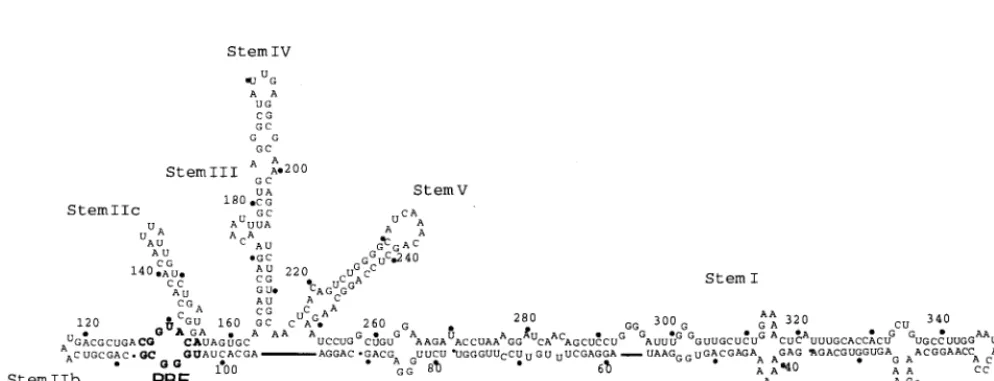
[image:2.612.49.552.80.157.2]neu-FIG. 1. The molecular rheostat model for the accumulation of Rev on the RRE. One model for Rev function suggests that Rev initially binds to the RBE whereas subsequent Revs oligomerize along an adjacent, imperfectly paired duplex in stem I (38, 58). In this model, the overall architecture of the RRE complex plays a critical role in sequestering multiple Rev molecules. The RRE is drawn and numbered according to Mann et al. (38). Rev protein molecules are represented as oblongs; the actual number and alignment of Revs on the RRE is unknown.
TABLE 1. Oligonucleotides used
Oligonucleotide Sequencea
5
9
T7 promoter ...5
9
AAT TCT AAT ACG ACT CAC TAT AGG GAG
ATC GAT
5
9
AGA GAA GAG
ATC GAT CTC CCT ATA GTG AGT CGT ATT A
RBE-linker monomer ...5
9
CTC TTC TCT GGT GGG CGC AGC TTC GGC TGA CGG TAC ACC
5
9
AGA GAA GAG GGT GTA CCG TCA GCC GAA GCT GCG CCC ACC
3
9
cap...5
9
CTC TTC TCT
ATC GAT ACC CAA AGT CGT GAC TGG GAA AAC G
5
9
GAT CCG TTT TCC CAG TCA CGA CTT TGG GTA
TCG AT
aClaI restriction sites are italicized, and the T7 RNA polymerase promoter is shown in boldface.
on November 9, 2019 by guest
http://jvi.asm.org/
[image:2.612.54.551.502.692.2]tralized with 2ml of 0.5 M acetic acid, and ethanol precipitated. Hydrolysis products were separated on a 6% denaturing polyacrylamide gel, and the diges-tion patterns were analyzed with a PhosphorImager (Molecular Dynamics, Sunnyvale, Calif.).
Cellular assays of RBE concatemers.To determine if RBE concatemers sup-ported Rev function, the reporter plasmids were cotransfected with a Rev ex-pression plasmid, pRSVRev, and CAT activities were assessed. One day prior to transfection, CV-1 cells were counted with a Coulter (Hialeah, Fla.) cell counter, and 55,000 cells were seeded into each well of a 24-well cell culture plate. The next day, the cells (at 70 to 80% confluency) were transiently transfected in duplicate with either a Rev-responsive reporter plasmid (pDM128; 0.2mg) or derivatives of pDM138 containing RBE concatemers (0.2mg), pRSVbgal (0.5mg) as a control for transfection efficiency, and a Rev expression plasmid (pRSVRev). The amount of pRSVRev used in each transfection was varied between limiting pRSVRev (0.01mg), saturating pRSVRev (0.2mg), or a titration of pRSVRev (0.002mg to 0.2mg). Cells were prepared for transfection by preincubation for 30 min in 1 ml of OptiMEM reduced-serum medium. Plasmid DNAs (1.2mg in total, including various amounts of a carrier plasmid, pUC118) in 100 ml of OptiMEM were mixed with 1.5ml of Lipofectamine in 100ml of OptiMEM. Lipid amalgams (200ml) were incubated at ambient temperature for 30 min to allow complex formation to occur; the mixture was added to cells in a total volume of 0.5 ml of OptiMEM (7.2 ng of liposome:2.4 ng of DNA per ml [final concentration]) and incubated for an additional 4.5 to 5 h at 37°C. The trans-fection medium was removed from the wells and replaced with complete me-dium. Forty-eight hours posttransfection, the cells were washed with 1 ml of phosphate-buffered saline and lysed in 0.25 M Tris-Cl (pH 7.6)–0.5% Triton X-100 (150ml). Harvested cellular extracts (100ml) were centrifuged for 5 min, and the supernatant was used for CAT assays andb-galactosidase assays.
CAT activity was measured according to standard procedures (32). Cellular extracts (40ml) were mixed with acetyl coenzyme A (0.45 mM [final concentra-tion]; Pharmacia, Piscataway, N.J.), glycerol (1.8% final), and14C-labeled chlor-amphenicol (0.1mCi; 50 mCi/mmol; DuPont NEN, Boston, Mass.) in 176ml of 0.14 M Tris-Cl (pH 7.6). The reaction mix was incubated at 37°C for 1.5 h; control experiments indicated that this was within the linear range of the assay. Chloramphenicol and less polar acetylated products were ethyl acetate extracted and separated by thin-layer chromatography in 5% methanol–95% chloroform on silica gel IB2 sheets (J. T. Baker, Phillipsburg, N.J.). The labeled chloram-phenicol products were quantitated with a Phosphorimager (Molecular
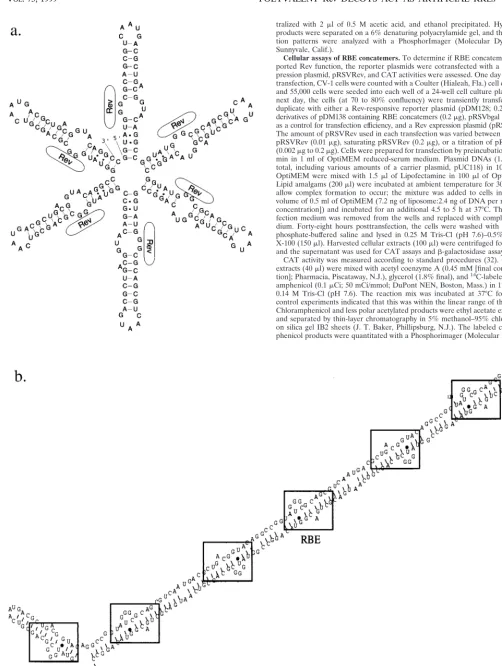
Dynam-FIG. 2. Alternative structures of RBE concatemers. (a) Design of an RBE hexamer by Kjems and Sharp (29). The desired structure is shown. Rev protein molecules interacting with the internal loop of the RBE are again represented as oblongs. (b) Predicted secondary structure of the RBE hexamer. When the secondary structure of the RBE hexamer shown in panel a is modeled with the program Mulfold (24, 25, 60), an elongated RNA originally predicted by Zemmel et al. (58) is observed.
on November 9, 2019 by guest
http://jvi.asm.org/
[image:3.612.49.551.54.720.2]ics). The amount of CAT activity present in each extract was defined as the percentage of total chloramphenicol that had been converted to acetylated prod-ucts. CAT activities were normalized to the amount ofb-galactosidase activity detected in each extract. Theb-galactosidase levels were determined by incu-bating 15ml of extract with 0.1 mM MgCl2, 0.35%b-mercaptoethanol (Sigma, St. Louis, Mo.), and 0.88 mg of o-nitrophenyl-b-D-galactopyranoside (Sigma) per ml in a final volume of 150ml of 0.1 M NaH2PO4-Na2HPO4. After incubation at 37°C for 45 min,b-galactosidase activities were determined with a microtiter plate reader (Cambridge Technology, Cambridge, Mass.) fitted with a 450-nm filter.
RESULTS AND DISCUSSION
The structural context of polyvalent Rev decoys.
Rev decoys
have been developed as potential therapeutics to combat HIV
infection. The RBE mounted on a retroviral vector sequesters
Rev and inhibits viral replication (30, 31, 54, 55). Anti-Rev
aptamers that have higher affinities for Rev than the wild-type
RBE have been selected from random-sequence populations
(2, 12, 51) and have been shown to be efficient Rev decoys both
in vitro and in vivo (13, 22, 50).
To further improve the efficacies of Rev decoys, we wished
to design RNA molecules that would capture multiple Rev
molecules. The fact that Rev responsiveness is potentiated by
the accumulation of multiple Rev molecules on the RRE (33,
36) suggested that polyvalent decoys might prove to be
espe-cially effective at blocking viral replication. Biochemical
anal-yses have previously revealed that 7 to 8 Rev molecules form a
stable complex with the RRE in vitro (6), and up to 11 to 12
Rev molecules may contribute to full Rev responsiveness in
vivo (38). Moreover, the accumulation of Rev on the RRE is
assisted by the tetramerization or oligomerization of Rev
monomers (15, 36, 42, 57), and mutations in the
multimeriza-tion domain of Rev inhibit in vivo Rev funcmultimeriza-tion (36, 57).
The simplest model for the design of polyvalent Rev decoys
would be the concatenation of multiple high-affinity
Rev-bind-ing sites. In support of this model, fusion proteins between Rev
and the bacteriophage MS2 coat protein directed transport of
intron-containing RNAs when multiple MS2 phage operator
sites were present (39, 52). These studies found that three to
four MS2 operator sites were required for efficient
Rev-depen-dent mRNA transport (39). Similarly, Kjems and Sharp (29)
designed constructs that contained one, three, or six copies of
RBEs. RNAs containing only one RBE fostered no
Rev-de-pendent mRNA transport, while RNAs expressing three copies
of the RBE had an intermediate Rev response (55% of the
wild-type RRE level), and six copies produced an almost full
Rev response (74% of the wild-type RRE level). A hexamer
RBE has also been shown to mediate Rev-dependent
suppres-sion of RNA splicing in vitro (27).
However, a competing model suggested that the simple
con-catenation of high-affinity Rev-binding sites might not direct
the accumulation of multiple Rev molecules (38, 58). In this
model, the high-affinity RBE within stem IIB of the RRE binds
the first Rev molecule, while the adjacent stem I, a long and
imperfect RNA duplex, mediates the subsequent accumulation
of additional Rev molecules (23, 38, 58) (Fig. 1). Nuclease
protection studies and gel shift analyses have shown that initial
Rev binding to the high-affinity RBE is required for additional
binding to adjacent, lower-affinity RNA duplexes (38, 58).
De-letion analyses originally revealed that the presence of stem I
was important for Rev responsiveness (35) and that truncation
of stem I reduces the number of Rev molecules bound in vitro
and Rev responsiveness in vivo (38). Taken together, these
results support the notion that coupled high- and low-affinity
sites on the RRE function as a molecular rheostat that is
sensitive to the concentration of Rev in a cell (38).
While these two models are not of necessity mutually
exclu-sive, Zemmel et al. (58) have argued that the RBE
concatem-ers constructed by Kjems and Sharp (29) (Fig. 2a) could be
folded into an alternative structure in which one or more RBEs
was adjacent to a long and imperfect RNA duplex (Fig. 2b). An
energetic analysis (60) of the Kjems and Sharp (29) RBE
concatemers suggests that the alternative conformation
pre-dicted by Zemmel et al. (58) was in fact the more favorable
conformation. In this view, increasing numbers of RBEs
pro-moted greater levels of mRNA transport not because multiple,
high-affinity Rev-binding sites were sequentially introduced
into a transcript but rather because a proportionately longer,
albeit unplanned, stem structure was formed. Before design
strategies for polyvalent RBEs could be established it was first
necessary to resolve these disparate interpretations.
Concatenation of discrete RBEs into polyvalent Rev decoys.
[image:4.612.55.293.66.390.2]A minimal, 30-nucleotide, stem-internal loop-stem RBE has
previously been shown to interact with Rev monomers both in
vitro (23, 28) and in vivo (16, 35). We therefore attempted to
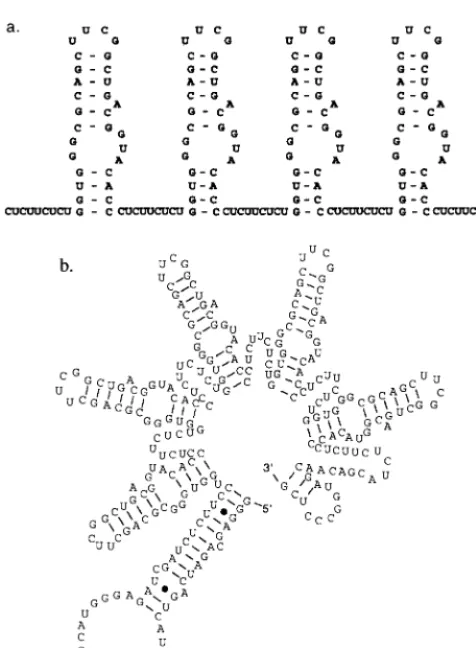
link together several RBEs to form polyvalent Rev decoys (Fig.
3a). The RBEs were topped with stable tetraloops (UUCG
[41]) that should have guided the formation of discrete
stem-internal loop-stem structures within the cell, and they were
flanked by pyrimidine spacers that should not have allowed the
formation of an extended helix similar to that shown in Fig. 2b.
An energetic analysis of the RBE concatemers suggested that
FIG. 3. Design and construction RBE concatemers. (a) Design of RBEcon-catemers. Individual RBEs were capped with a stable UUCG tetraloop sequence and separated by nine-nucleotide pyrimidine linkers (CUCUUCUCU). The tet-ramer T4 is shown. (b) Predicted secondary structure of a RBE pentamer. When the secondary structure of the RBE concatemer T5 (this report) is modeled with the program Mulfold, a discrete series of unit-length RBE structures is observed.
on November 9, 2019 by guest
http://jvi.asm.org/
the structure shown in Fig. 3b was likely the most favorable
conformation.
The length (.200 nucleotides) of the larger RBE
concate-mers prevented their direct synthesis as a single
oligonucleo-tide, and a modular synthetic scheme was instead devised.
Individual oligonucleotides encoding RBE-linker monomers
were synthesized. The RBE monomers were ligated to form
concatemers, which were then capped with oligonucleotides
[image:5.612.90.514.74.570.2]that allowed PCR amplification; one of the capping
oligonu-cleotides also contained a T7 RNA polymerase promoter to
further biochemical analysis. Following amplification, a ladder
of bands corresponding to concatemers of different lengths was
observed on an agarose gel. The concatemer pool was cloned,
and concatemers T1, T2, T3, T4, and T5 were recovered and
sequenced. To further buttress our contention that the
con-catemers folded into discrete Rev-binding sites, the secondary
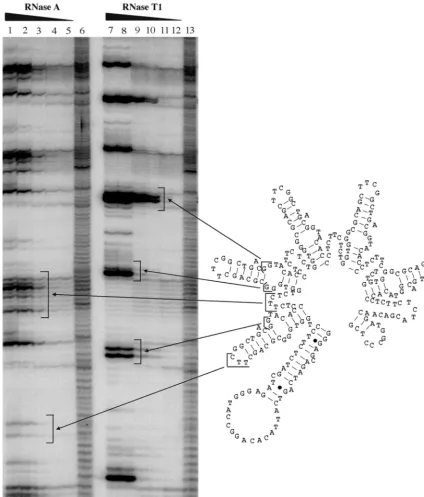
FIG. 4. Mapping the structure of T5. The secondary structure of T5 was mapped with RNase T1and RNase A as described in Materials and Methods. Lanes 1 to 5, digestion of T5 with decreasing concentrations of RNase A; lanes 7 to 12, digestion of T5 with decreasing concentrations of RNase T1; lanes 6 and 13, alkaline hydrolysis ladder of T5. A repeating pattern is observed with both nucleases; elements of this pattern are indicated by arrows stretching between the proposed secondary structure of the RBE concatemer and the digests. The sizes and spacings of the digestion products that make up this pattern are consistent with the formation of unit-length RBEs that contain single-stranded pyrimidines (in the case of RNase A) or single-stranded guanosines (in the case of RNase T1). The digestion patterns are inconsistent with the formation of a long, extended helix.on November 9, 2019 by guest
http://jvi.asm.org/
structure of the T5 concatemer was mapped in vitro (Fig. 4).
The nuclease sensitivity of T5 is consistent with the formation
of unit-length RBEs and inconsistent with the formation of an
extended secondary structure.
The RBE concatemers were subcloned into pDM138, a
well-characterized Rev-dependent CAT reporter for use with tissue
culture cells (17, 18, 21). Plasmid pDM138 is derived from
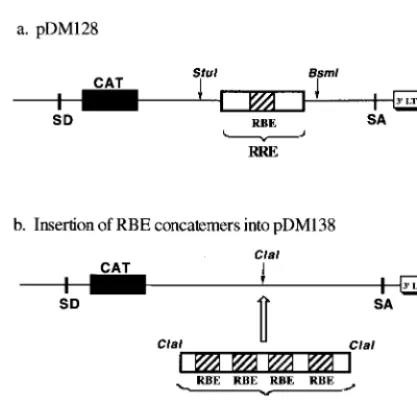
pDM128 (Fig. 5a), which contains the RRE and a CAT
re-porter gene within an HIV-1 intron. In the absence of Rev,
RNAs transcribed from pDM128 are spliced and negligible
CAT activity is observed. When Rev is present and interacts
with the RRE, Rev-mediated mRNA transport competes with
splicing and CAT activity is detected. Plasmid pDM138
con-tains a unique ClaI site in place of the RRE (Fig. 5b). By
placing the RBE concatemers into the pDM138 reporter,
con-structs that were superficially similar to pDM128 were formed.
If the RBE concatemers can in fact bind multiple Rev
mole-cules and thereby be transported from the nucleus, then higher
amounts of CAT activity should be present in transfected
cel-lular extracts in the presence of Rev than in its absence.
Optimization of assay conditions.
To determine how much
reporter plasmid should be transfected into cells to obtain a
robust Rev response, we first carried out a series of ranging
experiments. Plasmid pRSVRev (driver) expresses the Rev
protein under the control of the strong RSV promoter.
Vari-ous amounts of the pRSVRev driver were transfected into
CV-1 African green monkey kidney cells along with the
paren-tal reporter plasmid, pDM128. A plasmid that contained the
b-galactosidase gene was transfected in parallel with the
re-porter and driver plasmids as a control for transfection
effi-ciencies (2). At 48 h posttransfection, the cells were harvested
and levels of CAT activity were determined and normalized to
levels of
b-galactosidase activity. As shown in Fig. 6, when 0.2
mg of pDM128 is transfected into tissue culture cells the
co-transfection of small amounts (e.g., 0.01
mg) of pRSVRev leads
to the production of small amounts of CAT, while the
cotrans-fection of large amounts of pRSVRev (e.g., 0.2
mg) saturates
the Rev-dependent CAT signal. These results are similar to
those previously observed in our lab with pDM128 and mutant
derivatives of pDM128 (50).
Polyvalent Rev decoys function as artificial RREs.
RBE
concatemers in pDM138 were cotransfected with pRSVRev,
and CAT signals were assayed at 48 h posttransfection. Since
the Rev-dependent CAT signal from the pDM128 reporter was
readily observed and reproducible in the presence of both
limiting and saturating amounts of cotransfected pRSVRev
driver, the RBE concatemer reporter constructs were assayed
under both conditions. A representative sample of the data is
shown in Fig. 7; a graphical summary of all of the data is shown
in Fig. 8.
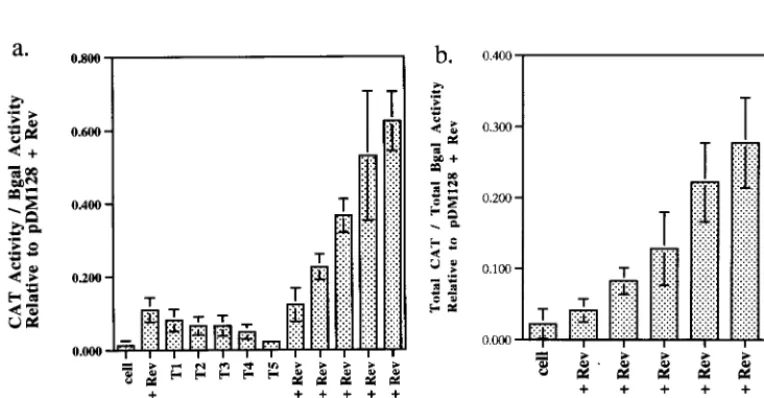
In the absence of Rev, the RBE concatemer reporters
(pDM138-T1, -T2, -T3, -T4, and -T5) produced only negligible
levels of CAT activity, comparable to results for a
no-transfec-tion control and to pDM138 in the presence of Rev. However,
when the Rev expression plasmid was included in the
trans-fection experiment, substantially greater amounts of CAT
ac-tivity were observed. The levels of Rev responsiveness
in-creased in a graded fashion; each RBE that was added to a
concatemer led to the production of additional CAT activity.
At limiting concentrations of the driver plasmid, the amount of
Rev-dependent CAT activity observed ranged from 1.3% of
type activity (pDM128) for pDM138-T1 to 51.5% of
wild-type activity for pDM138-T5 (background activity subtracted
relative to Fig. 8). At saturating concentrations of the driver
plasmid, the values ranged from 4.2% above background for
pDM138-T1 to 25.2% for pDM138-T5.
Rev responsiveness of artificial RREs as a function of Rev
concentration.
The experiments at limiting and saturating
[image:6.612.69.278.66.267.2]con-centrations of the Rev expression plasmid gave some
indica-tion of how the artificial RREs differed from their natural
counterparts. To derive a fuller understanding of how the Rev
responses of the artificial and natural elements differed or
overlapped, Rev titration experiments similar to those
origi-nally carried out with pDM128 were also carried out with
pDM138-T2 and -T5 (Fig. 9). The RBE concatemer reporter
pDM138-T2 was chosen rather than pDM138-T1 because the
extremely small amounts of signal produced by pDM138-T1
would have been difficult to follow at low concentrations of
pRSVRev. The amounts of RBE concatemer reporter
plas-mids used for transfection were held constant (0.2
mg), while
the amounts of pRSVRev were varied from 0.002 to 0.2
mg.
FIG. 5. Reporter plasmids. (a) Plasmid pDM128 (17, 18), which serves as a [image:6.612.311.551.76.200.2]positive control and contains the wild-type RRE within an HIV-1 intron adjacent to a CAT reporter gene. SD, splice donor; SA, splice acceptor; LTR, long ter-minal repeat. (b) Insertion of RBE concatemers into pDM138. Plasmid pDM138 (21), a derivative of pDM128, contains a unique ClaI site in place of the RRE. RBE concatemers T1, T2, T3, T4, and T5 were inserted into the ClaI site of pDM138.
FIG. 6. Rev responsiveness as a function of pRSVRev concentration. The relative activities of the wild-type RRE in pDM128 are shown as a function of the amount of pRSVRev included in transfection experiments. CV-1 cells were transiently transfected with constant amounts of pDM128 (0.2mg) and constant amounts of pRSVbgal (0.5mg). The amounts of pRSVRev included in each transfection varied (0.002, 0.01, 0.02, 0.05, and 0.2mg). CAT activities (arbitrary units) were determined and normalized tob-galactosidase levels (b-gal) (arbi-trary units). The results of eight separate determinations (four repetitions in duplicate) were averaged. Bars indicate standard deviations of the data.
on November 9, 2019 by guest
http://jvi.asm.org/
In consonance with the results shown in Fig. 8, the RBE
concatemer reporter pDM138-T5 was again more Rev
respon-sive than pDM138-T2 and elicited higher levels of
Rev-depen-dent CAT activity. Interestingly, the level of Rev-responsive
mRNA transport exhibited by pDM138-T5 at saturating
con-centrations of the driver plasmid was roughly 2.5 times the
level exhibited by pDM138-T2 at saturating concentrations of
the driver plasmid. This result is consistent with a model in
which the number of Rev-binding sites on a multivalent decoy
is the sole determinant of the level of mRNA transport. However,
both pDM138-T2 and pDM138-T5 reached maximal levels of
Rev responsiveness when approximately 0.01
mg of pRSVRev
was added, while the RRE did not reach maximal levels of Rev
responsiveness until approximately 0.05
mg of pRSVRev had
been added (Fig. 6). The results presented in Fig. 6, 8, and 9
indicate that there is not only a quantitative difference between
the natural and artificial RREs but a qualitative one as well.
While concatenated Rev-binding sites allow a transcript to be
transported in a Rev-dependent fashion, they do not
necessar-ily respond to Rev or accumulate Rev in the same manner as
the natural RRE does.
Toward design principles for polyvalent decoys and
artifi-cial RREs.
By eliminating heterologous (i.e., MS2)
[image:7.612.111.493.491.690.2]compo-nents (39, 52) and by clarifying the structures of the RNA
substrates (29), our studies are the first to fully delineate and
delimit Rev-RNA interactions in a functional (albeit artificial)
RRE. The graded increase in Rev-dependent mRNA transport
activity observed with increasing numbers of RBEs confirms
the findings of Kjems and Sharp (29) and is consistent with the
model in which multiple, discrete Rev-RNA complexes can
mediate Rev responsiveness. The use of discrete Rev-binding
sites greatly simplifies the analysis of where and how many Rev
molecules are bound by a RNA molecule. For example, Huang
et al. (21) demonstrated that a single copy of an 88-nucleotide
FIG. 7. RBE concatemers are Rev responsive. A representative sample of results of CAT assays carried out with the RBE concatemer series is shown. Lane 1, no-plasmid control; lanes 2 to 4, pDM128 plus pRSVREV (positive control; triplicate determinations); lanes 5, 6, and 22, pDM138 plus pRSVRev (negative control); lanes 7 to 11, RBE concatemers pDM138-T1 through pDM138-T5, respectively; lanes 12 to 21, RBE concatemers pDM138-T1 through pDM138-T5 plus pRSVRev, respectively (duplicate determinations).FIG. 8. Rev responsiveness of RBE concatemers at limiting and saturating concentrations of pRSVRev. Graphical summaries of the data from Fig. 4 and other determinations. CV-1 cells were transiently transfected with constant amounts of RBE concatemer (0.2mg), pRSVbgal (0.5mg), and limiting (0.01mg) (a) or saturating (0.2mg) (b) levels of pRSVRev. The CAT activities of RBE concatemers were normalized tob-galactosidase (bgal) activities and to the CAT activity of the positive control (pDM128 plus pRSVRev). Results of six separate determinations (three repetitions in duplicate) were averaged. Bars indicate standard deviations of the data.
on November 9, 2019 by guest
http://jvi.asm.org/
RRE fragment encompassing the RBE supported a partial Rev
response (26% of the wild-type RRE response), but it was
unclear how many Rev-binding sites may have been present on
this fragment. Based on our results, a similar level of
Rev-dependent mRNA transport would have required
approxi-mately five independent, high-affinity Rev-binding sites (see
also Fig. 8). By simplifying the structural context for the
pre-sentation of high-affinity Rev-binding sites, it should now be
possible to directly compare the efficacies of polyvalent Rev
decoys in which the number, spacing, and affinities of the
binding sites are varied.
However, it should be noted that our results are also in
accord with the rheostat model for the accumulation of Rev on
the RRE, since artificial RREs with either two or five RBEs
saturated at roughly the same concentration of the driver
plas-mid, while the natural RRE saturated at a higher
concentra-tion. Thus, it is likely that the discrete-binding-site and rheostat
models may be simultaneously correct. To accumulate sufficient
Rev molecules to mediate mRNA transport, it is sufficient
either to have multiple, independent high-affinity Rev-binding
sites or to have multiple, interdependent high- and low-affinity
Rev-binding sites. Thus, in addition to varying the placement
and type of Rev decoys in a polyvalent decoy, it would likely be
fruitful to explore whether the inclusion of additional
second-ary structural elements can drive the cooperative accumulation
of even more Rev molecules.
Overall, our results support the simple design principle that
we originally set out to assess, that simple concatenation of
Rev-binding sites can be used to generate polyvalent Rev decoys.
Most importantly, since polyvalent Rev decoys can function as
artificial RREs, they may be able to inhibit viral replication by
additional mechanisms, such as binding cytoplasmic as well as
nuclear Rev or competing for nuclear export pathways.
ACKNOWLEDGMENT
This work was supported by Department of Health and Human
Services grant AI-36083 from the National Institutes of Health.
REFERENCES
1. Ausubel, F., R. Brent, R. Kingston, D. Moore, J. G. Seidman, J. A. Smith, and K. Struhl (ed.).1997. Short protocols in molecular biology, 3rd ed. John Wiley & Sons, Inc., New York, N.Y.
2. Bartel, D. P., M. L. Zapp, M. R. Green, and J. W. Szostak. 1991. HIV-1 Rev regulation involves recognition of non-Watson-Crick base pairs in viral RNA. Cell 67:529–536.
3. Bogerd, H. P., R. A. Fridell, S. Madore, and B. R. Cullen. 1995. Identification of a novel cellular cofactor for the Rev/Rex class of retroviral regulatory proteins. Cell 82:485–494.
4. Cook, K. S., G. J. Fisk, J. Hauber, N. Usman, T. J. Daly, and J. R. Rusche. 1991. Characterization of HIV-1 Rev protein: binding stoichiometry and minimal RNA substrate. Nucleic Acids Res. 19:1577–1583.
5. Cullen, B. R. 1991. Regulation of HIV-1 gene expression. FASEB J. 5:2361– 2367.
6. Daly, T. J., R. C. Doten, P. Rennert, M. Auer, H. Jaksche, A. Donner, G. Fisk, and J. R. Rusche.1993. Biochemical characterization of binding of multiple HIV-1 Rev monomeric proteins to the Rev responsive element. Biochemis-try 32:10497–10505.
7. Fischer, U., S. Meyer, M. Teufel, C. Heckel, R. Luhrmann, and G. Raut-mann.1994. Evidence that HIV-1 Rev directly promotes the nuclear export of unspliced RNA. EMBO J. 13:4105–4112.
8. Fischer, U., J. Huber, W. C. Boelens, I. W. Mattaj, and R. Luhrmann. 1995. The HIV-1 Rev activation domain is a nuclear export signal that accesses an export pathway used by specific cellular RNAs. Cell 82:475–483. 9. Fornerod, M., M. Ohno, M. Yoshida, and I. W. Mattaj. 1997. CRM1 is an
export receptor for leucine-rich nuclear export signals. Cell 90:1051–1060. 10. Fritz, C. C., M. L. Zapp, and M. R. Green. 1995. A human nucleoporin-like
protein that specifically interacts with HIV Rev. Nature 376:530–533. 11. Gerace, L. 1995. Nuclear export signals and the fast track to the cytoplasm.
Cell 82:341–344.
12. Giver, L., D. Bartel, M. Zapp, A. Pawul, M. Green, and A. D. Ellington. 1993. Selective optimization of the Rev-binding element of HIV-1. Nucleic Acids Res. 21:5509–5516.
13. Good, P. D., A. J. Krikos, S. X. L. Li, E. Bertrand, N. S. Lee, L. Giver, A. D. Ellington, J. A. Zaia, J. J. Rossi, and D. R. Engelke.1997. Expression of small, therapeutic RNAs in human cell nuclei. Gene Ther. 4:45–54. 14. Hadzopoulou-Cladaras, M., B. Felber, C. Cladaras, A. Athanassopoulos, A.
Tse, and G. N. Pavlakis.1989. The Rev (Trs/Art) protein of human immu-nodeficiency virus type 1 affects viral mRNA and protein expression via a
cis-acting sequence in the Env region. J. Virol. 63:1265–1274.
15. Heaphy, S., J. T. Finch, M. J. Gait, J. Karn, and M. Singh. 1991. Human immunodeficiency virus type 1 regulator of virion expression, rev, forms nucleoprotein filaments after binding to a purine-rich “bubble” located with the rev response region of viral mRNAs. Proc. Natl. Acad. Sci. USA 88: 7366–7370.
16. Holland, S. M., M. Chavez, S. Gerstberger, and S. Venkatesan. 1992. A specific sequence with a bulged guanosine residue(s) in a stem-bulge-stem structure of Rev-responsive element RNA is required for trans activation by human immunodeficiency virus type 1 Rev. J. Virol. 66:3699–3706. 17. Hope, T. J., D. McDonald, X. Huang, J. Low, and T. G. Parslow. 1990.
Mutational analysis of the human immunodeficiency virus type 1 Rev trans-activator: essential residues near the amino terminus. J. Virol. 64:5360–5366. 18. Hope, T. J., X. Huang, D. McDonald, and T. G. Parslow. 1990. Steroid-receptor fusion of the human immunodeficiency virus type 1 Rev transacti-vator: mapping cryptic functions of the arginine-rich motif. Proc. Natl. Acad. Sci. USA 87:7787–7791.
19. Hope, T. J., N. P. Klein, M. E. Elder, and T. G. Parslow. 1992. Trans-dominant inhibition of human immunodeficiency virus type 1 Rev occurs through formation of inactive protein complexes. J. Virol. 66:1849–1855. FIG. 9. Rev responsiveness of artificial RREs as a function of pRSVRev concentration. The relative CAT activities of pDM138-T2 and pDM138-T5 are shown as a function of Rev concentration. CV-1 cells were transiently transfected with constant amounts of T2, T5, or pDM128 (0.2mg), constant amounts of pRSVbgal (0.5 mg), and various amounts of pRSVRev (0.002, 0.01, 0.02, 0.05, and 0.2mg). CAT activities were normalized tob-galactosidase (b-gal) levels. Results of eight separate determinations (four repetitions in duplicate) were averaged.
on November 9, 2019 by guest
http://jvi.asm.org/
20. Hope, T. J. 1997. Viral RNA export. Chem. Biol. 4:335–344.
21. Huang, X., T. J. Hope, B. L. Bond, D. McDonald, K. Gahl, and T. G. Parslow. 1991. Minimal Rev-response element for type 1 human immunodeficiency virus. J. Virol. 65:2131–2134.
22. Inouye, R. T., B. Du, D. Boldt-Houle, A. Ferrante, I.-W. Park, S. M. Hammer, L. Duan, J. E. Groopman, R. J. Pomerantz, and E. F. Terwilliger.1997. Potent inhibition of human immunodeficiency virus type 1 in primary T cells and alveolar macrophages by a combination anti-Rev strategy delivered in an adeno-associated virus vector. J. Virol. 71:4071–4078.
23. Iwai, S., C. Pritchard, D. A. Mann, J. Karn, and M. J. Gait. 1992. Recog-nition of the high affinity binding site in rev-response element RNA by the human immunodeficiency virus type 1 rev protein. Nucleic Acids Res. 20: 6465–6472.
24. Jaeger, J. A., D. H. Turner, and M. Zuker. 1989. Improved predictions of secondary structures for RNA. Proc. Natl. Acad. Sci. USA 86:7706–7710. 25. Jaeger, J. A., D. H. Turner, and M. Zuker. 1990. Predicting optimal and
suboptimal secondary structure for RNA. Methods Enzymol. 183:281–306. 26. Junker, U., K. Rittner, M. Homann, D. Bevec, E. Bohnlein, and G. Sczakiel. 1994. Reduction in replication of the human immunodeficiency virus type 1 in human T cell lines by polymerase III-drived transcription of chimeric tRNA-antisense RNA genes. Antisense Res. Dev. 4:165–172.
27. Kjems, J., A. D. Frankel, and P. A. Sharp. 1991. Specific regulation of mRNA splicing in vitro by a peptide from HIV-1. Cell 67:169–178. 28. Kjems, J., B. J. Calnan, A. D. Frankel, and P. A. Sharp. 1992. Specific
binding of basic peptide from HIV-1 Rev. EMBO J. 11:1119–1129. 29. Kjems, J., and P. A. Sharp. 1993. The basic domain of Rev from human
immunodeficiency virus type 1 specifically blocks the entry of U4/U6-U5 small nuclear ribonucleoprotein in spliceosome assembly. J. Virol. 67:4769– 4776.
30. Lee, S.-W., H. F. Gallardo, E. Gilboa, and C. Smith. 1994. Inhibition of human immunodeficiency virus type 1 in human T cells by a potent Rev response element decoy consisting of the 13-nucleotide minimal Rev-binding domain. J. Virol. 68:8254–8264.
31. Lee, T. C., B. A. Sullenger, H. F. Gallardo, G. E. Ungers, and E. Gilboa. 1992. Overexpression of RRE-derived sequences inhibits HIV-1 replication in CEM cells. New Biol. 4:66–74.
32. Lin, Y. S., and M. R. Green. 1989. Similarities between prokaryotic and eukaryotic cyclic AMP-responsive promoter elements. Nature 340:656–659. 33. Malim, M. H., S. Bohnlein, J. Hauber, and B. R. Cullen. 1989. Functional dissection of the HIV-1 Rev trans-activator: derivation of a trans-dominant repressor of Rev function. Cell 58:205–214.
34. Malim, M. H., J. Hauber, S.-Y. Le, J. V. Maizel, and B. R. Cullen. 1989. The HIV-1 rev trans-activator acts through a structured target sequence to acti-vate nuclear export of unspliced viral mRNA. Nature 338:254–257. 35. Malim, M. H., L. S. Tiley, D. F. McCarn, J. R. Rusche, J. Hauber, and B. R.
Cullen.1990. HIV-1 structural gene expression requires binding of the Rev trans-activator to its RNA target sequence. Cell 60:675–683.
36. Malim, M. H., and B. R. Cullen. 1991. HIV-1 structural gene expression requires the binding of multiple Rev monomers to the viral RRE: implica-tions for HIV-1 latency. Cell 65:241–248.
37. Malim, M. H., D. F. McCarn, L. S. Tiley, and B. R. Cullen. 1991. Mutational definition of the human immunodeficiency virus type 1 Rev activation do-main. J. Virol. 65:4248–4254.
38. Mann, D. A., I. Mikaelian, R. W. Zemmel, S. M. Green, A. D. Lowe, T. Kimura, M. Singh, J. G. Butler, M. J. Gait, and J. Karn.1994. Co-operative rev binding to stem I of the rev-response element modulates human immu-nodeficiency virus type 1 late gene expression. J. Mol. Biol. 241:193–207. 39. McDonald, D., T. J. Hope, and T. G. Parslow. 1992. Posttranscriptional
regulation by the human immunodeficiency virus type 1 Rev and human T-cell leukemia virus type 1 Rex proteins through a heterologous RNA binding site. J. Virol. 66:7232–7238.
40. Meyer, B. E., and M. H. Malim. 1994. The HIV-1 Rev trans-activator shut-tles between the nucleus and cytoplasm. Genes Dev. 8:1538–1547. 41. Molinaro, M., and I. J. Tinoco. 1995. Use of ultra stable UNCG tetraloop
hairpins to fold RNA structures: thermodynamic and spectroscopic applica-tions. Nucleic Acids Res. 23:3056–3063.
42. Olsen, H. S., A. W. Cochrane, P. J. Dillon, C. M. Nalin, and C. A. Rosen. 1990. Interaction of the human immunodeficiency virus type 1 Rev protein with a structured region in env mRNA is dependent on multimer formation mediated through a basic stretch of amino acids. Genes Dev. 4:1357–1364. 43. Parslow, T. G. 1993. Post-transcriptional regulation of human retroviral gene expression, p. 101–136. In B. R. Cullen (ed.), Human retroviruses. Oxford University Press, New York, N.Y.
44. Peterlin, B. M., P. A. Luciw, P. J. Barr, and M. D. Walker. 1986. Elevated levels of mRNA can account for the trans-activation of human immunode-ficiency virus. Proc. Natl. Acad. Sci. USA 83:9734–9738.
45. Richard, N., S. Iacampo, and A. Cochrane. 1994. HIV-1 Rev is capable of shuttling between the nucleus and cytoplasm. Virology 204:123–131. 46. Ruhl, M., M. Himmelspach, G. M. Bahr, F. Hammerschmid, H. Jaksche, B.
Wolff, H. Aschauer, G. K. Farrington, H. Probst, D. Bevec, and J. Hauber. 1993. Eukaryotic initiation factor 5A is a cellular target of the human im-munodeficiency virus type 1 Rev activation domain mediating transactiva-tion. J. Cell Biol. 123:1309–1320.
47. Schatz, O., M. Oft, C. Dascher, M. Schebesta, O. Rosorius, H. Jaksche, M. Dobrovnik, D. Bevec, and J. Hauber.1998. Interaction of the HIV-1 Rev cofactor eukaryotic initiation factor 5A with ribosomal protein L5. Proc. Natl. Acad. Sci. USA 95:1607–1612.
48. Sczakiel, G., M. Oppenlander, K. Rittner, and M. Pawlita. 1992. Tat- and Rev-directed antisense RNA expression inhibits and abolishes replication of human immunodeficiency virus type 1: a temporal analysis. J. Virol. 66:5576– 5581.
49. Stutz, F., E. Izaurralde, I. W. Mattaj, and M. Rosbash. 1996. A role for nucleoporin FG repeat domains in export of human immunodeficiency virus type 1 Rev protein and RNA from the nucleus. Mol. Cell. Biol. 16:7144– 7150.
50. Symensma, T. L., L. Giver, M. Zapp, G. B. Takle, and A. D. Ellington. 1996. RNA aptamers selected to bind human immunodeficiency virus type 1 Rev in vitro are Rev responsive in vivo. J. Virol. 70:179–187.
51. Tuerk, C., and S. MacDougal-Waugh. 1993. In vitro evolution of functional nucleic acids: high-affinity RNA ligands of HIV-1 proteins. Gene 137:33–39. 52. Venkatesan, S., S. M. Gerstberger, H. Park, S. M. Holland, and Y. S. Nam. 1992. Human immunodeficiency virus type 1 Rev activation can be achieved without Rev responsive element RNA if Rev is directed to the target as a Rev/MS2 fusion protein which tethers the MS2 operator RNA. J. Virol. 66:7469–7480.
53. Wen, W., J. L. Meinkoth, R. Y. Tsien, and S. S. Taylor. 1995. Identification of a signal for rapid export of proteins from the nucleus. Cell 82:463–473. 54. Yamada, O., G. Kraus, L. Luznik, M. Yu, and F. Wong-Staal. 1996. A
chimeric human immunodeficiency virus type 1 (HIV-1) minimal Rev re-sponse element-ribozyme molecule exhibits dual antiviral function and in-hibits cell-cell transmission of HIV-1. J. Virol. 70:1596–1601.
55. Yuyama, N., J. Ohkawa, T. Koguma, M. Shirai, and K. Taira. 1994. A multifunctional expression vector for an anti-HIV-1 ribozyme that produces a 59- and 39-trimmed trans-acting ribozyme, targeted against HIV-1 RNA, and cis-acting ribozymes that are designed to bind to and thereby sequester trans-activator proteins such as Tat and Rev. Nucleic Acids Res. 22:5060– 5067.
56. Zapp, M. L., and M. R. Green. 1989. Sequence-specific RNA binding by the HIV-1 Rev protein. Nature 342:714–716.
57. Zapp, M. L., T. J. Hope, T. G. Parslow, and M. R. Green. 1991. Oligomer-ization and RNA binding domains of the type 1 human immunodeficiency virus Rev protein: a dual function for an arginine-rich binding motif. Proc. Natl. Acad. Sci. USA 88:7734–7738.
58. Zemmel, R. W., A. C. Kelley, J. Karn, and P. J. G. Butler. 1996. Flexible regions of RNA structure facilitate co-operative rev assembly on the rev-response element. Mol. Biol. 258:763–777.
59. Zhou, C., I. C. Bahner, G. P. Larson, J. A. Zaia, J. J. Rossi, and D. B. Kohn. 1994. Inhibition of HIV-1 in human T-lymphocytes by retrovirally trans-duced anti-tat and rev hammerhead ribozymes. Gene 149:33–39. 60. Zuker, M. 1989. On finding all suboptimal foldings of an RNA molecule.
Science 244:48–52.
on November 9, 2019 by guest
http://jvi.asm.org/