Vol. 67,No. 3 JOURNALOFVIROLOGY,Mar. 1993,p. 1545-1554
0022-538X/93/031545-10$02.00/0
Copyright © 1993,AmericanSociety for Microbiology
Functional and Defective
Components of Avian
Endogenous
Virus Long
Terminal
Repeat
Enhancer
Sequences
DONALDE. HABEL,1 KIRSTIN L. DOHRER,2AND KATHLEENF. CONKLIN2,3*
Department ofCell andDevelopmental Biology,1Institute of Human Genetics,2*andDepartmentof
Microbiology,3
Box206UMHC,
University
of
Minnesota,
Minneapolis,
Minnesota 55455Received 5 October 1992/Accepted 11 December 1992
Oncogenicavianretroviruses, such asRoussarcomavirus(RSV) and theavian leukosis viruses, containa strongenhancer in the U3portion oftheprovirallongterminalrepeat (LTR). The LTRs ofasecond classof avianretroviruses,theendogenous viruses (ev) lackdetectableenhanceractivity.Bycreating ev-RSV hybrid
LTRs,wepreviouslydemonstratedthat,despitethelackofindependent enhanceractivityin theevU3 region,
ev LTRs contain sequences that are ableto functionally replace essential enhancer domains from the RSV enhancer. A hypothesis proposed to explain these data was that ev LTRs contain a partial enhancer that includes sequences necessarybut not sufficient forenhanceractivity and thatthese sequences were
comple-mentedbyRSV enhancer domains present intheoriginalhybridconstructs togenerateafunctionalenhancer.
Studies described in this reportweredesigned todefinesequencesfromboth theevand RSV LTRsrequired togenerate thiscompositeenhancer. Thiswasapproached by generatingadditionalev-RSVhybridLTRs that
exchangeddefined regionsbetween evand RSVandbydirectly testingtherequirementforspecificmotifsby
site-directed mutagenesis. Results obtained demonstrate thatevenhancersequences are present inthe same relativelocationasupstreamenhancersequencesfromRSV, withwhich they share limitedsequencesimilarity.
In addition, a 67-bp region from the internal portion of the RSV LTR that is required to complement ev enhancersequenceswasidentified.Finally,datashowingthatCArG motifsareessential forhigh-levelactivity, afindingthat hasnotbeen previouslydemonstrated forretroviral LTRs,arepresented.
The long terminal repeats (LTRs) of avian exogenous retroviruses, such as Rous sarcoma virus (RSV) and the avian leukosis viruses (ALVs), contain a strong enhancer that is required for
high-level
expression
from the viral promoterand thatcanaugmenttranscription fromanumber ofheterologouspromotersin differentcell types(8, 9, 13, 15,22, 24, 26, 29, 44, 45). In ALVs, the LTR-associated
enhancer isalso an important contributorto cellular
trans-formation,since it isresponsiblefor theincreased
transcrip-tion of cellular oncogenes adjacent to sites of provirus
integration(18, 23, 31). TheLTRsofasecond class ofavian retroviruses, the avian endogenousviruses(ev) (1, 21, 32),
aredistinct from those of the exogenous viruses in thatthey
lackadetectable LTR-associated enhancer(5, 8-10, 29, 44).
The absence of a strong enhancer in ev LTRs has been correlated with the lowoncogenic
potential
ofevrelative toexogenous viruses (6). Sequence comparisons have demon-strated major differences between ev and exogenous virus LTRs (19, 20, 37, 38), although it is not known which of these differences is responsible for their distinct enhancer activities.
We havepreviouslydemonstrated thatevLTRs,although
lacking detectable enhanceractivity,contain sequences that
are able to functionally replace, in an
orientation-indepen-dent manner,essential enhancer sequences in theRSVLTR,
withwhich theyshare limited sequence similarity (5). This
wasdemonstratedbyconstructingev-RSVhybridLTRs that
replaced sequences from the RSV LTR required for
en-hancer function with sequences from theevU3region. The
ability of the ev U3 region to restore high-level
transcrip-tional activity to the enhancer-deleted RSV was not
ex-plained bydifferences intheabilityofevand RSVpromoters
*Correspondingauthor.
to respond to enhancers placed in cis. In agreement with previous data
(8-10,
29, 44), it was also found that the sameevU3 fragment that was able to restore transcription to the enhancer-deficient RSV LTR was unable to enhance
tran-scriptionfromanunrelated promoter, that of theherpesvirus
thymidine kinase gene. A hypothesis proposed to explain these data was that ev LTRscontain motifs necessary but
notsufficient for enhancer function and that these motifs can becomplemented by sequences from the RSV LTR present in the hybrid constructs to generate a functional enhancer element.Experiments presented in this report were designed
to define sequences from both the ev and RSV LTRs
requiredto generate thiscomposite enhancer.
Sequences from RSV that were included in the hybrid
LTR constructs mentioned above and that were therefore candidate sequences required to complement ev enhancer sequences extended downstream of an SphI site at -141
from the start site oftranscription. At least three proposed components of the RSV enhancer have been identified within this region. These include two inverted CCAAT boxes centered at positions -67 and -131 (-67 and -131 CCAAT boxes) that bind a nuclear factor(s) that will be
referredto asEFI, with the -131 site showingan apparent higheraffinityfor thisprotein(s) (12, 14, 16, 30, 33, 34, 39). Mutational analyses have demonstrated that each of these CCAAT motifs is required for maximal transcription from
the RSVLTR (16). Also included in this region is a CArG box, defined by the sequenceCC(A-Trich)6GG, centeredat
position -100. This motif binds a factor called EFIII (2),
which is theproposedavianhomolog of the serumresponse factor, apositive regulatoryproteinthat mediates
transcrip-tionalupregulationof thec-fos serumresponse element and
otherCArG-containingelementsin response to a
variety
of growth factors and mitogens, including serum (42). CArG boxesarealsorequisitetranscriptional regulatorysequences1545
on November 9, 2019 by guest
http://jvi.asm.org/
1546 HABEL ET AL.
found upstream of other cellular genes, including the verte-brate actin genes and the murine immediate-early gene
zif268
(42). Sequence comparisons demonstrate that ev LTRs lack motifs analogous to the -67 inverted CCAAT box and the -100 CArG box. In addition, although ev LTRs do contain aninverted CCAAT box at the same relative location as the -131 CCAAT box in RSV, previous studies indicated that the ev CCAAT box does not detectably bind RSV CCAAT boxbinding factor EFI (46). Thus, the two inverted CCAAT boxes and the -100 CArG box motifs in RSV are all candidate sequences required to complement ev enhancer
sequences in hybrid LTRs.
Theportion of the RSV enhancer that was deleted during
construction of hybrid LTRs, and which therefore was functionally replaced by ev U3 regions, extended from the 5' end of the LTR at position -229 through the
SphI
site at -141. This 88-bp fragment can enhance transcription from at least some heterologous promoters (8) and the deletion ofsequences within this region can abrogate transcriptional activation (8, 22, 24, 29), demonstrating the necessity of 5' proximal LTR sequences for enhancer function. Protein binding studies with the RSV LTR and the highly related LTR of ALV have identified at least three sites within this region that bind avian nuclear proteins. These include a second CArG box-EFIII binding site centered at position -162 (46) and two poorly characterized regions that bind aviannuclear proteins that have been named EFII (39),FIII
(14) or al (33, 34), and a3 (33, 34). Proteins that interact with the al and a3 binding regions show B-cell-specific lability in cells from chickens susceptible to virus-induced lymphom-agenesis and have been implicated in the regulation of
tumorigenesis byALVs (33, 34).
The ev U3fragment inserted in place of the upstream RSV enhancersequencesextended from the 5' end of the ev LTR through an AccI site at -50. This region of the ev LTR contains a binding site for a CCAAT/enhancer-binding-protein (c/EBP)-like heat-stable protein whose role in
tran-scriptional regulation has not been determined (36). Se-quence comparisons and protein binding studies have also
demonstratedthepresence of a CArGbox-EFIII binding site at the same relative position as the RSV -162 CArG box (46), suggesting that this motif is one component of ev enhancer sequences. Finally, ev LTRs also contain an inverted CCAAT box at the same relative position as the RSV -131CCAAT box-EFI binding site although, as men-tioned above, the ev CCAAT box does not detectably bind the EFI factor (46). Aside from these CArG and CCAAT motifs, however, ev LTRs show extensive divergence from RSVwithin 5' LTRsequences, and the identity and location of evsequences that are functionally equivalent to the RSV 5' enhancer sequences have yet to be determined.
Todefinesequencesfrom the ev LTR that can functionally substitute for the upstream RSV enhancer domains and to define sequences from RSV required to complement ev enhancersequences, additional hybrid LTRs that exchanged defined sequences between ev and RSV were constructed.
Inaddition, therequirementfor specific motifs for high-level transcription from hybrid LTRs was tested directly by
site-directed mutagenesis. Results obtained indicate that enhancersequences from the ev LTR are located in the same relative position as the upstream enhancer domains from RSV. Thisfinding was unusual because of the limited degree of sequence similarity between ev and RSV LTRs in this region. A 67-bp region from the RSV LTR that was required
to complement ev enhancer sequences was also identified. Additional data showing that CArG motifs are essential for
high-level activity of theseretroviral LTRs, afinding that has not been previously demonstrated, are presented.
MATERIALS
AND METHODSGeneration of ev-RSV hybrid LTRs.Theparental plasmids
used for construction of ev-RSV hybrid LTRs have been previously described (5) and are called pM-RSVNeo and pRAV-ONeo. pM-RSVNeo contains the 3' LTR from the Schmidt-Ruppin A strain of RSV and was derived from pRSVNeo (15). The LTR in pRAV-ONeo was generated from the 3' LTR of ev-2 (kindly provided by P. Tsichlis and J. Coffin). In each case, the LTR fragment extended from an
MstII
site (which was converted to a BamHI site) located 39 bp upstream of the LTR in the 3' untranslated region through a BstNI site inU5
(which was converted to aHindIII
site). These LTRs were linked to the neomycin resistance(Neor)
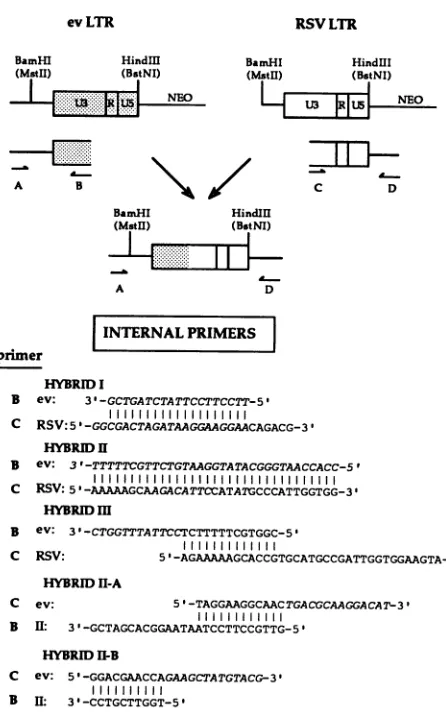
gene encoding sequences as previously described (5).The basic strategy used to generate hybrid LTRs is shown in Fig. 1. First, overlapping regions from pRAV-ONeo and from either pM-RSVNeo (for hybrids I, II, and III) or hybrid II (for hybrids
II-A
andII-B)
were amplified separately by polymerase chain reaction (PCR). The overlap between ev and RSV sequences either was due to naturally occurring regions of similarity between these two LTRs (for hybridII)
or was generated by using hybrid oligonucleotides as internal primers (for all other hybrid constructs). The products of these reactions were then mixed and subjected to a second round of amplification with only the external primers (la-beled A and D in Fig. 1) to generate hybrid LTRs whose junction was defined by the identity of the internal primers used in initial reactions. The PCR-generated LTRs were then digested withBamHI
(which cleaves upstream of the LTR at the convertedMstII
site in the 3' untranslated region) andHindIII (which cleaves within
U5
at the convertedBstNI
site) and inserted in place of the RSV LTR in pMRSVNeo. Parental, mutant, and chimeric LTRs were sequenced by dideoxy sequencing (Sequenase), and at least two isolates of each plasmid were tested in primer extension assays. Some isolates of hybrid II contained a T to C mutation at position -51 that did not affect the transcriptional activity of individ-ual isolates (see Fig. 6B). This alteration was also present in hybrid II LTRs that contained mutations in the ev CCAAT box and ev CArG box.The
external
5' primer (primer A) used in the first and second amplification reactions was a universal sequencing primer (5'-GTAAAACGACGGCCACT-3'), while the exter-nal 3' primer (primer D) was a neomycin specific primer(5'-CGTACTGCCTAACTTGTACC-3').
The sequences of internal primers (primers B and C) used to generate each of the hybrid LTRs are shown in the lower portion of Fig. 1. Hybrids I, II, and III contained one ev-RSV crossover point that is shown in Fig. 1 and 2. Hybrid II was used to generate additional hybrids(II-A
andII-B)
with a second crossover point also shown in Fig. 1 and 2.Site-directed mutagenesis. Hybrid II was used to introduce site-specific mutations into the ev CArG box, the RSV -100 CArG box, and the ev CCAAT box. This was accomplished by using mutant oligonucleotides that contained specific alterations described below as internal primers in PCR amplifications.
Transfection, RNA isolation, and primer extension. Hybrid,
mutant, and wild-type LTR constructs were transfected into QT35 cells, a chemically transformed quail embryo fibro-blast cell line (28), and RNA was isolated after 48 h as previously described (5). In some cases, a plasmid that
J. VIROL.
on November 9, 2019 by guest
http://jvi.asm.org/
ev LTR ENHANCER SEQUENCES 1547
RSV LTR
BamHI HindIIl
(MstII) (BetNI)
lEE-
a-C D
INTERNALPRIMERS primer
HYBRIDI
B ev: 3'-GCTGATCTATTCCTTCCTT-5'
C RSV:5'-GGCGACTAGATAAGGAAGGAACAGACG-3' HYBRi II
B ev: 3'-TTTTTCGTTCTGTAAGGTATACGGGTAACCACC-5'
C RSV: 5 '-AAAAAGCAAGACATTCCATATGCCCATTGGTGG-3'
HYBRID m
B ev: 3'-CTGGTTTATTCCTCTTTTTCGTGGC-5'
C RSV: 5'-AGAAAAAGCACCGTGCATGCCGATTGGTGGAAGTA-31
HYBRID11-A
C ev: 5'-TAGGAAGGCAACTGACGCAAGGACAT-3' 111111111111
B II: 3'-GCTAGCACGGAATAATCCTTCCGTTG-5'
HYBRIDI1-B
C ev: 5'-GGACGAACCAGAAGCTATGTACG-3'
111111111l B II: 3'-CCTGCTTGGT-5'
FIG. 1. ev-RSV hybrid LTRs: construction and sequence of primers. The top portion shows the strategy for constructing ev-RSVhybridLTRs. To generateev-RSVhybridLTRs that contained one crossoverpoint(hybrids I, II,andIII),internaloligonucleotide primers (B and C) listed in the lower portion of the figure and externalprimers(AandD)described in Materials and Methodswere
usedtoamplifydiscreteregionsof each LTR in separate reactions. Thesequencesof internalprimersused inthese reactionsweresuch thattheyresulted inasequenceoverlapbetweenevandRSVLTRs. This overlap either was due to naturally occurring regions of similaritybetween thesetwoLTRs(hybridII)orwasgeneratedby
using primers that contained an artificialjunction ofev and RSV sequence information (all other hybrids). The products of these initialamplificationswerethenmixed,subjectedto asecond round ofamplification with onlythe externalprimers, and cleavedwith BamHI andHindIll. Theresultanthybrid LTRfragmentwasthen inserted into a neomycin expression construct as described in Materials and Methods.HybridsII-AandII-Bwereconstructedby
thesame strategy, except that thehybrid IItemplate wasused in initial amplification reactions in place of the RSV LTR. The se-quencesofinternalprimersused in initialamplificationreactionsare
shown in the lowerportionof thefigure. evsequencesareshown in italics,and RSV sequencesareinromantype; verticallines between the sequences indicateidentity. HybridsI, II,and III containedone
crossoverpointbetweenevandRSV sequences shown in thefigure,
whilehybridsII-AandII-B containedasecondcrossover; onlythe secondcrossoverpointsin thesehybridsareshown. The locations ofcrossoverpointswithin thecontextof intactevandRSV LTRs arealso shown inFig.2.
contained the cytomegalovirus (CMV) promoter (7) driving expression of the Neorgene (kindlyprovided by M. Linial) wascotransfected withexperimentalconstructsasan
inter-nal control. Transcriptsgenerated from both theCMV- and
LTR-containingvectors were detected by primer extension
aspreviously described (5) by usingthe 22-nucleotide
neo-mycin-specific primer described above. Correctly initiated
transcripts from the LTR promoters are 77 nucleotides in length, while those from the CMV promoter are 90 nucle-otides in length. Transcript levels were quantitated from autoradiogramsby using computer-assisted video
densitom-etry(25) aspreviously described (5).
EMSA. Nuclear extracts wereprepared from QT35 cells
as previously described (46), except that 0.5 M NaCI was
used for nuclear extractions. Electrophoretic mobility shift
assays (EMSA) and methylation interference assays were
conducted aspreviously described (46), with approximately 0.002pmol (10,000 cpm)perreaction. The sequences of the 5' (upper) strands of oligonucleotides used in Fig. 6A that contained the wild-type CArG motifs were as follows: for the RSV -100 CArG box, 5'-CGATCGTGCCTTATTAGG AAGGCAAC-3'; for theevCArG box,5'-TCTAAAGACCA AATAAGGAAAAAGC-3'. Oligonucleotides that contained the mutated CArG motifs (named GArC in Fig. 6) were
identical to those listed above except for the CArG box mutations described below. Foruse in EMSA, oligonucle-otides were labeled on one strand with T4 polynucleotide kinase (Bethesda Research Laboratories) and [_y-32P]ATP (New EnglandNuclear), made doublestranded by incubat-ing with the complementary strand, and purified as previ-ously described (46).
DNA fragments thatweregenerated forEMSAshownin Fig. 5Bextended from what in RSVis definedas the -131 CCAAT box-EFI binding site and the -100 CArG box-EFIII binding site. For generation of end-labeled DNAfragments, 20 pmol ofone of the oligonucleotide primers listed below was labeled on its 5' end with T4 polynucleotide kinase (Bethesda Research Laboratories) and [y-32P]ATP (New England Nuclear). Conditions for PCR amplification and purification of DNAfragmentswere aspreviouslydescribed (46). The templates and primer pairsused to generate these DNA fragmentswere asfollows: for theRSVLTR,5'primer
5'-AGAAAAAGCACCGTGCATGCCGATTGGTGGAA
GTA-3' and 3' primer 5'-CGATCGTGCCTTATTAGGAAG GCAAC-3'; for the ev LTR,5' primer5'-AAAAAGCAAG
ACATTCCATATGCCCATTGGTGG-3' and 3' primer
5'-CGACTAGATAAGGAAGGAA-3'). For thehybridIILTR,
the5'primerwas the same as thatused for the ev LTR while the 3' primerwasthe same asthatused with the RSVLTR. For thehybridIItemplatethatcontained a mutantCCAAT
box, the 5' primer was the same as that used for the ev
template exceptthat itcontained theCCAAT boxmutations describedbelow, while the 3' primerwas the same as that
used with the RSV LTR. Amplification reactions were conducted aspreviously described (46), andproductswere
purified byacrylamide gel electrophoresis.
RESULTS
ev enhancer sequences are located in the same relative
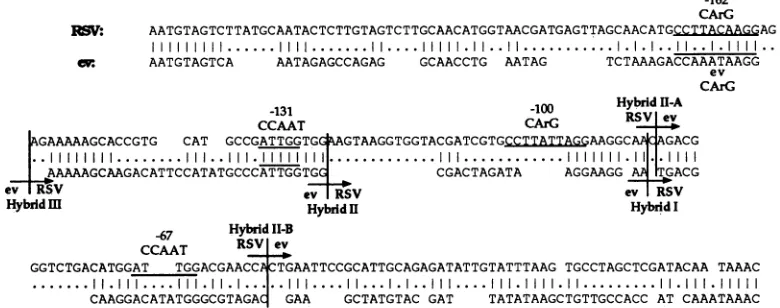
positionasupstreamRSV enhancerdomains. Figure2 shows a sequence comparison of the RSV and ev U3 regions aligned to show maximum homologies. Also shown in the
figurearepreviously described factorbindingmotifs within eachU3region. Figure3 shows adiagrammatic
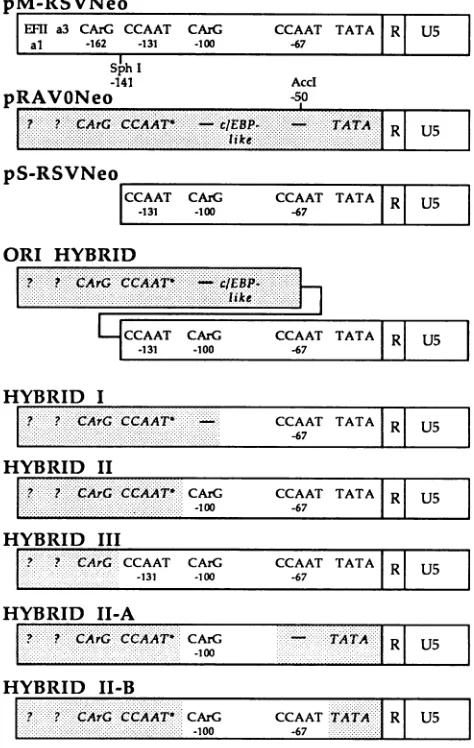
representa-tionof the RSV(pM-RSVNeo) andev(pRAV-ONeo)LTRs evLTR
BamHI HindIll
(MstI) (BatNI)
LL:IIEj~N
A B
BamHI HindIfi
(MSthI) (BatNI)
A D
VOL. 67,1993
\X
40el
on November 9, 2019 by guest
http://jvi.asm.org/
[image:3.612.63.286.87.443.2]1548 HABEL ET AL.
-162 CArG
~V: AATGTAGTCTTATGCAATACTCTTGTAGTCTTGCAACATGGTAACGATGAGTTAGCAACATGCCTTACAAAG
IlllllllI..IIII....
IIIIIIIi.II..I.ill.l.l..l...l
cv: AATGTAGTCA AATAGAGCCAGAG GCAACCTG AATAG TCTAAAGACCAAATAAGG ev
CArG
-131 -100 Hybrid 11-A
CCAAT CArG RS Ie
AGAAAAAGCACCGTG CAT GCCGATTGGTGG
AGTAAGGTGGTACGATCGTGC.IAITTAT.QAAGGCA
ACAGACG..I I.II..II111III11...III.I...1111
.AAAAAGCAAGACATTCCATATGCCCATTGGTGG CGACTAGATA AGGAAGG A TGACG
Hybrid-
MevTRSV
ev RSVHybridilI
~~~~~~Hybridil
HybridI-67
CCTRSV
HybridII-Bev
GGTCTGACATGGAT TGGACGAACCA CTGAATTCCGCATTGCAGAGATATTGTATTTAAG TGCCTAGCTCGATACAA TAAAC
CAAGGACATATGGGCGTAGAq
GAA GCTATGTAC GAT TATATAAGCTGTTGCCACC AT CAAATAAACFIG. 2. Sequence comparison of ev and RSV U3 regions. Sequences of the RSV andev-2/RAV-0U3 regions arefrompreviouslypublished sequences (20, 37, 38) and were independently confirmed. Vertical lines between the sequences represent identity, while dots represent mismatches. Gaps were introduced to allow maximum alignment between the two sequences. Previously described protein binding motifs within each LTR areunderlined (RSV) or overlined (ev). Designated lines identify crossover points of hybridLTRs.Notethat forthehybrid II-A andII-BLTRs,whichwere generated fromhybridII,only the second crossover point is labeled.
and the previously described ev-RSV hybrid LTR (ori
hy-brid)thatdemonstrated the presence of enhancer sequences in ev U3regions (5). As shown, this hybridLTRcontained RSV sequences downstream of an SphlI site at -141 and therefore included the -131 CCAAT motif and sufficient flanking DNA to retain EFI binding activity (39), the -100 CArG box-EFIII binding site, the -67 CCAAT box-EFI binding site, and downstream promoter sequences. The ev fragment in these original hybrids extended from the 5' end of theLTRthroughanAcclsite at -50. Thisregion contains the ev CArG box-EFIII binding site (46), a c/EBP-like binding site (36), and the ev CCAAT box, which does not
detectably bind EFI (46). Other ev sequences included in this hybrid have not been characterized with respect to
protein binding and/ortranscriptional regulatory activity.To determine whether ev enhancer sequences werepresent at
the same relative location as the RSV upstream enhancer domains orwhether additional 3' sequences such asthe ev
c/EBP-like binding site might also be required for maximal
transcription of hybrid LTRs, additionalLTRs that simply replaced increasing amounts of information from the 3'
portion of the ev LTR with the similarly positioned se-quences from RSV were constructed. The sequence of
crossoverpoints for each hybrid is shown in Fig. 1 and 2 and
depicted diagrammatically in Fig. 3.
As shown, hybrid I contained the ev CArG box-EFIII
bindingsite, theevCCAAT box, and additional upstream ev sequences of unknown function linked to RSV sequences that included the -67CCAAT box-EFI binding site and the RSV promoter. The RSV-derived sequences in hybrid II extended further upstream thanthose in hybrid Itoinclude the -100 RSV CArG box-EFIII binding site and an addi-tional 13 nucleotides upstream of this site in place of the corresponding sequences from the ev LTR, while hybrid III contained an additional replacement of the ev CCAAT box region with sequences from RSV. At least two isolates of each LTR were inserted in place of the RSV LTR in an RSV-neomycin vector and transfected into avian fibroblasts, and transcription from the control and experimental plas-midswas monitored by primer extension with a neomycin-specific primer as described in Materials and Methods.
Resultsobtained with these hybrids and control constructs
areshown inFig. 4. In agreement with previous results,the
intact RSV LTR(pM-RSVNeo)wastranscribedefficientlyin
this system, while the deletion of essential enhancer
se-quences upstreamof theSphlI site resulted in virtual elimi-nation oftranscription from the pS-RSVNeo construct. This low level oftranscriptional activityis approximately equal to that seen withan intactev LTR(pRAV-ONeo). In contrast, the originalev-RSVhybrid LTR gave riseto easily detect-able levels of transcripts, demonstrating the ability of ev
sequencesto restoretranscriptionalactivitytothe enhancer-deleted RSV LTR. Quantitation ofautoradiograms demon-strated that thishybridwas20-to25-foldhigherin
transcrip-tional activity than the intact ev LTRor the deleted RSV
LTRandwasonly 2-fold lower in activity thananintactRSV LTR.
Figure4also shows resultsobtained withhybrids I, II, and III. Hybrid I,whichcontained the RSV promoterand -67 CCAAT box linkedtoupstreamsequencesfrom theevLTR,
gave rise to barely detectable levels of extension product,
which is analogous to results obtained with an intact ev
LTR.TheinactivityofhybridIindicatesthatsubstitutionof the ev promoter with that from RSV is not sufficient to
complementevenhancer sequences,aresultconsistent with
previous data that indicated that the promoter is not the
defectivecomponentwithin theevLTR(5). Thesedata also indicate that the presence ofapromoter-proximal CCAAT
box, which ismissing in intactevLTRs, doesnotresult in
high-level transcription in conjunction with upstream ev
sequences.
Hybrid
II,
whichincluded RSV sequences that extend in the 3' direction from a site 13 nucleotides upstream of the RSV -100 CArG box-EFIII binding site, was transcribed efficiently in this system, giving rise to a level oftranscriptsthatwaseitherequal to orwithintwofold of that seenwith the original ev-RSVhybrid LTR. The finding that in some
experiments,suchasthat shown inFig.4,hybridIIgaverise
to a slightly lower level of transcripts than the original ev-RSVhybridLTRsuggeststhat the additional evorRSV sequences included in theoriginal hybrid might be required formaximalactivity.However, thehigh-leveltranscriptional activity of hybrid II demonstrates that the primary ev
enhancer sequencesarepresentatthesamerelative location
J. VIROL.
on November 9, 2019 by guest
http://jvi.asm.org/
[image:4.612.115.505.78.232.2]ev LTR ENHANCER SEQUENCES 1549
pM-RSVNeo
EFM a3 CArG CCAAT CAzG CCAAT TATA RI U5
al -162 -131 -100 -67
SphI
-141 AccI
pRAVONeo -50
-_
?!
CArG CCAT:
- l;eI UpS-RSVNeo_______________
CCAAT CArG CCAAT TATAIRI U5 l
ORI HYBRID
*... c...
4'CCAAT CArG CCAAT TATA RI U5l
-131 -100 -67 lI
HYBRID I
p? ? cAGCAT CCAAT TATAjR| U5
I? .A:C :T -10 -67 TAT RlU
HYBRID
III
... ...
I? ? CArG CCAAT CArG CCAAT TATA RU
.-6..
-131 -100 -67 R
HYBRID ID-A
I? ? CArO CCAT
-CATA
L~~~~~~~~~~
....'::'"""'':''-10...:HYBRID
II-B
I??CArSCCAAT!~'
CAAT.ATA....U
-1006....7
FIG. 3. Content of ev-RSV hybrid LTRs. pM-RSVNeo, pS-RSVNeo, and pRAV-ONeo have been previously described (5) and represent an intact RSV LTR, an RSV LTR deleted for sequences upstream of the SphI site at -141, and an intact ev LTR inserted into a neomycin-based expression vector, respectively. The con-struct labeled oni hybrid has also been previously described and includes ev U3 sequences that extend from the 5' end of the LTR through an AccI site at -50 inserted into the pS-RSVNeo vector. The construction of hybrids I, II, III, II-A, and II-B shown in the figure is described in the legend to Fig. 1 and in Materials and Methods. These LTRs represent PCR-generated ev-RSV hybrid LTRs that contain either a single crossover point (hybrids I, II, and III) or two crossover points (hybridII-A,andII-B)thatwere defined by the identity of internal primers used in amplification reactions. The location and identity of previously described factor binding sites in ev and RSV LTRs are shown. RSV motifs are depicted in roman type, while those from the ev LTR and shown in italics and are shaded.
as the upstream enhancer sequences from RSV and also demonstrate that the promoter-proximal c/EBP-like binding site in the ev LTR is not required for high-level transcrip-tional activity in the context of these hybrid LTRs. With the exception of a CArG box-EFIII binding site and an inverted CCAAT box, which are present in both the ev and RSV LTRs, other sequences within this functionally exchange-able 5' portion of ev and RSV LTRs share only limited sequence similarities (Fig. 2).
:MI-RS'
\1
-o'.R4~%' IIIN,.."1 i ) I
Ne2 Nt'L IIh) il) II III
i
1
- - -.~
-FIG. 4. Transcriptional activity of hybrids I, II, and III. Indi-catedplasmids (10,ugeach)weretransfectedinto avianfibroblasts, and total RNAwasharvested after 48 h.Twentymicrograms of each RNA sample was thenused in aprimer extension assaywith a Neor gene-specific primeraspreviously described (5). For hybridsI, II, andIII,each lanerepresents results obtained withdifferentisolates of each construct. The 77-nucleotide LTR extension product is indicated. Thelanemarked M contains pBR322MspI-digested DNA as amarker. Therelative levels ofextension productgeneratedfrom pRAV-ONeo and hybrids I, II, and III were analogous when a CMV-neomycin vector was cotransfected as an internal control
(datanot shown).
Hybrid III, which exchanged ev sequences with RSV sequences that include and extend downstream of theRSV -131 CCAAT box-EFI binding site, was approximately
equal intranscriptionalactivitytohybridII,which contained
the ev CCAAT box. Previous studies indicated that the ev CCAAT box does notdetectably bind the RSV CCAAT box binding factor EFI or any other nuclear protein (46). Given the fact that mutations in the RSV -131 CCAAT box that abrogate EFI binding can result in a significant decrease in transcription from the RSV LTR(16), it wassurprising that hybrids II and IIIexhibited equivalent transcriptional activ-ities. The basis for this apparent discrepancy was investi-gatedfurther, as described below.
Sequences within the ev CCAAT box are required for high-level transcriptional activity of thehybrid II LTR. One possibleexplanationforthe similartranscriptional activities of hybrid III, which contained the RSV -131 inverted CCAATbox, andhybrid II, which contained theevinverted CCAATbox, was that in contrasttoresults obtained with an intact RSV LTR (16), a functional upstream CCAAT box may not be required for high-level transcription in the context of thesehybrid LTRs. Toinvestigate this possibility, the evinvertedCCAAT box inhybridII (5'-ATTGG-3')was mutated to 5'-AATCG-3' as described in Materials and Methods and the transcriptional activity of this LTR was monitoredby primerextension as described above. In these andthefollowingexperiments, aCMV-neomycinvectorwas
includedin transfectionsas an internalcontrol;the presence of this vector did not alter the relative activities of the pRAV-ONeo and hybrid I, II, and III templates (data not
shown).
As shown in Fig. 5A, transcription from hybrid II LTRs VOL.67, 1993
on November 9, 2019 by guest
http://jvi.asm.org/
[image:5.612.64.301.79.453.2] [image:5.612.325.562.79.275.2]1550 HABEL ET AL.
II I
A
N'
1
-7 r--
X
q _ _q~~~--k Vf
_0w _m i ..-I
a_ s~~~~~~~~~~~~~~~~
r-B
>
>
>
EFI
-H
[image:6.612.108.261.73.593.2]U
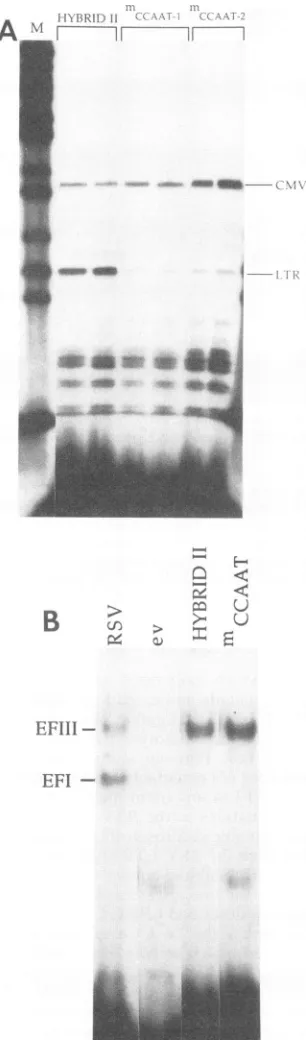
FIG. 5. ev CCAAT box: protein binding activity and role in transcription. (A) Transcriptional activity of hybrid II LTRs with a mutated ev CCAAT box. Mutations described in the text were introduced into the ev CCAAT box in the hybrid II LTR. Two differentisolates of this construct(mCCAAT-1 andmCCAAT-2), in parallel with the parental hybrid II plasmid, were transfected into avianfibroblasts,andtranscription was monitored by primer exten-sion. Tenmicrogramsof a CMV-neomycin vector was cotransfected with each sample as an internal control. The LTR (77-nucleotide) andCMV (90-nucleotide) extension products are marked. (B) DNA fragments that extend from what in RSV is defined by the -131 CCAAT box-EFI binding site and the -100 CArG box-EFIII binding site were generated from the RSV, ev, hybrid II, and
that contained the mutant ev CCAAT box (mCCAAT)was
decreased approximately 20-fold relative to that seen with the unmutated hybrid II plasmid. These results are consis-tent with the requirement for an upstream CCAAT box for high-level transcription in thecontextofhybrid LTRs.They
arenot,however, consistent withourprevious results show-ing that the ev CCAAT box does notdetectably bind EFI. Onepossible explanation for this apparentdiscrepancy was that the ev CCAAT box may be able to bind EFI in the contextof hybrid II because of the location of the crossover point in thishybrid, which placeda13-bp RSV sequence that ismissing in ev LTRs downstream of the ev CCAAT box (Fig. 2). To investigate this possibility, DNA probes that extended from what in RSV is definedby the -131 CCAAT box-EFIbinding site and the -100 CArG box-EFIIIbinding site (Fig. 2) were generated from RSV, ev, hybrid II, and hybrid II mCCAAT LTRtemplates and used in EMSA as
As shown in Fig. 5B, the RSV-derived probe generated twoDNA-protein complexes designated EFI and EFIII. The identity of these complexes was verified by methylation interference assays(46 and data notshown). The ev-specific probe failed to generate a complex corresponding to EFIII binding, a finding consistent with the absence of a CArG motif in ev LTRs at a position corresponding to the RSV -100 CArG box-EFIII binding site. The ev-specific probe also failedto generate an EFI complex, which is in
agree-ment with previous results that demonstrated the lack of detectable EFI binding to the ev CCAAT box (46). The fragment generated from hybrid II formed an EFIII-DNA protein complex, a result thatwaspredicted because of the presence of the RSV -100 CArG box-EFIII binding site in this construct. However, wefailed to detect an EFI-DNA complex with this probe, indicating that the presence of RSV sequences downstream of the evCCAAT box in hybrid II doesnotdetectablyincrease theaffinityofthis motif for EFI.
Aspredicted, the hybridII mCCAAT-specific fragment also failed to form an EFI complex. Thus, although sequences within the ev CCAAT motif are required for maximal
tran-scriptional activity of these hybrid LTRs, an upstream,
high-affinityEFI binding site is not required.
CArG box-EFIII binding sites are required for
transcrip-tional activityofhybridLTRs. All LTRs tested that showed
hightranscriptional activity, including the intact RSV LTR and hybrids II and III, contained two CArG box-EFIII
bindingsites. InRSV, these motifsarecenteredatpositions -100and -162. InhybridsII and III, the RSV -162motif wasreplaced by the conserved CArG box found in ev LTRs. Previous studies have demonstrated that the -162 RSV CArG box is located within sequences required for full enhancer function (8, 22, 24, 29). Similarly, Cullen and coworkers(8) have demonstrated that deletions thatremove
the RSV -100 CArG box result in an approximately 80%
decrease in transcription from the RSV LTR. In each of these cases, however, deletions were not confined to the CArG boxes but included additional sequences flanking thesemotifs. Itwastherefore unclear whether each of these
mCCAAT LTRsbyPCRasdescribed in Materials and Methods and used in EMSA with nuclear extracts prepared from QT35 cells. All reaction mixtures contained 5 ,ug of salmon sperm DNA as a nonspecific competitor. The EFI and EFIII complexes are indi-cated. The more quickly migrating complex seen in the ev and mCCAATlanes isnonspecificasdeterminedbybinding competition experiments (datanotshown).
J. VIROL.
.0 ..A'lk..Ab.i f is ". ww i.
:9*ft..
". .-I. AIN., "',
A6Ai -AL-i. '.
on November 9, 2019 by guest
http://jvi.asm.org/
ev LTR ENHANCER SEQUENCES 1551 CArG boxes is required for full activity of the RSV LTRor
whether the ev CArG box is required for high-level
tran-scription in the context of the hybrid LTRs. To investigate
these questions,mutationswereintroduced individuallyinto
the evCArG and the -100 RSV CArG motif in thecontext
ofhybridIIby using oligonucleotide-directedmutagenesisas
described in Materials andMethods, and the effects of these
mutations on transcription were analyzed after transfection
intoavian fibroblasts. In eachcase, mutations that changed theterminaltwocytidine residuesoneach end ofthe motifto
guanine residueswereintroduced, thus altering the
consen-sus 5'-CC(A/T-rich)6GG-3' sequence to 5'-GG(A/T-rich)6 CC-3'. Studies with other CArG motifs have demonstrated
that thesemutations abrogateserumresponsefactor binding
and significantly decrease CArG-mediated transcriptional
activation (42).
Toverify the loss of EFIII bindingactivity of thesemutant
CArG motifs, mutant (GArC) and wild-type (CArG)
oligo-nucleotides that define theevCArG and RSV -100
CArG-EFIII binding site regions describedin Materials and
Meth-odsweretested by EMSA.Asshown in Fig.6A,both of the
oligonucleotides that contained a wild-type CArG motif generated a single DNA-protein complex in EMSA that representsEFIIIbindingasdefinedbymethylation
interfer-ence assays(46 and datanotshown).Asexpected,however,
oligonucleotides that contained the ev GArC or the RSV
GArC sequence failed to generate this distinct complex,
verifying the importance of the 5' cytidine dinucleotide
within theCArG motiffor EFIII binding.
Figure 6B shows the results ofaprimer extension assay
conducted with RNAisolated from avian fibroblasts
trans-fectedwith the wild-typehybridIIconstructand with hybrid IIconstructs thatcontained eitherthe ev orthe RSV -100
GArC mutation. As shown, each of the mutant hybrids showedanatleast20-fold decrease in transcriptionalactivity
comparedwith the parental hybrid IIconstruct. These data support the hypothesis that two CArG motifs are required
forhigh-level LTR-directedtranscription, aresultnot previ-ouslydemonstrated for retroviral LTRs, and identifytheev CArG motifas onecomponent of theevenhancer.
Identification ofsequences from RSV required to comple-mentev enhancersequences. Datapresented above indicate
thattheRSV -100CArG box-EFIII binding site is required
forhigh-level transcription in the context ofhybrid LTRs. To determine whether this portion of the RSV LTR was sufficienttocomplementupstreamevenhancersequencesor
whetherapromoter-proximal CCAAT box-EFI binding site, which is also missing in ev LTRs, might be additionally requiredforcomplementation, hybrids II-A and II-B shown
in Fig. 3 were constructed. These hybrids contained a second crossover point to replace downstream RSV
se-quences in hybrid II with those from the ev LTR. The crossoverpointin hybrid II-Awasdownstream of the RSV
-100CArGbox-EFIII binding site and therefore resulted in
the replacement ofthe RSV -67 CCAAT box-EFI binding
site and RSVpromoter with the corresponding 71 bp from
the evLTR. TheRSV contribution tothis hybrid therefore
included the -100 CArG box-EFIII binding site and an additional13 bpupstreamof this site,sequencesthatarenot represented in ev LTRs. The second crossover point in
hybrid II-Bwas downstream ofthe RSV -67 CCAAT box
and therefore resulted in the generation of an LTR that
contained the RSV -100CArG box and -67CCAAT box
linkedtotheevpromoterandupstreamenhancersequences. Transcription from each of these constructs was
moni-toredby primerextensionasdescribed above. Asshown in
A
evV <~ <
RSV
v
wJ UJ
B IYBRID I r .(
I1 1 A M 1
I
b--On
-.p i
S>
FIG. 6. LTRCArG motifs: protein bindingandrolein transcrip-tion.(A) Wild-type (CArG)and mutant(GArC) oligonucleotides from ev andRSVLTRsdescribed in Materials andMethodswere incu-batedwith nuclear extractspreparedfromQT35 cells in the presence of5 ,ugof salmon spermDNA asanonspecific competitor, and the resultantDNA-protein complexes were resolved after electrophore-sis inpolyacrylamide gels (5).Theprominent complexseenwith the CArG-containingoligonucleotidesrepresents EFIIIbindingas deter-minedby methylation interference assays(46 and datanotshown). (B)Thetranscriptionalactivity ofhybridIIconstructsandhybridII constructsthatcontained theevGArCorRSV -100GArC mutation weretestedbyprimerextensionanalysisaftertransfectionintoavian fibroblastsasdescribed in thelegendstoFig.4and 5. Thethree lanes labeled hybrid II show results obtained with three isolates of this construct,twoof whicharewild type in sequenceandoneof which containsaTtoC mutationatposition -51.
VOL. 67, 1993
-i 1x
on November 9, 2019 by guest
http://jvi.asm.org/
[image:7.612.362.524.72.590.2]1552 HABEL ET AL.
pM-RSVpRAV--R S A-1
NE( NEC) 11 Il-A
Il-I1 -- 1
c mV- al~ma -"MA uusmo aM~
'M-ITR- - Am
41
*
0
At I,,, ... _ 1
.W . a
nP,s .0
FIG. 7. Sequences within an internal 67-bp fragment from RSV
arerequiredtocomplementevenhancersequences. HybridIIwas
usedto generate twoadditional constructs (II-A and lI-B; Fig. 3)
that replaced the RSV promoter and additional 3' proximal
se-quenceswith the similarly positioned sequences from theevLTR.
The transcriptional activity of the RSV (pM-RSVNeo),ev
(pRAV-ONeo), and single (hybrid II)- and double-crossover (hybrids Il-A andII-B)constructswasanalyzed by primer extension asdescribed
inthe legendstoFig.4and 5.
Fig. 7, inclusion of only the -100 RSV CArG box-EFIII bindingsite and the 13 bp upstreamofthissequence (hybrid II-A) resulted in a30-fold decrease in transcription relative
tothat seen with hybrid II. In contrast, hybrid II-B, which
also included the -67 RSV CCAATbox-EFI binding site,
gave rise to easily detectable transcript levels that were
approximately equaltothoseseenwith hybrid II, which also
included the RSVpromoter.These data demonstrate that the
region from RSV required for high-level transcriptional
activity from these hybrid LTRs included the -100 RSV
CArGbox-EFIII binding site, the 13 bpupstreamofthis site,
and the -67 CCAAT box-EFIbindingsite.
DISCUSSION
In this study, we have localized enhancer sequences
within the 5' 87 bpoftheevLTR and have defined atleast two transcriptional control sequences from the RSV LTR that are required to complement ev enhancer sequences. Data obtained with hybrid II-B demonstrated that the
re-placement of an internal portion of the ev LTR with
se-quences from RSV resulted in an approximately 15-fold increase in transcription relative to thatseenwith anintact
ev LTR. The 67-bpsequence from the RSVLTR thatwas
present in hybrid II-Bcontained twoknown transcriptional
regulatorymotifs, aCCAATbox andaCArGbox. Mutation
ofthe -100 RSV CArG box in hybrid II demonstrated the necessity of this motif for transcriptional activity of the
hybrid LTR, and the requirement for apromoter-proximal
CCAATbox formaximal transcription fromthe RSV LTR has been shown previously (16). Each of these motifs is
missinginev LTRs,indicating that the primarydefect inev
LTRs lies within this internal region. It is currently not known whether additional sequences withinthis 67-bp frag-ment from RSV, such as the 13 bp upstream of the -100 CArG box, might also contribute to activity, a possibility
currently under study. It should be noted that the level of transcripts encoded by the hybrid II-B construct was ap-proximately twofold lower than that seen with an intact RSV LTR. It is not clear whether this reflects the fact that the upstream ev enhancer sequences are less active than those from RSV or whether the location of crossover points selected to make the hybrid LTRs might have disrupted uncharacterized motifs required for full ev enhancer func-tion.
A CArG box and aCCAAT box were also present in the portion of the ev U3 region that could functionally replace upstream RSV enhancersequences, and mutational analyses demonstrated the importance of these motifs for high-level transcription from the hybrid LTRs. Since upstream RSV enhancer sequences that were replaced by ev sequences in the transcriptionally active hybrid LTRs also included a CArG and a CCAAT box, these data indicate, first, that two copies of each of these motifs are required for maximal transcription from both the RSV and hybrid LTRs and, second, that there may have been a simple exchange of these upstream RSV motifs with thecorresponding ev sequences inthe hybrid LTRs. However, differences in the relationship between protein binding activity and function of the ev CCAAT box relative to that reported for the RSV -131 CCAAT box were seen. Inparticular, we have been unable to detectbinding of the EFI factor to the ev CCAAT box by EMSA with DNAfragments in which the conserved penta-nucleotide was flanked either by ev sequences or by down-stream sequences from RSV as it is positioned in the transcriptionally active hybrid II construct. These findings mayreflect the fact that the ev CCAAT box can bind EFI but at a level below thatrequired for detection in EMSA and that this level of binding may be sufficient for activity. This possibility is at least partiallysupported by studies with the RSVCCAAT box, in which it was shown that two different point mutations that eliminated EFI binding to the -131 CCAAT box as determined by EMSA led to only a 2- to 3-fold decrease intranscription from the RSV LTR, while a deletion of thepentanucleotide resulted in an approximately 20-folddecrease in transcription (16). In these studies, it was also demonstrated that although the mutant RSV CCAAT motifs tested were unable todetectably bind EFI by EMSA, they could compete for EFI binding to the RSV -131 CCAAT box when added to binding reaction mixtures at a concentration that was fivefold higher than that required for competition by the wild-type sequence. These findings indi-cate that the mutant CCAAT motifs could bind EFI with a relatively low affinity and that this reduced level of binding activity resulted in only a modest reduction intranscription. Similar bindingcompetition experiments that we have con-ducted with anoligonucleotide that includes the ev CCAAT box have demonstrated that it is unable to compete for EFI binding to the RSV -131 CCAAT box, even when added at concentrations 20-fold higher than that required for compe-tition by the RSV CCAAT box oligonucleotide (4). How-ever, we have recently found that a DNA fragment that includes the evCCAAT box flanked by downstream RSV sequences is able to detectably compete for binding of the EFIfactor to the RSV -131 CCAAT box when a large (500 to 2,000) molar excess of the fragment is used in binding competition experiments (4). We are currently investigating the relative affinity of EFI for the ev and RSV CCAAT
J. VIROL.
on November 9, 2019 by guest
http://jvi.asm.org/
ev LTR ENHANCER SEQUENCES 1553
motifs by more rigorous means to determine whether this
apparent low level of binding might reasonably be expected
tooccur invivo. An alternative explanation for our findings is that the CCAAT box region of the ev LTR may not bind EFI but may interact with another protein(s) required for high-level transcription from hybrid LTRs. In this case, mutations that were introduced into the ev CCAAT box might have inadvertently altered residues required for bind-ing of this proposed factor. Attempts to identify such a
factor(s) with the ev, hybrid II, and mCCAAT hybrid II templates have been unsuccessful to date. Additional exper-iments will therefore be required to resolve this question.
As noted above, the second ev motif identified that was required for high-level transcription from hybrid LTRs was a CArG box locatedin aposition analogous tothe -162 RSV CArG motif. Thus,all LTRs testedthat exhibitedhigh-level
transcriptional activity, including the RSV LTR and hybrids II, III, and II-B,contained two CArG motifs. Multiple CArG box motifs are also present in the regulatory regions of several cellular genes (42). Work from several laboratories has demonstrated that many CArG motifs interact with a protein indistinguishable from serum response factor (3, 27, 43). However, recent studies indicate that at least some CArG boxes interact with distinct or additional proteins,
someof which exhibit differentaffinities for individual CArG motifs and show differences in cell-type-specificor develop-mentally regulated binding activity (11, 17, 35, 41; for a review, see reference 42),suggesting that theyare involved in different types of CArG box-mediated regulation.
Previ-ousstudies have demonstrated that theevCArG box and the
-100and-162 CArG boxes from RSV all bind EFIII(2,46), the proposed avian homolog ofserum response factor (2). We have recently identified anadditional cellularprotein of approximately 50 kDa that also binds an oligonucleotide containing the RSV-162 CArG box butnottheevCArGor
the RSV -100 CArG (40), raising the possibility that the RSV -162 CArG box, like other CArG motifs associated with cellular genes mentioned above, may bind additional proteins that contribute to its regulation. In this case, the regulatory contributions of the RSV -162 CArG and the ev CArG maynotbe equivalentunder allgrowth conditions, a
possibility currentlyunderstudy.
Deletion studies with RSV have demonstrated that the 5' proximal LTR sequences upstream of the -162 CArG box thatwere replacedwith evsequences in hybrid constructs areessential for enhancer function(8, 22, 24, 29). Although
the precise motifs included in these enhancer sequences have not been identified by site-directed mutagenesis,
EMSA, DNase I footprinting, andmethylation interference assays define at least two regions within 5' proximal
en-hancer sequences that interact with avian nuclearproteins. Interestingly, the patterns of DNA-protein complexes de-tected by EMSA with probes from this region show
cell-type-specificvariation (14, 33, 34, 39), suggesting that the exogenous virus enhancer may be subject to differential
regulation in specificcell types. In support of this hypothe-sis,ALVenhancerbinding proteinsdesignatedal and a3by
Ruddell andcolleaguesshowcell-type-specificdifferencesin
binding activitythat havebeen correlated with theoncogenic
spectrum of ALV in vivo(33, 34).Asequencecomparisonof theevand RSVand ALV5' enhancer sequences shows that
evLTRs lack sequences included in the al and a3 binding
sites. We are currently defining the 5' proximal enhancer
motifs withinthe ev LTRupstreamenhancer sequencesand
the relationship between ev and RSV enhancer
binding
proteins. The availability of hybrid LTRs that are
tran-scribed efficiently yetwhich contain enhancer motifs from the weakly oncogenic ev LTR will also provide a system to directly investigate the relationship among enhancer activ-ity, the identity and function of distinct enhancer motifs, and, by inserting hybrid LTRs into replication-competent virus, the role of specific enhancer motifs in oncogenesis.
ACKNOWLEDGMENTS
We thank Brian VanNess and members of his laboratory for critical discussionsduringthecourseof theseexperiments.
This workwas supported by Public Health Service grant R01-GM41571fromthe National Institute ofGeneral MedicalSciences andagrantfrom the Leukemia Task Force.
REFERENCES
1. Astrin, S.M.,H.L.Robinson,L. B.Crittenden,E. G.Buss, J. Wyban, and W. S. Hayward. 1980. Ten genetic loci in the chicken that contain structural genes for endogenous avian leukosis viruses. Cold Spring HarborSymp. Quant. Biol. 44: 1105-1109.
2. Boulden, A., and L.Sealy. 1990.Identificationofathirdprotein factor which bindstothe Rous sarcomavirus LTR enhancer: possible homology with the serum response factor. Virology 174:204-216.
3. Boxer,L.M.,R.Prywes,R.G.Roeder,and L. Kedes.1989. The sarcomericactinCArG-binding factorisindistinguishablefrom thec-fosserumresponsefactor. Mol. Cell. Biol. 9:515-522. 4. Conklin,K. F.Unpublishedobservations.
5. Conklin, K. F. 1991. Activation of an endogenous retrovirus enhancer by insertion into a heterologous context. J. Virol. 65:2525-2532.
6. Crittenden, L.B., R. L.Witter,and A. M.Fadley.1979. Low incidencelymphoidtumorsinchickenscontinuously producing endogenousvirus.Avian Dis. 23:646-653.
7. Cullen, B. R. 1986. Trans-activation of human immunodefi-ciencyvirusoccursviaabimodal mechanism. Cell 46:973-982. 8. Cullen,B.R.,K.Raymond,andG.Ju.1985.Functionalanalysis
of the transcription control region located within the avian retrovirallong terminalrepeat. Mol.Cell.Biol. 5:438-447. 9. Cullen, B. R.,K. Raymond, and G.Ju. 1985. Transcriptional
activityof avian retrovirallong terminalrepeatsdirectly corre-lates with enhanceractivity.J. Virol. 53:515-521.
10. Cullen,B.R.,A. M.Skalka,andG.Ju.1983.Endogenousavian retroviruses contain deficient promoter and leader sequences. Proc. Natl. Acad. Sci. USA80:2946-2950.
11. Dalton,S.,andR.Treisman.1992.CharacterizationofSAP-1,a
protein recruited byserumresponsefactorto thec-fos serum response element. Cell 68:597-612.
12. Faber, M., and L. Sealy. 1990. Rous sarcomavirus enhancer factor I is a ubiquitous CCAAT transcription factor highly
relatedtoCBF and NF-Y. J. Biol. Chem. 265:22243-22254. 13. Gilmartin, G. M., and J. T. Parsons. 1983. Identification of
transcriptionalelements within thelongterminal repeatof Rous sarcomavirus. Mol. Cell. Biol.3:1834-1845.
14. Goodwin,G. H.1988. Identification of three sequence-specific
DNA-binding proteins which interact with the Rous sarcoma
virus enhancer and upstream promoter elements. J. Virol. 62:2186-2190.
15. Gorman, C. M.,G. T. Merlino,M. C.Willingham,I.Pastan, and B. H. Howard.1982. The Roussarcomaviruslongterminal repeat is astrong promoter when introduced into avarietyof
eukaryotic cells by DNA-mediated transfection. Proc. Natl. Acad. Sci. USA79:6777-6781.
16. Greuel,B.T.,L.Sealy,andJ.E.Majors.1990.Transcriptional
activityof the Rous sarcomaviruslong terminalrepeat corre-lates with binding ofa factor to an upstream CCAAT boxin vitro.Virology177:33-43.
17. Grueneberg,D.A.,S.Natesan,C.Alexandre,andM.Z.Gilman. 1992. Human andDrosophila homeodomainproteins that en-hance the DNA-binding activity of serum response factor. Science257:1089-1095.
VOL. 67,1993
on November 9, 2019 by guest
http://jvi.asm.org/
1554 HABEL ET AL.
18. Hayward, W.S., B. G. Neel, and S.M.Astrin. 1981. Activation ofa cellular oncgene bypromoter insertion in ALV-induced lymphoid leukosis. Nature(London) 290:475-480.
19. Hishinuma,F., P.J. DeBona, S. Astrin,and A. M.Skalka.1981. Nucleotide sequence of the acceptor siteand termini of inte-grated avian endogenous provirus ev-1: integration createsa6 bprepeatofhost DNA.Cell 23:155-164.
20. Hughes, S.H. 1982. Sequence of the long terminalrepeat and adjacentsegmentsof the endogenous avian virus Rous-associ-ated virus 0. J. Virol. 43:191-200.
21. Hughes,S.H., K. Taysoshima,J.M.Bishop, and H.E. Varmus. 1981.Organization of the endogenous proviruses of chickens: implications for origin andexpression. Virology 108:189-207. 22. Laimins, L. A., P. Tsichlis, and G. Khoury. 1984. Multiple
enhancer domains in the 3' terminusof the Prague strain of Rous
sarcomavirus. Nucleic Acids Res. 12:6427-6441.
23. Linial, M., andM.Groudine. 1985.Transcription of threec-myc
exonsisenhanced inchickenbursal lymphomacell lines.Proc.
Natl. Acad. Sci. USA 82:53-57.
24. Luciw, P. A., J. M. Bishop,H.E. Varmus, and M. R.Cappecchi. 1983. Location and function of retroviral and SV40sequences thatenhancebiochemical transformation after microinjection of DNA. Cell33:705-716.
25. Mariash, C. N.,S. Seelig,and J. H.Openheimer. 1982. A rapid, inexpensive quantitation technique for the analysis of two
dimensionalelectrophoretograms.Anal.Biochem.121:388-394. 26. Mitsialis, S. A., J. L. Manley, and R. V. Guntaka. 1983. Localization of active promoters for eukaryotic RNA
poly-merase II in the long terminal repeat of avian sarcomavirus
DNA. Mol. Cell. Biol. 3:811-818.
27. Mohun, T.J.,A. E.Chambers, N. Towers, and M. V. Taylor. 1991.Expression ofgenesencoding thetranscription factor SRF during early development of Xenopus laevis:identification ofa
CArGbox-binding activityas SRF.EMBOJ. 10:933-940. 28. Moscovici, C., M. G. Moscovici,H.Jiminez,M.M.C.Lai, M. J.
Hayman, and P. K. Vogt.1977. Continuous tissue culture cell linesderivedfromchemically inducedtumorsof Japanesequail. Cell11:95-103.
29. Norton,P. A., and J.M.Coffin.1987. Characterization of Rous
sarcomavirussequencesessential for viralgeneexpression. J.
Virol.61:1171-1179.
30. Ozer, J.,M. Faber, R. Chalkley, andL. Sealy. 1990. Isolation andcharacterization ofacDNAclone for the CCAAT
transcrip-tionfactorEFIArevealsanovelstructural motif. J. Biol. Chem.
265:22143-22152.
31. Payne,G. S.,J. M.Bishop, and H. E. Varmus. 1982. Multiple
arrangements of viral DNA and an activated host oncogene
(c-myc)inbursallymphomas. Nature (London) 295:209-214.
32. Robinson, H. 1979.Inheritance andexpression of chicken genes which arerelated to avian-leukosis sarcoma viruses. Curr.Top. Microbiol. Immunol.83:1-36.
33. Ruddell, A., M. L. Linial, and M. Groudine. 1989. Tissue-specific lability and expression of avian leukosis virus long terminal repeat enhancer-binding proteins. Mol. Cell. Biol. 9:5660-5668.
34. Ruddell, A., M. Linial, W. Schubach, and M. Groudine. 1988. Lability of leukosis virus enhancer-binding proteins in avian hematopoieticcells. J. Virol.62:2728-2735.
35. Ryan, W. A., B. R. Franza, Jr., and M. Z. Gilman. 1989. Two distinct cellular phosphoproteins bind to the c-fos serum re-sponseelement. EMBO J. 8:1785-1792.
36. Ryden, T. A., and K. Beemon. 1989. Avian retroviral long terminal repeats bind CCAAT/enhancer-binding protein. Mol. Cell. Biol. 9:1155-1164.
37. Scholl, D. R., S. Kahn, R. Malavarca, S. Astrin, and A. M. Skalka. 1983. Nucleotide sequence of the long terminal repeat andflanking cellular sequences of avian endogenous retrovirus ev-2: variation in Rous-associatedvirus-0expressioncannotbe explainedbydifferencesinprimarysequence. J.Virol. 45:868-871.
38. Schwartz, D. E., R. Tizard, and W. Gilbert. 1983. Nucleotide sequenceof Roussarcomavirus. Cell32:853-869.
39. Sealey, L., and R. Chalkley. 1987. Atleasttwonuclearproteins bindspecificallytothe Rous sarcomaviruslongterminal repeat enhancer. Mol. Cell. Biol. 7:787-798.
40. Seroogy, C. M., E. Houtz, and K. F. Conklin. Unpublished observations.
41. Taylor, M. V. 1991. Afamily of muscle gene promoter element (CArG) binding activities in Xenopus embryos: CArG/SRE discrimination and distributionduring myogenesis. Nucleic Ac-ids Res. 19:2669-2675.
42. Treisman, R. 1990. The SRE: a growth factor responsive transcriptionalregulator.Semin. Cancer Biol. 1:47-58. 43. Walsh, K. 1989.Cross-bindingof factorstofunctionally
differ-entpromoter elements in c-fosand skeletal actin genes. Mol. Cell.Biol. 9:2191-2201.
44. Weber,F.,and W.Schaffner.1985. Enhanceractivity correlates with the oncogenic potential of avian retroviruses. EMBO J. 4:949-956.
45. Yamamoto, T., B. deCrombrugghe, andI.Pastan. 1980. Iden-tification ofafunctional promoter in thelong terminal repeat of Roussarcomavirus. Cell 22:787-797.
46. Zachow, K. R., and K. F.Conklin. 1992. CArG, CCAAT, and CCAAT-like protein bindingsites in avian retrovirus long ter-minal repeat enhancers. J. Virol. 66:1959-1970.
J.VIROL.