City, University of London Institutional Repository
Citation
:
Garcez, A., Gabbay, D. M. and Lamb, L. C. (2005). Value-based argumentation
frameworks as neural-symbolic learning systems. Journal of Logic and Computation, 15(6),
pp. 1041-1058. doi: 10.1093/logcom/exi057
This is the unspecified version of the paper.
This version of the publication may differ from the final published
version.
Permanent repository link: http://openaccess.city.ac.uk/294/
Link to published version
:
http://dx.doi.org/10.1093/logcom/exi057
Copyright and reuse:
City Research Online aims to make research
outputs of City, University of London available to a wider audience.
Copyright and Moral Rights remain with the author(s) and/or copyright
holders. URLs from City Research Online may be freely distributed and
linked to.
Value-based Argumentation Frameworks as
Neural-Symbolic Learning Systems
Artur S. d’Avila Garcez
Department of Computing City University London EC1V 0HB, London, UK.
Dov M. Gabbay
Department of Computer Science King’s College London WC2R 2LS, London, UK
Luis C. Lamb
Institute of Informatics Federal University of Rio Grande do Sul
Porto Alegre, 91501-970, Brazil [email protected]
Abstract
While neural networks have been successfully used in a number of machine learning applications, logical languages have been the standard for the representation of argumentative reasoning. In this paper, we establish a relationship between neural networks and argumentation networks, combining reasoning and learning in the same argumentation framework. We do so by presenting a new neural argumentation algorithm, responsible for translating argumentation networks into standard neural networks. We then show a correspondence between the two networks. The algorithm works not only for acyclic argumentation networks, but also for circular networks, and it enables the accrual of arguments through learning as well as the parallel computation of arguments.
Keywords: Neural-Symbolic Systems, Value-based Argumentation Frameworks, Hybrid Systems.
1
Introduction
The study of formal models of argumentation has long been a subject of intensive investigation in several areas, notably in logic, philosophy, decision making, artificial intelligence, and law [5, 6, 8, 9, 15, 17, 22, 27, 28, 34]. In artificial intelligence, models of argumentation have been one of the approaches used in the representation of commonsense, nonmonotonic reasoning. They have been particularly successful when modelling chains of defeasible arguments so as to reach a conclusion [25, 26]. Although logic-based models have been the standard for the representation of argumentative reasoning [6, 16], such models are intrinsically related to artificial neural networks, as we will show in this paper.
has been advocated by Valiant as a key challenge for computer science [31].
In this paper, we introduce a neural argumentation algorithm, which is responsible for translating value-based argumentation networks into standard neural networks with the use of neural-symbolic systems [11]. Neural-symbolic systems concern the application of problem-specific symbolic knowl-edge within the neurocomputing paradigm. They have been used to combine neural network-based learning systems with nonmonotonic, epistemic, and temporal symbolic knowledge representation and reasoning [13, 14].
We show that the neural network created by the neural argumentation algorithm executes a sound computation of the prevailing arguments in the argumentation network. This shows that the two representations are equivalent. However, arguments will frequently attack one another in such a way that cycles are formed. In such cases, a notion of relative strength of the arguments may be required to decide which arguments should prevail. Still, in some cases, circularities may lead to an infinite loop in the computation. To tackle this problem, we propose the use of a learning mechanism. Learning can be used to resolve circularities by the iterative change of the strength of arguments as new information becomes available. Learning and its relation to accrual, cumulative argumentation [32, 27] in neural networks will also be discussed.
Our long-term goal is to facilitate learning capabilities in value-based argumentation frame-works, as arguments may evolve over time, with certain arguments being strengthened and others weakened. At the same time, we seek to enable the parallel computation of argumentation frame-works by making use of the machinery of neural netframe-works.
The remainder of the paper is organised as follows. In Section 2, we present the basic concepts of value-based argumentation, neural networks, and neural-symbolic systems used throughout the paper. In Section 3, we introduce the neural argumentation algorithm, and prove that the neural network executes a sound computation of the argumentation network, and therefore that the transla-tion is correct. In Sectransla-tion 4, we investigate how learning may help overcome circularities, and how neural networks may support accrual, cumulative argumentation. Section 5 concludes the paper and discusses directions for future work.
2
Background
In this section, we present the basic concepts of value-based argumentation frameworks used throughout this paper. We also define neural networks and introduce neural-symbolic learning sys-tems.
2.1
Value-based Argumentation Frameworks
We start by describing the notion of value-based argumentation frameworks, following Bench-Capon’s work [4]. In order to record the values associated with arguments, Bench-Capon has ex-tended Dung’s argumentation framework [15] by adding to it a set of values and a function mapping arguments to values. A notion of relative strength of arguments may then be defined by an audience, which essentially creates an ordering on the set of values. As a result, if an argumentAattacks an argumentBand the value ofB is preferred over the value ofAthen it may be the case thatAis accepted, and yetAis not able to defeatB. Therefore, a distinction between attacks and defeats -which are typically defined as successful attacks - is used [9, 26].
Definition 2 [4] A value-based argumentation framework is a 5-tupleV AF =< α, attacks, V, val, P >,whereαis a finite set of arguments,attacksis an irreflexive binary relation onα, V is a non-empty set of values,val is a function mapping elements inαto elements inV, andP is a set of possible audiences, where we may have as many audiences as there are orderings onV. For every
A∈α,val(A)∈V.
Bench-Capon also uses the notion of colouring in order to define preferences among audiences. For example, consider audience red (which prefers red over blue) and audience blue (which prefers blue over red), and the following value-based argumentation:A(coloured red) attacksB(coloured blue) which attacksC(coloured blue). As a result,{A, C}are the prevailing arguments for audience
red; however, for audience blue the prevailing arguments are{A, B}. It is also important to note that Bench-Capon defines the notions of objective and subjective acceptability of arguments. The first are arguments acceptable no matter the choice of preferred values for every audience, whereas the second are acceptable to some audiences. Arguments which are neither objectively nor subjectively acceptable are called indefensible. Following Bench-Capon and the extension to argumentation networks given in [3], we model the strength of arguments by defining a functionvfrom attack to
{0,1}, which gives the relative strength of an argument. Givenαi, αj∈α, ifv(αi, αj) = 1thenαi is said to be stronger thanαj. Otherwise,αiis said to be weaker thanαj.
Let us briefly consider the relationship between argumentation frameworks and neural networks informally. We can think of a neural network as a graph in which the vertices represent neurons and the edges indicate the connections between neurons. In a neural network, each edge is labelled with a real number indicating the relative weight of the connection. If we represent an argument as a neuron then a connection from neuronito neuronjcan be used to indicate that argumentieither attacks or supports argumentj. The weight of the connection can be seen as corresponding to the strength of the attack or the support. Any real number can be assigned to the weight of a connection in a neural network, and thus we will associate negative weights with attacks, and positive weights with supporting arguments1, as detailed later on.
In order to compute the prevailing arguments in a neural network, one needs to take into consid-eration the relative strength of the attacks as given, for example, by an audience. Since the strength of the different arguments is represented by the weights of the network, and since learning is the process of progressively changing the weights, it seems natural to use neural learning algorithms to change the network as new information becomes available. We will investigate this in more detail in Section 4. First, let us define neural networks precisely and introduce neural-symbolic systems.
2.2
Neural-Symbolic Learning Systems
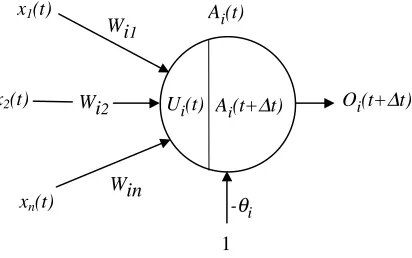
An artificial neural network is a directed graph with the following structure: a unit (or neuron) in the graph is characterised, at timet,by its input vectorIi(t), its input potentialUi(t), its activation
stateAi(t), and its outputOi(t). The units of the network are interconnected via a set of directed and weighted connections such that if there is a connection from unit ito unit j thenWji ∈ R denotes the weight of this connection. The input potential of neuroniat timet(Ui(t)) is obtained by computing a weighted sum for neuronisuch that Ui(t) = jWijIi(t) (see Figure 1). The activation stateAi(t)of neuroniat timet- a bounded real or integer number - is then given by the
1Generally speaking, an argumentisupports an argumentjif the coordination ofiandjreduces the likelihood ofj
neuron’s activation functionhisuch thatAi(t) =hi(Ui(t)).Typically,hiis either a linear function, a non-linear (step) function, or a sigmoid function (e.g.:tanh(x)). In addition,θi(an extra weight with input always fixed at1) is known as the threshold of neuroni. We say that neuroniis active at timet if Ai(t) > θi.Finally, the neuron’s output value Oi(t) is given by its output function
fi(Ai(t)). Usually,fiis the identity function.
Wi1
Wi2
Win
Ui(t) Ai(t+∆t) Oi(t+∆t)
Ai(t) x1(t)
x2(t)
xn(t) -θi
[image:5.612.231.437.148.277.2]1
Figure 1: The neuron or processing unit.
The units of a neural network can be organised in layers. A n-layer feedforward network is an acyclic graph. It consists of a sequence of layers and connections between successive layers, containing one input layer,n−2hidden layers, and one output layer, wheren≥2. Whenn= 3, we say that the network is a single hidden layer network. When each unit occurring in thei-thlayer is connected to each unit occurring in thei+ 1-stlayer, we say that the network is fully-connected. A multilayer feedforward network computes a functionϕ : Rr → Rs, whererandsare the number of units occurring, respectively, in the input and output layers of the network. In the case of single hidden layer networks, the computation ofϕoccurs as follows: at timet1, the input vector is presented to the input layer. At timet2, the input vector is propagated through to the hidden layer, and the units in the hidden layer update their input potential and activation state. At timet3, the hidden layer activation state is propagated to the output layer, and the units in the output layer update their input potential and activation state. At timet4, the output vector is read off the output layer. In addition, most neural models have a learning rule, responsible for changing the weights of the network progressively so that it learns to approximateϕgiven a number of training examples (input vectors and their respective target output vectors).
The Connectionist Inductive Learning and Logic Programming System C-ILP [11] is a massively parallel computational model based on an artificial neural network that integrates inductive learning and deductive reasoning. In C-ILP, a translation algorithm maps a logic programP into a single hidden layer neural networkN such thatN computes the least fixed-point ofP[23]. This provides a massively parallel model for computing the stable model semantics ofP[18]. In addition,N can be trained with examples using a neural learning algorithm [29], havingP as background knowl-edge. The knowledge acquired by training can then be extracted [10], closing the learning cycle, as advocated in [30].
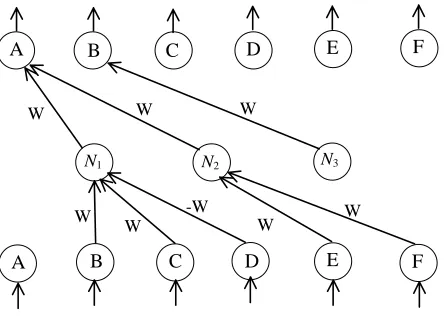
Let us exemplify how C-ILP’s translation algorithm works. Each rule (rl) ofPis mapped from the input layer to the output layer ofN through one neuron (Nl) in the single hidden layer ofN. Intuitively, the translation algorithm fromP toN has to implement the following conditions: (c1) the input potential of a hidden neuronNlcan only exceed its thresholdθl, activatingNl, when all the positive antecedents ofrlare assigned truth-valuetruewhile all the negative antecedents ofrl are assignedfalse; and (c2) the input potential of an output neuronAcan only exceed its threshold (θA), activatingA, when at least one hidden neuronNlthat is connected toAis activated.
Example 3 (C-ILP) Consider the logic programP ={B∧C∧ ∼D→A;E∧F →A;B}, where
∼stands for negation [23]. FromP, the C-ILP translation algorithm produces the networkN of Figure 2, setting weights (W) and thresholds (θ) in a way that conditions (c1) and (c2) above are satisfied. Note that, ifN ought to be fully-connected, any other link (not shown in Figure 2) should receive weight zero initially. Each input and output neuron ofN is associated with an atom ofP. As a result, each input and output vector ofN can be associated with an interpretation forP. Note also that each hidden neuronNlcorresponds to a rulerlofPsuch that neuronN1will be activated if neuronsBandCare activated while neuronDis not; output neuronAwill be activated if either
N1orN2is activated; and output neuronBwill be activated ifN3is, whileN3is always activated regardless of the input vector (i.e.Bis a fact). To compute the stable models ofP, the output vector is recursively given as the next input to the network such thatN is used to iterate the fixed-point operator ofP[11]. For example, output neuronB should feed input neuronB. N will eventually converge to a stable state which is identical to the stable model ofPprovided thatPis an acceptable program [2]. For example, given any initial activation in the input layer ofNr(network of Figure 2 recurrently connected), it always converges to a stable state in which neuronBis activated and all the other neurons are not. We associate this with literalBbeing assigned truth-valuetrue, while all the other literals are assigned truth-valuefalse, which represents the unique fixed-point ofP.
In the case of argumentation networks, it will be sufficient to consider definite logic programs (i.e. programs without∼). In this case, the neural network will contain only positive weights (W). We will then extend such a positive network to represent attacks by using negative weights from the network’s hidden layer to its output layer, as explained in detail in what follows.
3
Argumentation Neural Networks
In this section, we introduce the algorithm that allows us to translate value-based argumentation networks into neural networks. Firstly, let us see how the translation works in a typical argumentation example, namely, the moral debate example [4].
E
D D
W
-W W
C C
B B A
W
W W
W
A E F
F
N1 N2 N3
[image:7.612.223.446.75.234.2]W
Figure 2: A neural network for logic programP.
house and uses some of her insulin. Was Hal justified? Does Carla have a right to compensation?
The following are some of the arguments involved in the example.
A: Hal is justified, he was trying to save his life;
B: It is wrong to infringe the property rights of another;
C: Hal compensates Carla;
D: Hal is endangering Carla’s life;
E: Carla has abundant insulin;
F: If Hal is too poor to compensate Carla he should be allowed to take the insulin as no one should die because they are poor.
Arguments and counter-arguments can be arranged in an argumentation network, as in Figure 3, where an arrow from argumentX to argumentY indicates thatX attacksY. For example, the fact that it is wrong to infringe Carla’s right of property (B) attacks Hal’s justification (A).
C
B
A
E
D
[image:8.612.205.463.71.132.2]F
Figure 3: The moral debate argumentation network.
A
B
D
h
1h
2h
3A
B
D
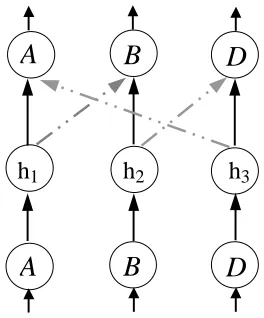
Figure 4: A neural network for argumentsA,B,D.
(input and output patterns) of the relationship between argumentsA,B andD. This will become clearer in Section 4, where we shall give examples of learning argumentation.
In Figure 4, generally speaking, if the absolute value of the weight from neuron h1 to output neuronA(i.e. the strength ofA) is greater than the sum of the absolute values of the weights from neurons h2and h3toA(i.e. the strength of the attacks onA), one should be able to say that argument
Aprevails (in which case output neuronAshould be active in the neural network). Let us implement this form of reasoning using C-ILP neural networks.
The neural argumentation algorithm introduced below takes a value-based argumentation frame-work as input and produces a C-ILP neural netframe-work as output. These netframe-works use a semi-linear activation functionh(x) =1+2e−x−1and inputs in{−1,1}, where1representstrueand−1
repre-sentsfalse.2 In addition, parameterA
min(0< Amin <1)indicates the minimum activation for a neuron to be considered active. The algorithm then defines the set of weights of the neural network as a function ofAmin such that the neural network computes the prevailing arguments according to the argumentation framework. The values of the weights derive from the proof of Theorem 5, which shows that the neural network indeed executes a sound computation of the argumentation framework.
Neural Argumentation Algorithm
1. Given a value-based argumentation framework A with arguments
α1, α2, ..., αn, let:
2A differentiable function such ash(x)is needed for a gradient descent learning algorithm such as backpropagation. The
[image:8.612.266.398.165.324.2]P ={r1:α1→α1, r2:α2→α2, ..., rn :αn→αn}.
2. Number each atom of P from 1 to n and create the input and output layers of a neural network N such that the i−th neuron represents the
i−th atom of P.
3. Given 0< Amin<1, calculate W ≥(1Amin)·(ln (1 +Amin)−ln (1−Amin)).
4. For each rule rl of P (1≤l≤n) do:
(a) Add a neuron Nl to the hidden layer of N;
(b) Connect neuron αl in the input layer of N to hidden neuron Nl and set the connection weight to W;
(c) Connect hidden neuron Nl to neuron αl in the output layer of N and set the connection weight to W.
5. For each (αi, αj)∈attack,3 do:
(a) Connect hidden neuron Ni to output neuron αj;
(b) If v(αi, αj) = 0 then set the connection weight to
W> h−1(Amin)−W Amin;
(c) If v(αi, αj) = 1 then set the connection weight to
W<(h−1(−Amin)−W)/Amin.
6. Set the threshold of each neuron in N to zero.
7. Set g(x) = x as the activation function of the neurons in the input layer of N.4
8. Set h(x) = 1+2e−x − 1 as the activation function of the neurons in the hidden and output layers of N.5
Note that, differently from the general C-ILP translation algorithm, in which rules may have any number of literals in the antecedent [11], here there is always a single literalαi in the antecedent of each ruleri. This allows us to use threshold zero in the algorithm above. Note also that, in the algorithm,W >0andW<0. This fits well with the idea of arguments having strengths (W), and attacks also having strengths (W). In practice, the values ofW andWcould be defined, e.g., by an audience using some form of voting system [4].
The notion of an argument that supports another seems natural in argumentation neural networks. If argumentαisupports argumentαj, this may be implemented easily in the neural network by the addition of a rule of the formαi→αjto programP.6We need to make sure that the neural network
3Recall that ifv(α
i, αj) = 1thenαishould defeatαj, and ifv(αi, αj) = 0thenαishould not defeatαj. The notion of defeat will be defined precisely in the sequel.
4In this way, the activation of the neurons in the input layer ofN, given by each input vectori∈ {−1,1}n, will represent
an interpretation forP, where1representstrueand−1representsfalse.
5In this way, a gradient-based learning algorithm, such as backpropagation, can be applied toN. 6In this way, an accumulation of arguments (α
computes the prevailing arguments of the argumentation framework. For example, if an argument αiattacks an argumentαj, andαi is stronger thanαj, then neuronαi should be able to deactivate neuronαj. Conversely, ifαiis weaker thanαj, and no other argument attacksαj, then neuronαi should not be allowed to deactivate neuronαj. The following definition captures this.
Definition 4 (N computes A) Let(αi, αj) ∈ attacks. Let Aα(t) denote the activation state of neuronαat timet. We say that a neural networkN computes an argumentation frameworkAif (i) wheneverv(αi, αj) = 1,ifAαi(t)> AminandAαj(t)> AminthenAαj(t+ 1)<−Amin;7and (ii) wheneverv(αi, αj) = 0,ifAαi(t)> AminandAαj(t)> Aminand for everyαk(k=i,j)such that(αk, αj)∈attacks, Aαk(t)<−AminthenAαj(t+ 1)> Amin.
We now show that the translation from argumentation frameworks to neural networks is correct.
Theorem 5 (Correctness of Argumentation Algorithm) For each argumentation network Athere exists a feedforward neural networkN with exactly one hidden layer and semi-linear neurons such thatN computesA.
Proof First, we need to show that the neural network computesP. Whenri : αi → αi ∈ P, we need to show that (a) ifαi > Amin in the input layer then αi > Amin in the output layer. We also need to show that (b) ifαi < −Aminin the input layer thenαi < −Aminin the output layer. (a) In the worst case, the input potential of hidden neuronNi isW ·Amin, and the output ofNiish(W ·Amin). We wanth(W ·Amin)> Amin. Then, again in the worst case, the input potential of output neuronαiwill beW ·Amin, and we wanth(W ·Amin)> Amin. As a result,
W > h−1(A
min)/Amin needs to be verified, which givesW > (1Amin)·(ln (1 +Amin)−
ln (1−Amin)),as in the algorithm. The proof of (b) is analogous to the proof of (a). Now, we need to show that the addition of negative weights to the neural network implements the attacks in the argumentation framework. Whenv(αi, αj) = 1, we want to ensure that the activation of output neuronαjis smaller than−Aminwhenever both hidden neuronsNiandNjare active. In the worst case scenario,Ni has activation Amin whileNj has activation 1. We haveh(W +AminW) <
−Amin. Thus, we needW <(h−1(−Amin)−W)/Amin; this is satisfied by the argumentation
algorithm. Similarly, whenv(αi, αj) = 0, we want to ensure that the activation of output neuronαj is larger thanAminwhenever both hidden neuronsNiandNjare active. In the worst case scenario, nowNihas activation1whileNjhas activationAmin. We haveh(AminW+W)> Amin. Thus, we needW> h−1(Amin)−W Amin. Again, this is satisfied by the argumentation algorithm. This completes the proof.
4
Argument Computation and Learning
In this section, we consider the computation of arguments in neural networks. We start by giving an example. We then consider the case in which arguments attack each other forming a cycle in the argumentation network. This may result in an infinite computation in the neural network. To tackle this problem, we propose the use of learning as a way of breaking the circularity. Learning can be seen as a way of implementing the accrual of arguments. We conclude the section by discussing this issue. There is interesting further research on each of these topics. In this section, our purpose is to
7We use−A
introduce a range of issues for argumentation neural networks, but we are far from exhausting the subject.
Once we have translated argumentation networks into neural networks, our next step is to run the neural network to find out which arguments prevail. To run the network, we connect output neurons to their corresponding input neurons using weightsWr= 1(see Figure 5) so that, for example, the activation of output neuronAis fed into input neuronAat the next time round [21]. This implements chains such asAattacksB,BattacksC,CattacksD, and so on, by propagating activation around the network. The following example illustrates this computation in the case of the moral debate example introduced above.
Example 6 (Moral Debate Neural Network) We apply the neural argumentation algorithm to the
argumentation network of Figure 3, and obtain the neural network of Figure 5. From the algorithm, we know that we should haveAmin >0andW >0. Let us takeAmin = 0.5andW = 5(recall thatW is the weight of solid arrows in the network). Following [16], let us consider the problem by grouping arguments according to the features of life, property and fact. ArgumentsA,DandF are related to the right of life, argumentsBandCare related to property rights, and argumentEis a fact. We may argue whether property is stronger than life, but facts are always the strongest. If property is stronger than life thenv(B, A) = 1,v(D, A) = 1,v(C, B) = 1,v(C, D) = 1, v(E, D) = 1, andv(F, C) = 0.From the neural argumentation algorithm, whenv(αi, αj) = 0we must have
W >−1.4, and whenv(αi, αj) = 1we must haveW <−12.2.The actual value of each attack may depend on an audience. Nevertheless, provided that the above conditions onW are satisfied, the network will compute the expected prevailing arguments according to Theorem 5, as follows: F does not defeat C, C defeats B, E defeats D and, as a result, we obtain{A,C,E}as the acceptable set of arguments. Now, if life is considered stronger than property thenv(F, C) = 1. As a result, F defeats C and, since C is defeated, it cannot defeat B, which in turn cannot defeat A (because life is stronger than property). Thus, the network converges to the state{A,B,E,F} of acceptable arguments.8 This shows that two different lines of value-based argumentation will provide the same answer to the question of whether Hall was justified (A), but two different answers to the question of whether Carla has the right to compensation (C).
4.1
Circular Argumentation
Arguments may frequently attack one another in such a way that cycles are formed. In such cases, the relative strength of the arguments will decide which of them should prevail, if any. In [3], as part of a study of the dynamics of argumentation networks [8], Barringer, Gabbay and Woods discuss how to handle loops during the computation of arguments. They differentiate between syntactic and semantic loops, in that the former occurs as cycles in the argumentation network (e.g., when argumentAattacks argumentBand vice-versa), while the latter also depends on the strength of the arguments involved in the loop.
In this way, ifAis considerably stronger thanBor vice-versa, no semantic loop will exist despite the fact that there is a (syntactic) loop in the network; the relative strength of the arguments resolves the loop. Even ifA andB both have similar strengths, one possible interpretation is that neither argument should prevail. This would also resolve the loop and, as we shall see in the sequel, the dynamics of argumentation neural networks follows this interpretation. Still, there are situations in which the network oscillates between stable states, which indicates the existence of alternative,
8The complete set of argument values in this case is: v(B, A) = 0,v(D, A) = 1,v(C, B) = 1,v(C, D) = 0,
A
B
C
D
h1 h2
A
B
h3
C
h4
D
E
h5
E
F
h6
F
⋅ ⋅ ⋅
W
rW
[image:12.612.200.465.70.234.2]r
Figure 5: The moral-debate example as a neural network.
conflicting sets of arguments. This problem may be resolved by changing the strength of certain arguments. Such a change may either be due to the fact that new information has become available, or it may come from the investigation of the oscillating behaviour of the argumentation network itself, as exemplified below.
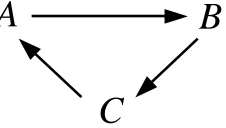
Example 7 (Argument Computation) Take the case in which an argument A attacks an argument B,
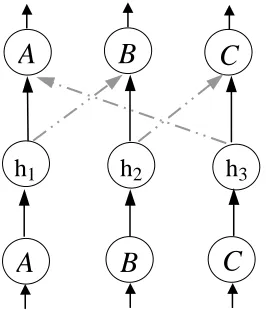
and B attacks an argument C, which in turn attacks A in a cycle, as shown in Figure 6. In order to implement this in a neural network, we need three hidden neurons (h1, h2, h3), positive weights to explicitly represent the fact that A supports itself (via h1), B supports itself (via h2), and so does C (via h3). In addition, we need negative weights from h1to B, from h2 to C, and from h3 to A to implement attacks (see Figure 7). If the value of argument A (i.e. the weight from h1to A) is stronger than the value of argument C (the weight from h3 to C, which is expected to be the same in absolute terms as the weight from h3to A), C cannot attack and defeat A. As a result, A is active and succeeds in attacking B (since we assume that the weights from h1and h2to B have the same absolute value). Since B is not active, C will be active, and a stable state{A,C}will be reached. In Bench-Capon’s model [4], this is precisely the case in which colour blue is assigned to A and B, and colour red is assigned to C with blue being stronger than red. Note that the order in which we reason does not affect the final result (the stable state reached). For example, if we had started with B successfully attacking C, C would not have been able to defeat A, but then A would successfully defeat B, which would, this time round, not be able to successfully defeat C, which in turn would be active in the final stable state{A,C}.
A
B
C
[image:12.612.278.391.547.611.2]In Example 7, a syntactic loop exists in that the attacks in the argumentation network form a loop in Figure 6. However, there is no semantic loop, as the computation of the arguments converges to a stable state, as exemplified above. Even if the strength of the arguments were all the same, the neural network of Figure 7 would converge to{ }, as follows: assume that solid arrows have weight
W, and dotted arrows have weight−W in the network of Figure 7. Let(A, B, C) = [1,1,1]denote the network’s input vector. Thus,h(W)will be the activation state of each hidden neuron, where
his the activation function of such neurons. Then,W ·h(W)−W ·h(W) = 0will be the input potential of each output neuron, and thush(0) = 0(recall thatθ= 0) will be the activation state of each output neuronA,B, andC. Now, given input vector(A, B, C) = [0,0,0], the activation state of each hidden neuron will be zero, and then the activation state of each output neuron will be zero. As a result, the network converges to a stable state{ }in which no argument prevails. This stable state is reached after a single computation step from[1,1,1]to[0,0,0].
A
B
C
h
1h
2h
3 [image:13.612.266.399.231.386.2]A
B
C
Figure 7: A circular argumentation neural network.
According to Definition 4, an argument prevails if its associated neuron has activation in the interval(Amin,1]withAmin >0. Dually, whenever an argument is defeated, its associated neuron should have activation in the interval[−1,−Amin). In the case of circular argumentation networks, however, there is a third possibility when arguments cancel each other and the neurons’ activations lie in the interval[−Amin, Amin], typically converging to zero, as illustrated above. In this case, we know that arguments do not prevail, and it might be useful in some situations to make a distinction between a clear defeat and a failure to prevail. We will return to this issue when we consider ar-gument learning. First, we need to study the more involved situation where the network oscillates between states.
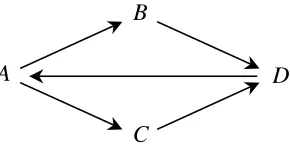
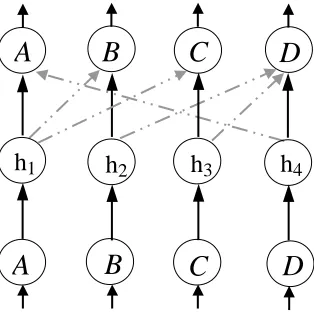
Unfortunately, not all argumentation neural networks are as well-behaved as the ones considered so far. Take the case in which an argumentAattacks two argumentsB andC; B andCin turn both attack an argumentD, andDattacksAin a cycle, as depicted in Figure 8. Assume that all the attacks have the same strength. Figure 9 shows the neural network for the argumentation network of Figure 8. Assume, as before, that solid arrows have weightW, and dotted arrows have weight
be−W ·h(OD·W), andAwill have a positive activationh(−W ·h(OD·W)). As a result, ifA successfully defeatsBandCthenDprevails, and thus defeatsA. In this case,BandCprevail, and defeatD, in a cycle.
A
B
C
[image:14.612.261.406.122.195.2]D
Figure 8: Semantic circularity.
Let us look at this cycle in more detail in the neural network. Let us assume, for convenience, thatW = 1,h(x) = 1ifx≥1,h(x) =−1ifx≤ −1, andh(x) =xfor−1< x < 1.9 We start with input vector[1,1,1,1], and obtain output vector[0,0,0,−1]. We then use[0,0,0,−1]as input to obtain output[1,0,0,−1]. Let us use→to denote the above mapping from input to output vectors, so that we have: [1,1,1,1]→[0,0,0,−1]→[1,0,0,−1]→[1,−1,−1,−1]→[1,−1,−1,1]→
[0,−1,−1,1]→[−1,−1,−1,1]→[−1,0,0,1]→[−1,1,1,1]→[−1,1,1,−1]→[0,1,1,−1]→
[1,1,1,−1]→[1,0,0,−1]→... →[1,0,0,−1]...,which shows that we have reached an infinite loop.
Can we learn anything from the sequence of arguments computed by the network? Initially, there is a situation in whichAseems to prevail. Then,AandDtogether prevail. Then,Dalone; thenB,
C, andDtogether; thenBandConly; and finallyA,B, andC, before we go back to the situation in whichAalone seems to prevail. One way to deal with this problem would be to simply assume that the loop itself indicates that no argument should prevail at the end. One may argue, however, that this does not really solve the problem. Alternatively, one could try and use the information obtained by the computation of arguments itself as an indication of how one should go about trying to solve the loop. In the example above, for instance, it seems that either{A, D}or{B, C}could serve as a basis for a stable set of arguments. Nevertheless, more information would be needed, and the loop itself could serve as the trigger for a search for new information. In the case of the network of Figure 9, one could start by searching for information in support for{A, D}and in support for{B, C}, and only then in support for the other combinations. It seems that the only real solution to the problem of semantic loops is to have new information in the form of new evidence about the relative strength of the arguments and to learn from it, as we discuss in the following section.
4.2
Argument Learning
Consider again the neural network of Figure 9. Suppose that new evidence becomes available in favour of argumentsAandC so that we would like both arguments to prevail. We do not know how this should affect argumentsBandD, but we know that, now, given input vector[1,1,1,1], we would like the network of Figure 9 to produce output[1,?,1,?],instead of[0,0,0,−1]. Since we do not have any information aboutBorD, the natural candidates for?are the original values (so that
[1,?,1,?]becomes[1,0,1,−1]). This will produce an error of zero for output neuronsB andD during learning, which is the best way of reflecting the lack of new information about such concepts. An error of zero will produce no change on the weights directly associated withB andD, but of
A
C
A
C
h
1h
3B
B
h
2D
D
[image:15.612.254.411.75.231.2]h
4Figure 9: A neural network encoding semantic circularity.
course the changes of other weights may affect the overall result of the network. Let us exemplify this in the case of the network of Figure 9 for our training example[1,1,1,1]→[1,0,1,−1].
We use the standard backpropagation learning algorithm10[29]. The use of backpropagation is made possible because the network is recurrently connected only when it comes to the computation of the arguments, not during learning. The recurrent connections are important for the reasoning process, having weights always fixed at 1. During learning, we are interested in establishing a new mapping from the input to the output, and thus a learning algorithm that applies to feedforward networks, such as backpropagation, suffices. We useW = 4.0 (solid arrows in Figure 9), and
W = −4.0(dotted arrows in Figure 9).11 Recall thatθ = 0and that any other connection not shown in Figure 9 is given weight zero initially.
After training, the thresholds of output neuronsA(θA) andC(θC) have been changed to−0.8, the weights fromh1toA(WA,h1) and from h3 toC(WC,h3) have been changed to4.8, and the weights fromh4toA(WA,h4) and fromh1toC(WC,h1) have been changed to−3.2. In addition, some very minor changes have occurred in the weights linking the input to the hidden layer of the network and, as expected, no changes have occurred in the weights leading to output neuronsB or
D, namelyWB,hi andWD,hi,1 ≤ i ≤ 4(recall that, for the purpose of learning, the network is fully-connected).
The computation of the arguments in the trained network is as follows. In addition to the tran-sition from[1,1,1,1]to[1,0,1,−1]learned as expected, the network then maps[1,0,1,−1]into
[1,−1,1,−1], which is a stable state. The newly learned sequence[1,1,1,1] → [1,0,1,−1] →
[1,−1,1,−1] →[1,−1,1,−1]is now loop free; stable state[1,−1,1,−1]corresponds to the ac-ceptance of{A, C}as prevailing arguments.
As another example, let us consider the Nixon diamond problem. In the traditional Nixon dia-mond problem, Nixon is a quaker (Q) and a republican (R). Quakers are generally pacifists (P), while republicans are generally non-pacifists (¬P). This produces an inconsistency in a number of formalisations of the problem [1]. Briefly, if the strength of the support for Nixon’s pacifism is the same as the strength of the support for his non-pacifism, the neural network will conclude that both
10We usetanhas activation function, a learning rate of0.1,and a term of momentum of0.4. We train the network on the
single training example ([1,1,1,1],[1,0,1,−1]) until a mean square error of0.01is reached.
11This is becausetanh(4.0) = 0.999, whiletanh(1.0) = 0.761. As a result,W= 4.0gives a good approximation for
Pand¬Pprevail. If, in addition, we assume thatPattacks¬P, and vice-versa,¬P attacksP, both with the same strength, then the stable state of the neural network will contain neitherP nor¬P. Finally, if we are faced with a situation in which we need to choose betweenP and¬P, we could learn to enforce a stable state in the network in which one but not the other argument prevails.
Suppose we need to make a decision about Nixon’s pacifism. We need to seek new information. We find out that Nixon is a football fan (F), and that football fans are normally non-pacifists. We then use this information to convince ourselves that Nixon is indeed a non-pacifist. We need to add an input, a hidden, and an output neuron to our original network to representF. Then, to make sure thatFattacks and defeatsP, we simply train the following example[1,1,1,1,1]→[1,1,−1,1,1], given argumentsQ, R, P,¬P, F in this order.
There are also situations in which the number of times that an example occurs should be relevant to the decision about the strength of an argument. In such cases, since the backpropagation algorithm does not really emphasise this aspect, alternative forms of learning would need to be investigated and compared with backpropagation. We believe this is an interesting research area with many open research issues to be addressed in the near future as we combine neural networks-based learning, case-based reasoning, and argumentation theory.
4.3
Cumulative (accrual) Argumentation
We have mentioned that neural networks deal with cumulative argumentation in the sense that a number of arguments, neither being individually stronger than a given argument, may defeat this ar-gument collectively. There is some controversy on whether arar-guments accrue. While Pollock denies the existence of cumulative argumentation [27], Verheij defends that arguments can be combined either by subordination or by coordination, and may accrue in stages [32]. In this section, we give an example of accrual by coordination, which happens to be a natural property of neural networks.
Consider the following scenario. Suppose you are the head of state of a country who needs to decide whether or not to go to war in order to remove a violent dictator from power. First, you consider the prospects of the loss of lives of fellow countrymen and women in action, and the killing of innocent civilians, which form a strong argument against going to war. Let us call this argument
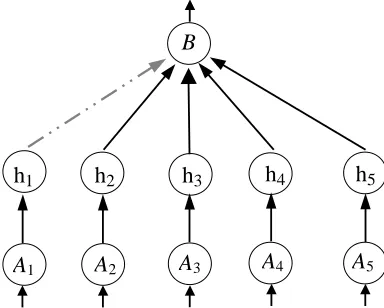
A1. In support for the war, according to documented evidence from your intelligence services, the dictator possesses chemical and biological weapons, having made use of such weapons in the past. We call this argumentA2. You also happen to posses what you believe is credible information about the fact that the dictator has recently acquired uranium from another country, most probably in order to continue with an unauthorised nuclear weapons capability programme. Let this be argumentA3. In addition, recent information sources indicate that the dictator has the capability and the will -having done so in the past - to attack neighbouring countries. Let us name this argumentA4.Finally, you receive evidence that the dictator has provided safe haven for well-known members of an active international terrorist network. This is argumentA5. The task at hand is to decide whether or not it is right to remove the dictator.
LetB denote the proposition it is right to remove the Dictator, and consider the situation in whichA1 attacks B while A2, ..., A5 support B. Assume, further, that A1 is stronger thanB, i.e. v(A1, B) = 1. We apply the neural argumentation algorithm and obtain the neural network of Figure 10. TakingAmin = 0.5, we calculateW > 2.2. Taking, e.g., W = 3, we calculate
W<−4.5. Let us takeW =−5.
According to the algorithm,W = 3andW=−5form an acceptable set of weights. Although
of neuronB, which is approximately(4·W) +W= 7, i.e. a relatively large positive value, which activates neuronB. Of course, a different outcome could be obtained by ensuring thatWis large enough (in absolute terms) to counteract the influence of all the other arguments together. A value ofW = −16, for example, would produce an input potential of−4, which would be sufficient to deactivate neuron B. Of course, these values should depend on your degree of belief on the arguments to go to war and against it, or on the influence of a number of examples (e.g., previous cases) from which you could learn to make an informed decision.
A
1A
2A
3A
4h
1h
2h
3B
h
4A
5 [image:17.612.235.427.172.326.2]h
5Figure 10: Cumulative support Argumentation.
5
Conclusion and Future Work
In this paper, we have presented a new hybrid model of computation that allows for the deduction and learning of argumentative reasoning. The model combines value-based argumentation frameworks and neural-symbolic learning systems by providing a translation from argumentation networks to neural networks. A theorem then shows that such a translation is correct. We have shown that the model works not only for acyclic argumentation networks, but also for circular networks, and it enables cumulative argumentation through learning.
Larger-scale experiments on learning argumentation over time are currently being conducted. Complexity issues regarding the parallel computation of argumentation neural networks in contrast with standard value-based argumentation frameworks are also being investigated. We believe that a neural implementation of this reasoning process may, in fact, be advantageous from a purely com-putational point of view due to the massive parallelism of neural networks.
for a quantitative approach to argumentation in an integrated model of reasoning under uncertainty and inductive learning.
Acknowledgments Artur d’Avila Garcez has been partly supported by The Nuffield Foundation.
Luis C. Lamb has been partly supported by the Brazilian Research Council CNPq, CAPES, and by the FAPERGS Foundation. We would like to thank the anonymous referees for several supportive comments that led to the improvement of the presentation of this paper.
References
[1] G. Antoniou. Nonmonotonic Reasoning. MIT Press, Cambridge, MA, 1997.
[2] K. R. Apt and D. Pedreschi. Reasoning about termination of pure prolog programs. Information
and Computation, 106:109–157, 1993.
[3] H. Barringer, D. M. Gabbay, and J. Woods. Temporal dynamics of support and attack networks: From argumentation to zoology. In D. Hutter and W. Stephan, editors, Mechanizing
Mathe-matical Reasoning: Essays in Honor of Joerg H. Siekmann, pages 59–98. Springer-Verlag,
2005.
[4] T. J. M. Bench-Capon. Persuasion in practical argument using value-based argumentation frameworks. Journal of Logic and Computation, 13:429–448, 2003.
[5] P. Besnard and A. Hunter. Towards a logic-based theory of argumentation. In Proceedintgs
of 17th National Conference on Artificial Intelligence AAAI’00, pages 411–416. AAAI Press,
2000.
[6] A. Bondarenko, P. Dung, R. Kowalski, and F. Toni. An abstract, argumentation theoretic ap-proach to default reasoning. Artificial Intelligence, 93:63–101, 1997.
[7] N. K. Bose and P. Liang. Neural Networks Fundamentals with Graphs, Algorithms, and
Appli-cations. McGraw-Hill, 1996.
[8] G. Brewka. Dynamic argument systems: A formal model of argumentation processes based on situation calculus. Journal of Logic and Computation, 11(2):257–282, 2001.
[9] C. I. Ches˜nevar, A. G. Maguitman, and R. P. Loui. Logical Models of Argument. ACM
Computing Surveys, 32(4):337–383, December 2000.
[10] A. S. d’Avila Garcez, K. Broda, and D. M. Gabbay. Symbolic knowledge extraction from trained neural networks: A sound approach. Artificial Intelligence, 125:155–207, 2001.
[11] A. S. d’Avila Garcez, K. Broda, and D. M. Gabbay. Neural-Symbolic Learning Systems:
Foun-dations and Applications. Springer-Verlag, 2002.
[12] A. S. d’Avila Garcez and D. M. Gabbay. Fibring neural networks. In Proceedings of 19th
National Conference on Artificial Intelligence AAAI’04, pages 342–347, San Jose, California,
[13] A. S. d’Avila Garcez and L. C. Lamb. Reasoning about time and knowledge in neural-symbolic learning systems. In S. Thrun, L. Saul, and B. Schoelkopf, editors, Advances in Neural
Infor-mation Processing Systems 16, Proceedings of the NIPS 2003 Conference, pages 921–928.
MIT Press, Cambridge, MA, 2004.
[14] A. S. d’Avila Garcez, L. C. Lamb, K. Broda, and D. M. Gabbay. Applying connectionist modal logics to distributed knowledge representation problems. Intl. Jnl. on Artificial Intelligence
Tools, 13(1):115–139, 2004.
[15] P. M. Dung. On the acceptability of arguments and its fundamental role in nonmonotonic reasoning, logic programming and n-person games. Artificial Intelligence, 77:321–357, 1995.
[16] D. M. Gabbay and J. Woods. The law of evidence and labelled deduction: A position paper.
Phi News, 4:5–46, October 2003.
[17] A. J. Garc´ıa and G. R. Simari. Defeasible logic programming: An argumentative approach.
Theory and Practice of Logic Programming, 4(1):95–138, 2004.
[18] M. Gelfond and V. Lifschitz. The stable model semantics for logic programming. In
Proceed-ings of the 5th Logic Programming Symposium, pages 1070–1080, 1988.
[19] R. Haenni, J. Kohlas, and N. Lehmann. Probabilistic argumentation systems. In J. Kohlas and S. Moral, editors, Handbook of Defeasible Reasoning and Uncertainty Management Systems, volume 5. Kluwer, 2000.
[20] S. Haykin. Neural Networks: A Comprehensive Foundation. Prentice Hall, 1999.
[21] S. Holldobler and Y. Kalinke. Toward a new massively parallel computational model for logic programming. In Proceedings of the Workshop on Combining Symbolic and Connectionist
Processing, ECAI 94, pages 68–77, 1994.
[22] R. Kowalski and F. Toni. Abstract argumentation. Artificial Intelligence and Law, 4(3-4):275– 296, 1996.
[23] J. W. Lloyd. Foundations of Logic Programming. Springer-Verlag, 1987.
[24] T. M. Mitchell. Machine Learning. McGraw-Hill, 1997.
[25] D. Nute. Defeasible logic. In D.M. Gabbay, C.J. Hogger, and J.A.Robinson, editors,
Hand-book of Logic in Artificial Intelligence and Logic Programming, Vol 3, pages 355–395. Oxford
University Press, 1994.
[26] J. Pollock. Defeasible Reasoning. Cognitive Science, 11:481–518, 1987.
[27] J. Pollock. Self-defeating arguments. Minds and Machines, 1(4):367–392, 1991.
[28] H. Prakken and G. A. W. Vreeswijk. Logical systems for defeasible argumentation. In D. Gab-bay and F. Guenthner, editors, Handbook of Philosophical Logic. Kluwer, 2nd edition, 2000.
[29] D. E. Rumelhart, G. E. Hinton, and R. J. Williams. Learning internal representations by error propagation. In Parallel Distributed Processing, volume 1, pages 318–362. MIT Press, 1986.
[30] G. G. Towell and J. W. Shavlik. Knowledge-based artificial neural networks. Artificial
[31] L. G. Valiant. Three problems in computer science. Journal of the ACM, 50(1):96–99, 2003.
[32] B. Verheij. Accrual of arguments in defeasible argumentation. In Proceedings of 2nd
Dutch/German Workshop on Nonmonotonic Reasoning, pages 217–224. Utrecht, 1995.
[33] B. Verheij. Rules, Reasons, Arguments: formal studies of argumentation and defeat. PhD thesis, Maastricht University, Holland, 1996.
[34] G. A. W. Vreeswijk. Abstract argumentation systems. Artificial Intelligence, 90(1–2):225–279, 1997.