A STUDY TO ASSESS THE EFFECTIVENESS OF STRUCTURED
VIDEO ASSISTED TEACHING PROGRAMME ON KNOWLEDGE AND
ATTITUDE REGARDING KANGAROO MOTHER CARE AMONG
ANTENATAL MOTHERS AT SELECTED TRIBAL AREA IN MUNNAR,
IDUKKI DISTRICT, KERALA.
By,
Mrs. Mayakutty. D
A DISSERTATION SUBMITTED TO
THE TAMILNADU DR.M.G.R MEDICAL UNIVERSITY, CHENNAI IN
PARTIAL FULFILLMENT OF THE REQUIREMENTS FOR THE
A STUDY TO ASSESS THE EFFECTIVENESS OF STRUCTURED
VIDEO ASSISTED TEACHING PROGRAMME ON KNOWLEDGE AND
ATTITUDE REGARDING KANGAROO MOTHER CARE AMONG
ANTENATAL MOTHERS AT SELECTED TRIBAL AREA IN MUNNAR,
IDUKKI DISTRICT, KERALA.
CERTIFIED THAT THIS IS THE BONAFIDE WORK OF
MRS. MAYAKUTTY. D II Year M.Sc., (N)
Karpaga Vinayaga College of Nursing Madurantakam Taluk
Kancheepuram District– 603 308
SEAL
Signature
Dr. (Mrs.).T. KOMALAVALLI, M.Sc.(N)., Ph.D.(N).,LLB., Principal and Professor
Karpaga Vinayaga College of Nursing Madurantakam Taluk
Kancheepuram District – 603 308
A DISSERTATION SUBMITTED TO
THE TAMILNADU DR.M.G.R MEDICAL UNIVERSITY, CHENNAI
IN PARTIAL FULFILLMENT OF THE REQUIREMENTS FOR
A STUDY TO ASSESS THE EFFECTIVENESS OF STRUCTURED
VIDEO ASSISTED TEACHING PROGRAMME ON KNOWLEDGE AND
ATTITUDE REGARDING KANGAROO MOTHER CARE AMONG
ANTENATAL MOTHERS AT SELECTED TRIBAL AREA IN MUNNAR,
IDUKKI DISTRICT, KERALA.
APPROVED BY THE DISSERTATION COMMITTEE ON: ………
Dr. ANNAMALAI REGUPATHY, M.S (Ortho) Managing Director
Karpaga Vinayaga Institute of Medical Sciences and Research Centre Madurantakam Taluk
Kancheepuram District – 603308
Research Guide:
Dr. (Mrs).T. KOMALAVALLI, M.Sc(N)., Ph.D(N)., LLB., Principal and Professor
Karpaga Vinayaga College of Nursing Madurantakam Taluk
Kancheepuram District - 603 308
A DISSERTATION SUBMITTED TO
THE TAMILNADU DR.M.G.R MEDICAL UNIVERSITY, CHENNAI IN
PARTIAL FULFILLMENT OF THE REQUIREMENTS FOR THE
CERTIFICATE
This is to certify that “A study to assess the effectiveness of structured video assisted teaching programme on knowledge and attitude regarding Kangaroo Mother Care among Antenatal Mothers at selected tribal area in Munnar, Idukki district, Kerala”
is a bonafide work done by Mrs.Mayakutty.D, M.Sc.(N) II Year, Karpaga Vinayaga College of Nursing, Kancheepuram District, in partial fulfillment of The Tamil Nadu Dr. M.G.R. Medical University rules and regulations towards the award of the degree of Master of Science in Nursing, Branch-II, Child Health Nursing, under my guidance and supervision during the academic year 2017.
Date: Signature of the Principal
A STUDY TO ASSESS THE EFFECTIVENESS OF STRUCTURED
VIDEO ASSISTED TEACHING PROGRAMME ON KNOWLEDGE AND
ATTITUDE REGARDING KANGAROO MOTHER CARE AMONG
ANTENATAL MOTHERS AT SELECTED TRIBAL AREA IN
MUNNAR, IDUKKI DISTRICT, KERALA.
By,
Mrs. Mayakutty.D
A DISSERTATION SUBMITTED TO
THE TAMILNADU DR.M.G.R MEDICAL UNIVERSITY, CHENNAI IN
PARTIAL FULFILLMENT OF THE REQUIREMENTS FOR THE
DEGREE OF MASTER OF SCIENCE IN NURSING
OCTOBER-2017
ACKNOWLEDGEMENT
At the very outset I give thanks and praise to God Almighty for his abundant blessings, health, support, wisdom, courage, and confidence throughout the dissertation.
I wish to express my deep sense of gratitude and thanks to our Managing Director Dr. ANNAMALAI REGUPATHY, M.S (Ortho), Karpaga Vinayaga Institute of Medical Sciences and Research Centre, Madurantakam Taluk in Kancheepuram District.
I wish to express my sense of gratitude and heartfelt thanks to our Principal,
Dr. (Mrs). T. KOMALAVALLI, M.Sc(N)., Ph.D(N)., LLB., and HOD of Child Health Nursing, Karpaga Vinayaga College of Nursing for helping me to uplift my professional career, with her patience, valuable guidance, support and direction to carry out this dissertation successfully.
With deep sense of gratitude, I express my wholehearted thanks to
Dr. (Ms).S.PUNITHA JOSEPHINE, M.Sc(N)., MBA., Ph.D(N).,Vice Principal, Karpaga Vinayaga College of Nursing for her guidance, constant motivation and support to culminate the study.
With deep sense of gratitude, I express my whole hearted thanks to
Mrs. D.KALAIMANI, M.Sc(N)., M.Phil., Professor, Department of Child Health Nursing for her guidance, motivation, support and suggestion throughout this study.
I extend my sincere thanks to Mrs. R.Madhumitha, M.Sc (N)., Assistant Professor, Department of Child Health Nursing for her guidance, support and suggestions to carry out this study.
My sincere thanks to Ms.G.Santhi, M.Sc (N)., Assistant Professor, Department of Child Health Nursing for her guidance, motivation, support and suggestions to carry out this study successfully.
I owe my sincere thanks to all the FACULTY members of Karpaga Vinayaga College of Nursing for extending their cooperation and support during the study.
I wish to express my greatest pleasure and deep sense of gratitude to
DR. (Mr).RAMANATH, MD, professor, HOD of Pediatrics, Karpaga Vinayaga Institute of Medical Science and Research Centre, Madurantakam Taluk in Kancheepuram District for his guidance to conduct this study.
I am indebted to thank Mr. ASHOK BHOORASAMY, M.Sc., M.Phil., Professor Biostatistics, for his constructive efforts and guidance in Statistical analysis.
I extend my sincere thanks to the Medical Officer, Ms. ARCHANA SP, MBBS for granting me permission to conduct the study.
I extend my sincere thanks to Mr. SATHYA, C.I.B.L., Librarian, Karpaga Vinayaga College of Nursing for his help in getting the reference material.
I extend my thanks to the librarian of THE TAMILNADU Dr. M.G.R MEDICAL UNIVERSITY, GUINDY, CHENNAI for their help in getting the reference material for my study.
Words are inadequate to express the affection, inspiration and dedication shown by MY HUSBAND, PARENTS AND BROTHERS for their unending words of encouragement and constant support throughout the study.
SYNOPSIS
A special type of care for neonates and their parents that provide early skin to skin contact between baby and the parents is Kangaroo Mother Care. This method enables parents to provide primary care and comfort to the neonates during their stay at home as well as in hospital areas. It is special way to care the neonates to foster their health and wellbeing by promoting effective thermal control, breastfeeding, infection prevention and bonding. A study was conducted to assess the effectiveness of structured video assisted teaching programme on knowledge and attitude regarding kangaroo mother care among antenatal mothers at selected tribal area in Munnar, Idukki district.
The objectives were, to assess the level of knowledge and attitude regarding Kangaroo Mother Care, to evaluate the effectiveness of video assisted teaching programme on knowledge and attitude regarding Kangaroo mother care, and to associate the selected demographic variables with level of knowledge and attitude regarding Kangaroo mother care among antenatal mothers at selected tribal areas in Munnar, Idukki district.
A quantitative research approach of pre experimental with one group pre and post test design was chosen for this study. By using purposive sampling technique a total of 50 samples were included for the study. The structured video assisted teaching programme was given by researcher. Pre and post test was conducted by multiple choice questionnaires and three point likert attitude scale. Data were recorded and coded. The data analysis was done by using descriptive and inferential statistics.
The result revealed that there was a statistically significant difference between pre and post test knowledge and attitude scores regarding Kangaroo Mother Care among Antenatal Mothers at level p < 0.001. This study implied that proper education regarding Kangaroo Mother Care to the antenatal mothers will foster the health and wellbeing of the neonates and thereby reduce the mortality and morbidity of the neonates during the initial stages of life after birth.
TABLE OF CONTENTS
CHAPTER
NO. TITLE
PAGE NO I INTRODUCTION
Background of the study Need for the study Statement of the problem Objectives of the study Operational definitions Hypotheses Delimitations Projected Outcomes 1-13 1 6 10 10 10 12 13 13
II REVIEW OF LITERATURE
Literature related to kangaroo mother care
Literature related to benefits of kangaroo mother care
Literatures related to knowledge and attitude regarding neonate care among tribal mothers
14-27 14
22
27
III METHODOLOGY
Research approach Research design Variables
TABLE OF CONTENTS
TABLE
NO. TITLE PAGE NO
Criteria for sample selection
Selection and development of study instrument Validity of the tool
Reliability Pilot study
Data collection procedure Plan for data analysis
38 39 42 42 42 43 45
IV DATA ANALYSIS AND INTERPRETATION
46-68
V DISCUSSION
69-72
VI SUMMARY, CONCLUSION, RECOMMENDATIONS, LIMITATIONS AND IMPLICATIONS
73-79
VII REFERENCES
80-90
LIST OF TABLES
TABLE
NO. TITLE PAGE NO
1 Research design 35
2 Data collection schedule 44
3 Plan for data analysis 45
4 Distribution of demographic variable among antenatal mothers 47
5 Distribution of level of knowledge on kangaroo mother care among
antenatal mothers in pre and post test 61
6 Distribution of level of attitude on kangaroo mother care among
antenatal mothers in pre and post test 63
7 Comparison of pre and post-test knowledge score on kangaroo
mother care among antenatal mothers
65
8 Comparison of pre and post-test attitude score on kangaroo mother care among antenatal mothers 66
9 Association of demographic variables with level of knowledge on
kangaroo mother care among antenatal mothers 67
10 Association of demographic variables with level of attitude on
LIST OF FIGURES
FIGURES NO TITLE PAGE
NO
1 Conceptual framework based on modified Dorothy Johnson’s Open
System Theory 33
2 Schematic representation of research methodology 36
3 Distribution of age in years antenatal mothers 50
4 Distribution of religious category of antenatal mothers 51
5 Distribution of educational status of antenatal mothers and husbands 52
6 Distribution of occupational status of antenatal mothers 53
7 Distribution of occupational status of husband 54
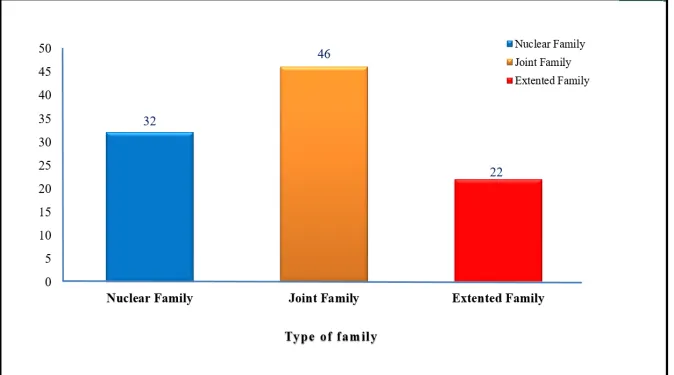
8 Distribution of type of family 55
9 Distribution of type of diet 56
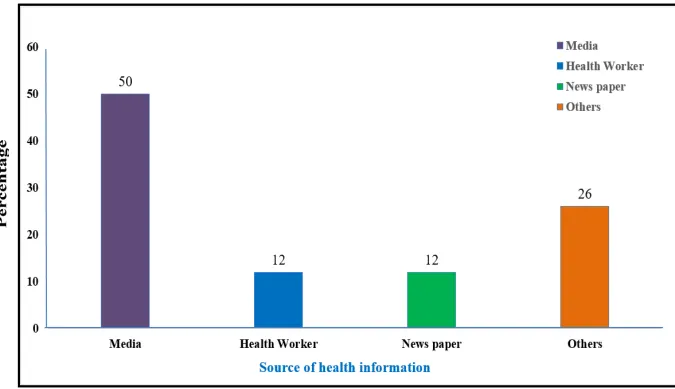
10 Distribution of source of health information 57
11 Distribution of gestational age among antenatal mothers 58
12 Distribution of gravida status of antenatal mothers 59
13 Distribution of frequency of antenatal checkup 60
14 Level of knowledge regarding kangaroo mother care among antenatal
mothers 62
15 Level of attitude regarding kangaroo mother care among antenatal
LIST OF APPENDICES
S.NO TITLE PAGE NO
1 Appendix – A Letter seeking permission for conducting the study i
2 Appendix – B Letter permitting to conduct the study ii
3 Appendix – C Letter requesting opinion and suggestion on experts for
establishing content validity of tool iii
4 Appendix – C1 Acceptance for tool validation iv
5 Appendix – D Research participants consent form v-vi
6 Appendix – E Certificate for English editing vii
7 Appendix – E1 Certificate for Tamil editing viii
8 List of Experts ix-x
9 Tool for the Study
PART – I
9.1 Demographic variables ( English )
9.2 Demographic variables ( Tamil )
PART – II
9.3 Structured Questionnaires (English)
9.4 Structured Questionnaires (Tamil)
PART – III
9.5 Three point Likert Attitude Scale ( English )
9.6 Three point Likert Attitude Scale ( Tamil )
xii xvii xviii xx xxv xxvii 10 Lesson Plan
10.1 Kangaroo Mother Care ( English ) 10.2 Kangaroo Mother Care ( Tamil )
xxviii xli
11 Data Sheet Lvii
CHAPTER-I
INTRODUCTION
An amazing creation of Almighty....,A newborn joeys, just 2 inches long, as small as grain of rice that hides in the magical pouch of its mother for 2-4 yrs being protected in the
warmth and love of its mother brings me a great lesson in caring my newborn…!!! (Mirala Nuwman)
BACKGROUND OF THE STUDY
Mother kangaroo is a mammal (just like us), and feeds its baby milk human mother does from a nipple inside its pouch. When the Joey’s (the kangaroo baby) is born has no hair and is called a PINKY. It is the size of a peanut, yet must crawl into the pouch of mother by itself. Once inside the pouch, the kangaroo baby latches on to a nipple, where it then remains attached, feeding on mother’s milk, non-stop, for months. The baby will come out of the pouch for the first time when it is about a quarter of the mother’s weight!! The joey can continue breastfeeding even when it is too big to fit in the pouch .The pouch covers the baby with skin, and this not only protects the very immature baby, but also provides it with a total environment which is essential for development. This includes warmth, food, comfort, stimulation, protection.
2
Kangaroo mother care has to be initiated early after the birth of the neonate. The mother has to be prepared for the first few sessions to bring about a better outcome. It’s important to build up a positive attitude among the family member to support mother which is particularly crucial for the mother to care the neonate at home. The mother should be explained on how to breast feed neonate and must be explained that while the baby is held between her breasts in Kangaroo care position milk production is stimulated as an automated reflex. Earlier the care is initiated with skin-to-skin contact, the greater the effect on breastfeeding will be.
Although women of many cultures have carried their infants against their breasts for
centuries, many of them do not know the importance and the mystery behind the method of
following kangaroo mother care. The method of kangaroo mother care was rediscovered in Bogota,
Colombia in the 1970s in response to shortages of people power and other resources in health care
facilities. During 1970s Drs. Rey and Martinez developed kangaroo mother care as a method of
ambulatory care for neonates in their hospital where there had been high morbidity and mortality
among newborns due to overcrowding and sepsis. Soon after the delivery the mothers were trained
in kangaroo mother care technique, the infants are sent home, irrespective of weight or gestational
age. They were advised to carry neonates between their breasts at all times and fed only mothers'
milk. They were followed up at a special kangaroo mother care clinics. The dramatic improvement
in the outcome of the Bogota patients prompted investigation from the World Health Organization,
UNlCEF(United Nations Children’s Fund) and North American, European and other health services
around the world. Thereafter they brought about a conclusion of implementing kangaroo mother
care into practice in majority of the health care facilities worldwide. Numerous studies
have evidenced that kangaroo mother care to be an effective and safe method of caring for these
Dr. Nils Bergman, Medical Superintendent of Mowbray Maternity Hospital in Cape Town, South Africa (2016), has been researching KMC for twelve years. He revealed that restoration of the original model of the infant-mother early care rather than our present incubator, bottle and feeding formula model can result in happier and healthier neonates.
One of the responses is despair to conserve energy for survival when the baby is fed up of crying. This is not only an automated reflex as the neonate consciously wants to be with its mother but a discovered truth, which is naturally inherited from the creator. The problem of unnecessarily separating mother from neonate is that, they exhibit the “protest-despair” response. Sadly, the neonate becomes too tired to cry if the mother doesn’t appear and gives up.
On recent findings in neuro-endocrinology(2017) Bergman, Professor of Liverpool university Italy, explains that it is the neonate by itself begins and directs the attachment process with the mother, that is aided by skin contact which acts as a mutually a stimulating system to which both respond by altering hormonal outputs. As an example, Bergman adds to it that if the newborn is placed on the mother’s chest, within an hour, the baby will pull itself to the breast, find the nipple and begin nursing.
4
Mother can provide skin to skin contact occasionally after giving the bath and during cold nights. Minimum of three sittings per day each of one hour has to be carried out initially and gradually increased up to 24 hours. But when the neonate starts wriggling to show that they feel uncomfortable, pulling limbs out, cries and fuses every time as the mother tries to put her back skin to skin, is the time to wean the neonate from Kangaroo Mother Care.
In India several initiatives and programmes have been undertaken among general as well as vulnerable population under the National Rural Health Mission to improve survival and ensure proper health of infants and children. Specifically a life cycle approach has been adopted by the government to minimize the rural urban differentials. It is viewed that among rural population, scheduled tribes are highly vulnerable to put them at risk, in terms of infant and child mortality.
By 2016 World Health Organisation, estimated that around 4 million neonatal deaths occur almost exclusively in low income countries and report that most of the neonate dies at home while they are cared by mothers, relatives, traditional birth attendants, suggest that there are evidences about contribution of certain practices with respect to the care of neonates immediately following delivery highly puts them at risk for morbidity and mortality.
life. A sustainable model is necessary for tackling infant mortality for better new born survival. This can be provided through Kangaroo mother care through its four vital components that add to better survival of the new born providing chances for better health status of the infant.
According to ARVIND VERMA AND KALYAN BRATA SAHA(2016), of National Institute of Research in tribal health , the neonate mortality in dominant states of central India is 85 per 1000 live births in rural areas and 61 per 1000 live births in urban areas respectively. He concludes in his study regarding the causes of neonatal mortality in tribal areas that the major cause of neonate mortality in tribal areas is improper deliveries conducted at home without proper assistance by midwives , lack of proper training to antenatal mothers about early neonate care, their traditional practices regarding treating umbilical stump and discarding colostrum result in high neonatal mortality .Moreover their rituals, culture and traditional practices sometimes act as hindrance in utilization of maternal and child health facilities especially in the tribal areas.
So it’s highly essential to upgrade the knowledge level of Antenatal mothers in the tribal areas regarding Kangaroo mother care in adjacent with the major components. Always knowledge will have greater impact on attitude and practices .Thus knowledge regarding kangaroo mother care should be promoted among the antenatal mothers to have positive impact on practice and attitude that is substantiated by the study conducted by Vijayalakshmi in 2016, to assess the effectiveness of planned teaching programme on infant rearing practices to their mothers, that revealed the need for educating mother’s regarding infant rearing practices.
6
NEED FOR STUDY
The quality of care rendered to neonates determines their wellbeing and is reflected in the existing neonate mortality rates. As per the survey on Neonatal Morbidity and Mortality (2016) it is reported that ,in India as many as 1.72 million children die annually before reaching their first birthday and out of these ,72 percent die during the first month of life ,the neonatal period. The neonatal mortality rate varies by state to state but overall it is reported to be 43 per 1000 live births by 2016.
During 2015 in the report of Millennium Development Goals achievements globally it was estimated that India constitutes nearly 20% of neonatal death and India accounts for 12Lakhs of 50Lakhs new born death. It is nearly a total quarter of global burden for a health care social system globally. India has made significant strides in reducing both Infant Mortality and Under Five Mortality. But has been unable to achieve the Millennium Development Goals by 2015. However few states namely West Bengal, Maharashtra, Punjab, and Himachal Pradesh are likely to achieve the goal, it appears to be a challenge for the remaining states and union territories of India. Among various social groups infant mortality appears to be higher among the tribal population (scheduled tribes). It mandates the nurses to impart the knowledge among tribal mothers to provide best care to their neonates .
Mosley Chen (2016) framework categorises the determinants of infant mortality into three (i) biologic factors (ii) socio economic factors (iii) environmental factors. Among the socio economic factors, the scheduled tribe family has 19 percent higher risk for dying in early neonatal period and 45 percent risk of dying in post neonatal period when compared with other social classes. He says in India till 2016 July has been observed that for infants and neonates in both tribal and non-tribal population, there is a disproportionate increase in the death rates. He adds to it that these differences may be due to increased social and health related vulnerabilities of tribal population. He adds up that on further examination of the neonate mortality among scheduled tribes by place of residence shows a highly disadvantaged position of the children of mothers belonging to the scheduled tribes in rural areas when compared to the urban areas. In general there is an increased likelihood of deaths of neonates in rural areas and slightly exacerbated among scheduled tribes which address the importance for nurses to educate the tribal mothers on kangaroo mother care which has proved its efficiency in reducing mortality and morbidity of the neonates .
8
One of the United Nations Millennium development goals 2015 has been the reduction of mortality among children less than 5 yrs of age by its two thirds that failed to meet the target. The global burden of neonatal death is primarily concentrated in developing countries. The key component of health development is the availability and accesses to proper health care in coincide with proper health teaching regarding the practises about proper care to the newborns.
The Neonatal Health Research Initiative is a comprehensive research endeavour funded jointly by the United States Agency For International Development and International Clinical Epidemiology Network to study the depth of many aspects of neonatal health in India, is now developing Community Based intervention to reduce high rate of mortality and morbidity in tribal and rural areas as the location and distance from the community stakeholder’s matters in seeking neonatal care. This is targeted especially in tribal areas where women had to travel long distances in reaching health care facility.
Francis Mcglone and Jorge.E.Esteves Researcher at Liverpool Johnmoores University, United Kingdom (2017 January) suggested from his study in reducing neonatal mortality and morbidity that, improvement of duration of breastfeeding in association with Kangaroo Mother Care must be extended to the community settings. He concludes that Kangaroo Mother Care is a technique used among neonates where they are held in skin to skin contact with the mother, which reliably reduces mortality and morbidity of the neonates and is highly advisable in the resource limited settings due to its best outcome.
Agustine Conde_Agudelo and Jose Luis Diaz Rossello of Hospital De Clinica and Universided De Montevideo of Italy(2017) suggested that, creating awareness among antenatal mothers regarding Kangaroo Mother Care would be more successful in initiating the newborn care at the early onset to give better care to the newborn and thereby reducing the neonatal mortality and morbidity. They also suggest that, early the onset of practice of kangaroo mother care more positive is the overall developmental outcome .
Perhaps rural and tribal areas are difficult to reach, particularly they lack in health care facilities and this has been recognised as one of the determinants of the high mortality and morbidity in rural and tribal areas in India. Thus, population specific systematic and comprehensive strategies are required to reduce neonatal mortality at National level. This made the investigator to conduct a structured video assisted teaching programme on kangaroo mother care among tribal mothers to make them more efficient in providing best care to their neonates during the initial stages of life thereby reducing the rate of mortality and morbidity during first year of their life and this would be more effective in terms of the outcome if the education is provided during the antenatal period specifically during the second and third trimester.
10
STATEMENT OF THE PROBLEM
A study to assess the effectiveness of structured video assisted teaching programme on knowledge and attitude regarding Kangaroo mother care among Antenatal mothers at selected tribal area in Munnar, Idukki District.
OBJECTIVES OF THE STUDY
1. To assess the level of knowledge and attitude regarding Kangaroo mother care among antenatal mothers at selected tribal area in Munnar.
2. To evaluate the effectiveness of structured video assisted teaching programme on knowledge and attitude regarding Kangaroo mother care among antenatal mothers at selected tribal area in Munnar.
3. To associate the selected demographic variables with level of knowledge and attitude regarding Kangaroo mother care among antenatal mothers at selected tribal area in Munnar.
OPERATIONAL DEFINITION
EFFECTIVENESS
STRUCTURED VIDEO ASSISTED TEACHING PROGRAMME
It refers to the well planned teaching programme on kangaroo mother care which was designed and implemented by the researcher using lecture cum discussion method with the help of video among antenatal mothers
KNOWLEDGE
It refers to the estimation of level of understanding of antenatal mothers regarding Kangaroo mother care as measured by structured multiple choice questionnaire in pre and post.
ATTITUDE
It refers to the view of antenatal mothers about Kangaroo Mother Care as precisely measured by three point likert attitude scale in pre and post-test.
ANTENATAL MOTHERS
It refers to the women who were in the second and third trimester of pregnancy aged between 19 to 30 yrs who visited Community Health Care Centre at Devikulam ,Munnar.
KANGAROO MOTHER CARE
12
TRIBAL AREA
Tribal area refers to areas covered by the community health centre at Devikulam Panchayath , Munnar, that includes Edamalaikudy,Mankulam,Marayoor,Kandhaloor having preponderance of tribal population.
ASSUMPTION
SIt is assumed that
• The structured video assisted teaching programme enhances practice of kangaroo mother care.
• The structured teaching programme on kangaroo mother care reduces neonatal mortality.
• The structured teaching programme on kangaroo mother care reduces neonatal morbidity.
HYPOTHESES
H1: There is a significant difference between pre-test and post-test level of knowledge regarding Kangaroo Mother Care among antenatal mothers those who were subjected to structured video assisted teaching programme.
DELIMITATIONS
The study is delimited to
Antenatal mothers residing at tribal areas aged between 19-30 yrs
Antenatal mothers of second and third trimester of pregnancy visiting Community Health Centre Devikulam, Munnar
Sample size of 50
A period of five weeks
PROJECTED OUTCOME
14
CHAPTER II
REVIEW OF LITERATURE
This chapter deals with the literature related to Kangaroo mother care and effectiveness of structured video assisted teaching programme on knowledge and attitude of antenatal mothers. The literature was collected extensively and organised under the following headings.
1. Review of literature related to Kangaroo Mother Care.
2. Review of literature related to benefits of kangaroo mother care.
3. Review of literature related to knowledge and attitude regarding neonatal care among tribal mothers.
1. REVIEW OF LITERATURE RELATED TO KANGAROO MOTHER CARE
Mondlane.De Grace.Ebhrahim (2009) conducted a study to assess the effectiveness of skin to skin contact as a method to maintain body warmth for Infants and its influence on weight gain among the same. The study was conducted among 132 Infants during cold season July to September. The result showed that there was remarkable weight gain among infants, that she graded as Grade I, i.e...Good among 109 infants. The researcher concluded that kangaroo mother care is advisable to all mothers for their infants ,specifically to those living in higher altitudes in cold climatic regions.
random number table. The Kangaroo Mother Care group was subjected to Kangaroo Mother Care for at least 6hrs a day. After 3 months interval structural maternal interview was conducted to assess the attachment between mother and babies. The total attachment score (24.46+/-1.64) in Kangaroo Mother Care babies was significantly higher than the obtained in control group (18.22+/-1.79) that the study was statistically significant difference at level p<0.001.They derived greater pleasure from babies. The researcher concluded that Kangaroo Mother Care facilitates Mother Baby attachment among infants.
Kostandy,Ludington,Cong & Abouelfettoh (2012), conducted a study to assess the effectiveness of Kangaroo Mother Care in reducing pain in infants .A prospective study randomized cross over study with 10 pre term infants 2-9 days old were randomly assigned to two sequences, sequence A: day 1- heel stick in Kangaroo Care [after 30 min of prone skin contact upright between maternal breast and day 2 -heel stick in incubator[inclined, nested and prone]: or sequence B : opposite of sequence A was conducted .videotapes of baseline, heel warming ,heel stick, and recovery phase were scored for audible and inaudible crying times .Audible and inaudible crying times for each subject in each phase were summed and analysed by repeated measures of analysis of variance . The study result showed that in Kangaroo Mother Care crying times was less during heel stick at value p=.001 and was statistically significant difference at p value<0.01 during recovery phase, regardless of sequence. Results showed that kangaroo care reduced in crying response to heel stick in Infants.
16
and 114 after stabilisation were cared for by Kangaroo Mother Care 24 hrs a day until discharge. No deaths were recorded in hospital: Meanwhile two twins died of severe Pneumonia after discharge and before the age of 3 months .The mean daily weight gain during Kangaroo Mother Care was 15 gms.The researchers conclude that Kangaroo Mother Care is an essential aspect to all infants for better weight gain.
Bosque .E.M., et.,al.,(2013), conducted a study on variations in physiologic characters of infant during kangaroo mother care versus incubator care in the tertiary level nursery. Her findings revealed that apnea, bradycardia ,oxygen saturation ,heart rate and respiratory rate were more stable and normal during Kangaroo mother care when compared to the incubator care which was statistically significant at was found to be more feasible and safe for selected mothers and infants in the tertiary level nursery and for better survival.
discharge (weighed mean difference 3.6 g/day ,95% confidence interval 0.8 to 6.4 ).Scores on mothers senses of competence according to infant stay in hospital and admission to NICU were better in Kangaroo Mother Care than in control group. Scores on mothers perception on social support according to infant stay in NICU were worse in Kangaroo Mother Care group than in control group (weighed mean difference -0.18 (95%) confidence interval -0.35 to -0.01).The researcher concluded that the Kangaroo Mother Care appears to reduce infant morbidity without any serious deleterious effect when compared to the conventional care where the study showed significant difference at level p<0.05 at‘t’ value 45.67.
18
Winberg.j.et.al... (2014) conducted a study to assess the interaction during close body contact between mother and newborn during initial period just after birth and its influence on physiology and behaviour on both. He concluded that close body contact of the infant with his/her mother helps regulate the temperature, energy and conservation, acid base balance, adjustment of respiration crying of the newborn in accordance with the nursing behaviour of mother. The investigator adds to it that increasing the duration of skin to skin contact between the mother and the infant would bring about a better outcome.
Ibe Oe. Austin. Sullivan.Fabanwo & Disue. (2014), conducted a study to determine the acceptability of mothers to Kangaroo Mother Care in hospitals of Laos, Nigeria.13 eligible Infants were nursed by mothers in 4 hour session of Kangaroo Mother Care. The study revealed that the risk of hypothermia was reduced by >90 when nursed by Kangaroo Mother Care rather than conventional care, relative risk rated 0.03 to 0.25).Mothers felt that Kangaroo Mother Care was safe and preferred method to conventional care because it kept their infants close to them, although some had problem in adjusting to the method of care. Where equipment’s of thermal regulation is lacking or unreliable, Kangaroo Mother Care is preferable method for managing infants and low birth weight infants.
Dunnebier (2014), conducted a study on Kangaroo Mother Care and parent Infant bonding process among Infants. The observational study in which several physiological variables were collected, such as heart rate, respiratory rate, breathing pattern, behavioural states...Etc. Kangaroo care significantly affected these variables comparing the period of 1hr before,1 hr during and 1 hr after Kangaroo Mother Care, which was statistically significant at value p<0.05. So the study concluded that Kangaroo Mother Care is a safe method, for neonates, Infants.
Thukral, Chawala & Agarwal (2014), conducted a study to assess the effectiveness of Kangaroo Mother Care an alternative to conventional care .Observational study have shown that there is reduction of mortality after institution of Kangaroo Mother Care. The study showed that the mothers and family members encouraged Kangaroo Mother Care for the best care of the baby and should be counselled during follow up visits regularly.
Worku & Kassie (2015), conducted a study to assess the effectiveness of early Kangaroo Mother Care sixty two infants were enrolled for Kangaroo Mother Care and the same number were enrolled to Conventional Method of Care. The demographic and socio economic variables were comparable. The researcher concluded that the Kangaroo Mother Care was the best method to care the infants for better survival. Kangaroo Mother Care had given better outcome in terms of weight gain, thermal control, and better bonding relationship with the mother over the conventional care. Moreover the baby had less incidence of crying episodes when compared to the infants treated in the Conventional care. The study was statistically significant at value p,0.05 with mean value of 24.65 and ‘t’ value at 46.35.
20
Ludington-Hoe & Swinth Satyshur.(2015), conducted a study on Kangaroo Mother Care compared to incubator care in maintaining body warmth in low birth weight infants .A randomized control trials of 16 Kangaroo Mother Care and 13 control infants using a pre test –post test design of three consecutive interfeedindg intervals of 2.5 to 3 hrs duration each was conducted over 1 day . Repeated ANOVA showed that baby had better temperature regulation and warmthness when compare to the conventional care which showed statistically significant difference at value p<0.05 at mean value of 28.56. The researcher concluded that the best method for thermal regulation in infants is Kangaroo Mother Care a natural and highly effective technique that keeps baby better bonded with mothers with less duration of separation that reduces chance of infection to infants and reduced anxiety level in mothers with respect to infantile separation.
Kadam,Binoy,Kanbur&Mondkar Ja (2015) conducted a study to determine the feasibility and acceptability of Kangaroo Mother Care in a tertiary care hospital in India .A Randomized control trial was performed over one year of period. In which 90 neonates were randomized into two groups Kangaroo Mother Care and conventional method of care.45 babies were randomized into Kangaroo Mother Care group and 45 into conventional care group. There was significant reduction in incidence of hypothermia, higher oxygen saturation, and decrease in respiratory tract infections among Kangaroo Mother Care group when compared to conventional care groups for which the study was statistically significant difference at value p<0.001 with a mean value of 25.45. The result showed that Kangaroo Mother Care is simple feasible intervention in reducing the rate of neonatal mortality and morbidity due to hypothermia, infection and respiratory problems, hence kangaroo mother care is advisable to all infants from the time of birth even at home.
design was a non-equivalent control group pre test post test . Data was collected from September 1 2015 to June 2016.The participants were 22 mothers in the experimental group and 22 in the control group was applied three times per day for a total of 10 times in 4 days to the experimental group. The degree of anxiety was statistically significant difference at level p<0.05 between the two groups and maternal role confidence and maternal infant attachment was statistically significant at level p<0.001. The results showed that Kangaroo Mother Care was effective for mother’s anxiety relief and it was effective for maternal role confidence and maternal infant attachment of mothers
Ministry Of Health And Family Welfare,(2016) stated that newborns must be always kept warm because small babies cannot maintain their body temperature .If left unprotected they rapidly become cold and die of hypothermia .as soon as the baby is born it should be dried with a clean cotton cloth. It is especially important to dry the scalp, quickly putting the child soon after the delivery and initiating breastfeeding.
22
,tranquil, quick witted, relaxed, proficient, happy, friendly ,and clear headed when compared to mothers caring infants in incubators showed the feeling of being clumsy. This study showed statistically significant difference at value p<0.05.The researcher concluded that there was positive effect of Kangaroo Mother Care on the mood variation of preterm infant mothers that points to the need for more human experience during the incubator care.
Anderson(2016) conducted a comparison study to assess the effectiveness of kangaroo mother care practised over the clothes of mother and infant with kangaroo mother care over the naked body of mother and infant with 67 samples each. The study was statistically significant at level p<0.05,with mean value of 28.34 and revealed that the physiologic outcome was better when the kangaroo mother care was practised by mother in naked, maintaining close skin to skin contact with infant wearing a diaper, gloves in extremities and a head cap, being placed in vertical position on mothers bare chest. He also suggested that in hospitals mothers who participate in kangaroo mother care can remove their shirts and wear an isolation gown that opens in the front so remain exposed to the infant in naked. A flannel blanket covers the infants back and mother that is fastened around them keeping them covered together in a closed system.
2. REVIEW OF LITERATURE RELATED TO BENEFITS OF KANGAROO MOTHER CARE
assess the attachment between mother and babies. The total attachment score (24.46+/-1.64) in Kangaroo Mother Care babies was significantly higher than the obtained in control group (18.22+/-1.79) that the study was statistically significant difference at level p<0.001 concluding that the kangaroo mother are group derived greater pleasure from babies when compared to the control group . The researcher concluded that Kangaroo Mother Care facilitates Mother Baby attachment among infants.
Bolanle., et.al.,(2011), stated that hypothermia has been recognized as a significant contributor to perinatal mortality and morbidity. Newborns are at risk for developing hypothermia as their regulation is limited and hypothermia remains a problem in developing countries with poor health care resources. Now it is highly makeable time to care for the neonates during the initial stage is to prevent hypothermia and enable better survival. This can be highly achieved by Kangaroo Mother Care that provides balance in temperature between the mother and the infant.
Guruprasanth (2013) conducted a study on the incidence of hypothermia among newborns, he revealed that even today that the incidence of hypothermia (body temperature less than 35.5 degree Celsius) in India varies from 50-70% which is usually uncommon to be seen during summer months .This is due to lack of awareness regarding extent and significance of neonatal stress among health personnel, mothers of families that ultimately contributes to neonatal morbidity related to hypothermia. The researcher conclude that the incidence of hypothermia can be avoided among the infants by adequate nursing care by Kangaroo Mother Care.
24
of in newborns ,quick drying of baby after birth and placing the infant to the naked mothers chest between the breast and covering with a pre warmed blankets prevents heat loss from the infants, this is highly feasible and effective method that prevents hest loss in new born through skin to skin contact between the mother and the newborn .This can be performed by the Fathers too by placing newborn on the bare naked chest and wrapping both together in a pre warmed blanket.
Barrette., et.al.,(2013) conducted a study to assess the best method of maintaining thermoregulation among newborn. He compared artificial care versus natural care .He explained that the thermoregulatory needs are high in newborns, when their body heat can be easily lost through conduction ,radiation ,convection and evaporation on one side ,on the other side heat can be gained through conduction, convection, radiation, condensation, and metabolism .Among infants the best method of heat regulation is through skin to skin contact method between the infant and caregivers that can be best provided through Kangaroo Mother Care technique. It is the natural care technique that does not require any external source to influence the physiology of the newborns.
Andrew., et., al. (2014) investigated on effect of changing environmental temperature on metabolic rate and water loss in newborns. In a longitudinal study of 22 light clothed babies and from the second day of birth to three months of age .At each age, total evaporative rate after loss fall linearly with falling environmental temperature both within and below the temperature range at which metabolic rate was minimal, thereby he concluded that more the newborns are protected from the external environmental changes more stable is the heat loss and evaporative loss from the body of the newborn thereby metabolic rate can be minimized that ultimately adds to weight gain of the newborn during initial stages of life after birth.
mother care technique. The study followed the sequence of confirming hypothermia by recording the actual body temperature by digital thermometer followed by re-warming the neonate by kangaroo mother care technique.The study included 124 newborns who were detected to have hypothermia and followed by warming the newborn by kangaroo mother care technique, he concluded that the best method for re-warming the neonate to prevent hypothermia is Kangaroo Mother Care. He also adds to it that all mothers has to be educated regarding the importance and benefits of Kangaroo Mother Care during their antenatal period so that they would gain better awareness and prepare themselves mentally and physically to provide Kangaroo Mother Care immediately after the birth of the neonate.
Aswanth et.,al.,(2014) conducted a study to assess the best cost efficient method of , maintaining thermoregulation in newborns to prevent cold stress .He briefed that thermoregulation is the ability to balance heat production and heat lose in order to maintain stable body temperature within the normal range. He concluded that thermoregulatory needs of the newborns can be effectively maintained through Kangaroo Mother Care during the initial stages of life, it is the most cost efficient technique that can be implemented in the low economic groups to care their infants.
26
reducing the rate of neonatal mortality and morbidity due to hypothermia, infection and respiratory problems. They concluded that kangaroo mother care is acceptable to all mothers to their infants from the time of birth even at home too.
UNICEF(2015), state in its Millennium Development Goals , which commits the international community to reducing the mortality and morbidity in children aged younger than 5 years of age ,a reduction in neonatal mortality is essential .Reducing the prevalence of hypothermia is essential attain this goal. At present its programmes concentrate on encouraging mother and care givers in providing adequate Care through the technique of Kangaroo Mother Care that has highly beneficiary in weight gain, exclusive breast feeding ,and maintaining an better bond with the care giver through skin to skin contact.
Antony Costello,et.al.,(2016) conducted a study to assess the effectiveness of kangaroo mother care on prevention of hypothermia, he stated that incidence of hypothermia is less among the newborn who were cared by kangaroo mother care when compared with those who had been cared by other techniques like incubator care .He adds to it that health professionals has the responsibility to create awareness among the mothers regarding Kangaroo Mother care that brings out a better outcome in their newborns which results in better mother child bonding and prevention of hypothermia during the initial stage of life after birth.
the baby thoroughly immediately after birth and commencing Kangaroo Mother Care to the infants that is a highly protective method of caring the infant to overcome the condition of hypothermia. He concluded that kangaroo mother care technique is the best method to prevent hypothermia that proved its effectiveness at‘t’ value 47.45, which can be practiced at home by both father and mother in alternative in all the round clock to care their infants.
3. REVIEW OF LITERATURE RELATED TO KNOWLEDGE AND ATTITUDE REGARDING NEONATAL CARE AMONG TRIBAL MOTHERS.
Chris Keenan, University Of Colorado School Of Medicine (2012) conducted a study on prevention of neonatal streptococcal infection among the infants of tribal mothers , the results showed only 8.6% of the Interviewed had knowledge about correct method of newborn care specifically umbilical cord care and eye care. He concluded that it is highly necessary to educate the mothers of tribal areas to educate regarding the proper care for umbilical cord and eye of their neonates to prevent neonatal streptococcal infection thereby reducing the infant mortality and morbidity.
28
Charpak,et.,al,(2013).,conducted a study on impact of kangaroo mother care at home stated that Kangaroo mother care has a positive impact on home environment .The results also suggested firstly, that both parents should be involved as direct care givers in that Kangaroo mother care procedure and secondly that this intervention should be directed more specifically at neonates who are most at risk at birth and normal newborns to maintain thermoregulation, improve breast feeding and creating better bonding of child with the parents .The kangaroo mother care intervention could be an excellent means to ensure best care to the infant during initial stages of life after birth.
Manju Jain Anad Madhu Jain (2013) , conducted a study to assess home based new born care practices in urban and rural areas and compare both practices in Aarlaganda at Kadapa District, Andhra Pradesh.Researcher emphasised that knowledge scores of rural areas is lesser than urban areas. Also there is more prevalence of various harmful practices on newborn like application of Kajal , delaying breast feed, discarding of colostrums etc.The study showed statistically significant difference at p value<0.01 and the mean of pre test was less than the mean of post test which was statistically significant at paired t value 42.13.
Kalaichelvi Solomon (2014) conducted a study on infant rearing practices in selected urban and rural communities in Madurai. Structured interview was used to collect the data. She concluded that higher is the rate of growth and development of infants in urban areas than in rural infants. And also she added that there is a need to give awareness for care of rural infant’s mothers regarding Nutritional Programme, importance of the breastfeeding. Higher nutritional status was observed among urban mothers when compared to the rural areas.
Bahl (2014), conducted a study to assess the knowledge regarding infant rearing practices among tribal mothers in Kinnar (district), Himachal Pradesh among 500 samples using one group pre test post test experimental technique. The author concluded that 83 percent of women is practicing harmful practices of infant rearing after birth such as hulking ,discarding colostrums, delaying breast feed etc.
Paul Garaner, Wainalai, Manasseh Bar, Keih Edwards and Peter Heywood (2014)
conducted a study on neonatal infection and umbilical cord care at a village in combodia, the study demonstrated the importance of umbilical cord care in the etiology of life threatening neonatal morbidity in village birth in a developing country. They concluded the necessity of educating the mothers residing in the village areas regarding the importance of proper care for the umbilical cord that ultimately reduces the mortality and morbidity rates of newborns.
30
door steps to impart adequate knowledge regarding the benefits and importance of breast feeding immediately after birth. She also recommended conducting a study on knowledge on newborn care among antenatal mothers during their antenatal visit to the antenatal clinics.
Sonapuri, Vikas Bhatia (2015), conducted a study on comparison of prevalent new born rearing practices, in urban and slum population in Chandigarh, Uttar Pradesh. The cross-sectional research design was used. He conducted study on 226 women of both rural and urban slum areas. The findings are women gave birth at home 38.4% only, 7.1% deliveries were conducted by skilled birth attended, 45.1% by traditional birth attendants. Of these 61.9% of new born infants had been bathed within the 0-12 hrs. Number of infants who were not given colostrums was 80.9% and 29.9% had been put on breast feed within 1-2 hrs of birth. He concluded that the newborn care are poorer in slum areas when compared with the urban newborn care at hospitals, which was statistically significant at value p<0.001.He adds to it that this ultimately lead to increasing rate of morbidity and mortality of the newborn during few weeks after birth.
Samalgc (2015), conducted study on infant feeding and rearing practices in a rural community Western Orissa. A study conducted on 500 rural mothers. The findings are that initiation a of breast feeding began on the first, third and ninth days respectively. As prelacteal feed such as diluted cow’s milk (31.2 %), boiled water (20.8%), sugar water 17%, and honey 86%, 94.2% of mother’s breast feed their babies for more than one year, 65.4 %for three or more years. Semi solids were introduced at 13 to 18 months in majority of cases 53.2% rice, rice flour etc.
is inadequate by assessing the pre and post test. The mean of pre test is less than post test mean at ‘t’ value 28.67. Also she emphasised on mothers has inadequate knowledge regarding infant rearing practises and feeding.
Nandwana (2016) conducted a study assess the knowledge of infant rearing regarding socio economic and personality development in rural areas. Rajasthan, the sample consisted of mothers having infants between 0 to 18 months. A self constructed interview was used to generate information on socio emotional and personality related to rearing practices for providing adequate stimulation for promoting socio emotional and personal development.
Abhy.T.Bang, ,Mahesh.D Deshmugh, et.,al, (2017) conducted a study on effect of home based neonatal care and management of sepsis on neonatal mortality. The study was conducted on Gadchiroli district of Maharashtra. The result showed that of the 763 neonates included 820 neonates had low birth weight, of the 280 parent interviewed 273 preferred care of ill from the female village health worker.
32
CONCEPTUAL FRAMEWORK
The conceptual framework deals with the interrelated concepts that are assembled together in some relational schemes by virtue of relevance to the variables of this study. It is the guide for the entire research process to answer the research question.
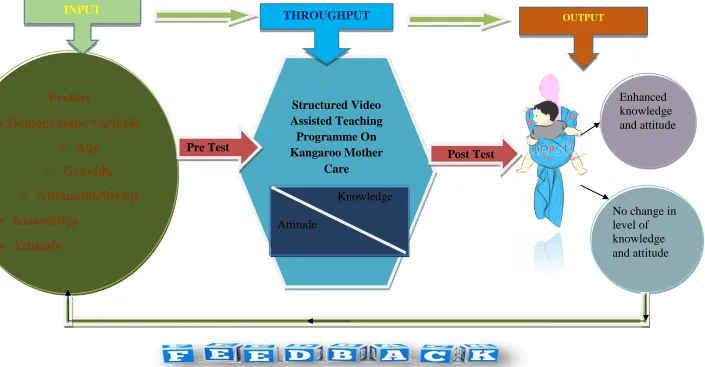
The conceptual framework of the present study is Modified Dorothy Johnsons (1980) Open System Theory.
According to the theory, a general system consist of an asset of interacting components that are regulated by biological, sociological and, psychological factors. An individual is composed of open and interactive subsystem. Open systems consist of input, throughput and output.
According to the theorist view the information matter and energy that the system receives from the environment are called the input for the system. The system uses, organizes and transforms the input in a process called throughput and releases information, matter and energy as output to the environment. The output that returns back to the system as input is called feedback
Structured Video Assisted Teaching Programme On Kangaroo Mother
[image:47.792.44.749.96.463.2]Care
FIGURE NO: 1 CONCEPTUAL FRAMEWORK ON MODIFIED DOROTHY JOHNSON’S OPEN SYSTEM THEORY(1980) INPUT
THROUGHPUT OUTPUT
Pretest
•
Demographic variable
Age
Gravida
Antenatalcheckp
•
Knowledge
•
Attitude
Post Test
Enhanced knowledge and attitude
No change in level of knowledge and attitude Knowledge
Attitude
34
INPUT
The antenatal mother reside in the tribal areas who visit Community Health Center at Devikulam Panchayath in Munnar are considered as the open system .Their level of knowledge was initially assessed by using a multiple choice questionnaire, and their attitude towards practice of Kangaroo Mother Care was assessed by three point Likert attitude scale.
THROUGHPUT
Through this activity phase and manipulative phase, the knowledge regarding the importance of Kangaroo mother care will be imparted through the structured video assisted teaching programme. During this interactive phase transformation of knowledge and attitude regarding kangaroo mother care will take place.
OUTPUT
CHAPTER III
METHODOLOGY
This chapter deals with the structured framework to conduct the study. It encompasses research approach, research design, settings, population, sample, inclusion criteria, sampling technique, description of the tool, validity and reliability of the tool, pilot study, data collection procedure, plan for data analysis.
RESEARCH APPROACH
A Quantitative research approach was used for this study.
RESEARCH DESIGN
A pre experimental one group pre and post-test design was chosen.
TABLE I
SCHEMATIC REPRESENTATION OF RESEARCH DESIGN
Group Pre test Intervention Post test
Study group O1 X O2
KEYS
O1 - Pre-test on knowledge and attitude regarding kangaroo mother care.
X - Video assisted structured teaching programme regarding kangaroo mother care
36
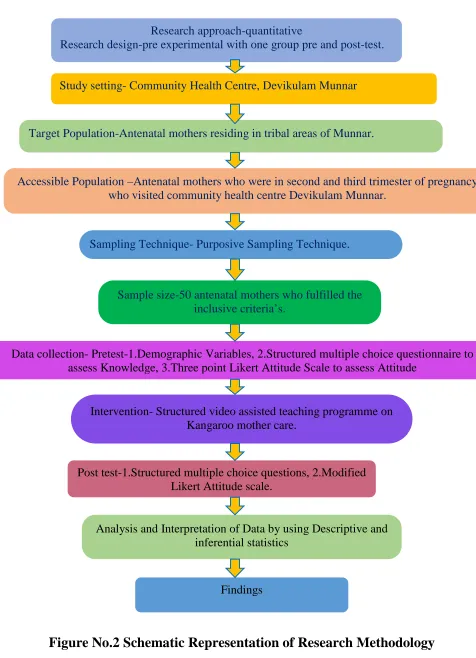
Figure No.2 Schematic Representation of Research Methodology
Research approach-quantitativeResearch design-pre experimental with one group pre and post-test.
Study setting- Community Health Centre, Devikulam Munnar
Target Population-Antenatal mothers residing in tribal areas of Munnar.
Accessible Population –Antenatal mothers who were in second and third trimester of pregnancy who visited community health centre Devikulam Munnar.
Sampling Technique- Purposive Sampling Technique.
Sample size-50 antenatal mothers who fulfilled the inclusive criteria’s.
Data collection- Pretest-1.Demographic Variables, 2.Structured multiple choice questionnaire to assess Knowledge, 3.Three point Likert Attitude Scale to assess Attitude
Intervention- Structured video assisted teaching programme on Kangaroo mother care.
Post test-1.Structured multiple choice questions, 2.Modified Likert Attitude scale.
Analysis and Interpretation of Data by using Descriptive and inferential statistics
VARIABLES
Dependent Variables: In this study dependent variables were Knowledge and attitude regarding Kangaroo Mother Care among antenatal mother belonging to Scheduled Tribes, residing at Devikulam Panchayath, Munnar .
Independent variable: In this study independent variable was Structured Video Assisted Structured Teaching Programme regarding kangaroo mother care.
SETTING OF THE STUDY
The study was conducted among the Antenatal Mothers at Community Health Centre , Devikulam Panchayath, Munnar. The Community Health Centre is located at Devikulam Panchayath in Munnar, which is 30 bedded and headed by the medical officer .It functions round the clock to serve the population.
POPULATION
TARGET POPULATION
It refers to the Antenatal Mothers who were in the second and third trimester of pregnancy.
ACCESSIBLE POPULATION
It refers to the Antenatal Mothers who were in the second and third trimester of pregnancy and who visited the Community Health Centre at Devikulam Panchayath in Munnar, from which the samples were drawn for the study.
SAMPLE
38
SAMPLING TECHNIQUE
A Purposive Sampling Technique was used.
SAMPLE SIZE
A Sample of 50 Antenatal mothers who visited the Community Health Centre at Devikulam Panchayath in Munnar and those who fulfilled the inclusive criteria were selected for the study
METHOD OF SAMPLE SELECTION
The Antenatal Mothers who fulfilled the inclusion criteria were selected purposively for the study. They were chosen by Purposive Sampling Technique from Antenatal Registers maintained at the Community Health Centre Devikulam Panchayath in Munnar.
CRITERIA FOR SAMPLE SELECTION Inclusion criteria
1. Antenatal Mother’s belonging to Scheduled Tribe aged between 19 -30 years.
2. Antenatal mothers who were in their second and third trimester of pregnancy who visited community health centre at Devikulam Panchayath ,Munnar
3. Antenatal Mothers who could talk and understand Tamil or English.
Exclusion Criteria
SELECTION AND DESCRIPTION OF THE STUDY INSTRUMENT
The researcher constructed the tool based on the literature review and opinion from experts which comprised the following content,
PART I
• Section A: Demographic variables
PART II
• Section A: Structured multiple choice questionnaire to assess the knowledge on Kangaroo Mother Care among Antenatal Mothers
• Section B: three point likert attitude scale to assess the attitude of antenatal mothers towards practice of Kangaroo Mother Care.
PART III
• Structured video assisted teaching programme on Kangaroo Mother Care.
DESCRIPTION OF THE TOOL
The tools for this study consisted of three parts.
PART I
Section A: Demographic Variables
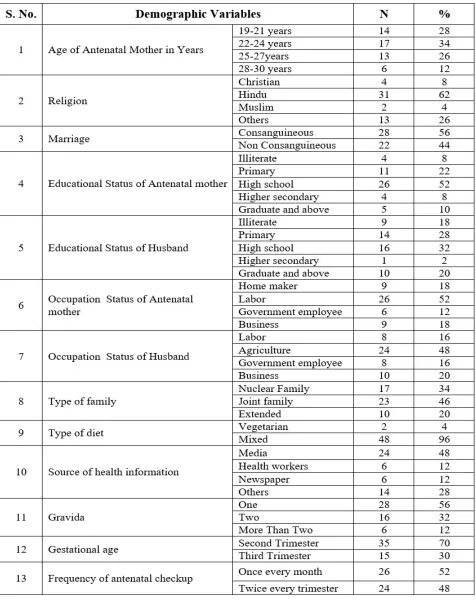
The demographic variables consisted of 13 items, of which it included age, religion, type of marriage, educational status of antenatal mother, educational status of husband, occupational status of antenatal mother ,occupational status of husband, type of family, type of diet, source of health information, Gravida ,gestational age and frequency of antenatal check-up.
PART II Section: A
40
Section: B
It is Three Point Likert Attitude Scale that consisted of 20 items that included both positive and negative statements to assess the attitude towards Kangaroo mother care.
Section: C
Structured video assisted teaching programme on Kangaroo mother care.
PART III
A structured video assisted teaching programme was implemented by lecture cum demonstration method , facilitated by the system of recordings and reproducing the contents using the video and models . The content of the structured video assisted teaching programme included definition, components, prerequisites, benefits, eligibility criteria for neonate ,preparation of neonate and mother for kangaroo mother care, steps of procedure and duration, criteria for discontinuation and special considerations to be followed during kangaroo mother care.
SCORE INTERPRETATION
PART I
The numerical values were assigned for Part I of the tool.
PART II Section A:
Section B:
It consisted of Three point Likert attitude Scale, which included both positive and negative statements.
The scores assigned were as mentioned below:
• Positive statements were numbered: 2, 4, 6, 7,10,16,17,18,19,20.
Positive statements Disagree Uncertain Agree
Scores 1 2 3
• Negative statements were numbered: 1, 3, 5, 8,9,11,13,14,15.
Negative statements Disagree Uncertain Agree
Scores 3 2 1
The total scores were classified as poor, better, best.
CATEGORY SCORES PERCENTAGE LEVEL OF KNOWLEDGE
I 1-10 0-50 Inadequate Knowledge
II 11-15 51-75 Moderately adequate knowledge III 16-20 76-100 Adequate knowledge
CATEGORY SCORES PERCENTAGE LEVEL OF ATTITUDE
I 1-30 0-50 Poor
II 31-45 51-75 Better
42
CONTENT VALIDITY
The content validity of the tool was established by the nursing and medical experts. The suggestions of the experts were incorporated and the tool was modified accordingly. The tool was then finalised and translated to Tamil.
RELIABILITY OF THE TOOL
The reliability of the structured tool to assess the knowledge and attitude was elicited by the test re-test method. The ‘r’ value was computed by Karl Pearson’s co-efficient formula and it was found to be 0.85 for both knowledge and attitude scales. This indicates that the tools are highly reliable.
PILOT STUDY
A pilot study is a study which is carried at the end of the planning phase of research in order to explore the feasibility of the study .A pilot study was conducted at Koviloor, in Vattavada Panchayath and administrative approval was obtained from the medical officer of Vattavada Primary Health Care Centre.
DATA COLLECTION PROCEDURE
The data collection procedure included the following steps throughout the study:
1. The Ethical Committee approval was obtained from the institutional ethical committee at Karpaga Vinayaga College Of Nursing, Kancheepuram District
2. A written permission was obtained from the Medical Officer at Community Health Centre at Devikulam Panchayath in Munnar. The data collection was done among antenatal mothers who fulfilled the inclusive criteria and who visited Community Health Centre at Devikulam Panchayath in Munnar for a period of 6 weeks. The participants for the main study were selected from the Antenatal records and registers maintained at the Community Health Centre, at Devikulam Panchayath in Munnar.
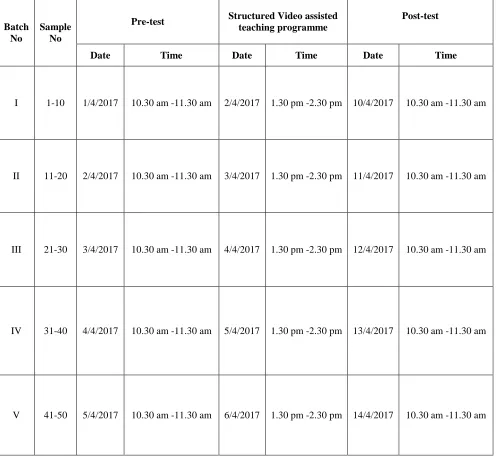
3. The researcher selected 50 samples, those who met the inclusive criteria by purposive sampling technique. Informed consent was obtained from all the samples .The total samples were divided into 5 batches with 10 samples in each batch. Pre-test was done for each batch. On day one, collection of demographic data, assessment of level of knowledge and attitude regarding Kangaroo Mother Care was done using structured multiple choice questionnaire and Three point Likert attitude scale respectively. The data was collected using interview technique.
44
Table: 2
Time Schedule for Data Collection
Batch No
Sample No
Pre-test Structured Video assisted
teaching programme
Post-test
Date Time Date Time Date Time
I 1-10 1/4/2017 10.30 am -11.30 am 2/4/2017 1.30 pm -2.30 pm 10/4/2017 10.30 am -11.30 am
II 11-20 2/4/2017 10.30 am -11.30 am 3/4/2017 1.30 pm -2.30 pm 11/4/2017 10.30 am -11.30 am
III 21-30 3/4/2017 10.30 am -11.30 am 4/4/2017 1.30 pm -2.30 pm 12/4/2017 10.30 am -11.30 am
IV 31-40 4/4/2017 10.30 am -11.30 am 5/4/2017 1.30 pm -2.30 pm 13/4/2017 10.30 am -11.30 am
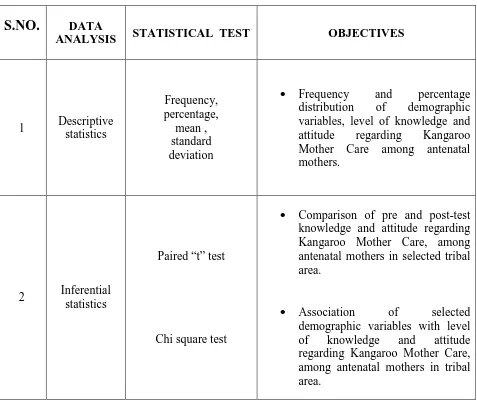
Table: 3
Plan for Data Analysis
The data analysis was done by using descriptive and inferential statistics .The plan for the data analysis was as mentioned below.
S.NO.
DATAANALYSIS STATISTICAL TEST OBJECTIVES
1 Descriptive statistics Frequency, percentage, mean , standard deviation
• Frequency and percentage distribution of demographic variables, level of knowledge and attitude regarding Kangaroo Mother Care among antenatal mothers.
2 Inferential statistics
Paired “t” test
Chi square test
• Comparison of pre and post-test knowledge and attitude regarding Kangaroo Mother Care, among antenatal mothers in selected tribal area.
46
CHAPTER –IV
DATA ANALYSIS AND INTERPRETATION
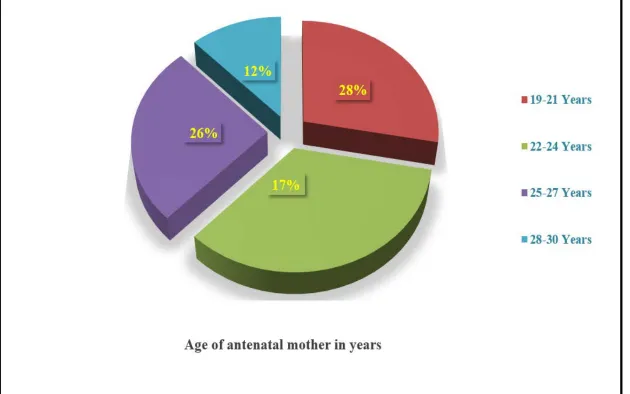
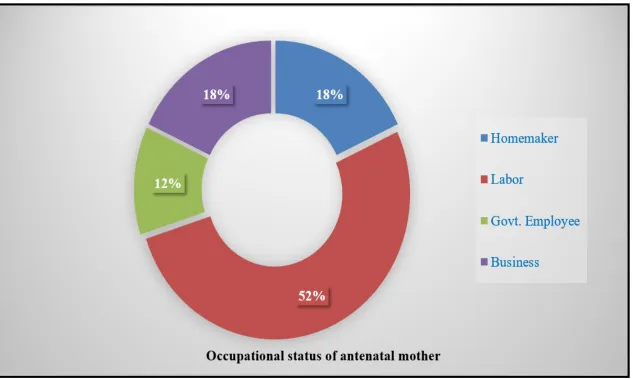
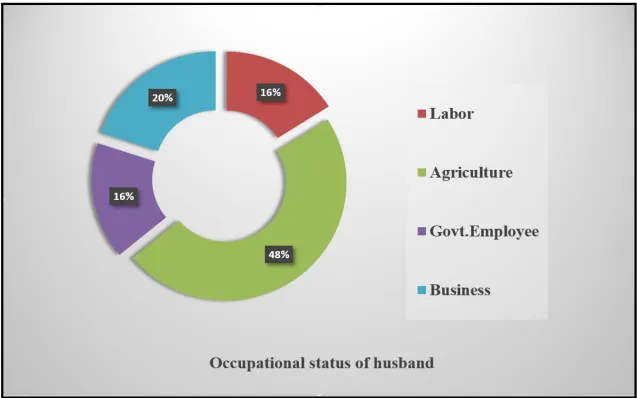
This chapter deals with the statistical analysis of data which enables the researcher to summarise, organize, evaluate, interpret, and communicate the numerical information.
The descriptive and inferential statistics were used to analyze the data to evaluate the effectiveness of structured video assisted teaching programme on Kangaroo Mother Care among the antenatal mothers at s