Int. J. Electrochem. Sci., 6 (2011) 2192 - 2200
International Journal of
ELECTROCHEMICAL
SCIENCE
www.electrochemsci.org
Influences of Gas Diffusion Layers with Pitch-based Carbon
Coated in Polymer Electrolyte Membrane Fuel Cell
Wei-Hung Chen, Tse-Hao Ko, Jui-Hsiang Lin, Ching-Han Liu*, Chin-Wei Shen, Chien-Hsun Wang
Department of Materials Science and Engineering, Feng Chia University, Taichung 40724, Taiwan *
E-mail: [email protected]
Received: 26 April 2011 / Accepted: 17 May 2011 / Published: 1 June 2011
For the purpose to increase performance in polymer electrolyte membrane fuel cell, self-made and commercial carbon papers with pitch-based carbon (meso-phase pitch and coal tar pitch) coated of gas diffusion layers have been investigated in this study. In order to improve the electrical conductivity and reduce surface indentation of carbon fibers in the paper of gas diffusion layers, we modified the carbon papers with pitch coated. Various analyses (through-plane resistance, SEM, contact angle, Gurley porosity and cell performance) were used to research the characters of carbon paper. SEM morphologies showed that surface of carbon fiber in treated CPs were smoother than untreated ones. Contact angles of carbon papers increased 3.62% and 5.70% for self-made GDL-MP and GDL-A240, respectively. Cell performances showed that current densities of self-made GDL-MP and GDL-A240 increased 16.7% and 34.3% at 0.5V loaded, respectively. And also 13.8% increased for coated and uncoated commercial CPs.
Keywords: Carbon paper, gas diffusion layer, polymer electrolyte membrane fuel cell
1. INTRODUCTION
Recent researches have focused on proton exchange membrane fuel cells (PEMFC). However, many technological difficulties must be overcome before commercialization is possible. The gas diffusion layer (GDL) is a critical part of any PEMFC [1]. The GDL supports gaseous fuel transfer to the catalyst layer (CL) in a fuel cell. It should be electrically conductive to obtain current from the redox reactions at the CL. During fuel cell operation, water is produced by the redox process.
The electrical resistance and functional group of carbon fibers as a function of heat treatment temperature decreased as treatment temperature increased [5, 6], but the hydrophobicity of the surface functional group declines [7, 8], and Lin et al. [9] mentioned that carbon fiber paper treated with pitch would improved the surface hydrophobicity, we put the same method in modifying commercial carbon fiber paper, and contrast to self-made GDLs which using in the PEMFC.
The most common materials used to make GDLs, no matter carbon paper or carbon cloth are both made of carbon fibers. Carbon fibers can be made by different manufacturing processes (intrudes precursor, temperature, and surface modified processes) and have slightly different properties. PAN and pitch are two types of carbon fiber precursor. In this study, we coated a pitch-based carbon film on the self-made carbon paper. According to carbon material science, pitch-based carbon has higher electrical conductivity than PAN-based carbon [10]. A carbon film coating on self-made carbon papers is smooth and continuous over the carbon fiber surface; moreover, it also improves the through-plane resistance. In this study, in order to increase the electrical conductivity and reduce the surface indentation of the carbon fibers, we modified the carbon fiber with carbon-based materials (mesophase pitch and coal tar pitch). This study reports on the modified method to improve the properties of raw GDL and subsequently to improve performance of the PEMFC.
2. EXPERIMENT
2.1. The manufacture and modify of GDL
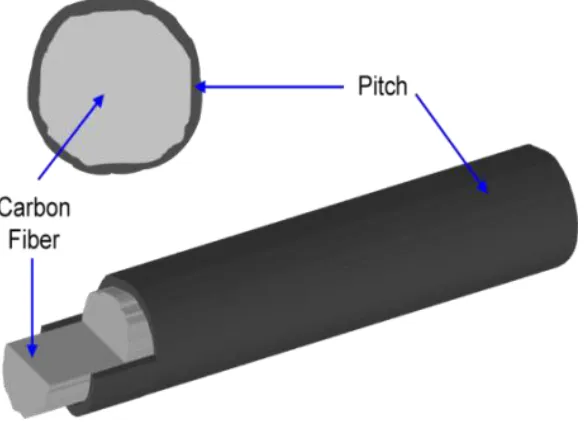
In this study, GDLs were manufactured from carbon fiber, and produced according to Taiwan patent no. I296449 [11] and U.S. patent no. US7390476B2 [12]. Coal-tar pitch A240 (Ashland Oil Company) and mesophase pitch (China Steel Chemical Corp.) were used as carbon precursor to form a carbon film on carbon paper surface. Two coating solutions were prepared by dissolving A240 and mesophase pitch in aqueous toluene solution at a proportion of 0.3 gml−1, respectively. The coated GDLs were dried at 70 oC and carbonized at 1400 oC (in nitrogen atmosphere). The two kind of coated GDLs were called GDL-A240 and GDL-MP, corresponding to the type of coating solution that we used. We used coal-tar pitch A240 coated on the commercial products(SGL25AA), the code name SGL for untreated sample, and SGL-A240 for the other. Figure 1. shows the carbon fiber with carbon film, after the pitch coated on fiber, the diameter will increase in theory, the light and dark two parts mean fiber and film, respectively.
2.2. Characterization of GDL
[image:3.596.158.450.135.346.2]
GDL surface. Gurley porosity values were acquired as an average of several time (second) determinations for 300 cm3 and weight of 142 g of displaced air.
Figure 1. A single carbon fiber with pitch coated.
Different treatments of these GDLs were tested with a Digidrop apparatus (GBX model D-S Instruments), using the triple point calculation method. An HPLC-quality water drop was placed on the disk surface at a static contact angle (θ) of 0 <θ< 90° and θ> 90°, called hydrophilic and hydrophobic, respectively. Drop shape and contact angle magnitude were controlled by three interaction forces of interfacial tension for each participating phase (gas, liquid, and solid). However, there are some limitations which can limit the reproducibility of contact angle measurements.
The through-plane resistance was measured by 2-point (10 mm in diameter) and various forces. Measurements were made a minimum of 5 points on a GDL and the average value was calculated for 5 pieces of GDL. The surface morphology of the GDL was investigated visually a via the variable vacuum scanning electron microscope (VVSEM) (HITACHI S-3000, Japan).
2.3. Electrochemical characterization of GDL in a PEMFC
Single-cell voltage and current density were measured simultaneously, using an FCED® PD50 (Asia Pacific Fuel Cell Technologies, Ltd., Taiwan). A Five-layer MEA was fabricated using three-layer MEA and two GDLs. The three-three-layer MEA was obtained from HEPHAS Energy CO., Ltd. (Ion Power CCM, 0.3 mg Pt/cm2). The activated area in each cell was 25 cm2, and the bipolar plates consisted of serpentine-type grooved graphite plates made of highly compact graphite.
3. RESULTS AND DISCUSSION
3.1 Characterization analysis of GDL
The porosity and contact angle values of our self-made carbon papers and commercial products after modified are shown in Table 1.
Table 1. The properties of various gas diffusion layers.
Sample Code Gurley porosity(cm3cm-2sec-1) Contact Angle(θ)
GDL 148 117.9
GDL-A240 263 124.6
GDL-MP 236 122.2
SGL 394 118.4
SGL-A240 591 123.9
[image:4.596.132.465.332.724.2]
The structure of carbon papers which coated carbon film improves transmission of electrons and augments vertical fibers conductivity. And the micro structures probably increased the width and length of micro crystallites at treatment temperatures of 1300-2500°C.
The results show that GDL heat treatment at 1,400°C acquires a hydrophobic property (>90°). Besides, the contact angles of GDL-A240 and GDL-MP were 124.6° and 122.2°, test results both show that the effect on hydrophobic were better than GDL (117.9°). Compared with SGL and SGL-A240, the value of contact angle increased 5.5°. Figure 2. show the contact angles photos of the self-made carbon papers and commercial products.
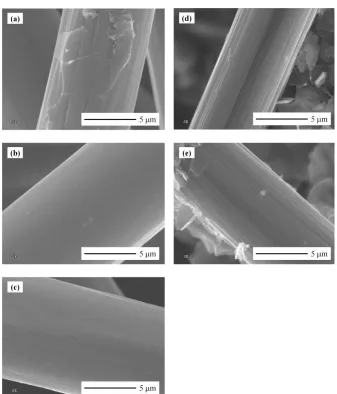
The porosity value of GDL is lower than GDL-A240 and GDL-MP. In addition, the microstructure of GDL can be described as quite rough, and consists of cylindrical carbon fibers (Figure 3(a)). The surface morphologies of GDL-A240 and GDL-MP were smooth. The micro structural changes probably caused increased smoothness and continuity of surface crystallites in the carbon fibers. The surface shape of the coated sample shows a smooth and continuous appearance, no matter self-made or commercial (Figure 3 (b), (c) and (e)).
[image:5.596.130.467.328.722.2]
The Gurley porosities of SGL and SGL-A240 are also shown in Table 1. The coating solutions of coal tar pitch A240 and mesophase pitch smoothed the carbon fiber surface and cross-linked parts of the carbon fibers in self-made carbon papers. For GDL-A240 and GDL-MP, the diameter of a single fiber in carbon paper increased after pitch coated on, as Table 2 list.
Table 2. Carbon fiber diameter list.
Sample Code Fiber Diameter(mm) Increase Percentage(%)
GDL 10.22 -
GDL-A240 10.48 2.54%
GDL-MP 10.36 1.37%
SGL 7.85 -
SGL-A240 7.96 1.46%
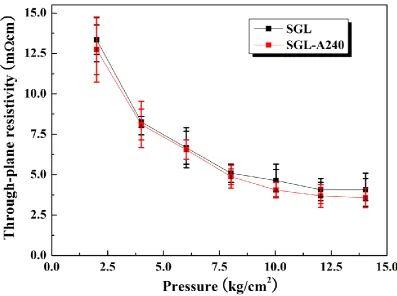
Figure 4. presents a comparison of the compression and through-plane electrical resistance curves for the commercial carbon papers. The through-plane resistance of SGL and SGL-A240 were reduced during the pressure process. Increased pressure caused the electrical transportation path to interlock and increased the carbon fiber density. This is the key factor in changing the through-plane resistance.
[image:6.596.98.495.426.722.2]
3.2. Electrochemical performance of a PEMFC
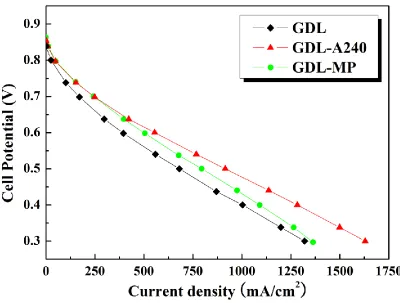
The above results can be confirmed by the polarization curves for a PEMFC using different self-made carbon papers (Figure 5.). The fuel cell temperature was operated at 40 oC, 95% RH of anode/cathode at 40 oC, and 0 psig back-pressure. Electrochemical performance tests were performed (to obtain polarization curves) using various self-made carbon papers to elucidate the effects of these alterations on performance. Polarization of the membrane electrode assembly (MEA) at 0.5V with GDL, GDL-A240 and GDL-MP achieved current densities of 681, 915 and 795mAcm−2, respectively.
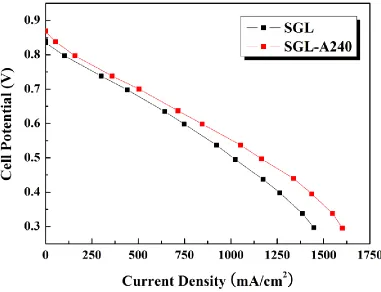
The polarization curves of commercial carbon papers (Figure 6.), the values of current densities at 0.5V were 1024 and 1165mAcm-2 for SGL and SGL-A240, respectively, the results showed that carbon fiber papers which after A240 coated would get the promotion of electrochemical performance.
Figure 5. Polarization curves of the PEMFC using various self-made carbon papers. (♦) GDL; (▲) GDL-A240; (●) GDL-MP.
[image:7.596.91.491.284.587.2]
Figure 6. Polarization curves of the PEMFC using commercial carbon papers. (■) SGL; (■) SGL-A240.
4. CONCLUSION
The surface hydrophobicity and gas permeability of carbon fiber paper promoted due to pitch coated on carbon fiber surface, and superior results in current density and power density by coating pitch on the carbon papers in this study, especially under low operating voltages. Polarizations at 0.5 V of the MEA with GDL, GDL-A240, and GDL-MP were 921, 1221 and 975 mAcm-2, respectively. The performances of GDL-A240 and GDL-MP at 0.5 V were 34.3% and 16.7% higher than GDL, respectively. And 13.8% increased for coated and uncoated commercial carbon papers. The carbon film coating improved the carbon fiber papers with respect to PEMFC performance.
References
1. M.V. Williams, E. Begg, L. Bonville, H.R. Kunz, J.M. Fenton, J Electrochem Soc 151 (2004) A1173
2. L.R. Jordan, A. Shukla, T. Behrsing, N. Avery, B. Muddle, M. Forsyth, J Power Sources 86 (2000) 250
3. J.H. Lin, W.H. Chen, Y.J. Su, T.H. Ko, Fuel 87 (2008) 2420
4. C.H. Liu, T.H. Ko, E.C. Chang, H.D. Lyu, Y.K. Liao, J Power Sources 180 (2008) 276 5. T. Yamaguchi, Carbon 1964; 2:95
[image:8.596.109.490.75.367.2]
7. M.Z. Wang, New Carbon Materials 13(4) (1998) 79 8. T.H. Ko, L.C. Huang, J Appl Polym Sci 70 (1998) 2409
9. J.H. Lin, W.H. Chen, S.H. Su, Y.K. Liao, T.H. Ko, J Power Sources 184 (2008) 38
10. D.B. Fischbach, K. Komaki, 14th Bienn. Conf. Carbon, Pennsylvania State University, University Park, PA, 1979, 191, extended abstracts.
11. T.H. Ko, Taiwan Patent No. I296449 2008. 12. T.H. Ko, US Patent No. US7390476B2 2008.
13. B.R. Sivertsen, N. Djilali, J Power Sources 141 (2005) 65 14. T.H. Zhou, H.T. Liu, J Power Sources 161 (2006) 444