Abstract: Cloud computing is a term for a wide range of developments possibilities. It is rapidly growing paradigm in software technology that offers different services. Cloud computing has come of age, since Amazon's rollouted the first of its kind of cloud services in 2006. It stores the tremendous amount of data that are being processed every day. Cloud computing is a reliable computing base for data-intensive jobs. Cloud computing provide computing resources as a service. It is on-demand availability of computing resources without direct interaction of user. A major focus area of cloud computing is task scheduling. Task scheduling is one among the many important issues to be dealt with. It means to optimize overall system capabilities and to allocate the right resources. Task scheduling referred to NP-hard problem. The proposed algorithm is Cost Effective ACO for task scheduling, which calculates execution cost of CPU, bandwidth, memory etc. The suggested algorithm is compared with CloudSim with the presented Basic Cost ACO algorithm-based task scheduling method and outcomes clearly shows that the CEACO based task scheduling method clearly outperforms the others techniques which are in use into considerations. The task is allotted to the number of VMs based on the priorities (highest to lowest) given by user. The simulation consequences demonstrate that the suggested scheduling algorithm performs faster than previous Ant Colony Optimization algorithm in reference to the cost. It reduces the overall cost as compare to existing algorithm.
Keywords: Cloud Computing, Cost Optimization, Task Scheduling, ACO, CEACO.
I. INTRODUCTION
Cloud computing is considered as the most significant computing models. It accumulates a lot of concentration in both industry and academia fields. It is an asset for both user and organizations. [1]. The computing devices like networking components, storage items, and processing segments, etc., create a model like Cloud [2]. Vice president at Sales force, cited about the cloud computing is a more protected and security function other than conventional computing, because mostly companies provided cyber-security issues and cyber-crime of higher quality other than many governmental agencies[3]. Cloud computing has large number of advantages i.e. user have to pay as you go model (monthly, yearly and many more), everyone having internet connection can access a cloud computing resources, and do not need to buy software and install environment for run. Cloud services become beneficial for everyone but have many issues. Task scheduling referred to NP-hard problem [4,
Revised Manuscript Received on August 05, 2019
Dr. Yogesh Kumar Gupta, Department of Computer Science, Banasthali Vidyapith, Rajasthan, India.
Chandrakanta Yadav, Department of Computer Science, Banasthali Vidyapith, Rajasthan, India.
5]. The improvements in different types of computing, like distributing computing, parallel computing and grid computing and so on is Cloud computing. The basic three cloud computing forms are hybrid, private and public. One of the best choice is Hybrid cloud for enterprises to benefit by taking least from the other cloud computing. Cloud services become beneficial for everyone. But cloud computing has various issues: (1) With cloud computing system implementation by companies and consumers group, the consumer calculated is growing drastically with rise in figure of cloud computing applications as well as solutions, the datacenter expansion and increase the power consumption. (2) Allocation of resources, i.e. allocation of VMs on datacenters to give users with high-quality resources and features of datacenters to give services at resources level. (3) When datacenters loading is high then execution cost of CPU, RAM, and bandwidth increases. Task Scheduling is the Major crux in Cloud Computing. Task scheduling refers to allotting jobs to the appropriate resources and optimizes the system execution as a whole. Planning is procedure of allocating task to the appropriate resources for particular jobs. Job is divided into multiple tasks and each task is work that should be done in a particular time period. Task scheduling referred to NP-hard problem [5]. In cloud computing Virtual Machine consider to be scheduling machines where task scheduling is completed with effective result. Where the main issues of the task scheduling is cost and calculates the cost for various resources. In cloud computing data center are heterogeneously worked. The Basic Cost ACO and other algorithm for calculating the cost produce the cost. But the suggested use of algorithm is to reduce cost of implementation of processed task based on budget constraints better than Basic Cost ACO [6]. ACO Firstly Marco Dorigo [8] proposed in 1992. Ant Colony Optimization algorithm (ACO) is a population-based meta-heuristic unsystematic optimization and investigation technique meant for allocating
the inward job to virtual equipment, algorithm adopted to hit
upon best possible solutions for intricate optimization problems [9]. It is established on ant colonies concept. The algorithm is nature inspired algorithm, based on natural conduct of real ants looking for a way between source to destination and in same time shortest path make high intensity of pheromones, which is helpful for other ant for finding food [10]. Ant
Cost Effective Ant Colony Optimization in
Cloud Computing
Colony Optimization algorithm is being utilized on many combinatorial optimization problems, multi-targets and parallel implementation [10]. This paper utilizes the ant colony optimization algorithm to achieve cloud task scheduling. The ACO algorithm is utilized for cloud scheduling because it provides the optimized fitness function. The remaining research is structured as hence: Section II describes various techniques engaged in algorithm to increase its overall workability. Section III presents task scheduling with ACO used for solving meta-heuristic techniques. In Section IV proposed Cost Aware task Scheduling algorithm CEACO is considered and in Section V Cloud simulation with optimized result and compare to others algorithm.
II. LITERATUREREVIEW
Al-maamari, et.al.[11] Explained Dynamic Adaptive Particle Swarm Optimization (DAPSO) based task allocation algorithm. Algorithm is used to amend the functionality of the basic PSO algorithm with minimize the make span of particular job set and maximum resource utility. The utilization of DAPSO algorithm is to enhance inertia weight and CS (cuckoo search) algorithm is utilized in the local search. Author has proposed a new algorithm, which is combination of DAPSO and CS called Modified Dynamic Adaptive Particle Swarm Optimization (MDAPSO). Proposed algorithm gives better result as compared to PSO, DAPSO, and PSOCS. Amandeep, et.al. [12] studied that a cloud workflow scheduling problems with a single objective. Author suggested the multi-objective hybrid particle swarm optimization algorithm built on non-dominance sorting technique for explaining the workflow arrangement crisis. The algorithm’s performance solves three conflicting objective energy intake, make span and total cost with budget and deadline restrains. An effort of the author extends the QoS constraints like trust management, reliability and VM migration. Author has improved multi-objective optimization issue into single objective optimization issue by means of scalar technique. Awad, A.I.et.al. [13] Explained algorithm for the enhancement of overall task performance in scheduling cloud computing environment. Algorithms based on heuristic techniques using load balancing mutation particle swarm optimization. LBMPSO (load balancing mutation particle swarm optimization) improved the execution time; make span, roundtrip time, transmission cost, load balancing between task and virtual machine. Guo, Lizheng, et al. [14] studied that task scheduling optimization method in cloud computing. Author compared and analyzed particle swarm optimization with crossover and mutation and local search algorithm depends on particle swarm optimization. Author planned the particle swarm algorithm embedded in SPV and improved the performance. In future Algorithm work based on research is for catering the energy efficiency and accessibility of services in cloud computing. Kennedy, James. et.al. [15] intended a particle swarm optimization (PSO) method using Non-linear functions. Algorithm explains the particle swarm optimization in terms of its precursors and in shortly the stages of its development from social simulation to optimizer. The concept of pbest and gbest are similar to the crossover operation as suggested in genetic algorithm and use
A. Research Gap
Goes through the literature review; it should have become apparent that there are certain limitations in previous research. In the literature, different type of algorithm are discussed like PSO, ACO,GA,ABC, DAPSO,MDAPSO, GWO etc, all the algorithm based on different type of techniques like heuristic, meta-heuristic, and hybrid techniques. These techniques improve the different parameters like time, cost, make span, energy consumption, and budget constraints etc. But algorithms improve the result insufficient. The hybrid particle swarm optimization algorithm have some restriction i.e. QoS constraints like consistency, trust management, and VM migration etc. PSO algorithm restricted on behalf of energy efficiency, and service reliability. So that the proposed algorithm is based on execution cost that improves the execution cost better than
existing algorithm’s.
III. RESEARCHMETHODOLOGY
The Proposed algorithm is improving the execution cost better than Basic Cost ACO by using Ant Colony Optimization algorithm. ACO algorithm is used for extracting information about cloud task scheduling. CloudSim is a simulation tool where the CEACO algorithm is implementing. The user submitting the task to the data center than task is categorized into various sub-tasks. The tasks are sent for scheduling through scheduling algorithm. The algorithm is implemented in the CloudSim 3.0.3.
A. Experimental setup
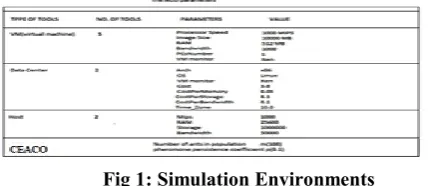
[image:3.595.49.264.593.686.2]The CloudSim 3.0.3 provides the cloud environment, File size, MIPS, BW, RAM, VMs configuration, Host and data center, same as components in physical cloud environments. Also, CloudSim provides scheduling environment on user requirements. This simulation can be used to test the efficiency and performance of task scheduling algorithm. It covers the need to experiment the proposed CEACO compare it with Basic Cost ACO. In the experiments, we employed two data centers contain VMs. We used different number of VMs and different number of cloudlets (tasks). In this algorithm, precise the performance depending on the execution cost for scheduling cloudlets on VMs. figure 1 show the results of running CEACO on the machine with specifications.
Fig 1: Simulation Environments
For simulation our hardware interface is this: Processor: i5, RAM: 8GB, OS: (64-bit), Windows 7 etc.
B. Proposed algorithm
The proposed algorithm minimizes total execution cost of processed task based on budget constraints [13]. The algorithm is cost effective task scheduling algorithm which is based on the (ACO) ant colony optimization.
Core motive of this algorithm is to schedule tasks to available virtual machines (VMs) efficiently with improving QoS constraints in terms of cost while maintaining the execution time. The proposed CEACO is schedule on M number of VMs and N number of cloudlets or tasks. This paper modifies the basic ACO by improving the initialization and updating of pheromone rule of ant colony algorithm. In this way, the proposed algorithm gives the optimized fitness function.
Initializing Pheromone VM= {VMi: i=0 to M}
Cloudlet= {Cloudletj: j =0 to N}
The proposed algorithm dynamically changes order of VMs and cloudlets with its capacity at each iteration. A priority is assigned to each task according to their length. For efficient resource utilization, all virtual Machines are arranged in order to their capacity and tasks are sent in to batches.
Batch size= Number of VM-1
Each batch is scheduled on VMs in order to find minimum cost. Total cost of scheduling is calculated by sum of cost of each batch.
Total Cost = Cost1+Cost2+………...…+Costµ (Where µ is the number of batches)
Cloudlet length is considered mainly for calculation of execution cost. The algorithm calculates the cost and gives minimum execution cost by using following mathematical equations
VML= TL ……….……… (1) CVM Where VML is VM load, CVM = is the capacity of VM, it refers to Penum*Pemips. Penum is defined the number of processing elements allocated, while Pemips is the amount of million instructions per second, TL is the total task length. Calculate the total cost of processing (CPU) for mapped task in each cluster resource (slow, fast) by using Equation (2). In this equation Cc is used to represent the total cost of CPU [4].
CC = CVM*(VMmips)*CPs ……… (2) Then we calculate the total cost of RAM, Bandwidth and storage of VM based on Equation (3), (4), (5). In these equations Cs is used to represent the total cost of storage consumption. CB represents the total cost of bandwidth consumption. Cm represents the total cost of RAM consumption. Cfit represent the cost of file input task, and cfot represent the cost of file output task.
CS= Cfit+(Cfot*CPSt) ………(3) CB =
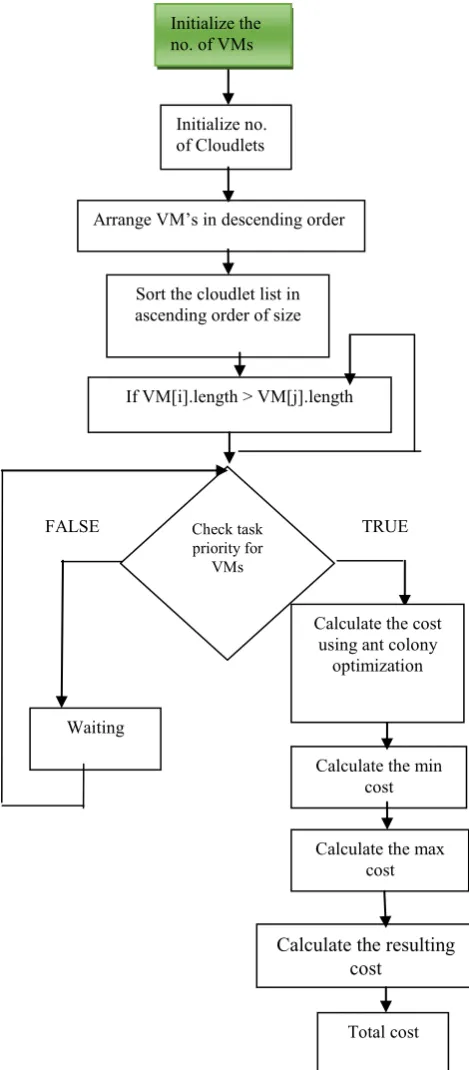
Fig 2: Proposed Model of ACO.
Algorithm: Calculate the execution cost based on the priority:-
Input: no. of task allocated on the no. of resources. Output: generate the execution cost of the no. of tasks. Categorized the resources based on the no. of tasks:-
Step 1: Initialize the no. of VMs. Step 2: Initialize the no. of Cloudlets.
Step 3: Sorted the VM list in decreasing order. Step 4: Sorted the Cloudlet list in increasing order. Step 5: Check the length of VMs
If VM[i], Length > VM[j]. Length then assigns the high priority task to the high priority VMs. Step 6: Check task priority related to the VMs.
if VMs is idle then waiting the cloudlets for VMs. Calculate the cost using ant colony optimization. Calculate the minimum and maximum cost. Step 7: Calculate the resulting cost.
Step8: Finally execution cost is calculated.
IV. RESULTANDDISCUSSION
[image:4.595.307.519.305.405.2]To evaluate the effectiveness of the suggested algorithm, we compared the execution cost of the proposed algorithm with Basic Cost ACO algorithm, which is based on ant colony optimization algorithm. Table 1 compares the improvement in execution cost with increase no. of VMs and Cloudlets. The experiment has been performed over 1500, 5000, 10000, 15000, 30000 request counts. Figure 3 represent the execution cost versus no. of cloudlets & no. of VMs. Execution cost has reduced over the proposed system in increase in completed requests over the system.
Table 1: Comparison Of The Proposed CEACO With ACO Experiments [1]
Regarding CEACO, simulation parameters algorithm is configured and resulting algorithm has produced the experiments results and CEACO has present the minimum execution cost than ACO.
Fig 3: Execution Cost versus no. of Cloudlets & no. of VMs.
V. CONCLUSION
The producing a lot with very little waste task scheduling algorithm must save the completion cost and used the useful things suitably. Here planned work i.e. an innovative task scheduling algorithm Cost Effective Ant Colony Optimization (CEACO) has been planned to execute the significant data in computer
that do work for you, S.
No.
VM Cloudlets BasicACO CEACO
1 15 1500 228186 227437 2 50 5000 761008 760236 3 100 10000 1523251 1522443 4 150 15000 2284829 2284053 5 300 30000 4569908 4569104 TRUE
FALSE
Arrange VM’s in descending order
If VM[i].length > VM[j].length
Check task priority for
VMs
Calculate the min cost
Calculate the max cost
Calculate the resulting cost
Total cost Waiting
Initialize the no. of VMs
Initialize no. of Cloudlets
Sort the cloudlet list in ascending order of size
Calculate the cost using ant colony
[image:4.595.314.551.456.624.2]but that are stored somewhere else and maintained by other companies . The proposed algorithm point at reduced the execution cost of processed task based on budget constraints. We experimented with algorithm in the CloudSim, and experiment proved the effectiveness of the algorithm. To (figure out of worth, or quality of) the performance of suggested algorithm, a (serving to compare two or more things) research has been done among our suggested algorithm CEACO and Basic Cost ACO. Both algorithms have been implemented and experimentally validated by means of simulation. The experimental outcomes show the efficiency of our projected algorithm CEACO in (making something as small as possible) the execution cost. It is planned to modify the algorithm in future to improve its reliability, execution time and performance.
REFERENCES
1. Abdi, s. and Saeed S.: Task scheduling using modified PSO algorithm in cloud computing environment. International conference on machine learning, electrical and mechanical engineering. 2014.
2. https://intellipaat.com/blog/what-is-cloud-computing/
3. Kumar, S. and Manpreet, S.: Metaheuristic based workflow scheduling in cloud environment. 5th International Conference on Reliability, Infocom Technologies and Optimization (Trends and Future Directions) (ICRITO). IEEE, 2016.
4. Lakshmi, R, and Srinivasu,N.: A dynamic approach to task scheduling in cloud computing using genetic algorithm. Journal of Theoretical & Applied Information Technology 85.2 2016.
5. Verma, A. and Kaushal, S.: A hybrid multi-objective Particle Swarm Optimization for scientific workflow scheduling. Parallel Computing 62: 1-19. 2017.
6. Reddy, G. and Kumar,S.: MACO-MOTS: Modified Ant Colony Optimization for Multi Objective Task Scheduling in Cloud Environment. 2019.
7. Agarwal, M. and Srivastava,G.: A PSO Algorithm-Based Task Scheduling in Cloud Computing. Soft Computing: Theories and Applications. Springer, Singapore, 295-301. 2019.
8. Jana, B. and Mandal T. : A Task Scheduling Technique Based on Particle Swarm Optimization Algorithm in Cloud Environment. Soft Computing: Theories and Applications. Springer, Singapore. 525-536. 2019.
9. Jain, R. and Sharma,N.: A systematic analysis of nature inspired workflow scheduling algorithm in heterogeneous cloud environment. International Conference on Intelligent Communication and Computational Techniques (ICCT). IEEE, 2017.
10. Alworafi, M. et al. : Cost-aware task scheduling in cloud computing environment. International Journal of Computer Network and Information Security 9.5, 52. 2017.
11. Al-maamari, Ali. and Fatma A.: Task scheduling using PSO algorithm in cloud computing environments. International Journal of Grid and Distributed Computing 8.5: 245-256. 2015.
12. Verma, A., & Kaushal, S. : Deadline constraint heuristic-based genetic algorithm for workflow scheduling in cloud. International Journal of Grid and Utility Computing, 5(2), 96-106. 2014.
13. Awad, A. I. and Abdel_kader,H. M.: Enhanced particle swarm optimization for task scheduling in cloud computing environments. Procedia Computer Science 65: 920-929. 2015. 14. Guo, L. et al.: Task scheduling optimization in cloud computing based
on heuristic algorithm. Journal of networks7.3, 547. 2012.
15. Kennedy, J. "Particle swarm optimization. " Encyclopedia of machine learning. Springer, Boston, MA, 760-766. 2011.
16. Kalra, M. and Singh, S. : A review of metaheuristic scheduling techniques in cloud computing. Egyptian informatics journal 16.3 275-295. 2015.
17. Saleh, H., Nashaat, H., Saber, W., & Harb, H. M. :IPSO task scheduling algorithm for large scale data in cloud computing environment. IEEE Access, 7, 5412-5420. 2018.
18. Kaur, R. and Singh,K. : Efficient Task Scheduling using Load Balancing in Cloud Computing. International Journal of Advanced Networking and Applications 10.3 3888-3892. 2018.
19. Mathew, T. K. and Jose, J. : Study and analysis of various task scheduling algorithms in the cloud computing environment. Advances
in Computing, Communications and Informatics (ICACCI) International Conference on. IEEE, 2014.
20. Sethi, N. and Singh,G. : Improved Mutation-Based Particle Swarm Optimization for Load Balancing in Cloud Data Centers. Harmony Search and Nature Inspired Optimization Algorithms. Springer, Singapore, 939-947. 2019.
21. Singh, R. et al.: Hybrid Metaheuristic Based Scheduling with Job Duplication for Cloud Data Centers. Harmony Search and Nature Inspired Optimization Algorithms. Springer, Singapore, 989-997. 2019. 22. Masdari, M. et al. : A survey of PSO-based scheduling algorithms in cloud computing. Journal of Network and Systems Management 25.1.122-158. 2017.
23. Buyya, R. and Rodrigo N. Calheiros.: Modeling and simulation of scalable Cloud computing environments and the CloudSim toolkit: Challenges and opportunities. 2009 international conference on high performance computing & simulation. IEEE, 2009.
24. Soltani, Nasim. and Barekatain,B.: Heuristic algorithms for task scheduling in cloud computing: a survey. International Journal of Computer Network and Information Security 9.8, 16. 2017.
25. Mohana, S. J., M. Saroja, and M. Venkatachalam. Comparative analysis of swarm intelligence optimization techniques for cloud scheduling. IJISET 1.10, 15-19. 2014.
26. Selvi, V. and Umarani,R.: Comparative analysis of ant colony and particle swarm optimization techniques. International Journal of Computer Applications 5.4, 1-6. 2010.
AUTHORSPROFILE
Dr. Yogesh Kumar Gupta is an Assistant Professor at Banasthali Vidyapith, India. He primarily works in Big data, data Analytics, Medical Image Processing, and Cloud Computing. He has over 12 years of teaching experience.