Determinants of the Interaction with MHV Nucleocapsid (N) Protein
Sarah C. Keane,* David P. Giedroc
Department of Chemistry, Indiana University, Bloomington, Indiana, USA
Coronaviruses (CoVs) are positive-sense, single-stranded, enveloped RNA viruses that infect a variety of vertebrate hosts. The
CoV nucleocapsid (N) protein contains two structurally independent RNA binding domains, designated the N-terminal domain
(NTD) and the dimeric C-terminal domain (CTD), joined by a charged linker region rich in serine and arginine residues (SR-rich
linker). An important goal in unraveling N function is to molecularly characterize N-protein interactions. Recent genetic
evi-dence suggests that N interacts with nsp3a, a component of the viral replicase. Here we present the solution nuclear magnetic
resonance (NMR) structure of mouse hepatitis virus (MHV) nsp3a and show, using isothermal titration calorimetry, that MHV
N219, an N construct that extends into the SR-rich linker (residues 60 to 219), binds cognate nsp3a with high affinity
(equilib-rium association constant [
Ka
], [1.4
ⴞ
0.3]
ⴛ
10
6M
ⴚ1). In contrast, neither N197, an N construct containing only the folded
NTD (residues 60 to 197), nor the CTD dimer (residues 260 to 380) binds nsp3a with detectable affinity. This indicates that the
key nsp3a binding determinants localize to the SR-rich linker, a finding consistent with those of reverse genetics studies. NMR
chemical shift perturbation analysis reveals that the N-terminal region of an MHV N SR-rich linker peptide (residues 198 to 230)
binds to the acidic face of MHV nsp3a containing the acidic
␣
2 helix with an affinity (expressed as
Ka
) of 8.1
ⴛ
10
3M
ⴚ1. These
studies reveal that the SR-rich linker of MHV N is necessary but not sufficient to maintain this high-affinity binding to N.
C
oronaviruses (CoVs) are positive-sense, single-stranded,
en-veloped RNA viruses that infect a variety of human and
ani-mal hosts. Severe acute respiratory syndrome (SARS) is caused by
a human CoV, SARS-CoV, a
Betacoronavirus
subgroup 2b
zoo-notic virus that emerged in 2002 from a reservoir population of
animal CoVs in bats in southern China (1). SARS-CoV is
charac-terized by its virulence, its ability to cross the species barrier, and a
fatality rate of 10% during the pandemic of 2002 to 2003 (2).
Although the SARS pandemic is clearly behind us, the significant
reservoirs of SARS-CoV-related zoonotic viruses in the wild (3)
and the recent identification of nine human cases of severe viral
pneumonia (with one death) attributed to a SARS-like CoV (4)
reveal that coronaviruses remain a significant threat to human
health.
The prototypical coronavirus murine hepatitis virus (MHV)
(
Betacoronavirus
subgroup 2a) is closely related to SARS-CoV and
is an established model system for the study of selected aspects of
CoV replication and transcription (5). The replication machinery
is translated from the genomic RNA (gRNA) as two large
polypro-teins, pp1a and pp1ab, formed as a result of a
⫺
1 ribosomal
frameshifting event that involves a complex pseudoknotted RNA
structure (6). These polyproteins are then proteolytically
pro-cessed into 16 nonstructural proteins (nsp1 to nsp16), which
as-semble to form the coronavirus replicase-transcriptase complex
(RTC). Coronaviral replication is a complex process that is poorly
understood but is certain to involve a substantial number of highly
dynamic protein-protein and protein-RNA interactions. For
ex-ample, Masters and coworkers have proposed that the initiation of
negative-strand synthesis in coronaviruses requires an interaction
between a
cis
-acting RNA pseudoknot in the 3
=
untranslated
re-gion (3
=
UTR) (7) and a complex of multiple replicase proteins
(8). Additional structural work has identified RNA hairpins in the
5
=
UTR of MHV as essential for replication (9–11). Stem-loop 1
(SL1) has been shown to possess moderately stable base pairing,
the dynamics of which is hypothesized to be essential for
mediat-ing a long-range interaction between the 5
=
and 3
=
UTRs, an
es-sential step in the transcription of subgenomic RNAs (sgRNAs).
The nucleocapsid protein (N) has long been suggested to be an
important component for both replication and transcription.
An-tibodies against N have been shown to strongly inhibit RNA
tran-scription (12), while inclusion of N strongly stimulates virus
rep-lication early in infection (13). N has also been shown to colocalize
with the RTC in the early stages of infection, poising N to function
in a regulatory role during viral replication and transcription (14,
15). Recently, N was found to be dynamically associated with the
RTC (16). This transient association presumably allows N
mole-cules to change places with one another in order to carry out a
variety of distinct functions that may be separated both spatially
and temporally during the viral life cycle.
Although N is known to be essential for efficient viral
replica-tion, the specific role that N plays in this process remains
un-known. Recent genetic evidence (17) suggests that N interacts
with the N-terminal domain of the nsp3 polyprotein (5), termed
nsp3a, which is a known component of the viral replicase. By use
of a reverse genetics system, the gene encoding MHV N was
re-placed with the closely related (71% sequence identity) bovine
coronavirus (BCoV) N gene in a direct open reading frame
Received5 November 2012Accepted5 January 2013
Published ahead of print9 January 2013
Address correspondence to David P. Giedroc, [email protected].
* Present address: Sarah C. Keane, Department of Chemistry and Biochemistry, Howard Hughes Medical Institute, University of Maryland, Baltimore County, Baltimore, Maryland, USA.
Supplemental material for this article may be found athttp://dx.doi.org/10.1128 /JVI.03112-12.
Copyright © 2013, American Society for Microbiology. All Rights Reserved.
doi:10.1128/JVI.03112-12
on November 7, 2019 by guest
http://jvi.asm.org/
(ORF)-for-ORF substitution in an otherwise all-MHV genome.
Strikingly, this substitution resulted in a severely defective virus,
which allowed the recovery of a number of revertant viruses that
restored wild-type-like viability and plaque size (17). These
mu-tants are summarized schematically in
Fig. 1
(17). Revertants were
identified only in two regions in the entire 31,335-nucleotide
ge-nome: the N terminus of nsp3 and the serine/arginine (SR)-rich
linker region of N that connects the N-terminal domain (NTD)
and the dimeric C-terminal domain (CTD) (see Fig. S1 in the
supplemental material). This genetic evidence is consistent with
the hypothesis that MHV N and MHV nsp3a interact physically. It
was also shown that BCoV N poorly stimulates the initiation of
infection by transfected MHV genomic RNA, as was found by our
group for point mutants with mutations in key RNA binding
res-idues in the NTD (18,
19). This low level of stimulation of
infec-tivity could be efficiently rescued by transfection of
in vitro
tran-scripts of BCoV N protein containing the reverting mutations
found in the MHV-BCoV N chimeric viruses (17).
Here we employ nuclear magnetic resonance (NMR)
spectros-copy and isothermal titration calorimetry (ITC) to evaluate this
proposed interaction and to elucidate the determinants of this
cognate viral protein-protein interaction. We present the solution
structure of MHV nsp3a and show that the NTD of MHV N forms
a high-affinity 1:1 complex with MHV nsp3a. The noncognate
BCoV N NTD binds MHV nsp3a weakly, in agreement with the
results of genetic experiments (17). Additionally, we show that a
key determinant of the binding free energy is localized to the
SR-rich linker region just C-terminal of the folded NTD and that this
region is necessary but not sufficient for high-affinity binding to
MHV nsp3a. NMR chemical shift perturbation studies reveal that
the N-terminal region of the SR-linker interacts with the central,
conserved acidic
␣
2 helix of MHV nsp3a.
(This work was performed by S. C. Keane in partial fulfillment
of the requirements for the Ph.D. at Indiana University.)
MATERIALS AND METHODS
Plasmids.To construct plasmids encoding MHV N1-219 (N residues 1 to 219) and N219 (N residues 60 to 219), the coding sequences were ampli-fied from the full-length MHV N gene using standard PCR methods. The
PCR products were digested by NdeI and BamHI and were ligated into a pET3a expression plasmid to create pMHV1-219 and pMHV60-219, re-spectively. Plasmids encoding the various substitution mutants were pre-pared using site-directed mutagenesis of pMHV60-219. For plasmids en-coding BCoV nucleocapsid protein residues 57 to 216, the en-coding sequence was amplified from the BCoV pN-SUMO plasmid (obtained from David Brian, University of Tennessee), digested with NdeI and BamHI, and ligated into pET3a to create pBCoV_NTD. The coding se-quence for MHV nsp3a residues 1 to 114 was amplified from the pGEX6P-nsp3 plasmid (17) (a gift from Paul Masters, Wadsworth Center, New York State Department of Health), digested with NdeI and BamHI, and ligated into the pET3a expression plasmid to create pNsp3a. The MHV CTD-pGST plasmid (pMHV_CTD) has been described previously (18).
The plasmid used to drive bacterial expression of the recombinant SR-linker peptide (residues 198 to 230) was designed to express an MHV N197 fusion protein containing N197 (N residues 60 to 197) immediately followed by an inserted nonnative cysteine residue and native N residues 198 to 230, with the exception that a single F229-to-Y229 substitution was introduced to eventually quantify peptide concentration. Tobacco etch virus (TEV) protease cleaves immediately N-terminal to the Cys [TEV(cys)] in the expressed protein construct and gives recombinant SR-linker peptide following purification (seeFig. 9Cfor sequence). Both tra-ditional and overlap extension PCR methodologies were used. First, N residues 60 to 197 were amplified from the pN60-197_MBP plasmid by using a reverse primer that excluded the stop codon and included the TEV protease cleavage sequence containing a C-terminal Cys. This insert was then used as a template for the extension of the linker sequence by overlap extension PCR with a series of overlapping primers. The overall insert was digested with NdeI and BamHI and was ligated into a pET15b plasmid to create pSRlinker. The integrity of all DNA constructs was verified by DNA sequencing performed by the Indiana Molecular Biology Institute.
MHV and BCoV N domain purification.Plasmids pMHV1-219, pMHV60-219, and pBCoV_NTD were transformed into BL21(DE3) cells, expressed, and purified as follows. A single colony from the trans-formation plate was used to inoculate a 200-ml LB culture containing 100 mg/liter ampicillin and was grown overnight at 25°C with shaking. The starter culture was used to inoculate six 1-liter LB (100 mg/liter ampicil-lin) cultures such that the 1-liter cultures would have an initial optical density at 600 nm (OD600) of 0.1. Large cultures were grown at 37°C with shaking until the OD600reached 0.6 to 0.8, at which time expression was induced with the addition of 500M isopropyl-D
-1-thiogalactopyra-noside (IPTG). Cells were grown at 37°C for an additional 4 h prior to FIG 1Map of revertant mutations identified when the MHV N gene was replaced by the BCoV N gene in an ORF-for-ORF substitution in an otherwise wild-type MHV A59 genome (17).
on November 7, 2019 by guest
http://jvi.asm.org/
[image:2.585.101.485.66.251.2]harvesting by centrifugation at low speed. Cell pellets were frozen at
⫺80°C overnight, thawed, resuspended in 200 ml lysis buffer (25 mM KPi, 2 mM EDTA, 500 mM KCl, 0.1 g protease inhibitor cocktail [Sigma] [pH 6.0]), and lysed by sonication. The lysate was clarified by centrifugation, and 0.15% (vol/vol) polyethyleneimine (PEI) was added dropwise to the supernatant with stirring at 4°C to precipitate nucleic acids. After stirring for 2 h, the solution was clarified by centrifugation. The supernatant was then subjected to (NH4)2SO4precipitation (at 30% and then 70% satura-tion), and the pellet was resuspended in 30 ml of buffer A (25 mM KPi, 2 mM EDTA [pH 6.0]) and was extensively dialyzed against buffer B (25 mM KPi, 2 mM EDTA, 50 mM KCl [pH 6.0]). The sample was then subjected to purification using an SP-Sepharose cation-exchange column (Pharmacia) equilibrated with buffer B. The dialyzed sample was loaded onto the column and was eluted with a linear gradient of KCl (50 mM to 750 mM) over 20 column volumes. Fractions containing purified N pro-tein were pooled and concentrated to a volume of⬍5 ml. The sample was then further purified by size exclusion chromatography on a Superdex 75 16/60 column (GE Healthcare) equilibrated with buffer C (50 mM KPi, 100 mM KCl [pH 6.0]).
MHV CTD purification.Plasmid pMHV_CTD was transformed into BL21(DE3)pLysS cells and was plated onto LB agar containing 100 mg/ liter ampicillin and 34 mg/liter chloramphenicol. A single colony from the transformation plate was used to inoculate a 200-ml LB culture contain-ing 100 mg/liter ampicillin and was grown overnight at 25°C with shakcontain-ing. The starter culture was used to inoculate six 1-liter LB (100 mg/liter am-picillin) cultures such that the 1-liter cultures would have an initial OD600 of 0.1. Large cultures were grown at 37°C with shaking until the OD600 reached 0.6 to 0.8, at which time expression was induced with the addition of 1 mM IPTG. Cells were grown at 37°C for an additional 4 h prior to harvesting by centrifugation at low speed. Cell pellets were frozen at
⫺80°C overnight, thawed, resuspended in 200 ml lysis buffer (25 mM KPi, 2 mM EDTA, 500 mM KCl, 2 mM dithiothreitol [DTT], 0.1 g protease inhibitor cocktail [Sigma] [pH 6.0]), and lysed by sonication. The lysate was clarified by centrifugation, and 0.15% (vol/vol) PEI was added drop-wise to the supernatant with stirring at 4°C to precipitate nucleic acids. After stirring for 2 h, the solution was clarified by centrifugation. The supernatant was then subjected to (NH4)2SO4precipitation (at 30% and then 70% saturation), and the 70% pellet was resuspended in 30 ml of buffer A (25 mM KPi, 2 mM EDTA, 2 mM DTT [pH 6.0]) and was exten-sively dialyzed against buffer B (25 mM KPi, 2 mM EDTA, 50 mM KCl, 2 mM DTT [pH 6.0]). The sample was then subjected to purification using an SP-Sepharose cation-exchange column (Pharmacia) equilibrated with buffer B. The dialyzed sample was loaded onto the column and was eluted with a linear KCl gradient (50 mM to 750 mM KCl) over 20 column volumes. Fractions containing the CTD– glutathioneS-transferase (GST) fusion protein were pooled and were precipitated with the addition of 70% ammonium sulfate. The pellet was resuspended in 20 ml buffer C (25 mM KPi, 2 mM DTT [pH 6.0]), at which point 0.4 ml of TEV protease was added to the sample. The sample was then dialyzed against TEV cleavage buffer (25 mM KPi, 50 mM KCl, 2 mM DTT [pH 6.0]) at 4°C. The prog-ress of TEV cleavage was monitored by sodium dodecyl sulfate-polyacryl-amide gel electrophoresis (SDS-PAGE). Once TEV cleavage was judged to be⬎95% complete, the sample was subjected to purification using an SP-Sepharose cation-exchange column (Pharmacia) equilibrated with buffer B. The dialyzed sample was loaded onto the column and was eluted with a linear KCl gradient (50 mM to 750 mM KCl) over 20 column volumes. Fractions containing the CTD were pooled and concentrated to a volume of⬍5 ml. The sample was then further purified by size exclusion chromatography on a Superdex 75 16/60 column (GE Healthcare) equil-ibrated with buffer D (50 mM KPi, 100 mM KCl, 2 mM DTT [pH 6.0]).
Recombinant SR-linker peptide purification.Plasmid pSRlinker was transformed intoEscherichia coliBL21(DE3) competent cells. A single colony from the transformation plate was used to inoculate 200-ml LB cultures containing 100 mg/liter ampicillin and was grown overnight at 25°C with shaking. This starter culture was used to inoculate six 1-liter LB
(100 mg/liter ampicillin) cultures such that the 1-liter cultures would have an initial OD600of 0.1. Large cultures were grown at 37°C with shaking until the OD600reached 0.6 to 0.8, at which time expression was induced with the addition of 500M IPTG. Cells were grown at 37°C for an additional 4 h prior to harvesting by centrifugation at low speed. Cell pellets were frozen at⫺80°C overnight, thawed, resuspended in 200 ml lysis buffer (25 mM KPi, 2 mM EDTA, 500 mM KCl, 2 mM DTT, 0.1 g protease inhibitor cocktail [Sigma] [pH 6.0]), and lysed by sonication. The lysate was clarified by centrifugation, and 0.15% (vol/vol) PEI was added dropwise to the supernatant with stirring at 4°C to precipitate nu-cleic acids. After stirring for 2 h, the solution was clarified by centrifuga-tion. The supernatant was then subjected to (NH4)2SO4precipitation (at 10% and then 80% saturation), and the final 80% pellet was resuspended in 30 ml of buffer A [25 mM Tris, 1 mM tris(2-carboxyethyl)phosphine (TCEP), 10 mM imidazole (pH 8.0)] and was extensively dialyzed against buffer B (25 mM Tris, 1 mM TCEP, 10 mM imidazole, 500 mM NaCl [pH 8.0]). The sample was then subjected to purification by immobilized metal ion affinity chromatography (HisTrap HP; GE Healthcare) with a column equilibrated with buffer B. The dialyzed sample was loaded onto the column and was eluted with a linear imidazole gradient (10 mM to 500 mM imidazole) over 20 column volumes. Fractions containing purified protein were pooled and were precipitated by the addition of ammonium sulfate to 80% saturation. The pellet was then resuspended in 20 ml buffer C (25 mM Tris, 1 mM TCEP, 10 mM imidazole [pH 8.0]) and was dia-lyzed against buffer D (25 mM Tris, 1 mM TCEP, 10 mM imidazole, 100 mM NaCl [pH 8.0]). The dialyzed sample was then placed in a 50-ml conical tube, and 0.5 ml TEV protease was added to cleave the peptide of interest. The progress of TEV cleavage was monitored by polyacrylamide gel electrophoresis. Once TEV cleavage was judged to be⬎95% complete, the sample was loaded back onto the HisTrap HP column, and the flow-through fractions that contained the cleaved peptide were collected. The peptide-containing fractions were then pooled and lyophilized. The dry peptide was resuspended in a minimal volume of water and was dialyzed extensively against buffer E (50 mM KPi, 100 mM KCl, 5 mM TCEP [pH 6.0]) using dialysis tubing with a molecular weight cutoff (MWCO) of 100 to 500 (Spectrapor).
MHV nsp3a purification.Plasmid pNsp3a was transformed intoE.
coliBL21(DE3)pLysS competent cells and was plated onto LB agar plates containing 100 mg/liter ampicillin and 34 mg/liter chloramphenicol. A single colony from the transformation plate was used to inoculate a 200-ml LB culture containing 100 mg/liter ampicillin and was grown overnight at 25°C with shaking. The starter culture was used to inoculate six 1-liter LB (100 mg/liter ampicillin) cultures such that the 1-liter cul-tures would have an initial OD600of 0.1. Large cultures were grown at 37°C with shaking until the OD600reached 0.6 to 0.8, at which time ex-pression was induced with the addition of 500M IPTG. Cells were grown at 37°C for an additional 4 h prior to harvesting by centrifugation at low speed. Cell pellets were frozen at⫺80°C overnight, thawed, resus-pended in 200 ml lysis buffer (25 mM Tris, 2 mM EDTA, 500 mM NaCl, 5 mM DTT, 0.1 g protease inhibitor cocktail [Sigma] [pH 8.0]), and lysed by sonication. The lysate was clarified by centrifugation, and 0.15% (vol/ vol) PEI was added dropwise to the supernatant with stirring at 4°C to precipitate nucleic acids. After stirring for 2 h, the solution was clarified by centrifugation. The supernatant was then subjected to (NH4)2SO4 precip-itation (at 50% and then 80% saturation), and the 80% pellet was resus-pended in 30 ml of buffer A (25 mM Tris, 2 mM EDTA, 5 mM DTT [pH 8.0]) and was extensively dialyzed against buffer B (25 mM Tris, 2 mM EDTA, 100 mM NaCl, 5 mM DTT [pH 8.0]). The sample was then sub-jected to purification using a Q-Sepharose anion-exchange column (Pharmacia) equilibrated with buffer B. The dialyzed sample was loaded onto the column and was eluted with a linear NaCl gradient (100 mM to 400 mM NaCl) over 24 column volumes. Fractions containing purified MHV nsp3a were pooled and concentrated to a volume of⬍5 ml. The sample was then subjected to size exclusion chromatography on a
on November 7, 2019 by guest
http://jvi.asm.org/
dex 75 16/60 column (GE Healthcare) equilibrated with buffer C (50 mM KPi, 100 mM KCl, 5 mM TCEP [pH 6.0]).
Uniformly15N- and13C-labeled MHV nsp3a and SR-linker peptide were prepared by growing transformed cultures on a minimal medium containing 1⫻M9 salts (6 g/liter Na2HPO4, 3 g/liter KH2PO4, 0.5 g/liter NaCl [pH 7.4]), 2 mM MgSO4, 0.1 mM CaCl2, 0.25 mg/liter thiamine hydrochloride, 100 mg/liter ampicillin, 2.5 g/liter [13C]glucose, and 1 g/li-ter15NH
4Cl. Protein expression was carried out at 25°C with vigorous shaking overnight. Protein purification was carried out as described above for unlabeled proteins. The purity of all final proteins used for structural analyses was estimated to be⬎95% by inspection of an overloaded Coo-massie-stained 18% Tris-glycine SDS-polyacrylamide gel.
Preparation of RNA samples.Unlabeled transcriptional regulatory sequence (TRS) RNA (10-mer; 5=-gAAUCUAAACU [where the lower-case letter stands for a nonnative nucleotide]) was prepared viain vitro
runoff transcription using SP6 polymerase from synthetic double-stranded DNA templates (20). Transcription conditions for individual templates were optimized for the concentrations of nucleotides (2 mM to 8 mM), RNA polymerase (2 ml to 6 ml of prepared stock solution), and magnesium chloride (10 mM to 20 mM) prior to large-scale synthesis. All transcription reaction mixtures contained 5 mM template, 0.05 g/ml of polyethylene glycol (PEG) (molecular weight [MW], 8,000), and 1⫻ tran-scription buffer (40 mM Tris-HCl [pH 8.0], 5 mM DTT, 1 mM spermi-dine, 50 mg/ml bovine serum albumin). Reaction mixtures were incu-bated at 40°C for 8 h, quenched by the addition of 0.5 M EDTA (10%, vol/vol), precipitated with absolute ethanol, and stored at⫺80°C over-night. Crude RNA was purified using ion-exchange chromatography un-der denaturing conditions. Immediately upon recovery from the column, RNAs were subjected to additional rounds of ethanol precipitation fol-lowed by resuspension in an appropriate buffer.
Isothermal titration calorimetry.Isothermal titration calorimetry experiments were carried out using a MicroCal VP-ITC calorimeter. A titrant containing a 10-fold molar excess of MHV nsp3a was titrated into 10 to 20M N protein at 25.0°C. A single 2-l injection followed by 69 4-l injections was used for each experiment. To obtain corrected binding isotherms, each data point was corrected for the heat of dilution by a point-by-point subtraction of data from a control experiment where the buffer was titrated into N protein under otherwise identical conditions. A buffer-into-buffer titration yielded heats of dilution that were small com-pared to that for the buffer-into-protein titration and thus were not con-sidered in the analysis. Limits on the solubility of MHV nsp3a in the titrant syringe (ⱕ200M), coupled with observable precipitation of so-lutions exceeding an nsp3a-to-N protein molar ratio of 2:1, precluded full saturation of protein-protein complexes in most titrations. To examine the effect of RNA binding on the nsp3a-N protein interaction, 200M MHV nsp3a was titrated into a complex of 20M N and 25M TRS RNA at 25.0°C. All samples were buffer-matched by extensive dialysis (50 mM KPi, 100 mM KCl, 5 mM TCEP [pH 6.0]). The corrected data were fit to a binding model invoking a single class ofnbinding sites, i.e., a single-site binding model, as described previously using Origin (21). All experiments were carried out in triplicate, and the average values (⫾standard devia-tions [SD]) of the fitted parameters obtained from the three replicates are reported.
NMR spectroscopy.All NMR experiments were acquired on a Varian DDR 600- or 800-MHz spectrometer, equipped with either a cryogenic or a room temperature probe, at the Indiana University METACyt Biomo-lecular NMR Laboratory. All spectra were acquired at 25°C on⬃200M MHV nsp3a or 1.8 mM SR-linker peptide in a buffer containing 50 mM KPi, 100 mM KCl, and 5 mM TCEP (pH 6.0). Proton resonances were referenced to an internal standard, 4,4-dimethyl-4-silapentane-1-sulfonic acid (DSS). Nitrogen and carbon resonances were referenced indirectly on the basis of the proton reference frequency by the equations C0 ⫽ 0.251449530·H0and N0⫽0.101329118·H0, where H0represents the ref-erenced proton frequency (22). Data were processed using NMRPipe/ nmrDraw and were analyzed using Sparky (23,24). Steady-state1H,15N
heteronuclear Overhouser effect (hNOE) experiments (25) were acquired by setting the relaxation delay (d1) to 5 s before the1H saturation (relaxT) of 0 s and 5 s for the control and experimental spectra, respectively. The steady-state nuclear Overhouser effect (NOE) values were analyzed as a ratio of peak intensity for each residue with and without proton saturation (equation 1).
NOE⫽ Intensitysat
Intensityunsat (1)
The error of the NOE value,NOE, was determined using the following relationship (equation 2):
NOE⫽
冋
Isat
Isat ⫹
冉
Iunsat
Iunsat
冊
2
册
12
NOE (2)
whereIsatandIunsatrepresent the measured intensities of a resonance with and without proton saturation andsatandIunsatrepresent the signal-to-noise level in each experiment. Resonances with a signal-signal-to-noise ratio of 5 or less were excluded from the analysis.
NMR titration experiments.A 170M15N-labeled MHV nsp3a sam-ple was titrated with increasing amounts of unlabeled SR-linker peptide in 50 mM KPi, 100 mM KCl, 5 mM TCEP (pH 6.0), and 10% D2O, and 1H,15N heteronuclear single quantum coherence (HSQC) spectra were recorded after each addition to the peptide. The change in the MHV nsp3a chemical shift at all resonances was monitored as a function of increasing concentration of SR-linker peptide, and the data were fit to a single-site binding model using global binding analysis with Dynafit (26). Chemical shift perturbations (⌬␦ppm) were calculated as [(⌬ppm1H)2⫹(⌬ppm 15N/7)2]1/2.
MHV nsp3a structure calculations.Backbone and side chain assign-ments were obtained as reported previously and have been deposited in the BioMagResBank under accession identification (ID) 18587 (27). Dis-tance constraints were derived from 3-dimensional13C- and15N-edited nuclear Overhouser effect spectroscopy (NOESY)-HSQC spectra. Back-bone amide residual dipolar couplings (RDC),1D
NH, were obtained from the difference in the scalar coupling (1J) measured in an 8% stretched polyacrylamide gel and in isotropic media using 2-dimensional in-phase/ antiphase (IPAP)-HSQC spectroscopy (28). NOE-derived distance con-straints were assigned in an iterative process using CYANA (29) supple-mented by manual assignment of NOE cross peaks. Structure calculations were performed using established protocols in Xplor-NIH (30). Initial structures were calculated by a distance geometry and simulated anneal-ing protocol with Xplor-NIH (30) and were further refined by the addi-tion of RDC restraints. The impact of individual RDC restraints was val-idated by randomly removing 20% of the restraints and recalculating the global precision of the structure bundle, which was shown not to be af-fected by this procedure. Initial estimates for the axial component and rhombicity were obtained by fitting the model with the lowest CYANA target function using REDCAT (31) with the final values given inTable 2. Of the 100 structures generated in the final round of calculations, nearly 50% showed good geometry and nonbonded contacts. The bundle of the 20 lowest-energy structures and the mean average solution structure of MHV nap3a have been deposited in the Protein Data Bank (PDB) under accession codes 2M0A and 2M0I, respectively.
Resonance assignments of the SR-linker peptide.Sequential back-bone resonance assignments for the SR-rich linker were made using a suite of 3-dimensional BEST pulse sequences with a 0.3-s interscan delay (HNCO, HNCACO, HNCA, HNCACB, BEST-HNCOCACB [32–35]) and the suite of 2-dimensional HADAMAC (Had-amard-encoded amino acid-type editing) experiments (36). Resonance assignments were confidently made for 90% (27 of the expected 30 reso-nances) of the backbone amides, with A198, R202, and S203 not observed in the spectra. Partial side chain assignments were obtained using the following suite of experiments; HBHA(CO)NH (37), C(CO)NH total-correlation spectroscopy (TOCSY) (38), H(CCO)NH-TOCSY (38,39),
on November 7, 2019 by guest
http://jvi.asm.org/
HCCH correlation spectroscopy (COSY) (40–42), and HCCH-TOCSY (43).
Accession numbers.MHV nsp3a backbone and side chain assign-ments have been deposited in the BioMagResBank under accession ID 18587 (27). The backbone resonance assignments of the MHV SR-linker peptide have been deposited in the BioMagResBank under accession ID 18803. The structure bundle and mean average solution structure of MHV nap3a have been deposited in the Protein Data Bank under accession codes 2M0A and 2M0I, respectively.
RESULTS
NMR solution structure of MHV nsp3a.
In order to structurally
characterize a physical interaction of MHV N with MHV nsp3a,
we solved the solution structure of MHV nsp3a. Although the
solution structure of SARS-CoV nsp3a is available (44), the two
domains exhibit only modest pairwise identity (29%), and we
were concerned about the relevance of the SARS-CoV structure to
studies of the cognate interaction of MHV nsp3a and N proteins.
The
1H,
15N HSQC spectrum of MHV nsp3a (see below) is
indic-ative of a well-folded, monomeric protein domain, which allowed
us to obtain nearly complete backbone resonance assignments
(C
␣
, H
␣
, C
=
, N, and NH), as well as
⬎
90% of the side chain
proton assignments, via traditional multidimensional NMR
anal-ysis carried out on uniformly
15N- and
13C-labeled MHV nsp3a
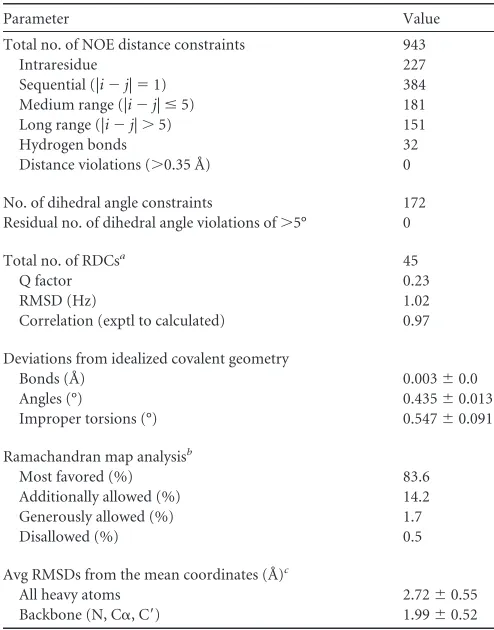
(27). The solution structure was calculated using 943 NOE
re-straints, 45
1D
NH
residual dipolar coupling restraints, and 32
hy-drogen bond restraints for the regions of well-defined structure
(residues 19 to 114) (Table 1). The experimentally derived
resid-ual dipolar coupling restraints are in good agreement with those
back-calculated from the average structure (Table 1; see also Fig.
S2 in the supplemental material).
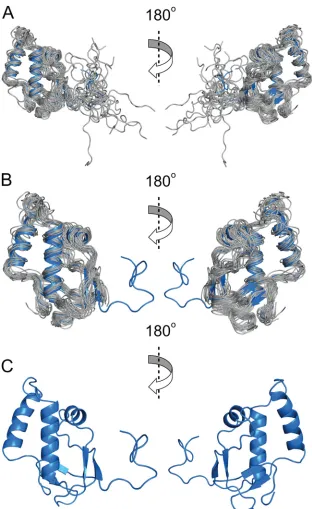
The solution structure of MHV nsp3a is shown in
Fig. 2.
In-spection of the structure reveals a fold composed of three
␣
-heli-ces and four

-strands arranged in the order

1–
␣
1–

2–
␣
2–
␣
3–

3–

4, onto which is appended an N-terminal unstructured
domain (residues 1 to 18). The structure shows some similarity to
a domain of the streptococcal pyogenic exotoxin precursor (PDB
code 1FNU) and an E3 ubiquitin ligase RING2 domain (PDB code
3GS2) (Dali
Z
-scores,
⬇
2.5) but is otherwise unique in the
data-base (45,
46). The highly dynamic nature of the N-terminal region
is consistent with an analysis of the
1H-{
15N}-hNOE values, which
show that this region is characterized by a backbone amide group
mobility significantly faster than that of the folded core of the
molecule (see Fig. S3 in the supplemental material). The core
structure of MHV nsp3a adopts a conformation similar but not
identical to the known solution structure of SARS-CoV nsp3a
(44), which has a root mean square deviation (RMSD) of
⬇
3.7 Å
(Dali
Z
-score, 4.8) (excluding the N-terminal domain) between
the C
␣
atoms relative to the average structure of MHV nsp3a (Fig.
3). The largest difference between the MHV and SARS-CoV nsp3a
structures lies in the
␣
3 helical region. In MHV, this region forms
a single, continuous helix, whereas in SARS-CoV nsp3a, this
re-gion forms two short, disjointed helices (
␣
3 and
␣
4 in Fig. S4 in
the supplemental material). This difference in secondary structure
was apparent even at early stages in the structural analysis from a
TALOS
⫹
prediction (see Fig. S4).
The SR-rich region of MHV N protein is essential for
high-affinity binding to MHV nsp3a.
With the solution structure in
hand, we next used isothermal titration calorimetry (ITC) to
de-termine whether MHV nsp3a and N interact physically and, if so,
to measure the affinity and energetics of the interaction directly. A
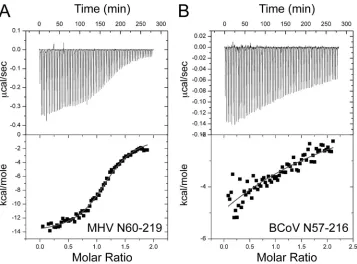
representative binding isotherm is shown in
Fig. 4a
and is well
modeled by a single class of
n
binding sites, subject to the caveat
that solubility limits precluded investigation of nsp3a/N protein
molar ratios exceeding
⬇
2:1 under these conditions (see Materials
and Methods). MHV N219 (residues 60 to 219) binds MHV nsp3a
with 1:1 stoichiometry (
n
, 1.2
⫾
0.2 in multiple experiments) and
with high affinity (equilibrium association constant [
K
a], [1.4
⫾
0.3]
⫻
10
6M
⫺1) (Fig. 4A;
Table 2). The binding is strongly
enthal-pically driven (
⌬
H
cal,
⫺
13.0
⫾
0.6 kcal mol
⫺1, where
⌬
H
calis the
calorimetric
⌬
H
value) and is opposed by entropy (Table 2). In
strong contrast, but in agreement with the genetic results (17), the
noncognate BCoV NTD (residues 57 to 216) binds MHV nsp3a
weakly, with very low heats of binding and with an affinity too low
to measure by direct titration (
K
a,
ⱕ
5.3
⫻
10
3M
⫺1) under the
same solution conditions (Fig. 4B;
Table 2).
[image:5.585.297.544.85.400.2]Next, we used a domain addition/deletion strategy for MHV N
in order to identify major determinants of this interaction. All
CoV N proteins contain a highly divergent N-terminal region
(residues 1 to 59 in MHV) of unknown function. The affinity of
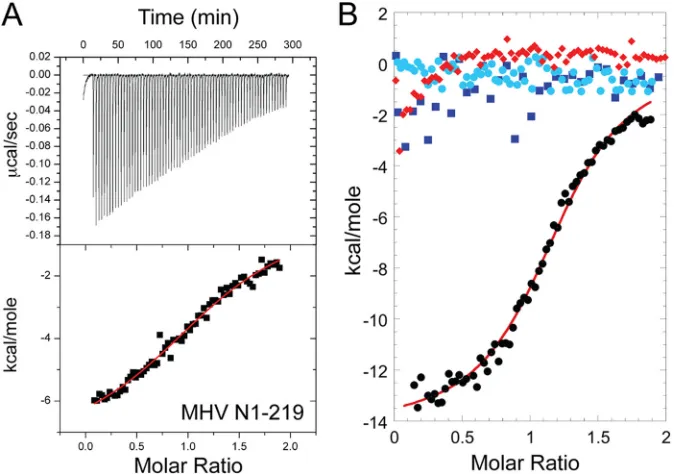
MHV N1-219 for cognate MHV nsp3a (
K
a, [1.7
⫾
0.2]
⫻
10
5M
⫺1) (Fig. 5A;
Table 2) is
⬇
8-fold lower than that of N219, with a
TABLE 1NMR structural statistics for MHV nsp3a (20 final lowest-energy structures)Parameter Value
Total no. of NOE distance constraints 943
Intraresidue 227
Sequential (|i⫺j|⫽1) 384 Medium range (|i⫺j|ⱕ5) 181 Long range (|i⫺j|⬎5) 151
Hydrogen bonds 32
Distance violations (⬎0.35 Å) 0
No. of dihedral angle constraints 172 Residual no. of dihedral angle violations of⬎5° 0
Total no. of RDCsa 45
Q factor 0.23
RMSD (Hz) 1.02
Correlation (exptl to calculated) 0.97
Deviations from idealized covalent geometry
Bonds (Å) 0.003⫾0.0
Angles (°) 0.435⫾0.013 Improper torsions (°) 0.547⫾0.091
Ramachandran map analysisb
Most favored (%) 83.6 Additionally allowed (%) 14.2 Generously allowed (%) 1.7
Disallowed (%) 0.5
Avg RMSDs from the mean coordinates (Å)c
All heavy atoms 2.72⫾0.55 Backbone (N, C␣, C=) 1.99⫾0.52 aBackbone1DNHresidual dipolar couplings were analyzed with the REDCAT program.
The values of the axial component (Da) and rhombicity (Dr) for MHV nsp3a in 8% stretched polyacrylamide gels were found to be⫺3.3 Hz and 0.33, respectively.
b
The ensemble structures between residues 19 and 114 were analyzed by using PROCHECK-NMR.
c
Coordinate precision was calculated by comparing individual structures of the bundle with the mean coordinates by best-fitting residues in the structured region (residues 19 to 114).
on November 7, 2019 by guest
http://jvi.asm.org/
significant alteration in the underlying energetics (
⌬
H
calis
ap-proximately half that of N219) (Fig. 6). Next, we used MHV N197
(residues 60 to 197) to determine the extent to which the SR-rich
region of N219 was required to maintain a high-affinity
interac-tion. Under these solution conditions, N197 exhibited no
measur-able net heat of binding to MHV nsp3a (Fig. 5B;
Table 2). An
identical titration carried out at 30.0°C also showed no observable
heat (data not shown). Although a significant limitation of ITC is
that a binding process which occurs with no net change in heat
(
⌬
H
cal⫽
0) cannot be taken as evidence of no binding (
K
a,
ⱕ
10
4M
⫺1under these experimental conditions), this is the simplest
interpretation of this experiment, particularly given the large heat
of binding observed with N219 (Fig. 4A).
We also examined the ability of the CTD dimer to bind MHV
nsp3a, and as found for N197 (residues 60 to 197), the CTD dimer
also shows no measurable evolved heat under these experimental
FIG 2Three ribbon representation views of the solution structure of MHV nsp3a. (A) Ensemble of the 20 lowest-energy structural models (gray), aligned to the average structure (blue). (B) Ensemble of the 20 lowest-energy structural models (gray), shown without the N-terminal unstructured residues (residues 1 to 18) for clarity, superimposed on the average structure (blue) in cartoon format. (C) Average NMR structure of MHV nsp3a.on November 7, 2019 by guest
http://jvi.asm.org/
[image:6.585.135.447.63.572.2]conditions (Fig. 5B). Taken together, these data provide strong
evidence that the SR-rich region of N is essential for mediating a
high-affinity interaction with MHV nsp3a, an observation
consis-tent with the localization of the recovered viral revertants
exclu-sively to the SR-rich region of N, with none found within either
the folded NTD or the CTD of N (Fig. 1) (17).
Coronavirus N is an RNA-binding protein that makes a
high-affinity complex with the transcriptional regulatory sequence
(TRS) RNA, the determinants of which we have mapped in detail
(18,
19). We therefore performed direct titration of MHV nsp3a
into an N219 –TRS complex. This titration also evolved no
signif-icant net heat (Fig. 5B). This suggests, again subject to the
limita-tions of the ITC experiment, that MHV N219 –nsp3a complex
formation is inhibited by bound RNA and that the binding of
MHV nsp3a and TRS RNA to N219 may be mutually exclusive.
The fact that TRS RNA seems to outcompete MHV nsp3a is
con-sistent with their relative affinities (
K
a, 10
8M
⫺1for TRS RNA [18,
19] versus 10
6M
⫺1for MHV nsp3a). These results are
qualita-tively consistent with prior findings (17) showing that the ability
to coprecipitate intact N protein bound to an MHV nsp3a–GST
fusion protein (using MHV nsp3a containing the immediately
adjacent C-terminal acidic region, residues 1 to 273) in an
infect-ed-cell lysate was enhanced by pretreatment with RNase A. This
suggests that the MHV N–nsp3a interaction in cells is not strictly
dependent on RNA, and binding of a high-affinity RNA TRS may
well inhibit this protein-protein interaction (17).
The MHV SR-linker peptide forms a complex with MHV
nsp3a and binds to the central, acidic
␣
2 helix.
Given the
impor-FIG 3Average solution structure of MHV nsp3a (PDB code 2M0I) (blue) superimposed on that of SARS-CoV nsp3a (PDB code 2GRI) (orange) (44).FIG 4Representative ITC titrations of MHV nsp3a (200M) into the MHV (20M) (A) or BCoV (20M) (B) NTD in 0.15 M K⫹–5 mM TCEP (pH 6.0). The curve in the lower graph of each panel indicates the best fit defined by a single-site binding model. Note that with the BCoV NTD, the low observed heat of binding and the lack of saturation under these conditions preclude quantitative analysis of the data beyond an estimate of⌬H. SeeTable 2for fitted parameters derived from the analysis of three independent experiments (and see Materials and Methods).
on November 7, 2019 by guest
http://jvi.asm.org/
[image:7.585.139.449.67.212.2] [image:7.585.114.471.421.685.2]tance of the SR-rich region of N for mediating the interaction with
MHV nsp3a, it was of interest to determine whether the SR-rich
region was both necessary and sufficient for this interaction.
Titra-tion of MHV nsp3a into a soluTitra-tion containing a 33-residue
pep-tide corresponding to the entire SR-rich region in MHV N
(resi-dues 198 to 230) showed no observable heat change by ITC (data
not shown), consistent with significantly weaker binding (
ⱕ
10
4M
⫺1) or vastly different energetics, e.g., smaller
⌬
H
cal
, relative to
intact N219. To further investigate this interaction, titration of the
same SR-linker peptide into
15N-labeled MHV nsp3a was
moni-tored by
1H,
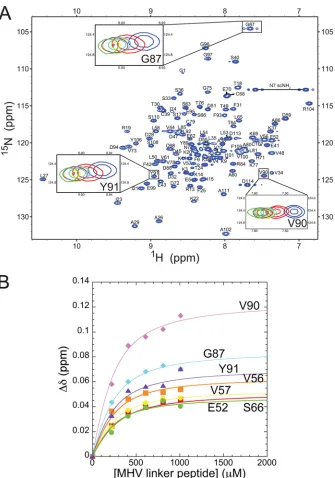
15N NMR spectroscopy (Fig. 7A). The change in the
chemical shift for select resonances as a function of increasing
peptide concentration was fit to a single-site binding model using
a global analysis (Fig. 7B). The affinity of MHV nsp3a for the
MHV SR-linker peptide was determined to be (8.1
⫾
0.3)
⫻
10
3M
⫺1, consistent with the fast chemical exchange observed
be-tween the free and bound components (Fig. 7A). Thus, while the
SR-rich region of N is necessary for stabilizing the interaction
between MHV N and MHV nsp3a (Fig. 5B, blue), it is clearly not
sufficient but still accounts for
⬇
60% of the binding free energy
(Table 2). The peptide-induced chemical shift perturbations,
while small in magnitude, map nearly exclusively to the long,
acidic
␣
2 helix on the “front” of MHV (Fig. 8A, left), with few if
any perturbations observed on the “back” side of the molecule
(Fig. 8A, right). This acidic region is electrostatically
complemen-tary to the basic MHV SR-linker peptide (Fig. 8C). Interestingly,
this region is largely the same to which three of the four BCoV
revertant mutations map (E5, T18, A38), with D113 in the
junc-tion region between the folded nsp3a domain and the
immedi-ately adjacent strongly acidic region (Fig. 8D).
[image:8.585.41.549.77.175.2]We also performed an experiment in which
15N-labeled
MHV–nsp3a was titrated with unlabeled, intact N219, in an effort
TABLE 2Binding affinities of CoV N proteins for MHV nsp3aaN protein n ⌬G(kcal mol⫺1)b ⌬H(kcal mol⫺1)b ⫺T⌬S(kcal mol⫺1K⫺1)c K
a(106M⫺1)d Fold decrease
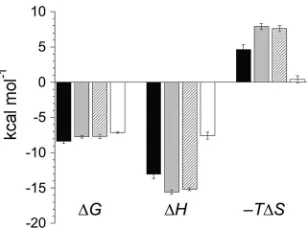
MHV N60-219 (N219) 1.2⫾0.2 ⫺8.4⫾0.3 ⫺13.0⫾0.6 4.6⫾0.7 1.4⫾0.3 —
MHV N60-197 (N197) — — — — ND ND
MHV N1-219 1.3⫾0.2 ⫺7.1⫾0.1 ⫺7.5⫾0.5 0.4⫾0.5 0.17⫾0.02 8
MHV CTD dimer — — — — ND ND
MHV S207D N60-219 1.2⫾0.1 ⫺7.7⫾0.2 ⫺15.6⫾0.3 7.9⫾0.4 0.5⫾0.1 3 MHV S218D N60-219 1.2⫾0.1 ⫺7.6⫾0.3 ⫺15.2⫾0.2 7.6⫾0.4 0.4⫾0.2 3
MHV N60-219⫹TRS RNA — — — — ND ND
BCoV N57-216 1.0e ⱕ⫺5.1 ⫺5.1⫾0.7 ND ⱕ0.0053 ⱖ250
aConditions are as follows: 0.15 M KP
i, 5 mM TCEP, pH 6.0, 25.0°C.n, number of binding sites; ND, not determined; —, no heat observed. b
The errors reported for⌬Gand⌬Hrepresent the SD of the average values ofKaand⌬Hobtained from three independent titrations.
c⫺T⌬Swas obtained from⌬G⫺ ⌬H, and the error in⫺T⌬Swas calculated from the square root of the sum of the squares of the SD in⌬Gand⌬H. d
Kavalues were averaged from multiple ITC titrations and were fit to a model invoking a single class ofnbinding sites, i.e., a single-site binding model.
eParameter value fixed in the analysis; only⌬Hcould be estimated from these experiments.
FIG 5(A) Representative ITC titrations of nsp3a (200M) into MHV N1-219 (20M) in 0.15 M K⫹–5 mM TCEP (pH 6.0). The red curve indicates the best fit defined by a single-site binding model (seeTable 2for fitted parameters). (B) Overlay of representative titrations of MHV nsp3a (200M) into MHV N219 (residues 60 to 219) (20M) (black), MHV N197 (residues 60 to 197) (20M) (blue), the MHV CTD dimer (20M dimer) (light blue), and MHV N219 bound to TRS RNA (20M protein, 25M RNA) (red) in 0.15 M K⫹–5 mM TCEP (pH 6.0).
on November 7, 2019 by guest
http://jvi.asm.org/
[image:8.585.124.463.446.683.2]to investigate the higher-affinity complex by NMR. The resulting
1H,
15N HSQC spectrum shows significant line broadening of
res-onances on both “faces” of MHV nsp3a (Fig. 8B), likely as a result
of intermediate chemical exchange of this micromolar complex
with free components. The only exception to this finding is that
resonances in the N-terminal unstructured region exhibit no line
broadening and therefore are not directly involved in the
interac-tion. These data, taken collectively, might suggest that the core
NTD (residues 60 to 197) wraps around and interacts with the
“back” side (Fig. 8B, right) of nsp3a. Unfortunately, this
hypoth-esis could not be tested directly, due to the poor solubility of both
nsp3a and N197 (18) under these conditions.
MHV nsp3a binds to the N-terminal region of the SR-linker
peptide.
We next examined the interaction of MHV nsp3a and the
MHV SR-linker peptide from the opposite perspective, i.e., by
titrating unlabeled MHV nsp3a into a solution of a
15N- and
13C-labeled SR-linker peptide. To this end, the backbone resonances of
the MHV SR-linker peptide were assigned to 90% completeness
(see Fig. S5 in the supplemental material). The narrow
distribu-tion of amide cross peaks in the
1H dimension of the
1H,
15N
HSQC spectrum of this 33-residue peptide reveals a lack of
de-fined secondary structure in the unbound state. The same is true
of the complex formed upon the addition of a molar excess of
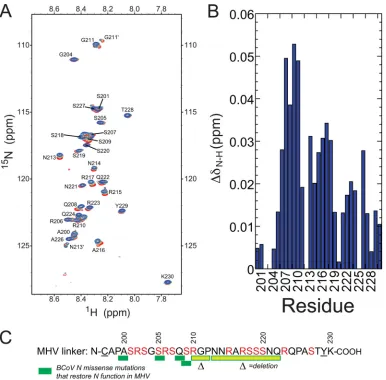
nsp3a, with small but measurable perturbations obtained as a
re-sult (Fig. 9A). The largest of these perturbations localize roughly
to the N-terminal portion of the peptide (residues 206 to 211),
with measurable perturbations through residue 218 in the linear
sequence (Fig. 9C). Interestingly, it is this region in BCoV N to
which missense mutations that restore N function map (17).
Single phosphomimetic substitutions in MHV N60-219 do
not strongly disrupt binding to nsp3a.
Given the electrostatic
complementarity of the two interacting interfaces mapped on
nsp3a and N219, serine phosphorylation in this region might be
anticipated to disrupt complex formation. CoV N is known to be
a phosphoprotein
in vivo
, and a number of phosphorylation sites
in the NTDs and CTDs of MHV, infectious bronchitis virus (IBV),
and transmissible gastroenteritis coronavirus (TGEV) have now
been mapped using mass spectrometry (47–51). Of particular
in-terest are putative phosphorylation sites within the MHV SR-rich
region, which may have been largely missed in previous analyses
(47–49); in fact, it is this region of MHV N that is most likely to be
phosphorylated on the basis of predictions made by NetPhos 2.0
(see Fig. S6 in the supplemental material) (52). While the role that
phosphorylation of N plays in CoVs is not well understood at
present, it has been proposed that phosphorylation of N may
reg-ulate the switch between viral replication and transcription or
viral recognition and genomic RNA packaging (47–49,
53,
54).
In an initial effort to examine the effect of phosphorylation on
this interaction, two phosphomimetic substitutions, each
con-taining a single serine-to-aspartic acid substitution (S207D and
S218D), were selected and tested. While these specific
phosphor-ylation sites have not been identified in MHV N, both S207 and
S218 are predicted by NetPhos 2.0 to be phosphorylated (see Fig.
S6 in the supplemental material) (52) and are contained in the
primary region of chemical shift perturbation induced by nsp3a
binding (Fig. 9). ITC-derived binding experiments reveal that
both the S207D and S218D forms of N219 bind to MHV nsp3a
with high affinity, although the binding is detectably weaker (
⬇
3-fold) than that of wild-type N219 (Table 2; see also Fig. S7 in the
supplemental material).
DISCUSSION
CoV N has long been implicated as playing an important role in
both viral replication and transcription, although the molecular
details, beyond a role in TRS RNA and genomic RNA binding, are
not well defined (12,
13,
55–57). Masters and coworkers recently
identified a genetic interaction between MHV N and a subunit of
the viral replicase, nsp3 (17). This is the first demonstration of a
suspected interaction of an RTC protein with MHV N, which
results in stimulation of viral replication in cultured cells at early
time points in infection and may derive from the ability of N to
deliver the gRNA template to the RTC (17). In this work, we show
that MHV N and nsp3a (the N-terminal domain of MHV nsp3)
do indeed interact physically, and we have mapped the binding
determinants and interfacial regions on each protein partner.
The MHV N–nsp3a interaction, while likely characterized by
electrostatic complementarity, is not simply the result of favorable
electrostatic interactions. Two lines of evidence support this. First,
the folded domain of MHV N (N197; residues 60 to 197) (17),
which itself is very basic, shows no measurable heat of binding to
MHV nsp3a as measured by ITC. Additionally, the dimeric CTD
of MHV is also quite basic but, like N197, shows no apparent
measurable affinity for MHV nsp3a. These findings support the
notion that there are specific features of the SR-rich linker region
in MHV N that mediate the physical association between MHV N
and MHV nsp3a. These results are also consistent with the
chem-ical shift perturbation analyses, which reveal that the SR-rich
re-gion of N immediately proximate to the folded core NTD (18) is a
primary site of interaction on the acidic face of folded MHV nsp3a
(Fig. 8). Interestingly, it is this SR-rich region of MHV N that is
most strongly divergent from that of BCoV N, in agreement with
the observation that substitution of BCoV N for MHV N
in vivo
results in a severely crippled virus, as well as our finding that the
BCoV NTD does not interact with the noncognate MHV nsp3a
(17).
The strong electrostatic complementarity in this complex
fur-ther suggests that reversible phosphorylation of one or more
ser-ine residues in the SR-rich region primarily defser-ined by residues
201 to 220 (Fig. 9) might modulate the affinity of the MHV
N–nsp3a interaction. However, our data suggest that multiple
phosphorylation events within this region of MHV N may be
necessary to regulate MHV nsp3a binding; alternatively, single
FIG 6Thermodynamic summary of MHV NTD–MHV nsp3a bindingequi-libria. Shown is a graphic comparison of the enthalpic (⌬H) and entropic (⫺T⌬S) components of the free energy (⌬G) for the binding of MHV nsp3a to MHV N60-219 (filled bars), MHV S207D N60-219 (stippled bars), MHV S218D N60-219 (diagonally striped bars), and MHV N1-219 (open bars). Data are fromTable 2.
on November 7, 2019 by guest
http://jvi.asm.org/
[image:9.585.87.241.66.180.2]residues other than S207 and S218, tested her,e may be stronger
modulators of the affinity. In this regard, it is interesting that all
wild-type-like recovered viral revertants from extensive passage of
the BCoV
N-MHV chimeric viruses (see
Fig. 1) introduce at least
one additional positively charged and/or bulky hydrophobic
res-idue into either side of the MHV N–nsp3a interface, each of which
might be expected to stabilize this protein-protein interaction.
Other revertants simply result in the deletion of the entire
down-stream region in BCoV, which is rich in Ser residues not found in
MHV N. Further inspection (Fig. 1) reveals that 9 out of 14
se-quenced missense revertants introduce a bulky hydrophobic
res-idue in place of Ser resres-idues corresponding to S205 and S209 in the
MHV sequence; this suggests that these sites, which are predicted
phosphorylation sites (see Fig. S6 in the supplemental material),
could be targeted individually or in combination for substitution
and elucidation of any functional role. In any case, it seems likely
that the SR-rich region of N is highly phosphorylated, as found in
other viral systems, but this remains to be unambiguously
estab-FIG 7Titration of the unlabeled SR-linker peptide into15N-labeled nsp3a. (A)1H,15N HSQC spectrum of MHV nsp3a (acquired at 600 MHz) highlightingselected chemical shift perturbations upon the addition of increasing amounts of the SR-linker peptide. Perturbations of only three residues are shown for clarity. Different points in the titration are color coded to indicate the molar ratio of nsp3a to the SR-linker peptide as follows: blue, 1:0; red, 1:1; cyan, 1:2; yellow, 1:3; purple, 1:4; green, 1:5. (B) Global binding analysis of the titration of the SR-linker peptide into nsp3a. The change in the chemical shift (⌬␦ppm) is plotted as a function of the SR-linker peptide concentration and is calculated as [(⌬ppm1H)2⫹(⌬ppm15N/7)2]1/2. Continuous lines through the data are the results of a
global nonlinear least-squares fit to a 1:1 binding model.
on November 7, 2019 by guest
http://jvi.asm.org/
[image:10.585.126.461.63.541.2]FIG 8(A) Chemical shift perturbations resulting from the addition of saturating concentrations of the MHV SR-linker peptide to MHV nsp3a. Perturbations (⌬␦ppm) are painted on the average structure of MHV nsp3a in colors ranging from yellow to red. Proline residues are shown as white, while residues with no information are shown as gray. (B) Line broadening that results from the addition of unlabeled MHV N60-219 to15N-labeled MHV nsp3a (molar ratio, 1:1). This
complex is in intermediate chemical exchange, which results in a loss of peak intensity rather than a change in chemical shift perturbations. The log of peak intensity is painted on the model in colors ranging from blue (most broadened) to green (no broadening). Proline residues are shown as white. (C) Electrostatic potential map of MHV nsp3a. The “front” face is largely acidic, and this is the region where the highly basic MHV SR-linker binds. The same views are presented in panels A, B, and C. (D) Ribbon representation of the MHV nsp3a structure, with residues in MHV nsp3a that are altered in wild-type-like viruses recovered from passage of the severely crippled BCoVN-MHV chimeric viruses shown in surface representation (17).
on November 7, 2019 by guest
http://jvi.asm.org/
[image:11.585.120.458.69.646.2]lished in MHV (58–60). It is noteworthy that this region of N also
plays a significant electrostatic role in N–TRS RNA interactions
(18); this suggests that TRS RNA binding and nsp3a binding
might be mutually exclusive on N219 (Fig. 5). Such a mechanism
would likely not prevent an interaction of genomic RNA with the
CTD simultaneously with an NTD–nsp3a interaction (17), but
this remains to be tested.
Finally, our findings point to a potential negative regulatory
role of the highly divergent N-terminal domain in controlling the
stability of the MHV N–nsp3a interaction (Fig. 5
and
6). Although
the function of this domain is not known for any CoV N, an early
RNA recombination experiment suggested that the N-terminal
domains of BCoV and MHV were not functionally
interchange-able (61). One might therefore speculate that a direct interaction
of this domain with another MHV protein or membrane lipid
associated with the RTC would relieve the intermolecular
inhibi-tion of MHV N–nsp3a complex formainhibi-tion. Although it is not
possible to pinpoint a structural explanation for the large change
in the underlying energetics in the absence of additional
informa-tion on linkage to potential protonainforma-tion-deprotonainforma-tion equilibria
or other solvent effects, a decreased
⌬
H
and an entropy of binding
close to zero (
⌬
H
⬇ ⌬
G
) (Fig. 6;
Table 2) might suggest that this
domain interacts weakly and transiently with another region
within MHV N219, perhaps the SR-rich region itself. In the
ab-sence of a binding partner, MHV nsp3a would have to disrupt
these interactions, thereby contributing unfavorably to complex
formation. Previous studies reveal that this domain is
conforma-tionally unstructured in the free N protein and plays no role in N
NTD-RNA interactions (19).
The original genetic mapping of the physical interaction
be-tween MHV N and MHV nsp3a provided evidence to suggest that
the SR-rich linker domain of N is involved directly in stimulation
of the initiation of the infectivity of gRNA early in the infection
process, via assembly of a genomic RNA–N complex that must be
brought to the replicase to initiate both RNA replication and
sgRNA transcription from the 3
=
end of the genome (17). It is not
known how reversible phosphorylation might regulate this
activ-ity. Studies to test these ideas are in progress, as are efforts to
FIG 9(A)1H,15N HSQC spectrum of the MHV SR-linker peptide, free and in the presence of increasing concentrations of unlabeled MHV nsp3a. Differentpoints in the titration are color coded to represent the molar ratio of nsp3a to the SR-linker peptide as follows: red, 1:0; orange, 1:1; cyan, 1:2; blue, 1:5. (B) Perturbation map of backbone amides of the MHV SR-linker peptide upon the addition of MHV nsp3a. (C) Sequence of the SR-linker peptide used in this study. Underlined residues are nonnative to MHV N. The missense and deletion mutations recovered in the BCoV N coding sequence in multiply passaged wild-type-like BCoVN-MHV chimeric viruses are illustrated schematically (17).
on November 7, 2019 by guest
http://jvi.asm.org/
[image:12.585.101.487.65.445.2]positively identify sites of phosphorylation in the MHV N SR-rich
region in virion particles versus infected cells (48). Our previous
studies of the core domain of N (NTD, residues 60 to 197) suggest
a critical role in subgenomic RNA transcription attributed to the
TRS RNA binding and helix destabilization activities of N, defects
in which also become strongly manifest in an gRNA infectivity
assay (18,
19). Each of these functions of N is enhanced by the
presence of the immediately adjacent SR-rich region (18,
19). It is
therefore of interest to dissect how these activities of N are
coor-dinated with one another in the context of replicase-transcription
complexes.
ACKNOWLEDGMENTS
This work was supported by a grant from the NIH to D.P.G. and J. L. Leibowitz, Texas A&M University (AI067416).
We thank J. L. Leibowitz for comments on the manuscript.
REFERENCES
1.Du L, He Y, Zhou Y, Liu S, Zheng B-J, Jiang S.2009. The spike protein of SARS-CoV—a target for vaccine and therapeutic development. Nat. Rev. Microbiol.7:226 –236.
2.Stadler K, Masignani V, Eickmann M, Becker S, Abrignani S, Klenk HD, Rappuoli R.2003. SARS— beginning to understand a new virus. Nat. Rev. Microbiol.1:209 –218.
3.Quan PL, Firth C, Street C, Henriquez JA, Petrosov A, Tashmukhame-dova A, Hutchison SK, Egholm M, Osinubi MO, Niezgoda M, Ogunkoya AB, Briese T, Rupprecht CE, Lipkin WI.2010. Identification of a severe acute respiratory syndrome coronavirus-like virus in a leaf-nosed bat in Nigeria. mBio1(4):e00208 –10. doi:10.1128/mBio.00208-10. 4.Corman V, Eckerle I, Bleicker T, Zaki A, Landt O, Eschbach-Bludau M, van Boheemen S, Gopal R, Ballhause M, Bestebroer T, Muth D, Muller M, Drexler J, Zambon M, Osterhaus A, Fouchier R, Drosten C.2012. Detection of a novel human coronavirus by real-time reverse-transcription polymerase chain reaction. Euro Surveill. 17(39):20285.
http://www.eurosurveillance.org/ViewArticle.aspx?ArticleId⫽20285. 5.Snijder EJ, Bredenbeek PJ, Dobbe JC, Thiel V, Ziebuhr J, Poon LL,
Guan Y, Rozanov M, Spaan WJ, Gorbalenya AE.2003. Unique and conserved features of genome and proteome of SARS-coronavirus, an early split-off from the coronavirus group 2 lineage. J. Mol. Biol.331:991– 1004.
6.Brierley I, Boursnell ME, Binns MM, Bilimoria B, Blok VC, Brown TD, Inglis SC.1987. An efficient ribosomal frame-shifting signal in the poly-merase-encoding region of the coronavirus IBV. EMBO J.6:3779 –3785. 7.Stammler SN, Cao S, Chen SJ, Giedroc DP. 2011. A conserved RNA
pseudoknot in a putative molecular switch domain of the 3=-untranslated region of coronaviruses is only marginally stable. RNA17:1747–1759. 8.Zust R, Miller TB, Goebel SJ, Thiel V, Masters PS. 2008. Genetic
interactions between an essential 3=cis-acting RNA pseudoknot, replicase gene products, and the extreme 3=end of the mouse coronavirus genome. J. Virol.82:1214 –1228.
9.Liu P, Li L, Millership JJ, Kang H, Leibowitz JL, Giedroc DP.2007. A U-turn motif-containing stem-loop in the coronavirus 5=untranslated region plays a functional role in replication. RNA13:763–780.
10. Li L, Kang H, Liu P, Makkinje N, Williamson ST, Leibowitz JL, Giedroc DP.2008. Structural lability in stem-loop 1 drives a 5=UTR-3=UTR in-teraction in coronavirus replication. J. Mol. Biol.377:790 – 803. 11. Lee CW, Li L, Giedroc DP.2011. The solution structure of coronaviral
stem-loop 2 (SL2) reveals a canonical CUYG tetraloop fold. FEBS Lett. 585:1049 –1053.
12. Compton SR, Rogers DB, Holmes KV, Fertsch D, Remenick J, McGowan JJ.1987. In vitro replication of mouse hepatitis virus strain A59. J. Virol.61:1814 –1820.
13. Schelle B, Karl N, Ludewig B, Siddell SG, Thiel V. 2005. Selective replication of coronavirus genomes that express nucleocapsid protein. J. Virol.79:6620 – 6630.
14. Denison MR, Spaan WJ, van der Meer Y, Gibson CA, Sims AC, Prentice E, Lu XT.1999. The putative helicase of the coronavirus mouse hepatitis virus is processed from the replicase gene polyprotein and localizes in complexes that are active in viral RNA synthesis. J. Virol.73:6862– 6871.
15. van der Meer Y, Snijder EJ, Dobbe JC, Schleich S, Denison MR, Spaan WJ, Locker JK.1999. Localization of mouse hepatitis virus nonstructural proteins and RNA synthesis indicates a role for late endosomes in viral replication. J. Virol.73:7641–7657.
16. Verheije MH, Hagemeijer MC, Ulasli M, Reggiori F, Rottier PJ, Masters PS, de Haan CA.2010. The coronavirus nucleocapsid protein is dynam-ically associated with the replication-transcription complexes. J. Virol. 84:11575–11579.
17. Hurst KR, Ye R, Goebel SJ, Jayaraman P, Masters PS.2010. An inter-action between the nucleocapsid protein and a component of the repli-case-transcriptase complex is crucial for the infectivity of coronavirus genomic RNA. J. Virol.84:10276 –10288.
18. Grossoehme NE, Li L, Keane SC, Liu P, Dann CE, III, Leibowitz JL, Giedroc DP.2009. Coronavirus N protein N-terminal domain (NTD) specifically binds the transcriptional regulatory sequence (TRS) and melts TRS-cTRS RNA duplexes. J. Mol. Biol.394:544 –557.
19. Keane SC, Liu P, Leibowitz JL, Giedroc DP.2012. Functional transcrip-tional regulatory sequence (TRS) RNA binding and helix destabilizing determinants of murine hepatitis virus (MHV) nucleocapsid (N) protein. J. Biol. Chem.287:7063–7073.
20. Stump WT, Hall KB.1993. SP6 RNA polymerase efficiently synthesizes RNA from short double-stranded DNA templates. Nucleic Acids Res.21: 5480 –5484.
21. MicroCal.2002. MicroCalorimeter user’s manual. MicroCal, Northamp-ton, MA.
22. Markley JL, Bax A, Arata Y, Hilbers CW, Kaptein R, Sykes BD, Wright PE, Wuthrich K.1998. Recommendations for the presentation of NMR structures of proteins and nucleic acids. J. Mol. Biol.280:933–952. 23. Delaglio F, Grzesiek S, Vuister GW, Zhu G, Pfeifer J, Bax A.1995.
NMRPipe: a multidimensional spectral processing system based on UNIX pipes. J. Biomol. NMR6:277–293.
24. Goddard TD, Kneller DG.Sparky 3. University of California, San Fran-cisco, CA.
25. Farrow NA, Muhandiram R, Singer AU, Pascal SM, Kay CM, Gish G, Shoelson SE, Pawson T, Forman-Kay JD, Kay LE. 1994. Backbone dynamics of a free and a phosphopeptide-complexed Src homology 2 domain studied by15N NMR relaxation. Biochemistry33:5984 – 6003.
26. Kuzmic P.1996. Program DYNAFIT for the analysis of enzyme kinetic data: application to HIV proteinase. Anal. Biochem.237:260 –273. 27. Keane SC, Giedroc DP.8 November 2012.1H,13C,15N resonance
assign-ments of murine hepatitis virus nonstructural protein 3a. Biomol. NMR Assign. [Epub ahead of print.] doi:10.1007/s12104-012-9443-5. 28. Ottiger M, Delaglio F, Bax A.1998. Measurement of J. and dipolar
couplings from simplified two-dimensional NMR spectra. J. Magn. Reson.131:373–378.
29. Guntert P.2004. Automated NMR structure calculation with CYANA. Methods Mol. Biol.278:353–378.
30. Schwieters CD, Kuszewski JJ, Tjandra N, Clore GM.2003. The Xplor-NIH NMR molecular structure determination package. J. Magn. Reson. 160:65–73.
31. Valafar H, Prestegard JH.2004. REDCAT: a residual dipolar coupling analysis tool. J. Magn. Reson.167:228 –241.
32. Kupce E, Freeman R. 2003. Projection-reconstruction of three-dimensional NMR spectra. J. Am. Chem. Soc.125:13958 –13959. 33. Kupce E, Freeman R. 2004. Projection-reconstruction technique for
speeding up multidimensional NMR spectroscopy. J. Am. Chem. Soc. 126:6429 – 6440.
34. Schanda P, Van Melckebeke H, Brutscher B.2006. Speeding up three-dimensional protein NMR experiments to a few minutes. J. Am. Chem. Soc.128:9042–9043.
35. Lescop E, Schanda P, Brutscher B.2007. A set of BEST triple-resonance experiments for time-optimized protein resonance assignment. J. Magn. Reson.187:163–169.
36. Lescop E, Rasia R, Brutscher B.2008. Hadamard amino-acid-type edited NMR experiment for fast protein resonance assignment. J. Am. Chem. Soc.130:5014 –5015.
37. Grzesiek S, Bax A.1993. Amino acid type determination in the sequential assignment procedure of uniformly13C/15N-enriched proteins. J. Biomol.
NMR3:185–204.
38. Grzesiek S, Anglister J, Bax A.1993. Correlation of backbone amide and aliphatic side-chain resonances in13C/15N-enriched proteins by isotropic
mixing of13C magnetization. J. Magn. Reson. Series B101:114 –119.
39. Montelione GT, Lyons BA, Emerson SD, Tashiro M.1992. An efficient
on November 7, 2019 by guest
http://jvi.asm.org/
triple resonance experiment using carbon-13 isotropic mixing for deter-mining sequence-specific resonance assignments of isotopically-enriched proteins. J. Am. Chem. Soc.114:10974 –10975.
40. Bax AD, Clore GM, Driscoll PC, Gronenborn AM, Ikura M, Kay LE. 1990. Practical aspects of proton-carbon-carbon-proton three-dimensional correlation spectroscopy of13C-labeled proteins. J. Magn.
Reson.87:620 – 627.
41. Kay LE, Ikura M, Bax A.1990. Proton-proton correlation via carbon-carbon couplings: a three-dimensional NMR approach for the assignment of aliphatic resonances in proteins labeled with carbon-13. J. Am. Chem. Soc.112:888 – 889.
42. Ikura M, Kay LE, Bax A.1991. Improved three-dimensional1H-13C-1H
correlation spectroscopy of13C-labeled protein using constant-time
evo-lution. J. Biomol. NMR1:299 –304.
43. Bax A, Clore GM, Gronenborn AM.1990.1H-1H correlation via
isotro-pic mixing of13C magnetization, a new three-dimensional approach for
assigning1H and13C spectra of13C-enriched proteins. J. Magn. Reson.
88:425– 431.
44. Serrano P, Johnson MA, Almeida MS, Horst R, Herrmann T, Joseph JS, Neuman BW, Subramanian V, Saikatendu KS, Buchmeier MJ, Stevens RC, Kuhn P, Wuthrich K.2007. Nuclear magnetic resonance structure of the N-terminal domain of nonstructural protein 3 from the severe acute respiratory syndrome coronavirus. J. Virol.81:12049 –12060.
45. Earhart CA, Vath GM, Roggiani M, Schlievert PM, Ohlendorf DH. 2000. Structure of streptococcal pyrogenic exotoxin A reveals a novel metal cluster. Protein Sci.9:1847–1851.
46. Wang R, Taylor AB, Leal BZ, Chadwell LV, Ilangovan U, Robinson AK, Schirf V, Hart PJ, Lafer EM, Demeler B, Hinck AP, McEwen DG, Kim CA.2010. Polycomb group targeting through different binding partners of RING1B C-terminal domain. Structure18:966 –975.
47. Calvo E, Escors D, Lopez JA, Gonzalez JM, Alvarez A, Arza E, Enjuanes L.2005. Phosphorylation and subcellular localization of transmissible gastroenteritis virus nucleocapsid protein in infected cells. J. Gen. Virol. 86:2255–2267.
48. White TC, Yi Z, Hogue BG.2007. Identification of mouse hepatitis coronavirus A59 nucleocapsid protein phosphorylation sites. Virus Res. 126:139 –148.
49. Chen H, Gill A, Dove BK, Emmett SR, Kemp CF, Ritchie MA, Dee M, Hiscox JA.2005. Mass spectroscopic characterization of the coronavirus
infectious bronchitis virus nucleoprotein and elucidation of the role of phosphorylation in RNA binding by using surface plasmon resonance. J. Virol.79:1164 –1179.
50. Siddell SG, Barthel AA, ter Meulen V.1981. Coronavirus JHM: a virion-associated protein kinase. J. Gen. Virol.52:235–243.
51. Stohlman SA, Lai MMC. 1979. Phosphoproteins of murine hepatitis viruses. J. Virol.32:672– 675.
52. Blom N, Gammeltoft S, Brunak S.1999. Sequence and structure-based prediction of eukaryotic protein phosphorylation sites. J. Mol. Biol.294: 1351–1362.
53. Stohlman SA, Fleming JO, Patton CD, Lai MM.1983. Synthesis and subcellular localization of the murine coronavirus nucleocapsid protein. Virology130:527–532.
54. Masters PS.2006. The molecular biology of coronaviruses. Adv. Virus Res.66:193–292.
55. Baric RS, Nelson GW, Fleming JO, Deans RJ, Keck JG, Casteel N, Stohlman SA.1988. Interactions between coronavirus nucleocapsid pro-tein and viral RNAs: implications for viral transcription. J. Virol.62:4280 – 4287.
56. Stohlman SA, Baric RS, Nelson GN, Soe LH, Welter LM, Deans RJ. 1988. Specific interaction between coronavirus leader RNA and nucleo-capsid protein. J. Virol.62:4288 – 4295.
57. Choi KS, Huang P, Lai MM.2002. Polypyrimidine-tract-bindin