DECLARATION
“I hereby declare that I have read this thesis and in my opinion this thesis is sufficient in term of scope and quality for the award of the Degree of Technology Management (High
Technology Marketing)”
ANALYZING MALACCA CITIZEN SATISFACTION BASED ON SERVQUAL MODEL: A STUDY ON UTC MALACCA
MOHAMED SOLEHUDDIN BIN MOHD NOOR
A project report submitted in fulfillment of the requirement for the award of Bachelor Technology Management (High Technology Marketing)
Faculty of Technology Management and Technopreneurship (FPTT) UNIVERSITI TEKNIKAL MALAYSIA MELAKA
ii
DECLARATION
“I declare that thesis entitle “Analyzing Malacca Citizen Satisfaction Based On SERVQUAL Model: A Study in UTC Malacca” is the result of my own research except
as cited in the references”
Signature :……….
iii
DEDICATION
iv
ACKNOWLEDGEMENT
v
ABSTRACT
vi
ABSTRAK
vii
TABLE OF CONTENTS
TITLE PAGE
DECLARATION ii
DEDICATION iii
ACKNOWLEDGEMENT iv
ABSTRACT v
ABSTRAK vi
TABLE OF CONTENTS vii
LIST OF TABLES xi
LIST OF FIGURES xii
NOMENCLATURE xiii
CHAPTER 1. INTRODUCTION 1.1Introduction 1
1.2Research Question 3
1.3Research Objective 3
1.4Scope 4
1.5Limitation 4
1.6Importance of study 5
viii
2. LITERATURE REVIEW
2.1Introduction 6
2.2Customer Satisfaction Theory 7
2.2.1 Customer Satisfaction Measurement Process 9
2.3SERVQUAL Model 10
2.4 One Stop Government 11
2.5 UTC Malacca 12
2.6The Theoretical Framework 15
2.7Summary 17
3. RESEARCH METHOD 3.1Introduction 18
3.2Research Design 19
3.2.1 Descriptive Research Design 19
3.3Research Design Method 20
3.3.1 Quantitative Research Method 20
3.4Primary and Secondary data source 21
3.4.1 Primary Data 21
3.4.2 Secondary Data 22
3.5Location of research 22
3.6Research Strategy 22
3.6.1 Survey Strategy 23
3.7Scientific Canons 23
3.7.1 Reliability 23
3.7.2 Construct Validity 24
3.7.3 Internal Validity 24
3.7.4 External Validity 24
3.8 Pilot Study 25
ix
3.10 Data analysis method 26
3.11 Summary 26
4. RESULT AND ANALYSIS 4.1 Introduction 27
4.2 Demography analysis 28
4.2.1 Gender 28
4.2.2 Age 29
4.2.3 Occupation 30
4.2.4 Educational Background 31
4.3 Percentages of satisfaction among respondents based on SERVQUAL 32
4.3.1 Percentages of satisfaction based on reliability 32
4.3.2 Percentages of satisfaction based on assurance 33
4.3.3 Percentages of satisfaction based on responsiveness 34
4.3.4 Percentages of satisfaction based on tangible 35
4.3.5 Percentages of satisfaction based on empathy 36
4.4 Degree of satisfaction among customers in UTC Malacca 37
4.4.1 Degree of satisfaction for government agencies and utilities 37
4.4.2 Degree of satisfaction based on age 38
4.4.3 Degree of satisfaction based on occupation 39
4.4.4 Degree of satisfaction based on education 40
4.5 Overall Satisfaction 41
4.5.1 Percentages of satisfaction based on scale 41
4.5.2 Mean score for overall satisfaction 46
4.6 Reliability analysis 47
x
5. DISCUSSION, CONCLUSION AND RECOMMENDATION
5.1 Introduction 49
5.2 Discussion of finding 49
5.2.1 Personal Background of Respondents 50
5.2.2 Research objective 1: To determine the prominent factor that contributes to customer satisfaction 51
5.2.3 Research objective 2: To explain the feedbacks from citizen about service provided in UTC Malacca 52
5.2.4 Research objective 3: To describe the overall satisfactions among customers about service in UTC Malacca 54
5.3 Conclusion 56
5.4 Recommendation 56
5.5 Scope for Further Research 57
xi
[image:12.612.135.506.145.707.2]LIST OF TABLES
TABLE NO. TITLE PAGE
4.1 Percentages of satisfaction based on reliability 31
4.2 Percentages of satisfaction based on assurance 32
4.3 Percentages of satisfaction based on responsiveness 33
4.4 Percentages of satisfaction based on tangible 34
4.5 Percentages of satisfaction based on empathy 35
4.6 Mean score for government agencies and utilities 36
4.7 Mean score for degree of satisfaction by ages 37
4.8 Mean score for degree of satisfaction by occupation 38
4.9 Mean score for degree of satisfaction by education 39
4.10 Percentages of overall satisfaction 40
4.11 Scale 1 analysis 41
4.12 Scale 2 analysis 41
4.13 Scale 3 analysis 42
4.14 Scale 4 analysis 43
4.15 Scale 5 analysis 44
4.16 Mean score for overall satisfaction 45
4.17 Cronbach’s Alpha and Internal Consistency 46
xii
LIST OF FIGURES
FIGURE NO. TITLE PAGE
2.1 Flows of related theory 8
2.2 Study Frameworks 15
4.1 Percentages of gender 27
4.2 Age of respondents 28
4.3 Occupation of respondents 29
xiii
NOMENCLATURE
UTC - Urban Transformation Centre
UTeM - Universiti Teknikal Malaysia Melaka SPSS - Statistical Package for Social Sciences SERVQUAL - Service Quality
1
CHAPTER 1
INTRODUCTION
1.1Introduction
The concept of customer satisfaction occupies a central position in marketing through and practice. Satisfaction was the major outcome of marketing activities and serves to link processes culminating in purchase and consumption with post purchase phenomena such as attitude change, repeat purchase, and brand loyalty. The centrality of the concept was reflected by its inclusion in the marketing concept that profits are generated through the satisfaction of consumer needs and wants.
In the early 1970s, customer satisfaction began to emerge as a legitimate field of inquiry. The U.S. Department of Agriculture’s Index of Consumer Satisfaction (Pfaff 1972) was the first study to report direct information on consumer satisfactions to policy makers. Both Olshavsky and Miller (1972) and Anderson (1973) examined disconfirmed expectancies and their influence on product performances rating. These two studies along with Cardozo’s (1964) experiment formed the foundation for much of the later theory testing and experimental research.
2
quality of services through strategic partnerships between government agencies and the other private sector.
The urban communities can make transactions with government departments and private sector in a building with save time, there was no need to go into the buildings from the government. UTC Malacca was launched by YAB Datuk Seri Utama Mohd Najib bin Tun Haji Abdul Razak, which is Malaysian Prime Minister on 23rd June 2012. UTC Malacca that was located at Jalan Hang Tuah has been proud by Malacca citizen because it was the first UTC in the world. UTC Malacca also becomes a benchmark for the federal government to establish other UTC in other country.
The prime minister said the people-friendly centre would give people the satisfaction of dealing with federal and state departments in one roof (same place). “This concept is so successful and made a lot of people happy. This was an example of how state and federal governments can forge close co-operation and produce a concept that provide good facilities to the people.”
According to Westbrook and Oliver (1991), customer satisfaction has traditionally been viewed as a cognitive construct where consumers cognitively compare perceived performance with an evaluative standard (expectations). Based on Tolman (1932), expectations represent the anticipated most likely level of performance. Consumer behavior was an ongoing process, not merely what happens at the moment a consumer hands over money or a credit card and in turn receives some good or service.
3
1.2Research Question
Nowadays, the identification of consumer motives is an important step to ensure that a product will satisfy appropriate needs. Traditional approaches to consumer behavior focus on the abilities of products to satisfy rational needs (utilitarian motives), but hedonic motives (like the need for exploration or for fun) also play a key role in many decision.
UTC Malacca should consider the customer satisfaction by providing suitable and good services to meet satisfaction and bring happiness to the customer. Based on the reason above, the research questions for this study are:
1. What is the prominent factor that contributes to customer satisfaction?
2. What are the feedbacks from citizen about service provided in UTC Malacca? 3. What are the overall satisfactions among customers about services in UTC
Malacca?
1.3Research Objective
The objectives of this research are to measuring customer satisfaction based on services performance in UTC Malacca. The objectives of this study are as below:
1. To determine the prominent factor that contributes to customer satisfaction. 2. To explain the feedbacks from citizen about service provided in UTC Malacca. 3. To describe the overall satisfactions among customers about service in UTC
4
1.4Scope
Measure customer satisfaction due to concept of SERVQUAL Models based on public services in UTC Malacca. By using the SERVQUAL Models concept, UTC Malacca improves their service such as provide a surau, Kedai Rakyat 1 Malaysia and canteen to make better customer satisfaction to their services.
SERVQUAL Models are the best concept for the UTC Malacca to identify their customer satisfaction and target market. The researcher method is distributing the questionnaire to the respondent.
1.5Limitation
Measuring customer satisfaction due to SERVQUAL Models based on service provided in UTC Malacca. The limitation researcher have to face is capability of UTC Malacca itself to fulfill the customers perception, which are Malacca citizen.
5
1.6Importance Of Study
Understanding consumer behavior is good business. The basic marketing concept states that firms exist to satisfy needs. To implement this, management of UTC Malacca need to understand the people or organizations that will get the services they are trying to serve.
The important of this research is to ensure that UTC Malacca provides best service to Malacca citizen. Besides, the research is also carry out to get the view what are the services that needed by Malacca citizen to be implement in UTC Malacca. Research is required to understand consumer behavior for Malacca citizen to ensure quality services in UTC Malacca.
1.7Summary
6
CHAPTER 2
LITERATURE REVIEW
2.1Introduction
Wallace and Wray states that the meaning of literature review is not just about a series of book and journal article review but its more to describing and summarizing what each is about. Research into the role of customer satisfaction has generally focused on expectations, perceived performance, and satisfaction as modeled within a confirmation/disconfirmation paradigm (Krampf et al., 2003). In this research, the reason is to refine further more research topic and research design, discover explicit recommendation for further research and to prevent researcher repeating the work that previously has been done.
7
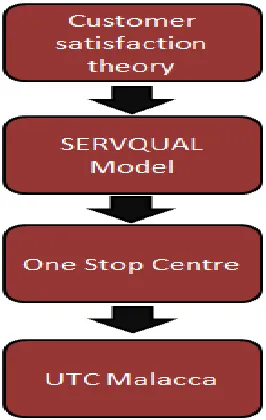
Figure 2.1: Flows of related theory
2.2Customer Satisfaction theory
The first research about customer satisfaction has been conducted in the early 1980s. Works by Oliver (1980), Churchill and Surprenant (1982), and Bearden and Teel (1983) tended to focus on the operation of customer satisfaction and background of the customer satisfaction.
8
Liljander and Strandvik (1997) suggest that satisfaction cannot be fully understood without acknowledging the affective dimension. The role and importance of affect is supported by empirical research. Dube-Rioux (1990), for instance, observed that the affective reports of consumers are highly predictive of level of satisfaction and may be more predictive of level of satisfaction than are cognitive evaluations.
Krampf et al. (2003) recently examined the relative contributions of emotion and cognition in determining customer satisfaction in a dental (service) setting and observed confirmatory results. Emotion can affect customer in determining their satisfaction about a service that they received.
Customer satisfaction has traditionally been viewed as a cognitive construct where consumers cognitively compare perceived performance with an evaluative standard (expectations) (Westbrook and Oliver, 1991). Based on Expectancy Theory (Tolman, 1932), expectations represent the anticipated most likely level of performance. Customer satisfaction is viewed as an objective outcome of the magnitude and direction of the difference existing between expectations and the perceived level of performance experienced.
Halstead et al. (1994) suggest that customer satisfaction processes differ in varying types of consumer settings. Services, for instance, are based on processes as well as outcomes, likely increasing the role played by emotions in the determination of customer satisfaction. Consumer consist of many different kinds of behavior, thus their satisfaction process may differ from each other.
9
2.2.1 Customer Satisfaction Measurement Process
Customer satisfaction should be measured into a number of measurable parameters. Customer satisfaction measurement is the most reliable feedback, taking into account that is provides in an effective, meaningful, direct, and objectives preference and expectations. It provides a sense of achievement and accomplishment for all employees involved in any stage of the customer services process in UTC Malacca.
Kotler (1996) defined customer satisfaction as “the level of a person’s felt state resulting from comparing a product’s perceived performance or outcome in violation to his/her own expectations”. So, customer satisfaction could be considered a comparative behavior between inputs beforehand and post obtainments. As the study focused on investigating user satisfaction in UTC Malacca, customer satisfaction is defined as the levels of service quality performances that meets user’s expectations. UTC Malacca also becomes a benchmark for the federal government to establish other UTC in other country.
10
2.3SERVQUAL Models
A series of articles by Parasuraman, Zeithaml, and Berry has traced the development of a theory that attempts to explain how consumers acquire perceptions of the quality of service firms. Parallel with their theory development, Parasuraman, et al. has experimented with various ways of measuring the hypothetical dimensions of service quality. Their latest effort resulted in a set of scales they have named SERVQUAL.
A research was published by Parusuraman, Zeithaml and Berry (1988) focused more about specifically on the psychometric aspects of service quality. Their multi-item SERVQUAL scale was considered as first trials to operate customer satisfaction construct. The SERVQUAL scale focused on the performance components of the service quality model which quality was obtained that can differentiate between expectations and performance.