PROGRAM ON THE KNOWLEDGE AND PRACTICE
REGARDING CORONARY ANGIOGRAM CARE
AMONG STAFF NURSES AT A SELECTED
HOSPITAL IN CHENNAI
Dissertation submitted to
THE TAMIL NADU Dr. M.G.R. MEDICAL UNIVERSITY
CHENNAI
In partial fulfilment of requirement for the degree of
MASTER OF SCIENCE IN NURSING
PROGRAM ON THE KNOWLEDGE AND PRACTICE
REGARDING CORONARY ANGIOGRAM CARE AMONG
STAFF NURSES AT A SELECTED HOSPITAL IN
CHENNAI
Certified that this is the bonafide work of Mrs. JULIN K. THOMAS
MMM College of Nursing, No.131, Sakthi Nagar, Nolambur,
Mogappair West, Chennai.
COLLEGE SEAL:
SIGNATURE:
Dr. (Mrs) ROSALINE RACHEL
R.N., R.M., M.Sc. (N), MHRM, PGDGC., Ph.D. (N)
Principal,
MMM College of Nursing, No.131, Sakthi Nagar, Nolambur,
Mogappair West, Chennai.
Dissertation submitted to
THE TAMIL NADU Dr. M.G.R. MEDICAL UNIVERSITY
CHENNAI
In partial fulfilment of requirement for the degree of
MASTER OF SCIENCE IN NURSING
PROGRAM ON THE KNOWLEDGE AND PRACTICE
REGARDING CORONARY ANGIOGRAM CARE
AMONG STAFF NURSES AT A SELECTED
HOSPITAL IN CHENNAI
Approved by the research committee in July 2014
PROFESSOR IN NURSING RESEARCH
Dr. (Mrs) ROSALINE RACHEL _____________________ R.N., R.M., M.Sc. (N), MHRM, PGDGC., Ph.D. (N)
Principal,
MMM College of Nursing, No.131, Sakthi Nagar, Nolambur, Mogappair West, Chennai. MEDICAL EXPERT
Dr. AJIT MULLASARI, _____________________ Director-Cardiology department
The Madras Medical Mission, Chennai RESEARCH GUIDE
Mrs. SHOBA.G _____________________ Reader, Medical surgical nursing
MMM College of Nursing.
Dissertation submitted to
THE TAMIL NADU Dr. M.G.R. MEDICAL UNIVERSITY
CHENNAI
In partial fulfilment of requirement for the degree of
MASTER OF SCIENCE IN NURSING
I thank LORD ALMIGHTY for his abundant blessing and sustaining me in all my endeavours to complete the dissertation and throughout my life
.
I express my gratitude to the Management and The administrators, Madras
Medical Mission (MMM) hospital for providing me an opportunity to undergo the post graduate program in this esteemed institution.
I would like to express my sincere and heartfelt thanks to Dr. (Mrs) Rosaline Rachel, Principal MMM College of Nursing, whose guidance and support enabled me to do the work.
I’m extremely thankful to Prof. (Mrs) Padmavathi Kamraj, Vice Principal MMM College of Nursing for her guidance and valuable suggestions throughout the period of my study.
I extend my gratitude to Dr. Ajit Mullasari, Director Cardiology department, MMM hospital for giving the permission to do the study in the cardiac unit of MMM hospital.
I extend my sincere gratitude to Mrs.Abitha Ananda Soundarya, H.O.D. Medical surgical nursing, MMM College of Nursing, for her valuable suggestions, support and encouragement during the study period.
I express my heartfelt thanks to Mrs.Shoba G, Reader, Medical surgical nursing for her constant guidance, untiring efforts, practical directions, which were vital in the completion of the study.
I’m indeed thankful to Mrs.Sosamma, Nursing Superintendent MMM hospital for giving me the permission to conduct the study over there.
I express my heartfelt thanks to Mrs.Arogya Jaya Deepa M, Nursing coordinator MMM hospital for her constant guidance and support during the study.
I thank sincerely the medical experts and the nursing experts who validated my tool by rendering their whole hearted cooperation and valuable suggestion.
I express my sincere heartfelt thanks and gratitude to Mrs.Sasikala B, for editing the entire manuscript in English.
My heartfelt thanks to all study participants for their valuable co-operation and patience throughout the study.
My immense thanks to the librarians of MMM College of Nursing and MMM hospital for their help in providing the literature.
I acknowledge my sincere appreciation to Mr.G.K.Venkataraman, Elite Computers for patiently transferring the manuscript into a legible piece of work.
Words are beyond expression for the meticulous effort of my parents and my husband Mr.Sibu Sam Cherian for their encouragement and constant support towards the successful completion of the study.
I owe my gratitude to all my friends and my classmates.
AHA
-
American Heart Association
ALS
-
Advance Life Support
BLS
-
Basic Life Support
CABG
-
Coronary Artery Bypass Graft
CAD
-
Coronary Artery Disease
CCF
-
Congestive Cardiac Failure
CHD
-
Chronic Heart Disease
CVD
-
Cardio Vascular Disease
IHD
-
Ischemic Heart Disease
INR
-
International
Normalized
Ratio
MI
- Myocardial
Infarction
NPO
-
Nil Per Oral
PCI
-
Percutaneous Coronary Intervention
PTCA
-
Percutaneous Trans luminal Coronary Angioplasty
RHD
-
Rheumatic Heart Disease
SD
-
Standard
Deviation
STAI
-
Spiel Berger’s State Anxiety Inventory
S.No. Title Page No. 1
1.1 1.2 1.3 1.4 1.5 1.6 1.7 1.8 1.9
INTRODUCTION Background of the study Need for the study Statement of the problem Objectives of the study Operational definition Hypotheses of the study Assumption
Delimitation
Conceptual framework
1 – 16 1 6 10 10 10 11 11 11 12
2 REVIEW OF LITERATURE 17 – 37
3 3.1 3.2 3.3 3.4 3.5 3.6 3.7 3.8 3.9 3.10 3.11 3.12 3.13 3.14 3.15 3.16
RESEARCH METHODOLOGY Research approach
Research design Variables Research setting Population Sample Sample size
Sampling technique
Criteria for sample selection
Development and Description of tool Validity of the tool
Reliability of the tool Ethical consideration Pilot study
Data collection procedure Data analysis procedure
38 – 47 38 38 39 39 39 39 39 40 40 40 42 42 43 43 44 47 4 DATA ANALYSIS AND INTERPRETATION 48 – 65
6
RECOMMENDATION AND LIMITATION
REFERENCES 77 – 86
Table No. Title Page No.
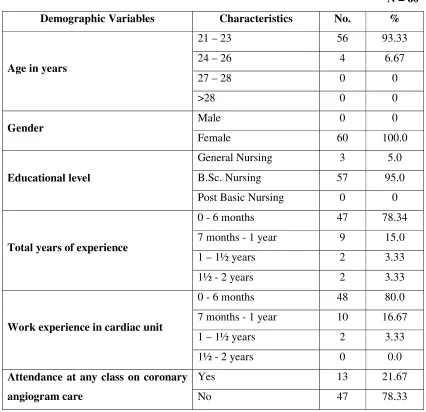
4.1 Frequency and percentage distribution of demographic
variables of staff nurses
49
4.2
Frequency and percentage distribution of aspects of pre-test level of knowledge regarding coronary angiogram care among the staff nurses
51
4.3
Frequency and percentage distribution of aspects of post-test level of knowledge regarding coronary angiogram care among staff nurses
53
4.4 Mean and S.D of knowledge of the staff nurses in the pre and
post-test period
55
4.5
Frequency and percentage distribution of aspects of pre-test level of practice regarding coronary angiogram care among the staff nurses
56
4.6
Frequency and percentage distribution of aspects of post-test level of practice regarding coronary angiogram care among staff nurses
57
4.7 Mean and S.D of practices of staff nurses regarding coronary
angiogram care in the pre and post-test period
58
4.8 Relationship between post-test knowledge and practice score
regarding coronary angiogram care among staff nurses
59
4.9 Comparison of pre-test and post-test level of knowledge
regarding coronary angiogram care among staff nurses
60
4.10 Comparison of pre-test and post-test level of practice regarding
coronary angiogram care among staff nurses
61
4.11
Association of mean differed level of knowledge regarding coronary angiogram care among the staff nurses with their selected demographic variables
62
4.12
Association of mean differed level of practice regarding coronary angiogram care among staff nurses with their selected demographic variables
Figure No. Title
1.1.1 Percentage of cardiac disease burden among men and women per
thousand populations
1.1.2 Percentage of risk factors in adult with cardiac disease in
U.S(2005-2006)
1.1.3 Percentage of total non- communicable disease among men and women
in 2010
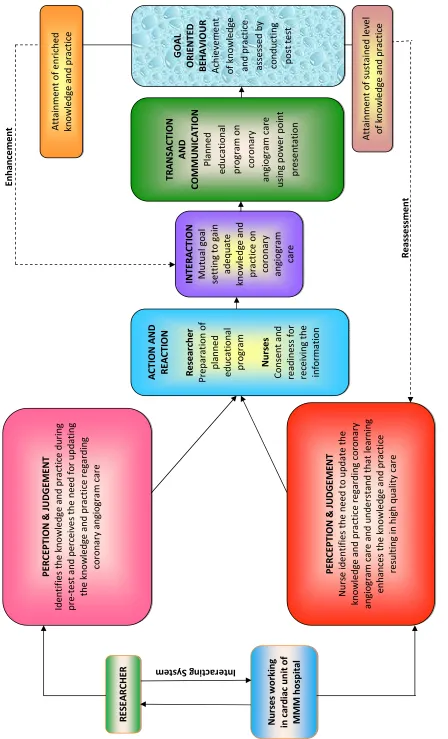
1.9.1 Conceptual framework based on modified Imogene king’s goal
attainment model
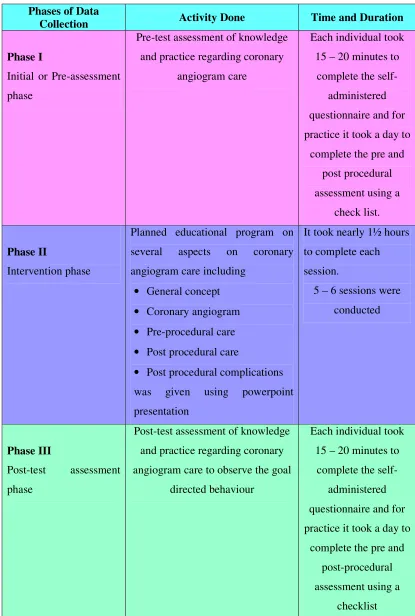
3.15.1 Schematic representation of data collection procedure
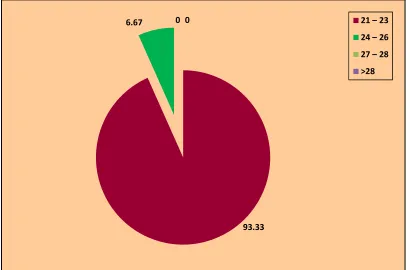
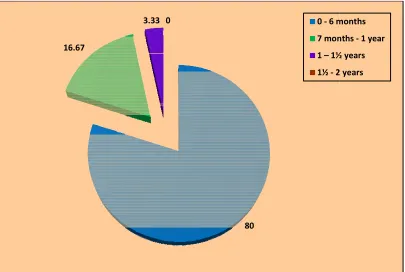
4.1 Percentage distribution of age of the staff nurses
4.2 Percentage distribution of total years of experience of the staff nurses
4.3 Percentage distribution of work experience of the staff nurses in cardiac
unit
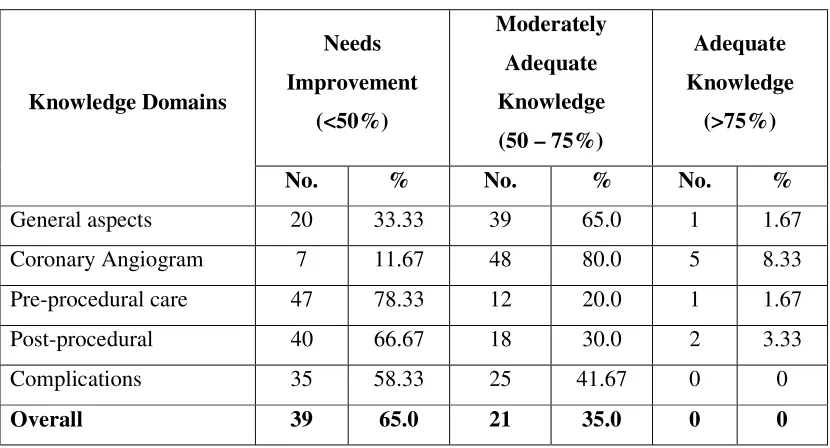
4.4 Percentage distribution of aspects of pre-test level of knowledge
regarding coronary angiogram care among staff nurses
4.5 Percentage distribution of aspects of post-test level of knowledge
regarding coronary angiogram care among staff nurses
4.6 Percentage distribution of aspects of pre-test level of practice regarding
coronary angiogram care among staff nurses
4.7 Percentage distribution of aspects of post-test level of practice regarding
Appendices Title
A Letter seeking permission for conducting the study
B Ethical clearance certificate
C Informed consent form
D Tool for data collection
E Intervention tool
F
Content validity
(i) Letter seeking expert’s opinion and suggestion for the content validity.
(ii) List of experts of content validity. (iii) Content validity certificates.
G Certificate of English editing
H Plagiarism report
$%675$&7
A study was conducted to assess the effectiveness of planned educational program on knowledge and practice regarding coronary angiogram care among staff nurses at a selected hospital in Chennai.
The objectives of the study were:
1. To assess the pre and post-test level of knowledge and practice of the staff nurses regarding coronary angiogram care.
2. To correlate the post-test knowledge and practice of the staff nurses regarding coronary angiogram care.
3. To assess the effectiveness of planned educational program on knowledge and practice of the staff nurses regarding coronary angiogram care.
4. To associate the mean differed level of knowledge and practice of the staff nurses with their selected demographic variables.
Methodology
The research approach was quantitative approach and the research design was pre-experimental one group pre-test and post-test. Sixty samples were selected based on sample selection criteria using non probability purposive sampling technique. The study was conducted in MMM hospital, Chennai. Structured questionnaire was used to assess the knowledge level and an observational check list to assess the practice level of staff nurses on coronary angiogram care. The data was collected in three phases.
Findings
coronary angiogram care. The overall post-test level of practice revealed that all 60(100%) had good practice regarding coronary angiogram care.
The calculated ‘r’ test value r = 0.371 showed a moderate positive correlation between post-test knowledge and practice score which was found to be statistically significant at p<0.01.
The findings also revealed that the pre-test mean score of knowledge was 13.0 with S.D of 3.71 whereas in the post test the mean score of knowledge was 26.98 with S.D of 1.89. The calculated paired ’t’ test value t = 28.758 found to be statistically significant at p<0.001. The findings revealed that the pre-test mean score of practice was 22.63 with S.D of 2.01 whereas in the post- test the mean score of practice was 40.75 with S.D 1.51. The calculated paired ‘t’ test value t = 57.933 was found to be statistically significant at p<0.001.
The findings revealed that there was statistical significance found between the
mean differed level of knowledge and the demographic variable age (χ2 = 4.286) at
(p=0.038)and there was no statistically significant association found with other demographic variables.
Conclusion
,1752'8&7,21
CHAPTER – 1
INTRODUCTION
“Knowledge is a treasure, but practice is the key to it”
ʊ Lao Tzu
1.1 BACKGROUND OF THE STUDY
The heart is one of the most important organs in the entire human body. It is really nothing more than a pump, composed of muscle which pumps blood throughout the body, beating approximately 72 times per minute of our lives. The heart pumps the blood, which carries all the vital materials which help our bodies function and removes the waste products that we do not need. The walls of the heart are made up of three layers, while the cavity is divided into four parts. There are two upper chambers, called the right and left atria, and two lower chambers, called the right and left ventricles. The right atrium, as it is called, receives blood from the upper and lower body through the superior vena cava and the inferior vena cava, respectively, and from the heart muscle itself through the coronary sinus. Coronary arteries supply blood to the heart and the coronary veins removes the deoxygenated blood.
In the dynamic human life previously most of the deaths and diseases were mainly due to communicable diseases. Now the scenario has changed as non-communicable diseases such as diabetes, hypertension and Coronary Artery Disease (CAD) which has become the major burden in the society and also constitutes about 63% of all the deaths. CAD is also called “Ischemic Heart Disease” (IHD).
World Health Organisation (WHO) (2009) stated that around 23.6 million people will die because of Cardio Vascular Disease (CVD) by 2030 with high incidence in South East Asian countries. In 1990, there was an estimated 1.17 million deaths related from CAD and it was doubled to 2.03 million deaths in 2010. CAD was prevalent in India for last 40 years.
worldwide, which primarily includes CVDs, cancers, chronic respiratory disease and diabetes. Among this, cardiovascular disease brings a major part of disease burden to the society. CAD is the leading cause of deaths in United Kingdom (UK) and worldwide. It generally affects more men than women from the age of 50.
Fig.1.1.1: Percentage of cardiac disease burden among men and women per thousand population
Source͗Heart Disease and Stroke Statistics—2009
American Heart Association (AHA) (2007) stated that, cardiovascular disease is the leading cause of mortality in United States. It is estimated that nearly 1.4 million deaths occur in every major ethnic group.
British Heart Foundation (2007) revealed that CAD accounted for more than 2, 33,000deaths in UK. Every 7 minutes a Canadian person dies out of CAD. WHO (2001) statistics states that nearly 91 people die every hour in the world due to heart attack with more incidence in younger group less than 40 years.
tobacco, physical inactivity, unhealthy diet, blood pressure, diabetes etc. The surgical management includes Percutaneous Coronary Intervention (PCI) and Coronary Artery Bypass Graft (CABG). Angioplasty opens blocked or narrowed coronary arteries with a balloon tipped catheter and this widens the artery and restores the blood flow and in CABG, arteries or veins from other areas of the body are used to bypass the narrowed arteries.
Fig.1.1.2: Percentage of risk factors in adult with cardiac disease in U.S (2005-2006) Source: Heart Disease Risk Factor Statistics 2006
The proportions of cardiovascular deaths caused by IHD, cerebrovascular disease, inflammatory heart disease, Rheumatic Heart Disease (RHD), hypertensive heart disease, and other cardiovascular diseases among men and women in 2011 is depicted
below. Globally CVDs are comprised principally of Chronic Heart Disease(CHD)
women. Cerebrovascular disease is the form of CVD with the second-highest
[image:19.612.146.487.141.331.2]mortality-34% of cardiovascular deaths in men and 37% in women.
Fig.1.1.3: Percentage of total non- communicable disease among men and women in 2010
Source: Global Status report on non- communicable diseases. Geneva: WHO 2010.
In national wide 45 million people are affected with CAD with an increasing number of young Indians getting effected. In India, in the past 5 decade the rate of CAD among urban population has risen from 4% to 11%. An estimated 1.5 million people die due to CAD every year. The prevalence of CAD was higher in Kerala (4.6%) than in Tamil Nadu (4.3%) or Gujarat (3.5%). The prevalence was higher in South India especially in lower socioeconomic groups. The main risk factors of coronary artery disease include lack of exercise, poor diet, smoking, exposure to chemicals and other environmental exposures.
of the coronary arteries. According to the reports the rate of coronary angiogram is increasing day by day.
Coronary angiography is very safe and is performed to detect an occlusion in the coronary arteries of the heart, by inserting a catheter into the coronary artery, either using a femoral or radial approach in order to view the patency of blood flow through the heart. Its risk and complication are very rare and the knowledge will help the staff nurses to detect them early and offer great assistance in preventing complications (Patient Education Institute, 2005).
The number of people opting for coronary angiography is increasing tremendously in UK, USA, India and in many other nations. It has been calculated that more than 1 million coronary angiograms are performed every year worldwide. The studies showed that more than 5.5 lakh coronary angiogram is performed in USA each year (The American Academy of Cardiac Surgeons, 2005).
According to the Cardiac diagnostic conference (2007), the number of coronary angiography patients has increased dramatically. According to them India’s total patients were 1,02,87,37,436 which showed a 21.3% increase since 1991, among them 7, 66, 22,381 were coronary angiography patients.
According to World medical Diagnostic procedure (2010), the percentage of patients undergoing coronary angiogram diagnostic procedure in various countries was represented as India 68.6, Russia 65.9, Saudi Arabia 75.9, United Kingdom 78.8, Australia 80.6, South Africa 42.5 and United States of America 78.
In Indian hospitals more than 76.6 million people are admitted per year after coronary angiography. With regard to the data of health ministry, India has 76,622,321 patients admitted per year in which 11.6 million are from Uttar Pradesh, 8.45 million from Maharashtra and 5.5 million from Tamil Nadu.
emergence of angioplasty. Compared to CABG, the pain is also very less. But the treatment decisions are made on a case by case basis.
Coronary angioplasty is a revascularization procedure that has revolutionized the treatment of IHD over the past 20 years. Coronary angiogram is now a gold standard in diagnosing CAD. A study conducted by national interventional council on the Indian coronary data for the year 2011 was published in Indian heart journal September 2013 which states that “A total of 152332 PCI procedures were performed in 332 centres and there is a growth of 28.8% as compared to the data available for the previous year”. In India, approximately 1 lakh angiograms are performed each year. In US in the year 1993, the coronary angiogram was performed on 10 lakhs patient’s which has increased to 30 lakhs by the year 2010. The risk of major complication is less than 2% but the factors such as patient’s conditions, acute renal insufficiency and cardiomyopathy significantly increases the risk.
Complication rates of PCI are low but neither negligible nor irreducible. Complication ranges widely from minor problems with short term sequel to life threatening situations that may cause irreversible damage, if urgent care is not provided. The complication of coronary angiogram includes hematoma formation, pseudo aneurysm, neuropathy, bacteraemia etc. The extent of CAD, Congestive Cardiac Failure (CCF), MI and bleeding are few of cardiovascular characteristics that can increase the complications.
1.2 SIGNIFICANCE OF THE STUDY
The WHO report (2008) emphasised on the fact that CAD is a modern epidemic and CAD will be India’s number one killer by 2010. The major cause of mortality and disease in Indian subcontinent is CAD causing more than 25% of deaths.
Guptha (2010) stated that it has been predicted that the disease will increase rapidly in India and our country will be the host to more than half the cases of heart disease in the world within the next 15 years.
Usman (2008) reported that CAD is the most common cause of death in UK. One in five men and one in seven woman die due to coronary heart disease. About 94000 deaths occurred from CAD in UK every year and the most vulnerable group belongs to more than 55 years of age and over.
Mckinsey (2005) stated that annual statistics revealed that nearly 174 million angiogram diagnostic procedures are performed each year with a rate of 1 for every 60 people in the world. Majority of the patients got well and went back home without any complications. The complication rate varies from 3% to 16% and permanent disability rate ranges from 0.4% to 0.8%.
Simon (2002) projected the metaanalysis of epidemiological studies of India, revealed that 2.6 lakhs patients got admitted in hospitals for coronary angiogram every year and nearly 35% to 39% were affected by complications after the procedure, sometimes end up with deleterious effect to the patients.
Balduf (2010) stated that 224 procedures were performed by 3 board certified vascular surgeons over a period from May 1999 to August 2000 out of which 144 were diagnostic angiography and they compared the complications of initial 25 and subsequent 119 angiography to evaluate the learning curve. The study findings revealed that 38% of angiography was done to define aneurysmal anatomy, 51% to rule out peripheral arterial stenosis and 12% to identify carotid artery disease. The complication rates involved in these three types were 0%, 2.7% and 5.9% respectively.
Taylor (2001) states that after coronary angiography the post-operative patients were mostly affected by back pain sleep disturbance and discomfort. Sleep management measure, psychological support, comfortable position and calm environment should be involved in the nursing care to improve the comfort level of the patients.
Advanced clinical care (1990) published an article on cardiac catheterization - before and after, what the patient need to know, what the nurses need to know. This provided helpful information for nurses regarding preparing patient for procedure, pre-catheterization and post-pre-catheterization teaching information, discharge instructions and follow up care.
Monett & Roberts (1995) published an article in describes the current management of patients posted for interventional cardiac catheterization and also given information about the new catheters, monitoring equipment and standards for the skilled personal.
Tracey (2009) published an article on evidence based care for patients undergoing coronary angiogram, which aim at updating the nurse’s knowledge and skill on caring for a patient undergoing coronary angiogram. The indication, contraindication and complication, various aspects of patient care were also discussed.
Thomas & Longo (1976) published an article on care of patients after cardiac catheterization. The article emphasises that the nursing action is very important to recognize and interpret potential post-catheterization complications. Any invasive procedure can lead to complications, quick and accurate nursing assessment and action are essential. They have enlisted the possible complications of cardiac catheterization which the nurses may encounter. This is divided into possible causes and their plan of action.
Roberts (1989) published an article on caring for patients undergoing therapeutic cardiac catheterization. In this he explained the role of critical care nurses in cardiac catheterization procedure and he emphasised that with courage and skill the risk of interventional catheterization can be minimized.
ambulation and to make them realize that it is safe and effective way to promote patients comfort.
The frequently observed post-procedural complications includes hematoma formation, acute vessel perforation and the patient will have the chance to develop contrast hypersensitivity, vasovagal reaction, pseudo aneurysm, retro peritoneal haemorrhage, infection, arteriovenous fistula. So the nurses should be vigilant enough to rule out the complications to avoid serious mishaps.
The complication rates of coronary angiogram cannot be neglected. Here arises the need for a checklist which was suggested by many researchers while working in the coronary care unit. A check list is an effective method to improve best practices and is a simple cost effective method to prevent or omit errors. Implementation of a checklist for pre and post angiogram period will improve their assessment, quality of care and can help to prevent errors. Nurses play a major role in providing care to patients in all the phases of coronary angiogram including pre intra and post period. The enhancement of knowledge regarding coronary angiogram care is essential in preventing complications. Nurses are the first hand members who are around the clock with the patients and should have sufficient knowledge and practical skill in caring the patient and identifying complications as early as possible to prevent life threatening situations for the patients. Nurses responsibility includes continuous cardiac monitoring assess the quality of the pulse, record vital signs, observe for any bleeding or hematoma, check for numbness or cold and clammy extremities, pain management thereby preventing complications.
in the clinical area. This led the nurse researcher to select the area of coronary angiogram for the present study.
1.3 STATEMENT OF THE PROBLEM
A pre-experimental study to assess the effectiveness of planned educational program on the knowledge and practice regarding coronary angiogram care among staff nurses at a selected hospital in Chennai.
1.4 OBJECTIVES OF THE STUDY
1. To assess the pre and post-test level of knowledge and practice of the staff nurses regarding coronary angiogram care.
2. To correlate the post-test knowledge and practice of the staff nurses regarding coronary angiogram care.
3. To assess the effectiveness of planned educational program on knowledge and practice of the staff nurses regarding coronary angiogram care.
4. To associate the mean differed level of knowledge and practice of the staff nurses with their selected demographic variables.
1.5 OPERATIONAL DEFINITION 1.5.1 Effectiveness
Refers to the degree to which the objectives are achieved in enhancing the cognitive and conative skills of staff nurses regarding coronary angiogram care.
1.5.2 Planned educational program
Refers to systematically planned and developed teaching module designed for staff nurses, which included general aspects of coronary angiogram, indications, contraindications, pre and post coronary angiogram care, complications using power point presentation.
1.5.3 Knowledge
1.5.4 Practice
Refers to procedural steps followed by staff nurses during pre and post coronary angiogram care which was assessed with the help of an observational checklist.
1.5.5 Coronary angiogram care
Refers to the care given by the staff nurses during pre and post coronary angiogram phases, provided for the safety and best quality care of the patient.
1.5.6 Staff Nurse
Refers to qualified and registered staff nurses working in cardiac unit of MMM hospital, Chennai.
1.6 HYPOTHESES
NH1: There is no significant relationship between the post-test knowledge and practice of staff nurses regarding coronary angiogram care.
NH2: There is no significant difference in pre and post-test level of knowledge and practice of staff nurses regarding coronary angiogram care.
NH3: There is no significant association of mean differed level of knowledge and practice of the staff nurses with their selected demographic variables.
1.7 ASSUMPTION
1. The patient undergoing coronary angiogram is prone to develop complications. 2. Staff nurses need adequate information on coronary angiogram care.
3. Planned educational program enriches the knowledge of staff nurses and which help them to practice better coronary angiogram care.
4. Protocol guides the nurses to perform standard care and helps to omit errors.
1.8 DELIMITATION
1.9 CONCEPTUAL FRAMEWORK
The conceptual framework designed for this study is based on Imogene King’s “Goal attainment theory”. In 1981 she refined her ideas in A Theory for Nursing: systems, concept and process. King proposes an open system framework as a theory for goal attainment. Her vision of the nursing process had a strong emphasis on interpersonal process. King bases her theory on general system theory, the behavioural sciences, deductive and inductive reasoning.
1.9.1 GENERAL CONCEPTS OF IMOGENE KING’S GOAL ATTAINMENT THEORY
The open system framework consists of three interacting system: personal, interpersonal and social system on the assumption that humans are open system in constant interaction with their environment.
Personal system:
This system is based on the individual and includes perception, self, growth and development, body image, space and time.
i) Perception – It refers to a person’s representation or reality and it is
universal, subjective and unique to each person.
ii) Self – Refers to a person’s subjective environment that makes up the
person. It included ideas, attitudes, values and commitments.
iii) Growth and Development – Refers to all the changes occurring in a
person.
iv) Body image – Refers to the manner in which one perceives one’s body
and the reaction of others to it.
v) Space – Refers to the immediate physical territory occupied by a person
and to the person’s behaviour.
vi) Time – Refers to a sequence of event and the relationship to each other.
Interpersonal system:
i) Interaction – Refers to verbal and non-verbal behaviour between an individual and the environment or between two or more individuals which will be goal directed.
ii) Communication – Refers to the transmission of information from one
person to another either directly or indirectly and it is the information component of the interaction.
iii) Transaction – Refers to the interaction between the person and the
environment for the purpose of goal attainment.
iv) Role – Refers to the expected behaviour of a person in a specific position.
v) Stress – Refers to an exchange of energy either positive or negative
between a person and environment.
Social Systems:
When interpersonal systems come together, they form larger system called social systems. A social system comprises of social roles behaviours and practices developed to maintain values and include organisation, authority, power, status and decision making.
i) Organisation – Refer to a group of people with similar interest to achieve
personal and organisational goals.
ii) Authority – Refers to the observable behaviour of providing guidance,
order and being responsible for actions.
iii) Power – Is a means by which one or more person can influence others.
iv) Status – Refers to the position occupied by a person in a group or in an
organisation.
v) Decision making – Results from developing and acting on perceived
choices of goal attainment.
1.9.2 APPLICATION OF MODIFIED IMOGENE KING’S GOAL ATTAINMENT THEORY FOR THE PRESENT STUDY
Personal system
Each personal system represents an individual. When individuals interact with each other it forms an interpersonal system or interacting system. Nurse researcher has her own perception, values, beliefs and judgement and she experience each system in a unique manner. Each staff nurse is a personal system having their own perception, values, and judgement and they come together for a purpose and makes judgment.
Interpersonal system
The members of the interpersonal system interact with each other by means of verbal and non-verbal behaviour and transmit information from one person to another either directly or indirectly for a purpose of goal attainment. Each one is expected to perform goal specific action to their position. Here the nurse researcher and the staff nurse interact with each other for transmitting the information.
Perception and judgement
During the process of interaction the nurse researcher by means of pre-test and assessment perceives that nurses working in cardiac unit need to be updated with the knowledge regarding coronary angiogram care and decides that planned educational programme can only update the knowledge of staff nurses. The staff nurse working in cardiac unit also perceives the reality of need for updating of knowledge and skill on coronary angiogram care and decides that continuous learning can only help them to update the current trends in coronary angiogram.
Action and reaction
Action is the mental and physical preparation of the individual to bring out desirable changes in the behaviour. A nurse researcher mentally prepares to educate the nurses and prepare material for planned educational programme. Staff nurses prepare mentally to show their consent and readiness for learning the information.
Interaction
and nurse mutually set goal in gaining adequate knowledge and practice regarding coronary angiogram.
Transaction and communication
It is the exchange of information between two systems to attain goal. It represents the human interaction and communication and the exchange of information between people during face to face meeting. Here the researcher conducts the planned education on coronary angiogram care using power point presentation to a group of nurses working in cardiac unit.
Goal oriented behaviour
5(9,(:2)
/,7(5$785(
CHAPTER – 2
REVIEW OF LITERATURE
Researchers rarely conduct research in an intellectual vacuum. Their studies are undertaken within the context of an existing base of knowledge. Review of literature is a broad, comprehensive, in-depth, systematic and critical review of scholarly literature, unpublished scholarly print materials, audio visual materials and personal communications on a particular topic.
Review of literature helps to lay the context and foundation for a new study. The process of review begins even before the selection of the topic and continues till the publication of the report. The researcher carried out in-depth review of literature relevant to the topic to gain knowledge and collect information for paving the foundation for his/her research.
The review of the literature is presented in two parts.
2.1: General concepts of coronary angiogram care 2.2: Research review
2.2.1 Section A: Literature related to knowledge on coronary angiogram care 2.2.2 Section B: Literature related to practice regarding coronary angiogram care 2.2.3 Section C: Literature related to complications related to coronary angiogram
care
2.1: General concepts of coronary angiogram care Introduction
Meaning:
Coronary angiography is a procedure that uses a special dye (contrast material) and X-rays to see how blood flows through the coronary arteries of the heart. Coronary angiography is commonly performed by the percutaneous femoral approach using polyurethane catheters. The catheters are guided over a guide wire through distal aortic arch to coronary ostieum. The guide wire is withdrawn and the catheter will be filled with contrast medium and images are recorded to ensure that all coronary segments are seen. It is the technique used to enlarge the internal diameter of the diseased vessel by applying balloon pressure to an area of stenosis. When inserted through radial or femoral artery it reaches the aortic root and images are recorded
Indications:
Coronary angiography is done for patients who are having CAD. It is a diagnostic procedure to rule out CAD. The indication for coronary angiography includes suspected coronary artery disease or known coronary artery disease with stable patterns, acute coronary syndrome, unstable angina, Non ST elevated myocardial infarction and ST elevated myocardial infarction with unstable pattern, congestive cardiac failure, preoperative assessment for non-cardiac surgery and structural or valvular heart disease.
Contraindication:
The contra indications of coronary angiogram include: 1. Coagulopathy.
2. Renal failure. 3. Anemia.
4. Contrast allergy. 5. Active infection. 6. If patient is not willing. .
Pre procedural care:
1. Medical and surgical history should be collected.
2. Information about the history of allergy to iodine should be obtained. 3. History regarding smoking and alcohol should be obtained.
6. Maintain good rapport with the patient. 7. Clarify all doubt and reassure the patient.
8. Record vital signs half an hour before going to catheterization lab. 9. Check quality of pulse in the extremities and record.
10. Monitor weight and height and record.
11. Before shifting ensure that patient empties bladder.
12. Therapeutic touch should be provided to reduce the anxiety level of the patient. 13. Keep patient in nil per oral status for 4-6hours.
14. Intake output chart should be maintained.
15. Anticoagulants should be withdrawn prior to the procedure.
16. Allen’s test should be performed to assess the patency of ulnar artery. 17. Patient should be off heparin 6hours before coronary angiogram. 18. Check all reports are collected or not.
19. Skin preparation to be done in a sterile manner. 20. Accessory and ornaments should be removed.
21. Teach the importance of taking deep breath and hold it without bearing down just before the injection, because it clears the diaphragm from the field.
22. Teach the patient to cough during angiogram to reduce flushing sensation.
23. Patient should be given instruction to skip anti-diabetes medication on the day of procedure to prevent hypoglycemia.
24. Explain to patient and relatives that the procedure may last for 30 – 60 minutes.
Post procedural care:
1. Assess & records vital signs every 15 minutes for 1st hour, every 30minutes for next 2 hours, every 1 hour for 4 hours.
2. Check for any numbness of the extremity. 3. Assess the intensity of pain using pain scale.
4. Administer IV fluids as the contrast agent is an osmotic diuretic. 5. Maintain intake output chart.
6. Start with soft diet as per doctor’s order. 7. Elevate the head end to 30 degree angle.
8. Lie down flat & apply pressure firmly with the finger tips using a clean cloth. 9. Instruct the patient that they should not lift any object more than 10 kg for 72
10. After 24 hours remove the wound site dressing & shower.
11. Instruct the patient do not drive any vehicle or operate any machine for 24 hours, if stent is placed wait for 48 hours.
12. Resume with a heart healthy diet.
13. Follow up care should be done according to doctor’s order.
Complication:
The complications of coronary angiography can be classified into major and minor complications.
The major complications include:
9 Myocardial infarction.
9 Major embolization.
9 Death.
The minor complications include:
• Puncture site complications
a. Hematoma:- Hardened area in the site with pain & discoloration. b. Acute vessel perforation.
• Contrast hypersensitivity
a. Cutaneous and mucosal:- Utricaria, pruritus, angioedema, laryngeal edema. b. Smooth muscle:- Bronchospasm causes dyspnea, cough and chocking
sensation.
c. Cardiovascular:- Hypotension, arrhythmia.
• Vasovagal reaction:- Hypotension, nausea, yawning, vomiting, diaphoresis.
• Pseudo aneurysm:- Painful pulsatile mass, new bruit, groin pain or burning.
• Retroperitoneal hemorrhage:- Hypotension, flank pain.
• Infection:- Pain, erythema, fever, purulent discharge.
2.2: Research review
2.2.1 Section A: Literature related to knowledge on coronary angiogram care
WU et al (2014) evaluated the effectiveness of an accessibility enhanced multimedia informational educational program, in reducing the anxiety level of patients undergoing cardiac catheterization. The aim of the study was to assess the effectiveness of the educational program in reducing anxiety and increasing satisfaction with the information. The study design used was a randomised experimental design with three cohort prospective comparison. The sample size was 123 patients and they were randomly assigned to three groups one with regular education, one with accessibility enhanced multimedia informational education and one with digital video education. Using Spielberger’s anxiety inventory, the anxiety of the patients was assessed before education immediately after the education, before cardiac catheterization and one day after cardiac catheterization. The study findings revealed that the patients who received accessibility enhanced multimedia informational education had lower anxiety at (p=0.004) and they concluded that the accessibility enhanced multimedia informational education was the most effective educational module for patients undergoing cardiac catheterization.
Mahgoub et al (2013) assessed the impact of knowledge about early ambulation on patient’s satisfaction on post percutaneous interventions. The study was conducted in Assuit university hospital. The aim of the study was to assess the knowledge of patients about early ambulation during post intervention period. The design used was a quasi- experimental design consisting of an experimental and control group with a sample size of 40 patients’ in each by conducting pre and post- test. The tool has got 4 parts including assessment of patient after femoral sheath removal, pre and post- test knowledge sheet, pre and post observation checklist, and satisfaction assessment sheet. Knowledge was assessed by the sheet filled by the patient and satisfaction with checklist The study findings revealed that there is a significant improvement in all the parameters (p<0.001) and they concluded that teaching the patient’s before the procedure can improve their level of knowledge and satisfaction.
mobility. The study design adopted was cross sectional study with a sample size of 250. They validated 3 of the 11 NANDA defining characteristics, such as limited range of motion, limited ability to perform, gross motor skill and difficulty turning. The study findings revealed that there was a statistically significant agreement with the inter-rater method to its relevance and was assessed using kappa coefficient.
Chair et al (2012) assessed the effect of video tape educational intervention on patients undergoing cardiac catheterization. The study design was quasi-experimental study, with a sample size of 132 patients undergoing cardiac catheterization. The anxiety level of the patients was assessed before the intervention using the Chinese state anxiety inventory and 20 to 24 hours after cardiac catheterization. The study findings revealed that, the use of video tape was effective in reducing the anxiety level of patients undergoing cardiac catheterization at (p<0.001) and they concluded that videotape education can be suggested for patients undergoing cardiac catheterization.
Sangka Chand et al (2011) had done a study on continuous ST segment monitoring, nurses’ attitude, practice and quality of patients care. The aim of the study was to assess the nurse’s knowledge in monitoring ischemia. The study was done with 61 staff nurses and their base line data of practice and attitude towards ischemia were monitored. Later an education was provided with ST-map software and follow-up data were collected after 4 months. The study findings revealed that, there was a significant improvement in knowledge from 13% to 90% before and after ST-map at (p<0.001).
Stacy (2011) had conducted a study to create a self-learning module for nurse those who care for patients undergoing angioplasty and receiving anticoagulation therapy. The aim of the study was to formulate a self-learning module for the nurses. The design adopted for the study was pre experimental one group pre-test and post-test design with a sample size of 24. Pre-test was done followed by self-learning module was introduced to the staff nurses and then evaluated the post-test knowledge. The study findings revealed that self-learning module enhanced the knowledge of the staff nurses and improved patient’s safety.
Arathy (2011) had done a study to assess the knowledge and practices among cardiac nurses about patient’s safety after cardiac catheterization .The study was done by conducting a survey with a sample size of 30 using a questionnaire and an observational tool. The study findings revealed that the knowledge level is more in staff nurses who have more than five years of experience (p=0.015)
King et al (2010) conducted a model for a nurse led program of bed side placement of peripherally inserted central catheters in neonates and infants with congenital heart disease. They evaluated the nurse performance during central catheter insertion for success, complication and completion of therapy after giving an educational program. About 125 central catheters were inserted in 105 patients successfully with complications limited to 3 people and the nursing team respond to 90% of the request within 24 hours. The finds revealed that the educational program was effective.
Snow et al (2008) conducted a study to assess the effect of women and health care provider focused heart health awareness initiative on diagnostic cardiac catheterization. The data used for the study was the American College of Cardiology National Cardiovascular Registry. The study revealed that only 7.03% in men and .96% women received cardiac catheterisation. This study was associated with a structured intervention focused on health care providers and women in the interventional hospital.
Steffenino et al (2007) evaluated the effectiveness of video based patient information before percutaneous cardiac interventions. The aim of the study was to assess whether information given prior to the procedure has any effect on the knowledge of the patient using a pre- experimental one group pre and post- test design. The sample size for the study was 108 patients undergoing coronary angiography. The data was collected using a standard information sheet. After the video, the patients were given the same multiple choice questionnaire. The study findings revealed that the knowledge had increased from 39% to 77% (p<0.0001) after watching the video. They concluded that watching video before the procedure improves the knowledge.
De Lima et al (2006) had conducted a study to assess the knowledge of nurses regarding nursing diagnosis for patients after heart catheterization. The study was conducted with 30 samples after cardiac catheterization aiming to establish nursing diagnosis according to (NANDA). The method of data collection was based on nursing process related to OREMS self-care deficit theory. In the end of the study nearly 25 nursing diagnosis have been established.
Chan & Cheung (2003) assessed the effects of education on anxiety among Chinese patients undergoing cardiac catheterization. The aim of the study was to evaluate the effect of education in reducing anxiety among patients undergoing cardiac catheterization. The design used in the study was randomised experimental design. The study was conducted in regional hospital in Hong Kong. The sample size for the study was 62 patients undergoing cardiac catheterization and they were randomly assigned in the experimental and control group with 31 in each. The data was collected using State Anxiety Inventory and knowledge was also assessed following the group education on cardiac catheterization. The study findings revealed that the experimental group has experienced low anxiety level than the control group (p<0.001).
Wolf et al (2003) conducted a study to evaluate the relationship between nurse caring and patient satisfaction in patients undergoing invasive cardiac procedure. The design used for the study was observational study with 73 patients undergoing interventional cardiology. The study findings revealed strong relationship between caring and patient satisfaction (r=0.53, p=0.01). The study concluded that as caring increase, the patient’s satisfaction also increases and there is no difference in opinion between male and female since caring is considered as fundamental nature of nursing, practising nurses must be appreciated for their satisfaction.
Mott (1999) conducted a study on psychological preparation to decrease anxiety associated with cardiac catheterization to compare the preparatory informative strategies in reducing anxiety before cardiac catheterization. The study was done with a sample size of 30 and the pre intervention and post intervention anxiety level was assessed. The study validates that psychological preparation is helpful in reducing the patient’s anxiety before a stressful experience such as cardiac catheterization and this study contributes to nursing knowledge that psychological preparation is more effective for patients undergoing any invasive procedures.
Steven et al (1998) assessed the impact of providing an educational video tape referred for coronary angiography to find out its effect on outcome of care. The study design was randomised control clinical trial with a sample size of 217 patients admitted for coronary angiography. The study findings revealed that, those who received the video tape were having more knowledge than the patient who received normal care with a mean score of 85 versus 58% at (p<0.0001).
2.2.2 Section B: Literature related to practice regarding coronary angiogram care Foji et al (2015) had done a study to evaluate the effect of guided imagery on pain, anxiety and other hemodynamic factors in patients undergoing coronary angiography. The aim of the study was to assess whether guided imagery has any effect on pain and anxiety in patients undergoing coronary angiography. The study design was random clinical study with a sample size of 62 patients undergoing coronary angiography. The samples were randomly assigned to experimental and control group. The data was collected using hemodynamic variable sheet, STAI anxiety questionnaire and a pain scale. The intervention was given to the experimental group and they were asked to listen to a guided imagery CD for 18 minutes. The study findings revealed that the mean level of anxiety for the experimental group had decreased significantly and the pain scale showed control group had slower level of pain but it was not statistically significant.
Mc Connel et al (2013) had done a study on management practices and quality of care in cardiac units to improve the quality of health care. The study design used was multivariate analysis to assess the practice of health care profession in four dimensions such as standardising care, key performance, setting target and incentivising in the cardiac units of US hospitals. 597 cardiac units were selected representing 51.5% of hospitals with interventional cardiac catheterization lab. The study findings revealed that 20% of hospitals scored 4 or 5 concluding that correlation associated with management practices and readmission (p<0.05).
exploratory qualitative study done between 2011 and 2012 with purposive sample of 15 patients including 7 men and 8 women. The data was collected using semi-structured interview method. The data were analysed using qualitative content analysis approach. The study findings revealed that the expectation of the patients regarding coronary angiography were categorised under 4 main themes such as from the treatment team, need for preparation of angiography, education and training. The study concluded that the nursing care during the preparation should focus on patient’s education and preparation, which can promote the quality of care and satisfaction of patients.
Chair et al (2012) assessed the effect of early ambulation after trans femoral cardiac catheterization in Hong Kong. The aim of the study was to rule out whether early ambulation has any effect on patient’s back pain, puncture site pain, vascular complication, urinary discomfort and satisfaction level. The study design was single blind randomised control trial with a sample size of 137 participants. The samples were randomly assigned 63 in experimental and 74 in control group. The experimental group were ambulated at 4 hours after cardiac catheterization and the control group was given the routine care of 12 to 24 hours. The results were assessed using chi-square test, multiple logistic regressions. The study findings revealed that ambulation at 4 hours reduces patient’s back pain (p<0.001), decreased urinary output (p=0.03) and increased general wellbeing (p=0.005) and it had no effect on puncture site pain and satisfaction of patient’s.
Conway et al (2012) conducted a study to identify risk factors for impaired respiratory function during nurse administered procedural sedation and analgesia in catheterization lab with an aim to identify pre-procedural risk factor. The design for the study was retrospective matched case control with 21 cases of impaired respiratory function and 113 controls over 18 years of age. The findings revealed that case patients were two times more likely than control to have impaired respiratory function (p<0.05)
Chang et al (2011) conducted a study to identify the psycho physiological response to sedative music in patients waiting for cardiac catheterization. The study design was a randomised control trial with a sample size of 54 aged between 47 and 70. The samples were randomly assigned to music group (27) and control group (27). The samples in the music group were allowed to listen to music for 30 minutes. The findings revealed that there is significant reduction in the level of anxiety (p=0.003) among experimental group.
John et al (2010) conducted a study to develop guidelines following a PCI. The study was done among the American and Australian registered nurses using a web based survey consisting of 116 items. 148 nurses attempted the survey and 110 nurses completed all the items. The study concluded that the survey identified diversity of practice patterns and range of educational needs. They developed a guide line based on the survey to promote quality of care and improved patient outcome.
Sedlacek & Newsome (2010) conducted a study in identifying vascular complications after cardiac catheterization by developing and implementing cardiac catheterization risk predictor tool. A practice team of Christ medical centre Oak Lawn after an extensive review of literature developed a cardiac catheterization risk predictor tool with an aim to identify the risk factors for developing vascular complications in the post- catheterization period. Afterwards a retrospective study was done using the risk predictor tool to rule out vascular complications. The findings revealed that the tool was effective in identifying patients who are at high risk for bleeding.
and face anxiety scale. The study findings revealed that the anxiety was more common mostly in men with an average age of 66.73 (p=0.001). They concluded that patients undergoing coronary angiogram and PCI have moderate anxiety before the procedure.
Ran & Choi (2009) conducted a study in to assess the factor predicting patient’s discomfort after coronary angiography. The purpose of the study was to identify the factors that predict discomfort after coronary angiogram among hospitalized patients. The study was done with a sample size of 203 patient’s and the result revealed that pre-experience reduces the anxiety level and nurse should educate the patient’s to reduce their physical and emotional discomfort.
Walker et al (2008) compared the complications during percutaneous coronary intervention (PCI) when patient’s mobilised at 3, 4 and 6 hours after femoral sheath removal. The aim of the study was to rule out complications during early ambulation after PCI. The samples were patients undergoing PCI at public hospital Brisbane. The site was assessed on the next day of sheath removal and found that there is no evidence of complications. The study revealed that the length of bed rest after femoral sheath removal had no significant effect on bleeding (p=0.21) or hematoma formation (p=0.612) among patient’s mobilised at 3, 4, 6 hours after sheath removal.
Schiks et al (2007) evaluated the performance of arterial femoral sheath removal by registered nurses after PCI. The aim of the study was to evaluate the nurse’s performance during arterial sheath removal with the help of a protocol. The design adopted was observational study. The sample size was 42. An extensive training was given to the staff nurses regarding sheath removal and a checklist was developed consisting of 10 elements and 65 items. The study findings revealed that no one has achieved a total score of more than 90% and 4 elements in the checklist scored more than 90% and three elements with less than 80%. The study concluded that even though excellent performance was not achieved, the training helped the staff nurses to improve the current performance.
experimental group. The patient’s in the experimental group were positioned during the first 6 hours and within 7 hours they were ambulated and the samples in the control group were managed routinely. The study revealed that the patient’s in the experimental group showed significantly higher comfort (p<0.01). The study concluded that the level of comfort and satisfaction is related to duration of bed rest and position of patient in bed.
Maud et al (2006) had done a study to explain the patient’s experience during and after coronary angiography. The study approach used was a qualitative content analysis, with a sample size of 14 patients. Data was collected by interview method under 4 main category including emotional thoughts, bodily sensation, nursing intervention and personal strategies. The study findings revealed that all patients made a comment on staff conduct and mentioned that nursing actions during coronary angiogram have got great importance.
Stables et al (2004) explored a randomised control trial to compare a nurse practitioner to medical staff in preparation of patient for diagnostic cardiac catheterization. The aim of the study was to compare a nurse practitioner with a medical staff in preparing patients for cardiac catheterization. The study design adopted was randomised control trials. The sample size for the study was 339 patients selected for diagnostic cardiac catheterization and were randomly allotted for each group. The study findings revealed a score of 98.8% in nurse practitioner and 93.35% in medical staff (p=1.0) and patient satisfaction was found to be high in nurse practitioner group (p=0.04). The study concluded that the patient preparation for cardiac catheterization was safely done by nurse practitioners.
sort of assistance from the radiologist. The study concluded that experienced nurses and radiographers can perform the diagnostic angiography safely and efficiently by acquiring skills.
Higgins et al (2001) conducted a qualitative study on preparing patients for coronary angiography regarding the patient’s experience. The objective of the study was to obtain participants experience regarding preparation for coronary angioplasty. The design used for the study was based on grounded theory. The samples consisted of 8 men and 3 women who were interviewed one month after the procedure. Verbatim transcripts were analysed using the themes of qualitative technique. The study was done in three steps. Step one was problem identification, step two coping responses and step three results of coping responses were evaluated. The study findings revealed that, the preparation period was a period of adjustment which provoked the anxiety level of the patient. The study concluded that the psychological aspect of nursing care has got an important role during the preparation of patients for angioplasty.
Morgan et al (2001) conducted a study on diagnostic angiography performed by nurses in UK. The aim of the study was to assess the practicability of nurse doing coronary angiography. An extensive training on techniques of arterial catheterization was given for the staff nurses, followed by the nurses performed coronary angiography for 68 patients under supervision of doctors. The study findings showed that out of 68 procedures 58(85%) was successful and there was only mild complications for the patients (p=1.0). The study concluded that it is feasible and safe for appropriately trained nurses to perform angiography.
Betty et al (2001) conducted a study to evaluate “coronary angiography observation- whether it is an evidence based or ritualistic practice”. The aim of the study was to identify the occurrence of femoral artery bleeding in the first 6 hours of the coronary angiography to find the relationship between existing post-angiogram protocol and complications. The design was prospective descriptive study with 55 patients. The study revealed that 4.2% of the patient’s had bleeding within 6 hours of angiography and required manual compression (p>0.05). The study concluded that the use of pressure bandage had significant effect on occurrence and pattern of bleeding.
Keeling et al (2000) had done a study in reducing time in bed after percutaneous trans-luminal coronary angiography (PTCA). The aim of the study was to evaluate whether reduction in bed rest after the procedure will develop any complications. The study design used was a prospective experimental – control group design with randomization. The samples were allocated to both experimental and control group consisting of 51 samples in each group. The experimental group was allowed to be in the bed for 4 hours and the control group remained in the bed for 6 hours after sheath removal. The study findings revealed that majority of the samples in the experimental group did not have any bleeding from the puncture site (p<0.001). The study concluded that reduction in bed rest had no effect on developing complications.
Zevola & Maier (1999) conducted a study on improving the care of cardiothoracic surgery through advanced nursing skills, with a sample size of 20. The skills of the staff nurses were assessed during annual evaluation and the new staff nurses were certified using the process of attending in-service training program and demonstrating the skill three times. The study revealed a tremendous improvement in the quality of care and provided an increased autonomy for the nurses.
Juran et al conducted a study to assess the nursing intervention to decrease the bleeding at the femoral site access after PCI. The design was descriptive correlational study with a sample size of 4010 patients who had nursing care intervention after PCI. The study revealed that significant correlation exists between nursing intervention and occurrence of moderate to severe bleeding in the access site. The study concluded that most of the nursing intervention aimed at reducing the bleeding at the vascular site without any clinical research to validate the nursing care.
2.2.3 Section C: Literature related to complications related to coronary angiogram care
Dal Molin et al (2015) conducted a study to assess bed rest for preventing complications after trans-femoral cardiac catheterization, a protocol of systematic review and network meta-analysis. The aim of the study was to assess the length of bed rest during post catheterization period has any effect on bleeding, hematoma and any other vascular complications. They prepared a protocol based on preferred reporting items for systematic reviews and meta-analysis protocol statement. They compared early mobilization with late mobilization. The study design was randomised control design.
Kim et al (2013) conducted a “meta-analysis of complications as a risk factor for early ambulation after percutaneous coronary intervention”. The aim of the study was to assess, whether early ambulation has any effect on vascular complications in patients undergoing coronary interventions. The design adopted for the study was retrospective design. Bias was corrected using regression analysis and the risk ratio of bleeding and hematoma at the puncture site was assessed using odds ratio and forest plot. The study finding revealed that early ambulation had significance on hematoma formation (OR = 0.89, CI = 0.68) and bleeding (OR = 1.12, CI = 0.77). The study concluded that early ambulation after percutaneous coronary intervention has no effect on hematoma formation and bleeding at puncture site.
for diagnostic procedures and less than 35 for PCI and the result showed that half of the medical errors are vascular related. The study concluded that specific strategies should be formulated to decrease the vascular complications.
Cosman et al (2011) conducted a study to assess the prevalence of bruising at the vascular access site one week after elective cardiac catheterization or PCI. The aim of the study was to rule out the prevalence of vascular access site bruising within 5-7 days of cardiac catheterization. The design adopted for the study was prospective observational study with a sample size of 172. The data was collected from chart review, pre-discharge assessment and telephone follow-up after 5-7 days of discharge. The study findings revealed that telephone follow up reported 68.6% of vascular access site bruising with 47% reported bruise greater than 7.5cm. There was a significant association between sex (females) and post discharge bruising (p = 0.001). The study concluded that majority of the patients had vascular access site bruising and had a significant increase among the women.
Charlotte et al (2010) conducted a pilot study to assess the effect of modified positioning and mobilization on back pain and delayed bleeding among patients received heparin before angiogram. The design used in the study was experimental research design with a sample size of 29. Randomised sampling technique was used in the study. The experimental group was ambulated 4 hours after angiography and bed was elevated to 45 degree whereas control group were treated normally. The pain was assessed using McGill pain intensity scale and the findings revealed that, experimental group had significantly less pain (p=0.02) and there was no difference in bleeding. So the study concluded that modified position reduced back pain after angiogram.
Johan et al (2008) conducted a study to evaluate the effect of early mobilization for patients undergoing coronary angiography, focusing on reducing vascular complications and back pain. A randomised control trial with 104 samples undergoing coronary angiogram was selected. The patients discomfort was measured at self-perceived grade of pain. The findings revealed that presence of hematoma more than 5 cm was 5.8% in experimental group when compared to control group it was 3.8%. So they concluded that early ambulation after coronary angiogram is safe without altering the occurrence of vascular complications.
Tsuchida et al (2007) evaluated the effectiveness of a nurse-initiated intervention in reducing catheter-associated bloodstream infections in an urban hospital. The design used was an intervention study before and after comparison. The study was conducted in 560 bedded hospital located in urban area in Japan. The patients included in the study were those who enrolled in the hospital between April 2000 and December 2002. During the first year, the infection control nurse assessed the catheter-associated bloodstream infections and in the following two years interventions were implemented such as enhanced skin preparation, new methods in inserting catheters, educating the staff to maintain sterile precautions. The study findings revealed that, the infection rate has declined from 4.0 to 1.1 (p<0.005).
Altioket al (2007) conducted a study to assess the methods to prevent femoral arteriotomy complications and contrast nephropathy among patients undergoing cardiac catheterization. The aim of the study was to assess the different approaches used in Turkey, in preventing femoral artery complications and contrast nephropathy among patients undergoing cardiac catheterization. The study design was a descriptive study. A questionnaire was mailed to 36 different hospitals which had active interventional cardiology units. Out of that 29 (80.5%) universities responded. The study findings revealed that in Turkey only manual pressure is used to achieve haemostasis at the femoral site with a pressure dressing and after procedure elevated the head to 50 degree. In order to prevent contrast nephropathy only intravenous saline solutions are used.
sample size of 760 samples. They were randomly placed into either experimental group (receives diazepam 5-10mg 30 to 60 minutes prior to procedures) and control group (no medications). The study showed that there is no difference in the development of complication in the experimental or control group (p=0.58) but it reduces procedural pain.
Steffemino et al (2006) conducted a study on vascular access complications after cardiac catheterization. The aim of the study was to assess the vascular access complications in patients using closure devices. A nurse led prospective survey was done in patients undergoing cardiac catheterization over 4 months. Out of 564 procedures the radial and femoral accesses used were 78 and 470 respectively. And 136 closure devices were used. The study findings revealed that, severe vascular complications were very few (at p=0.004) and they concluded that, vigorous anti coagulation cause increased complications.
Kirst