9-20-2017
Iowa NSF EPSCoR Narrative Report
Iowa EPSCoRTheodore J. Heindel
Iowa State University, [email protected]
Follow this and additional works at:https://lib.dr.iastate.edu/epscor_reports
This Report is brought to you for free and open access by the Iowa State University Digital Repository at Iowa State University Digital Repository. It has been accepted for inclusion in Iowa NSF EPSCoR Reports by an authorized administrator of Iowa State University Digital Repository. For more information, please [email protected].
Recommended Citation
Iowa EPSCoR and Heindel, Theodore J., "Iowa NSF EPSCoR Narrative Report" (2017).Iowa NSF EPSCoR Reports. 4.
Iowa NSF EPSCoR Narrative Report
Final Report
HEADING
Award Number: 1101284
Project Title: Iowa EPSCoR: Harnessing Energy Flows in the Biosphere to Build
Sustainable Energy Systems
Awardee Institution: Iowa State University
PI: Theodore (Ted) J. Heindel, Principal Investigator Robert C. Brown, Co-Principal Investigator Patrick B. Butler, Co-Principal Investigator Sriram Sundararajan, Co-Principal Investigator
Award Start Date: 09/01/2011
Report Submission Date: 09/20/2017
Reporting Period Dates: 09/01/2016 - 08/31/2017
1 OVERVIEW
1.1 Project vision, mission, and goals:
The vision of the Iowa NSF EPSCoR project “Harnessing Energy Flows in the Biosphere to Build Sustainable Energy Systems” is to establish Iowa as a leader in the world-wide transition in energy supply from mining subsurface (fossil) energy stores to harnessing renewable energy flows in the biosphere. The mission is to achieve organizational excellence, enhance Iowa’s research infrastructure, and prepare a diverse STEM educated workforce needed to advance Iowa’s competitive position in renewable energy and energy utilization. The research program is organized into four research platforms – BioEnergy, Wind Energy, Energy Utilization, and Energy Policy – and a Broader Impacts platform. Each of the five platforms has two or more Planks that focus on specific aspects of the platform and has identified various Strategic Priorities (goals) to focus efforts over this five-year project; these platforms and their Strategic Priorities (SP) are outlined in Section 4 and the numbers correspond to the strategic priorities articulated in the strategic plan that was updated and approved by NSF on March 5, 2014.
platform, of all milestones and metrics from the entire Iowa NSF EPSCoR project and their status at the conclusion of the project.
1.2 Major Participating Institutions:
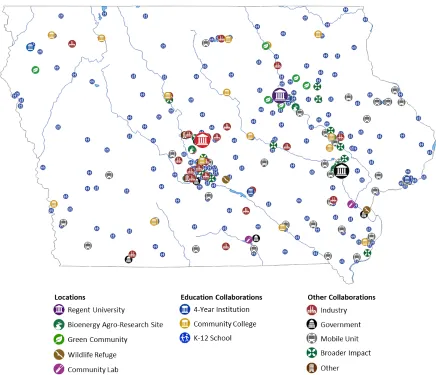
The Iowa NSF EPSCoR Project was led by Iowa State University (ISU), with major activities at ISU as well as at the University of Northern Iowa (UNI) and the University of Iowa (UI). Iowa’s community colleges also participated where appropriate over the 5+1 years of the project. Figure 1 shows an Iowa map identifying locations where Iowa NSF EPSCoR had activities at some point during the duration of this project. Examples of activities on the map location in Figure 1 included, but are not limited to, active research sites, community outreach events, teacher training recipients, etc.
[image:3.612.88.524.245.620.2]1.3 Key Accomplishments During Reporting Period:
1.3.1 Intellectual Merit:
Key intellectual accomplishments during the NCE period focused on the completion and commissioning of the two tall towers for wind energy data acquisition. Iowa now has a unique platform to assess 120 m of the atmospheric boundary layer at two locations, one outside an operating wind farm and one located inside the operating wind farm. The towers have been operating for almost one year and assessment of this preliminary data is provided below.
1.3.2 Broader Impacts:
Key broader impacts accomplishments during the NCE period included an open house at the state capital during the legislative session, the full institutionalization of the importance of broader impacts at ISU, and the second offering of a graduate course on broader impacts at ISU. Details of these accomplishments are summarized below.
1.4 Significant Problems, Novel Opportunities, and/or Changes in Strategy:
Higher than anticipated data loss for the tall tower instrumentation led the manufacturer to send out an engineer to examine our deployment. It was determined that some of the sonic anemometers had a manufacturing flaw that allowed water penetration into the signal splitter on each anemometer during severe weather. As a result, these instruments were returned to the manufacturer for replacement parts.
2 RESEARCH AND EDUCATION
2.1 Major Accomplishments and Research Findings:
2.1.1 Tall Tower Activities During NCE Period
The major research focus during the no-cost extension period focused primarily on the tall tower installation and operation, which was directed by Dr. Gene Takle at ISU. Construction was completed on both towers and instrumentation was installed as specified in the tower
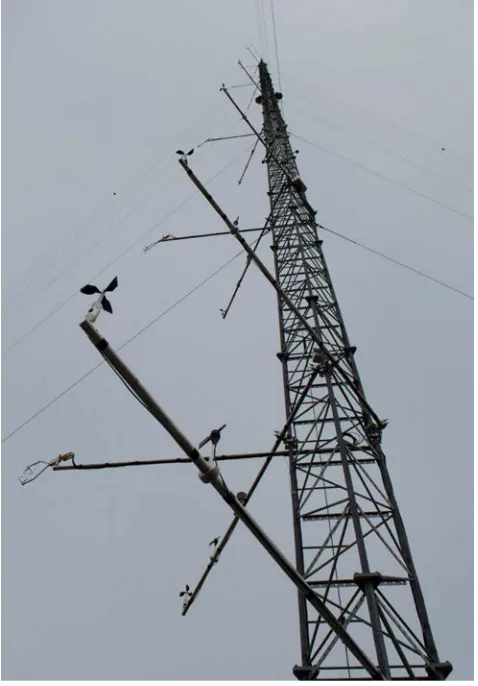
Figure 2: Photos of the Story County (A1) and Hamilton County (A2) 120-m meteorological towers now available for basic and applied research in and near wind farms. Note the wind turbines in the background of tower A1.
[image:5.612.159.450.76.269.2]
Figure 4: Tall tower instrumentation.
Data from the tall towers are being transmitted in real time to the ISU campus where they are archived on the special secure server established for this purpose. Duplicate raw data are being archived on the Iowa Environmental Mesonet and are available for download at
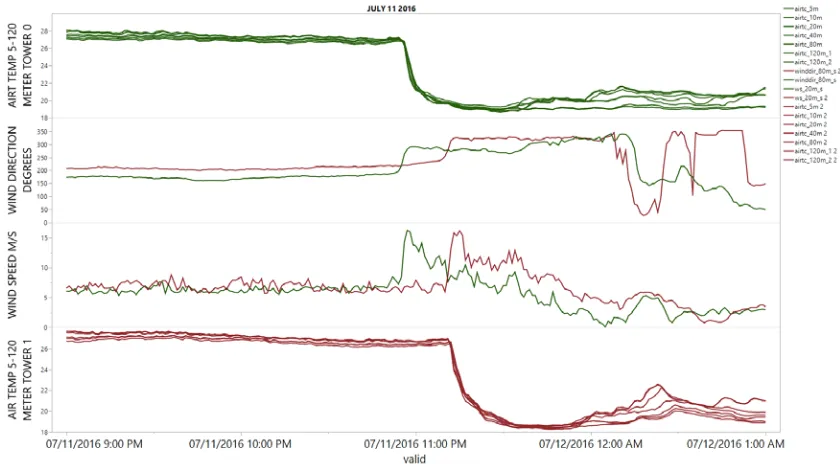
https://mesonet.agron.iastate.edu/projects/iao/. A sample plot of the first tower data used by a student for an undergraduate thesis is shown in Figure 4, reproduced from the Meteorology Senior Thesis of Mitchell Morehead (Morehead, Mitchell J., 2016: Two 120-Meter-Tall
[image:6.612.187.426.72.415.2]Figure 5: Some of the first samples of air temperature, wind speed, and wind direction from all six levels from the 120-m meteorological towers at the Story County and
Hamilton County sites.
The Iowa Atmospheric Observatory was established through Iowa NSF EPSCoR to better understand the characteristics of the atmospheric boundary layer throughout the wind farm from the ground surface to the top of the blade travel (typically 120 m in the current fleet of turbines). A better understanding of these characteristics will help quantify the influence of wind turbines on crops and the factors influencing the total power production of a wind farm.
Wind turbines convert a fraction of the mean kinetic energy flowing through the wind farm to electrical energy and convert another fraction to turbulence, with the remainder leaving the wind farm as a reduced amount of kinetic energy. The kinetic energy reduction (i.e., mean wind speed reduction) and increase in turbulence have a direct influence on the exchange of heat, moisture, and carbon dioxide in the wind farm, and may create an aggregate wind farm effect beyond the boundary.
An individual turbine in a wind farm extracts energy and creates a downwind wake consisting of a conical region of reduced mean wind speed and increased turbulence. Eventually this cone of disturbed air reaches the ground and will influence the exchange of heat, moisture, and CO2 between the atmosphere and crop/soil. In a low-density wind farm (distance between turbines is generally greater than 15D, where D is the rotor turbine diameter, e.g. 80 m) typical of current wind farms in the Midwest US, wakes of individual turbines eventually intersect with other wakes to create a modified atmospheric boundary layer (lowest ~ 40 m of the
atmosphere).
[image:7.612.94.514.74.306.2]characteristics, and downwind extent of wakes are highly dependent on the thermal
stratification of the lowest 200 m of the ambient atmosphere. If the wake is not fully dissipated when it encounters a downwind turbine, the impacted turbine will produce less power than upwind turbines. The net wind farm result is that its total power production is reduced below its nameplate power level, and this changes with time as wakes change direction and dissipate.
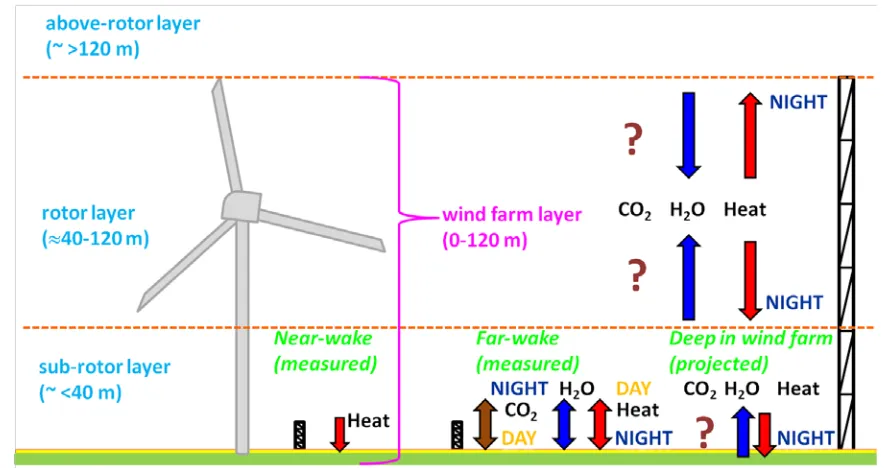
Figure 6 summarizes the impacts on surface and boundary layer microclimate deep in the wind farm from the initial assessment of microclimate changes in the leading few lines of turbines. Currently available measurements from in situ surface flux stations and remote sensing
techniques lack the temporal and vertical resolution to describe the full 3-dimensional structure of wind farm microclimates. The measurements from the tall towers downwind of several lines of turbines augment the understanding of wind-farm impacts on microclimate.
Figure 6: Idealized conceptualization of wind farm modification of surface and boundary layer microclimate based on previous measurements and numerical simulations.
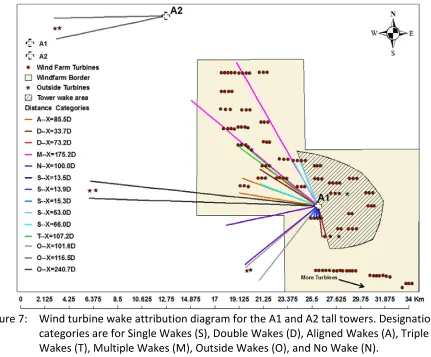
[image:8.612.83.526.265.499.2]Figure 7: Wind turbine wake attribution diagram for the A1 and A2 tall towers. Designation categories are for Single Wakes (S), Double Wakes (D), Aligned Wakes (A), Triple Wakes (T), Multiple Wakes (M), Outside Wakes (O), and No Wake (N).
Figure 8: 80-m and 10-m difference composites (A1-A2) with sensitivities to 80-m hub-height wind speed for combined stability category of “stable” for normalized wind speed (∆U/U0), normalized total turbulence energy (∆TTE/TTE0), potential temperature (∆θ), and specific humidity (∆q). The different sizes of symbols indicate the sample size for each composite.
In the rotor layer, temperatures (Figure 8, lower left) are weakly responding to hub-height speed variations across all wake categories (differences of about ±0.2 K) except for multiple wakes when UH > 6 m s-1 which gave 0.5 K higher temperatures at A1. Under conditions of single and double wakes, 10-m temperatures are lower by 0.4-0.8 K when 3.5 < UH < 5 m s-1, but for UH > 6-7 m s-1 in single wakes and multiple wakes temperatures increase linearly. Surface-layer and rotor-layer differences in temperature for the no-wake conditions are within the natural variation expected because of the vegetation differences at A2 and A1, but higher
A simplified summary of how turbines affect meteorological conditions in the ambient
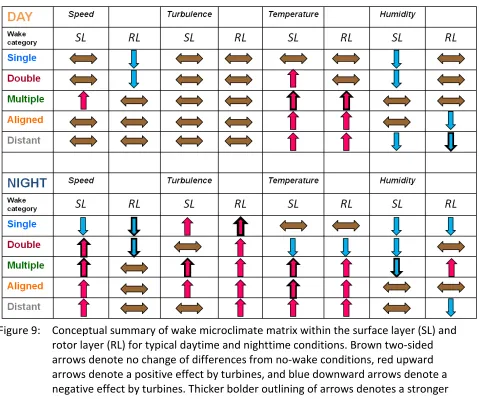
atmospheric boundary layer in the layer occupied by the turbine rotor (RL: 40-120 m) and in the sub-rotor (surface) layer (SL: 5-40 m) is given in Figure 9, which is based on data from our initial year of tall tower data collection.
Figure 9: Conceptual summary of wake microclimate matrix within the surface layer (SL) and rotor layer (RL) for typical daytime and nighttime conditions. Brown two-sided arrows denote no change of differences from no-wake conditions, red upward arrows denote a positive effect by turbines, and blue downward arrows denote a negative effect by turbines. Thicker bolder outlining of arrows denotes a stronger difference.
2.1.2 Building Energy Activities During NCE Period
One activity in the Building Science Plank of the Energy Utilization Platform was completed during the NCE period. The Mobile Diagnostic Lab (MDL), led by Dr. Ulrike Passe, was originally scheduled to be completed by the end of year 5, but construction delays caused the completion to be pushed into the NCE period.
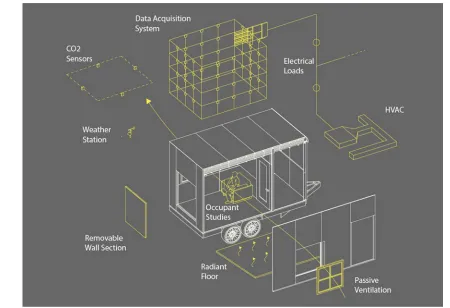
[image:11.612.74.553.146.545.2]long trailer with air suspension. The MDL envelope is built to be airtight and a 6’ by 6’ module wall section is interchangeable to test novel material assemblies for energy efficient
[image:12.612.73.523.131.439.2]construction. A schematic of the MDL is shown in Figure 10.
Figure 10: MDL research capacities (from Jeanblanc (2017).
The MDL houses a programmable HVAC system, a backup propane generator, and an expandable data acquisition system (DAS). The DAS can collect data at different frequencies with multiple sensors connected and can provide live data with remote access. Currently, about 250 data measurement points are wired in the MDL including: a complete weather station, interior air temperature and humidity inside the experiment cabin, surface temperature and heat flux inside and outside the experiment cabin, power generation, and gas consumption. The research capacities of the MDL include, but are not limited to study: diverse heat transfer paths through different building materials, heat and moisture transfer between building interior assembly and the surrounding climate, cool roof materials, green roof materials, PV power system efficiency, baseline energy consumption for different climates, and CFD model for natural ventilation and passive heating.
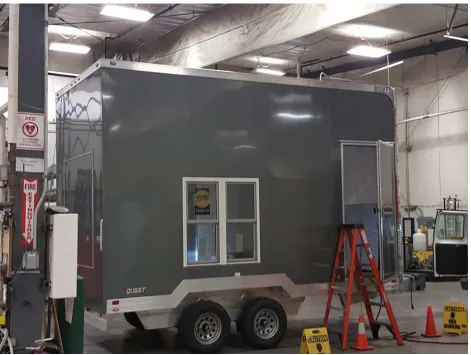
The custom-built trailer was delivered in fall 2016 and the construction of the custom-design interior was completed indoors at the Iowa Energy Center BECON facility in Nevada, IA by hourly research students from disciplines including architecture, civil, and mechanical
acquisition system has been installed and programmed by ISU researchers. The completed trailer is shown in Figure 11.
Figure 11: Exterior view of MDL trailer with removable wall section visible on the left wall behind the white hanging box.
2.1.3 Broader Impact Activities During NCE Period
2.1.3.1 Tall Tower BI
As part of Takle’s tall tower activities, he was invited by the ISU Vice President/Chief Information Officer to provide a talk about his work at the ISU IT Quarterly forum. His talk, entitled “Using advances in computation and visualization to reveal our future global climate changes,” gave examples of how the high-performance computing, data management, and visualization provided through ISU infrastructure helps faculty researchers be successful and raise the scientific stature of their efforts.
wakes and crop energy flux comparisons over corn vs. soybean and extremes in growing season (wet vs. dry) are the subject of one graduate student’s MS thesis work.
Basic meteorological data are widely used by the private sector for a wide range of
environmental and economic applications. Continuous measurements at heights reaching 120-m are especially rare and highly valued. The unique 120-measure120-ments fro120-m the two tall towers will find use in agriculture for assessing and predicting crop growth and yields. As these data
become a part of the NOAA tall tower network, they will find additional value for filling in a gap caused by a lack other of tall tower data from Iowa.
Takle has also provided outreach to the public through a chapter for a book entitled Wildlife and Wind Farms – Conflicts and Solutions aimed at the general public on the impacts of wind energy on the environment. Takle’s chapter used findings from the Iowa NSF EPSCoR Wind Energy plank to describe how turbines interact with crops in an agricultural environment. The book was published in 2017.
2.1.3.2 General BI
Selected specific broader impact activities were also completed during the NCE period and were led by Dr. Sriram Sundararajan; these activities fell within two broad categories of (1) Workforce Development and (2) External Engagement and Communications.
In the area of Workforce Development, primary activities included:
1. Sponsoring faculty development workshops and promoting the institutionalization of the importance of BI activities.
2. Offering of the graduate course ME 605x: Broader Impacts of Engineering on Society at ISU for the second time.
3. Collaborating with the NSF STEM-C grant to provide workshops to elementary school teachers to educate them on engineering and ideas to incorporate engineering content into K-12 as required by the next generation science standards in the State of Iowa.
The external engagement and communications team conducted the following significant activities during the NCE period:
1. The Iowa NSF EPSCoR web site used during the project was consolidated and
transitioned to “legacy” pages that will be available well after the project ends, but will no longer be updated. The homepage of this new site can be found here:
http://www.iowaepscor.org/. The legacies left by each platform were also summarized and provided on the site. The new site home pages contains the following statement:
“Note: This Website serves as a reference and archive for the Iowa NSF EPSCoR program and replaces the site used during the program. This site contains almost all of the content of the old site, and more. Please use the menus (above) or the search function (below) to find content.”
attended representing the overall project. Also attending were Gene Takle (ISU, Wind), Emily Heaton (ISU, Bioenergy), Mary Losch (UNI, Energy Utilization), Andrey Petrov (UNI, Wind and Bioenergy), Al Ratner (UI, Bioenergy), and James Buchholz (UI, Wind). An estimated 15-20 legislators and several staffers walked through between the 7-9 am poster session. There were also at least three different communications photographers taking pictures of legislators talking with Iowa NSF EPSCoR representatives. Ratner also had the small business representatives with whom he worked on his gasifier project, and they went to see Governor Branstad after our poster session carrying his poster through the capital; that meeting was also very successful.
2.2 Significance of Accomplishments and Findings:
Iowa NSF EPSCoR ended in August 2017. Shelly Peterson from the Iowa Economic Development Authority (IEDA) attended the legislative open house in February. The IEDA provided a $2M cost-share through the Iowa PowerFund for the Iowa NSF EPSCoR project. She indicated to Ted Heindel that her office feels that Iowa NSF EPSCoR was one of the most success PowerFund projects that they supported (this comment was unsolicited). We feel this is a significant accomplishment that is shared by all involved in this project.
2.2.1 Tall Tower Accomplishments and Findings During NCE Period
Preliminary data from the Iowa NSF EPSCoR tall towers have provided additional evidence that the 60-year old Monin-Obukhov Similarity Theory (MOST) should be replaced. MOST provides the basis for describing fluxes of heat, moisture, momentum, and trace gases that couple the atmosphere to land and water surfaces, as well as ice masses. MOST is used in every global, regional, and local climate model and every weather forecast model used anywhere in the world. The Iowa NSF EPSCoR tall tower facility has provided the opportunity for Takle’s group to develop a proposal to NSF (recently approved for funding) that provides the basic data to create an alternative to MOST.
The tall tower work will improve the capabilities of any discipline that uses weather forecasts or simulations of future climates. For example, advances already gleaned from wind farm data (see dissertation of David Jahn) have provided an improved component of weather forecast models that increases the skill of these models for use in forecasting wind farm power production. Takle’s work has revealed important interactions between wind turbines and agriculture. Their data provide essential information for making informed decisions on further build-out of wind farms and how to manage dual uses of the landscape where wind farms overlay intensively managed agricultural production.
winds (civil engineering), vertical range of pollen drift (agriculture), dispersion of pollen from genetically modified plants (environmental science), spread of avian flu virus (poultry science), and insect flight (entomology).
The continuously accumulating data archive from the two tall towers is providing an increasing rich database from which to find more extreme and unusual meteorological conditions for further study. Now going into it second year of continuous operation, the tower database also provides one of the longest running archives for studying climate normals, climate variability, and climate extremes in the state of Iowa at elevations above 100 ft. Such unique
meteorological databases normally provide data archives that are used over and over again for decades to come as new problems and opportunities call for re-analyzing fundamental
environmental datasets for different applications.
The tall tower data has the potential of being used to increase wind power and reduce society’s dependence on fossil fuels. Early results from the work of David Jahn show that predicted wind farm wind speeds can be improved by using his modification to a widely used weather forecast model. The extension of the Iowa NSF EPSCoR work through a newly funded NSF award will have very broad implications for societal advances that directly result from improved weather forecasts and future global and regional climate projections.
Finally, Takle’s group published three peer-reviewed journal papers during the NCE period. One PhD dissertation and one book chapter were also published. Five presentations were made on topics highly relevant to the wind resource characterization plank at scientific meetings. Four additional public presentations were made on wind energy research.
2.2.2 Building Energy Accomplishments and Findings During NCE Period
The Building Science Plank continues to have a significant impact on the work conducted at the ISU Center for Building Energy Research (CBER) directed by Passe. The MDL is currently being used to establish new collaborations with the construction engineering department, as well as material science and engineering.
The MDL will have significant impact on potential new research as it has been incorporated into new collaborations with Drs. Kristin Cetin, An Chen, and Behrouz Shafei. Cetin and Shafei have already secured Iowa Energy Center funding to test a novel concrete-phase-change-material assembly in the removable wall section of the MDL. An MS in Architecture thesis currently under the supervision of Passe is preparing to use the MDL to test a new application of nano-cellulose-materials in wall assemblies. The ISU PIRI (Presidential Interdisciplinary Research Initiative) Big Data for Sustainable Cities project is planning on using the MDL to collect microclimate data in the City of Des Moines, Iowa. Finally, Dr. Chen has included the MDL as available facilities in his pending CAREER proposal.
2.2.3 Broader Impact Accomplishments and Findings During NCE Period
1. Broader impacts have been emphasized at faculty development workshops at ISU and the institutionalization of the importance of broader impacts has been completed with a new webpage and BI links at the ISU’s Grants Hub (see, for example,
http://www.grantshub.iastate.edu/proposal-preparation/broader-impacts/). The Grants Hub is a centralized unit at ISU within the Office of the Vice President for Research that provides a broad range of services, resources, and training to help researchers find, obtain, and manage external funding. In particular, the Grants Hub aims to assist new researchers’ pursuit of funding and help experienced researchers reach higher levels of funding. Sundararajan’s success of instituting a BI focus through the ISU Grants Hub has been recognized with an invited presentation at the 2017 Annual Meeting of the
American Association for the Advancement of Science (AAAS), held in Boston in February 2017.
2. A second offering of a graduate course ME 605x: Broader Impacts of Engineering on Society at ISU was completed during the NCE period. The course is the first of its kind in the nation and exposes graduate students to the importance of broader impacts and how their graduate research activities can serve a larger audience. Several other universities have inquired about this course and Sundararajan has given a presentation at the ASEE 2017 Annual Conference and Exposition.
3. Sundararajan collaborated with the NSF STEM-C grant to provide workshops to elementary school teachers to educate them on engineering and ideas to incorporate engineering content into K-12 as required by the next generation science standards in the State of Iowa. These collaborations have led to an accepted journal publication in Science and Children, as well as presentations at the 2017 National Alliance for Broader Impacts (NABI) Summit and the ASEE 2017 Annual Conference and Exposition.
2.3 Problems, Unexpected Results, and Novel Opportunities:
Only one significant problem occurred during the NCE period. Higher than anticipated data loss for the tall tower instrumentation led the manufacturer to send out an engineer to examine our deployment. It was determined that some of the sonic anemometers had a manufacturing flaw that allowed water penetration into the signal splitter on each anemometer during severe weather. As a result, these instruments were returned to the manufacturer for replacement parts.
2.4 Integration of Research and Education:
Limited activities during the NCE period resulted in a small amount of research and education integration.
2.4.1 Tall Tower Research and Education Integration During NCE Period
Three undergraduate students (Gronlund, Nelson, Morehead; see publications list in RPPR) used Iowa NSF EPSCoR data from the tall towers and the Crop/Wind Energy eXperiments (CWEX) measurements to complete their undergraduate senior thesis requirements. Included in these requirements are development of oral, written, data analysis, data plotting, and keyboard skills. Each submitted a written thesis (available online through the ISU Library website provided in the publications list) and an oral presentation at the Annual Atmospheric Science Undergraduate Research Symposium held in December 2016.
Takle’s tall tower team is integrating the tall towers into undergraduate education. For
example, in fall 2016, Takle and his team hosted 50-60 freshman in ISU’s Agronomy 183 – Basic Skills for Agronomists. The catalog describes this course as having a goal of “Developing the skills that agronomists employ in their work with crops, soil, and the environment through activities involving tools and methodologies used by agronomists.” During the class visit to the tall towers, students worked in teams, each team having a set of sensors for making their own measurements, in the area around the tower, to be used for studying the science of
[image:18.612.197.416.350.651.2]measurements (see Figure 12). They then compared their measurements with those from the tall towers and had a discussion of measurement issues, like accuracy, error, and why some of the measures differed from one another.
Takle is also mindful that women lag behind men in the number of STEM college degrees granted, performance metrics, and general interest in STEM careers. Furthermore, STEM bachelor's degrees earned by black college students is not tracking upward with the overall number of bachelor's degrees earned by black students. Therefore, the tall tower team has expanded their broader impacts activities as follows:
1. The Iowa Illinois Nebraska STEM Partnership for Innovation in Research and Education (IINSPIRE) is an NSF Louis Stokes Alliance for Minority Participation (LSAMP) alliance among 16 two-year and four-year colleges and universities working together to broaden the participation of underrepresented minorities in science, technology, engineering, and mathematics (STEM) education the Midwest. The ISU IINSPIRE-LSAMP program annually hosts an IINSPIRE-LSAMP conference
(http://www.iinspirelsamp.iastate.edu/Conference_info_16-17.php) and the tall tower team is represented at this conference.
2. In summer 2016, the tall tower field measurement team hosted Mohamed Gesalla, an IINSPIRE-LSAMP Iowa community college student, for a 10-week research immersion. His poster entitled Preliminary trends from two tall meteorological towers in central Iowa, was presented at the Annual Iowa EPSCoR meeting in summer 2016 and the ISU summer REU poster session. Mohamed graduated from the Des Moines Area
Community College, and now has successfully completed his first year at ISU in the Department of Electrical Engineering.
3. The tall tower team arranged for the ISU summer 2017 IINSPIRE-LSAMP program to visit the Iowa Atmospheric Observatory (IAO) field site in the near-campus wind farm and to create follow-on activities using IAO data. Through this activity with the ISU IINSPIRE-LSAMP, the team developed written materials and datasets appropriate to this level of STEM students. The tall tower team will continue to work with the ISU IINSPIRE-LSAMP recruitment staff to identify students to participate in our field program. Takle’s tall-tower team has demonstrated through their work with Mohamed Gesalla that the ISU tall-tower research team is committed to addressing the acknowledged lack of success in addressing shortcomings in meeting US STEM participation goals.
2.4.2 BI Research and Education Integration During NCE Period
Figure 13: Iowa NSF EPSCoR BE plank researcher Dr. Emily Heaton discussing her work with a state legislator at the Iowa capital in February 2017.
Another significant integration of BI research with education has occurred through the ISU graduate course ME 605x: Broader Impacts of Engineering on Society. Through this course, students:
• Explore ways an engineer’s activities can generally benefit society as well as contribute to specific societal goals, such as broadening diverse participation and public awareness of and engagement in engineering projects;
• Learn about and develop a broader impacts agenda of activities to supplement their technical projects; and
• Hear directly from faculty, staff and others who are leading efforts on campus and in the nation to effect societal impact through science and engineering.
Figure 14: Project presentation in ME 605x: Broader Impacts of Engineering on Society.
3 SOLICITATION-SPECIFIC PROJECT ELEMENTS
3.1 Workforce Development:
Takle has devoted substantial time for professional development of the two staff members drawing significant salary from the tall tower portion of Iowa NSF EPSCoR. Postdoc Dan Rajewski and technician Samantha Purdy (female) are both being groomed for position
advancements in the post-EPSCoR era. For Postdoc Rajewski, considerable one-on-one time has been spent on developing skills for directing work of graduate students and undergraduate students, including project definition, data management, and oral and written presentation of results. Dan has been assigned increasingly more responsibility for proposal writing, proposal reporting functions, budget management, and data analysis and interpretation. The recently awarded NSF proposal has a scientific staff position defined for which he would be qualified with the advances he has made over the past year.
For technician Purdy, Takle has been assigning more responsibility for ensuring the quality and integrity of the data acquisition, processing, and archiving from the tall tower facility, including the role of central contact with the manufacturer on specialized equipment. Takle also worked very extensively with Purdy on her transition to balancing her professional responsibilities with her new family responsibilities related to the birth of her son. Being the only female technician in the co-located agricultural meteorology program and the atmospheric science program, she is a highly visible role model for other females in both of these programs.
3.2 Diversity:
During the NCE period, Takle worked with the Iowa Illinois Nebraska STEM Partnership for Innovation in Research and Education (IINSPIRE), as part of the NSF Louis Stokes Alliance for Minority Participation (LSAMP) alliance, to offer internships and facility tours.
The BI course for Engineering Graduate students reported a high level of impact on the participating students – 9 out of 10 students reported a high gain in understanding and appreciation of broader impacts activities aimed at achieving specific societal outcomes and a diverse workplace environment.
3.3 Partnerships and Collaborations:
Sundararajan collaborated with the STEM-C grant leaders to provide workshops to elementary school teachers to educate them on engineering and ideas to incorporate engineering content into K-12 as required by the next generation science standards in the State of Iowa.
4 TABULAR/GRAPHIC REPRESENTATION OF PROGRESS TO DATE
Table 1: Strategic Priority 1.1: Expand research capacity for evaluating ecosystem sustainability of bioenergy agriculture.
Milestone Yr1 Yr 2 Yr 3 Yr 4 Yr 5 Comments
Establish agreements and
collaborations for use of watersheds
as BAER sites On track Done
Agreements are in place and collaborations established (Landscape Biomass and COBS- Big Creek, NSF CNH –Clear Creek. Train two technicians for
monitoring/maintaining BAER sites On track Done
Big Creek is supported by a technician, Clear Creek is supported by graduate students.
Establish BAER site databases Initiated Done Data base and website at UI will
serve as team site. Purchase hyper-spectral camera and
develop remote sensing platforms Done Operations and data collection began summer 2013.
Implement data base of
hyperspectral imagery for BAER sites On track Done
Purchase/install stream flow, water
quality, soil water, and GHG sensors On track On track On track On track Done
Implement databases for carbon,
water, nutrient, and GHG fluxes On track On track Done
Preliminary data available on carbon,
nutrient, water, and GHG fluxes On track On track Done
Begin remote monitoring of ecosystem changes within the BAER
sites Done
Begin annual monitoring of
ecosystem changes within BAER sites Done
AGRO-IBIS models parameterized
watersheds On track On track Done
Involve students in research in the
BAER sites On track On track
Prepare a large-scale, inter-platform
grant proposal Done
Prepare a large-scale, grant proposal
involving bioenergy faculty Done
Host conference or workshop on
bioenergy agriculture Done
Metrics Yr 1 Yr 2 Yr 3 Yr 4 Yr 5 Comments
Research Publications 1 21 13 12 18
Scientific Presentations 0 44 20 19 18
Extramural Grants Submitted 16 24 19 14 15
Extramural Grants Awarded 5 4 10 2 6
Cross-Institutional authorship of publications 0 8 6 5 8
Table 2: Strategic Priority 1.2: Expand capacity to perform experimental and computational studies of thermochemical biomass conversion.
Milestone Yr 1 Yr 2 Yr 3 Yr 4 Yr 5 Comments
Purchase/install equipment in three
thermochemical processing pilot plants On track On track On track On track Done Completed.
Purchase/install instruments in the
biomass characterization laboratory On track On track On track Done
Instrumentation purchased/installed in
laser lab for fundamental studies On track Done
Hire post-doc researcher to develop
software Done
First bioenergy project in
cyberinfrastructure launched On track Done
Model for simulating biomass thermochemical conversion developed.
First open-source virtual engineering
tools software will be available Done
Open-source code released to research community, see narrative.
Second bioenergy project in
cyberinfrastructure launched Initiated On track Done
Ongoing code development for the open source software to characterize
thermochemical conversion at the particle level.
Workshop conducted on integrating experimental and computational
studies Done
Host conference/workshop on biomass
conversion Done
At least 50% of plank faculty members
engaged in industry collaborations On track On track
Involve students in expanded pilot
plants On track On track Done
Prepare a large-scale, inter-platform
grant proposal Done
Enter into research collaborations with PUI/CCs providing equipment to build
their research infrastructure Done
Agreements established with Indian Hills Community College, and Dordt and Central Colleges.
Three research collaborations with PUI/CCs providing equipment to build their research infrastructure
On
track On track On track Done
Metric Yr 1 Yr 2 Yr 3 Yr 4 Yr 5 Comments
Research Publications 3 49 20 37 42
Scientific Presentations 26 40 48 55 41
Extramural Grants Submitted 19 64 69 38 44
Extramural Grants Awarded 5 11 24 6 5
Scientific Pilot Project Awarded 2 0 10 1 0
Cross-Institutional authorship of publications 0 13 5 10 10
Table 3: Strategic Priority 1.3: Advance the science of wind energy resource
characterization, optimal multi-turbine performance and effective energy delivery.
Milestone Yr 1 Yr 2 Yr 3 Yr 4 Yr 5 Comments
Install instrumented tall
towers On Track On Track
Consultant engaged Y1, sites identified, land contracts under negotiation.
Complete construction of first tower, acquire lease for second, complete
construction of second tower by end of Y3
Delayed On track Done
Both land leases signed, construction and
instrumentation completed summer 2016. Focus of NCE period.
One multi-month dataset on characteristics of the
low-level jet Delayed Delayed Done
Multiple test cases available
for model validation Done
Acquire Windcube Delayed Not needed With the anticipated installation of the two wind towers, the unit
will not be needed. Archive one month of data
from tower and Windcube On track Done Data from CU/NREL unit archived.
One complete year of wind climate data publicly
available in the archive by Y4 On track On track Done
Archive and disseminate
multiple years of data Done
Conduct annual multi-institutional field campaign
Delaye d to
2013 Done Done Done Done
Multi-institutional proposal has been submitted to NSF. Due to a conflict with another field program sponsored by NSF/NCAR, ours was not approved but we have been encouraged to re-apply for a 2018 field program. One test case available in IEA
WAKEBENCH for model
validation On track Done
One test case used by modelers at NREL, PNNL, LLNL.
Establish wind data archive and have inaugural data sets publicly available
On
track Done
Data available from NCAR used by junior faculty. Additional data archived and available from IA Env Mesonet.
Expand archive with CWEX 13 data, facilitate access to
data On track Done CWEX13 data added to archive.
Multiple modeling groups
providing CWEX data Done
See above example- multiple modeling groups conducting research on CWEX data. CWEX data provided for
classes, theses On going On going On going On going
CWEX data used for multiple PhD dissertations, MS theses, undergrad theses, REU projects. Hold international
conference on windfarm model simulation and validation
Will not take place
Metric Yr 1 Yr 2 Yr 3 Yr 4 Yr 5 Comments
Research Publications 0 6 9 1 8
Scientific Presentations 5 7 7 7 13
Extramural Grants Submitted 13 12 10 7 3
Extramural Grants Awarded 0 3 5 2 1
Cross-Institutional authorship of publications 0 0 4 1 3
[image:26.612.72.542.87.170.2]Publications and presentations by junior faculty 2 4 4 2 9
Table 4: Strategic Priority 1.4: Optimize wind energy economics to compete with fossil fuels through engineering advancements in turbine reliability, manufacturability, and maintainability, and delivery of energy to grid.
Milestone Yr 1 Yr 2 Yr 3 Yr 4 Yr 5 Comments
Assess state of the art models for management of generation and distribution of wind energy and renewable energy
Done
Develop risk-based stochastic optimization models to quantify effects of uncertainties on
performance of energy supply chain
Done
Design optimal curtailment curves for
wind generators Done
Develop a multistate flow network model for renewable energy supply chain
On
Track Done
Develop distributed algorithms for voltage and frequency regulation* with piecewise linear cost functions and inter-generator
communications**. Develop methods for demand shaping***
See milestone descript: *done See milestone descript: **done See milestone descript: ***done Generalize loss-of-load-probability metrics to account for generation
variability Done
Design distributed algorithms for voltage and frequency regulation and control with no inter-generator communication
Done
Develop and code discrete-event simulation models for wind energy
supply chain On track Done
Study the effects of storage and load management techniques on reserve
requirements Done
Assess state of the art models for management of generation and distribution of wind energy and renewable energy
Done
Develop risk-based stochastic optimization models to quantify effects of uncertainties on
performance of energy supply chain
Design optimal curtailment curves for
wind generators Done
Develop a multistate flow network model for renewable energy supply chain
On
Track Done
Develop distributed algorithms for voltage and frequency regulation* with piecewise linear cost functions and inter-generator
communications**. Develop methods for demand shaping***
See milestone descript: *done See milestone descript: **done See milestone descript: ***done Generalize loss-of-load-probability metrics to account for generation
variability Done
Develop multiscale blade damage
model On track Done
Develop computational code blade
damage initiation and propagation On track Done
Validate models developed in
previous years Done
Develop multiscale model of gearbox
bearing failure On track Done
Develop multiscale model of gear
teeth failure On track Done
Conduct RBDO of gear box bearing
and teeth under aerodynamic loads Done
Develop material processes to improve manufacturability and
maintainability Done
Conduct pilot tests and develop
models for finished part integrity On track Done
Improve the processes with models Done
Develop wind energy drivetrain
modeling and simulation code Done
Integrate the drivetrain simulation code with RBDO with wind load and geometry uncertainties. Demonstrate RBDO methodology on turbine drivetrain
On track Done
Conduct RBDO of wind turbine
drivetrain Done
At least 50% of plank faculty members engaged in industry
collaborations On track On track
Continued industrial engagement by
Metric Yr 1 Yr 2 Yr 3 Yr 4 Yr 5 Comments
Research Publications 15 14 32 9 19
Scientific Presentations 6 20 22 17 11
Extramural Grants Submitted 17 15 16 12 3
Extramural Grants Awarded 3 3 6 6 1
[image:28.612.72.541.71.147.2]Publications and presentations by junior faculty 7 26 37 32 23
Table 5: Strategic Priority 1.5: Utilize community-level laboratories to determine whether or not social marketing interventions can change energy conservation knowledge, attitudes and behaviors.
Milestone Yr 1 Yr 2 Yr 3 Yr 4 Yr 5 Comments
Three communities and partnering community colleges/four-year colleges selected
Done
Communities: Charles City, LeMars, and Oskaloosa; Colleges: Hawkeye CC, Western Iowa Technical CC, Wartburg College and Buena Vista University.
CSBR Summer Minority Internship
Developed Done
Focus groups, interviews and
pretest surveys completed On Track Done
Intervention Materials Developed On Track Done
Materials and media buys in place
in communities On track Done
Intervention events completed Done Completed August, 2013.
Energy Audit follow-up completed Done Completed August, 2013.
Posttest Interviews Completed Done
Survey and audit interviews
completed On track Done
Sales and energy data collected
and analyzed On track Done
Grant Proposal Developed with
Junior Faculty On track Done
Metric Yr 1 Yr 2 Yr 3 Yr 4 Yr 5 Comments
Collaborative Agreements with 4-Year Colleges
& Community Colleges Established 3 0 - - -
Scientific Presentations 0 0 5 1 2
Extramural Grants Submitted 1 4 0 2 0
Extramural Grants Awarded 0 0 0 0 0
Number of Female and URM Students
Participating in Plank 2 6 2 2 2
Table 6: Strategic Priority 1.6: Study the relationship between building science, design, and human behavior in existing structures in Iowa.
Milestone Yr 1 Yr 2 Yr 3 Yr 4 Yr 5 Comments
Establish data acquisition system and performance evaluation baseline of Interlock House as community lab
On
track Done
Interlock House established as working community laboratory August 2013.
Evaluate Interlock House data On track Done
Establish field laboratory with
one middle school/high school On Track Done Upgrades to Columbus Junction High School completed August 2013.
Establish two field laboratories to study energy efficiency in building structures and construction processes with outreach to K-12 STEM education projects
On
track On track Done
Establish Baseline reporting
parameters On Track On track Done Baseline data collected and reported for Y2 and Y3 for Interlock House.
Multiple calibrated design models and simulations completed
On
track Done
Evaluation strategies developed On track Done
Metric Yr 1 Yr 2 Yr 3 Yr 4 Yr 5 Comments
Research Publications 0 2 11 5 12
Scientific Presentations 7 6 23 17 19
Extramural Grants Submitted 5 10 17 21 19
Extramural Grants Awarded 0 0 5 5 10
Cross-Institutional authorship of publications 0 3 4 3 0
Number of undergraduate students involved in building
science research and / or independent study projects 24 29 38 31 30
Number of graduate students involved in building science
research and/or independent study projects 6 6 7 6 5
Table 7: Strategic Priority 1.7: Advance integrated engineering/economic modeling to project the impact of federal, state, and local policies on renewable energy markets, technology design and deployment.
Milestone Yr 1 Yr 2 Yr 3 Yr 4 Yr 5 Comments
Post-doc from engineering hired
to support platform Done
Establish and run a regular
seminar series On track Established Seminar series first offered F12-S13, available as webinars.
Run a regular seminar series where research results are
presented and discussed Done Done Done
Establish and deliver energy policy
graduate course On track Done
Courses developed: BRT515x -Energy Policy; BRT516x - International Energy Policy.
Offer energy policy course On going On going On going BRT515x was offered in F15; BRT516x was offered in S16.
Develop a market modeling framework integrating economic
and engineering analyses Done
Develop new methods to solve stochastic models and
communicate results within the modeling framework
On
going On going
Evaluate the economic and technical feasibility of new renewable energy technologies
On
going On going On going On going Done
Provide stipends for faculty to travel/participate in
interdisciplinary workshops and conferences
Done Done Done Done
Provide stipends for faculty to develop interdisciplinary (engineering/economics) teams and grant applications
Done Done Done Done
Metric Yr 1 Yr 2 Yr 3 Yr 4 Yr 5 Comments
Research Publications 2 11 3 7 9
Scientific Presentations 1 21 18 15 5
Extramural Grants Submitted 3 27 18 10 9
Extramural Grants Awarded 1 3 4 2 1
Number of students taking policy classes 0 39 34 24 29
Number of faculty participating in
workshops/seminars 2 32 40 44 45
On-campus seminars held 0 6 6 6 7
Cross-disciplinary authorship of publications 0 9 2 7 3
Presentations by junior faculty at scientific
conferences 3 9 20 14 5
Table 8: Strategic Priority 1.8: Analyze market and technology deployment impacts of policies designed to promote RE and communicate results to the public, federal and state legislators and regulators.
Milestone Yr 1 Yr 2 Yr 3 Yr 4 Yr 5 Comments
Use the newly-developed integrated modeling framework to conduct analysis of proposed policies and new technologies and publish web-based reports on findings
Done Done Done Done Done
Brief legislators and regulators as requested as to the technical and economic feasibility of new
renewable energy technologies Done Delayed Done Done Done
Metric Yr 1 Yr 2 Yr 3 Yr 4 Yr 5 Comments
Legislative/Congressional Public Briefings 1 0 2 0 0
Updates of web-based outlook information 2 4 6 1 2
Table 9: Strategic Priority 1.9: Implement coordinated multi-institutional human resource development activities for assisting with the recruitment and mentoring of early career tenure-track faculty for RE/EE research and education capacity.
Milestone Yr 1 Yr 2 Yr 3 Yr 4 Yr 5 Comments
Establish the FLARE Institute: hire staff; establish Advisory Board. New in Y3: Review concept, move to Decentralize leadership
Done Done Trans formed
Decision was made that each University would build on their individual strengths in faculty development; this change was approved in the revised strategic plan.
Diversity taskforce provides resources to help search committees reach women and URM candidates
Being develo ped
On
track On track On track Institutionalization completed
Coordinate plans across the Regent Institutions and hire new faculty
members Done Done
Plans for RE/EU faculty completed as part of the final negotiation for the grant - 3 faculty hired in Y1 started work in Y2; 3 new faculty hires in Y2 started work in Y3. NOTE: 1 new faculty hire leveraged in Y4 to support EPSCoR Policy courses. Engage additional faculty through
seed grants Done Done
Several seed grants made to faculty at the three regent universities- see narrative. BI leaders provide appropriate
mentoring and professional development programs for new faculty
On
track On track On track On track BI checklist developed
Plan and implement professional development programs for researchers, post-docs, and graduate students
Done Done On track On track On track
Catalog existing BI related programs
Collect and analyze data on BI programs; modify programs as needed
On
track On track On track
Gather information/data on the successes and the challenges faced by existing BI programs to identify strategies appropriate for Iowa
On
going On going On going
Started collaborating with a subset of BI programs at all 3 campuses in Y2, will continue to gather data.
Disseminate lessons learned at Iowa and best practices across the state and EPSCoR jurisdictions
On track Collaborate with the NSF I-3,
ADVANCE programs and other BI related programs at Regent institutions
On
track On going On going On going
Best Practices from SP@ISU (NSF I-3 program) and ADVANCE documented, available Fall 2013. Collaborations with NCBI. Disseminate best practices
nationally. On track
Metric Yr 1 Yr 2 Yr
3 Yr 4 Yr 5 Comments
Number of new faculty hired in
RE/EU platforms 5 3 0 1 0
Updated Y2 number: New hire in WE Platform (ISU) started Jan 2014. New BE and EU hires at UNI started Fall 2013. New Energy Policy Hire started Sept 2014.
Women faculty in RE/EE
platforms 14 13 24 32 32
URM faculty in RE/EE platforms 2 3 7 8 10
Number of faculty development
programs offered 10 18 18 21 29
Number of non-Regent
Institutions in Iowa that connect
with Iowa NSF EPSCoR 3 13 19 19 19
Includes Iowa´s 15 CCs, Dordt, Central, Coe and Grinnell Colleges.
Number of non-Iowa institutions that connect with or
communicate with Iowa NSF EPSCoR for purposes of dissemination
0 1 5 5 5
Percentage of EPSCoR faculty, post-docs, graduate students who
attend development programs 50% 65% 70% 70% 70%
Table 10: Strategic Priority 2.1 (maps to outcomes A, C and D): Increase participation of women and underrepresented minorities (URMs) in STEM, especially in RE/EU fields through the coordination of statewide, multi-institutional efforts.
Strategic Priority 2.2 (maps to outcomes B, C and D): Coordinate resources to help faculty, staff, and students create a more welcoming environment with sustainable support systems for success of women and URMs in affected programs.
Outcomes Yr 1 Yr 2 Yr 3 Yr 4 Yr 5 Comments
A
Catalog existing Diversity related programs at the Regent universities (including education and outreach)
On track Done
A
Identify a subset of the
cataloged programs that EPSCoR can work with to leverage and maximize impact
On track On track Done
Examples of
collaborations include Pre-engineering camps, PLTW, MESA, SHPE, NSBE, WiSE, FIRST tech challenge, Office of Veterans affairs, IINSPiRE LSAMP, SP@ISU.
A Continue collaborating with other BI related programs at
related institutions On track
A Increase participation of female and URM students in EPSCoR supported programs.
In
progress In progress In progress In progress In progress
A Disburse/award matching support for CC and UG STEM
research interns Done Done Done On track Done
A
Expand RE/EU research internship programs for community college and
undergraduate students. On track On track
Accomplished through the EPSCoR internships and co-funding with the IINSPiRE LSAMP and Bridge Program at Kirkwood CC.
A
Establish appropriate indicators and benchmarking data to represent information about
participation Initiated
In
progress
A
Refine and utilize indicators and benchmarking data to inform progress in participation of women and URMs in EPSCoR programs
Done
A
Catalog resources to help search committees in reaching qualified female and URM applicants via ISU ADVANCE and other related initiatives
A
Provide search committee training to positively impact efforts to recruit highly qualified women and URM applicants
On track On track Done
A
Search committees across the state use the resources
developed by the Diversity team in their hiring practices and processes to reach qualified women and URM applicants
Done
Search committee training
institutionalized at UI and UNI.
B
Catalog existing STEM education and outreach programs (diversity and WFD) across the jurisdiction
On Track Done
B
Inform programs of evidence-based practices to promote effectiveness and success. Establish appropriate indicators and benchmarking data for to represent information about participation
Initiated On track
Diversity
Report/Action Plan, training workshops and conference presentations used to share best practices and to monitor key indicators.
B Programs utilize evidence-based practices and measure progress Ongoing
B
Network with a subset of existing diversity related program leaders to learn about their needs and ways to engage them
Done
B
Leverage existing programs to increase quantity of participants or extent to which change is achieved
Initiated On track Done
Examples include SHPE, MESA, NSBE, Upward Bound and Black Youth Achieving Excellence. Started working with Iowa First Nations, CC students.
B
Provide NCBI and/or other training workshops for interested project faculty, staff,
and students. Done Done Done Done Done
Curricular component: “Culturally Intelligent Leadership”, established. C
Implementation of review processes for Iowa NSF EPSCoR programs and expected program
specific diversity goals Initiated
In
progress In progress
C
Programs show evidence of sustainable practices in moving towards attainment of diversity goals.
Done
Examples are PLTW (self-sustained) and summer research experiences.
C Establish appropriate indicators and benchmarking data for
various stakeholder programs Initiated On track On track
C Refine and utilize indicators and benchmarking data to inform progress in programs
B , D
Implementation of a process that compiles and reviews results from existing climate/attitude surveys conducted by constituents and from new assessments
Initiated On track In progress
B , D
Use of process to measure change in overall
climate/attitudes across jurisdiction to the best extent possible
In
[image:35.612.73.541.72.196.2]progress
Table 11: Strategic Priority 3.1: Create innovative and transformative approaches to educate the future workforce necessary to strengthen the state’s leadership in renewable energy and energy utilization.
Milestone Yr 1 Yr 2 Yr 3 Yr 4 Yr 5 Comments
Develop K-12 Professional
Development (PD) training materials On track Done
Provide PD training for K-12
educators On track On track On track
Develop and provide appropriate PD
programs for CC instructors On track On track On track On track On track
Provide student summer and academic year research experiences, directly and/or by leverage of other programs.
Done Done Done Done Done
Provide opportunities for interested community college instructors to have summer research experiences at Regent Institutions
On
track Done
Several opportunities provided in Y2. Feedback indicated that this was not viable/feasible as support - goal transformed in Y3.
Provide assistance to Community Colleges for pedagogy and
curriculum development as needed. Provide partnership support in pursuing external grants
On
track Upon request Upon request
Feedback from community colleges indicated that they preferred this kind of engagement. Students enroll in Energy Systems
undergraduate minor at ISU. First students complete minor in Y3-4
On
Metric Yr 1 Yr 2 Yr 3 Yr 4 Yr 5 Comments
Number of K-12 teachers
participating in RE/EU PD training 160 231 421 519 504
Number of students impacted each year by K-12 teachers receiving RE/EU
PD training 14,560 28,875
40,58
0 55,220 49,280
Estimate 20 students reached by Elem. teacher; 100 by MS/HS teacher.
Schools audited by RE/EU PD training
teachers 15 12 12 15 20
RE/EU lesson plans by RE/EU PD
training teachers -- 31 46 50 55
Lesson plans developed by Summer Academy and Energy Institute participants. Students Participating in RE
[image:36.612.72.539.72.230.2]undergraduate minor at ISU 0 14 15 23 19
Table 12: Strategic Priority 3.2: Expand the Iowa workforce that is technically qualified to support the growing renewable energy and energy efficiency sectors.
Milestone Yr 1 Yr 2 Yr 3 Yr 4 Yr 5 Comments
Hire PLTW
Implementation/Diversity Coach
Completed Summer
2012
PLTW coach visits high-need PLTW secondary schools and community college PLTW directors
Ongoing Ongoing Ongoing Ongoing
Worked with 146 school districts for program improvement and future implementation and grant opportunities.
Increase in the number of PLTW
affiliated schools. On track On track On track On track Steady state in Yr 5.
Increase diversity of PLTW
course participants On track On track On track On track
Metric Yr 1 Yr 2 Yr 3 Yr 4 Yr 5 Comments
PLTW secondary schools visited by D/I Coach 5 52 8 9 8
New PLTW secondary schools added to state
network 14 32 26 26 ** **Numbers not available.
Percentage females in PLTW courses 15.4% 16.1% 18.2% 18.2%* 18.2%* *State has not provided updated #s.
Number of community college teachers
Table 13: Strategic Priority 4.1: Facilitate communication between various constituencies within the Iowa jurisdiction, outside the Iowa jurisdiction, and at the state and federal government level.
Milestone Yr 1 Yr 2 Yr 3 Yr 4 Yr 5 Comments
NSF EPSCoR Renewable Energy web hub established with initial content; Extend
web outreach and involvement Done Done
Monthly additions to web site on platforms; Increased traffic on website from previous year; Y3: Add new diversity tab
Done Done On track On track Done
Create/subscribe users to Iowa EPSCoR
newsletter Done On going On going On going Done
Hire, train, and utilize student journalists Done Done Done Done Done
Core “talking points” developed and
shared with Iowa EPSCoR faculty Done Done Done Done NA
Conduct one workshop for federal
congressional staff in in Years 1, 3, 5 Done Done Not Done
Two state legislators/year participate in
“legislators in the lab” Done Delayed Done Done Done
Conduct annual meeting Done Done Done Done Done
Metric Yr 1 Yr 2 Yr 3 Yr 4 Yr 5 Comments
Iowa NSF EPSCoR web site hits 1,124 6,000 2,720 7,645 6060
Iowa NSF EPSCoR newsletters developed 1 3 3 3 3
Iowa NSF EPSCoR newsletter subscriptions 0 632 864 883 1159* *as of March 2016.
Embedded journalists (# students) 2 3 3 3 2
Embedded journalists (# articles) 6 9 12 12 6
Talking points 1 1 1 1 0
Elected officials and State Legislators in the lab 3 3 2 2 9
Workshops for federal congressional aides 1 0 2 0 0
Workshop attendees (federal congressional
aides) 34 0 80 0 0
Annual meeting (internal participants- faculty
and staff) 73 78 69 52 50** **Estimate
Annual meeting (student participants) 60 59 61 55 50** **Estimate
Table 14: Strategic Priority 5.1: Support overall project goals by providing connectivity, access, and CI-related training for EPSCoR members, educators, and industry partners.
Milestone Yr 1 Yr 2 Yr 3 Yr 4 Yr 5 Comments
Hire two CI technical staff (one at ISU and
one at UI). Done
Develop comprehensive Iowa EPSCoR
website Done
Develop an open-source suite for computational and theoretical models, for research platforms
On
track Done
Open source web based access to basic data analytical and statistical tools.
Establish connections among Regent
institutions using existing facilities On Track Done
Identify and establish a community of CI users (researchers, staff and students) in RE/EU
On
track On track
Grow the community of CI users
(researchers, staff, and students) in RE/EU Done
Implement training programs to interface
HPC with the scientific community In progress Done
Develop and implement training materials
for CI resources as needed On track On track Done Interlock House CI tools, resources from training.
Link sensors from across the state that measure climatic, environmental, and
ecological data Done
Integrate data driven models with large scale computational modeling to develop a simulation based research environment to predict large scale energy systems behavior
On
track Done
Y4: EPSCoR seed funding on using Cyber infrastructure to enhance understanding of bioenergy agrosystems. Create a virtual engineering tool to assist
the bioenergy platform develop efficient systems for collecting, analyzing, and modeling data
Not done
CI resources instead used to support the Wind Tall Tower project.
Establish guidelines for developing and
designing energy systems for state wide use On track Done
CI platform for Interlock house: data collection for monitoring energy usage. Energy consumption data disseminated to
promote efficient use of energy for
commercial and residential consumers Done
Interlock House data available for public review.
Develop educational portals On track Done
Seek additional funding for CI related
projects On going
On goin g
On
Metric Yr 1 Yr 2 Yr 3 Yr 4 Yr 5 Comment
CI Technical hires are made 2.5 - - - -
Number of research projects that have CI-enabled
data/resources 3 2 3 4 4
Number of Project Participants Using High
Performance Computing Resources 10 15 15 2 2
Number of educational programs connected via CI 2 4 3 1 1
Number of training programs for HPC related skills 0 1 3 1 1
Number of open-source materials available 0 5 4 1 1
Number of CI related grant proposals submitted 2 0 6 2 0
[image:39.612.74.540.72.212.2]Number of CI related grant proposals funded. 0 0 1 1 0
Table 15: Strategic Priority 6.1: Implement an integrated, multi-year evaluation plan to measure progress toward the goals and objectives of the IA EPSCoR Project.
Milestone Yr 1 Yr 2 Yr 3 Yr 4 Yr 5 Comments
Evaluation processes are developed Done A logic model and a data implementation plan has been
developed. Engage an external evaluator and
appoint an evaluation advisory team On track Done External Evaluator confirmed, Scientific Advisory Board established.
Identify project outcomes, metrics, and
baseline data On track Done
Project outcomes and metrics are in the evaluation plan; base line date was collected summer 2012. Research and BI outcomes are identified
and assessed with respect to established goals
On
[image:39.612.67.545.261.404.2]going On going Done BI checklist is available through the newly created ISU Grants Hub.
Table 16: Strategic Priority 7.1: Build a statewide RE/EU research and education enterprise that continues beyond the five-year project period.
Milestone Yr 1 Yr 2 Yr 3 Yr 4 Yr 5 Comments
Statewide Science and Technology Plan
completed and adopted Done
Grant proposals submitted Ongoing Ongoing
Growth in sponsored funding in RE/EU at
the three Regent Institutions On track On track On track
Faculty hired into tenure-track positions Done Done
9 faculty (2 females, 1 URM) were hired to the Regent Universities as a result of IA NSF EPSCoR.
Metric Yr 1 Yr 2 Yr 3 Yr 4 Yr 5 Comment
Extramural Grants Submitted 74 129 142 98 76
Extramural Grants Awarded 14 24 48 29 18
Table 17: Strategic Priority 8.1: Maintain an effective, transparent and multi-level
management structure to provide oversight and coordinate the research, BI, and sustainability plans of the project.
Milestone Yr 1 Yr 2 Yr 3 Yr 4 Yr 5 Comments
Management
Develop project strategic plan Done
Review and revise project strategic
plan using evaluation data Done Strategic plan revised, approved 3/5/14.
Project strategic plan updated for
post-award activities N/A
Project review of sustainable activities. IA graduated from EPSCoR.
Hire Budget Analyst and Project
Administrator Done Done New budget analyst and PA started in Y2.
Establish an external Advisory
Board On Track Done Science Expert Board finalized in Y1.
Conduct annual review by the
Science Expert Board Done Done On track On track Done
Governance
Establish the State Governing
Committee’s charter and by-laws Done
Develop and approve state S&T
plan Done Signed S&T Plan sent to NSF 8/2012.
State Governing Committee assists researchers in pursuing funding
opportunities NA NA NA NA
Iowa graduated from the EPSCoR program in Spring 2015.
5 SPECIAL CONDITIONS