1
Basavaraju S
#1,
Dr.Shivakumar B
#2Assist Prof, SCE College, Bangalore, Prof and HOD TC dept, Dr AIT, Bangalore
#1
[email protected], #[email protected]
Abstract
: In this paper, considering Post processing and Rate distortion(rate control) algorithm for a new google released VP8 Video codec’s , even though these two algorithms considering already for other video codec’s and applying for VP8 video codec to improving the performance in terms of quality of the data as well as improving the speed is novel method. Actually rate control method will plays a better role in especially video coding and transmission to provide the good video quality at the receiver end, our proposed algorithm technique mainly exploits the existing constant-quality control, which is governed by a parameter called quality factor (QF) to give a constant bitrates. So that for this purpose a new modified mathematical model called the rate–quality factor(R–Q`) is derived to generate optimum QF for the current coding frame using the bitrates resulting from the encoding of the previous frame in order to meet the target bitrates. And also in this method the process of calculating the quality factor is so simple and further calculation is not required for each coded frame. It also provides the rate control solution for both intra-frame and inter-frame coding modes. Similarly In order to improve the quality of the reconstructed video introducing novel deblocking algorithms and classify them into several categories and implemented for VP8 Video codec’s. On the other side the PSNR is widely used for checking the quality of the compressed video. However, PSNR sometimes does not reveal the quality perceived by human visual system. In this paper, we will introduce another measurement to estimate the blockiness in the compressed video. So that VP8 video codec is successfully implemented based on this method and achieve better visual quality of video data and also able to achieve good performance.Keywords— Rate distortion, Post processing, Video, VP8, Mobile, PSNR, QF
1
INTRODUCTIONVideo coding and transmission of this data in mobile multimedia communication is very much important for today’s multimedia‘s applications, And increasing digital applications are everyday and in this most of the applications have very different constraints. Major challenges in designing a good digital video system are to provide encoded video with good visual quality and compression performance. For high compression video coding is mainly needed operational control of the video encoder, And also for real-time mobile multimedia communication, an efficient rate control algorithm at the encoder is very important to assure successful transmission of coded video data. Essentially, the rate control part of the encoder tries to regulate varying bitrates characteristics of coded bit- streams in order to produce high-quality decoded frame at the receiver for a given target bitrates so that compressed bit streams can be delivered through the available channel bandwidth without causing buffer overflow and underflow.
1.1 Survey about Post processing algorithms:
146
severe quantization noise to the low frequency component. One example is shown in Fig. 1 Now almost all techniques are working on block by block basis.So that considering in order to reducing this blocking artifact, several deblocking algorithms had been proposed earlier also. Here we can classify the whole deblocking algorithms into four different types: in-loop filtering, post-processing, pre-processing and overlapped block methods. Especially here considering the in-loop filtering algorithm inserts deblocking filter into the encoding and decoding in-loop of the video CODEC, and one example of this method is adopted in both H.264/AVC as a well as VP8 Video codec’s .
And also one more important parameter is other post processing algorithms have been proposed for video coding, most of them applying a one dimensional vertical filter to remove horizontal edges, followed by another one dimensional horizontal filter to remove vertical edges [9], [10], resulting in a large number of redundant operations. Furthermore, these methods operate on previously decoded frames as a processing unit, where each decoded picture should be fetched and stored in external memory twice for applying filters in both directions, which increases drastically the memory bandwidth.
Major Observations of Blocking Artefacts:
Mainly three major observations on blocking artefacts could be identified in block-based transform coding.
I. Because of the masking effect of the human visual system (HVS), there are different sensitivity of
the HVS to areas of the image and video with different complexity. The blocking artifacts are more noticeable in flat areas than in complex areas.
II. The deblocking filter can remove some high frequency discontinuity over the block boundaries; however, it may result into blurring the real edges in the original image or video frames.
III. The motion compensation prediction (MCP) propagates the blocking artifacts into the next frame in
video coding.
1.2 Survey about Rate distortion algorithm for Video codec’s
The main Rate–distortion optimization (RDO)-based rate control algorithm is proposed earlier methods [2][4], in that mode usually minimizes the cost function is chosen and the respective QP is used for actual encoding. Even considering their proposed algorithm achieves a maximum gain of almost 0.48dB over H.264 current rate control scheme, the algorithm requires two-pass RDO process in finding the optimum QP, which introduces unnecessary coding delay and complexity to the encoder
And most of the modern codec’s algorithms are beyond still image compression techniques and take into account for the similarities between frames to achieve better compression.Basically coding efficiency of any system or codec’s depends on prediction accuracy .The more accurate prediction of codec is the smaller the prediction errors and use fewer number of bits for representing them. And also even to make more accurate predictions, more neighboring pixels should be taken into consideration. So the choosing of the predictor and also the weights of the neighbouring pixels has a direct bearing on the efficiency of the algorithm. Considering any kind of video coding the all prediction errors in each of the DCT blocks (8x8) are DCT transformed, and then quantized (according to specified QP), zigzag scanned, and lastly run-length coded. This Rate controller method will chooses compression mode and quantization. In this way, Rate-distortion optimization techniques have been mainly applied to video encoders [5] and it will provide good potential for substantial improvements in compression efficiency.
2. POST PROCESSING ALGORITHM FOR VP8 VIDEO: a) VP Video codec:
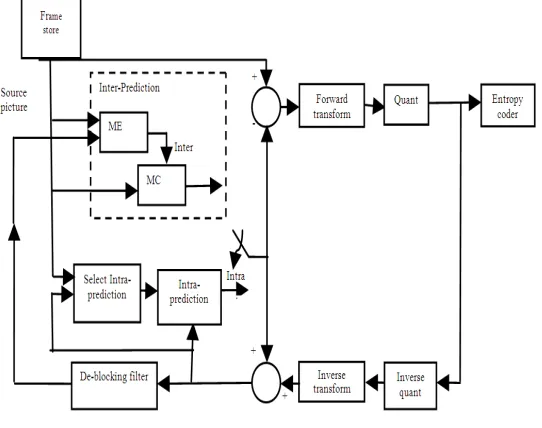
The complete block diagram of VP8 Video codec [12] is shown in fig 1 Basically VP8 Video codec is released by On2 technologies and then Google acquired On2 calls for Google to release the VP8 source code.At this moment, libvpx is the only software library capable of encoding VP8 video streams and also the same libvpx is capable of decoding VP8 video streams. VP8 offers the "highest quality real-time video delivery",
It has also started to attract broad interest in the video coding research community from both industry and academia.
VP8 has a highly adaptive in-loop deblocking filter. The type and strength of the filtering can be adjusted for different prediction modes and reference frame types.
147
one an “alternate reference frame.” VP8 bit stream initially separating the compressed data into two categories, one for macro block coding modes and motion vectors and one for quantized transform coefficients.And major features of VP8 Video codec is it will support for low bandwidth applications and major features are Web video format, Hybrid transform with adaptive quantization, Flexible reference frames, Efficient intra prediction and interpretation, sub-pixel interpolation, Adaptive in-loop deblocking filtering, even Frame level adaptive entropy coding, and friendly data partitioning.
VP8 video compression codec of the WebM open video format that is available freely. And A 3-bit version number (0 - 3 are defined as four different profiles with different decoding complexity; other values may be
defined for
future variants of the VP8 data format).
There are two decoders 1) VPX decoder
2) Simple Decoder the only difference between the two is that simple decoder just simply decodes a stream and nothing else, while the vpxdec can do plenty of other things.
2.1 In-loop adaptive Deblocking Filter
In order to enhance the visual quality and coding performance, VP8 adopts the in-loop filter in its coding loop [1-3]. Fig. 2 shows the encoding architecture ofVP8 video. As can be seen from the figure, the previously reconstructed frame passes the loop filter before motion estimation. Because the filtered frame is more similar to the original frame, we can obtain motion vectors with higher accuracy.
As mentioned in the previous section, we know that the blocking artifact will propagate into the later frames in video coding, which will degrade the visual quality and thus affect the compression ratio. Based on this observation, we can achieve higher compression ratio and better visual quality if we can effectively eliminate the blocking artifacts. Therefore, H.264/AVC[1] and H.263+ add the deblocking filter into the coding loop to improve the visual quality and the accuracy of MCP. In the following two sub-sections, we will introduce the in H.264/AVC in-loop filter and one novel in-loop filter in [4].
Optimal Post-Process/In-Loop Filtering:
In the previous sub-section, we introduced the VP8 and other Video codec’s in-loop filter[9] for removing the blocking artifact. However, the filter coefficients are fixed so that they may not be the best solution to the entire macro block.
Table: 1: Block mode conditions and Boundary strength value
Block modes and conditions BS Pixels to be
148
Otherwise 0 No filtering
is applied
Post-processing De blocking Algorithms
Post-processing algorithms [4] are the most popular methods for improving the quality of the image and video and eliminate the annoying blocking artifact. On the other hand, the post-processing algorithms can achieve deblocking without the original image and video, so the standard need not to be modified. In this section, we will introduce several post-processing algorithm for removing blocking artifact.
2.2 Reduction of Blocking Artifacts in DCT Domain:
In this subsection, we introduce a post-processing filtering algorithm in DCT domain [6-8]. We define the block
,
In the original image, the neighboring DCT coefficients at the same frequency are very similar and do not vary radically within a small range. Thus, we can apply low pass filter to the DCT coefficients at each frequency to filter the high frequency parts resulting from blocking effect. However, this method may blur the real edges in the original image, so we must have the mechanism to detect activity of the block and apply the filter with
corresponding strength. DCT-domain filtering is applied to revise the block
B
m n,( , )
u v
to obtain the new DCTcoefficients
B
m n,( , )
i j
.The post-filtering works in different ways for the blocks with different activities.
For blocks with low activity, the blocking artifact is more noticeable, so we apply strong filtering to smooth the highfrequency components. The filter coefficients are defined in eq (3)
,
1, ,
2,..., 2
k lw
=
k l
= −
(3)149
A) In-loop Adaptive De blocking filter algorithm Table: 2
B) Post-processing De blocking Algorithms: The post-processing algorithms are employed at the decoder
output, so they have good potential to be integrated into existing image and video standards.
3 .PROPOSED RATE DISTORTION OPTIMIZATION FOR VP8 VIDEO CODEC:
So that the rate control plays very much an important role in all video standards. Without this rate control technique [2], may be underflow and overflow of the end buffer may occur due to the mismatching between the source bit rate and the available channel bandwidth for delivering a compressed bit stream. In other words, without rate control, any video coding encoder is difficult to use.
150
3.1 RD Proposed Algorithm for VP8 Video Codec:
Fig. 5 shows the complete block diagram of VP8 Video Codec In this Using the generated number of bits required to encode a frame as the feedback parameter (bitrates, R), R–QF model adaptively calculates the optimum QF to encode the following frames in order to achieve the target bitrates. Given the value of QF, l is calculated using Eq. (1) in the next block, l(QF).
Calculation of bitrates contributed from different types of individual frames becomes possible by using the allocated bits to each frame type and the overall frame rate. The rate control procedure in TM5works in three steps. First off all, target bit allocation estimates the number of bits available to code the next picture. In the final step, adaptive quantization is carried out by modulating the reference value of the QP from the previous step according to the spatial activity in the MB to derive the final QP. In the proposed rate control method, only the modified version of TM5’sstepone, which is target bitallocation,is used to estimate the optimum number of bits required from the different types of frame in order to meet the target bit rate. Finally, we employed our proposed rate control algo rithm in order to achieve a bitrates close to the target bitrates for both types of frame coding available inVP8, which are intra-frame-onlycoding,
The rate–QF (R–F) model
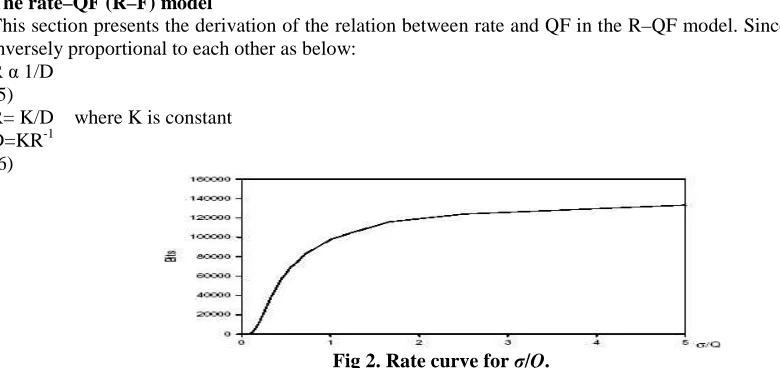
This section presents the derivation of the relation between rate and QF in the R–QF model. Since R and D are inversely proportional to each other as below:
R α 1/D
(5)
R= K/D where K is constant
D=KR-1 (6)
Fig 2. Rate curve for σ/Q.
For the data rate high the, this distortion considering by the quantization usually approximately uniformly distributed and also the power of the quantization noise P is Q2/12 .Considering the distortion of the quantization noise at low bit rates is not exact uniform. So that defining a distortion D for the quantization parameter Q by
D=Ρ×Q (7)
And here P states that distortion value. And our scheme for this Video coding can expressed as
R(D)=log2 (σ /Ρ × D) (8)
Frame-level and Macroblock-levelrate control
To finding out the quantization parameter, we should allocate target bits for the current image frame. For this purpose need to find number of bits allocated to I and P frames like in same manner of MPEG 2 TMS Model.
And also In order to decide the quantization parameter for the Current macro block, considering the rate-quantization model Statistical characteristics of the source data for the current macro block should be known to calculate the quantization parameter. And VP8 encodes each macro block at the block level; need to estimate the standard deviation of the current macro block from those of adjacent macro blocks using standard deviations of the left macro block and the top macro block of the current macro block respectively.
Similarly to determine the quantization parameter, considering distortion parameter, which can be obtained from the quantization parameter, And then Predicting the distortion parameter by distortion parameters of the left and the top macro blocks of the current macro block, respectively.
151
The quantization parameter is adjusted by considering the type of the current macro block and the difference between the previous quantization and the current quantization parameters. And final quantization parameter used for encoding. Also for to minimize fluctuation of picture quality and blocking artifacts, applying different adjustment methods.So today’s video compression scheme using rate distortion efficiency is based on good interaction between different motion representation possibilities, and coding for different regions. This rate distortion algorithm [4] for optimization especially requires an ability to measure the distortion here the perceived distortion in visual content is a very much difficult quantity to measure.
Usually another method for rate distortion optimization is carried out to determine the encoding mode for each packet and channel capacity, and also in order to minimize the overall expected end-end distortion. Also adaptive RDO model will improve the performance.
So this model based kind for improving the approaching speed of a blind method such as the bisection method also in general adapted model fits well, a reduced number of trail and errors can be greatly improved. Model based for approaching the
152
Fig 4 VP8 Video encoder and decoder
0
Fig 5: the highly compressed image/video block
critical rates is based on the monotonically it is non decreasing property. From a Rate distortion theoretic point of view [9], a good coding design is very much important to find a set of encoding and decoding algorithmic to minimize the actual RD cost. And even mode selection for motion estimation will conduct based on actual RD cost in a macro block by macro block manner.
153
(9)Fig 6: PSNR for “vp80-00-comprehensive-002” (frame Rate = 15fps, target bit rate=64kbps)
4.
RESULT ANALYSISFig 7 : Akiyo_qcif with RD and De blocking
Fig 8 : Akiyo_qcif without RD and De blocking
154
Fig 10: VP80-00-comprehensive-011 without RDFig 11: With Rate distortion algorithm for VP8 Codec
Fig 12: Without Rate distortion algorithm for VP8 Codec
155
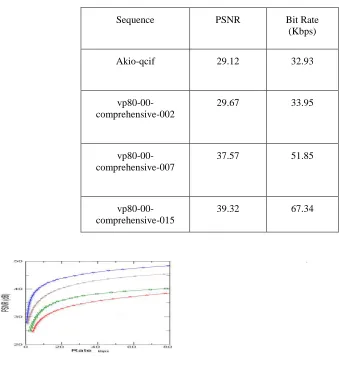
Table-3: Rate and distortion of encoded sequences :Sequence PSNR Bit Rate
(Kbps)
Akio-qcif 29.12 32.93
vp80-00-comprehensive-002
29.67 33.95
vp80-00-comprehensive-007
37.57 51.85
vp80-00-comprehensive-015
39.32 67.34
Fig 14:Bitrates VS PSNR for different VP8Video test streams
5. CONCLUSION AND FUTURE WORK:
156
De blocking filter improves the PSNR of about 0.1 dB for video encoded using MPEG-4, H.264 and VP8 without using its own in-loop de blocking filter. It has proven to be good in the reduction of the very annoying blocking artifacts caused by video compression.Similarly observed that after implementing rate distortion algorithm like rate-quantization model based on the rate distortion function of the R–QF model And successfully show and prove that the bit rate curve can be modeled by the logarithm function. And also our Simulation results shows that the introduced rate control method generates coding bits very close to target bits and provides improved coding efficiency at low bit rates. In this along with optimization quality of the data also looks good, this shows that performance of VP8 video codec along with Rate distortion algorithm yield good quality and optimized of data. In future there is lot of scope for improving this work like considering this rate distortion algorithm for more resolution data, in this way still we are working.
References:
[1] Lain E.G. Richardson, “H.264 and MPEG-4 Video Compression: Video Coding for Next-generation
Multimedia”, John Wiley & Sons, Jan. 2004.
[2] Lee, Jae-Beom, Kalva and Hari, ”The VC-1 and H.264 Video Compression Standards for Broadband
Video Services”, Springer, 2008.
[3] “Text of ISO/IEC FDIS 14496-10/Draft ITU-T H.264: Information Technology – Coding of
Audio-Visual Objects: Advanced Video Coding”, International Organization for Standardization, 2003.
[4] Dong-Hwan Kim, Hwa-Yong Oh, O˘guzhan Urhan, Sarp Ertürk and Tae-Gyu Chang, “Optimal
Post-Process/In-Loop Filtering for Improved Video Compression Performance”, IEEE Trans. on Consumer Electronics, vol. 53, no. 4, Nov. 2007.
[5] S. Romero, and L.F. Romero, “An Optimized Preconditioned Conjugate Gradient Algorithm”, Technical
Report No: UMA-DAC-02/11, University of Malaga, Sept. 2002.
[6] Tao Chen, Hong Ren Wu and Bin Qiu, “Adaptive Post filtering of Transform Coefficients for the Reduction of Blocking Artifacts”, IEEE Trans. on Circuits and Systems for Video Technology, vol. 11, no. 5, Dec. 2001.
[7] Shizhong Liu and Alan C. Bovik, “Efficient DCT-Domain Blind Measurement and Reduction of Blocking
Artifacts”, IEEE Trans. on Circuits and Systems for Video Technology, vol. 12, no. 12, May 2002.
[8] Ci Wang, Wen-Jun Zhang and Xiang-Zhong Fang, “Adaptive Reduction of Blocking Artifacts in DCT
Domain for Highly Compressed Images”, IEEE Trans. on Circuits and Systems for Video Technology, vol. 50, no. 2, May 2004.
[9] A. Z. Averbuch, A. Schclar and D. L. Donoho, “Deblocking of block-transform compressed images using
weighted sums of symmetrically aligned pixels,” IEEE Trans. on Circuits Syst. Video Technology, vol.14, pp.200-212, Feb. 2005.
[10] Zixiang Xiong, Michael T. Orchard, and Ya-Qin Zhang, “A Deblocking Algorithm for JPEG-Compressed
Images Using Over complete Wavelet Representations”, IEEE Trans. on Circuits and Systems for Video Technology, vol. 7, no. 2, April 1997
[11] Gary J. Sullivan and Thomas weigand “Rate Distortion Optimization for Video Compression” IEEE
Signal processing in Nov 1998.
[12] T. Wiegand, M. Lightstone, D. Mukherjee, T. G. Campbell, and S. K.Mitra, “Rate-distortion optimized mode selection for very low bit rate video coding and the emerging H.263 standard”, IEEE Transactions on Circuits and Systems for Video Technology, vol. 6, no.2, pp. 182–190, Apr. 1996
[13] J. Bankoski, P. Wilkins, Y.Xu, “VP8 Data format and Decoding Guide,”
http://www.ietf.org/internet-draft/draft-bankoski-vp8-bitstream-01.txt,Jan 2011
[14] En-hui Yang, Xiang Yu “Rate Distortion Optimization in H.264
[15] Rate Control Algorithm for H.264/AVC Video Coding Standard Based on Rate-Quantization Model by Seonki Kim and Yo-Sung Ho
[16] Rate distortion efficient video compression using A- 3D Model by Peter Eisert, Thomas Wiegand and Bernd Girod
[17] Rate distortion optimized layered coding with unequal error protection for internet video by Michael Gallant, Member, IEEE, and Faouzi Kossentini, Senior Member, IEEE.
[18] Pre and post processing algorthims for compressed video enhancement by C Andrew seagall and aggelos
k.katsaggelos.
Basavaraju.S holds the Master degree from VTU, Karnataka, and currently pursuing PhD at PRIST
157
processing domain and currently working as Assistant professor in Sapthagiri College of engineering, Bangalore.Dr B Sivakumar holds PhD degree from Anna University Tamilnadu, and currently working as Professor