432
COMPARATIVE PERFORMANCE ANALYSIS
OF LINK RECOVERY BETWEEN EIGRP AND
OSPF PROTOCOLS BASED ON SIMULATION
Vimla Dangi
1
Dr.Tarun Shrimali
21 2
Department of Computer Science & Engineering, CTAE, MPUAT Udaipur 2
Career point Technical Campus Rajsmand
1Email- [email protected]
Protocols, we choose EIGRP and OSPF routing protocols for doing performance evaluation for real-time traffics. The experiment is setup to find out the retransmission time and rerouting time from both protocols when there is a failure link in a data transmission path. Before there is a failure link, the average transmission times are 17.5ms with OSPF and 17.1 with EIGRP. Then the average transmission times increase to 29ms and 28.4ms for OSPF and EIGRP respectively after a link fails. Finally, the research experiment results show that EIGRP is a better than OSPF in retransmission time after a link fails.
Keywords: router protocol; OSPF; EIGRP; link fail.
1. INTRODUCTION
In modern time internet grow very rapidly. Computer Communication network is a very waste now a time. Communication technology facilitates users by providing user friendly services such as file transferring, print sharing, video streaming and voice conferencing. Internet is a global system of interconnected computer networks. Computer communication networks are based on a technology that provides the technical infrastructure, where routing protocols are used to transmit packets across the Internet.
There are many routing protocols for specify how routers communicate with each other by forwarding information. The router has prior knowledge about the adjacent networks which can assist in selecting the routes between two nodes. In the IP networking many routing protocols are used.
Three classes are common on IP networks as follows:
• Interior gateway routing over link state routing protocols, such as IS-IS and OSPF.
• Interior gateway routing over distance vector protocols, such as RIP, IGRP and EIGRP.
• Exterior gateway routing, such as BGP v4 routing protocol.
Among different routing protocols, Enhanced Interior Gateway Routing Protocol (EIGRP) and Open Shortest Path First (OSPF) have been considered as the pre-eminent routing protocols for real-time applications. EIGRP is a Cisco proprietary distance-vector protocol based on Diffusing Update Algorithm (DUAL) . On the other hand, OSPF is a link-state interior gateway protocol based on Dijkstra algorithm (Shortest Path First Algorithm).
433
2. OPEN SHORTEST PATH FIRST (OSPF)
Open Shortest Path First is a routing protocol that was developed by Interior Gateway Protocol (IGP) working group of the Internet Engineering Task Force for Internet Protocol (IP) networks. OSPF is a link state routing protocol that is used to distribute information within a single Autonomous System [4][9]. In 1989, first version of OSPF was defined as OSPFv1 was published in RFC 1131. The second version of OSPFv2 was introduced in 1998 which was defined in RFC 2328. In 1999, the third version of OSPFv3 for IPv6 was released in RFC 2740[10].
2.1 SPF Calculation
OSPF will use algorithm Diijkstra (link state) to calculate the shortest path based on the shortest path from one point to another. When it reaches its destination, it will make cumulative cost or value of the link, or bandwidth, by comparison, if any path out from the origin to the end and the cost is the best, that path is the shortest path in CISCO routers with the formula. The OSPF routing path to be taken from the formula [7]
(Cost = 108/Bandwidth) (1) Where to find the shortest path will take the cost of your outgoing internet interface at one point to another interface at one point added to it until the interactive effects of the destination router and to compare it with other paths. We call this the total of the "cumulative cost".
2.2 Enhance Interior Getaway Routing Protocol (EIGRP)
Enhanced Interior Gateway Routing Protocol (EIGRP) is a CISCO proprietary protocol, which is an improved version of the interior gateway routing protocol (IGRP). EIGRP is being used as a more scalable protocol in both medium and large scale networks since 1992. EIGRP is said to be an extensively used IGRP where route computation is done through Diffusion Update Algorithm (DUAL). However, EIGRP can also be considered as hybrid protocol because of having link state protocol properties.
2.3 Method of EIGRP
EIGRP has four methods. They are:
• Neighbor Discovery/Recovery
• Reliable Transport Protocol (RTP)
• Diffusion Update Algorithm (DUAL)
• Protocol Dependent Modules (PDM) EIGRP Metrics
With the use of total delay and the minimum link bandwidth, it is possible to determine the routing metrics in EIGRP. Composite metrics, which consists of bandwidth, reliability, delay, and load, are considered to be used for the purpose of calculating the preferred path to the networks. The EIGRP routing update takes the hop count into account though EIGRP does not include hop count as a component of composite metrics. The total delay and the minimum bandwidth metrics can be achieved from values which are put together on interfaces and the formula used to compute the metric is followed by:
256* ( 1∗ + 2∗ 256− + 3∗ ) ∗ 5 4+ -(1)
For weights, the default values are: 1=1, 2=0, 3=1, 4=0, 5=0, Put those values in equation 1. 256∗ + - - - (2) If 5=0, the formula trims down like
256* 1∗ + 2∗ 256− + 3∗
434
Where, (( )) is in kilobits and represents the minimum bandwidth on the interface to destination. Bw= Bandwidth
The formula that EIGRP uses to calculate scale bandwidth is: Delay= D (n)*256 - - - (4)
Where D (n) represents in microseconds and sum of the delays configured on the interface to the destination.
3 SIMULATIONS
Figure 1: Transmission path before a link fails
Figure 2: Transmission path before a link fails
3.1 Result Analysis
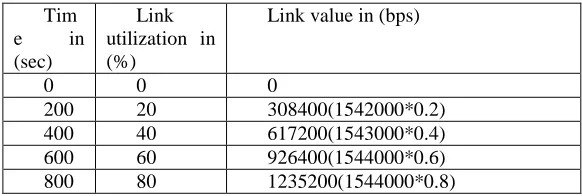
In both network models, data rate for PPP_DS1 links are1.544 Mbps. We consider background utilization on each network by varying the link utilization and analyze the variation of defined parameters. Link utilization is set in increasing order from normal 0% to 90%. Table 4.1 shows the corresponding link utilization.
Tim e in (sec)
Link utilization in (%)
Link value in (bps)
0 0 0
200 20 308400(1542000*0.2)
400 40 617200(1543000*0.4)
600 60 926400(1544000*0.6)
800 80 1235200(1544000*0.8)
435
3.2 Throughput
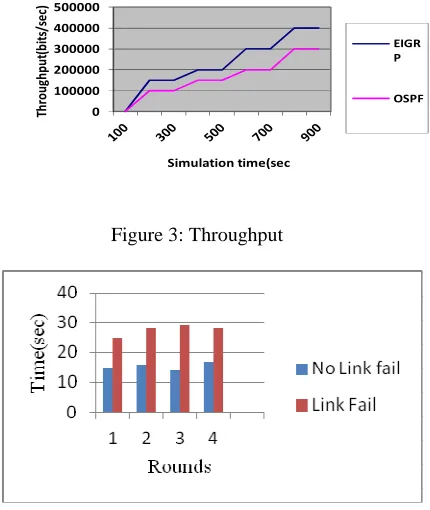
The throughput is a key parameter to determine the rate at which the total data packets are successfully delivered through the channel in the network. At around 200 seconds, the throughput of EIGRP network is two times higher than OSPF network. Consequently, EIGRP throughput at 40%, 60% and 80% background load for the corresponding simulation times is being proportionally increased compare to the OSPF throughput.
0 100000 200000 300000 400000 500000
Th
ro
u
gh
p
u
t(
b
it
s/
se
c)
Simulation time(sec
EIGR P
OSPF
Figure 3: Throughput
Figure 4: Data transmission time before and after the link fail using OSPF.
Figure 5: Data transmission time before and after the link fail using EIGRP.
The experimental figures 4 and 5 show that the average data transmission time before the link fail with protocol EIGRP is 18.4 ms faster than OSPF average at 18.7 ms. After the link fails, protocol EIGRP 196 packet data transmission time averages 27.5ms compare to OSPF packet data average at 28 ms, is used to transmit data path is based on the same route both before and after the link fail. Estimates standard deviation
436
4. CONCLUSTION
EIGRP take fewer time than OSPF in the data transmission before and after the link failure. In addition, the simulation results have shown that the throughput of EIGRP network is much higher than for OSPF network due to high congestion in the link. From simulation and results EIGRP is better than OSPF protocol.
REFERENCES
[1] Shen Yang (Inst. of Command Autom, PLA Univ. of Sci. & Tech., Nanjing, China); Dai Hao; Qi Qang-dong “Performance comparisons between OSPF and EIGRP in tactical IP networks” Source: Journal of PLA University of Science and Technology (Natural Science Edition), v 6, n 3, p2 41-5, June 2000
[2] http://en.wikipedia.org/wiki/Routing_protocol.
[3] Esuendale Lemma; Syed Hussain; Wendwossen Anjelo; “Performance Comparison of EIGRP/ IS and OSPF/
IS-IS” Blekinge Tekniska Hogskolan. Sweden, 2010. http://www.essays.se/essay/cc996c98ff/
Rick Graziani and Allan Jonson, “Routing protocols and concepts: CCNA exploration
[4] companion guide” Pearson Education. London, 2008.
[5] Online source. (2004, Aug 27), “Advanced IP Addressing Management, Cisco Systems”
http://www.informit.com/articles/
[6] Douglas E. Comer, “Internetworking with TCP/IP, Principles, Protocols and Architecture” 5th ed. Vol.1, Pearson Prentice Hall, 2006.
[7] Talal Mohamed Jaffar, “Simulation-Based Routing Protocols Analysis (Thesis)” Ph.D., Dept. Elect. Eng., Georgia Institute of Technology, 2007.
[8] Tony Larsson and Nicklas Hedman, “Routing Protocols in Wireless Ad-hoc Networks-A simulation Study (Master’s thesis )” Dept. Com. & Eng., Luleå Univ., Stockholm, 1998.
[9] Javvin network management and security. “IS-IS: Intermediate System to Intermediate system routing protocol” http://www.javvin.com/protocolOSPF.html.
[10] Todd Lammle, “Cisco Certified Network Associate” 5th edition, 2005
[11] Christian Huitema, “Routing in the internet” 2. Ed. Prentice Hall PTR, cop. 2000.
[12] Faraz Shamim, Zaheer Aziz, Johnson Liu, Abe Martey, “Troubleshooting IP Routing Protocols” Cisco Press, Pages: 912, May 07, 2002.
[17] Cisco, "Internet Technology Handbook"
http://www.cisco.com/en/US/docs/internetworking/technology/handbook/Enhanced_IGRP.html
[18] Cisco, “IP Routing, Introduction to EIGRP” Document ID: 13669.
http://www.cisco.com/en/US/tech/tk365/technologies_tech_note09186a0080093f07.shtml#hw [19] http://www.ciscocertificationacademy.com/Enhanced-Interior-Gateway-Routing-Protocol-EIGRP.php
[20] Ravi Malhotra, “IP Routing" 0-596-00275-0” January 2002.
http://oreilly.com/catalog/iprouting/chapter/ch04.html#45434
David Billings,”A collection of materials for the study of intranet and internet networking”
[21] GTCC. http://www.gtcc-it.net/billings/eigrp.html.
[22] GNS3: http/www.gns3.net/
[23] Dynamips: http://www.ipflow.utc.fr/index.php/Cisco_7200_Simulator