Available online: http://edupediapublications.org/journals/index.php/IJR/ P a g e | 8 6
B
rain Gate Neural Interface System
Rohini Venkatesan
1, D. S. Prem Kumar
21 , 2 Rajalak sh m i E n gin eer in g Co llege
A bs tract :
The Brain Gate Neural Interface System owned by Cyber kinetics podium technology, designed to help those who have lost control of their limbs, or other bodily functions. The System consists of a sensor that is entrenched on the motor cortex of the brain and examines brain signals. The principle of operation behind the Brain Gate System is that with intact brain function, brain signals are generated even though they are not sent to the arms, hands and legs. The sensor, implanted into the brain, monitors brain activity in the patient and converts the thoughts of the user into computer commands. Currently the chip uses 100 hair-thin electrodes that 'hear' neurons firing in specific areas of the brain, for example, the area that controls arm movement. Cyber kinetics is further developing the Brain Gate System to potentially provide limb movement to people with several motor disabilities. The goal of this development program would be to allow these individuals to use their own arms and hands again.
Keywords
Electrode, Motor Cortex, Brain Gate
1.
Introduction
Body's voluntary movements are controlled by the brain. The most important region in the brain which controls all the sensory neurons is “motor cortex”. It is the region of the cerebral cortex involved in the planning, control and execution of voluntary movements. The motor cortex is situated in the dorsal portion of the frontal lobe just before the central sulcus that separates the frontal lobe from the parietal lobe. The motor cortex is again divided into two main areas, Area 4 and Area 6. Area 4, also known as the primary motor cortex, is located in the posterior of the frontal lobe. Area 6 is also called agranular frontal area. It lies immediately forward of Area 4. Area 6 is wider and is further subdivided into two distinct sub-areas. This part controls all the bodily movements of human being. Brain gate technology is designed to help people who has lost control of their limbs, but their brain remains in
active state. This may allow the Brain Gate system to create an output signal directly from the brain, bypassing the route through the nerves to the muscles that cannot be used in paralyzed people. There is no practical training required to use Brain Gate because the signals read by a chip implanted, for example, in the area of the motor cortex for arm movement, are the same signals that would be sent to the real arm. A user who has an implanted chip can immediately begin to respond by moving a cursor with thought alone.
Fig 1: Regions of brain
2.
Principle
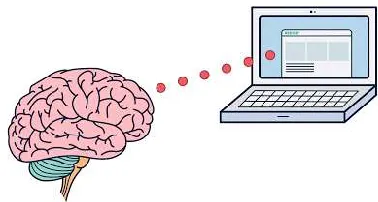
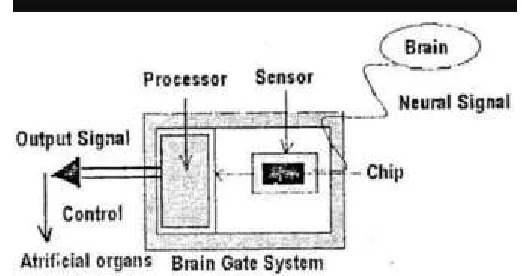
The brain gate technology involves a chip, which is implanted into the brain. It monitors brain activity in the patient and converts the signals into computer commands. The chip uses nearly 100 thin electrodes that sense the electromagnetic signals from neurons emerging in specific areas of the brain. The brain gate uses chip which is in the size of contact lens. The computer then translates the signal into communication output which can move a computer cursor.
Available online: http://edupediapublications.org/journals/index.php/IJR/ P a g e | 8 7
3.
WORKING OF TECHNOLOGY
The basic elements of Brain Gate are: The chip:
The neuro chip is made up of four-millimetre square silicon which comprises about 100 hair-thin microelectrodes. It is placed in the primary motor cortex. This region is responsible for controlling all the movements of the human body. Hence all the signals from this region can be recorded in the chip and can be transmitted.
The connector:
When the person thinks of moving the computer cursor, electrodes on the silicon chip implanted into the person’s brain detect neural activity. The cortical neurons fire in a distinctive pattern, the signal is transmitted through the pedestal plug attached to the skull. This connector is a peripheral used to connect the chip with the pedestal of the skull.
The converter:
The signal travels to a small sized amplifier which is placed on user’s wheelchair, it is then converted to optical data and jumped by fibre optic cable to a computer.
The computer:
The computer translates the activity of the brain and creates a communication output using software. System uses translation algorithm. The algorithms are written in C, JAVA or MATLAB. For example, researchers could figure out what signals are sent to the brain by the optic nerve when someone sees the colour red. These signals are again passed to a mobile of another person in the form of alert. The person who takes care of the paralyzed person need not to be with that person always instead whenever there is an alert they can come
4.
How does the brain control motor
function?
The brain’s motor system is contained mostly in the frontal lobes. It starts with premotor areas, for planning and coordinating complex movements, and ends with the primary motor cortex, where the final output is sent down the spinal cord to cause contraction and movement of specific muscles. The primary motor cortex on the left side of the brain controls movement of the right side of the body, and vice-versa, the right motor cortex controls movement of the left side of the body. The connection from the
primary motor cortex to muscles of the body is so important that any damage leads to an impaired ability to move. Neurons act like the processor in a computer, gathering and transmitting signals. Motor neurons carry signals from the central nervous system to the muscles, skin and glands of the body, while sensory neurons carry signals from those outer parts of the body to the central nervous system. Therefore the brain controls the motor function of the human body.
F ig 3: Sensory areas
5.
How does this communication happen?
Available online: http://edupediapublications.org/journals/index.php/IJR/ P a g e | 8 8
Since the brain is active, the brain gate technology helps them to do their bodily movements.
Fig 5: Working of technology
6.
METHODS:
Basically, there are two methods to sense the signals sent by the neurons:
ECOG: Invasive method EEG: Non-invasive method
ECOG – Electrocorticography
:
Electrocorticography (ECOG) is a neural signal recording process that uses electrodes placed directly on the exposed surface of the cerebral cortex. ECOG can be carried out either in the operation room during surgery (intraoperative ECOG) or outside of surgery (extra operative ECOG). In order to ingress the cortex, a surgeon should first perform a craniotomy. Craniotomy is a process of removing a part of the skull, in order to expose the brain surface. This procedure can be done either under general anaesthesia or under local anaesthesia if patient interaction is needed for functional cortical mapping. Electrodes are surgically inserted on the surface of the motor cortex, which is monitored by magnetic resonance imaging (MRI). Electrodes can be placed either on the outer side of the dura mater (epidural) or under the dura mater (subdural). Patients are made to take rest for five to six days after the surgery in order to cure the wounds and become active. ECOG electrode is made up of sixteen pointless, disposable stainless steel, carbon tip, platinum iridium alloy each placed on a ball and socket joint for ease in positioning. These electrodes are fixed to a frame in certain configurations. Subdural strip and grid electrodes are also widely used in various
dimensions. The grids are transparent, flexible, and standard gap between them is 1 cm. The electrodes on the cortical surface, are designed with more flexibility so that routine movements of the brain do not affect. To get a higher resolution, scientists can insert electrodes directly into the grey matter of the brain, or on the surface of the brain, beneath the skull. This provides more direct reception of electric signals.
Fig 6: Block diagram of brain gate system
EEG – Electro en cep h alo g rap h y :
Available online: http://edupediapublications.org/journals/index.php/IJR/ P a g e | 8 9 Fig 4: Brain gate working pattern via simulation
7.
Paralyzed Woman Moves Robot In Her
Mind:
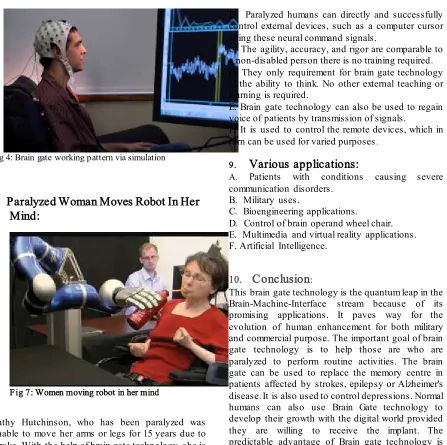
Fig 7: Women moving robot in her mind
Cathy Hutchinson, who has been paralyzed was unable to move her arms or legs for 15 years due to stroke. With the help of brain gate technology, she is able to guide a robotic arm towards a bottle of water, grab it up, and drink it. The brain gate interface consists of a sensor implanted in Cathy's brain, which is used to “read” her thoughts, and a decoder helps in turning her thoughts into order or instruction for the robotic arm.
8.
Advantages of brain gate :
A. Brain Gate can safely be implanted in the brain for at least two years. Later it can safely be removed as well.
B. Paralyzed humans can directly and successfully control external devices, such as a computer cursor using these neural command signals.
C. The agility, accuracy, and rigor are comparable to a non-disabled person there is no training required. D. They only requirement for brain gate technology is the ability to think. No other external teaching or learning is required.
E. Brain gate technology can also be used to regain voice of patients by transmission of signals.
F. It is used to control the remote devices, which in turn can be used for varied purposes.
9.
Various applications:
A. Patients with conditions causing severe communication disorders.
B. Military uses.
C. Bioengineering applications.
D. Control of brain operand wheel chair. E. Multimedia and virtual reality applications. F. Artificial Intelligence.
10. Conclusion:
This brain gate technology is the quantum leap in the Brain-Machine-Interface stream because of its promising applications. It paves way for the evolution of human enhancement for both military and commercial purpose. The important goal of brain gate technology is to help those are who are paralyzed to perform routine activities. The brain gate can be used to replace the memory centre in patients affected by strokes, epilepsy or Alzheimer's disease. It is also used to control depressions. Normal humans can also use Brain Gate technology to develop their growth with the digital world provided they are willing to receive the implant. The predictable advantage of Brain gate technology is that it helps people to gain their voice who have lost it due to brain diseases. The chip transmits an electric pulse from the brain hence the patient can communicate through a robotic voice or it can be interpreted on the screen. More research had been made in order to utilize the resources of brain gate technology. Hence this brain gate technology is a boon to the patients who are suffering from brain diseases.
REFERENCES:
Available online: http://edupediapublications.org/journals/index.php/IJR/ P a g e | 9 0 [ii] Jonathan R. Wolpaw, “Brain-computer inter face
technology: A review of the first international meeting,” IEEE Trans. on Rehab. Eng 2000; 8:164–173.
[iii] SHAHIN NISHA (B. Tech (IT),IFET College of Engineering.) International Journal of Engineering Research and Applications (IJERA) ISSN: 2248-9622. [iv] NIDHI BEHL, LECTURER (Department Of CSE, M.M. College Of Engineering) International Journal of Engineering Research and Applications (IJERA) ISSN: 2248-9622.