z
∼
2
Thesis by Naveen A. Reddy
In Partial Fulfillment of the Requirements for the Degree of
Doctor of Philosophy
California Institute of Technology Pasadena, California
2006
ii
c
2006 Naveen A. Reddy
Acknowledgements
This thesis work, and the valuable experience I have gained as a graduate student at Caltech,
were made possible by more people than I can name here. During my first year at Caltech
the senior graduate students made us feel welcome and provided us with great insights into
the department and the faculty. I would like to thank Nick Scoville for making Caltech a
less intimidating place with his informal yet enthusiastic presence. Thanks to my former
collaborators in the world of long wavelength astronomy, including Nick, Andrew Blain,
Dave Frayer, and Lee Armus. I would especially like to acknowledge Lee for teaching me
the correct way to handle Keck ToO requests. Thanks to Shardha for her patience while
teaching me the ropes at OVRO.
I am grateful to the peers in my graduate class, especially Pranjal Trivedi, Alison Farmer,
Dawn Erb, and George Becker, for going through classes with me and sharing in the trials
and tribulations of graduate school. Thanks also to my regular lunch group, including
Micol Christopher, George, Edo Berger, Dawn, Alison, Dave Kaplan, and Jackie Kessler,
for providing a necessary respite during the middle of the day.
I am indebted to my former officemates, Dawn Erb, Alison Farmer, Jackie Kessler, Alicia
Soderberg, and Joanna Brown, for providing just the right amount of distraction to keep
me going throughout the day. A special acknowledgment goes out to Alison for keeping me
company in the office when no one else seemed to be around, and for our endless discussions
of Daleks and hemispherical bugs. And Jackie, for staying in the office late while working
on her thesis and accompanying me on trips to Baskin Robins to get a Chocolate Vortex.
And Alicia, both for keeping me company in the office and for keeping me apprised of who
was making all that noise outside our office.
A special thanks to the Astronomy Department systems administrators, Patrick
Shop-bell, Cheryl Southard, and Anu Mahabal, for always being ready with a solution whenever
my machine, nicmos, started acting up. They know more about computers than anyone
else I know, and my thesis work would not have been possible without their support. I am
grateful to the Caltech ITS technician, Kar Cheung, for tirelessly working for 6 straight
months to get my Mac laptop working again.
All of the work in this thesis is based on a spectroscopic sample of galaxies obtained
iv
for the best possible instrument support. Thanks to Jean Mueller and Karl Dunscombe for
their lively company during the long nights at Palomar, and Dipali and Rose for their good
cooking and hospitality at the Monastery.
I am lucky to have been a part of an excellent collaborative group, including Alice
Shapley, Max Pettini, Kurt Adelberger, Dawn Erb, and Matt Hunt. I especially want to
acknowledge Max for being a steadfast collaborator who always provided insightful
com-ments and suggestions, and great humor during observing runs and conferences. Kurt was
also an excellent resource of information and, while we did not overlap at Caltech, I am
grateful that he accompanied us on a few observing trips to Keck. And of course Dawn Erb,
who has been there since the beginning as a classmate, collaborator, and a good friend.
I would be amiss not to mention the support and encouragement of two very close friends,
Micol Christopher and Alice Shapley, whom I’ve come to think of as siblings. Thanks, Micol,
for being a loyal friend and a constant pillar of support for me through some tough times,
and for sharing in the good times. Thanks also for letting me bug you everyday to make
light conversation when I needed some distraction from work. And, of course, Alice, who
has been an unwavering source of enthusiasm, support, and encouragement, and with whom
I’ve had many conversations about galaxies, ramekins, and menudo, which kept me going
throughout the day.
I am grateful to Min Yun whose mentoring and friendship while I was a summer student
at NRAO prompted my decision to pursue astrophysics as a career. And, last but not least,
none of this would have been possible without my advisor, Chuck Steidel. Despite his busy
schedule, Chuck was always available to look at drafts of papers, send comments, suggest
new avenues to pursue, and answer my questions with patience. He provided just the
right amount of independence and encouragement. I also particularly enjoyed the scientific
discussions I had with Chuck. Chuck is an easy person to work with; his approachability
and modesty are only superseded by his incredible grasp of astronomy, and he is one of the
smartest people I know. I am very grateful to have had the opportunity to be his graduate
student. Finally, I could not have come this far without the support and encouragement of
A Multi-Wavelength Census of Star Formation at Redshifts z ∼ 2 by
Naveen A. Reddy
In Partial Fulfillment of the
Requirements for the Degree of
Doctor of Philosophy
Abstract
We examine the census of star-forming galaxies and their extinction properties at redshift
z ∼ 2, when a large fraction of the stellar mass in the universe formed. We find a good agreement between the X-ray, radio, and de-reddened UV estimates of the average star
formation rate (SFR) for our sample ofz∼2 galaxies of∼50M⊙ yr−1, indicating that the
locally calibrated SFR relations appear to be statistically valid from redshifts 1.5∼< z∼<3.0.
Spitzer MIPS data are used to assess the extinction properties of individual star-forming
galaxies, and we find that the rest-frame UV slope of most galaxies at z ∼2 can be used to infer their attenuation factors, Lbol/LUV. As in the local universe, the obscuration,
LFIR/LUV, is strongly dependent on bolometric luminosity, and ranges in value from < 1
to ∼ 1000 within the sample considered. However, the obscuration is ∼ 10 times smaller
at a given Lbol (or, equivalently, a similar level of obscuration occurs at luminosities ∼10
times larger) at z∼2 than at z∼0. This trend is expected as galaxies age and their gas becomes more dust-enriched. Specific SFRs indicate wide range in the evolutionary state
of galaxies at z ∼ 2, from galaxies that have just begun to form stars to those that have already accumulated most of their stellar mass and are about to become, or already are,
passively evolving. Finally, we examine two techniques for assessing the census of galaxies
at z ∼2. In the first, we select galaxies using optical, near-IR, and sub-mm criteria, and find a large overlap between optical and near-IR selected samples of galaxies at z ∼ 2. The second technique involves reconstructing the luminosity function of z ∼2 galaxies as determined from Monte Carlo simulations. We find that the SFR density increases between
vi
Contents
1 Introduction 1
1.1 The Optical Selection of High Redshift Galaxies . . . 3
1.1.1 Photometric Selection . . . 3
1.1.2 Spectroscopic Followup . . . 4
1.2 Bolometric Measures of Star Formation Rates . . . 7
1.3 Outline of the Thesis . . . 9
2 X-Ray/Radio Emission from UV-Selected Galaxies at 1.5∼< z∼<3.0 10 2.1 Introduction . . . 11
2.2 Data . . . 12
2.3 Stacking Procedure . . . 12
2.4 Results and Discussion . . . 14
2.4.1 SFR Estimates . . . 14
2.4.2 Stacked Galaxy Distribution and AGN . . . 15
2.4.3 Bolometric Properties of z∼2 Galaxies . . . 17
2.5 Conclusions . . . 18
3 Optical/Near-IR Selected Galaxies at z∼2 21 3.1 Introduction . . . 22
3.2 Data and Sample Selection . . . 25
3.2.1 Imaging . . . 25
3.2.2 Selection Criteria . . . 26
3.2.3 X-ray Data and Stacking Method . . . 34
3.3 Results . . . 35
viii
3.3.2 Overlap Between Samples . . . 39
3.3.3 Stacked X-ray Results . . . 49
3.4 Discussion . . . 50
3.4.1 Star Formation Rate Distributions . . . 52
3.4.2 Passively Evolving Galaxies at z∼2 . . . 59
3.4.3 Selecting Massive Galaxies . . . 65
3.4.4 Star Formation Rate Density at z∼2 . . . 68
3.5 Conclusions . . . 72
4 Star Formation and Extinction in z∼2 Galaxies 84 4.1 Introduction . . . 86
4.2 Sample Selection and Ancillary Data . . . 88
4.2.1 Optical and Near-IR Selection . . . 88
4.2.2 X-Ray Data . . . 89
4.3 Mid-IR Data . . . 91
4.4 Photometric Redshifts of Near-IR Selected Galaxies . . . 93
4.5 Infrared Luminosities of Optical, Near-IR, and Submillimeter Selected Galax-ies at z∼2 . . . 97
4.5.1 Inferring Infrared Luminosities from L5−8.5µm . . . 97
4.5.2 Infrared Luminosity Distributions . . . 101
4.5.3 Stacked 24 µm Flux . . . 111
4.6 Dust Attenuation in Optical and Near-IR Selected Galaxies . . . 112
4.6.1 Results for Optically Selected Galaxies . . . 113
4.6.2 Results for Near-IR and Submillimeter Selected Galaxies . . . 116
4.6.3 Relationship between β and Obscuration as a Function of Luminosity 117 4.7 Relationship Between Dust Obscuration and Bolometric Luminosity . . . . 118
4.8 Properties of 24 µm Faint Galaxies . . . 123
4.8.1 Ages and Masses of Faint 24 µm Galaxies . . . 123
4.8.2 Composite UV Spectra . . . 123
4.9 Mid-IR Properties of Massive Galaxies at z∼2 . . . 125
4.10 Discussion . . . 127
4.10.2 Mass Assembly at High Redshift . . . 130
4.11 Conclusions . . . 135
5 Spectroscopic Survey of the GOODS-North Field 142 5.1 Introduction . . . 143
5.2 Data and Sample Selection . . . 145
5.2.1 Optical and Near-IR Imaging and Photometry . . . 145
5.2.2 Photometric Selection . . . 146
5.2.3 Optical Spectroscopy . . . 148
5.3 Spectroscopic Results and Catalog . . . 151
5.4 Spitzer IRAC and MIPS Data . . . 154
5.5 Stellar Population Modeling . . . 154
5.6 The Diverse Properties of Optically Selected Galaxies at High Redshift . . . 156
5.6.1 Star-Forming Galaxies . . . 156
5.6.2 AGN . . . 160
5.7 Summary . . . 163
6 Rest-Frame UV Luminosity Function and Star Formation Rate Density at z∼2 216 6.1 Introduction . . . 217
6.2 Sample Selection and Observations . . . 221
6.2.1 Fields . . . 221
6.2.2 BX Color Selection . . . 222
6.2.3 Spectroscopic Followup . . . 223
6.2.4 Interloper Contribution and AGN . . . 224
6.2.5 Spectroscopic Completeness . . . 227
6.3 Incompleteness Corrections . . . 227
6.3.1 Monte Carlo Simulations . . . 229
6.3.2 Lyα Equivalent Width Distribution . . . 231
6.3.3 Photometric Uncertainties . . . 233
6.3.4 Quantifying the Selection Function . . . 234
x
6.4 Reddening Distribution . . . 239
6.5 UV Luminosity Function . . . 245
6.5.1 Preferred LF . . . 245
6.5.2 Faint-End Slope,α . . . 247
6.5.3 Field-to-Field Variations . . . 250
6.5.4 Bolometric Measures of the Luminosity Function . . . 250
6.6 Discussion . . . 253
6.6.1 Evolution in the Luminosity Function . . . 253
6.6.2 Evolution in the Luminosity Density . . . 257
6.7 Conclusions . . . 260
7 Epilogue 262
List of Figures
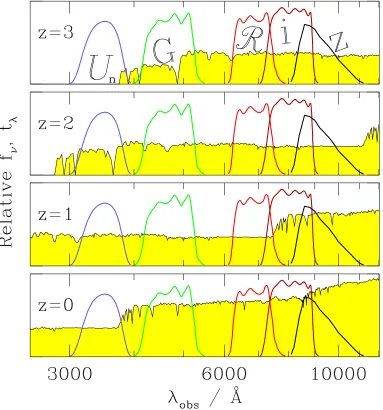
1.1 UnGRIz Colors of Galaxies at 0< z <3 . . . 5
1.2 ExpectedUnGRColors of Star-Forming Galaxies . . . 6
1.3 Spectroscopic Redshift Distributions . . . 8
2.1 Average X-ray Count Distribution . . . 16
3.1 Spectroscopic Redshift Distributions to Ks= 21 . . . 28
3.2 Redshift Distribution of BzK Galaxies . . . 30
3.3 Transmission of z,J,Ks, and IRAC 3.6 µm Filters . . . 32
3.4 Optical Magnitude Distributions . . . 33
3.5 Optical/X-ray Flux Ratios . . . 36
3.6 IRAC Colors . . . 38
3.7 z−K Color Distribution . . . 40
3.8 (z−K)ABversus Optical Magnitude . . . 41
3.9 J −Ks Color Distributions . . . 42
3.10 Overlap Fraction Between Optical/Near-IR Samples . . . 43
3.11 BX/BM Colors of BzK Galaxies . . . 44
3.12 BzK Colors of BX/BM Galaxies . . . 46
3.13 BzK Colors as a Function of Ks . . . 48
3.14 Stacked X-ray Luminosity as a Function of Ks . . . 51
3.15 X-ray Inferred Star Formation Rates . . . 53
3.16 Variation of SFR with Near-IR Color . . . 56
3.17 Attenuation Distribution with Near-IR Color . . . 57
3.18 Comparison of Colors with SED Models . . . 63
xii
3.20 Cumulative Star Formation Rate Density . . . 70
4.1 Redshift Distribution of Optical/Near-IR Samples . . . 90
4.2 Expected 24 µm Fluxes of Local Templates . . . 94
4.3 Photo-z Results . . . 95
4.4 Ratio of Mid-IR to X-ray Luminosity . . . 99
4.5 Comparison Between MIPS and Hα InferredLbol . . . 102
4.6 Distributions of LIR . . . 103
4.7 L850IRµm versusL5IR−8.5µm . . . 107
4.8 LIR as a Function of Near-IR Magnitude and Color . . . 108
4.9 Stacked 24 µm Flux of MIPS-Undetected Galaxies . . . 110
4.10 IRX-β Relation atz∼2 . . . 114
4.11 Lbol versus Dust Obscuration . . . 119
4.12 Histograms of Age and Mass . . . 122
4.13 Normalized Composite UV Spectra . . . 124
4.14 Lbol versus Stellar Mass . . . 126
4.15 Specific Star Formation Rate . . . 132
5.1 Positions of BX/BM Galaxies in GOODS-N Field . . . 147
5.2 BX/BM Color Selection Windows . . . 149
5.3 Redshift Histograms for BM/BX and LBG Galaxies . . . 153
5.4 Stellar Mass Distribution of BX/BM Galaxies . . . 158
5.5 SEDs of Obscured AGN . . . 162
6.1 Redshift Distribution of BX Galaxies . . . 225
6.2 Perturbation of BX/BM colors from Lyα . . . 226
6.3 Apparent Magnitude versus Redshift . . . 228
6.4 Lyα Equivalent Width Distributions . . . 232
6.5 Transitional Probability Function . . . 238
6.6 Expected and Observed Redshift Distributions . . . 240
6.7 Best-fit E(B−V) Distribution . . . 241
6.8 E(B−V) Distribution in Bins of Apparent Magnitude . . . 244
6.10 Covariance Between α and M∗
. . . 248
6.11 Degeneracy Between Schechter Parameters . . . 249
6.12 Dispersion in LF Normalization . . . 251
6.13 Attenuation as a Function of Apparent Magnitude . . . 254
6.14 Comparison of z∼2 and z∼3 E(B−V) Distributions . . . 256
xiv
List of Tables
2.1 Radio and X-ray Stacking Results . . . 19
2.2 Star Formation Rate Estimates . . . 20
3.1 Interloper Contamination of the BX/BM Sample . . . 76
3.2 Sample Properties . . . 77
3.3 Possible Star-Forming Direct X-ray Detections . . . 79
3.4 Properties of Submillimeter Galaxies with Ks-band Data . . . 80
3.5 Cumulative Contributions to the SFRD Between 1.4< z <2.6 . . . 82
4.1 Properties of the Samples . . . 138
4.2 Local Template Galaxies . . . 139
4.3 Interstellar Absorption Line Wavelengths and Equivalent Widths for 24µm Detected and Undetected BX/BM Galaxies . . . 140
5.1 Sample Statistics to R= 25.5 . . . 165
5.2 GOODS-N BX/BM Galaxies with Spectroscopic Redshifts . . . 166
5.3 Spitzer Photometry . . . 187
5.4 Stellar Population Parameters . . . 200
5.5 Stellar Masses . . . 214
5.6 AGN at z >1.4 . . . 215
6.1 Survey Fields . . . 261
Chapter 1
Introduction
Understanding the star formation history and stellar mass evolution of galaxies is perhaps
one of the most fundamental issues in cosmology. Observations of the stellar mass and
star formation rate density, the number density of QSOs, and galaxy morphology at both
low (z ∼< 1) and high (z ∼> 3) redshifts indicate that most of the activity responsible for shaping the bulk properties of galaxies to their present form occured in the epochs between
1∼< z ∼<3 (e.g., Dickinson et al. 2003b; Rudnick et al. 2003; Chapman et al. 2005; Madau et al. 1996; Lilly et al. 1996, 1995; Steidel et al. 1999; Shaver et al. 1996; Fan et al. 2001; Di
Matteo et al. 2003; Conselice et al. 2004; Papovich et al. 2003; Shapley et al. 2001; Giavalisco
et al. 1996). Galaxy studies during this intermediate redshift range have suffered, however,
because of our inability to identify large samples of galaxies during this critical epoch. The
primary difficulty at these redshifts was due to the fact that the lines used for redshift
identification are shifted into the near-UV where detector sensitivity has lagged, or to the
near-IR where spectroscopy is more difficult due to higher backgrounds.
However, the advent of 8−10 m class telescopes and improvements in detector technology
have allowed us to make significant progress by making it possible to select large samples
of galaxies during the critical epochs corresponding to redshifts 1.4 ∼< z ∼<3.0. There are essentially two ways in which to proceed in order to assess the census of galaxies at high
redshift. The first is to observe galaxies over as wide a range in wavelengths as possible
in order to select those that comprise the bulk of the total star formation rate density
(SFRD). Along this line, several color criteria have been developed to target galaxies over
2
2004; Steidel et al. 2004). The second method is to select galaxies by their near-IR z−K
color, taking advantage of the fact that for redshiftsz∼>1.4, the z−and K-bands bracket the age-sensitive Balmer and 4000 ˚A break features in the spectra of most star-forming and
“passively evolving” (or quiescent) galaxies (Daddi et al. 2004b). The third method selects
either passively evolving or star-forming galaxies at redshifts z ∼> 2 based on the single color criteriaJ−Ks >2.3 (in Vega magnitudes), again taking advantage of the Balmer and
4000 ˚A breaks (Franx et al. 2003). The fourth method relies on the monochromatic flux
at 850µm to select dusty, high redshift galaxies (Blain et al. 1999). Each selection method presents its own advantages and disadvantages, but one critical issue that has previously
been neglected is that one must take into account the substantial overlap between these
samples when estimating the total SFRD (Reddy et al. 2005). Each of the selection criteria
and their respective overlap and contributions to the SFRD are discussed in Chapter 3.
The second approach to assessing the total star formation rate density is to simulate
many realizations of the intrinsic distribution of galaxy properties at high redshift, subject
these realizations to the same photometric methods and selection criteria as applied to real
data, and then adjust the simulated realizations until convergence is reached between the
expected and observed distribution of galaxy properties. This Monte Carlo approach has
the advantage, unlike the first method, of not requiring the observational effort necessary
to conduct a panchromatic assessment of the total SFRD. The method works especially
well when applied to joint spectroscopic and photometric samples of galaxies and therefore
works best for optically-selected samples where spectroscopy is much more feasible than for
near-IR selected samples. Perhaps the main disadvantage of this method is the inability
to correct sample completeness for galaxies that are completely missed (i.e., not scattered
into the color selection windows). Nevertheless, applying this method to spectroscopically
confirmed samples of high redshift galaxies allows one to evaluate the systematic effects of
photometric scatter and the intrinsic variation in colors due to line emission and absorption
with great accuracy. We can further evaluate the signficance and magnitude of the dust
extinction corrections necessary to translate UV luminosities to total bolometric luminosities
(see below and Chapters 2, 3, 4, and 6). Our Monte Carlo approach to computing sample
incompleteness can then be used to reconstruct the total SFRD. This method is discussed
1.1
The Optical Selection of High Redshift Galaxies
1.1.1 Photometric Selection
Constructing a practical set of selection criteria to select all galaxies in any desired redshift
range and reject all others is an intractable problem. One extreme is to select all objects
down to a given magnitude limit, such as in flux-limited surveys of high redshift galaxies,
but unfortunately such studies suffer from significant amounts of foreground contamination.
Without additional color criteria, one may spend 99% of the time spectroscopically
con-firming low redshift contaminants before assembling a significant sample of galaxies at the
desired redshift range. Color-selected samples have the distinct advantage of allowing one
to specifically target a desired redshift range while minimizing the number of interlopers.
Perhaps the most successful of the various color criteria that have been designed to select
galaxies at different epochs is rest-frame UV color selection, pioneered by Steidel et al.
(1995) to select galaxies at z ∼ 3, and extended to higher redshifts (e.g., Bouwens et al. 2005, 2004; Bunker et al. 2004; Dickinson et al. 2004; Yan et al. 2003). The success of this
technique is partly due to its simplicity in that only a few broadband filters are required
to assemble such samples and, at lower redshifts (1.4 ∼< z ∼< 3.5), where the galaxies can be spectroscopically observed and precise redshifts can be obtained in a short amount of
observing time. Combined, these surveys have given us an unprecedented view of galaxy
evolution over almost the entire age of the universe.
For the past several years, the main focus of our group has been to assemble a large
sam-ple of galaxies at the peak epoch of galaxy formation and black hole growth, corresponding
to redshifts 1.5∼< z∼<2.6. The selection criteria aim to select actively star-forming galaxies at z∼2 with the same range in intrinsic UV color and extinction as Lyman break galaxies (LBGs) atz∼3 (Steidel et al. 2003). While galaxies atz∼2 do not have any of the strong spectral breaks across theUnGRbands used to select higher redshift galaxies (Figure 1.1), they do occupy a particular area ofUnGRcolor space that can be singled out (Figure 1.2). We have used the “BX” criteria of Adelberger et al. (2004) and Steidel et al. (2004) to
4
colors:
G− R ≥ −0.2
Un−G ≥ G− R+ 0.2
G− R ≤ 0.2(Un−G) + 0.4
Un−G ≤ G− R+ 1.0. (1.1)
Similarly we have selected “BM” galaxies at redshifts 1.5 ∼< z ∼< 2.0 using the following criteria:
G− R ≥ −0.2
Un−G ≥ G− R −0.1
G− R ≥ 0.2(Un−G) + 0.4
Un−G ≤ G− R+ 0.2. (1.2)
To ensure a sample of galaxies amenable to spectroscopic followup, we imposed a magnitude
limit of R= 25.5. This limit corresponds to an absolute magnitude 0.6 mag fainter atz= 2.2±0.4 (the mean and dispersion of the measured redshift distribution for BX candidates with z > 1) than at z ∼ 3. We also excluded candidates with R < 19 since almost all of these objects are stars. Given the constraints of the color criteria and the self-imposed
magnitude limits, the combined BM, BX, and LBG samples constitute 25 to 30% of the
total R andKs band counts to R= 25.5 and Ks(AB) = 24.4, respectively.
1.1.2 Spectroscopic Followup
The spectroscopic followup to the optically selected sample is discussed in detail in the
following chapters. Briefly, we took advantage of the multi-object capabilities of the Keck
LRIS (Low Resolution Imaging Spectrograph; Oke et al. 1995) instrument to obtain
spec-troscopy. The unrivaled near-UV sensitivity of the blue arm of LRIS (LRIS-B; Steidel et al.
2004) is necessary for spectroscopically identifying galaxies in the so-called spectroscopic
desert where BX and BM selected galaxies are expected to lie and where the stellar and
6
Figure 1.2 Expected UnGR colors of stars (stars; from Gunn & Stryker 1983) and star-forming galaxies at redshifts z = 1.5, 2.0, and 2.5 (blue circles and red squares; data from Papovich et al. 2001 and Shapley et al. 2001). Green tracks indicate the colors of
galaxies of different spectral types (Im, Sb, Sc), proceeding from z = 0 to z = 1.5, in intervals of δz = 0.1 as denoted by the crosses. The trapezoid denotes the BX selection window, as defined by Equation 1.1, which is designed to include as many galaxies at
near-UV. The spectroscopic sample presently consists of 104 BM, 1125 BX, and 1444 LBG
galaxies (spread throughout multiple uncorrelated fields), with mean spectroscopic redshifts
of hzi = 1.72±0.34, hzi = 2.20±0.32, and hzi = 2.96±0.26, for the BM, BX, and LBG samples, respectively (Figure 1.3). It is the spectroscopic samples at z∼2 (BM and BX) that form the basis of the work presented in Chapters 2, 3, 4, and 5. In Chapter 6, we
con-sider the joint photometric and spectroscopic samples to compute the luminosity function
and the contribution of optically-selected galaxies to the total star formation rate density
at z∼2.
1.2
Bolometric Measures of Star Formation Rates
Estimating the star formation rates of galaxies based on a single monochromatic flux (or
even broadband SEDs) entails many assumptions, some of which have been tested and
oth-ers which have not. For example, one must assume a particular form of the initial mass
function (IMF) of stars in order to estimate a star formation rate, but directly measuring
the IMF is very difficult for everything except local global clusters where stars can be
in-dividually resolved. Another assumption that was previously untested at high redshift is
the relationship between the observed UV luminosities of star forming galaxies and their
total bolometric luminosities. Prior to the advent of large-scale multi-wavelength surveys,
it was common to make untested extinction corrections to galaxies in UV surveys based on
relationships established locally. The situation has changed significantly with panchromatic
surveys which have allowed us to examine the extinction free measures of star formation
rates in high redshift galaxies and compare these estimates with the observed UV emission,
as discussed in Chapters 2 and 4. Combining our census of the star-forming galaxy
popu-lation at high redshift and our intimate knowledge of the extinction corrections required to
estimate bolometric SFRs, we can now make assertions regarding the star formation
his-tory and buildup of stellar mass in the Universe with much more confidence than previously
8
Figure 1.3 Arbitrarily normalized spectroscopic redshift distributions of galaxies with z >
1.3
Outline of the Thesis
The outline of this thesis is as follows. In the next chapter, we use deep X-ray and radio
emission as independent probes of the star formation rates and bolometric activity in
galax-ies at z ∼2. While the X-ray and radio data are not sufficiently sensitive to detect most optically-selected galaxies at these redshifts, we can use stacking analyses to infer
impor-tant information regarding the average star formation rates of well-selected subsamples of
galaxies. In Chapter 3, we perform a detailed comparison of galaxies selecting using optical,
near-IR, and sub-mm criteria. We quantify the overlap between these samples and, using
stacked X-ray emission, demonstrate that this sample overlap must be taken into account
when estimating the total star formation rate density. We extend the results of the
cen-sus of star-forming galaxies presented in Chapter 3 by examining the rest-frame infrared
emission from z ∼ 2 galaxies selected in various ways. We also discuss how the average extinction factors for galaxies of a given luminosity change as a function of redshift, from
z∼2 to z = 0. We go on to show how bolometric measures of the star formation rates of galaxies, combined with stellar mass estimates from population synthesis modelling, can be
used to deduce the evolutionary state of galaxies in terms of their propensity for future star
formation. In Chapter 5 we discuss in detail the spectroscopic sample of optically-selected
galaxies in the GOODS-North field (Giavalisco et al. 2004b; Dickinson et al. 2003a), which
is the basis for the work presented in Chapters 2, 3, and 4. Using multi-wavelength data in
this field, we examine the properties of obscured AGN in optically-selected host galaxies.
Finally, in Chapter 6, we use sophisticated Monte Carlo analysis of our joint photometric
and spectroscopic samples of galaxies in the z ∼ 2 survey (e.g., Adelberger et al. 2004; Steidel et al. 2004) to estimate the effects of photometric scattering, Lyman-alpha line
per-turbations, and other systematic effects introduced by the optical selection of star-forming
galaxies at redshift z ∼ 2. We use these results to construct the luminosity function at
z∼2, and incorporating our knowledge of extinction, to estimate the total star formation rate density and the implications for the star formation history and buildup of stellar mass
in the Universe. Finally, in the epilogue, we discuss several unresolved but important
is-sues to consider for obtaining even more stringent constraints on the cosmic star formation
10
Chapter 2
X-Ray and Radio Emission from UV-Selected Star
Forming Galaxies at Redshifts 1
.
5
∼
< Z
∼
<
3
.
0 in
the GOODS-North Field
∗†Naveen A. Reddy & Charles C. Steidel
California Institute of Technology, MS 105–24, Pasadena, CA 91125; [email protected],
Abstract
We have examined the stacked radio and X-ray emission from UV-selected galaxies
spec-troscopically confirmed to lie between redshifts 1.5∼< z∼<3.0 in the GOODS-North field to determine their average extinction and star formation rates (SFRs). The X-ray and radio
data are obtained from the Chandra 2 Msec survey and the Very Large Array, respectively.
There is a good agreement between the X-ray, radio, and de-reddened UV estimates of the
average SFR for our sample ofz∼2 galaxies of∼50 M⊙ yr
−1, indicating that the locally
calibrated SFR relations appear to be statistically valid from redshifts 1.5 ∼< z∼<3.0. We find that UV-estimated SFRs (uncorrected for extinction) underestimate the bolometric
∗Based on data obtained at the W. M. Keck Observatory, which is operated as a scientific partnership
among the California Institute of Technology, the University of California, and NASA, and was made possible
by the generous financial support of the W. M. Keck Foundation.
SFRs as determined from the 2 to 10 keV X-ray luminosity by a factor of ∼4.5 to 5.0 for galaxies over a large range in redshift from 1.0∼< z∼<3.5.
2.1
Introduction
Estimating global star formation rates (SFRs) of galaxies typically requires using relations
that can be quite uncertain as they incorporate a large number of assumptions in
convert-ing between specific and bolometric luminosities (e.g., assumed IMF, extinction, etc.; e.g.,
Adelberger & Steidel 2000). The varied efforts in the Great Observatories Origins Deep
Survey (GOODS; Giavalisco et al. 2004b) allow us to examine the same galaxies over a
broad range of wavelengths to mitigate some of these uncertainties. X-ray, radio, and UV
emission are all thought to result directly from massive stars and are consequently used as
tracers of current star formation (e.g., Ranalli et al. 2003; Condon 1992; Gallego et al. 1995).
Here we use the X-ray, radio, and UV emission, each differently affected by extinction (or
not at all), to determine SFRs of galaxies at z∼2.
Observations of the QSO and stellar mass density, and morphological diversification all
point to the epoch around z∼2 as an important period in cosmic history (e.g., Di Matteo et al. 2003; Chapman et al. 2003). Until recently, this epoch has been largely unexplored as
lines used for redshift identification are shifted to the near-UV, where detector sensitivity has
been poor or to the near-IR, where spectroscopy is more difficult due to higher backgrounds.
With the recent commissioning of the blue side of the Low Resolution Imaging Spectrograph
(LRIS; Oke et al. 1995) on the Keck I telescope, we have for the first time been able to obtain
spectra for large numbers of galaxies at these redshifts. Adding to the multi-wavelength
efforts in the GOODS-North field, we have undertaken a program to identify photometric
candidates in this field between 1.5 ∼< z ∼< 3.0 and perform followup spectroscopy with LRIS-B (Steidel et al. 2004). This UV-selected sample of galaxies forms the basis for our
subsequent multi-wavelength analysis.
Current sensitivity limits at X-ray and radio wavelengths preclude the direct detection
of normal star forming galaxies atz∼>1.5. Nonetheless, we can use a “stacking” procedure to add the emission from a class of objects in order to determine their average emission
properties (e.g., Nandra et al. 2002; Brandt et al. 2001; Seibert et al. 2002). In this paper,
12
galaxies at redshifts 1.5 ∼< z ∼< 3.0 to cross-check three different techniques of estimating SFRs at high redshifts. Ho = 70 km s−1 Mpc−1, ΩM = 0.3, and ΩΛ = 0.7 are assumed
throughout.
2.2
Data
The techniques for selecting galaxies at z∼2 are designed to cover the same range of UV properties and extinction to those used to select Lyman-break galaxies (LBGs) at higher
redshifts (z ∼> 3.0; Adelberger et al. 2004). Here, we simply mention that we have two spectroscopic samples at 1.5∼< z∼<2.5: a “BX” sample of galaxies selected on the expected
UnGR colors of LBGs de-redshifted to 2.0 ∼< z ∼< 2.5; and a “BM” sample targeting
z ∼1.5−2.0. (see Adelberger et al. 2004; Steidel et al. 2004 for a complete description). We presently have 138 redshifts (hzi ∼2.2±0.3) and 48 redshifts (hzi ∼ 1.7±0.3) in the GOODS-North BX and BM samples, respectively.
The X-ray data are from the Chandra 2 Msec survey of the GOODS-North region
(Alexander et al. 2003). We made use of their raw images and exposure maps in the Chandra
soft X-ray band (0.5−2.0 keV). Dividing the raw image by the appropriate exposure map yields an image with the count rates corrected for vignetting, exposure time, and variations
in instrumental sensitivity. The on-axis soft band sensitivity is∼2.5×10⁻¹⁷
ergs cm−2
s−1
(3 σ).
The radio data are from the Richards (2000) Very Large Array (VLA) survey of the
Hubble Deep Field North (HDF-N), reaching a 3 σ sensitivity of ∼ 23µJy beam−1 at
1.4 GHz. The final naturally weighted image has a pixel size of 0′′.
4 and resolution of 2′′.
0,
with astrometric accuracy of<0′′.
03.
2.3
Stacking Procedure
We divided the spectroscopic data into subsets based on selection (BX and BM) and redshift,
removed sources with matching X-ray or radio counterparts within 2′′.
5 (or sources whose
apertures are large enough to contain emission from a nearby extended X-ray or radio
source), and stacked galaxies in these subsets. Four of the removed x-ray/radio sources are
The X-ray data were stacked using the following procedure. We added the flux within
apertures randomly dithered by 0′′.
5 at the positions of the galaxies (targets) in the X-ray
images to produce a signal. Similarly sized apertures were randomly placed within 5′′
of
the galaxy positions to sample the local background near each galaxy while avoiding known
X-ray sources. This was repeated 1000 times to estimate the mean signal and background.
The Chandra PSF widens for large angles from the average pointing (off-axis angle), and
we fixed the aperture sizes to the 50% encircled energy (EE) radii (Feigelson et al. 2002)
for off-axis angles > 6′
. Background included at large off-axis angles becomes significant
due to increasing aperture size and this can degrade the total stacked signal. Consequently,
we only stacked galaxies within the off-axis angle that results in the highest S/N (this
varies for each subsample, from 6 to 8′
). Including all sources in the stack reduces the
S/N but does not affect the absolute flux value. For sources<6′
from the pointing center,
the 50% EE radius falls below 2′′.
5, and we adopted a fixed 2′′.
5 radius aperture to avoid
the possibility of placing an aperture off a target as a result of dithering or astrometric
errors—which are ∼ 0′′.
3—for sources very close to the average pointing. Stacking was
performed on both the raw and normalized images to calculate the S/N and total count
rate, respectively. Aperture corrections were applied to the raw counts and count rate. The
conversion between count rate and flux was determined by averaging the count rate to flux
conversions for the 74 optically bright X-ray sources in Table 7 of Alexander et al. (2003)
that are assumed to have a photon index of Γ = 2.0, typical of the X-ray emission from star forming regions (e.g., Kim et al. 1992; Nandra et al. 2002), and incorporate corrections
for the QE degredation of the ACIS-I chips. In converting flux to rest-frame luminosity, we
assume Γ = 2.0 and a Galactic absorption column density ofNH= 1.6×1020 cm−2 (Stark
et al. 1992). Uncertainties in flux and luminosity are dominated by Poisson noise and not
the dispersion in measured values for each stacking repetition, so we assume the former.
To stack the radio data, we extracted subimages at the locations of the targets from
the mosaicked radio data of Richards (2000). These were corrected for the primary beam
attenuation of the VLA with a maximum gain correction of 15%, coadded using a 1/σ2
weighted average to produce a stacked signal with maximal S/N ∼4.5, and smoothed by 1′′.
14
AIPS1 task JMFIT using an elliptical gaussian to model the stacked emission. We assume
a synchrotron spectral index of γ =−0.8, typical of the non-thermal radio emission from star-forming galaxies (Condon 1992). Results of the X-ray and radio stacks for various
subsamples are presented in Table 2.1. Four subsamples contain too few sources to yield a
robust estimate of the stacked radio flux.
2.4
Results and Discussion
2.4.1 SFR Estimates
The relations established atz= 0 to convert luminosities to SFRs for ourz∼2 sample are adopted from the following sources: Kennicutt (1998a,b) for conversion of the 1500−2800 ˚A
luminosity; Ranalli et al. (2003) for the 2−10 keV luminosity; and Yun et al. (2001) for the
1.4 GHz luminosity. These relations must be used with caution when applied to individual galaxies given uncertainties in the SFR relations (e.g., burst age, IMF) as well as the factor
of ∼2 dispersion in the correlations between different specific luminosities. However, they
should yield reasonable results when applied to an ensemble of galaxies, as we have done
here.
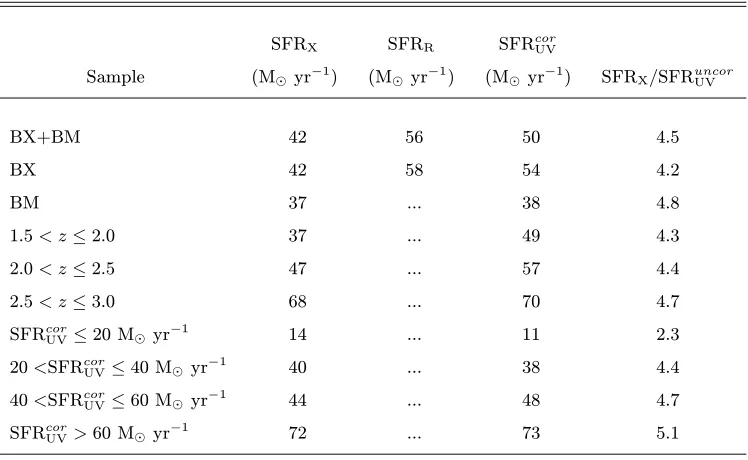
Table 2.2 shows the SFR estimates based on the 2 −10 keV (“SFRX”), 1.4 GHz
(“SFR1.4 GHz”), and UV (“SFRUV”) luminosities, with typical error of ∼ 20%. We
ap-proximate the UV luminosity by using the 1600 ˚A rest-frame flux for all samples except
the highest redshift bin sample (2.5 < z ∼< 3.0) where we use the 1800 ˚A rest-frame flux. UV-estimated SFRs were corrected for extinction using the observedG− R colors, a spec-tral template assuming constant star formation for>108 yr (after which the UV colors are essentially constant), and applying the reddening law of Calzetti et al. (2000) and Meurer
et al. (1999). We created four additional subsamples of galaxies according to de-reddened
UV-estimated SFR, also shown in Table 2.2.
1AIPS is the Astronomical Image Processing System software package written and supported by the
2.4.2 Stacked Galaxy Distribution and AGN
Stacking only indicates the average emission properties of galaxies, not their actual
distri-bution, and the observed signal may result from a few luminous sources lying just below
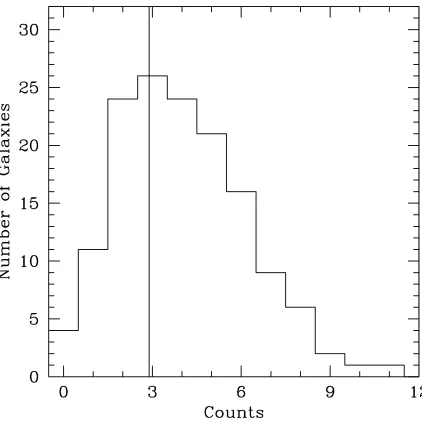
the detection threshold. To investigate this, we plot the average distribution in counts for
the sample of 147 stacked spectroscopic galaxies (Figure 2.1). Much of the high-end tail of
the distribution results from random positive fluctuations. Only three sources consistently
had >7 counts. Removing those objects whose apertures have>6 counts still results in a stacked signal with S/N ∼2.5 and an average loss of 21 galaxies (∼14% of the sample). It is therefore likely that most of the stacked galaxies contribute to the signal, particularly
given their wide range in optical, and likely X-ray, properties.
Contribution of low luminosity AGNs to the stacked signal is a concern. This is a
problem with most X-ray stacking analyses, but we also possess the UV spectra for our
sources. There are two objects undetected in X-rays for which the UV spectra show emission
lines consistent with an AGN. Our ability to identify AGNs from their UV spectra regardless
of their X-ray properties, and having identified only 2 such objects out of 149, suggests that
subthreshold luminous AGNs do not contribute significantly to the stacked X-ray flux.
Furthermore, UV selection biases against the dustiest sources so we do not expect to find
many Compton-thick AGNs in our sample.
There are also two BM galaxies coincident with known radio sources that are not
de-tected in X-rays and are not included in the stacked samples. Removing such objects
ensures excluding radio-loud AGN that might have unassuming UV and X-ray properties.
For comparison, the 3σ radio sensitivity is sufficient to detect SFR∼>170 M⊙yr−1, a factor
of 4 higher than the median SFR of our sample based on the X-ray or de-reddened UV
SFR estimates. The stacked X-ray emission indicates a SFR of∼42 M⊙ yr−1. The on-axis
soft-band flux limit implies a sensitivity to SFR∼> 186 M⊙ yr
−1 at z ∼2, a factor of 4.5
higher than the average SFR for spectroscopic z ∼2 galaxies. Stacking the radio flux for the full spectroscopic sample indicates average SFRs from 33−70 M⊙ yr
−1 depending on
which estimator is used: the Bell (2003), Condon (1992), and Yun et al. (2001) calibrations
give low, high, and median (∼ 56 M⊙ yr
−1) values, assuming γ =−0.8. We adopted the
Yun et al. (2001) calibration as it is most relevant to the radio luminosity range considered
16
Figure 2.1 Average distribution of counts for the spectroscopic sample. The vertical line
denotes the average background count per aperture. The number excess at high counts
2.4.3 Bolometric Properties of z ∼ 2 Galaxies
The UV-implied reddening indicates AV ∼0.5 mag and NH ∼7.5×1020 cm−2 assuming
the Galactic calibration (Diplas & Savage 1994). For this column density, absorption in
the 2−10 keV band is negligible, and we therefore assume that SFRX is indicative of the
bolometric SFR. In this case, we find a good agreement between the SFRs determined from
the X-ray, radio, and de-reddened UV luminosities (LX,L1.4 GHz, andLUV), suggesting that
the locally calibrated relations between specific luminosity and SFR remain valid within
the uncertainties at z ∼2, under the caution that we cannot independently test for these relations as we have no direct measure of Lbol.
The hLXi and hL1.4 GHzi of spectroscopically identified z ∼2 galaxies are comparable to those of local starbursts. The X-ray/FIR relation for local galaxies (Ranalli et al. 2003)
implies hLFIRi ∼ 2.6 ×10¹¹ L⊙. The stacked L1.4 GHz implies hLFIRi = 1.1×10¹¹ L⊙
(Yun et al. 2001). These estimates are similar to the FIR luminosity of luminous infrared
galaxies (LIRGs), and are expected to have S850µm ∼ 0.3 mJy (e.g., Webb et al. 2003)
and would therefore be missing in confusion-limited SCUBA surveys to 2 mJy. Spitzer
will have the same rest-frame 7 µm sensitivity to z ∼ 2 galaxies as ISO has at z ∼ 1 for
LFIR ∼>5×10¹⁰ L⊙ galaxies (Weedman et al. 2004; Flores et al. 1999). Therefore, unlike
the stacked averages presented here, theSpitzerdata will be the first extinction-free tracer
of the SFR distribution of thez∼2 sample as the stacked galaxies should be individually detected at 24µm.
For a fair comparison between the three redshift bins for 1.5< z∼<3.0, we have added back those direct X-ray detections in the stacks for the 1.5 < z ≤ 2.0 and 2.0 < z ≤ 2.5 samples that would not have been detected if they hadz >2.5. There were no such sources with 1.5 < z ≤ 2.0 and only one with 2.0 < z ≤ 2.5, increasing hL2−10 keVi by 2% to
2.38×1041 ergs s−1.
The distance independent ratio SFRX/SFRuncorUV (Table 2.2) is similar among the
selec-tion and redshift subsamples indicating that on average UV-estimated SFRs (uncorrected
18
BX/BM sample using the Calzetti et al. (2000) extinction law is similar to that computed
from SFRX/SFRuncorUV . The de-reddened UV-estimated SFRs (SFRcorUV) agree well with those
predicted from the radio continuum for the two samples for which radio estimates could be
obtained. Finally, we note the factor of∼5 UV attenuation is similar to that advocated by
Steidel et al. (1999) for UV-selected samples at all redshifts.
The average attenuation factor increases as the SFR increases, as shown by the last four
subsamples in Table 2.2, and is expected if galaxies with higher SFRs have greater dust
content on average (Adelberger & Steidel 2000). SFRcor
UV follows the bolometric SFR even
for low luminosity systems, indicating that the observed correlations are not entirely driven
by only the most luminous galaxies.
2.5
Conclusions
We have made significant progress in estimating and comparing SFRs determined from
UV, X-ray, and radio emission from galaxies between redshifts 1.5 ∼< z ∼< 3.0, postulated to be the most “active” epoch for galaxy evolution. The locally calibrated SFR relations,
though uncertain in individual systems, appear to remain statistically valid at high redshift.
Stacking the X-ray and radio emission from UV-selected galaxies at z ∼ 2 indicates that these galaxies have an average SFR of∼50 M⊙yr
−1
and an average UV attenuation factor
of ∼ 4.5. The prospect of increased radio sensitivity with the E-VLA, as well as X-ray campaigns in different fields to similar depth as the 2 Msec survey in the GOODS-North
field, will allow for a more direct probe of the radio and X-ray flux distribution for the
stacked galaxies. SpitzerMIPS 24µm data for the GOODS-N field will trace the dusty star formation inz∼2 galaxies and allow for the cross-checking of the results presented here.
We thank Alice Shapley, Dawn Erb, Matt Hunt, and Kurt Adelberger for help in
ob-taining the data presented here. CCS has been supported by grants AST 0070773 and
0307263 from the National Science Foundation (NSF) and by the David and Lucile Packard
19
F0.5−2.0 keVd L2.0−10 keVe S1.4 GHzf L1.4 GHzg νLνh
Sample Nsa hzib S/Nc (×10−18ergs cm−2 s−1) (×1041 ergs s−1) (µJy) (×1022 W Hz−1) (×1010L⊙)
BX+BM 147 2.09 8.9 5.65±0.68 2.11±0.25 2.30±0.65 5.90±1.66 3.50
BX 109 2.22 6.8 4.83±0.79 2.09±0.34 2.09±0.75 6.17±2.21 3.86
BM 38 1.71 6.0 8.04±1.34 1.84±0.31 ... ... 2.46
1.5< z≤2.0 54 1.82 5.6 6.89±1.27 1.84±0.33 ... ... 2.81 2.0< z≤2.5 73 2.24 6.0 5.24±0.96 2.33±0.43 ... ... 4.05 2.5< z≤3.0 43 2.87 3.3 4.21±1.46 3.40±1.18 ... ... 4.61
aNumber of galaxies stacked
bMean redshift
cSignal-to-noise calculated in a manner analogous to that in Nandra et al. 2002
dAverage soft-band X-ray flux per object
eAverage rest-frame X-ray luminosity per object, assuming Γ = 2.0 andN
H= 1.6×1020cm−2, for our adopted cosmology fAverage integrated radio flux density per object
gAverage rest-frame 1.4 GHz luminosity per object, assuming synchrotron spectral index ofγ=−0.8
20
Table 2.2. Star Formation Rate Estimates
SFRX SFRR SFRcorUV
Sample (M⊙ yr−1) (M⊙yr−1) (M⊙yr−1) SFR
X/SFRuncorUV
BX+BM 42 56 50 4.5
BX 42 58 54 4.2
BM 37 ... 38 4.8
1.5< z≤2.0 37 ... 49 4.3 2.0< z≤2.5 47 ... 57 4.4 2.5< z≤3.0 68 ... 70 4.7 SFRcor
UV≤20 M⊙yr
−1 14 ... 11 2.3
20<SFRcor
UV≤40 M⊙yr
−1 40 ... 38 4.4
40<SFRcor
UV≤60 M⊙yr−1 44 ... 48 4.7
SFRcor
UV>60 M⊙yr
Chapter 3
A Census of Optical and Near-Infrared Selected
Star-Forming and Passively Evolving Galaxies at
Redshift
z
∼
2
∗†Naveen A. Reddy,a Dawn K. Erb,b Charles C. Steidel,a Alice E. Shapley,c
Kurt L. Adelberger,d & Max Pettinie
aCalifornia Institute of Technology, MS 105–24, Pasadena, CA 91125
bHarvard-Smithsonian Center for Astrophysics, 60 Garden Street, Cambridge, MA 02138
cAstronomy Department, University of California, Berkeley, 601 Campbell Hall, Berkeley, CA 94720
dMcKinsey & Company, 1420 Fifth Avenue, Suite 3100, Seattle, WA 98101
eInstitute of Astronomy, Madingley Road, Cambridge CB3 OHA, UK
Abstract
Using the extensive multi-wavelength data in the GOODS-North field, including our
ground-based rest-frame UV spectroscopy and near-IR imaging, we construct and draw comparisons
between samples of optical and near-IR selected star-forming and passively evolving galaxies
∗Based, in part, on data obtained at the W. M. Keck Observatory, which is operated as a scientific
partnership among the California Institute of Technology, the University of California, and NASA, and was
made possible by the generous financial support of the W. M. Keck Foundation.
22
at redshifts 1.4∼< z∼<2.6. We find overlap at the 70−80% level in samples of z∼2 star-forming galaxies selected by their optical (UnGR) and near-IR (BzK) colors when subjected
to commonK-band limits. DeepChandradata indicate a∼25% AGN fraction among near-IR selected objects, much of which occurs among near-near-IR bright objects (Ks <20; Vega).
Using X-rays as a proxy for bolometric star formation rate (SFR) and stacking the X-ray
emission for the remaining (non-AGN) galaxies, we find the SFR distributions of UnGR,
BzK, and J−Ks >2.3 galaxies (i.e., Distant Red Galaxies; DRGs) are very similar as a
function of Ks, with Ks < 20 galaxies having hSF Ri ∼ 120 M⊙ yr −1
, a factor of 2 to 3
higher than those with Ks >20.5. The absence of X-ray emission from the reddest DRGs
and BzK galaxies with (z−K)AB ∼>3 indicates they must have declining star formation
histories to explain their red colors and low SFRs. While theM/Lratio of passively-evolving galaxies may be larger on average, theSpitzer/IRAC data indicate that their inferred stellar
masses do not exceed the range spanned by optically selected galaxies, suggesting that the
disparity in current SFR may not indicate a fundamental difference between optical and
near-IR selected massive galaxies (M∗
>1011M⊙). We consider the contribution of optical,
near-IR, and submillimeter-selected galaxies to the star formation rate density (SFRD) at
z∼2, taking into account sample overlap. The SFRD in the interval 1.4∼< z∼<2.6 ofUnGR
and BzK galaxies to Ks = 22, and DRGs to Ks = 21 is ∼0.10±0.02 M⊙ yr
−1 Mpc−3.
Optically-selected galaxies to R = 25.5 and Ks = 22.0 account for ∼ 70% of this total.
Greater than 80% of radio-selected submillimeter galaxies toS850µm∼4 mJy with redshifts
1.4< z <2.6 satisfy either one or more of the BX/BM, BzK, and DRG criteria.
3.1
Introduction
A number of surveys have been developed to select galaxies atz∼2, determine their bolo-metric star formation rates (SFRs), and compare with other multi-wavelength studies to
form a census of the total star formation rate density (SFRD) at z∼2 (e.g., Steidel et al. 2004; Rubin et al. 2004; Daddi et al. 2004b). A parallel line of study has been to compare
optical and near-IR selected galaxies that are the plausible progenitors of the local
popula-tion of passively evolving massive galaxies. However, biases inherent in surveys that select
galaxies based on their star formation activity (e.g., Steidel et al. 2004) and stellar mass
with an accurate knowledge of the overlap between these samples can we begin to address
the associations between galaxies selected in different ways, their mutual contribution to
the SFRD at z ∼ 2, and the prevalence and properties of passively evolving and massive galaxies at high redshift. Quantifying this overlap between optical and near-IR surveys is
a primary goal of this paper.
In practice, optical surveys are designed to efficiently select galaxies with a specific
range of properties. The imaging required for optical selection is generally a small fraction
of the time required for near-IR imaging, and can cover much larger areas within that
time. In contrast, near-IR surveys sample galaxies over a wider baseline in wavelength than
optical surveys, and can include galaxies relevant to studying both the star formation rate
and stellar mass densities at high redshift. However, in order to achieve a depth similar
(and area comparable) to that of optical surveys, near-IR selection requires extremely deep
imaging and can be quite expensive in terms of telescope time due to the relatively small size
of IR arrays compared to CCDs. Furthermore, the “color” of the terrestrial background for
imaging is (B−Ks)AB≃7 magnitudes, much redder than all but the most extremez∼2
galaxies. Once selected, of course, such extreme galaxies then require heroic efforts to obtain
spectra, whereas optical selection, particularly at redshifts where key features fall shortward
of the bright OH emission “forest,” virtually guarantees that one can obtain a spectroscopic
redshift with a modest investment of 8 - 10m telescope time and a spectrograph with
reasonably high throughput. As we show below, optical and near-IR surveys complement
each other in a way that is necessary for obtaining a reasonably complete census of galaxies
at high redshift.
The SFRs of z ∼ 2 galaxies are typically estimated by employing locally calibrated relations between emission at which the galaxies can be easily detected (e.g., UV, Hα) and their FIR emission. The X-ray luminosity of local non-active galaxies results primarily
from high mass X-ray binaries, supernovae, and diffuse hot gas (e.g., Grimm et al. 2002;
Strickland et al. 2004); all of these sources of X-ray emission are related to the star formation
activity on timescales of∼<100 Myr. Observations of galaxies in the local Universe show a tight correlation between X-ray and FIR luminosity, prompting the use of X-ray emission as
an SFR indicator (Ranalli et al. 2003). This correlation between X-ray emission and SFR
applies to galaxies with a very large range in SFRs, from∼0.1−1000 M⊙ yr −1
24
analyses at X-ray and radio wavelengths, and comparison with UV emission, indicate that
the local SFR relations appear to give comparable estimates of the instantaneous SFRs
of galaxies after assuming continuous star formation models and correcting for dust (e.g.,
Reddy & Steidel 2004; Nandra et al. 2002; Seibert et al. 2002).
Two surveys designed to select massive galaxies at redshifts 1.4∼< z∼<2.5 and passively-evolving (PE) galaxies at redshifts z ∼> 2, respectively, are the K20 and FIRES surveys. The K20 and FIRES selection criteria were developed to take advantage of the sensitivity
of rest-frame optical light and color to stellar mass and the strength of the Balmer break,
respectively, for z∼2 galaxies (e.g., Cimatti et al. 2002a; Franx et al. 2003). The Gemini Deep Deep Survey (GDDS) extends this near-IR technique to target massive galaxies at
slightly lower redshifts (0.8∼< z∼<2.0; Abraham et al. 2004).
X-ray stacking analyses of the brightest galaxies in the K20 and FIRES surveys indicate
an average SFR a factor of 4 to 5 times larger than for optically-selected z ∼ 2 galaxies (Daddi et al. 2004a; Rubin et al. 2004), inviting the conclusion that optical selection misses
a large fraction of the star formation density at high redshift. While it is certainly true
that optical surveys miss some fraction of the SFRD, the past quoted difference in the
average SFRs of galaxies selected optically and in the near-IR disappears once the galaxies
are subjected to a common near-IR magnitude limit, as we show below.
We have recently concluded a campaign to obtain deep near-IR imaging for fields in the
z ∼ 2 optical survey (Steidel et al. 2004), allowing for a direct comparison of optical and near-IR selected galaxies. One result of this comparison is that Ks <20 (Vega)
optically-selected galaxies show similar space densities, stellar masses, and metallicities as Ks-bright
galaxies in near-IR samples (Shapley et al. 2004). More recently, Adelberger et al. (2005a)
show that the correlation lengths forKs-bright galaxies among optical and near-IR samples
are similar, suggesting an overlap between the two sets of galaxies, both of which plausibly
host the progenitors of massive elliptical galaxies in the local Universe. These results suggest
that near-IR bright galaxies have similar properties regardless of the method used to select
them.
In this paper, we extend these results by examining the color distributions and
complementary data available, includingChandra/X-ray, ground-based optical and near-IR,
and Spitzer/IRAC imaging. Multi-wavelength data in a single field are particularly useful
in that we can use a common method for extracting photometry that is not subject to the
biases that may exist when comparing galaxies in different fields whose fluxes are derived
in different ways. The addition of our rest-frame UV spectroscopic data in the
GOODS-N field provides for a more detailed analysis than otherwise possible of the properties of
galaxies as a function of selection technique. Furthermore, the GOODS-N field coincides
with the ChandraDeep Field North (CDF-N) region which have the deepest (2 Ms) X-ray
data available (Alexander et al. 2003). The X-ray data allow for an independent estimate
of bolometric SFRs and the available depth allows more leeway in stacking smaller numbers
of sources to obtain a statistical detection, as well as identifying AGN to a lower luminosity
threshold than possible in other fields that have shallower X-ray data.
The outline of the paper is as follows. In § 2, we describe the optical, near-IR, X-ray,
and IRAC data and present the optical and near-IR selection criteria and X-ray stacking
method. Color distributions, direct X-ray detections, and stacked results are examined in
§ 3. In§ 4, we discuss the SFR distributions of optical and near-IR selectedz∼2 galaxies and their relative contributions to the SFRD, and the presence of a passively evolving
population of galaxies. A flat ΛCDM cosmology is assumed with H0 = 70 km s−1 Mpc−1
and ΩΛ= 0.7.
3.2
Data and Sample Selection
3.2.1 Imaging
Optical UnGR images in the GOODS-North field were obtained in April 2002 and 2003
under photometric conditions using the KPNO and Keck I telescopes. The KPNO/MOSAIC
U-band image was obtained from the GOODS team (PI: Giavalisco) and was transformed to reflect Un magnitudes (e.g., Steidel et al. 2004). The Keck IG andRband images were
taken by us with the Low Resolution Imaging Spectrograph (LRIS; Oke et al. 1995, Steidel
et al. 2004), and were oriented to provide the maximum overlap with the GOODS ACS and
Spitzersurvey region. The images cover 11′ ×15′
with FWHM∼0′′.
26
Steidel et al. (2003). We obtained deepB-band images of the GOODS-N field from a public distribution ofSubaru data (Capak et al. 2004). The deep z-band data are acquired from the public distribution of the HST Advanced Camera for Surveys (ACS) data (Giavalisco et al. 2004b). The B and z band data have 5 σ depths of 26.9 and 27.4 mag measured in 3′′
and 0′′.
2 diameter apertures, respectively. TheKs andJ imaging was accomplished with
the Wide Field Infrared Camera (WIRC) on the Palomar Hale 5 m telescope (Wilson et al.
2003), providing 8.′
7 × 8.′
7 coverage in the central portion of the GOODS-N field. The
near-IR images cover ∼ 43% of the optical image. The images had FWHM ∼ 1′′.
0 under
photometric conditions and 3 σ sensitivity limits of ∼22.6 and∼24.1 mag in theKs and
J bands, respectively. The near-IR data are described in detail by Erb et al. (2006c). The total area studied in the subsequent analysis is∼72.3 arcmin2.
The procedures for source detection and photometry are described in Steidel et al.
(2003). Briefly,UnGR magnitudes were calculated assuming isophotal apertures that were
adjusted to theR-band flux profiles. Source detection was done at Ks-band. BzK and J
magnitudes are computed assuming the isophotal apertures adjusted to the Ks-band flux
profiles, unless theR-band isophotes gave a more significantKsdetection. In the analysis to
follow, “Ks” andJ magnitudes are in Vega units. We use the conversionKAB=Ks+ 1.82.
All other magnitudes are in AB units.
Fully reducedSpitzer/IRAC mosaics of the GOODS-North field were made public in the
first data release of the GOODS Legacy project (PI: Dickinson). The IRAC data overlap
completely with our Ks-band image, but currently only two channels (either 3.6 µm and
5.8µm, or 4.5µm and 8.0µm) are available over most of the image. A small area of overlap has coverage in all four channels. The images are deep enough that source confusion is an
issue. We have mitigated the effects of confusion noise by employing the higher spatial
resolutionKs-band data to constrain source positions and de-blend confused IRAC sources.
We performed PSF photometry using the procedure described in Shapley et al. (2005).
3.2.2 Selection Criteria
3.2.2.1 Optical Selection of Star-Forming Galaxies
We have optically-selected z ∼ 2 galaxies in the GOODS-N field based on their observed
25.5. The selection criteria aim to select actively star-forming galaxies at z ∼ 2 with the same range in UV properties and extinction as LBGs at z∼3 (Steidel et al. 2003). “BX” galaxies are selected to be at redshifts 2.0∼< z∼<2.6 using the following criteria:
G− R ≥ −0.2
Un−G ≥ G− R+ 0.2
G− R ≤ 0.2(Un−G) + 0.4
Un−G ≤ G− R+ 1.0, (3.1)
and “BM” objects are selected to be at redshifts 1.5∼< z∼<2.0 using the following criteria:
G− R ≥ −0.2
Un−G ≥ G− R −0.1
G− R ≤ 0.2(Un−G) + 0.4
Un−G ≤ G− R+ 0.2 (3.2)
(Adelberger et al. 2004; Steidel et al. 2004). For subsequent analysis, we will refer to BX
and BM objects as those that are optically-, or “BX/BM”-, selected. Optical color selection ofz∼2 galaxies in the 11′
by 15′
area of the GOODS-North field
yielded 1360 BX and BM candidates, of which 620 lie in the region where we have
comple-mentary J− and K-band data (§ 3.2.1), and 199 have Ks < 21.0. Followup spectroscopy
with the blue channel of the Low Resolution Imaging Spectrograph (LRIS-B) yielded 147
redshifts for objects with Ks-band data (248 redshifts over the entire optical field). Of
these 147 objects with redshifts andKs-band data, 129 have z >1, and 60 havez >1 and
Ks <21. The mean redshift of the 60 BX/BM objects is hzi= 1.99±0.36. The
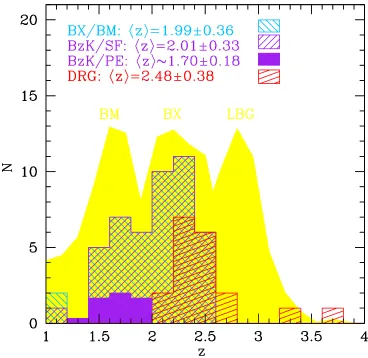
spectro-scopic interloper fractions in the BX/BM sample are summarized in Table 3.1. The BX and BM selection functions (shown as shaded distributions in Figure 3.1) have distributions
28
Figure 3.1Spectroscopicredshift distributions toKs = 21 for the various samples considered
here. The BX/BM and BzK/SF distributions (hashed histograms) include sources from our sample in the GOODS-North field and overlap almost completely. The DRGs have a
higher mean redshift ofhzi= 2.48±0.38 from our sample ofJ−Ks >2.3 sources withz >1
in all four fields of the optical survey (Steidel et al. 2004) where we have complementaryJ−
andK-band imaging. The redshift distribution of DRGs within our sample (all of which are selected with the BX/BM or z∼3 LBG criteria) is similar to that found by van Dokkum et al. (2004), van Dokkum et al. (2003), and F¨orster Schreiber et al. (2004b). The solid
histogram shows the redshift distribution for BzK/PE galaxies from Daddi et al. (2004a) and Daddi et al. (2005b), scaled down by a factor of 3 for clarity. The background shaded
regions show the arbitrarily normalized redshift distributions for optically-selected BX and
3.2.2.2 Near-IR Selection of Star-Forming Galaxies
The near-IR properties of galaxies can be used both to target star forming galaxies and to
identify those with extremely red colors that may indicate passive evolution. To address the
former issue, we have employed the “BzK” selection criteria of Daddi et al. (2004a) to cull objects in the GOODS-N field and directly compare with those selected on the observed
optical properties ofz∼>2 galaxies. Daddi et al. (2004a) define the quantity “BzK”:
BzK ≡(z−K)−(B−z); (3.3)
star-forming galaxies withz >1.4 are targeted by the following criterion:
BzK ≥ −0.2, (3.4)
in AB magnitudes. Of the 1185 sources with>3σ B,z, andKdetections andKs <21, 221
satisfy Equation 3.4. The surface density of BzK galaxies with Ks <21 is ∼3 arcmin−2,
similar to the surface density of BX/BM galaxies to a similar Ks-band depth. These
star-forming BzK galaxies will be referred to as “BzK/SF” galaxies, and their spectroscopic redshift distributionfrom our spectroscopic sampleis shown in Figure 3.1. Our deep near-IR
imaging allows us to determine the redshift distribution forBzK/SF galaxies withKs>20
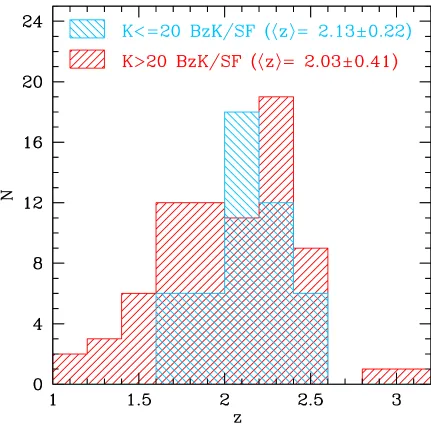
(and which also satisfy the BX/BM criteria), and the results are shown in Figure 3.2. The mean redshifts of the Ks ≤ 20 and Ks > 20 distributions are hzi = 2.13±0.22 and hzi = 2.03±0.41, respectively, and agree within the uncertainty. We note, however, that theBzK/SF criteria selectKs >20 objects over a broader range in redshift (1.0≤z≤3.2)
than Ks ≤20 objects. This reflects the larger range in BzK colors of Ks > 20 BzK/SF
galaxies compared with those having Ks ≤ 20. Additionally, the photometric scatter in
colors is expected to increase for fainter objects, so a broadening of the redshift distribution
forBzK/SF objects with fainterKs magnitudes is not surprising.
We emphasize that we only know the redshifts for BzK/SF galaxies that also happen to fall in the BX/BM sample. In general, the true redshift distribution,NoBzK/SF(z), of the
30
Figure 3.2 Arbitrarily normaliz