International Journal of Chronic Obstructive Pulmonary Disease
Dovepress
O r I g I n A L r e s e A r C H
open access to scientific and medical research
Open Access Full Text Article
effect of gene environment interactions on lung
function and cardiovascular disease in COPD
Tillie-Louise Hackett1,2,*
Dorota stefanowicz1,*
Farzian Aminuddin1
Don D sin1
John e Connett3
nicholas r Anthonisen4
Peter D Paré1
Andrew J sandford1
1University of British Columbia, James
Hogg research Laboratories, st Paul’s Hospital, Division of respirology, Department of Medicine, 2Department
of Anesthesiology, Pharmacology, and Therapeutics, University of British Columbia, Vancouver, BC, Canada;
3school of Public Health, University
of Minnesota, Minneapolis, Mn, UsA;
4Faculty of Medicine, University of
Manitoba, Winnipeg, MB, Canada
*These authors contributed equally to this work
Correspondence: Andrew sandford UBC James Hogg research Centre at the Heart and Lung Institute, st Paul’s Hospital, 1081 Burrard street, Vancouver, BC, Canada V6Z 1Y6 Tel +1 604 806 8346
Fax +1 604 806 8351
email [email protected]
Background: The objective of this study was to determine if gene-environment interactions between cigarette smoking and interleukin-6 (IL6), interferon-γ (IFNG), interleukin-1β (IL1B), or interleukin-1 receptor antagonist (IL1RN) single nucleotide polymorphisms are associ-ated with lung function decline and cardiovascular disease in chronic obstructive pulmonary disease (COPD).
Methods: Single nucleotide polymorphisms (SNPs) in IL6, IFNG, IL1B, and IL1RN were genotyped in the Lung Health Study and correlated with rate of decline of forced expiratory volume in 1 second (FEV1) over 5 years, baseline FEV1, serum protein levels, cardiovascular disease, and interactions with smoking.
Results: The IL6 rs2069825 single nucleotide polymorphism was associated with the rate of decline of prebronchodilator FEV1 (P= 0.049), and was found to have a significant interac-tion (P= 0.004) with mean number of cigarettes smoked per day. There was also a significant interaction of IFNG rs2069727 with smoking on prebronchodilator (P= 0.008) and postbron-chodilator (P= 0.01) FEV1. The IL6 polymorphism was also associated with cardiovascular disease in heterozygous individuals (P= 0.044), and was found to have a significant interaction with smoking (P= 0.024). None of the genetic variants were associated with their respective serum protein levels.
Conclusion: The results suggest interactions of IL6 rs2069825 and IFNG rs2069727 single nucleotide polymorphisms with cigarette smoking on measures of lung function. The IL6 rs2069825 single nucleotide polymorphism also interacted with smoking to affect the risk of cardiovascular disease in COPD patients.
Keywords: gene-environment interactions, interleukin-6, forced expiratory volume in one second, cardiovascular disease, chronic obstructive pulmonary disease
Introduction
Cigarette smoking is responsible for nearly five million deaths annually, with the leading cause of tobacco-related mortality being cardiovascular disease, followed by chronic obstructive pulmonary disease (COPD).1 While the adverse effects of cigarette smoking
on lung health and “systemic” diseases are well established, the precise mechanism by which cigarette smoke mediates its systemic effects needs to be clarified. Due to the large variation in the adverse effects of cigarette smoke, it has been proposed that other factors, such as gene-environment interactions, may be important in promoting tobacco-related disease.2,3 COPD represents a clear example of gene-environment
interactions because although cigarette smoking is the main environmental trigger for COPD in developed countries, considerable variation exists in disease outcomes, which are likely related to an individual’s genetic load.
International Journal of Chronic Obstructive Pulmonary Disease downloaded from https://www.dovepress.com/ by 118.70.13.36 on 22-Aug-2020
For personal use only.
Number of times this article has been viewed
Dovepress
Hackett et al
Pulmonary inflammation is central to the development of COPD, characterized by increased numbers of neutrophils, macrophages, and lymphocytes, leading to the destruction of lung parenchyma, goblet cell hypertrophy, and tissue remodeling. In some patients, COPD is associated with systemic effects, which include cachexia, skeletal muscle wasting, and increased comorbidities, such as cardiovascular disease.4 These systemic effects may be caused or sustained
by the enhanced systemic inflammation observed in some COPD patients.
Due to the complexity of the inflammatory mediators released by immune cells in response to smoking, mul-tiple mediators have been suggested to be involved in the progression of COPD. We have previously demonstrated the association between interleukin-6 (IL6), interferon-γ
(IFNG), interleukin-1β (IL1B), and interleukin-1 receptor antagonist (IL1RN) polymorphisms and a rapid decline or baseline level of lung function in smokers.5–7 The Lung
Health Study (LHS) is a multicenter community-based cohort of smokers with mild to moderate airflow limitation.8
Our previous studies utilized a subset of individuals from the LHS cohort to form a nested case-control study based on the extremes of distribution for the rate of decline in lung function and baseline lung function.5–7 Our rationale in
this study was to investigate if gene × smoking interactions were associated with lung function decline in the entire LHS cohort. This approach would therefore allow us to estimate the effect of the identified polymorphisms and interactions with smoking on continuous measures of lung function, rather than dichotomous extremes, which the previous subset analyses were underpowered to perform. Our second aim was to determine whether the genetic variants and/or gene × smoking interactions were predictors of cardiovas-cular disease. We hypothesized that the link between COPD and mortality from cardiovascular disease is inflammation, through both local and systemic mechanisms.
Methods
LHs participants
The details of the LHS cohort have previously been pub-lished.8 Briefly, 5887 subjects who were cigarette smokers,
aged 35–60 years, with mild to moderate airflow obstruction were recruited into the LHS cohort. Airflow obstruction was defined by a forced expiratory volume in one second (FEV1) to forced vital capacity (FVC) ratio of #0.70 and FEV1 55%–90% of predicted. Lung function measurements were performed annually over the 5 years of the study using
standardized spirometry, with quality control in accordance with the American Thoracic Society guidelines.9,10
Dur-ing the follow-up phase of the study, the vital status of the participants was captured every 6 months. An independent mortality and morbidity committee reviewed death certifi-cates, autopsy reports, and relevant hospital records to assign the causes of death for all participants who died during the study and confirmed data by linkage with the US National Death Index.11
On recruitment into the LHS cohort, each individual’s smoking history was recorded in pack-years. At each sub-sequent annual visit, the smoking status of each participant was ascertained based on self-reporting and was objectively verified by determining cotinine levels in saliva samples and/ or carbon monoxide concentrations in expired air (Minico, Catalyst Research or EC50, Vitalograph). Participants were categorized as continued smokers or sustained quitters based on self-reporting and a validated biochemical measurement at all five follow-up visits.8
Individuals who had a history of cancer (except carci-noma in situ or basal cell carcicarci-noma of the skin), myocardial infarction (in the past 2 years), angina, heart failure, stroke (in the past 2 years), renal failure, insulin-requiring diabetes mellitus, cirrhosis or other serious liver disease, pulmonary embolism, disorders of the central nervous system, narrow-angle glaucoma, or any other major diseases which could have compromised follow-up, were excluded from the cohort.
Polymorphism selection
and genotyping methods
Four single nucleotide polymorphisms (SNPs) were selected because they showed significant associations with either rate of decline or baseline lung function in our previous nested case-control studies of the LHS cohort.5–7 In addition, the
respective proteins have previously been implicated in the pathogenesis of cardiovascular disease.12–17 Genotyping was
performed using the TaqMan method (Applied Biosystems, Foster City, CA).
serum
IL6
,
IL1
β
,
IL1RN
, and
IFNG
concentrations
At the fifth annual visit, DNA and serum was isolated using venipuncture. The serum samples were stored at -70°C and used to measure the concentrations of IL6, IL1β, IL1RN, and
IFNG using a highly sensitive chemiluminescent multiplexed sandwich immunoassay (SearchLight Proteome Array System, Rockford, IL).
International Journal of Chronic Obstructive Pulmonary Disease downloaded from https://www.dovepress.com/ by 118.70.13.36 on 22-Aug-2020
Dovepress gene-environment interactions in COPD
statistical analysis
Hardy–Weinberg equilibrium was assessed using χ2
goodness-of-fit tests, and linkage disequilibrium estimations were performed using the CubeX cubic exact solutions program.18 Multivariate linear regressions for
prebronchodila-tor and postbronchodilaprebronchodila-tor rate of decline were performed to test for associations with each SNP. The confounding factors included for these analyses were age, body mass index, smoking status (continuous versus noncontinuous), and mean number of cigarettes smoked per day during the LHS follow-up period.
Multivariate linear regressions for baseline FEV1% pre-dicted were performed to test for associations with each SNP. Confounding factors included for analyses of baseline lung function were age, body mass index, and pack-years of smok-ing. Pack-years of smoking was used as the covariate because this smoking measure was thought to be the most representative of patient smoking history prior to the start of the study.
Multivariate logistic regressions were used to test for the association of each SNP with cardiovascular disease and fatal cardiovascular disease.
Multivariate linear regressions were also performed to test for association of each SNP with logarithmically transformed serum levels of their respective proteins, with age, body mass index, and pack-years of smoking included as covariates.
Rate of decline in lung function was determined by the difference between lung function at the start and end of the study divided by the number of years between the two measurements. Gene × smoking interactions were tested in the entire LHS cohort by adding a multiplicative term to the regression models.
The single locus analyses described above were per-formed using the JMP statistical package (SAS Institute Inc, Cary, NC). Haplotype analysis was done using the SimHap package.19 If we were to apply a Bonferroni correction for the
total number of 29 comparisons conducted in this study, there would be no association that would survive this stringent level of correction. Because many of the phenotypes and the IL1B and IL1RN SNPs tested were significantly associ-ated, we used a matrix spectral decomposition approach to estimate the effective number of independent phenotypes and genotypes.20 Using the matrix spectral decomposition
approach, the total effective number of variables (Veff) tested for IL6, IFNG, IL1B, and IL1RN was 8.15, 7.25, 9, and 9, respectively. The significance threshold required to keep the Type I error rate at 5% (0.05/Veff) for IL6, IFNG, IL1B, and
IL1RN was 6.137 × 10⁻³, 6.894 × 10⁻³, 5.555 × 10⁻³, and
5.555 × 10⁻³, respectively, for each gene.
Results
Characteristics of study participants
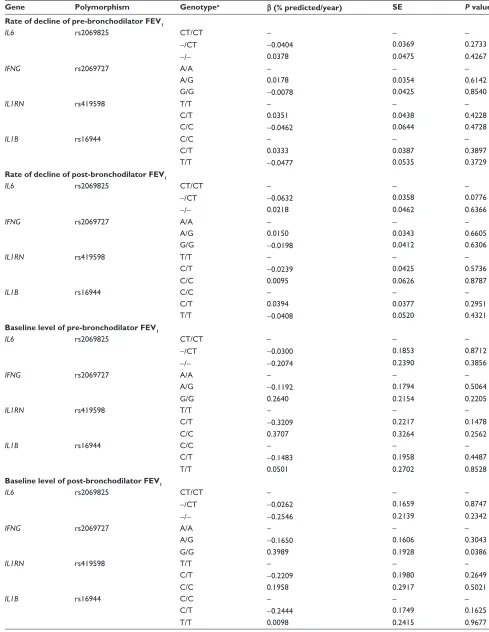
Of the 5887 LHS participants, 4189 had DNA and com-plete phenotypic data available. Of those, 4036 (96%) were of European descent and were utilized in the subsequent analyses because we had insufficient power to study the other ethnic groups. The total cohort (n = 4036) was used to investigate gene × smoking interactions on lung function, the effects of polymorphisms on serum levels of their respective proteins, and the influence of genetic variants on cardiovas-cular disease. The subset of LHS participants (n = 2523) that had not been previously included in genetic studies of these polymorphisms was used to investigate associations with lung function measures. The demographic characteristics of the LHS participants are shown in Table 1.
Table 1 Distribution of demographic characteristics for participants in the Lung Health study
Total cohort Subseta
(N = 4036) (N = 2523)
gender (F/M) 1479/2557 925/1598
Age (years) 48.51 (6.74) 48.54 (6.69)
smoking history (pack yearsb) 40.26 (18.29) 40.36 (18.12)
Mean cigarettes/dayc 15.09 (13.55) 13.97 (13.69)
smoking status during 5-year follow-upd
Continuing smokers 2177 1169
Intermittent quitters 1148 833
sustained quitters 711 521
BMI (kg/m2) 25.52 (3.83) 25.56 (3.84)
Baseline FeV1 (% predicted pre-BD)e 75.41 (8.87) 76.18 (6.57)
Baseline FeV1 (% predicted post-BD)f 78.55 (9.20) 79.16 (5.88)
∆ FEV1/year (% predicted pre-BD)g -0.83 (1.67) -0.72 (1.37)
∆ FEV1/year (% predicted post-BD)h -0.64 (1.57) -0.51 (1.36)
Median (IQr) IL6 (pg/mL) 2.6 (1.8–4.3) nA Median (IQr) IFnγ (pg/mL) 6.1 (3.4–14.2) nA Median (IQr) IL1rn (pg/mL) 138 (96–198) nA Median (IQr) IL1β (pg/mL) 1.27 (0.79–2.44) nA Cardiovascular disease death (yes/no) 71/3965 nA Cardiovascular disease (yes/no) 705/3331 nA
Notes:aexcluding participants in previous studies; bnumber of packs of cigarettes
smoked per day times number of years smoking; cnumber of cigarettes smoked
per day during 5-year follow-up; dContinuing smokers: participants who reported
smoking at each annual visit. sustained quitters: participants who were validated by salivary cotinine or exhaled carbon monoxide levels as abstinent at every annual visit. Intermittent quitters: participants who were not sustained quitters or continuing smokers; eLung function at the start of the LHs measured as FeV
1 %
predicted pre-bronchodilator; fLung function at the start of the LHs measured as
FeV1 % predicted post-bronchodilator; gChange in lung function per year over a
5-year period as % predicted FeV1 pre-bronchodilator; hChange in lung function
per year over a 5-year period as % predicted FeV1 post-bronchodilator. Values are
means ± sD for continuous data unless otherwise stated.
Abbreviations: BD, bronchodilator; BMI, body mass index; FeV1, forced expiratory
volume in 1 second; IL6, interleukin-6; IFnγ, interferon gamma; IL1rn, interleukin 1 receptor antagonist; IL1β, interleukin-1β; IQr, interquartile range.
International Journal of Chronic Obstructive Pulmonary Disease downloaded from https://www.dovepress.com/ by 118.70.13.36 on 22-Aug-2020
Dovepress
Hackett et al
Table 2 Frequency of snP alleles and genotypes in the total cohort (n = 4036)
Gene SNP Allelesa Chromosomal locationb Position in gene Minor allele
frequency (%)
Genotype frequency (%)
AA AB BB
IL6 rs2069825 CT/- 7: 22765341–22765342 Promoter 39 38 46 16
IFng rs2069727 A/g 12: 68548223 3′ region 47 29 49 22
IL1rn rs419598 T/C 2: 113887207 exon 3 27 53 39 8
IL1B rs16944 C/T 2: 113594867 Promoter 33 45 44 11
Notes:aThe first allele is the major allele, the second is the minor allele; bChromosome: base position (nCBI Build 37.1).
Polymorphism genotyping assays, linkage
disequilibrium, and Hardy–Weinberg
equilibrium
In our previous study of IL1B and IL1RN polymorphisms, we genotyped a variable number of tandem repeats in intron 2 of the IL1RN gene.7 In order to facilitate rapid genotyping
of the large number of samples in this study, we utilized a SNP (rs419598) that was reported to be in high linkage disequilibrium with the tandem repeat polymorphism.21
We confirmed this association in a sample of 571 LHS participants for whom we had genotypic information for both polymorphisms. The linkage disequilibrium statistic between the tandem repeat (considering alleles A1 and A2) and rs419598 in these individuals was r2= 0.97.
We genotyped the LHS participants for four poly-morphisms, ie, rs2069825 in IL6, rs2069727 in IFNG, rs16944 in IL1B, and rs419598 in IL1RN. In the total of 4032 individuals, genotyping success rates were in the range of 91.8%–96.2%. The frequencies of the SNP alleles and genotypes are listed in Table 2. All SNPs were in Hardy –Weinberg equilibrium in all groups, except for
IL6 rs2069825, for which there was a slight excess of heterozygotes (P= 0.02).
Analysis of rate of decline and baseline FeV
1We analyzed each polymorphism for association with rate of decline of prebronchodilator and postbronchodilator FEV1 in the LHS participants not previously studied for these vari-ants. In contrast with our previous studies,5,6 there was no
association of any polymorphism with the rate of decline of lung function (Table 3). Similarly, there was no association of the polymorphisms with measures of baseline lung func-tion in the same subset of individuals (Table 3). However, when we analyzed the entire LHS cohort (P= 0.0486) and the original subset of patients (P= 0.0063) we did find a significant effect of the IL6 rs2069825 SNP on the rate of decline of prebronchodilator FEV1 (Table 4).
We had previously found a significant association of
IL1B and IL1RN haplotypes with rate of decline of lung function.7 Therefore, we tested haplotypes of the rs16944
and rs419598 polymorphisms in the LHS cohort not previ-ously tested. Contrary to our previous results, none of the haplotypes were associated with the rate of decline of lung function or with baseline lung function. When we analyzed the entire LHS cohort, we also found no significant asso-ciations except with the original subset analysis (data not shown).
Analysis of gene × smoking interactions
We investigated gene × smoking interactions in the entire LHS cohort. The data in Table 4 suggested a recessive effect of the IL6 rs2069825 SNP and therefore interac-tions of this polymorphism were explored in a recessive model. We found a significant interaction (P= 0.0044) of the IL6 rs2069825 SNP with mean number of cigarettes smoked per day on rate of decline of prebronchodilator FEV1 (Table 5) which remained significant after correc-tions for multiple comparisons by gene (P= 0.0359). This interaction is illustrated in Figure 1, which shows a faster rate of decline in individuals with the IL6 rs2069825 [–/–] genotype. There was also a significant overall interaction of IFNG rs2069727 with smoking on prebronchodilator (P = 0.0098) and postbronchodilator (P= 0.0077) FEV1 (Table 5). There were no significant gene × smoking interactions on lung function parameters with the other polymorphisms studied.
Analysis of serum protein levels
We determined whether each of the four polymorphisms was associated with the serum level of its respective protein. However, none of the genetic variants was significantly associated with the protein levels of IL6, IL1β, IL1RN, or IFNγ measured in peripheral blood (P= 0.176–0.599).
International Journal of Chronic Obstructive Pulmonary Disease downloaded from https://www.dovepress.com/ by 118.70.13.36 on 22-Aug-2020
Dovepress gene-environment interactions in COPD
Table 3 Analysis of rate of decline and baseline of FeV1 in the LHs subset not previously studied
Gene Polymorphism Genotypea β (% predicted/year) SE P value
Rate of decline of pre-bronchodilator FEV1
IL6 rs2069825 CT/CT – – –
-/CT -0.0404 0.0369 0.2733
-/- 0.0378 0.0475 0.4267
IFNG rs2069727 A/A – – –
A/g 0.0178 0.0354 0.6142
g/g -0.0078 0.0425 0.8540
IL1RN rs419598 T/T – – –
C/T 0.0351 0.0438 0.4228
C/C -0.0462 0.0644 0.4728
IL1B rs16944 C/C – – –
C/T 0.0333 0.0387 0.3897
T/T -0.0477 0.0535 0.3729
Rate of decline of post-bronchodilator FEV1
IL6 rs2069825 CT/CT – – –
-/CT -0.0632 0.0358 0.0776
-/- 0.0218 0.0462 0.6366
IFNG rs2069727 A/A – – –
A/g 0.0150 0.0343 0.6605
g/g -0.0198 0.0412 0.6306
IL1RN rs419598 T/T – – –
C/T -0.0239 0.0425 0.5736
C/C 0.0095 0.0626 0.8787
IL1B rs16944 C/C – – –
C/T 0.0394 0.0377 0.2951
T/T -0.0408 0.0520 0.4321
Baseline level of pre-bronchodilator FEV1
IL6 rs2069825 CT/CT – – –
-/CT -0.0300 0.1853 0.8712
-/- -0.2074 0.2390 0.3856
IFNG rs2069727 A/A – – –
A/g -0.1192 0.1794 0.5064
g/g 0.2640 0.2154 0.2205
IL1RN rs419598 T/T – – –
C/T -0.3209 0.2217 0.1478
C/C 0.3707 0.3264 0.2562
IL1B rs16944 C/C – – –
C/T -0.1483 0.1958 0.4487
T/T 0.0501 0.2702 0.8528
Baseline level of post-bronchodilator FEV1
IL6 rs2069825 CT/CT – – –
-/CT -0.0262 0.1659 0.8747
-/- -0.2546 0.2139 0.2342
IFNG rs2069727 A/A – – –
A/g -0.1650 0.1606 0.3043
g/g 0.3989 0.1928 0.0386
IL1RN rs419598 T/T – – –
C/T -0.2209 0.1980 0.2649
C/C 0.1958 0.2917 0.5021
IL1B rs16944 C/C – – –
C/T -0.2444 0.1749 0.1625
T/T 0.0098 0.2415 0.9677
Notes: aThe first allele is the major allele, the second is the minor allele.
Abbreviations: FeV1, forced expiratory volume in 1 second; IFnγ, interferon gamma; IL1rn, interleukin 1 receptor antagonist; IL6, interleukin-6; IL1β, interleukin-1β.
International Journal of Chronic Obstructive Pulmonary Disease downloaded from https://www.dovepress.com/ by 118.70.13.36 on 22-Aug-2020
Dovepress
Hackett et al
Analysis of cardiovascular disease
and fatal cardiovascular disease
There was an association of the IL6 polymorphism with cardiovascular disease, although there was only an effect of the heterozygous genotype (P= 0.0446). There was no association of the IFNG polymorphism or IL1B-IL1RN
haplotypes with either cardiovascular disease outcome. In addition, we found a significant gene × smoking interaction between cardiovascular disease and the IL6 polymorphism (P= 0.0239, Table 6).
Discussion
We have investigated polymorphisms in the IL6,IL1RN,IL1B,
and IFNG genes which have previously been demonstrated as risk factors for accelerated decline in lung function or baseline lung function in COPD patients. Unlike our previous
studies, which used nested case-control designs including patients within the extremes of distribution for lung func-tion parameters, we only found an associafunc-tion for IL6 with rate of decline in lung function for the entire LHS cohort. We found significant gene × smoking interactions between
IL6 and IFNG and the rate of decline in lung function and baseline FEV1, respectively. In addition, we also demonstrated a significant association between IL6 and an IL6× smoking interaction for cardiovascular disease.
The current paradigm for the pathogenesis of COPD includes a local and systemic inflammatory response to environmental challenges, notably cigarette smoking, which ultimately results in airflow obstruction. In COPD patients, high levels of serum or sputum IL6 have been associated with impaired lung function, exacerbations, pulmonary infections, and skeletal muscle weakness.22–27 It has also been Table 4 Analysis of rate of decline of FeV1 in the entire LHs cohort
Gene Polymorphism Genotypea β (% predicted/year) SE P value
Rate of decline of pre-bronchodilator FEV1
IL6 rs2069825 CT/CT – – –
-/CT 0.0582 0.0356 0.1020
-/- -0.1130 0.0460 0.0141
Notes: aThe first allele is the major allele, the second is the minor allele.
Abbreviation: FeV1, forced expiratory volume in 1 second; IL6, interleukin-6.
Table 5 Analysis of gene × smoking interactions on lung function
Term β SE P value
Rate of decline of pre-bronchodilator FEV1
Age -0.0354 0.0038 ,0.0001
BMI 0.0207 0.0066 0.0018
smoking status [Continuous]a -0.2521 0.0340 ,0.0001
Mean cigarettes per dayb -0.0274 0.0030 ,0.0001
IL6 rs2069825 [–/–] -0.0851 0.0344 0.0136
IL6 rs2069825 [–/–] × Mean cigarettes per day -0.0071 0.0025 0.0044
Baseline level of pre-bronchodilator FEV1
Age -0.1346 0.0229 ,0.0001
BMI -0.0926 0.0371 0.0125
smoking history (pack-years) -0.0354 0.0088 ,0.0001
IFNG rs2069727 [A/g] 0.2841 0.1891 0.1331
IFNG rs2069727 [g/g] -0.3918 0.2280 0.0858
IFNG rs2069727 [A/g] × smoking history -0.0316 0.0126 0.0023
IFNG rs2069727 [g/g] × smoking history 0.0207 0.0158 0.0996
Baseline level of post-bronchodilator FEV1
Age -0.2151 0.0236 ,0.0001
BMI -0.0142 0.0382 0.7102
smoking history (pack-years) -0.0445 0.0091 ,0.0001
IFNG rs2069727 [A/g] 0.3225 0.1947 0.0977
IFNG rs2069727 [g/g] -0.4193 0.2347 0.0742
IFNG rs2069727 [A/g] × smoking history -0.0326 0.0107 0.0023
IFNG rs2069727 [g/g] × smoking history 0.0279 0.0129 0.0310
Notes: anumber of packs of cigarettes smoked per day times number of years smoking; bnumber of cigarettes smoked per day during 5-year follow-up.
Abbreviations: BMI, body mass index; FeV1, forced expiratory volume in 1 second; IL6, interleukin-6; IFnγ, interferon gamma.
International Journal of Chronic Obstructive Pulmonary Disease downloaded from https://www.dovepress.com/ by 118.70.13.36 on 22-Aug-2020
Dovepress gene-environment interactions in COPD
demonstrated that overexpression of IL6 in the adult murine lung results in airway inflammation and emphysema-like airspace enlargement.28 In this study, we found the IL6 SNP
rs2069825 deletion allele was associated with rate of decline of prebronchodilator FEV1 in the entire LHS cohort. In a pre-vious independent case-control sample study, associations of IL6 SNPs with COPD susceptibility were also found. In particular, these IL6 SNP were in high linkage disequilib-rium with the IL6 SNP rs2069825 genotyped in the present study.5 IL6 haplotypes, including rs2069825, have been
previously associated with COPD in an independent study of a Caucasian population.29 Furthermore, IL6 haplotypes
have been found to be associated with COPD defined by lung function in a Spanish population.30 In contrast, a much
smaller study has previously reported no association of an
IL6 SNP (rs1800795) with COPD.31 The rs1800795
polymor-phism is in high linkage disequilibrium (r2= 0.9) with the
IL6 rs2069825 SNP investigated in this study. Because we believe that the associations found in well-powered cohorts are not likely to represent false positive results, together these studies indicate an association of IL6 SNPs with COPD. In contrast with our previous study in which we analyzed the association of the IL6 rs2069825 SNP with individuals not defined within the extremes of decline of lung function, we found no significant effect. However, when we analyzed the entire LHS cohort and the original subset of patients for rate of decline in prebronchodilator FEV1, we did confirm the findings of our previous study.5 Our finding of an IL6
rs2069825 interaction with level of smoking indicates that other factors are required for the effect of IL6 rs2069825 to manifest. Indeed, this is the first study to demonstrate a gene × environment interaction for IL6 and smoking with a lung function parameter.
The number of IFNγ-expressing lymphocytes is elevated in smokers and COPD bronchial biopsies.32 Studies of IFNγ
knockout mice have also demonstrated an important role for IFNγ in emphysema.33 The IFNG rs2069727 SNP was
previously associated with baseline lung function in the LHS subset using the extremes of the distribution of lung func-tion measurements.6 We also found a significant interaction
with smoking history in our previous study.6 Therefore, the
interaction of rs2069727 with pack-years of smoking in the total LHS cohort found in this study is consistent with these data. In support of the importance of IFNG, a different IFNG
polymorphism (rs2430561) was previously associated with COPD in a Macedonian population.34 For the IL1RN rs419598
and IL1B rs16944 polymorphisms, we found no associations with rate of decline or baseline FEV1. We could confirm our findings of the previous association study for IL1RN and
IL1B in the subset, but not the whole LHS cohort. This sug-gests that either the polymorphisms are only risk factors in the most severely affected individuals (those with very rapid decline in lung function), or the previous associations were false positive results.
It has long been recognized that smokers with COPD have high cardiovascular-related mortality.35,36 Indeed,
decreased expiratory flow from the lung, which is the defining feature of COPD, increases the risk of isch-emic heart disease, strokes, and sudden cardiac death by 2–3-fold, independent of other risk factors.37 In particular,
this increased risk is thought to be especially relevant to patients with mild to moderate COPD, because in severe
100 80 60
40 20 0
Rate of decline (pre-bronchodilator FE
V1
)
Linear (--) Linear (-C/CC)
Mean cigarettes per day
120
−10 −6 −2
−4
−8 2
0 8
6
4 10
-C/CC
--Figure 1 IL6 rs2069825 [-/-] genotype and rate of decline in lung function. Individuals in the Lung Health study cohort were genotyped for the IL6 rs2069825 single nucleotide polymorphism. Their genotype was plotted against mean cigarettes per day (x axis) and rate of decline (prebronchodilator FeV1 [y axis]). The slopes demonstrate a faster
decline in individuals with a [-/-] genotype (triangles) compared with individuals with the heterozygote [-/C] or homozygote [C/C] genotypes (squares).
Table 6 Analysis of gene × smoking interactions on cardiovascular disease
Term β SE P value
gender [Male] -0.3537 0.0524 ,0.0001
Age -0.0762 0.0074 ,0.0001
BMI -0.0330 0.0122 0.0069
Mean cigarettes per daya -0.0001 0.0036 0.9664
Diastolic blood pressure at year 5 0.0261 0.0065 ,0.0001 systolic blood pressure at year 5 -0.0261 0.0039 ,0.0001
IL6 rs2069825 [-/CT] 0.1253 0.0624 0.0446
IL6 rs2069825 [-/-] -0.0475 0.0792 0.5489
IL6 rs2069825 [-/CT] × mean cigarettes per day
-0.0101 0.0045 0.0239
IL6 rs2069825 [-/-] × mean cigarettes per day
0.0010 0.0058 0.0873
Notes: anumber of cigarettes smoked per day during 5-year follow-up.
Abbreviations: BMI, body mass index; IL6, interleukin-6.
International Journal of Chronic Obstructive Pulmonary Disease downloaded from https://www.dovepress.com/ by 118.70.13.36 on 22-Aug-2020
Dovepress
Hackett et al
COPD patients the primary cause of death is usually respiratory disease.11 The mechanisms of cardiovascular
disease in COPD include hypoxia, systemic inflamma-tion, and oxidative stress.38 Due to the poor correlations
of circulating levels of cytokines such as tumor necrosis factor and interleukin-8 with sputum levels in COPD, the data suggest that systemic inflammation may not be a simple spillover effect from lung inflammation.39 Thus,
intermediate factors may play an important role because smoking is associated with increased systemic levels of inflammatory mediators, including IL6, tumor necrosis factor, reactive oxygen species, and IFNγ.40,41 Although it
is widely accepted that cigarette smoking induces systemic inflammation, which contributes to both the pathogen-esis of COPD and cardiovascular disease morbidity and mortality,32,42 it is not known which inflammatory genes
are important.
We found that the IL6 rs2069825 SNP was associated with cardiovascular disease. The minor allele of the IL6
promoter SNP, rs1800795 (-174G/C), has been previously associated with increased circulating IL6 levels, cardiovas-cular disease, and cardiovascardiovas-cular disease-related mortality in populations of older adults.43–46 However, IL6 gene
varia-tion was only weakly associated with serum IL6 levels and not with cardiovascular outcomes in the Cardiovascular Health Study.47 More recently, Carty et al studied several IL6
SNPs in the Cardiovascular Health Study, including the IL6
polymorphism, rs1554606,48 which is in moderate linkage
disequilibrium (r2 = 0.49) with IL6 rs2069825, the SNPs
used in our study. However, the study found no associations between the five IL6 SNPs investigated and cardiovascular outcomes.48 The differences in the findings for IL6 rs2069825
and cardiovascular disease outcome potentially reflects the cohorts studied. The Cardiovascular Health Study consisted of older patients (mean 72.6 years), of whom 59.5% were female and only 11.0% were current smokers49 in comparison
with our cohort, which consisted of only current smokers (on enrollment) with COPD that were 36.6% female and younger (mean 48.51 years).
The systemic inflammatory response is characterized by stimulation of the hematopoietic system. Circulating cytokines, such as IL6, have been postulated to stimulate the bone marrow to release leukocytes and platelets involved in systemic inflammation.50 Several studies have shown
increased levels of systemic IL6 in smokers compared with never-smokers.51,52 Furthermore, IL6 has been found to
corre-late significantly with fibrinogen and white blood cell counts,
reflecting a major role for IL6 as an inducer of fibrinogen,53
which has been demonstrated to be an important marker in cardiovascular disease.54 In addition, levels of IL6 can be used
to predict future cardiovascular disease.17,55 Indeed, in COPD,
IL6 levels are increased, particularly during exacerbations, and IL6 levels parallel C-reactive protein levels.56
Our previous search for COPD susceptibility genes had focused on genes involved in the inflammatory response, but we had no intermediate phenotypes to test whether the significant associations we observed were acting through inflammatory pathways. The recent analy-sis of serum samples from the LHS participants offered the opportunity to use measurements of serum proteins and cytokines as powerful intermediate phenotypes. We examined the association of our identified SNPs with IL6, IFNγ, IL1β, and IL1RN serum levels. We did not find any associations, and therefore we found no evidence that the associations we reported were mediated through an influ-ence on the production of the serum cytokines measured. However, we did not measure cytokine levels within the lung, and therefore we could not test if the associations of IL6 rs2069825 with lung function are driven via local pulmonary expression.
There are several explanations for the lack of association between the SNPs studied and serum cytokine levels measured. Many serum proteins have been demonstrated to have marked diurnal variability, and the serum samples were not obtained at a specific time of day for all patients. Additionally, the serum half-life of cytokines such as IL6 is short. Another limitation is the lack of healthy nonsmoking control subjects, thus the relationship of these candidate genes to normal lung function decline with age and cardiovascular disease in a nonsmoking population is unknown.
Compared with previous studies, the strengths of this study include a larger sample size and good power. This sample size provides more than adequate power to detect common genetic risk variants, as shown in our previous power analyses.57 There were several potential limitations
to the study. First, false positive results could have been generated by population stratification. However, previous studies have suggested that US Caucasian populations are unlikely to contain sufficient stratification to cause wide-spread false positive results.58 One important difference
with our previously identified associations between IL6, IFNγ, IL1β, and IL1RN polymorphisms and rate of decline and baseline lung function is that these studies utilized a case-control analysis that compared individuals from the
International Journal of Chronic Obstructive Pulmonary Disease downloaded from https://www.dovepress.com/ by 118.70.13.36 on 22-Aug-2020
Dovepress gene-environment interactions in COPD
extremes of the distribution for rate of decline or baseline lung function. When we analyzed the entire LHS cohort, only the IL6 rs2069825 SNP remained significant. This could indicate that the IFNG rs2069727, IL1RN rs419598, and IL1B rs16944 polymorphisms previously identified are important only in individuals with severe airflow limita-tion and rapid decline in lung funclimita-tion over the course of their disease. There may also be increased power to detect genetic susceptibility loci using extremes of the distribution of a continuous variable.59 However, it is also possible that
previous studies were underpowered and the results obtained were false positives.
In this study, we have made multiple comparisons and therefore most of the results would not be significant at the 5% level if a Bonferroni correction was made. On the other hand, only a limited number of SNPs were chosen based on a prior association with lung function measures in the LHS. Furthermore, the prebronchodilator and postbronchodilator measures of lung function utilized in this study are highly correlated. Only the association of the IL6 rs2069825 SNP with mean number of cigarettes smoked per day on rate of decline of prebronchodilator FEV1 was significant after correction for multiple comparisons. Thus, given the lack of formal significance for the other reported results, they should be regarded as hypothesis-generating.
In summary, we have demonstrated signif icant interactions of the IL6 rs2069825 and IFNG rs2069727 SNPs with cigarette smoking on lung function in a well-powered cohort of exsmokers and current smokers. In addition, the IL6 rs2069825 SNP was also associated with cardiovascular disease. Because several large randomized clinical trials and population-based studies have demonstrated a substantial reduction in the risk of cardiovascular disease and loss of lung function follow-ing smokfollow-ing cessation.60–62 We propose that individuals
with the IL6 rs2069825 SNP would be at risk for the development of both COPD and cardiovascular disease, and could be targeted in future therapeutic strategies aimed at the IL6 pathway.
Acknowledgments
This work was supported by grants from the Canadian Insti-tutes of Health Research and National InstiInsti-tutes of Health. The Lung Health Study was supported by the Division of Lung Diseases of the National Heart, Lung, and Blood Institute. TLH is a recipient of CIHR/Canadian Lung Association/GSK, CIHR IMPACT, and Michael Smith Foundation for Health Research
post-doctoral fellowships. AS is the recipient of a Canada Research Chair in genetics and a Michael Smith Foundation for Health Research senior scholar award.
Disclosure
The authors have no conflicts of interest to report in this work.
References
1. Ezzati M, Lopez AD. Estimates of global mortality attributable to smoking in 2000. Lancet. 2003;362(9387):847–852.
2. Teo KK, Ounpuu S, Hawken S, et al. Tobacco use and risk of myocardial infarction in 52 countries in the INTERHEART study: A case-control study. Lancet. 2006;368(9536):647–658.
3. Garantziotis S, Schwartz DA. Ecogenomics of respiratory diseases of public health significance. Annu Rev Public Health. 2010;31:37–51. 4. Barnes PJ, Celli BR. Systemic manifestations and comorbidities of
COPD. Eur Respir J. 2009;33(5):1165–1185.
5. He JQ, Foreman MG, Shumansky K, et al. Associations of IL6 poly-morphisms with lung function decline and COPD. Thorax. 2009;64(8): 698–704.
6. He JQ, Burkett K, Connett JE, Anthonisen NR, Paré PD, Sandford AJ. Interferon gamma polymorphisms and their interaction with smoking are associated with lung function. Hum Genet. 2006;119(4):365–375. 7. Joos L, McIntyre L, Ruan J, et al. Association of IL-1beta and IL-1
receptor antagonist haplotypes with rate of decline in lung function in smokers. Thorax. 2001;56(11):863–866.
8. Anthonisen NR, Connett JE, Kiley JP, et al. Effects of smoking intervention and the use of an inhaled anticholinergic bronchodilator on the rate of decline of FEV1. The Lung Health Study. JAMA. 1994;272(19): 1497–1505. 9. Enright PL, Connett JE, Kanner RE, Johnson LR, Lee WW. Spirometry
in the Lung Health Study. 1. Methods and quality control. Am Rev
Respir Dis. 1991;143(6):1215–1223.
10. American Thoracic Society. Standardization of spirometry – 1987 update. Statement of the American Thoracic Society. Am Rev
Respir Dis. 1987;136(5):1285–1298.
11. Anthonisen NR, Skeans MA, Wise RA, et al. The effects of a smoking cessation intervention on 14.5-year mortality: A randomized clinical trial. Ann Intern Med. 2005;142(4):233–239.
12. Jha HC, Divya A, Prasad J, Mittal A. Plasma circulatory markers in male and female patients with coronary artery disease. Heart Lung. 2010;39(4):296–303.
13. Isoda K, Ohsuzu F. The effect of interleukin-1 receptor antagonist on arteries and cholesterol metabolism. J Atheroscler Thromb. 2006;13(1): 21–30.
14. Guillén I, Blanes M, Gómez-Lechón MJ, Castell JV. Cytokine signaling during myocardial infarction: Sequential appearance of IL-1 beta and IL-6. Am J Physiol. 1995;269(2 Pt 2):R229–R235.
15. Patti G, D’Ambrosio A, Mega S, et al. Early interleukin-1 receptor antagonist elevation in patients with acute myocardial infarction. J Am
Coll Cardiol. 2004;43(1):35–38.
16. Miyao Y, Yasue H, Ogawa H, et al. Elevated plasma interleukin-6 levels in patients with acute myocardial infarction. Am Heart J. 1993;126(6): 1299–1304.
17. Cesari M, Penninx BW, Newman AB, et al. Inflammatory markers and cardiovascular disease (The Health, Aging and Body Composition [Health ABC] Study). Am J Cardiol. 2003;92(5):522–528.
18. Gaunt TR, Rodriguez S, Day IN. Cubic exact solutions for the esti-mation of pairwise haplotype frequencies: Implications for linkage disequilibrium analyses and a web tool ‘CubeX’. BMC Bioinformatics. 2007;8:428.
19. Carter KW, McCaskie PA, Palmer LJ. SimHap GUI: An intuitive graphical user interface for genetic association analysis. BMC Bioinformatics. 2008;9:557.
International Journal of Chronic Obstructive Pulmonary Disease downloaded from https://www.dovepress.com/ by 118.70.13.36 on 22-Aug-2020
Dovepress
Hackett et al
20. Nyholt DR. A simple correction for multiple testing for single-nucleotide polymorphisms in linkage disequilibrium with each other. Am J Hum
Genet. 2004;74(4):765–769.
21. Clay FE, Tarlow JK, Cork MJ, Cox A, Nicklin MJ, Duff GW. Novel interleukin-1 receptor antagonist exon polymorphisms and their use in allele-specific mRNA assessment. Hum Genet. 1996;97(6):723–726. 22. De Torres JP, Pinto-Plata V, Casanova C, et al. C-reactive protein levels
and survival in patients with moderate to very severe COPD. Chest. 2008;133(6):1336–1343.
23. Hurst JR, Perera WR, Wilkinson TM, Donaldson GC, Wedzicha JA. Systemic and upper and lower airway inflammation at exacerbation of chronic obstructive pulmonary disease. Am J Respir Crit Care Med. 2006;173(1):71–78.
24. Hurst JR, Donaldson GC, Perera WR. Use of plasma biomarkers at exacerbation of chronic obstructive pulmonary disease. Am J Respir
Crit Care Med. 2006;174(8):867–874.
25. Wilkinson TM, Hurst JR, Perera WR, Wilks M, Donaldson GC, Wedzicha JA. Effect of interactions between lower airway bacterial and rhinoviral infection in exacerbations of COPD. Chest. 2006;129(2): 317–324.
26. Yende S, Waterer GW, Tolley EA, et al. Inflammatory markers are asso-ciated with ventilatory limitation and muscle dysfunction in obstructive lung disease in well functioning elderly subjects. Thorax. 2006;61(1): 10–16.
27. Broekhuizen R, Wouters EF, Creutzberg EC, Schols AM. Raised CRP levels mark metabolic and functional impairment in advanced COPD.
Thorax. 2006;61(1):17–22.
28. Kuhn C 3rd, Homer RJ, Zhu Z, et al. Airway hyperresponsiveness and airway obstruction in transgenic mice. Morphologic correlates in mice overexpressing interleukin (IL)-11 and IL-6 in the lung. Am J Respir
Cell Mol Biol. 2000;22(3):289–295.
29. Yanbaeva DG, Dentener MA, Spruit MA, et al. IL6 and CRP hap-lotypes are associated with COPD risk and systemic inflammation: A case-control study. BMC Med Genet. 2009;10:23.
30. Córdoba-Lanús E, de-Torres JP, López-Aguilar C, et al. Association of IL-6 gene polymorphisms and COPD in a Spanish population.
Respir Med. 2008;102(12):1805–1811.
31. Seifart C, Dempfle A, Plagens A, et al. TNF-alpha-, TNF-beta-, IL-6-, and IL-10-promoter polymorphisms in patients with chronic obstructive pulmonary disease. Tissue Antigens. 2005;65(1):93–100.
32. Hogg JC. Pathophysiology of airflow limitation in chronic obstructive pulmonary disease. Lancet. 2004;364(9435):709–721.
33. Wang Z, Zheng T, Zhu Z, et al. Interferon gamma induction of pulmo-nary emphysema in the adult murine lung. J Exp Med. 2000;192(11): 1587–1600.
34. Trajkov D, Mirkovska-Stojkovikj J, Petlichkovski A, et al. Association of cytokine gene polymorphisms with chronic obstructive pulmonary disease in Macedonians. Iran J Allergy Asthma Immunol. 2009;8(1): 31–42.
35. Anthonisen NR, Connett JE, Enright PL, Manfreda J; Lung Health Study Research Group, Hospitalizations and mortality in the Lung Health Study. Am J Respir Crit Care Med. 2002;166(3): 333–339.
36. Calverley PM, Anderson JA, Celli B, et al. Salmeterol and fluticasone propionate and survival in chronic obstructive pulmonary disease.
N Engl J Med. 2007;356(8):775–789.
37. Sin DD, Wu L, Man SF. The relationship between reduced lung function and cardiovascular mortality: A population-based study and a systematic review of the literature. Chest. 2005;127(6):1952–1959.
38. McNicholas WT. Chronic obstructive pulmonary disease and obstruc-tive sleep apnea: Overlaps in pathophysiology, systemic inflammation, and cardiovascular disease. Am J Respir Crit Care Med. 2009;180(8): 692–700.
39. Vernooy JH, Küçükaycan M, Jacobs JA, et al. Local and systemic inflammation in patients with chronic obstructive pulmonary disease: Soluble tumor necrosis factor receptors are increased in sputum. Am J
Respir Crit Care Med. 2002;166(9):1218–1224.
40. Yanbaeva DG, Dentener MA, Creutzberg EC, Wesseling G, Wouters EF. Systemic effects of smoking. Chest. 2007;131(5):1557–1566. 41. Brozyna S, Ahern J, Hodge G, et al. Chemotactic mediators of Th1
T-cell trafficking in smokers and COPD patients. COPD. 2009;6(1): 4–16.
42. MacCallum PK. Markers of hemostasis and systemic inflammation in heart disease and atherosclerosis in smokers. Proc Am Thorac Soc. 2005;2(1):34–43.
43. Mayosi BM, Avery PJ, Baker M, et al. Genotype at the -174G/C polymorphism of the interleukin-6 gene is associated with common carotid artery intimal-medial thickness: family study and meta-analysis.
Stroke. 2005;36(10):2215–2219.
44. Brull DJ, Montgomery HE, Sanders J, et al. Interleukin-6 gene -174 g . c and -572 g . c promoter polymorphisms are strong predictors of plasma interleukin-6 levels after coronary artery bypass surgery. Arterioscler
Thromb Vasc Biol. 2001;21(9):1458–1463.
45. Podgoreanu MV, Schwinn DA. New paradigms in cardiovascular medi-cine: Emerging technologies and practices: Perioperative genomics.
J Am Coll Cardiol. 2005;46(11):1965–1977.
46. Jenny NS, Tracy RP, Ogg MS, et al. In the elderly, interleukin-6 plasma levels and the -174G . C polymorphism are associated with the development of cardiovascular disease. Arterioscler Thromb Vasc Biol. 2002;22(12):2066–2071.
47. Walston JD, Fallin MD, Cushman M, et al. IL-6 gene variation is associated with IL-6 and C-reactive protein levels but not cardiovascular outcomes in the Cardiovascular Health Study. Hum Genet. 2007;122(5): 485–494.
48. Carty CL, Heagerty P, Heckbert SR, et al. Interaction between fibrino-gen and IL-6 fibrino-genetic variants and associations with cardiovascular disease risk in the Cardiovascular Health Study. Ann Hum Genet. 2010; 74(1):1–10.
49. Fried LP, Borhani NO, Enright P, et al. The Cardiovascular Health Study: Design and rationale. Ann Epidemiol. 1991;1(3):263–276. 50. van Eeden SF, Yeung A, Quinlam K, Hogg JC. Systemic response to
ambient particulate matter: Relevance to chronic obstructive pulmonary disease. Proc Am Thorac Soc. 2005;2(1):61–67.
51. Helmersson J, Larsson A, Vessby B, Basu S. Active smoking and a history of smoking are associated with enhanced prostaglandin F(2alpha), interleukin-6 and F2-isoprostane formation in elderly men.
Atherosclerosis. 2005;181(1):201–207.
52. Bermudez EA, Rifai N, Buring JE, Manson JE, Ridker PM. Relation between markers of systemic vascular inflammation and smoking in women. Am J Cardiol. 2002;89(9):1117–1119.
53. Woodward M, Rumley A, Tunstall-Pedoe H, Lowe GD. Associations of blood rheology and interleukin-6 with cardiovascular risk factors and prev-alent cardiovascular disease. Br J Haematol. 1999;104(2): 246–257. 54. Kamath S, Lip GY. Fibrinogen: Biochemistry, epidemiology and
deter-minants. QJM. 2003;96(10):711–729.
55. Ridker PM, Rifai N, Stampfer MJ, Hennekens CH. Plasma con-centration of interleukin-6 and the risk of future myocardial infarc-tion among apparently healthy men. Circulation. 2000;101(15): 1767–1772.
56. Walter RE, Wilk JB, Larson MG, et al. Systemic inflammation and COPD: The Framingham Heart Study. Chest. 2008;133(1):19–25. 57. Tanaka G, Sandford AJ, Burkett K, et al. Tumour necrosis factor and
lymphotoxin A polymorphisms and lung function in smokers. Eur
Respir J. 2007;29(1):34–41.
58. Ardlie KG, Lunetta KL, Seielstad M. Testing for population subdivision and association in four case-control studies. Am J Hum Genet. 2002; 71(2):304–311.
59. Allison DB, Heo M, Schork NJ, Wong SL, Elston RC. Extreme selection strategies in gene mapping studies of oligogenic quantitative traits do not always increase power. Hum Hered. 1998;48(2):97–107. 60. Twardella D, Küpper-Nybelen J, Rothenbacher D, Hahmann H, Wüsten B,
Brenner H. Short-term benefit of smoking cessation in patients with coro-nary heart disease: Estimates based on self-reported smoking data and serum cotinine measurements. Eur Heart J. 2004;25(23): 2101–2108.
International Journal of Chronic Obstructive Pulmonary Disease downloaded from https://www.dovepress.com/ by 118.70.13.36 on 22-Aug-2020
International Journal of COPD
Publish your work in this journal
Submit your manuscript here: http://www.dovepress.com/international-journal-of-copd-journal
The International Journal of COPD is an international, peer-reviewed journal of therapeutics and pharmacology focusing on concise rapid reporting of clinical studies and reviews in COPD. Special focus is given to the pathophysiological processes underlying the disease, intervention programs, patient focused education, and self management protocols.
This journal is indexed on PubMed Central, MedLine and CAS. The manuscript management system is completely online and includes a very quick and fair peer-review system, which is all easy to use. Visit http://www.dovepress.com/testimonials.php to read real quotes from published authors.
Dovepress
Dovepress
gene-environment interactions in COPD
61. Critchley J, Capewell S. Smoking cessation for the secondary prevention of coronary heart disease. Cochrane Database Syst Rev. 2004;1; CD003041.
62. Gratziou C. Respiratory, cardiovascular and other physiological consequences of smoking cessation. Curr Med Res Opin. 2009;25(2): 535–545.
International Journal of Chronic Obstructive Pulmonary Disease downloaded from https://www.dovepress.com/ by 118.70.13.36 on 22-Aug-2020