Overview: Recognition and Response
Pathogens, agents that cause disease, infect a wide range of animals, including humans
The immune system enables an animal to avoid or limit many infections
All animals have innate immunity, a defense that is active immediately upon infection
Innate immunity is present before any exposure to pathogens and is effective from the time of birth
It involves nonspecific responses to pathogens
Adaptive immunity, or acquired immunity, develops
after exposure to agents such as microbes, toxins, or other foreign substances
Figure 35.2
INNATE IMMUNITY (all animals)
• Recognition of traits shared by broad ranges of
pathogens, using a small set of receptors
• Rapid response
Barrier defenses: Skin Mucous membranes Secretions Internal defenses: Phagocytic cells Natural killer cells
Antimicrobial proteins Inflammatory response
Humoral response:
Antibodies defend against infection in body fluids.
Cytotoxic cells defend Cell-mediated response: ADAPTIVE IMMUNITY
(vertebrates only)
• Recognition of traits specific to particular pathogens, using a vast array of receptors
Concept 35.1: In innate immunity, recognition and
response rely on traits common to groups of
pathogens
Innate immunity is found in all animals and plants
Innate Immunity of Invertebrates
Insects rely on their exoskeleton as a first line of defense against infection
In the digestive system, the enzyme lysozyme
breaks down bacterial cell walls, protecting against pathogens ingested along with food
Hemocytes also release antimicrobial peptides that disrupt the plasma membranes of fungi and bacteria
The immune system recognizes bacteria and fungi by structures on their cell walls
Innate Immunity of Vertebrates
The immune system of mammals is the best understood of the vertebrates
Innate defenses include barrier defenses,
phagocytosis, and antimicrobial peptides
Additional defenses are unique to vertebrates:
Barrier Defenses
Barrier defenses include the skin and mucous membranes of the respiratory, urinary, and
reproductive tracts
Mucus traps and allows for the removal of microbes Many body fluids including saliva, mucus, and tears
are hostile to many microbes
Cellular Innate Defenses
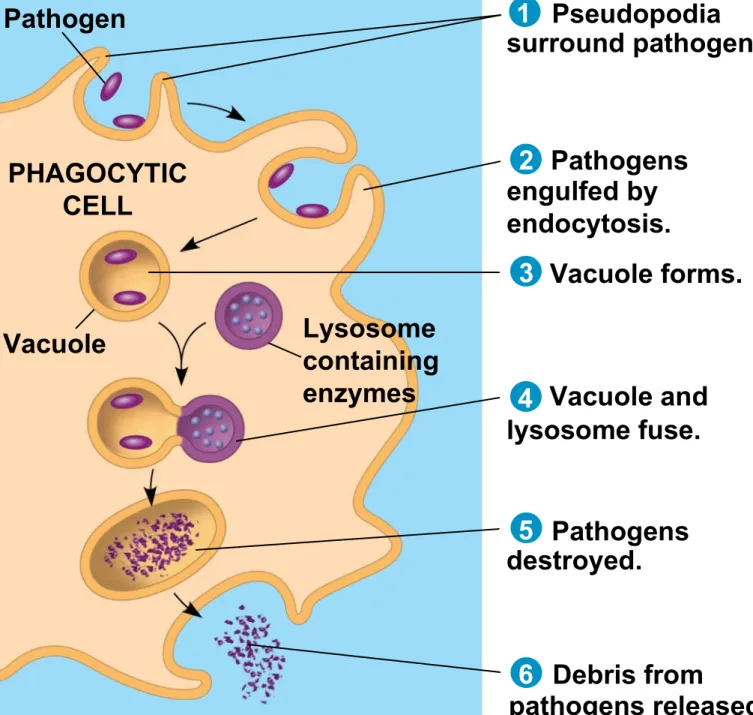
Pathogens entering the mammalian body are subject to phagocytosis
Phagocytic cells recognize groups of pathogens by
Toll-like receptors (TLRs)
There are two main types of phagocytic cells in mammals
Neutrophils circulate in the blood and are attracted
by signals from infected tissues
Two additional types of phagocytic cells
Dendritic cells stimulate development of adaptive immunity in cells that contact the environment (such as skin)
Cellular innate defenses in vertebrates also involve
natural killer cells
These circulate through the body and detect abnormal cells
They release chemicals leading to cell death,
inhibiting the spread of virally infected or cancerous cells
Antimicrobial Peptides and Proteins
In mammals, pathogen recognition triggers release of peptides and proteins that attack pathogens or impede their reproduction
Interferons provide innate defense, interfering with viruses and helping activate macrophages
The complement system consists of about 30 proteins that are activated by substances on microbe surfaces
Inflammatory Response
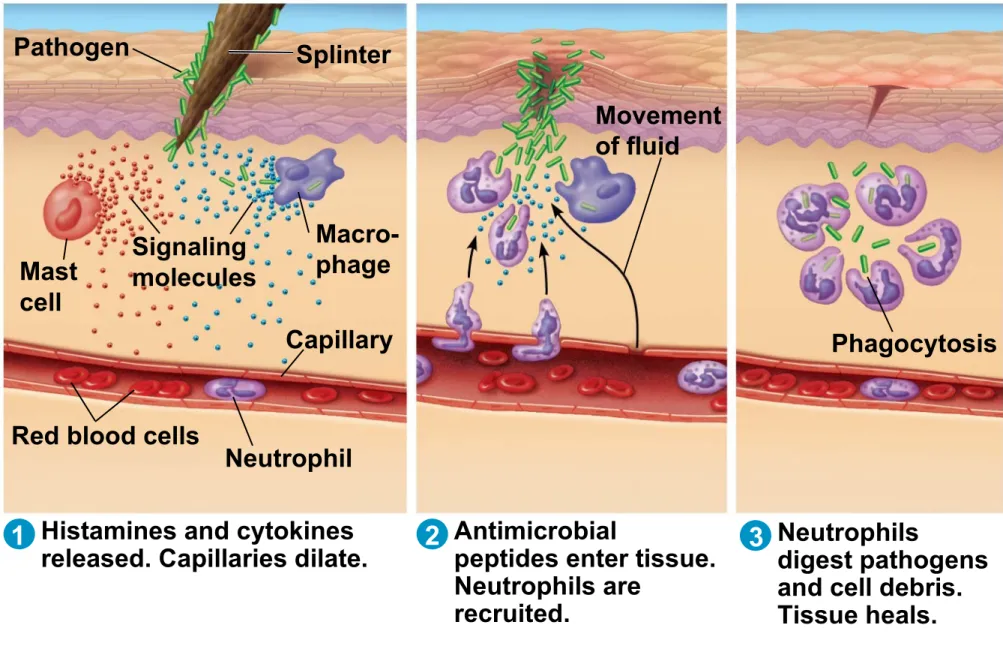
The inflammatory response, such as pain and swelling, is brought about by molecules released upon injury of infection
Mast cells release histamine, which triggers blood vessels to dilate and become more permeable
Activated macrophages and neutrophils release
Enhanced blood flow to the site helps deliver antimicrobial peptides
This results in an accumulation of pus, a fluid rich in
white blood cells, dead pathogens, and cell debris from damaged tissues
Video: Leukocyte Rolling
Figure 35.5-3 Pathogen Splinter Macro-phage Capillary Neutrophil Red blood cells
Mast cell
Signaling molecules
1 Histamines and cytokines
released. Capillaries dilate.
Movement of fluid
2 Antimicrobial
peptides enter tissue. Neutrophils are
recruited.
Phagocytosis
3 Neutrophils
Inflammation can be either local or systemic (throughout the body)
Fever is a systemic inflammatory response triggered by substances released by macrophages
Septic shock is a life-threatening condition caused by an overwhelming inflammatory response
Evasion of Innate Immunity by Pathogens
Adaptations have evolved in some pathogens that enable them to avoid destruction by phagocytic cells
Tuberculosis (TB) resists breakdown within lysosomes after being engulfed by a host cell
Concept 35.2: In adaptive immunity, receptors
provide pathogen-specific recognition
The adaptive response relies on two types of
lymphocytes, or white blood cells
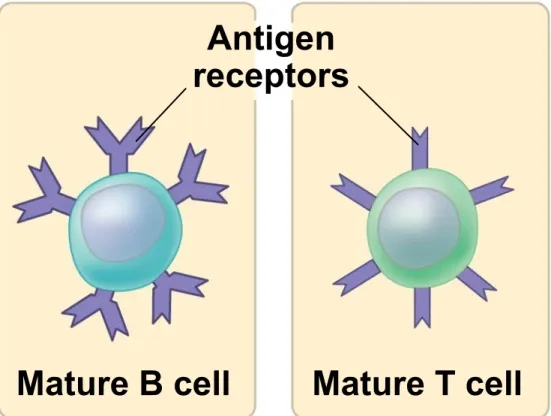
Figure 35.UN01
Antigen receptors
Antigens are substances that can elicit a response from a B or T cell
Recognition occurs when a B or T cell binds to an antigen, via an antigen receptor
The immune system produces millions of different antigen receptors but the receptors, on a single B cell or T cell are all identical to one another
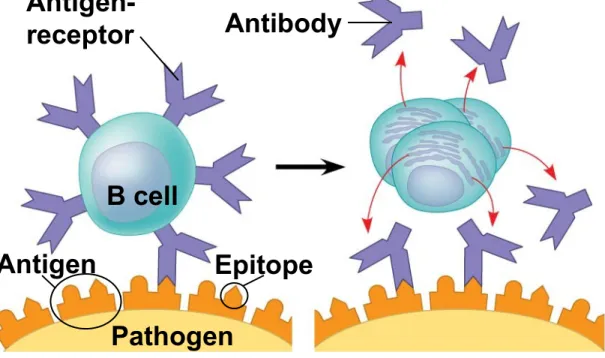
Binding of a B cell antigen receptor to an antigen is an early step in B cell activation
This gives rise to cells that secrete a soluble form of the protein called an antibody or immunoglobulin (Ig)
Secreted antibodies are similar to B cell receptors but are not membrane bound
Figure 35.7
Antigen-receptor Antibody
B cell
Antigen Epitope
Pathogen
(a) B cell antigen receptors and antibodies
Antibody C Antibody A
Antibody B
Antigen
T cells bind only to antigen fragments displayed or presented on a host cell
MHC (major histocompatibility complex)
In infected cells, antigens are cleaved into smaller peptides by enzymes
MHC molecules bind and transport the antigen fragments to the cell surface, a process called
antigen presentation
A T cell can then bind both the antigen fragment and the MHC molecule
Figure 35.9
Displayed antigen fragment
MHC
molecule
Antigen fragment
Pathogen
T cell
B Cell and T Cell Development
The adaptive immune system has four major characteristics
Diversity of lymphocytes and receptors
Self-tolerance; lack of reactivity against an animal’s own molecules
Proliferation of B and T cells after activation
Generation of B and T Cell Diversity
By combining variable elements, the immune system assembles a diverse variety of antigen receptors
The capacity to generate diversity is built into the structure of Ig genes
Many different chains can be produced from the same gene by rearrangement of the DNA
Origin of Self-Tolerance
Antigen receptors are generated by random rearrangement of DNA
As lymphocytes mature in bone marrow or the thymus, they are tested for self-reactivity
Some B and T cells with receptors specific for the body’s own molecules are destroyed by apoptosis, or programmed cell death
Proliferation of B Cells and T Cells
In the body only a tiny fraction of antigen receptors are specific for a given epitope
In the lymph nodes, an antigen is exposed to a
steady stream of lymphocytes until a match is made
Once activated, a B or T cell undergoes multiple cell divisions to produce a clone of identical cells (called clonal selection)
Two types of clones are produced
Short-lived activated effector cells that act immediately against the antigen
Long-lived memory cells that can give rise to effector cells if the same antigen is encountered again
Figure 35.11
B cells that differ in antigen specificity
Antigen
Antigen receptor
Immunological memory is responsible for long-term protections against diseases, due to a prior infection
The first exposure to a specific antigen represents the primary immune response
During this time, selected B and T cells give rise to their effector forms
In the secondary immune response, memory cells
facilitate a faster, stronger, and longer response
Immunological memory can span many decades
Figure 35.12 Primary immune response to antigen A Secondary immune response to antigen A
Antibodies
to A Antibodies
to B
101
103
104
100
0 7 14 21 28 35 42 49 56
Primary immune response to antigen B A n ti b o d y c o n c en tr a ti o n (a rb it ra ry u n it s ) Exposure to antigen A
Exposure to
antigens A and B
Concept 35.3: Adaptive immunity defends against
infection of body fluids and body cells
B and T lymphocytes produce a humoral immune response and a cell-mediated immune response
In the humoral immune response, antibodies help neutralize or eliminate toxins and pathogens in the blood and lymph
Helper T Cells: A Response to Nearly All Antigens
A type of T cell called a helper T cell triggers both the humoral and cell-mediated immune responses
An antigen must be displayed on the surface of an
antigen-presenting cell and bind specifically to the antigen receptor of a T cell
Antigen-presenting cells are recognized based on their class II MHC molecules
Antigen receptors on the surface of helper T cells
bind to the antigen and the class II MHC molecule
Signals are then exchanged between the two cells
The helper T cell is activated, proliferates, and forms a clone of helper T cells, which then activate the
appropriate B cells
Figure 35.13
Antigen-presenting
cell Antigen fragment
Class II MHC molecule Accessory protein (CD4) Antigen receptor
Cytotoxic T Cells: A Response to Infected Cells
Cytotoxic T cells are the effector cells in the cell-mediated immune response
Cytotoxic T cells recognize fragments of foreign
proteins produced by infected cells and possess an accessory protein that binds to class I MHC
molecules
The activated cytotoxic T cell secretes proteins that disrupt the membranes of target cells and trigger apoptosis
Figure 35.14-3
Antigen fragment Class I
B Cells and Antibodies: A Response to
Extracellular Pathogens
The humoral response is characterized by
secretion of antibodies by clonally selected B cells
Activation of B cells involves helper T cells and proteins on the surface of pathogens
In response to cytokines from helper T cells and an
antigen, a B cell proliferates and differentiates into memory B cells and antibody-secreting effector
Figure 35.15-3
Helper T cell Antigen fragments Pathogen CD4 Antigen-presenting cell Antigen receptor MHC B cell Cytokines Activated helper T cell
2
1 3
Plasma cells
Antibodies do not kill pathogens; instead, they mark pathogens for destruction
In neutralization, antibodies bind to viral surface proteins, preventing infection of a host cell
Antigen-antibody complexes may bind to a complement protein
B cells can express five different forms (or classes) of immunoglobulin (Ig) with similar antigen-binding specificity but different heavy-chain C regions
One type, the B cell antigen receptor, is membrane
bound
Both the humoral and cell-mediated responses can include primary and secondary immune responses
Memory cells enable the secondary response
Figure 35.16
B cell Helper T cell
Antigen-presenting cell
Engulfed by Antigen (1st exposure) Humoral (antibody-mediated)
immune response Cell-mediated immune response
Key
Stimulates Gives rise to
Cytotoxic T cell
Memory helper T cell
Memory cytotoxic T cells Memory
B cells
Antigen (2nd exposure)
Active cytotoxic T cells
Active and Passive Immunization
Active immunity occurs naturally when a pathogen infects the body
Passive immunity provides immediate, short-term protection
It is conferred naturally when antibodies cross the
placenta from mother to fetus or pass from mother to infant in breast milk
Active immunity is induced when antigens are introduced into the body in vaccines
In this process of immunization, inactivated
bacterial toxins or weakened or killed pathogens are introduced
Antibodies as Tools
Polyclonal antibodies, produced following exposure to an antigen, are products of many different clones of plasma cells, each specific for a different epitope
Monoclonal antibodies are prepared from a single clone of B cells grown in culture
Immune Rejection
Cells transferred from one person to another can be attacked by the recipient’s immune defenses
This complicates blood transfusions and the
transplant of tissues or organs
To minimize rejection, physicians use donor tissue that closely matches the MHC molecules of the
recipient
Disruptions in Immune System Function
Although adaptive immunity offers significant
Allergies
Allergies are exaggerated (hypersensitive) responses to antigens called allergens
In localized allergies such as hay fever, plasma cells secrete antibodies specific for antigens on the
surface of pollen grains
This triggers immune cells in connective tissue to release histamine and other inflammatory chemicals
Figure 35.17
IgE
Allergen
Granule Mast cell
1
2
Histamine
An acute allergic response can lead to anaphylactic shock, a life-threatening reaction
Substances that can trigger anaphylactic shock in allergic individuals include bee venom, penicillin, peanuts, and shellfish
Autoimmune Diseases
In individuals with autoimmune diseases, the immune system targets certain molecules of the body
Autoimmune diseases include systemic lupus erythematosus, rheumatoid arthritis,
Immune System Avoidance
Mechanisms to thwart immune responses have evolved in pathogens
A pathogen may alter how it appears to the immune system by changing the epitopes it expresses
Such changes are called antigenic variation
Some viruses avoid an immune response by
infecting cells and then entering an inactive state called latency
The virus (such as herpes simplex) remains latent until a stimulus reactivates it
Acquired immunodeficiency syndrome (AIDS) is
caused by HIV (human immunodeficiency virus), which both attacks and escapes the immune system
It infects helper T cells with high efficiency
It escapes the immune system through its high mutation rate, which reduces the ability of the immune system to eliminate the infection
People with AIDS are highly susceptible to infections and cancers that a healthy immune system would
normally defeat
Unprotected sex and transmission via
HIV-contaminated needles account for the majority of HIV infections
Cancer and Immunity
The frequency of certain cancers increases when adaptive immunity is impaired
20% of all human cancers involve viruses
The immune system can act as a defense against viruses that cause cancer and against cancer cells that harbor viruses
In 2006, a vaccine was released that acts against
Figure 35.UN03
Stem cell
Antigen
Antibody Cell division and
gene rearrangement Elimination of self-reactive B cells Clonal selection
Memory B cells