Pyrex
Journals
2035-
4876
Pyrex Journal of Educational Research and Review
Vol 1 (6) pp. 057-061 July, 2015
http://www.pyrexjournals.org/pjerr
Copyright © 2015 Pyrex Journals
Review Paper
Comparative Analysis of Students Academic Performance of Public and Private
Schools in Physical and Health Education JSC Examinations Between 2011-2012
in Ilorin Metropolis
Ajeigbe Yaqub Issa
Department of Kinesiology, Health Education and Sports Administration, Kwara State University, Malete, Nigeria
Accepted 19
thMay, 2015
The study investigated comparative analysis of students’ academic performance of public and private schools in physical
and health education JSC Examinations between 2011- 2012 in Ilorin. Three null hypotheses were formulated and tested
for the study and research design adopted was a descriptive survey. Four schools were randomly selected (Two public
and two private schools) for the study and two years JSCE consecutive results were used and all the candidates that sat
for the exams between the year of the study in the selected schools were considered as a sample for the study. The
hypotheses formulated were tested using t-Test statistics and all the hypotheses were retained at the 0.05 alpha level.
Among the recommendations given include: Adequate facilities and equipment be put in place for students use in order
to enhance their learning abilities.
Key words: Public and private schools, physical and health education, Examination, Academic performance.
INTRODUCTION
The better the citizens, the better the society. In order to improve the society, schools were established with the responsibility of developing each child to his fullest capacity, that is, physically, mentally, morally as well as emotionally. However, a desirable school program for the best development of the children will provide ample opportunity for a wide variety of physical activities and for the development of skills, which can be used throughout life.
Bucher (1997) stated that a good physical education programs will contributes to the basic needs of children, which include societal recognition and this can be achieved through mastery of skills and engage in team games. Bucher opined further that the values inherent in physical activities are achieved only when the teacher makes a careful selection of activities and plan his work in such a way that their values become part of the total learning process. However, physical and Health education has a greater opportunity for achieving educational goals than almost any other area of the school curriculum because physical activities holds a lot of natural attraction for children and enhances their total development.
The new national policy on education (2001) revised edition reiterated that physical and health education has been regarded as one of the core and examinable subject at the
junior secondary school examination (JSCE) and that must be passed before the certificate is awarded to candidates. However, in spite of its inclusion in the national policy on education, little concern is attributed to the teaching of physical and health education in our secondary schools (Olarewaju, 2005). She stated further that a clear observation of the student’s attitude shows that they do not have an interest in the subject, especially when it comes to the practical aspect for the fear of injury and due to religious doctrine which frown at female exposing their bodies for the sake of performance. Methodology
The research design adopted for this study was a descriptive survey, the sample for the study comprised all the candidates that sat for the junior secondary school physical and health education examination in all the four schools that were randomly selected for the study that is, (two public and two private schools) in Ilorin metropolis .Three null hypotheses were formulated for the study and the two years JSCE physical and health education results was used as data. The hypotheses formulated were tested using t-Test statistic at the 0.05 level of significance.
Research Hypotheses The following hypotheses were formulated for this study and these include;
1. There is no significant difference in the academic performance of male students in public and private schools in physical and health education JSC Examination between 2011- 2012.
2. There is no significant difference in the academic performance of female students in public and private schools in physical and health education JSC Examination between 2011- 2012.
3. There is no significant difference in the academic performance of male and female students in public and private schools in physical and health education JSC Examination between 2011- 2012.
Literature review
Physical education as a curriculum offered in schools had its inception in the first half of the nineteenth century. At the inception, only a few private schools offered formal physical education classes, but in the middle of the century, more and more public schools had instituted physical education as part of the curriculum. However, physical education is a subject concerned with the study of man and his movement.
The term physical education has always been misconceived and misunderstood, unfortunately this difficulty continue to exist till today. Though, it is quite right to say that more effective interpretation of the process of physical education is being carried out today than in the past. In addition, continuous efforts are still required to convey this interpretation clearly and persuasively not only to the members of the physical education profession but also to the public they serve and most of all, to the children and adults in the program. Ajiboye (2000) described physical education as an integral part of the total education process and a field of endeavor that is aimed at improving human performance through the medium of physical activities that have been selected with a view to realizing this outcome. NTI (1990) defined it as an aspect of education which aims at using physical activities and related knowledge for all round development of the learners.
The word physical refers to the body. It is often used in reference to various body characteristics such as physical appearance, physical strength, physical prowess and physical development. Bucher (1997) asserted that education is added to the word physical, thus, forming physical education. Therefore, physical education refers to the process of education that concerns activities which develop and maintain the body while health education is the sum total of all experiences which favorably influences practices, attitudes and knowledge relating to health. Ajala, Amusa & Sohi (1990) described physical education as that part of the educational process which contributes to the mental, physical, social and emotional growth and development of boys and girls through the medium of physical activities of various types.
Generally, every school subject has its own objectives in which physical and health is not an exception. Physical education makes important contributions to various aspects of
child development. Babatunde (2004) described the objective of physical and health education under three domains of education, that is, cognitive, affective and psychomotor.
Consequently, physical and health education has a positive educational influence on children who are slow, dull and lethargic (Lawal, 2001). He went further to say that those who observe little of what goes on around them and who react slowly may be completely transformed by a good program of physical and health education. Olarewaju,(2005) opined that by taking part in a number of activities, children learn to take their turns with others, the bold child learns not to monopolize games, while the slow or dull ones equally learn to adjust and be smarter in order to stand the test of rigor of the activities with the group. Children also learn to accept defeat without being discouraged and accept winning without undue elation.
However, despite the accrued values of physical and health education to the development of human personality, the attitude of the students towards the subject still remains un-encouraging. Briggs (1995) noted that poor attitudes of the students are important factor causing failures amongst the students. Such student in extreme cases develops fear and hatred for schooling as a whole. He went further to say that students wrongly assume that physical and health education is easy to pass and they tend to lose sight of the fact that it has a wider scope demanding utmost concentration. It also involves practical lesson which most students run away from for the fear of injury. Therefore, students could improve their performance as soon as they cultivate interest and become more serious with the subject.
Test of hypotheses
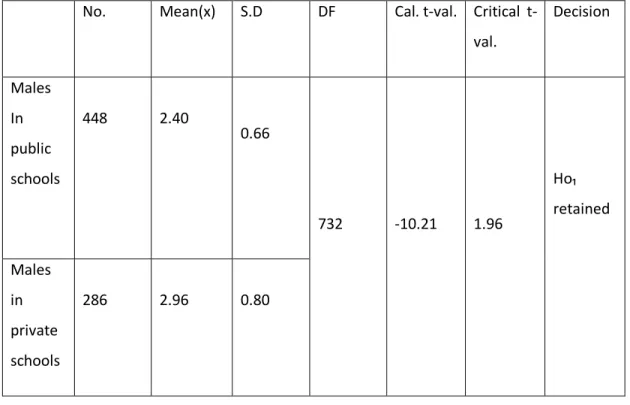
Table 1: t-Test analysis on academic performance of male students in JSCE physical and health education in public and private schools between 2011-2012.
Table 1 below revealed the t-test analysis on the academic performance of male students in physical and health education JSC Examinations in public and private schools between 2011-2012 academic sessions. The mean scores of 2.40 and standard deviation of 0.66 was obtained in public schools, while the mean scores of 2.96 with a standard deviation of 0.80 was obtained in private schools. However, the calculated t-value of -10.21 was obtained with the degree of freedom in 732. Therefore, since the calculated t-value was less than the table value, the hypothesis one (Ho₁) were retained. This simply means that the performance of male students in physical and health education JSC Examination in public and private schools between 2011- 2012 are the same.
Table 2: t-Test analysis on academic performance of female students in JSCE physical and health education in public and private schools between 2011- 2012
Table 1: t-Test analysis on academic performance of male students in JSCE physical and health education in public and private schools between 2011-2012
No.
Mean(x)
S.D
DF
Cal. val. Critical
t-val.
Decision
Males
In
public
schools
448
2.40
0.66
732
-10.21
1.96
Ho₁
retained
Males
in
private
schools
286
2.96
0.80
Table 2: t-Test analysis on academic performance of female students in JSCE physical and health education in public and private schools between 2011- 2012
No.
Mean(x) S.D
DF
Cal.
t-val.
Critical
t-val.
Decision
Females
in public
schools
340
2.28
0.73
644
-10.48
1.96
Ho₂
Retained
Females
in private
schools
306
2.89
0.75
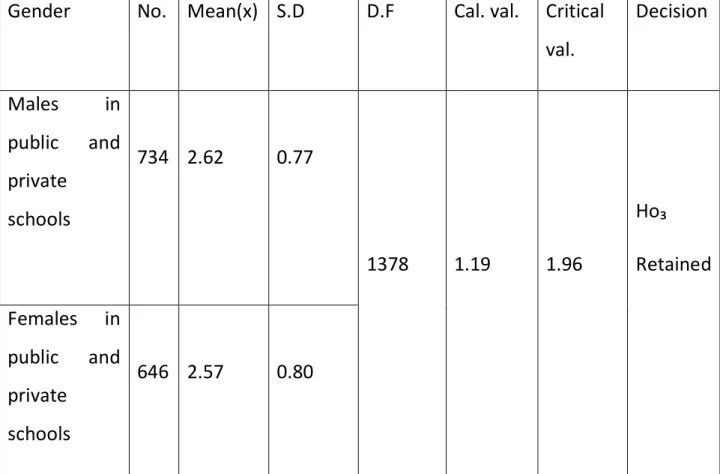
Table 3: t-Test analysis on academic performance of both male and female students in JSCE physical and health education in public and private schools between 2011- 2012
Gender
No. Mean(x) S.D
D.F
Cal. val.
Critical
val.
Decision
Males
in
public
and
private
schools
734
2.62
0.77
1378
1.19
1.96
Ho₃
Retained
Females
in
public
and
private
schools
646
2.57
0.80
In table 2 above, the mean scores for the females in public schools were 2.28 with a standard deviation of 0.73, while the mean scores for females in private schools was 2.89 with a standard deviation of 0.75. However, the calculated tvalue of -10.48 obtained was less than the table value of 1.96 with the degree of freedom of 644. Therefore, since the calculated t-value was less than the critical t-t-value, the hypothesis two (Ho2) were accepted or retained. This means that the performance of females in physical and health education JSC Examination 2011-2012 between public and private schools was the same.
Table 3 revealed that the mean scores for males in both public and private schools was 2.62 with a standard deviation of 0.77, while the mean scores for females in both public and private schools was 2.57 with a standard deviation of 0.80. The calculated t-value of 1.19 obtained was less than the critical value of 1.96. Therefore, since the critical value is greater than the calculated t-value, the hypothesis three (Ho3) was equally retained.
Discussion of findings
Based on the hypotheses tested and interpretation carried out in this study, the findings of the three hypotheses tested revealed that there is no significant difference in the academic performance of both male and female students in public and private schools in physical and health education JSC Examination between 2011-2012.This finding is in line with Bakinde (2004), who carried out a comparative study of academic performance of public and private primary schools in
difference in the academic performance of female pupils from public and private schools.
The study was also supported by Babatunde (2004) when he carried out a comparative analysis of secondary school student performance in social studies in Edu L.G.A of Kwara state and discovered that there was no significant difference between students’ performance in 2000 and 2001 social studies JSC Examination. This finding is also in line with Ojerinde (1994), in which no significant difference was found in the academic performance of the public and private primary school pupils in the National Common Entrance examinations over three consecutive years.
Recommendations
Based on the findings of the study, the following recommendations were given;
1. Teachers should be given more opportunity for training and re-training in order to enhance and improve their productivity.
2. Adequate facilities and equipment should be put in place for students use in order to improve their learning abilities.
3. Teachers should be well motivated in terms of prompt payment of their salaries and allowances so that they will be encouraged to put in their best.
4. Students should be given the opportunity to explore things themselves and be more creative in order to enhance their academic performance.
timetable and by providing the needed equipment and facilities that will facilitate its learning.
References
Ajiboye,G.A. (2000). Physical and health education hand book for secondary Schools. Igbogbo, Ikorodu Lagos, Ajibson Nigeria Enterprises.
Ajala J.A., Amusa L.O. and Sohi A.S. (1990), Physical Education Book 1 and 2.Lagos: Macmillan Nigeria Publishers Ltd.
Babatunde C.O. (2004). Physical and Health Education Handbook, A study guides for Nigerian Schools. Minna: Larthex Press.
Bakinde S.T. (2004). Comparative study of academic performance of public and private schools in Ilorin town. Health and Fitness Journal, University of
Ilorin.
Briggs F.(1995). Teaching of Health Education in Secondary Schools. London:
C.V. Mosby Company.
Bucher C.A.(1997). Foundation of Physical Education. New York: C.V. Mosby Company.
Federal Republic of Nigeria (2001). New National Policy on Education. Revised Edition.
Lawal S.B.(2001). How to increase reading ability attitude. A guide to development at and remedial method. Ibadan: Macmillan Press. National Teacher Institute (1990). NCE/DLS Course Book on Physical Health
and Education Cycle 2, Kaduna NTI.
Ojerinde O.A.(1994). Comparative Analysis of Secondary School Students Performance in Social Studies in Edu L.G.A. Kwara State. Unpublished Project, University of Ilorin.
Olarewaju F.A.(2005). Comparative Analysis of Students Academic Performance in Physical and Health Education JSSCE Examination between 2002- 2004 in Ilorin Metropolis.