Collocations in Multilingual Generation
Ulrich tieid, Sybille Raab
Universit~t Stuttgart, Projekt Polygloss Institut f/ir maschinelle Sprachverarbeitung
Keplerstrasse 17
D-7000 Stuttgart 1, West Germany
Abstract
We present a proposal for the structuring of collocation knowledge 1 in the lexicon of a multilingual generation system and show to what extent it can be used in the pro- cess of lexical selection. This proposal is part of Polygloss, a new research project on multilingual generation, and it has been inspired by work carried out in the S EM- SYN project (see e.g. [I~(~SNEtt 198812). The descriptive approach presented in this proposal is based on a combination of re- sults from recent lexicographical research and the application of Meaning-Text-Theory (MTT) (see e.g. [MEL'CUK et al. 1981], [MEL'CUK et al. 1984]). We first outline the overall structure of the dictionary system that is needed by a multilingual generator; section 2 gives an overview of the results of lexicograph- ical work on collocations and compares them with "lexical functions" as used in Meaning- Text-Theory. Section 3 shows how we intend to integrate collocations in the generation dic- 1We use the t e r m "collocation" in the sense of
[HAUSMANN 1985] referring to constraints on the cooccurrence of two lexeme words; the two elements are not completely freely combined, but one of them semantically determines the other one. Examples are for instance solve a problem, turn dark, expose someone to a risk, etc. For a more detailed definition see section 2.
2 Research reported in this paper is supported by the G e r m a n Bundesministerium fiir Forschung u n d Tech- nologie, B M F T , under grant No. 08 B 3116 3. The views and conclusions contained herein are those of the authors and should not be interpreted as positions of the project as a whole.
tionary and how "lexical functions" can be used in generation.
1
Lexical knowledge for
multilingual generation
Within a multilingual generation system, it seems necessary to keep the dictionary as modular as possible, separating information that pertains to different levels of linguistic description 3. We assume that the system's lex- ical knowledge is stored in the following types of "specialized dictionaries":
• semantic: inventory of possible lexicaliza- tions of a concept in a given language; syntactic: one inventory of realization classes per language, providing informa- tion about number, type and realization of the arguments of a given lexeme; • morphological: one inventory of inflec-
tional classes per language.
each of the layers. These mechanisms give ac- cess to the knowledge about the linguistic "be- haviour" of lexemes needed in the process of lexicalization 4.
2
A p p r o a c h e s to t h e descrip-
tion of collocations
2 . 1 C o n t r i b u t i o n s f r o m l e x i c o g r a - p h y
The tradition of British Contextualism 5 de- fines collocations on the basis of statistical as- sumptions about the probability of the cooc- curence of two lexemes. Particularly frequent combinations of lexical units are regarded as collocations.
A more detailed definition can be found in the work of Franz Josef H a u s m a n n (1985:119):
"One p a r t n e r determines, another is determined. In other words: colloca- tions have a basis and a cooccurring c o l l o c a t e . "6
This determination manifests itself in so far as a given basis does not allow all of the collocates t h a t would be possible according to general semantic coocurrence conditions, but only a certain subset: so in French, retenir son admiration, retenir sa haine, sa joie are possi- ble, but *retenir son dgsespoir is not.
The choice of collocates depends strongly on the lexeme that has been chosen as the ba- sis; knowledge about possible collocations can be only partly derived from knowledge about general semantic properties of lexemes. There- fore general cooccurrence rules or selectional
4Possibly including classifications according to se- mantically motivated lexeme classes and a modelling of paradigmatic relations between lexemes, such as hy- ponymy or synonymy.
5The term "collocation" was introduced into linguis- tic discussion by John R. Firth (1951:94).
eTranslation by the authors. We use the terms ba-
sis and collocate in the sense of [ttAUSMANN 1985]; HAUSMANN'S original terms are Basis and Kollokator.
restrictions (e.g. using semantic markers) are not adequate for the choice of collocates in the process of lexicalization.
These considerations lead to two propos- als for the structuring of the lexical knowledge used in a generator:
• Heuristic for the lexicalization process:
"First the basis is lexicalized, then the collocate, depending on which lexeme has been cho- sen as the basis."
Knowledge about the possibility of com- bining lexemes in collocations should be stored in the lexicalization dictionary (where lexicalization candidates for con- cepts are provided), and specifically in the entries for the bases.
The following table shows in terms of categories 7 what can be a possible collocate for a particular basisS:
basis possible collocates
noun noun, Verb , adjective
verb adverb
adjective adverb
7Unlike British Contextualism (cf. the recent [SINCLAIR 1987]) we assume that bases and collocates are of one of the following categories: noun, verb, ad- jective or adverb.
2 . 2 L e x i c a l f u n c t i o n s o f t h e
M e a n i n g - T e x t - T h e o r y a s a t o o l f o r t h e d e s c r i p t i o n o f c o l l o c a - t i o n s
In M T T , developed by Mel'~uk and co- workers, there exist about 60 "lexical func- tions" which describe regular dependencies be- tween lexical units of a language. In M T T , lexical functions are understood as cross- linguistically constant operators (f), whose application to a lexeme ("keyword", L) yields other lexemes (v). Mel'~uk (1984:6), (1988:31f) uses the following notation:
f ( L ) = v
T h e result of the application of a lexi- cal function to a given lexeme can be another "one-word" lexeme, or a collocation, an idiom or even an interjection.
T h e parallelism between the collocation definition used in this paper and the notion of lexical function is t h a t b o t h start from the principle t h a t collocates depend upon the re- spective bases (in M T T , v is a function of L). Therefore lexical functions seem to be a useful device for the description of collocations in a generation lexicon.
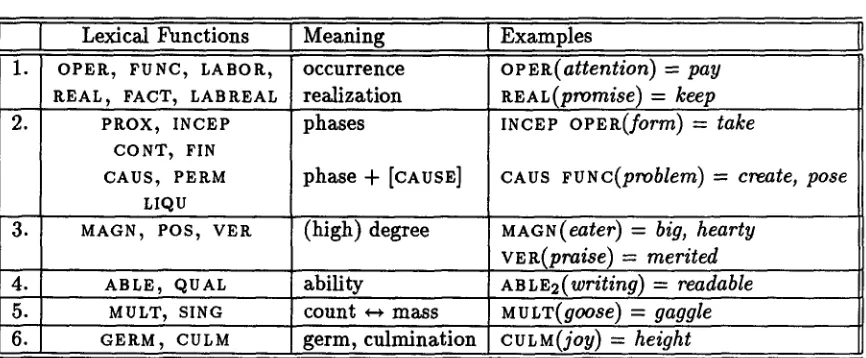
In the following, we only consider lexi- ca/ functions which, when applied to a lex- eme word, yield collocationsS; Table 1 gives some examples of such lexical functions, to- gether with a definitional gloss, taken from [ S T E E L E / M E Y E R 198811°:
sit should be investigated to what extent the cat- egory of v is predictable for every f, according to the category of L. For instance, J~s of group 1 and 2 specified in the table below, applied to nouns, yield substantive+verb-collocations, those of groups 3 and 4 yield substantive+adjective-collocations, and those of groups 5 and 6 return substantive+substantive- collocations.
l°Lexical functions of group 2, normally occur to- gether with those from 1; ABLB only occurs in combi- nation with other lexical functions.
3
G e n e r a t i n g C o l l o c a t i o n s
We propose t h a t every lexeme entry in the lex- icalization dictionary contains slots for lexical functions, whose fillers are possible collocates; within a slot/filler-notation as the one used in Polygloss, a (partial) lexical entry, e.g. for
problem, could be represented in the following w a y :
( p r o b l e m
( . . . )
(caus func (create, pose))
( r e a l ( s o l v e . . . . ) )
( . . . ) )
It might be possible to predict the types of lexical functions applicable to a given lex- eme from its membership in a semantic class. Syntactic properties of bases and collocates are accessible t h r o u g h reference to the realization lexicon.
[ M E L ' C U K / P O L G U E R E 1987]:271f themselves stress the advantage of describ- ing collocations with lexical functions within language generation and machine translation: they give the example of OPER (*QUESTION*), realized as
• English ask a question,
• French poser une question,
• Spanish hacer una pregunta and
• Russian zadat' vopros
respectively 11 .
3 . 1 L e x i c o n s t r u c t u r e a n d p o s s i b l e g e n e r a l i z a t i o n s
On the basis of the analysis of some entries in [MEL'CUK et al. 1984] and of material we
[1111
1. ..
.
5. 6.
[ Lexical Functions Meaning Examples
OPER, FUNC, LABOR,
REAL, FACT, LABREAL
PROX, INCEP
CONT, FIN
CAUS, P E R M
LIQU MAGN, POS, VER
occurrence realization
MULT, SING
phases
phase + [CAUSE] (high) degree ABLE, QUAL ability
count ~ mass
OPER( attention) = pay REAL(promise) = keep INCEP O P E R ( f o r m ) "-- take
CAUS FUNC(problem) = create, pose MAGN( eater) = big, hearty
VZR(praise) = merited A B L E2 (writing) = readable MULT(goose) = gaggle GERM, CULM germ, culmination CULM(joy) = height
Table 1: Examples of lexical functions used for the description of collocations
have analysed within Polygloss x2, it seems pos- sible to generalize over some regularities in collocation formation for members of seman- tically homogenous lexeme classes.
An example: the following default assumptions can be made for nouns expressing information handled by a computer (we assume seman- tic classes *I-NoUNSG* and *I-NoUNSF* for German and French respectively):
OPERI(*PA* )
Exception:
O P EIt 1 ( a d m i r a t i o n )
O P E R l ( h a i n e )
= ressentir ( SUBJ OBJ (OBJ PRED) ~;*PA*
= nourrir (sosJ OBJ), (OBJ P R E D ) =
"admiration" = nourrir (SUBJ OBJ), (OBJ PRED)= "haine"
• *I-NOUNSG* = { Datei, Nachrichten, Verzeichnis }
• *I-NoUNSF* = { fichier, messages, rgpertoire }
Information,
information,
LIQU FUNC0(*I-NouNsG*) = ldschen LIQU FUNCo(*I-NoUNSF*) --- supprimer
Some exceptions, however, have to be stated explicitly, as illustrated by the example of French nouns expressing personal attitudes, treated in [MEL'CUK et al. 1984]:
PA* -" { admiration, coldre, dgsespoir, en- thousiasme, enyie, gtonnement, haine, joie, mgpris, respect }
12Manuals for PC-Networks that have been provided in machine-readable form in German and French by IBM; cf. [RAAB 1988].
3 . 2 T h e g e n e r a t i o n o f p a r a p h r a s e s One of the aims in the development of the "how-to-say"-component of a generation sys- tem is to ensure that variants (i.e. true para- phrases) can be generated for one and the same semantic structure.
[image:4.596.64.497.105.284.2][MEL'(~UK 1988]:38-41 rules are stated, which express paraphrase relations between certain types of collocations. Ideally these rules can be set up for pairs of lexical functions, without consideration of concrete lexemes. Examples a r e :
Jean s'est mis en colors contre Paul
(--INCEP O P E R 1 ) John got angry with Paul
Paul s'est attirg la colors de Jean. (--INCEP O P E R 2 )
Panl angered John.
Jean s'est pris d'enthousiasme pour cette ddcouverte.
(=oPER)
John got enthusiastic about this discovery.
(A cause de cette ddcouverte) l'enthousiasme s'est empard de Jean.
(=FuNc)
John was enthused by this discovery.
Within a generation system, such descrip- tions can be used to state paraphrase rela- tions between collocational lexicalization can- didates. The choice between candidates de- pends on parameters, amongst which the fol- lowing ones seem to be essential:
• syntactic "behaviour" of the lexemes building up a collocation 13
- in relation to roles in the frame struc-
ture to be realized;
- in relation to the thematic structure
of the intended utterance;
18We plan to investigate to what extent it is possible to describe the syntactic form of certain collocations with general rules. This is possible e.g. for OVER, FUNC, LABOR, i.e. for lexical functions yielding col-
locations of the t y p e of "Funktionsverbgeffige":
OPBR(L) , verb (SUBJ OBJ . . . ) (OBJ PRBD) = L
PUNO(L) , verb < SUBJ . . . )
(SUBJ PRED) -~
LABOR(L) ~ verb (SUBJ OBJ Y ) (V PRBD) = L
• markedness of lexemes (e.g. registers, style);
• general heuristics for text generation (e.g. "avoid repetition", "avoid deep embed- ding" etc. )
In the following, we give an example for the lexicalization possibilities that can be de- scribed with the proposed device:
given the following (rudimentary) semantic representation 14:
mental process : * B E - H A P P Y * : B E A R E R * P I E R R E *
:CAUSE * N E W S * ,
there should be available the following in- formation about collocations with joie as a basislS:
C A U S FU NC(joie)
CAUS OVER(joie)
INCEP FUNC(joie)
INCEP OPER(joie)
= causer la joie de qn,
causer de
la joie chez qn = rgjouir qn,
mettre qn en joie remplir qn de joie = la joie
s'empare de qn la joie saisit qn, la joie
nab
dansle coeur de qn = qn se met e n j o i e
The choice between INCEP and CAUSE de- pends on whether (and how) the causality is to be expressed. The choice between INCEP OPER and INCEP FUNC depends on whether the re- laization of *PIERRE* or Of*NEWS* should be- come the subject.
14 menta/ process is m e a n t to be a concept type; :BBARBR and :OAUSB are semantic relations; *BB- HAPPY*~ *PIBRRB* and *NBWS* are concepts.
Here constraints caused by the syntax of the utterance to be generated play an impor- tant role: in a relative clause e.g. the an- tecedent has already been introduced. This fact limits the choice:
• - . . . et alors cette n o u v e l l e arriva, qui . . .
- causa la j o i e de P i e r r e
(=
cAus FUNC)- m i t Pierre en joie
(= CAUS FUNC)
• . . . et alors M a r i e e n v o y a cette n o u v e l l e fi P i e r r e , q u i . . .
- se r d j o u i t (= CAUS FUNC)
-- se mit e n j o i e (= CAUS FUNC)
This example shows that the heuristic "lexicalize bases first, then collocates" inter- acts with constraints stemming e.g. from syn- tax; these constraints can also be produced by a text structuring component (decisions about topic, thematic order etc.). The modular de- sign of the lexicon supports generation of vari- ants by giving access to all information needed at the appropriate choicepoints.
4
C o n c l u s i o n a n d d i r e c t i o n s
for f u t u r e w o r k
We propose a method for the description of knowledge about collocations in the dictionary of a multilingual generation system. Advan- tages for text generation result from the ap- plication of MTT's lexical functions and the formulation of the heuristic discussed above.
In the generation literature, the gener- ation of collocations is regarded as a prob- lem (cf. [MATTHIESSEN 1988]). The only system we know of, in which attempts have been made to bring it to a solution, is DIO- GENES, a knowledge b a s e d generation sys- tem under development at Carnegie Mel-
lon University 16. Our approach differs from NIRENBURG'S in that it introduces the dis- tinction between basis and collocate. This leads to differences in the lexicalization strat- egy: within DIOGENES, heads are lexicalized before modifiers, irrespective of word classes, cf. [NIRENBURG/NIRENBUI~G 1988].; we have come up with data that seems to favour the distinction between basis and collocate.
Further contrastive descriptive work will be the basis for a prototypical implementa- tion within Polygloss. With respect to lexical functions, some questions related to defaults (e.g. syntactic realization defaults, inheritance of collocational properties within lexem classes etc.) should be investigated in more detail.
4.1 A c k n o w l e d g e m e n t s
We would like to thank Sergei Nirenburg and our collegues at the IMS for the fruitful discus- sions in this paper. All remaining errors are of course our own.
R e f e r e n c e s
[FIRTH 1951] John Rupert Firth: "Modes of Meaning." (1951) in: P a p e r s in L i n g u i s - t i c s 193~-51. (London) 1957 (SS.190-215) [HAUSMANN 1985] Franz Josef Hausmann : "Kollol~tionen im deutschen WSrterbuch. Ein Beitrag zur Theorie des lexikographischen Beispiels." in: Henning Bergenholtz / Joachim Mugdan (Eds.):
L e z i k o g r a p h i e u n d G r a m m a t i k . A k t e n des E s s e n e r K o l l o q u i u m s z u r G r a m m a t i k irn W 6 r t e r b u c h . 1985: 118-129 [= Lexico- graphica. Series Major 3]
eration", internal paper, University of Stuttgart, IMS, 1989
[MATTHIESSEN 1988]
Christian Matthiessen: "Lexicogrammat- ical Choices in Natural Language Gen- eration', ms., paper presented at the Catalina Workshop on Natural Language Generation, (Los Angeles), June 1988
[MEL'(~UK 1988] Igor A. Mel'~uk: "Para- phrase et lexique dans la thdorie linguis- tique Sens-Texte." in: Lexique 6, Lexique et paraphrase. Lille 1988:13-54
[MEL'~UK et al. 1981] Igor A. Mel'~uk et al.: "Un nouveau type de dictionnaire: le dictionnaire explicatif et combinatoire du franfais contemporain (six entrdes de dic- tionnaire)." in: Cahiers de Lexicologie
(28) 1981-I: 3-34
[MEL'CUK et al. 1984] Igor A. Mel'~uk et al.:
Dictionnaire explicatif et combinatoire du francais contemporain. Recherches Lezico-
SOmantiques. (I), Montr6al 1984
[MEL'(~UK/POLGUEttE 1987] Igor A. Mel'~uk, Alain Polgu~re: "A Formal Lex- icon in the Meaning-Text Theory (or how to do Lexica with Words)." in: Computa-
tional Linguistics 13 3-4 1987:261-275
[NIRENBURG 1988] Sergei Nirenburg: "Lex- ical selection in a blackboard-based gen- eration system." Paper presented at the
Catalina Workshop on NL generation, Los
Angeles 1988, ms.
[NIRENBURG et al. 1988] Sergei Nirenburg et al.: "DIOG~.Nv.S-88, CMU-CMT-88-
107." Pittsburgh: CMU, 1988, ms.
[NIRENBURG et al. 1988] Sergei Nirenburg et al.: "Lexical Realization in Natural Language Generation." in : Second In- ternational Conference on Theoretical and Methodological Issues in Machine Trans- lation of Natural Languages. Pittsburgh, Pennsylvania June 12- 14, 1988, Proceed-
ings, 1988
[NIRENBUttG/NIRENBURG 1988] Sergei Nirenburg, Irene Nirenburg: "Choosing Word carefully", (Pittsburgh, Pa.: ICMT, Carnegie-Mellon University), 1988, inter- nal paper.
[ttAAB 1988] Sybille Kaab: Zur Beschreibung
fachsprachlicher Kollokationen, ms., Uni-
versity of Stuttgart, 1988
[tt()SNEtt 1988] Dietmar l~6sner: "The S~.M- SYN generation system", in: Proceedings of ACL-applied, Austin, Texas, February 1988, 1988
[SINCLAIR 1987] John McH Sinclair: "Collo- cation. A progress report." in: Ross Steele / Terry Threadgold (Eds.): Language Topics. Essays in honour of Michael Hal-
liday. (Amsterdam/Philadelphia) 1987,
vol. 2.: 319-331