Using bilingual word-embeddings for multilingual collocation extraction
Marcos Garcia, Marcos Garc´ıa-Salido and Margarita Alonso-Ramos Universidade da Coru˜na, Departamento de Galego-Portugu´es, Franc´es e Ling¨u´ıstica
Facultade de Filolox´ıa, Campus da Zapateira, 15701 — A Coru˜na, Galicia, Espa˜na
{marcos.garcia.gonzalez,marcos.garcias,margarita.alonso}@udc.gal
Abstract
This paper presents a new strategy for multilingual collocation extraction which takes advantage of parallel corpora to learn bilingual word-embeddings. Monolingual collocation candidates are retrieved using Universal Dependencies, while the distri-butional models are then applied to search for equivalents of the elements of each col-location in the target languages. The pro-posed method extracts not only collocation equivalents with direct translation between languages, but also other cases where the collocations in the two languages are not literal translations of each other. Several experiments —evaluating colloca-tions with three syntactic patterns— in En-glish, Spanish, and Portuguese show that our approach can effectively extract large pairs of bilingual equivalents with an av-erage precision of about90%. Moreover, preliminary results on comparable corpora suggest that the distributional models can be applied for identifying new bilingual collocations in different domains.
1 Introduction
Even though there is no universal definition of col-location, there is a general tendency to consider any syntactically related frequent pair of words to be a collocation (Smadja, 1993; Evert and Kermes, 2003; Kilgarriff, 2006). In the Firthian tradition of the term “collocation”, not even a syntactic rela-tion between the members is necessary, but in the phraseological tradition, not only the syntactic re-lation is a condition but also a lexical restriction.1
1An overview of different visions on collocations —both
from theoretical and practical perspectives— can be found in Seretan (2011).
From this phraseological point of view, a colloca-tion is a restricted binary co-occurrence of lexi-cal units (LUs) between which a syntactic relation holds, and that one of the LUs (thebase) is cho-sen according to its meaning as an isolated LU, while the other (the collocate) is chosen depend-ing on the base and the intended meandepend-ing of the co-occurrence as a whole, rather than on its mean-ing as an isolated LU (Mel’ˇcuk, 1998). Thus, a noun in English such as “picture” requires the verb “to take” (and not “to do”, or “to make”) in the phrase “take a picture”, while “statement” selects “to make” (“make a statement”).
In a bilingual (or multilingual) scenario, equiv-alent collocations are needed to produce more nat-ural utterances in the target language(s). In this regard, the referred noun “picture” would select the verb “tirar” in Portuguese —“to remove”— (“tirar uma fotografia”). Similarly the Span-ish “vino” (“wine”) would require the adjective “tinto” (“vino tinto”), which is not the main trans-lation of “red” (“red wine”).
The unpredictability of these structures involves problems for tasks such as machine translation, whose performance can benefit from lists of mul-tilingual collocations (or transfer rules for these units) (Orliac and Dillinger, 2003). In areas like second language learning, it has been shown that even advanced learners need to know which word combinations are allowed in a specific linguistic variety (Altenberg and Granger, 2001; Alonso-Ramos et al., 2010). Thus, obtaining resources of multilingual equivalent collocations could be use-ful for different applications such as those men-tioned above. However, this kind of resources is scarce, and constructing them manually requires a large effort of expert lexicographers.
In the last years, several approaches were im-plemented aimed at extracting bilingual colloca-tions, both from parallel corpora (Kupiec, 1993;
Smadja et al., 1996; Wu and Chang, 2003), and from comparable or even from non-related mono-lingual resources (L¨u and Zhou, 2004; Rivera et al., 2013), often combining statistical approaches with the use of bilingual dictionaries to find equiv-alents of eachbase.
In this paper we explore the use of distribu-tional semantics (by means of bilingual word-embeddings) for identifying bilingual equivalents of monolingual collocations: On one hand, mono-lingual collocation candidates are extracted using a harmonized syntactic annotation —provided by Universal Dependencies (UD)2—, as well as
stan-dard association measures. On the other hand, bilingual word-embeddings are trained using lem-matized versions of noisy parallel corpora. Fi-nally, these bilingual models are employed to search for semantic equivalents of both the base and thecollocateof each collocation.
Several experiments —using the OpenSubti-tles2016 parallel corpora in English, Portuguese, and Spanish (Lison and Tiedemann, 2016)— show that the proposed method successfully identi-fies bilingual collocations with different patterns: adjective-noun,noun-noun, andverb-object. Fur-thermore, preliminary results in comparable cor-pora suggest that the same strategy can be applied in this kind of resources to extract new pairs of bilingual collocations.
Section 2 includes some related work on collo-cation extraction, specially on papers dealing with bilingual resources. Then, our method is presented and evaluated in Sections 3 and 4, respectively. Finally, some conclusions and further work are drawn in Section 5.
2 Related work
Several approaches were employed in order to automatically identify monolingual collocations (and other multiword expressions) from corpora. Most strategies use statistical association mea-sures on windows ofn-gramswith different sizes (Church and Hanks, 1990; Smadja, 1993). Other methods, such as the one presented in Lin (1999), started to apply dependency parsing aimed at bet-ter identifying combinations of words which oc-cur in actual syntactic relations. More recently, the large availability of better parsers allowed re-searchers to combine automatically obtained syn-tactic information with statistical methods to
ex-2http://universaldependencies.org/
tract collocations more accurately (Evert, 2008; Seretan, 2011).
A different perspective on collocation extrac-tion focuses not only on their retrieval, but on se-mantically classifying the obtained collocations, in order to make them more useful for NLP appli-cations (Wanner et al., 2006; Wanner et al., 2016). Concerning the extraction of bilingual colloca-tions, most works rely on parallel corpora to find the equivalent of a collocation in a target lan-guage. In this respect, Smadja (1992; 1996) first identifies monolingual collocations in English (the source language), and then usesmutual informa-tion(MI) and theDice coefficient(respectively) to find French equivalents of the source collocations. Kupiec (1993) also uses parallel corpora to find noun phrase equivalents between English and French. The method consist in applying an expec-tation maximization (EM) algorithm to previously extracted monolingual collocations.
Similarly, Haruno et al. (1996) obtain Japanese-English chunk equivalents by computing their MI scores and taking into account their frequency and position in the aligned corpora.
Another work which uses parallel corpora is presented in Wu and Chang (2003). The authors extract Chinese and Englishn-gramsfrom aligned sentences by computing theirlog-likelihoodratio. Then, thecompetitive linking algorithmis used to decide whether each bilingual pair actually corre-sponds to a translation equivalent.
More recently, Seretan and Wehrli (2007) took advantage of syntactic parsing to extract bilingual collocations from parallel corpora. The strategy consist in first extracting monolingual collocations usinglog-likelihood, and then searching for equiv-alents of each base using bilingual dictionaries. The method also uses the position of the colloca-tion in the corpus, and relies on the syntactic anal-ysis by assuming that equivalent collocations will occur in the same syntactic relation in both lan-guages.
adjacent sentences) of the source collocation. A different approach, which uses non-related monolingual corpora for finding bilingual colloca-tions, was presented in L¨u and Zhou (2004). Here, the authors apply dependency parsing and the log-likelihoodratio for obtaining English and Chinese collocations. Then, they search for translations us-ing word translation equivalents with the same de-pendency relation in the target language (using the EM algorithm and a bilingual dictionary).
Although not focused on collocations, Pascale Fung applied methods based on distributional se-mantics to build bilingual lexica from compara-ble corpora (Fung, 1998, among others). This approach takes into account that in this type of resources the position and the frequency of the source and target words are not comparable, and also that the translations of the source words might not exist in the target document.
Similarly, the approach presented in this paper leverages noisy parallel corpora for building bilin-gual word-embeddings. However, with a view to applying it in other scenarios (such as compara-ble corpora), it does not need information about the position of the collocations in the corpora, — neither their comparative frequency— to identify the equivalents. Furthermore, it does not take ad-vantage of external resources such as bilingual dic-tionaries, so the method can be easily applied to other languages.
3 Bilingual collocation extraction
This section presents our method for automati-cally extracting bilingual collocations from cor-pora. First, we briefly describe the approach for identifying candidates of monolingual collo-cations using syntactic dependencies. Then, the process of creating the bilingual word-embeddings is shown, followed by the strategy for discovering the collocation equivalents between languages.
3.1 Monolingual dependency-based collocation extraction
Early works onn-grambased collocation extrac-tion already pointed out the need for using syn-tactic analysis for better identifying collocations from corpora (Smadja, 1993; Lin, 1999). Syntac-tic analysis can, on the one hand, avoid the extrac-tion of syntactically unrelated words which occur in a small context windows. On the other hand, it can effectively identify the syntactic relation
be-tween lexical items occurring in long-distance de-pendencies (Evert, 2008).
Besides, and even though it is not always the case (L¨u and Zhou, 2004), our method assumes that most bilingual equivalent of collocations bear the same syntactic relation in both the source and the target languages.
In order to better capture the syntactic relations between the base and the collocate of each col-location, our method uses state-of-the-art depen-dency parsing. Apart from that, and aimed at ob-taining harmonized syntactic information between languages, we rely onuniversal dependencies an-notation, which permits the use of the same strat-egy for extracting and analyzing the collocations in multiple languages.3
Preprocessing: Before extracting the colloca-tion candidates from each corpus, we apply a pipeline of NLP tools in order to annotate the text with the desired information. Thus, the output of this process consists of a parsed corpus in a CoNLL-U format, where for each word we have its surface form, its lemma, its POS-tag and mor-phosyntactic features, its syntactic head as well as theuniversalrelation the word has in this context.4
From this analyzed corpus, we extract the word pairs belonging to the desired relations (colloca-tion candidates). On the one hand, we keep their surface forms, POS-tags, and other syntactic de-pendents which may be useful for the identifica-tion of potential collocaidentifica-tions. On the other hand, in order to apply association measures, we retain a list of triples containing (a) the syntactic rela-tion, (b) the head, and (c) the dependent (using their lemmas together with the POS-tags). Thus, from a sentence such as “John took a great respon-sibility”, we obtain (among others) the following triples:
nsubj(takeVERB,JohnPROPN)
amod(responsibilityNOUN,greatADJ)
dobj(takeVERB,responsibilityNOUN)
This information (and also the corpus size and the frequency of the different elements of the po-tential collocations) is saved in order to rank the candidates.
Collocation patterns: At the moment, we are
focused on extracting three different syntactic
terns of collocations in three languages (Spanish —es—, Portuguese —pt—, and English —en):
Adjective—Noun (amod): these candidates
are pairs of adjectives (collocate) and nouns (base) where the former syntactically depends of the latter in a amod relation. Example: killerbase;serialcollocate.
Noun—Noun (nmod): this collocation
pat-tern consists of two common nouns related by the nmod relation, where the head is the base and the dependent is the collocate(optionally with a casemarking dependent preposition: “of” in En-glish, “de” in Portuguese and Spanish). Example: rageb;fitc.5
Verb—Object (vobj): verb-object
colloca-tions consists of a verb (thecollocateand a com-mon noun (thebase) occurring in adobjrelation. Example:careb;takec.
Identification of candidates: For each of the three patterns of collocations, we extract a list of potential candidates for the three languages. After that, the candidates are ranked using standard as-sociation measures that have been widely used in collocation extraction (MI, t-score, z-score, Dice, log-likelihood, etc.) (Evert, 2008).
In the current experiments, we selected two sta-tistical measures whose results complement each other:t-score(which prefers frequent dependency pairs, and has been proved useful for collocation extraction (Krenn and Evert, 2001)), and mutual information (which is useful for a large corpus (Pecina, 2010), even if it tends to assign high scores to candidates with very low-frequency).
The output of both association measures is merged in a final list for each language and collo-cation pattern, defining thresholds of t-score=>2 and MI=>3 (Stubbs, 1995), and extracting only collocations with a frequency of f=>10 (a rela-tively large value for reducing the extraction of in-correct entries from a noisy corpus and from po-tential errors of the automatic analysis).
It must be noted that, since these lists of mono-lingual collocations have been built based on sta-tistical measures of collocability, their members need not be bona fidecollocations in the phrase-ological meaning. Thus, the lists can include
id-5Note that some collocations belonging to this pattern are
analyzed in UD —mainly in English— using thecompound relation, so they are not extracted in the experiments per-formed in this paper.
ioms (e.g., “kick the bucket”), quasi-idioms (e.g., “big deal”) (Mel’ˇcuk, 1998), or free combinations (e.g., “buy a drink”).
3.2 Bilingual word-embeddings
Word-embeddings are low-dimensional vector representations of words which capture their tributional context in corpora. Even though dis-tributional semantics methods have been largely used in previous years, approaches based on word-embeddings have gained in popularity recently, since the publication ofword2vec(Mikolov et al., 2013).
Based on the Skip-gram model of word2vec, Luong et al. (2015) proposed BiSkip, a word-embeddings model which learns learns bilingual representations using aligned corpora, thus being able to predict words crosslinguistically.
As our approach for collocation extraction uses lemmas (instead of surface forms) to identify the candidates, the bilingual models are also trained on lemmatized corpora. Therefore, we convert the raw parallel corpora in lemmatized resources (with any other information) keeping the original sen-tence alignment.
Once we have the lemma version of the corpora, the bilingual models are built using MultiVec, an implementation of word2vec and BiSkip (Berard et al., 2016). As we work with three different lan-guages, we need three different bilingual models: es–en,es–pt, andpt–en.
As it will be shown, the obtained models can predict the similarity between words in bilingual scenarios by computing the cosine distance be-tween their vectors. As the models learn the distribution of single words (lemmas), they deal with different semantic phenomena such as pol-ysemy or homonymy. Concerning collocations, this means that, ideally, the bilingual models could predict not only the equivalents of abase, but also to capture the (less close) semantic relation be-tween the bilingual collocates, if they occur an enough number of times in the corpora.
3.3 Bilingual collocation alignment
In order to identify the bilingual equivalent (in a target language) of a collocation, our method needs (a) monolingual collocations (ideally ob-tained from similar resources), and (b) a bilingual source-targetmodel of word-embeddings.
lan-guage (e.g., l´ıob;tremendoc, in Spanish) we
se-lect its base and obtain —using the bilingual model— the n most similar lemmas in the tar-get language (where n=5 in our experiments): “trouble”, “mess”, etc. Then, starting from the most similar lemma, we search in the tar-get list for collocations containing the equiva-lents of the base(troubleb;littlec, troubleb;deepc,
messb;hugec, messb;finec, etc.). If a
colloca-tion with a base equivalent is found, we com-pute the cosine distance between both collocates (“tremendo” versus “little”, “deep”, “huge”, and “fine”) and select them as potential candidates if their similarity is higher than a threshold (empiri-cally defined in this paper as0.65), and if the tar-get candidate is among thenmost similar words of the sourcecollocate(again,n=5). Finally, if these conditions are met, we align the source and target collocations, assigning the average distance be-tween thebasesand thecollocatesas a confidence value:es-en:l´ıob;tremendoc=messb;hugec;0.721.
4 Experiments
This section presents the experiments carried out in order to evaluate the proposed method (hence-forth DIS) in the three analyzed languages,
us-ing the three collocation patterns defined in Sec-tion 3.1. Our approach is compared against a base-line system (BAS) which uses hand-crafted
bilin-gual dictionaries.6
Corpora: Monolingual collocations were
ex-tracted from a subset of the OpenSubtitles2016 corpus (Lison and Tiedemann, 2016), which con-tains parallel corpora from TV and Movie subti-tles. We selected this resource because it is a large and multilingual parallel corpus likely to contain different collocations types (also from an informal register) to those present in other corpora, thus be-ing useful for comparative studies.7
From the en, es and pt corpora, we selected those sentences which appear in the three lan-guages (a total of 13,017,016). They were tok-enized, lemmatized and POS-tagged with a multi-lingual NLP pipeline (Garcia and Gamallo, 2015), obtaining three corpora of ≈ 91M (es and pt), and≈ 98M (en) tokens. The resulting data were
6The extractions of both methods are available at
http://www.grupolys.org/˜marcos/pub/mwe17.tar.bz2
7Note, however, that OpenSubtitles2016 includes
non-professional translations with some noisy elements such as typos or case inconsistencies, among others.
Lg amod nmod vobj
[image:5.595.308.526.63.119.2]es 480k 13,870 1.6M 5,673 430k 17,723 pt 420k 12,967 1.7M 5,643 560k 20,984 en 460k 14,175 1.6M 3,133 490k 15,492
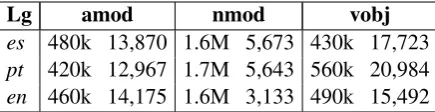
Table 1: Number of unique input dependencies for each syntactic pattern, and final monolingual col-location candidates.
enriched with syntactic annotation using statisti-cal models trained with MaltParser (Nivre et al., 2007) and the 1.4 version of the UD treebanks (Nivre et al., 2016).
Collocations: From each corpus, three patterns of collocations candidates were extracted: amod, nmod, and vobj. For each language and pattern, we obtained a single list of collocations by merg-ing theMIandt-scoreoutputs as explained in Sec-tion 3.1. Table 1 shows the number of filtered col-locations in each case.
Another version of the corpora was created only with the lemma of each token, keeping the orig-inal sentence alignments. These corpora were used for training three bilingual word-embeddings models with MultiVec (with 100dimensions and a window-size of8words): es–en,es–pt, andpt– en.8
Baseline (BAS): The performance of the method described in Section 3.3 was compared to a base-line which follows the same strategy, but us-ing bilus-ingual dictionaries instead of the word-embeddings models. Thus, the BAS method
ob-tains the equivalents of both thebaseand the col-locateof a source collocation, and verifies whether exists a target collocation with the translations. The bilingual dictionaries provided by the aper-tiumproject (SVN revision 75,477) were used for these experiments (Forcada et al., 2011).9
The es-pt dictionary has14,364entries, while thees-enone contains 34,994. The pt-en dictio-nary (not provided byapertium) was automatically obtained by transitivity from the two other lexica, with a size of9,160pairs.
4.1 Results
With a view to knowing the performance of both BASand DIS in the different scenarios,100
bilin-gual collocation pairs were randomly selected
8These models are available at http://www.grupolys.
org/˜marcos/pub/mwe17_models.tar.bz2
Lg amod nmod vobj
Pair BAS DIS BAS DIS BAS DIS
es-pt 657 9,464 320 3,867 529 12,887 es-en 248 7,778 32 890 183 8,865 pt-en 213 7,083 43 917 241 9,206
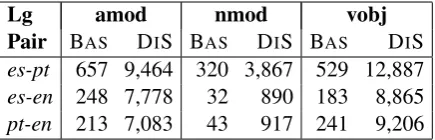
Table 2: Number of bilingual extractions of the baseline and DIS systems.
from each language and pattern,10creating a total
of 18 lists (9 from BASand 9 from DIS).
Two reviewers labeled each bilingual colloca-tion pair as (a) correct, (b) incorrect, or (c) du-bious (which includes pairs where the translation might be correct in some contexts even if they were not considered faithful translations).11
Cor-rect collocation equivalents are those pairs where the monolingual extractions were considered cor-rect (both in terms of co-occurrence frequency and of collocational pattern classification), and that their translations were judged as potential trans-lations in a real scenario. The reviewers achieved 92% and 83% inter-annotator agreement in BAS
and DIS outputs, respectively. Those pairs with
correct/incorrect disagreement were discarded for the evaluation. Those with at least one dubious la-bel were checked by a third annotator, deciding in each case whether they were correct, incorrect, o dubious.
From these data, we obtained the precision val-ues for each case by dividing the number of correct collocation equivalents by the number of correct, incorrect, and dubious cases (so dubious cases were considered incorrect). Recall was obtained by multiplying the precision values for the num-ber of extracted equivalents, and dividing the re-sult by the smallest number of input collocations for each pair (Table 2).12 Finally, we obtained
F-score values (the harmonic mean between preci-sion and recall) for each case, and calculated the macro-average results for each language, pattern,
10Except for those baseline extractions with less than100
elements, where all of them were selected.
11Some of these dubious equivalents are actual translations
in the original corpus, such as thees-en“copa de champa˜na” (“champagne cup”) — “cup of wine”, even if they are seman-tically different.
12Note that these recall results assume that every
colloca-tion in the shortest input list of each pair has an equivalent on the other language, which is not always the case. Thus, more realistic recall values (which would need an evaluation of every extracted pair) will be higher than the obtained in our experiments.
[image:6.595.73.291.62.132.2]and approach.
Table 2 contains the bilingual collocation equiv-alents extracted by each method in the 9 settings, from the input lists of monolingual data (Table 1). These results clearly show that the baseline ap-proach extract a lower number of bilingual equiva-lents. This might have happened due to the size of the dictionaries and because of the internal proper-ties of the collocations, where thecollocatesmay not be direct translations of each other. Moreover, it is worth noting that in both BAS and DIS
re-sults, the bilingual extractions including English are smaller than thees-ptones.
Concerning the performance of the two ap-proaches, Tables 3 (baseline) and 4 (DIS) contain
the precision, recall and f-score for each language pair and collocation pattern.
BASobtains high-precision results in every
lan-guage and collocation pattern (91.7% in the worst scenario), with a macro-average value of 97%. These results are somehow expected due to the quality of the hand-crafted dictionaries. However, because of the poor recall numbers, the general performance of BASis low, achieving f-score
re-sults of≈4.7%. Interestingly, the size of the dic-tionary does not seem crucial to the results of the baseline. In this respect, thees-ptresults are much higher (specially in recall) thanes-en, whose dic-tionary size is more than the double. Also, the pt-en results are slightly better than the es-pt ones, the latter being obtained using a dictionary built by transitivity.
About DIS model, its precision is lower than the
baseline, with results between83.9%(pt-en:vobj) and92.9%(es-pt:amod). However, this approach finds much more bilingual equivalents than the bilingual dictionaries, so recall values increase to an average of almost50%. Unlike BAS(whose
re-sults are more homogeneous along the collocation patterns), DIS model obtains more variable
num-bers in each setting. Noticeably, thenmod extrac-tions of the pairs including English have very low recall when compared to the other results, maybe derived from not having extracted nouns analyzed as compound (Section 3.1). As in the baseline, the DISes-ptresults are better than the two other
col-Lang amod nmod vobj avg Pair Prec Rec F1 Prec Rec F1 Prec Rec F1 Prec Rec F1 es–pt 99.0 5.0 9.6 97.8 5.5 10.5 98.7 3.0 5.7 98.5 4.5 8.6 es–en 95.8 1.7 3.4 100 1.0 2.0 100 1.2 2.3 98.6 1.3 2.6 pt–en 97.9 1.6 3.2 91.7 1.3 2.5 92.1 1.4 2.8 93.9 1.4 2.8 avg 97.6 2.8 5.4 96.5 2.6 5.1 96.9 1.9 3.6 97.0 1.8 4.7
Table 3: Precision, recall and f-score of the baseline (BAS) system (avgis macro-average).
Lang amod nmod vobj avg
[image:7.595.90.507.182.266.2]Pair Prec Rec F1 Prec Rec F1 Prec Rec F1 Prec Rec F1 es–pt 92.9 67.8 78.4 93.8 64.3 76.3 90.1 66.0 76.5 92.5 66.0 77.1 es–en 92.0 51.6 64.3 88.0 25.0 38.9 84.0 48.1 61.2 87.5 41.6 56.4 pt–en 90.5 49.5 64.0 90.0 26.3 40.1 83.9 49.9 62.6 88.2 41.9 56.8 avg 91.8 56.3 68.9 90.6 38.5 51.9 86.2 54.7 66.7 89.5 49.8 63.4
Table 4: Precision, recall and f-score of DIS system (avgis macro-average).
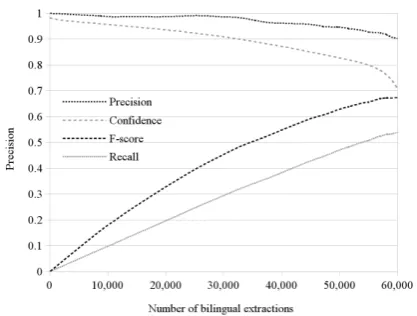
locateequivalents) to each bilingual pair of collo-cations. In this respect, Figure 1 plots the average performance and confidence curves versus the to-tal number of extracted pairs. This figure shows that using a high confidence value (> 90%), it is possible to extract≈ 35,000bilingual pairs with high-precision. Besides, it is worth mentioning that filtering the extraction with confidence values higher than 90% does not increase the precision of the system, so we can infer that the errors pro-duced in the most confident pairs arise due fac-tors other than the semantic similarity (e.g. dif-ferent degrees of compositionality). However, as the confident value decreases the precision of the extraction also gets worse, despite the rise in the number of extractions which involves higher recall and consequently better f-score.
Finally, all the bilingual collocations extracted by DIS were merged into a single list with the
three languages, thus obtaining new bilingual equivalents (not extracted directly by the sys-tem) by transitivity.13 This final multilingual
re-source has 31,735 collocations, 8,747 of them with translations in the three languages.
4.2 Error analysis
The manually annotated lists of bilingual colloca-tions were used to perform an initial error analysis of our approach. These errors were classified, due to its origin, in the following types:
13The merging process obtained3,352new bilingual
col-location equivalents not present in the original extractions.
Figure 1: Average precision, recall, f-score, and confidence curves (from 0 to 1) versus total num-ber of extractions of the DIS model.
Preprocessing: Several errors derived from is-sues produced by the NLP pipeline, such as POS-tagging or dependency parsing: e.g., “painNoun,
endVerb” was labeled asdobj(instead ofnsubj).
Bilingual model: The bilingual
word-embeddings approach, though useful, pro-duces some errors such as the identification of antonyms (with similar distribution), which can align opposite collocation equivalents (such as pt-en:tecidob;vivoc=tissueb;deadc) where the
ex-tracted equivalent of thecollocate“vivo” (“alive”, in pt) was “dead”. In most cases, however, the system obtained similar (but not synonym) collocations: pt-en:ch´ab;pretoc=coffeeb;blackc
[image:7.595.314.523.311.469.2]Lemmatization and gender: The lemmatiza-tion of some words differs from language to lan-guage, so working with lemmas instead of to-kens also might involve some errors. For in-stance, the word “hija” (“daughter”, in ish) is lemmatized as “hijo” (“son”) in Span-ish and Portuguese (“filha, filho”), while in English “son” and “daughter” appear as dif-ferent entries. Thus, some bilingual colloca-tions differ in the gender of their bases: es-en:hijob;encantadorc=daughterb;lovelyc
Monolingual extraction: The extraction of
baseandcollocatepairs produced incorrect collo-cations such asplanb;figurec, instead of obtaining
the phrasal verb “figure out” ascollocate.
Other errors: Some other errors were produced by mixed languages in the original corpus (e.g., the verb form “are”, in English, was analyzed as a verb form of the verb “arar” —“to plow”—, in Spanish) and from noise and misspellings in the corpora (proper nouns with lower case letters, etc.).
4.3 Comparable corpora
A final experiment was carried out in order to know (a) whether the bilingual word-embeddings —trained in the same parallel corpora as those used for extracting the collocations— could be successfully applied for aligning collocations ob-tained from different resources, and (b) the per-formance of the proposed method in comparable corpora.
So we applied the same strategy for monolin-gual collocation extraction in the Spanish and Por-tuguese Wikipedia Comparable Corpus 2014,14
and calculated the semantic similarity between the collocations using the same word-embeddings models as in the previous experiments.
From these corpora, we obtained filtered lists of73,291and119,311candidate collocations in Portuguese and Spanish, respectively (from 140M, and 80M of tokens). From the 51,183bilingual collocations obtained by the DIS approach, we
randomly selected and evaluated100es-ptpairs. The precision of the extraction was88.9%, with a recall of62.1%(again computed using the whole set of monolingual collocations), and 73.1% f-score. These results are in line with those obtained in the OpenSubtitleses-ptpair (≈ 3%lower), so
14http://linguatools.org/tools/corpora/
wikipedia-comparable-corpora/
the method works well in different corpora and do-mains. It is worth noting that43,025of the ex-tracted collocation equivalents (84%) had not been retrieved from the OpenSubtitles corpus.
This last experiment shows that (a) the bilingual word-embeddings can be used for identifying col-location equivalents in different corpora than those used for training, and that (b) they can also be ap-plied in corpora of different domains to obtain pre-viously unseen multilingual collocations.
5 Conclusions and further work
In this paper we have presented a new strategy to automatically discover multilingual collocation equivalents from corpora.
First, three different patterns of monolingual collocations were extracted using syntactic anal-ysis provided by harmonized UD annotation, to-gether with a combination of standard association measures.
Besides, bilingual word-embeddings were trained in parallel corpora that had been previ-ously lemmatized. These bilingual models were then used to find distributional equivalents of both the base and the collocate of each source collocation in the target language.
The performed experiments, using noisy par-allel corpora in three languages, showed that the proposed method achieves an average precision in the bilingual alignment of collocations of about 90%, with reasonable recall values. Furthermore, the evaluation pointed out that using a confidence value for setting up a threshold is useful for retain-ing only high-precise bilretain-ingual equivalents, which could benefit different work on multilingual lexi-cography.
Finally, a preliminary test using compara-ble corpora suggested that the bilingual word-embeddings can be efficiently applied in different corpora than those used for learning, discovering new bilingual collocations not present in the orig-inal resources.
Acknowledgments
This work has been supported by the Spanish Ministry of Economy, Industry and Competitive-ness (MINECO) trough the projects with refer-ence FFI2016-78299-P and FFI2014-51978-C2-1-R, by a Juan de la Cierva formaci´on grant (FJCI-2014-22853), and by a postdoctoral fellow-ship granted by the Galician Government (POS-A/2013/191).
References
Margarita Alonso-Ramos, Leo Wanner,
Or-solya Vincze, Gerard Casamayor del Bosque, Nancy V´azquez Veiga, Estela Mosqueira Su´arez, and Sabela Prieto Gonz´alez. 2010. Towards a Mo-tivated Annotation Schema of Collocation Errors in Learner Corpora. In Nicoletta Calzolari (Con-ference Chair), Khalid Choukri, Bente Maegaard, Joseph Mariani, Jan Odijk, Stelios Piperidis, Mike
Rosner, and Daniel Tapias, editors, Proceedings of
the Seventh conference on International Language Resources and Evaluation (LREC 2010), pages 3209–3214, Paris. European Language Resources Association (ELRA).
Bengt Altenberg and Sylviane Granger. 2001. The grammatical and lexical patterning of MAKE in na-tive and non-nana-tive student writing. Applied linguis-tics, 22(2):173–195.
Alexandre Berard, Christophe Servan, Olivier Pietquin, and Laurent Besacier. 2016. MultiVec: a Multilin-gual and Multilevel Representation Learning Toolkit for NLP. In Nicoletta Calzolari (Conference Chair), Khalid Choukri, Thierry Declerck, Sara Goggi, Marko Grobelnik, Bente Maegaard, Joseph Mari-ani, Helene Mazo, Asuncion Moreno, Jan Odijk,
and Stelios Piperidis, editors, Proceedings of the
Tenth International Conference on Language Re-sources and Evaluation (LREC 2016), pages 4188– 4192, Paris. European Language Resources Associ-ation (ELRA).
Kenneth Ward Church and Patrick Hanks. 1990. Word association norms, mutual information, and lexicog-raphy.Computational linguistics, 16(1):22–29.
Stefan Evert and Hannah Kermes. 2003. Experi-ments on candidate data for collocation extraction. InProceedings of the Tenth Conference on European Chapter of the Association for Computational Lin-guistics (EACL 2003), volume 2, pages 83–86, Bu-dapest. Association for Computational Linguistics.
Stefan Evert. 2008. Corpora and collocations. In Anke L¨udeling and Merja Kyt¨o, editors,Corpus Linguis-tics. An International Handbook, volume 2, pages 1212–1248. Mouton de Gruyter, Berlin.
Mikel L. Forcada, Mireia Ginest´ı-Rosell, Jacob Nord-falk, Jim O’Regan, Sergio Ortiz-Rojas, Juan An-tonio P´erez-Ortiz, Felipe S´anchez-Mart´ınez, Gema Ram´ırez-S´anchez, and Francis M. Tyers. 2011. Apertium: a free/open-source platform for
rule-based machine translation. Machine translation,
25(2):127–144.
Pascale Fung. 1998. A statistical view on bilingual lexicon extraction: from parallel corpora to
non-parallel corpora. InProceedings of the Third
Con-ference of the Association for Machine Translation in the Americas. Machine Translation and the Infor-mation Soup (AMTA 1998), pages 1–17, Langhorne, Pennsylvania. Association for Machine Translation in the Americas.
Marcos Garcia and Pablo Gamallo. 2015. Yet An-other Suite of Multilingual NLP Tools. In Jos´e-Luis Sierra-Rodr´ıguez and Jos´e Paulo Leal and
Al-berto Sim˜oes, editor, Languages, Applications and
Technologies. Communications in Computer and Information Science, International Symposium on Languages, Applications and Technologies (SLATE 2015), pages 65–75.
Masahiko Haruno, Satoru Ikehara, and Takefumi Ya-mazaki. 1996. Learning bilingual collocations
by word-level sorting. InProceedings of the 16th
Conference on Computational Linguistics (COLING 1996), volume 1, pages 525–530, Copenhagen. As-sociation for Computational Linguistics.
Adam Kilgarriff. 2006. Collocationality (and how to measure it). In Elisa Corino and Carla Marello and Cristina Onesti, editor,Proceedings of the 12th EURALEX International Congress, volume 2, pages 997–1004, Torino.
Brigitte Krenn and Stefan Evert. 2001. Can we do better than frequency? A case study on extracting
PP-verb collocations. In Proceedings of the ACL
Workshop on Collocations, pages 39–46, Toulouse. Association for Computational Linguistics.
Julian Kupiec. 1993. An algorithm for finding noun phrase correspondences in bilingual corpora. In Proceedings of the 31st Annual Meeting on Asso-ciation for Computational Linguistics (ACL 1993), pages 17–22, Columbus, Ohio. Association for Computational Linguistics.
Dekang Lin. 1999. Automatic Identification of
Non-compositional Phrases. InProceedings of the
37th Annual Meeting of the Association for Com-putational Linguistics on ComCom-putational Linguistics (ACL 1999), pages 317–324, College Park, Mary-land. Association for Computational Linguistics.
Maegaard, Joseph Mariani, Helene Mazo, Asun-cion Moreno, Jan Odijk, and Stelios Piperidis, edi-tors,Proceedings of the Tenth International Confer-ence on Language Resources and Evaluation (LREC 2016), Paris. European Language Resources Associ-ation (ELRA).
Yajuan L¨u and Ming Zhou. 2004. Collocation trans-lation acquisition using monolingual corpora. In Proceedings of the 42nd Annual Meeting on Asso-ciation for Computational Linguistics (ACL 2004), pages 167–174, Barcelona. Association for Compu-tational Linguistics.
Minh-Thang Luong, Hieu Pham, and Christopher D. Manning. 2015. Bilingual Word Representations
with Monolingual Quality in Mind. In
Proceed-ings of the 1st Workshop on Vector Space Modeling for Natural Language Processing (VSM-NLP) at the 2015 Conference of the North American Chapter of the Association for Computational Linguistics – Hu-man Language Technologies (NAACL HLT 2015), pages 151–159, Denver, Colorado. Association for Computational Linguistics.
Igor Mel’ˇcuk. 1998. Collocations and Lexical
Func-tions. In Anthony Paul Cowie, editor,
Phraseol-ogy. Theory, Analysis and Applications, pages 23– 53. Clarendon Press, Oxford.
Tomas Mikolov, Kai Chen, Greg Corrado, and Jeffrey Dean. 2013. Efficient estimation of word
represen-tations in vector space. In Workshop Proceedings
of the International Conference on Learning Repre-sentations (ICLR) 2013, Scottsdale, Arizona. arXiv preprint arXiv:1301.3781.
Joakim Nivre, Johan Hall, Jens Nilsson, Atanas Chanev, G¨ulsen Eryigit, Sandra K¨ubler, Svetoslav Marinov, and Erwin Marsi. 2007. MaltParser: A language-independent system for data-driven
de-pendency parsing. Natural Language Engineering,
13(02):95–135.
Joakim Nivre, Marie-Catherine de Marneffe, Filip Gin-ter, Yoav Goldberg, Jan Hajic, Christopher D. Man-ning, Ryan McDonald, Slav Petrov, Sampo Pyysalo, Natalia Silveira, Reut Tsarfaty, and Daniel Zeman. 2016. Universal Dependencies v1: A Multilingual Treebank Collection. In Nicoletta Calzolari (Con-ference Chair), Khalid Choukri, Thierry Declerck, Sara Goggi, Marko Grobelnik, Bente Maegaard, Joseph Mariani, Helene Mazo, Asuncion Moreno, Jan Odijk, and Stelios Piperidis, editors, Proceed-ings of the Tenth International Conference on Lan-guage Resources and Evaluation (LREC 2016), pages 1659–1666, Paris. European Language Re-sources Association (ELRA).
Brigitte Orliac and Mike Dillinger. 2003. Collocation
extraction for machine translation. InProceedings
of Ninth Machine Translation Summit (MT Summit IX), pages 292–298, New Orleans, Lousiana.
Pavel Pecina. 2010. Lexical association measures
and collocation extraction. Language Resources and
Evaluation, 44(1-2):137–158.
Oscar Mendoza Rivera, Ruslan Mitkov, and Gloria Corpas Pastor. 2013. A Flexible Framework for Collocation Retrieval and Translation from
Paral-lel and Comparable Corpora. InProceedings of the
Workshop on Multi-word Units in Machine Transla-tion and TranslaTransla-tion Technology, pages 18–25, Nice. Violeta Seretan and Eric Wehrli. 2007. Collocation translation based on sentence alignment and pars-ing. InActes de la 14e conference sur le Traitement Automatique des Langues Naturelles (TALN 2007), pages 401–410, Toulouse.
Violeta Seretan. 2011. Syntax-based collocation
ex-traction, volume 44 of Text, Speech and Language Technology Series. Springer Science & Business Media.
Frank Smadja, Kathleen R McKeown, and Vasileios Hatzivassiloglou. 1996. Translating collocations for
bilingual lexicons: A statistical approach.
Compu-tational linguistics, 22(1):1–38.
Frank Smadja. 1992. How to compile a bilingual collocational lexicon automatically. InProceedings of the AAAI Workshop on Statistically-Based NLP Techniques, pages 57–63, San Jose, CA.
Frank Smadja. 1993. Retrieving Collocations from Text: Xtract. Computational linguistics, 19(1):143– 177.
Michael Stubbs. 1995. Collocations and semantic pro-files: On the cause of the trouble with quantitative studies. Functions of language, 2(1):23–55. Leo Wanner, Bernd Bohnet, and Mark Giereth. 2006.
Making sense of collocations. Computer Speech & Language, 20(4):609–624.
Leo Wanner, Gabriela Ferraro, and Pol Moreno.
2016. Towards Distributional Semantics-Based
Classification of Collocations for Collocation
Dic-tionaries. International Journal of Lexicography.
10.1093/ijl/ecw002.