Relation Extraction from Community Generated Question-Answer Pairs
Denis Savenkov
Emory University [email protected]
Wei-Lwun Lu
Jeff Dalton
Eugene Agichtein
Emory University
Abstract
Community question answering (CQA) web-sites contain millions of question and answer (QnA) pairs that represent real users’ inter-ests. Traditional methods for relation extrac-tion from natural language text operate over individual sentences. However answer text is sometimes hard to understand without know-ing the question,e.g., it may not name the sub-ject or relation of the question. This work presents a novel model for relation extrac-tion from CQA data, which uses discourse of QnA pairs to predict relations between entities mentioned in question and answer sentences. Experiments on 2 publicly available datasets demonstrate that the model can extract from
∼20% to∼40% additional relation triples, not extracted by existing sentence-based models.
1 Introduction
Recently all major search companies have adopted knowledge bases (KB), and as a result users now can get rich structured data as answers to some of their questions. However, even the largest existing knowledge bases, such as Freebase (Bollacker et al., 2008), DPpedia (Auer et al., 2007), NELL (Carlson et al., 2010), Google Knowledge Graphetc., which store billions of facts about millions of entities, are far from being complete (Dong et al., 2014). A lot of information is hidden in unstructured data, such as natural language text, and extracting this infor-mation for knowledge base population (KBP) is an active area of research (Surdeanu and Ji, 2014).
One particularly interesting source of unstruc-tured text data is CQA websites (e.g. Yahoo! An-swers,1 Answers.com,2 etc.), which became very
1http://answers.yahoo.com/ 2http://www.answers.com
popular resources for question answering. The in-formation expressed there can be very useful, for example, to answer future questions (Shtok et al., 2012), which makes it attractive for knowledge base population. Although some of the facts mentioned in QnA pairs can also be found in some other text documents, another part might be unique (e.g. in Clueweb3 about 10% of entity pairs with
exist-ing Freebase relations mentioned in Yahoo!Answers documents cannot be found in other documents). There are certain limitations in applying existing re-lation extraction algorithms to CQA data, i.e., they typically consider sentences independently and ig-nore the discourse of QnA pair text. However, of-ten it is impossible to understand the answer without knowing the question. For example, in many cases users simply give the answer to the question with-out stating it in a narrative sentence (e.g.“What does ”xoxo” stand for? Hugs and kisses.“), in some other cases the answer contains a statement, but some im-portant information is omitted (e.g.“What’s the cap-ital city of Bolivia? Sucre is the legal capcap-ital, though the government sits in La Paz“).
In this work we propose a novel model for rela-tion extracrela-tion from CQA data, that uses discourse of a QnA pair to extract facts between entities men-tioned in question and entities menmen-tioned in answer sentences. The conducted experiments confirm that many of such facts cannot be extracted by existing sentence-based techniques and thus it is beneficial to combine their outputs with the output of our model.
2 Problem
This work targets the problem of relation extraction from QnA data, which is a collection of(q, a)pairs,
3http://www.lemurproject.org/clueweb12/
whereqis a question text (can contain multiple sen-tences) andais the corresponding answer text (can also contain multiple sentences). By relation in-stancerwe mean an ordered binary relation between
subjectandobjectentities, which is commonly rep-resented as [subject, predicate, object]triple. For example, the fact that Brad Pitt married Angelina Jolie can be represented as [Brad Pitt, married to, Angelina Jolie]. In this work we use Freebase, an open schema-based KB, where all entities and pred-icates come from the fixed alphabetsE andP cor-respondingly. Lete1ande2be entities that are men-tioned together in a text (e.g. in a sentence, or e1 in a question ande2 in the corresponding answer), we will call such an entity pair with the correspond-ing context a mention. The same pair of entities can be mentioned multiple times within the corpus, and for all mentionsi = 1, ..., nthe goal is to pre-dict the expressed predicate (zi ∈ P) or to say that none applies (zi = ∅). Individual mention predic-tions z1, ..., zn are combined to infer a set of rela-tionsy={yi ∈P}between the entitiese1ande2.
3 Models
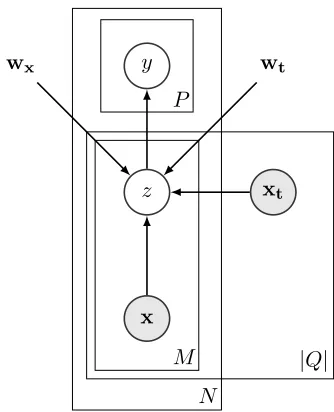
Our models for relation extraction from QnA data incorporates the topic of the question and can be represented as a graphical model (Figure 1). Each mention of a pair of entities is represented with a set of mention-based featuresx and question-based featuresxt. A multinomial latent variablez repre-sents a relation (or none) expressed in the mention and depends on the features and a set of weights
wxfor mention-based andwtfor question-based fea-tures: zˆ=arg max
z∈P∪∅ p(z|x, xt, wx, wt). To estimate this variable we use L2-regularized multinomial lo-gistic regression model, trained using the distant su-pervision approach for relation extraction (Mintz et al., 2009), in which mentions of entity pairs related in Freebase are treated as positive instances for the corresponding predicates, and negative examples are sampled from mentions of entity pairs which are not related by any of the predicates of interest. Fi-nally, to predict a set of possible relationsybetween the pair of entities we take logical OR of individual mention variablesz,i.e.yp =∨i=1M [zi =p, p∈P], where M is the number of mentions of this pair of entities.
y P
z
x
xt
wt
wx
|Q|
[image:2.612.342.509.51.257.2]M N
Figure 1: QnA-based relation extraction model plate diagram. N - number of different entity pairs,M -number of mentions of an entity pair,|Q|- number of questions where an entity pair is mentioned,xand xt- mention-based and question-based features,w andwt- corresponding feature weights, latent vari-ablesz- relation expressed in an entity pair mention, latent variablesy- relations between entity pair
3.1 Sentence-based baseline model
Existing sentence-based relation extraction models can be applied to individual sentences of a QnA pair and will work well for complete statements,e.g.
“Who did Brad Pitt marry? Brad Pitt and Angelina Jolie married at secret ceremony”. In sentence-based scenario, when the set of question-sentence-based fea-tures is empty, the above model corresponds to the Mintz++ baseline described in Surdeanu et al. (2012), which was shown to be superior to the orig-inal model of Mintz et al. (2009), is easier to train than some other state of the art distant supervision models and produces comparable results.
3.2 Sentence-based model with question features
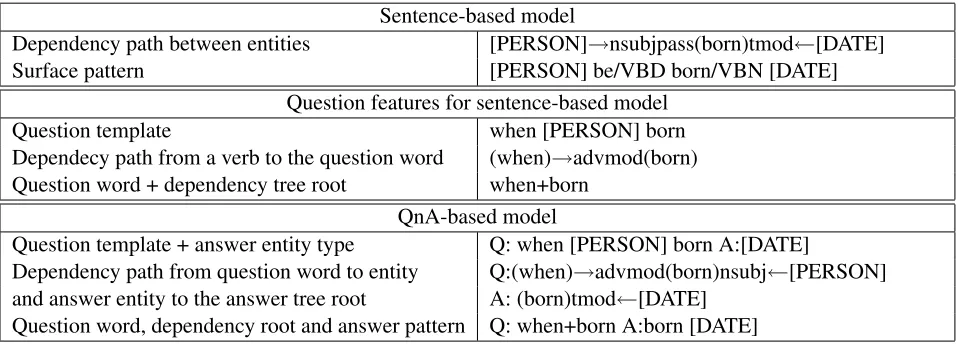
Table 1: Examples of features used for relation extraction for “When was Mariah Carey born? Mariah Carey was born 27 March 1970”
Sentence-based model
Dependency path between entities [PERSON]→nsubjpass(born)tmod←[DATE]
Surface pattern [PERSON] be/VBD born/VBN [DATE]
Question features for sentence-based model
Question template when [PERSON] born
Dependecy path from a verb to the question word (when)→advmod(born)
Question word + dependency tree root when+born
QnA-based model
Question template + answer entity type Q: when [PERSON] born A:[DATE]
Dependency path from question word to entity Q:(when)→advmod(born)nsubj←[PERSON] and answer entity to the answer tree root A: (born)tmod←[DATE]
Question word, dependency root and answer pattern Q: when+born A:born [DATE]
information can help the model to account for the question topic and improve predictions in some am-biguous situations.
3.3 QnA-based model
The QnA model for relation extraction is inspired by the observation, that often an answer sentence do not mention one of the entities at all, e.g., “When was Isaac Newton born? December 25, 1642 Wool-sthorpe, England”. To tackle this situation we make the following assumption about the discourse of a QnA pair: an entity mentioned in a question is re-lated to entities in the corresponding answer and the context of both mentions can be used to infer the re-lation predicate. Our QnA-based rere-lation extraction model takes an entity from a question sentence and entity from the answer as a candidate relation men-tion, represents it with a set features (Table 1) and predicts a possible relation between them similar to sentence-based models. The features are conjunc-tions of various dependency tree and surface patterns of question and answer sentences, designed to cap-ture their topics and relation.
4 Experiments 4.1 Datasets
For experiments we used 2 publicly available CQA datasets: Yahoo! Answers Comprehensive Ques-tions and Answers4 and a crawl of WikiAnswers5 4http://webscope.sandbox.yahoo.com/catalog.php?datatype=l 5http://wiki.answers.com
(Fader et al., 2014). The Yahoo! Answers dataset contains 4,483,032 questions (3,894,644 in English) with the corresponding answers collected on 10/25/2007. The crawl of WikiAnswers has 30,370,994 question clusters, tagged by WikiAn-swers users as paraphrases, and only 3,386,256 them have answers. From these clusters we used all possi-ble pairs of questions and answers (19,629,443 pairs in total).
For each QnA pair we applied tokenization, sentence detection, named entity tagger, parsing and coreference resolution from Stanford CoreNLP (Manning et al., 2014). Our cascade entity link-ing approach is similar to Chang et al. (2011) and considered all noun phrase and named entity men-tions as candidates. First all named entity menmen-tions are looked up in Freebase names and aliases dictio-nary. The next two stages attempt to match mention text with dictionary of English Wikipedia concepts (Spitkovsky and Chang, 2012) and its normalized version. Finally for named entity mentions we try spelling correction using Freebase entity names dic-tionary. We didn’t disambiguate entities and instead took top-5 ids for each coreference cluster (using the
p(entity|phrase)score from the dictionary or num-ber of existing Freebase triples). All pairs of entities (or entity and date) in a QnA pair that are directly related6 in Freebase were annotated with the
corre-sponding relations.
Table 2: Yahoo! Answers and WikiAnswers datasets statistics
Y!A WA
Number of QnA pairs 3.8M 19.6M
Average question length (in chars) 56.67 47.03
Average answer length (in chars) 335.82 24.24
Percent of QnA pairs with answers that do not have any verbs 8.8% 18.9% Percent of QnA pairs with at least one pair of entities related in Freebase 11.7% 27.5% Percent of relations between entity pairs in question sentences only 1.6 % 3.1% Percent of relations between entity pairs in question and answer sentences only 28.1% 46.4% Percent of relations between entity pairs in answer sentences only 38.6% 12.0%
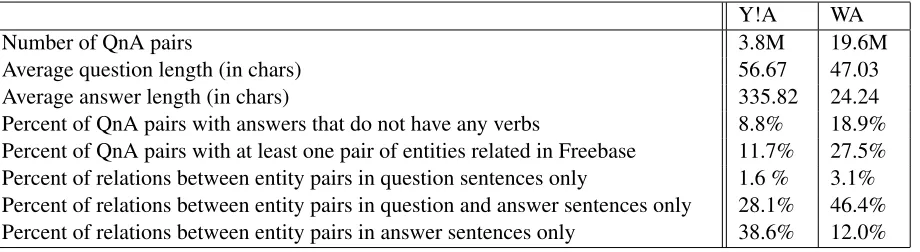
Table 2 gives some statistics on the datasets used in this work. The analysis of answers that do not have any verbs show that ∼8.8% of all QnA pairs do not state the predicate in the answer text. The percentage is higher for WikiAnswers, which has shorter answers on average. Unfortunately, for many QnA pairs we were unable to find relations between the mentioned entities (for many of them no or few entities were resolved to Freebase). Among those QnA pairs, where some relation was annotated, we looked at the location of related entities. In Yahoo! Answers dataset 38.6% (12.0% for WikiAnswers) of related entities are mentioned in answer sentences and can potentially be extracted by sentence-based model, and 28.1% (46.4% for WikiAnswers) be-tween entities mentioned in question and answer sentences, which are not available to the baseline model and our goal is to extract some of them.
4.2 Experimental setup
For our experiments we use a subset of 29 Freebase predicates that have enough unique instances anno-tated in our corpus, e.g. date of birth, profession, nationality, education institution, date of death, dis-ease symptoms and treatments, book author, artist album, etc. We train and test the models on each dataset separately. Each corpus is randomly split for training (75%) and testing (25%). Knowledge base facts are also split into training and testing sets (50% each). QnA and sentence-based models predict la-bels for each entity pair mention, and we aggregate mention predictions by taking the maximum score for each predicate. We do the same aggregation to produce a combination of QnA- and sentence-based models,i.e., all extractions produced by the models are combined and if there are multiple extractions of
the same fact we take the maximum score as the final confidence. The precision and recall of extractions are evaluated on a test set of Freebase triples,i.e.an extracted triple is considered correct if it belongs to the test set of Freebase triples, which are not used for training (triples used for training are simply ig-nored). Note, that this only provides a lower bound on the model performance as some of the predicted facts can be correct and simply missing in Freebase.
4.3 Results
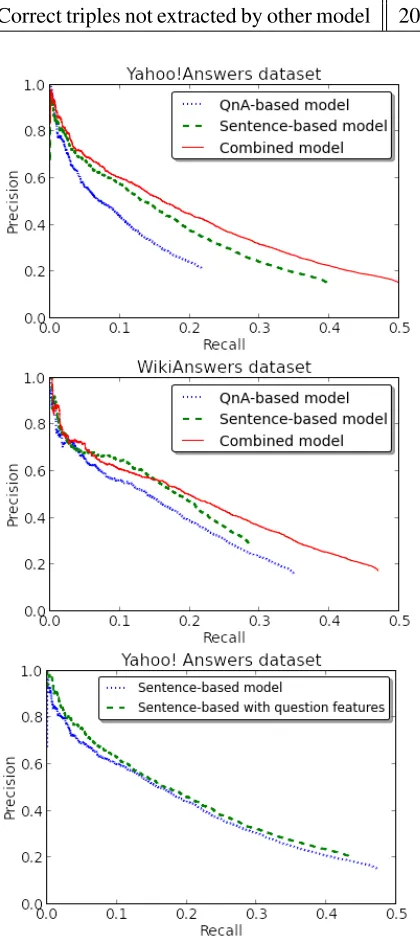
Figure 2 shows Precision-Recall curves for QnA-based and sentence-QnA-based baseline models and some numeric results are given in Table 3. As 100% recall we took all pairs of entities that can be extracted by either model. It is important to note, that since some entity pairs occur exclusively inside the answer tences and some in pairs of question and answer sen-tences, none of the individual models is capable of achieving 100% recall, and maximum possible re-calls for QnA- and sentence-based models are dif-ferent.
Results demonstrate that from 20.5% to 39.4% of correct triples extracted by the QnA-based model are not extracted by the baseline model, and the com-bination of both models is able to achieve higher precision and recall. Unfortunately, comparison of sentence-based model with and without question-based features (Figure 2) didn’t show a significant difference.
5 Error analysis and future work
Table 3: Extraction results for QnA- and sentence-based models on both datasets
Yahoo! Answers WikiAnswers
QnA Sentence Combined QnA Sentence Combined
F-1 score 0.219 0.276 0.310 0.277 0.297 0.332
Number of correct extractions 3229 5900 7428 2804 2288 3779
Correct triples not extracted by other model 20.5% 56.5% - 39.4% 25.8%
-Figure 2: Precision-Recall curves for QnA-based vs sentence-based models and sentence-based model with and without question features
Freebase (and thus are considered incorrect for precision-recall analysis).
The major reason (40%) of false positive
extrac-tions is errors in entity linking. For example: “Who is Tim O’Brien? He was born in Austin on October 1, 1946”. The model was able to correctly extract [Tim O’Brien, date of birth, October 1, 1946], how-ever Tim O’Brien was linked to a wrong person. In a number of cases (16%) our discourse model turns out to be too simple and fails for answers, that men-tion numerous addimen-tional informamen-tion,e.g.“How old is Madonna really? ...Cher was born on 20 May 1946 which makes her older that Madonna...”. A possible solution would be to either restrict QnA-based model to cases when no additional informa-tion is present or design a better discourse model with deeper analysis of the answer sentence and its predicates and arguments. Some mistakes are due to distant supervision errors, for example for the mu-sic.composition.composer predicate our model ex-tracts singers as well as composers (which are in many cases the same).
Of course, there are a number of cases, when our extractions are indeed correct, but are either missing (33%) or contradicting with Freebase (8%). An example of an extracted fact, that is missing in Freebase is “Who is Wole Soyinka? He studied at the University College, Ibadan(1952-1954) and the University of Leeds (1954-1957)”, and [Wole Soyinka, institution, University of Leeds] is cur-rently not present in Freebase. Contradictions with Freebase occur because of different precision lev-els (“pianist” vs “jazz pianist”, city vs county,etc.), different calendars used for dates or “incorrect” in-formation provided by the user. An example, when existing and extracted relation instance are different in precision is:“Who is Edward Van Vleck? Edward Van Vleck was a mathematician born in Middle-town, Connecticut” we extract [Edward Van Vleck, place of birth, Middletown], however the Freebase currently has USA as his place of birth.
attention. It has been studied in CQA research,e.g.
(Shah and Pomerantz, 2010), and an example of such QnA pair is: “Who is Chandrababu Naidu? Nara Chandra Babu Naidu (born April 20, 1951)”. Other authoritative resources on the Web give April 20, 1950 as Chandrababu Naidu’s date of birth. This raises a question of trust to the provided answer and expertise of the answerer. Many questions on CQA websites belong to the medical domain, e.g. peo-ple asking advices on different health related topics. How much we can trust the answers provided to ex-tract them into the knowledge base? We leave this question to the future work.
Finally, we have seen that only a small fraction of available QnA pairs were annotated with exist-ing Freebase relations, which shows a possible lim-itation of Freebase schema. A promising direction for future work is automatic extraction of new pred-icates, which users are interested in and which can be useful to answer more future questions.
6 Related work
Relation extraction from natural language text has been an active area of research for many years, and a number of supervised (Snow et al., 2004), semi-supervised (Agichtein and Gravano, 2000) and un-supervised (Fader et al., 2011) methods have been proposed. These techniques analyze individual sen-tences and can extract facts stated in them using syn-tactic patterns, sentence similarity, etc. This work focus on one particular type of text data, i.e.QnA pairs, and the proposed algorithm is designed to ex-tract relations between entities mentioned in ques-tion and answer sentences.
Community question-answering data has been a subject of active research during the last decade. Bian et al. (2008) and Shtok et al. (2012) show how such data can be used for question answering, an area with a long history of research, and numer-ous different approaches proposed over the decades (Kolomiyets and Moens, 2011). One particular way to answer questions is to utilize structured KBs and perform semantic parsing of questions to transform natural language questions into KB queries. Berant et al. (2013) proposed a semantic parsing model that can be trained from QnA pairs, which are much eas-ier to obtain than correct KB queries used
previ-ously. However, unlike our approach, which takes noisy answer text provided by a CQA website user, the work of Berant et al. (2013) uses manually cre-ated answers in a form of single or lists of KB enti-ties. Later Yao and Van Durme (2014) presented an information extraction inspired approach, that pre-dicts which of the entities related to an entity in the question could be the answer to the question. The key difference of this work from question an-swering is that our relation extraction model doesn’t target question understanding problem and doesn’t necessarily extract the answer to the question, but rather some knowledge it can infer from a QnA pair. Many questions on CQA websites are not factoid, and there are many advice and opinion questions, which simply cannot be answered with a KB en-tity or a list of entities. However, it is still possi-ble to learn some information from them (e.g.from “What’s your favorite Stephen King book? The Dark Half is a pretty incredible book” we can learn that the Dark Half is a book by Stephen King). In ad-dition, answers provided by CQA users often con-tain extra information, which can also be useful (e.g.
from “Where was Babe Ruth born? He was born in Baltimore, Maryland on February 6th, 1895” we can learn not only place of birth, but also date of birth of Babe Ruth).
7 Conclusion
In this paper we proposed a model for relation ex-traction from QnA data, which is capable of predict-ing relations between entities mentioned in question and answer sentences. We conducted experiments on 2 publicly available CQA datasets and showed that our model can extract triples not available to ex-isting sentence-based techniques and can be effec-tively combined with them for better coverage of a knowledge base population system.
Acknowledgments
References
Eugene Agichtein and Luis Gravano. 2000. Snowball: Extracting relations from large plain-text collections. InProceedings of the Fifth ACM Conference on Dig-ital Libraries, DL ’00, pages 85–94, New York, NY, USA. ACM.
S¨oren Auer, Christian Bizer, Georgi Kobilarov, Jens Lehmann, Richard Cyganiak, and Zachary Ives. 2007. Dbpedia: A nucleus for a web of open data. Springer. Jonathan Berant, Andrew Chou, Roy Frostig, and Percy Liang. 2013. Semantic parsing on freebase from question-answer pairs. In Proceedings of the 2013 Conference on Empirical Methods in Natural Lan-guage Processing, EMNLP’13, pages 1533–1544. Jiang Bian, Yandong Liu, Eugene Agichtein, and
Hongyuan Zha. 2008. Finding the right facts in the crowd: Factoid question answering over social media. In Proceedings of the 17th International Conference on World Wide Web, WWW ’08, pages 467–476, New York, NY, USA. ACM.
Kurt Bollacker, Colin Evans, Praveen Paritosh, Tim Sturge, and Jamie Taylor. 2008. Freebase: A Col-laboratively Created Graph Database for Structuring Human Knowledge. InProceedings of the 2008 ACM SIGMOD International Conference on Management of Data, SIGMOD ’08.
A. Carlson, J. Betteridge, B. Kisiel, B. Settles, E.R. Hr-uschka Jr., and T.M. Mitchell. 2010. Toward an Archi-tecture for Never-Ending Language Learning. In Pro-ceedings of the Conference on Artificial Intelligence (AAAI), AAAI’10, pages 1306–1313. AAAI Press. Angel X Chang, Valentin I Spitkovsky, Eneko Agirre, and
Christopher D Manning. 2011. Stanford-ubc entity linking at tac-kbp, again. InProceedings of Text Anal-ysis Conference, TAC’11.
Xin Dong, Evgeniy Gabrilovich, Geremy Heitz, Wilko Horn, Ni Lao, Kevin Murphy, Thomas Strohmann, Shaohua Sun, and Wei Zhang. 2014. Knowledge vault: A web-scale approach to probabilistic knowl-edge fusion. InProceedings of the 20th ACM SIGKDD International Conference on Knowledge Discovery and Data Mining, KDD ’14, pages 601–610, New York, NY, USA. ACM.
Anthony Fader, Stephen Soderland, and Oren Etzioni. 2011. Identifying relations for open information extraction. In Proceedings of the Conference on Empirical Methods in Natural Language Processing, EMNLP ’11, pages 1535–1545, Stroudsburg, PA, USA. Association for Computational Linguistics. Anthony Fader, Luke Zettlemoyer, and Oren Etzioni.
2014. Open question answering over curated and ex-tracted knowledge bases. InProceedings of the 20th
ACM SIGKDD International Conference on Knowl-edge Discovery and Data Mining, KDD ’14, pages 1156–1165, New York, NY, USA. ACM.
Oleksandr Kolomiyets and Marie-Francine Moens. 2011. A survey on question answering technology from an information retrieval perspective. Inf. Sci., 181(24):5412–5434, December.
Christopher D. Manning, Mihai Surdeanu, John Bauer, Jenny Finkel, Steven J. Bethard, and David McClosky. 2014. The Stanford CoreNLP natural language pro-cessing toolkit. InProceedings of 52nd Annual Meet-ing of the Association for Computational LMeet-inguistics: System Demonstrations, pages 55–60.
Mike Mintz, Steven Bills, Rion Snow, and Dan Jurafsky. 2009. Distant supervision for relation extraction with-out labeled data. InProceedings of the Joint Confer-ence of the 47th Annual Meeting of the Association for Computational Linguistics and the 4th International Joint Conference on Natural Language Processing of the AFNLP, ACL ’09.
Chirag Shah and Jefferey Pomerantz. 2010. Evaluat-ing and predictEvaluat-ing answer quality in community qa. InProceedings of the 33rd international ACM SIGIR conference on Research and development in informa-tion retrieval, pages 411–418. ACM.
Anna Shtok, Gideon Dror, Yoelle Maarek, and Idan Szpektor. 2012. Learning from the past: Answering new questions with past answers. InProceedings of the 21st International Conference on World Wide Web, WWW ’12, pages 759–768, New York, NY, USA. ACM.
Rion Snow, Daniel Jurafsky, and Andrew Y Ng. 2004. Learning syntactic patterns for automatic hypernym discovery. Advances in Neural Information Process-ing Systems 17.
Valentin I Spitkovsky and Angel X Chang. 2012. A cross-lingual dictionary for english wikipedia con-cepts. InLREC, pages 3168–3175.
Mihai Surdeanu and Heng Ji. 2014. Overview of the en-glish slot filling track at the tac2014 knowledge base population evaluation. InProc. Text Analysis Confer-ence (TAC2014).
Mihai Surdeanu, Julie Tibshirani, Ramesh Nallapati, and Christopher D. Manning. 2012. Multi-instance multi-label learning for relation extraction. In Proceed-ings of the 2012 Joint Conference on Empirical Meth-ods in Natural Language Processing and Computa-tional Natural Language Learning, EMNLP-CoNLL ’12, pages 455–465, Stroudsburg, PA, USA. Associa-tion for ComputaAssocia-tional Linguistics.