Searching for Context: a Study on Document-Level Labels for Translation
Quality Estimation
Carolina Scarton1, Marcos Zampieri2,3, Mihaela Vela2, Josef van Genabith2,3and Lucia Specia1 1University of Sheffield / Regent Court, 211 Portobello, Sheffield, UK
2Saarland University / Campus A2.2, Saarbr¨ucken, Germany
3German Research Centre for Artificial Intelligence / Saarbr¨ucken, Germany
{c.scarton,l.specia}@sheffield.ac.uk
{marcos.zampieri,m.vela}@uni-saarland.de josef.van [email protected]
Abstract
In this paper we analyse the use of pop-ular automatic machine translation evalu-ation metrics to provide labels for qual-ity estimation at document and paragraph levels. We highlight crucial limitations of such metrics for this task, mainly the fact that they disregard the discourse structure of the texts. To better understand these limitations, we designed experiments with human annotators and proposed a way of quantifying differences in translation qual-ity that can only be observed when sen-tences are judged in the context of entire documents or paragraphs. Our results in-dicate that the use of context can lead to more informative labels for quality anno-tation beyond sentence level.
1 Introduction
Quality estimation (QE) of machine translation (MT) (Blatz et al., 2004; Specia et al., 2009) is an area that focuses on predicting the quality of new, unseen machine translation data without rely-ing on human references. This is done by trainrely-ing models using features extracted from source and target texts and, when available, from the MT sys-tem, along with a quality label for each instance.
Most current work on QE is done at the sentence level. A popular application of sentence-level QE is to support post-editing of MT (He et al., 2010). As quality labels, Likert scores have been used for post-editing effort, as well as post-editing time and edit distance between the MT output and thefinal version – HTER (Snover et al., 2006).
c
�2015 The authors. This article is licensed under a Creative Commons 3.0 licence, no derivative works, attribution, CC-BY-ND.
There are, however, scenarios where quality pre-diction beyond sentence level is needed, most no-tably in cases when automatic translations without post-editing are required. This is the case, for ex-ample, of quality prediction for an entire product review translation in order to decide whether or not it can be published as is, so that customers speak-ing other languages can understand it.
The quality of a document is often seen as some form of aggregation of the quality of its sentences. We claim, however, that document-level quality assessment should consider more information than sentence-level quality. This includes, for exam-ple, the topic and structure of the document and the relationship between its sentences. While cer-tain sentences are considered perfect in isolation, their combination in context may lead to incoher-ent text. Conversely, while a sincoher-entence can be con-sidered poor in isolation, when put in context, it may benefit from information in surrounding sen-tences, leading to a document that is fit for pur-pose.
Document-level quality prediction is a rather understudied problem. Recent work has looked into document-level prediction (Scarton and Spe-cia, 2014; Soricut and Echihabi, 2010) using au-tomatic metrics such as BLEU (Papineni et al., 2002) and TER (Snover et al., 2006) as quality labels. However, their results highlighted issues with these metrics for the task at hand: the evalu-ation of the scores predicted in terms of mean er-ror was inconclusive. In most cases, the predic-tion model only slightly improves over a simple baseline where the average BLEU or TER score of the training documents is assigned to all test docu-ments.
au-tomatically evaluate MT output (not for QE pur-poses). Carpuat and Simard (2012) report that MT output is overall consistent in its lexical choices, nearly as consistent as manually translated texts. Meyer and Webber (2013) and Li et al. (2014) show that the translation of connectives differs from humans to MT, and that the presence of explicit connectives correlates with higher HTER values. Guzm´an et al. (2014) explore rhetori-cal structure (RST) trees (Mann and Thompson, 1987) for automatic evaluation of MT into English, outperforming traditional metrics at system-level evaluation.
Thus far, no previous work has investigated ways to provide a global quality score for an entire document that takes into account document struc-ture, without access to reference translations. Pre-vious work on document-level QE use automatic evaluation metrics as quality labels that do not con-sider document-level structures and are developed for inter-system rather than intra-system evalua-tion. Also, previous work on evalution of MT does not focus on complete evaluation at document-level.
In this paper, we show that the use of BLEU and other automatic metrics as quality labels do not help to successfully distinguish different qual-ity levels. We discuss the role of document-wide information for document-level quality estimation and present two experiments with human annota-tors.
In the first experiment, translators are asked to subjectively assess paragraphs in terms of cohe-sion and coherence (herein, SUBJ). In the second experiment, a two-pass post-editing experiment is performed in order to measure the difference be-tween corrections made with and without wider contexts (the tow passes are called PE1 and PE2, repectively).
The task of assessing paragraphs according to cohesion and coherence is highly subjective and thus the results of the first study did not show high agreement among annotators. The results of the two-stage post-editing experiment showed sig-nificant differences from the post-editing of sen-tences without context to the second stage where sentences were further corrected in context. This is an indication that certain translation issues can only be solved by relying on wider contexts, which is a crucial information for document-level QE. A manual analysis was conducted to evaluate
differ-ences between PE1 and PE2. Although several of the changes were found to be related to style or other non-discourse related phenomena, many dis-course related changes were performed that were only possible given the wider context available.
In the remainder of this paper we first present related work in Section 2. In Section 3 we discuss the use of BLEU-style metrics for QE at document level. Section 4 describes the experimental set up used in the paper. Section 5 presents thefirst study were the annotators assess quality in terms of co-hesion and coherence, while Section 6 shows the two-pass post-editing experiment and its results. The conclusions and future work are presented in Section 7.
2 Related work
The research reported here is about quality esti-mation at document-level. Therefore, work on document-level features and document-level qual-ity prediction are both relevant, as well as studies on how discourse phenomena manifest in the out-put of MT systems.
Soricut and Echihabi (2010) propose document-level features to predict document-document-level quality for ranking purposes, having BLEU as quality label. While promising results were reported for ranking of translations for different source documents, the results for predicting absolute scores proved incon-clusive. For two out of four domains, the predic-tion model only slightly improves over a baseline where the average BLEU score of the training doc-uments is assigned to all test docdoc-uments. In other words, most documents have similar BLEU scores, and therefore the training mean is a hard baseline to beat.
Scarton and Specia (2014) propose a number of discourse-informed features in order to predict BLEU and TER at document level. They also found the use of these metrics as quality labels problematic: the error scores of several QE mod-els were very close to that obtained by the train-ing mean baseline. Even when mixtrain-ing translations from different MT systems, BLEU and TER were not found to be discriminative enough.
lexi-cal choices, nearly as consistent as manually trans-lated texts.
Meyer and Webber (2013) present a study on implicit discourse connectives in translation. The phenomenon is evaluated using human references and machine translations for English-French and English-German. They found that humans trans-lated explicit connectives in the source (English) into implicit connectives in the target (German and French) in 18% of the cases. MT systems trans-lated explicit connectives into implicit ones less often.
Li et al. (2014) study connectives in order to improve MT for Chinese-English and Arabic-English. They show that the presence of ex-plicit connectives correlates with high HTER for Chinese-English only. Chinese-English also showed correlation between ambiguous connec-tives and higher HTER. When comparing the pres-ence of discourse connectives in translations and post-editions, they found that cases of connectives only appearing in the translation or post-edition also show correlation with high HTER scores.
Guzm´an et al. (2014) explore RST trees (Mann and Thompson, 1987) for automatic evaluation of MT into English, with a discourse parser to anno-tate RST trees at sentence level in English. They compare the discourse units of machine transla-tions with those in the references by using tree ker-nels to compute the number of common subtrees between the two trees. This metric outperformed others at system-level evaluation.
In summary, no previous work has investigated ways to provide a global quality score for an entire document that takes into account document struc-ture, neither for evaluation nor for estimation pur-poses.
3 Automatic evaluation metrics as quality labels for document-level QE As discussed in Section 2, although the use of BLEU-style metrics as quality scores for document-level QE clearly seems inadequate, pre-vious work resorted to these automatic metrics be-cause of the lack of better labels. In order to better understand this problem, we conducted an experiment with French-English translations from the LIG corpus (Potet et al., 2012). We took the
first part of the corpus containing119source doc-uments on the news domain (from various WMT news test sets), their MT by a phrase-based SMT
system, a post-edited version of these translations by a human translator, and a reference transla-tion. We used a range of automatic metrics such as BLEU, TER, METEOR-ex (exact match) and METEOR-st (stem match), which are based on a comparison between machine translations and hu-man references, and the “huhu-man-targeted” version of BLEU and TER, where machine translations are compared against their post-editions: HBLEU and HTER. Table 1 shows the results of the average score (AVG) for each metric considering all docu-ments, as well as the standard deviation (STDEV).
AVG STDEV BLEU (↑) 0.27 0.05
TER (↓) 0.53 0.07
METEOR-ex (↑) 0.29 0.03
METEOR-st (↑) 0.30 0.03
HTER (↓) 0.21 0.03
[image:3.595.347.483.243.324.2]HBLEU (↑) 0.64 0.05
Table 1: Average metric scores in the LIG corpus.
We conducted a similar analysis on the English-German (EN-DE) news test set from WMT13 (Bo-jar et al., 2013), which contains 52 documents, both at document and paragraph levels. Three MT systems were considered in this analysis: UEDIN
(an SMT system),PROMT(a hybrid system) and
RBMT-1 (a rule-based system). Average metric
scores are shown in Table 2.
For all the metrics and corpora, the STDEV val-ues for documents are very small (below0.1), in-dicating that all documents are considered similar in terms of quality according to these metrics (the scores are all very close to the mean).
At paragraph level (Table 2), the scores variation increases, with BLEU showing the highest varia-tion. However, the very high STDEV values for BLEU (very close to the actual average score for all documents) is most likely due to the fact that BLEU does not perform well for short segments such as a paragraph due to the n-gram sparsity at this level, as shown in Stanojevi´c and Sima’an (2014).
UEDIN PROMT RBMT-1
Document Paragraph Document Paragraph Document Paragraph
AVG STDEV AVG STDEV AVG STDEV AVG STDEV AVG STDEV AVG STDEV
BLEU (↑) 0.2 0.048 0.2 0.16 0.19 0.05 0.2 0.16 0.15 0.04 0.16 0.14
TER (↓) 0.62 0.063 0.63 0.24 0.61 0.07 0.62 0.25 0.66 0.06 0.67 0.23
METEOR-ex (↑) 0.37 0.056 0.37 0.16 0.36 0.06 0.37 0.16 0.32 0.05 0.33 0.15
[image:4.595.76.537.72.151.2]METEOR-st (↑) 0.39 0.058 0.39 0.16 0.38 0.06 0.39 0.16 0.34 0.05 0.35 0.15
Table 2: Average metric scores for automatic metrics in the WMT13 EN-DE corpus.
4 Experimental settings
In the following experiments, we consider a para-graph as a “document”. This decision was made to make the annotation feasible, given the time and resources available. Although the datasets are dif-ferent for the two subtasks, they were taken from the same larger corpus and annotated by the the same group of translators.
4.1 Methods
The SUBJ experiment (Section 5) consists in as-sessing the quality of paragraphs in terms of co-hesion and coherence. We define cohesion as the linguistic marks (cohesive devices) that connect clauses, sentences or paragraphs together; coher-ence captures whether clauses, sentcoher-ences or para-graphs are connected in a logical way, i.e. whether they make sense together (Stede, 2011). In or-der to assess these two phenomena, we propose a 4-point scale. For coherence: 1=Completely co-herent; 2=Mostly coco-herent; 3=Little coherent, and 4=Incoherent; for cohesion: 1=Flawless; 2=Good; 3=Disfluent and 4=Incomprehensible.
PE1 and PE2 (Section 6) consist in objective assessments through the post-editing of MT sen-tences in two rounds: in isolation and in context. In thefirst round (PE1), annotators were asked to post-edit sentences which were shown to them out of context. In the second round (PE2), they were asked to further post-edit the same sentences now given in context andfix any other issues that could only be solved by relying on information beyond individual sentences. For this, each annotator was given as input the output of their PE1, i.e. the sen-tences they had previously post-edited themselves.
4.2 Data
The datasets were extracted from the test set of the EN-DE WMT13 MT shared task. EN-DE was chosen given the availability of in-house annota-tors for this language pair. Outputs of theUEDIN
SMT system were chosen as this was the best
par-ticipating system for this language pair (Bojar et al., 2013). For the SUBJ experiment, paragraphs were randomly selected from the full corpus.
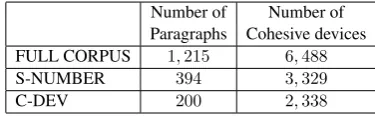
For PE1 and PE2, only source (English) para-graphs with3-8sentences were selected (filter S-NUMBER) to ensure that there is enough infor-mation beyond sentence-level to be evaluated and make the task feasible for the annotators. These paragraphs were further filtered to select those with cohesive devices. Cohesive devices are lin-guistic units that play a role in establishing co-hesion between clauses, sentences or paragraphs (Halliday and Hasan, 1976). Pronouns and dis-course connectives are examples of such devices. A list of pronouns and the connectives from Pitler and Nenkova (2009) was considered for that. Fi-nally, paragraphs were ranked according to the number of cohesive devices they contain and the top200paragraphs were selected (filter C-DEV). Table 3 shows the statistics of the initial corpus and the resulting selection after eachfilter.
Number of Number of Paragraphs Cohesive devices
FULL CORPUS 1,215 6,488
S-NUMBER 394 3,329
[image:4.595.320.508.500.560.2]C-DEV 200 2,338
Table 3: WMT13 English source corpus.
4.3 Annotators
The annotators for both experiments are students of “Translation Studies” courses (TS) in Saarland University, Saarbr¨ucken, Germany. All students were familiar with concepts of MT and with post-editing tools. They were divided in two sets: (i) Undergraduate students (B.A.), who are na-tive speakers of German; and (ii)Master students (M.A.), the majority of whom are native speak-ers of German. Non-native speakspeak-ers have at least seven years of German language studies. B.A. and M.A. students have on average 10 years of En-glish language studies. Only the B.A. group did the SUBJ experiment. PE1 and PE2 were done by all groups.
PE1 and PE2 were done using three CAT tools: PET (Aziz et al., 2012), Matecat (Federico et al., 2014) and memoQ.1 These tools operate in very
similar ways in terms of their post-editing func-tionalities, and therefore the use of multiple tools was only meant to make the experiment more in-teresting for students and did not affect the results. SUBJ was done without the help of tools.
5 Coherence/cohesion judgements
Ourfirst attempt to access quality beyond sentence level was to explicitly guide annotators to consider discourse, where the notion of “discourse” covers various linguistic phenomena observed across dis-course units. Disdis-course units can be clauses (intra-sentence), sentences or paragraphs.
Six sets with17paragraphs each were randomly selected from FULL CORPUS and given to25 an-notators from the B.A. group (each annotator eval-uated one set). The task was to assess the para-graphs in terms of cohesion and coherence, using the scale given. The annotators could also rely on the source paragraphs. The agreement for the task in terms of Spearman’s rank correlation and the number of students per set are presented in Table 4. The number of annotators per set is different because some of them did not complete the task.
Set 1 Set 2 Set 3 Set 4 Set 5 Set 6
Annotators 3 3 4 7 6 2
Coherence 0.07 0.05 0.16 0.16 0.28 0.58
Cohesion 0.38 0.43 0.28 0.09 0.38 0.12
Table 4: Spearman’s correlation for the SUBJ task.
A low agreement in terms of Spearman’sρrank
1https://www.memoq.com/
correlation was found for both cohesion (ranging from 0.09 to 0.43) and coherence (ranging from 0.05to0.28, having0.58as an outlier) evaluations. Naturally, these concepts are very abstract, even for humans, offering substantial room for subjec-tive interpretations. In addition, the existence of (often many) errors in the MT output can hinder the understanding of the text altogether, rendering judgements on any specific quality dimension
dif-ficult to make.
6 Quality assessment as a two-stage post-editing task
Using HTER, we measured the edit distance be-tween the post-edited versions with and without context. The hypothesis is that differences be-tween the two versions are likely to be corrections that could only be performed with information be-yond sentence level.
For PE1, paragraphs from C-DEV set were di-vided in sets of seven and the sentences were ran-domised in order to prevent annotators from hav-ing access to context when post-edithav-ing. For PE2, sentences were put together in their original para-graphs and presented to annotators in context. A total of112paragraphs were evaluated in16 differ-ent sets, but only sets where more than two annota-tors completed the task are presented here (SET1, SET2, SET7, SET9, SET14 and SET15).2
6.1 Task agreement
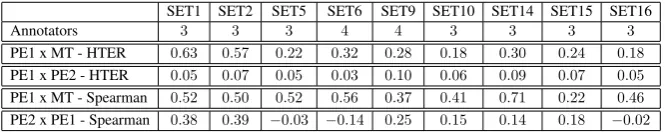
Table 5 shows the agreement for the PE1 and PE2 tasks using Spearman’sρ rank correlation. It was calculated by comparing the HTER values of PE1 against MT and PE2 against PE1. “Annotators” shows the number of annotators per set.
The HTER values of PE1 against PE2 are low, as expected, since the changes from PE1 to PE2 are only expected to reflect discourse related is-sues. In other words, no major changes were ex-pected during the PE2 task. The correlation in HTER between PE1 and MT varies from0.22 to 0.56, whereas the correlation in HTER between PE1 and PE2 varies between−0.14and0.39. The negativefigures mean that the annotators strongly disagreed regarding the changes made from PE1 to PE2. This can be related to stylistic choices made by annotators, although further analysis is needed to study that (see Section 6.3).
SET1 SET2 SET5 SET6 SET9 SET10 SET14 SET15 SET16
Annotators 3 3 3 4 4 3 3 3 3
PE1 x MT - HTER 0.63 0.57 0.22 0.32 0.28 0.18 0.30 0.24 0.18
PE1 x PE2 - HTER 0.05 0.07 0.05 0.03 0.10 0.06 0.09 0.07 0.05
PE1 x MT - Spearman 0.52 0.50 0.52 0.56 0.37 0.41 0.71 0.22 0.46
[image:6.595.133.466.71.138.2]PE2 x PE1 - Spearman 0.38 0.39 −0.03 −0.14 0.25 0.15 0.14 0.18 −0.02
Table 5: HTER values for PE1 against MT and PE1 against PE2 and Spearman’s rank correlation values for PE2 against PE1.
6.2 Issues beyond sentence level
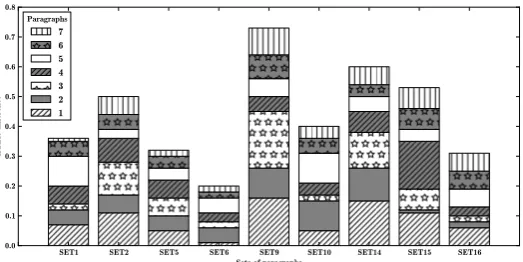
The values for HTER among annotators in PE2 against PE1 were averaged in order to provide a better visualisation of changes made in the para-graphs from PE1 to PE2. Figure 1 shows the re-sults for individual paragraphs in all sets. The ma-jority of the paragraphs were edited in the second round of post-editions. This clearly indicates that information beyond sentence-level can be helpful to further improve the output of MT systems. Be-tween0and19%of the words have changed from PE1 to PE2 (on average7%of the words changed). An example of changes from PE1 to PE2 related to discourse phenomena is shown in Table 6. In this example, two changes are related to the use of information beyond sentence level. Thefirst is re-lated to the substitution of the sentence “Das ist falsch” - literal translation of “This is wrong” -by “Das ist nicht gut”, which fits better into the context. The other change is related to explici-tation of information. The annotator decided to change from“Hier ist diese Schicht ist d¨unn”- lit-eral translation of “Here, this layer is thin” - to “Hier ist die Anzahl solcher Menschen gering”, a translation that betterfits the context of the para-graph“Here, the number of such people is low”.
6.3 Manual analysis
In order to better understand the changes made by the annotators from PE1 to PE2 and also better explain the negative values in Table 5, we man-ually inspected the post-edited data. This analy-sis was done by senior translators who were not involved in the actual post-editing experiments. They counted modifications performed and cate-gorised them into three classes:
Discourse/context changes: changes related to
discourse phenomena, which could only be made by having the entire paragraph text.
Stylistic changes: changes related to translator’s
stylistic or preferential choices. These
changes can be associated with the paragraph context, although they are not strictly neces-sary under our post-editing guidelines.
Other changes: changes that could have been
made without the paragraph context (PE1), but were only performed during PE2.
The results are shown in Table 7. Low agree-ment in the number of changes and the type of changes among annotators is found in most sets. Although annotators were asked not to make un-necessary changes (stylistic), some of them made changes of this type (especially annotators 2 and 3from sets 5and6, respectively). These sets are also the ones that show negative values in Table 5. Since stylistic changes do not follow a pattern and are related to the background and preferences of the translator, the high number of this type of change for these sets can be the reason for the neg-ative correlationfigures. In the case of SET6, an-notator 2 also performed several changes classified as “other changes”. This may have also led to neg-ative correlation values. However, the reasons be-hind the negative values in SET16 could include other phenomena, since overall the variation in the changes performed is low. Further analysis con-sidering the quality of the post-edition needs to be done in order to better explain these results. 7 Conclusions
This paper focused on judgements of translation quality at document level with the aim to pro-duce labels for QE datasets. We highlighted is-sues with the use of automatic evaluation metrics for the task, and proposed and experimented with two methods for collecting labels using human an-notators.
���� ���� ���� ���� ���� ����� ����� ����� ����� ������������������
��� ��� ��� ��� ��� ��� ��� ��� ���
���������������
����������
[image:7.595.170.432.73.204.2]� � � � � � �
Figure 1: HTER between PE1 and PE2 for each of the seven paragraphs in each set.
PE1:- St. Petersburg bietet nicht viel kulturelles Angebot, Moskau hat viel mehr Kultur, es hat eine Grundlage. Es ist schwer fr die Kunst, sich in unserem Umfeld durchzusetzen.
Wir brauchen das kulturelle Fundament, aber wir haben jetzt mehr Schriftsteller als Leser. Das ist falsch.
In Europa gibt es viele neugierige Menschen, die auf Kunstausstellungen, Konzerte gehen. Hier ist diese Schicht ist d¨unn.
PE2:- St. Petersburg bietet nicht viel kulturelles Angebot, Moskau hat viel mehr Kultur, es hat eine Grundlage. Es ist schwer fr die Kunst, sich in unserem Umfeld durchzusetzen.
Wir brauchen das kulturelle Fundament, aber wir haben jetzt mehr Schriftsteller als Leser. Das ist nicht gut.
In Europa gibt es viele neugierige Menschen, die auf Kunstausstellungen, Konzerte gehen. Hier ist die Anzahl solcher Menschen gering.
SRC:- St. Petersburg is not a cultural capital, Moscow has much more culture, there is bedrock there. It’s hard for art to grow on our rocks.
We need cultural bedrock, but we now have more writers than readers. This is wrong.
In Europe, there are many curious people, who go to art exhibits, concerts. Here, this layer is thin.
Table 6: Example of changes from PE1 to PE2.
SET1 SET2 SET5 SET6 SET9 SET10 SET14 SET15 SET16
Annotators 1 2 3 1 2 3 1 2 3 1 2 3 4 1 2 3 4 1 2 3 1 2 3 1 2 3 1 2 3
Discourse/context 2 3 1 0 6 2 2 1 0 2 2 0 0 1 7 1 0 4 0 0 1 0 1 2 1 2 0 1 1
Stylistic 2 0 1 1 0 1 3 11 0 0 3 9 3 5 10 1 3 1 2 2 6 0 0 3 3 2 2 1 3
Other 1 2 4 0 2 2 2 2 6 0 6 0 1 2 0 4 2 1 0 2 2 0 1 1 2 1 1 1 0
Total errors 5 5 6 1 8 5 7 14 6 2 11 9 4 8 17 6 5 6 2 4 9 0 2 6 6 5 3 3 4
Table 7: Manual analysis of PE1 and PE2.
Our second method for collecting labels using human annotators is based on post-editing and showed promising results on uncovering issues that rely on wider context to be identified (and
fixed). Although some annotators did not follow the task specification and made unnecessary
modi-fications or did not correct relevant errors at sen-tence level, overall the results showed that sev-eral issues could only be solved with paragraph-wide context. Moreover, even though stylistic changes can be considered unnecessary, some of them could only be made based on wider context.
We will now turn to studying how to use the in-formation reflecting differences between the two
rounds of post-editing as labels for QE at docu-ment level. One possibility is to use the HTER be-tween the second andfirst rounds directly, but this can lead to many “0” labels, i.e. no edits made. Another idea is to devise a function that combines the HTER without context (PE1 x MT) and the dif-ference between PE1 and PE2.
Our findings reveal important discourse depen-dencies in translation that go beyond QE, with rel-evance for MT evaluation and MT in general.
Acknowledgments
References
Aziz, Wilker, Sheila Castilho Monteiro de Sousa, and Lucia Specia. 2012. Cross-lingual Sentence Com-pression for Subtitles. In The 16th Annual Con-ference of the European Association for Machine Translation, pages 103–110, Trento, Italy.
Blatz, John, Erin Fitzgerald, George Foster, Simona Gandrabur, Cyril Goutte, Alex Kulesza, Alberto San-chis, and Nicola Ueffing. 2004. Confidence Esti-mation for Machine Translation. InThe 20th Inter-national Conference on Computational Linguistics, pages 315–321, Geneva, Switzerland.
Bojar, Ondˇrej, Christian Buck, Chris Callison-Burch, Christian Federmann, Barry Haddow, Philipp Koehn, Christof Monz, Matt Post, Radu Soricut, and Lucia Specia. 2013. Findings of the 2013 Workshop on Statistical Machine Translation. In The Eighth Workshop on Statistical Machine Translation, pages 1–44, Sofia, Bulgaria.
Carpuat, Marine and Michel Simard. 2012. The Trou-ble with SMT Consistency. In The Seventh Work-shop on Statistical Machine Translation, pages 442– 449, Montreal, Quebec, Canada.
Federico, Marcello, Nicola Bertoldi, Mauro Cettolo, Matteo Negri, Marco Turchi, Marco Trombetti, Alessandro Cattelan, Antonio Farina, Domenico Lupinetti, Andrea Martines, Alberto Massidda, Hol-ger Schwenk, Lo¨ıc Barrault, Frederic Blain, Philipp Koehn, Christian Buck, and Ulrich Germann. 2014. THE MATECAT TOOL. InThe 25th International Conference on Computational Linguistics: System Demonstrations, pages 129–132, Dublin, Ireland.
Guzm´an, Francisco, Shafiq Joty, Llu´ıs M`arquez, and Preslav Nakov. 2014. Using Discourse Structure Improves Machine Translation Evaluation. In The 52nd Annual Meeting of the Association for Compu-tational Linguistics, pages 687–698, Baltimore, MD.
Halliday, Michael A. K. and Ruqaiya Hasan. 1976. Co-hesion in English. English Language Series. Long-man, London, UK.
He, Yifan, Yanjun Ma, Josef van Genabith, and Andy Way. 2010. Bridging SMT and TM with Translation Recommendation. In The 48th Annual Meeting of the Association for Computational Linguistics, pages 622–630, Uppsala, Sweden.
Li, Junyi Jessy, Marine Carpuat, and Ani Nenkova. 2014. Assessing the Discourse Factors that Influence the Quality of Machine Translation. InThe 52nd An-nual Meeting of the Association for Computational Linguistics, pages 283–288, Baltimore, MD.
Mann, Willian C. and Sandra A. Thompson. 1987. Rhetorical Structure Theory: A Theory of Text Orga-nization. Cambridge University Press, Cambridge, UK.
Meyer, Thomas and Bonnie Webber. 2013. Implicita-tion of Discourse Connectives in (Machine) Trans-lation. InThe Workshop on Discourse in Machine Translation, pages 19–26, Sofia, Bulgaria.
Papineni, Kishore, Salim Roukos, Todd Ward, and Wei jing Zhu. 2002. BLEU: a Method for Automatic Evaluation of Machine Translation. InThe 40th An-nual Meeting of the Association for Computational Linguistics, pages 311–318, Philadelphia, PA. Pitler, Emily and Ani Nenkova. 2009. Using Syntax
to Disambiguate Explicit Discourse Connectives in Text. In The Joint conference of the 47th Annual Meeting of the Association for Computational Lin-guistics and the Fourth International Joint Confer-ence on Natural Language Processing of the Asian Federation of Natural Language Processing, pages 13–16, Suntec, Singapore.
Potet, Marion, Emmanuelle Esperanc¸a-Rodier, Laurent Besacier, and Herv´e Blanchon. 2012. Collection of a Large Database of French-English SMT Output Corrections. InThe 8th International Conference on Language Resources and Evaluation, pages 23–25, Istanbul, Turkey.
Scarton, Carolina and Lucia Specia. 2014. Document-level translation quality estimation: exploring dis-course and pseudo-references. InThe 17th Annual Conference of the European Association for Machine Translation, pages 101–108, Dubrovnik, Croatia.
Snover, Matthew, Bonnie Dorr, Richard Schwartz, Lin-nea Micciulla, and John Makhoul. 2006. A Study of Translation Edit Rate with Targeted Human Anno-tation. InProceedings of the Seventh biennial con-ference of the Association for Machine Translation in the Americas, AMTA 2006, pages 223–231, Cam-bridge, MA.
Soricut, Radu and Abdessamad Echihabi. 2010. TrustRank: Inducing Trust in Automatic Transla-tions via Ranking. InThe 48th Annual Meeting of the Association for Computational Linguistics, pages 612–621, Uppsala, Sweden.
Specia, Lucia, Marco Turchi, Nicola Cancedda, Marc Dymetman, and Nello Cristianini. 2009. Estimating the Sentence-Level Quality of Machine Translation Systems. InThe 13th Annual Conference of the Eu-ropean Association for Machine Translation, pages 28–37, Barcelona, Spain.
Stanojevi´c, Miloˇs and Khalil Sima’an. 2014. Fitting Sentence Level Translation Evaluation with Many Dense Features. In 2014 Conference on Empiri-cal Methods in Natural Language Processing, pages 202–206, Doha, Qatar.