Proc. of the Joint Workshop on Automatic Knowledge Base Construction & Web-scale Knowledge Extraction (AKBC-WEKEX), pages 19–24,
Automatic Evaluation of Relation Extraction Systems on Large-scale
Mirko Bronzi†, Zhaochen Guo‡, Filipe Mesquita‡, †Universit`a degli Studi Roma Tre
Via della Vasca Navale, 79 Rome, Italy
{bronzi,merialdo}@dia.uniroma3.it
Denilson Barbosa‡, Paolo Merialdo† ‡University of Alberta
2-32 Athabasca Hall Edmonton, Canada
{zhaochen,mesquita,denilson}@ualberta.ca
Abstract
The extraction of relations between named en-tities from natural language text is a long-standing challenge in information extraction, especially in large-scale. A major challenge for the advancement of this research field has been the lack of meaningful evaluation frame-works based on realistic-sized corpora. In this paper we propose a framework for large-scale evaluation of relation extraction systems based on an automatic annotator that uses a public online database and a large web corpus.
1 Introduction
It is envisioned that in the future, the main source of structured data to build knowledge bases will be automatically extracted from natural language sources (Doan et al., 2009). One promising tech-nique towards this goal is Relation Extraction (RE): the task of identifying relations among named en-tities (e.g., people, organizations and geo-political entities) from natural language text. Traditionally, RE systems required each target relation to be given as input along with a set of examples (Brin, 1998; Agichtein and Gravano, 2000; Zelenko et al., 2003). A new paradigm termed Open RE (Banko and Et-zioni, 2008) has recently emerged to cope with the scenario where the number of target relations is too large or even unknown. Open RE systems try to ex-tract every relation described in the text, as opposed to focusing on a few relations (Zhu et al., 2009; Banko and Etzioni, 2008; Hasegawa et al., 2004; Rosenfeld and Feldman, 2007; Chen et al., 2005; Mesquita et al., 2010; Fader et al., 2011).
One challenge in advancing the state-of-the-art in open RE (or any other field for that matter) is having meaningful and fair ways of evaluating and compar-ing different systems. This is particularly difficult when it comes to evaluating therecallof such sys-tems, as that requires one to enumerate all relations described in a corpus.
In order to scale, a method for evaluation of open RE must have no human involvement. One way to automatically produce a benchmark is to use an ex-isting database as ground truth (Agichtein and Gra-vano, 2000; Mintz et al., 2009; Mesquita et al., 2010) . Although a step in the right direction, this approach limits the evaluation to those relations that are present in the database. Another shortcoming is that the database does not provide “true” recall, since it often contains many more facts (for the rela-tions it holds) than described in the corpus.
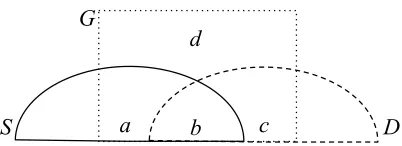
Figure 1: Venn diagram showing the interaction between an external database D (Freebase), the ground truth G and a system outputS.
PMI is also useful to evaluate systems automatically. Using our method, we compare two state-of-the-art open RE systems, ReVerb (Fader et al., 2011) and SONEX (Mesquita et al., 2010), applied to the same corpus, namely the New York Times Corpus (Sand-haus, 2008).
2 Evaluation Methodology
We now describe how our method measures both true precision and true recall, using a database and the web (as a large external text corpus). Afactis a triplefi = he1, r, e2i associating entities e1 and
e2 via relation r. We measure precision by assess-ing how many of the facts produced by the system have been correctly extracted. A fact is said to be
correctif (1) we can find the fact in the database or (2) we can detect a statistically significant associa-tion between e1, e2 andr on the web. To measure recall, we estimate the size of the ground truth (i.e., the collection ofallfacts described in the corpus).
2.1 Interactions between the system, database and ground truth
Now, we discuss our method to evaluate open RE systems. Given a corpus annotated with named entities, an open RE system must produce a set of facts S = {f1, f2, . . . , f|S|}. An example of fact ish“Barack Obama”,“married to”,“Michelle Obama”i. In order to evaluate the precision of
S, we partially rely on an external database D = {f1, f2, . . . , f|D|}. In order to measure recall, we try to estimate the set of facts described in the input corpus. This set corresponds to the ground truth and it is denoted byG={f1, f2, . . . , f|G|}.
In Figure 1, we present a Venn diagram that il-lustrates the interactions between the system output (S), the ground truth (G) and the external database
(D). There are four marked regions (a, b, c, d) in this diagram. We need to estimate the size of these re-gions to measure the true precision and recall of a system. We discuss each marked region as follows.
• acontains correct facts from the system output that are not in the database.
• b is the intersection between the system out-put and the database (S∩D). We assume that this region is composed by correct facts only, i.e., facts that are in the ground truth. This is because it is unlikely for a fact mistakenly ex-tracted by a system to be found in the database.
• c contains the database facts described in the corpus but not extracted by the system.
• dcontains the facts described in the corpus that are not in the system output nor in the database.
Precision and recall Observe that all true posi-tives are in regions a and b, while all false nega-tives are in regions c and d. Considering that |G| =|a|+|b|+|c|+|d|, we can define precision (P), recall (R) and F-measure (F) as follows.
P = |a|+|b|
|S| R =
|a|+|b| |a|+|b|+|c|+|d|
F = 2·P·R
P+R
The need for the web An evaluation method that relies exclusively on a database can only determine the size of regions b andc. Therefore, in order to compute true precision and recall we need to eval-uate those facts that are not in the database. The whole web would be the ideal candidate for this task since it is by far the most comprehensive source of information. In our preliminary experiments, more than 97% of the extractions cannot be evaluated us-ing a database only.
2.2 Estimating precision
Using the external database We calculate the size of regionb by determining, for each fact f = he1, r, e2i in S, whether f is in D. In our experi-ments, D corresponds to Freebase, which contains data from many sources, including Wikipedia. Free-base provides Wikipedia ids for many of its enti-ties. Since we perform entity disambiguation with Wikipedia as a preprocessing step, findinge1ande2 in Freebase is trivial.
On the other hand, we are required to match r
to a relation in Freebase. We perform this match-ing by usmatch-ing a widely-used semantic similarity mea-sure proposed by Jiang and Conrath (Jiang and Con-rath, 1997). This measure uses a lexical terminology structure (WordNet) with corpus statistics. Given a relationr0 in Freebase, we determine the similarity between r and r0 by the maximum similarity be-tween the words that compose r andr0. We select the relationr0 with maximum similarity withr and consider thatr=r0 if their similarity score is above a predetermined threshold.
Using the web We estimate |a| by leveraging Pointwise Mutual Information (PMI) on web doc-uments. In particular, we use an adaptation of the PMI-IR (Turney, 2001), which computes PMI us-ing a web search engine. The PMI of a fact f = he1, r, e2i measures the likelihood of observing f, given that we observede1ande2, i.e,
PMI(e1, r, e2) =
Count(e1ANDrANDe2)
Count(e1ANDe2)
(1)
where Count(q) is the number of documents re-turned by the query q. PMI values range from 0 (whenf is not observed) to 1 (whenf is observed for every occurrence of the paire1 ande2). We use the PMI function to determine whether a fact was correctly extracted. The underlying intuition is that facts with high (relative) frequency are more likely to be correct.
There are different ways one can estimate the re-sult of theCount(·) function. One may use the hit counts of a web search engine, such as Google or Bing. Another option is to use a local search engine, such asLucene1, on a large sample of the web, such as the ClueWeb09 corpus.
1
http://lucene.apache.org/
We consider two versions of the PMI function, which differ by how their queries are defined. Equa-tion 1 presents the CLASSIC version, which uses the AND operator. This simple approach is effi-cient but ignores the locality of query elements. It is known that query elements close to each other are more likely to be related than those sparsely dis-tributed throughout the document. The second ver-sion of PMI, called PROXIMITY, relies on proxim-ity queries, which consider the localproxim-ity aspect. In this version, queries are of the form “e1NEAR:X r NEAR:X e2”, whereXis the maximum number of words between the query elements. In Figure 2 we see an example of proximity query.
We deem a fact as correct if its PMI value is above a thresholdt, determined experimentally2. By cal-culating the PMI of extracted facts that are not in the regionb, we are able to estimate|a|. With both|a| and|b|, we estimate the precision of the system.
2.3 Estimating recall
To provide a trustworthy estimation of recall, we need to estimate the size of regions c and d. We produce a supersetG0 of the ground truthG(G0 ⊇ G). Note thatG0 contains real facts (G) as well as wrongly generated facts (G0 \G). We approximate
Gby removing these wrong facts, either exploiting the external database and the PMI function.
One way to produce G0 is to perform a Carte-sian product of all possible entities and relations. LetE = {e1, e2, . . . , em}be the set of entities and R = {r1, r2, . . . , rn} be set of relations found in
the input corpus. The superset of G produced by Cartesian product isG0 = E ×R×E. For exam-ple, the facts extracted from the sentence “Barack Obama is visiting Rome to attend the G8 Summit” are presented in Figure 3, where the correct facts are highlighted. The shortcoming of this approach is the huge size of the resultingG0. Even so, we remove many incorrect facts thanks to heuristics; e.g., we do not consider entities from different sentences.
OnceG0is produced, we estimate|G∩D|=|b|+ |c|by looking for facts inG0 that match a fact in the databaseD, as before. Once we have|b|and|G∩D|, we can estimate|c| = |G∩D| − |b|. By applying
2
1 2 3 4 5 6 7 8
[image:4.612.134.478.70.117.2]Valerie Jarrett was appointed as senior advisor by Barack Obama
Figure 2: A sentence matching the query “(Valerie Jarrett) NEAR:4 (advisor) NEAR:4 (Barack Obama)”. Grey words represent matching terms, while white words are noise.
e1 r e2
Barack Obama visit Rome Barack Obama visit G8 Summit Barack Obama attend Rome Barack Obama attend G8 Summit
[image:4.612.104.265.167.245.2]Rome visit G8 Summit Rome attend G8 Summit
Figure 3: Facts produced for the supersetG0for “Barack Obama is visiting Rome to attend the G8 Summit”. Facts in the ground truthGare highlighted in bold.
the PMI of the facts not in the database (G0 \ D) we can determine|G\D|. Finally, we can estimate |d|=|G\D| − |a|. Now that we have estimated the sizes of regionsa, b, candd, we can determine the true recall of the system.
2.4 PMI Effectiveness
To measure PMI effectiveness, we compare the re-sults of our evaluation system (A) and a human (H0) over a set of 558 facts. To this end, we defined the agreement betweenAandH0as follows.
Agreement= Number of facts whereA=H0 Number of facts
Our system achieved an agreement of 73% with re-spect to the human evaluation; the agreement in-creases up to 80% if we consider only popular facts. This is a well-known property of PMI: when deal-ing with small hit count numbers, the PMI function is very sensible to changes, amplifying the effect of errors.
We also compare how distant the agreement achieved with the automatic annotator (A) is from the agreement between humans. For this experi-ment, we asked two additional volunteers (H1 and
H2) to evaluate the set of 558 facts as before. For a more reliable measurement we created an additional annotator (H12) by selecting the facts whereH1and
H2agreed. We also include the human annotations (H0) from the previous experiment.
Annotators Agreement
H0–H1 80.8%
H1–H2 80.3%
H0–H2 78.0%
A–H0 71.9%
A–H1 68.8%
A–H2 72.8%
[image:4.612.373.479.168.256.2]A–H12 75.9%
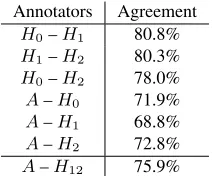
Table 1: Agreement between human and automatic anno-tators.
Table 1 shows the agreement between humans and the automatic annotator. While the agreement be-tween humans varies bebe-tween 78% and 81%, the agreement between human and automatic annotators varies between 69% and 73%. These results show that our automatic annotator is promising and could potentially achieve human levels of agreement with little improvement. In addition, the agreement with the more reliable annotatorH12is quite high at 76%.
2.5 The Difference Between Extracting and Evaluating Relations
The tasks of extracting relations from a corpus (e.g., New York Times) and evaluating relations using a corpus (e.g., the web) are virtually the same. How-ever, we stress how an evaluation process is per-formed in an easier scenario, thus more effective.
In order to measure precision, we judge a fact as correct or wrong by looking for mentions in the ex-ternal sources. This process is easier than extracting a fact: first, we already know the fact we are looking for; second, this fact is probably going to be repli-cated many times in several different ways, and so easy to spot. This is not true for a generic extraction process, where the fact may be published only once and in a particular difficult form.
sce-nario: in fact, to materialize the extracted data, we randomly generate facts, and then we filter out the ones that are not replicated anywhere else. Note that our system can hardly be used as an extraction sys-tem: we only validate facts already published some-where else, i.e., we do not generate any new infor-mation, that is the main goal of an extraction system; moreover, we require several additional information sources.
3 Comparing ReVerb and SONEX
We now use our evaluation method to compare two open RE systems: ReVerb and SONEX. The input corpus for this comparison is the New York Times corpus, composed by 1.8 million documents.
ReVerb (Fader et al., 2011) extracts relational phrases using rules over part-of-speech tags and noun-phrase chunks. It also employs a logistic re-gression classifier to produce a confidence score for each extracted fact; an extracted fact is only in-cluded in the output if above a user-defined thresh-old. SONEX (Mesquita et al., 2010) tries to find sets of entity pairs that share the same relation by cluster-ing them. SONEX uses a hierarchical agglomerative clustering algorithm (Manning et al., 2008).
3.1 Results
We run ReVerb with five different confidence thresh-olds (0.2, 0.4, 0.6, 0.8, 0.95) and report the output with highest F-measure (0.2 in our case). SONEX uses a user-defined threshold to stop the agglomera-tive clustering. We try five different thresholds (0.1, 0.2, 0.3, 0.4, 0.5) and report the output with highest F-measure (0.4 in our case). For each run, we ran-domly select 10 thousand facts from the output of each system. These are used to estimate the sizes of regionsaandb. We also randomly select 40 thou-sand facts fromG0to estimate the sizes ofcandd.
Reverb produced about 2.6 million facts, while SONEX produced over 3.2 million facts. We found about 63 million facts in G0, the superset of the ground truth G. Table 2 presents the size of all re-gions for ReVerb and SONEX. Note that Freebase (regions b and c) plays a minor role in this esti-mation when compared to PMI (regions a and d): more than 97% of the ground truth is defined by using PMI. This behaviour can be explained by the
Systems a b c d S D G0
[image:5.612.312.554.72.105.2]ReVerb 77 3 41 1,944 2,643 3,926 62,930 SONEX 259 4 40 1,763 3,288 3,926 62,930
Table 2: The size of all regions for ReVerb and SONEX, in thousands of facts.
Systems Precision Recall F-measure
ReVerb 3.1% 3.9% 3.4%
[image:5.612.341.511.160.194.2]SONEX 8.0% 12.8% 9.8%
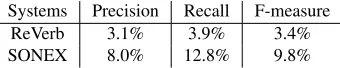
Table 3: Performance results for ReVerb and SONEX.
small number of facts with two entities with a cor-responding entry in Wikipedia: 1.6% for ReVerb, 0.9% for SONEX, 1.7% forG0. The importance of the external database may be higher for other cor-pora (e.g., Wikipedia) better covered by the database (e.g., Freebase).
Table 3 shows the precision, recall and F-measure for ReVerb and SONEX. Observe that SONEX achieves more than double the precision and recall presented by ReVerb; however both systems pre-sented low results. These results not only illustrate but also quantify the challenges of dealing with large corpora. Moreover, they underscore the pressing need for more robust and effective open RE tools. Finally, they yield a vast amount of incorrect extrac-tions, which are in turn an invaluable source of open problems in this field.
4 Conclusion and Future Work
This paper introduces the first automatic method for large-scale evaluations of open RE systems that es-timates true precisionandrecall. Our method scales to realistic-sized corpora with million of documents, instead of the few hundreds of previous evaluations.
References
Eugene Agichtein and Luis Gravano. 2000. Snowball: extracting relations from large plain-text collections.
InProceedings of the ACM Conference on Digital
li-braries, pages 85–94. ACM.
Michele Banko and Oren Etzioni. 2008. The tradeoffs between open and traditional relation extraction. In
Proceedings of the Annual Meeting of the ACL, pages
28–36, Columbus, Ohio, June. Association for Com-putational Linguistics.
Michele Banko, Michael J. Cafarella, Stephen Soderland, Matthew Broadhead, and Oren Etzioni. 2007. Open information extraction from the Web. InProceedings of the International Joint Conference on Artificial
In-telligence, pages 2670–2676.
Sergey Brin. 1998. Extracting patterns and relations from the world wide web. InThe World Wide Web and
Databases, International Workshop, pages 172–183.
Jinxiu Chen, Donghong Ji, Chew Lim Tan, and Zhengyu Niu. 2005. Unsupervised feature selection for rela-tion extracrela-tion. In Proceedings of the International
Joint Conference on Natural Language Processing.
Springer.
A. Doan, J. F. Naughton, A. Baid, X. Chai, F. Chen, T. Chen, E. Chu, P. Derose, B. Gao, C. Gokhale, J. Huang, W. Shen, and B. Vuong. 2009. The Case for a Structured Approach to Managing Unstructured Data. InProc. CIDR.
Oren Etzioni, Michael J. Cafarella, Doug Downey, Ana-Maria Popescu, Tal Shaked, Stephen Soderland, Daniel S. Weld, and Alexander Yates. 2005. Unsuper-vised named-entity extraction from the web: An ex-perimental study. Artif. Intell., 165(1):91–134. Anthony Fader, Stephen Soderland, and Oren Etzioni.
2011. Identifying Relations for Open Information Ex-traction. InEMNLP.
Takaaki Hasegawa, Satoshi Sekine, and Ralph Grishman. 2004. Discovering relations among named entities from large corpora. In Proceedings of the Annual
Meeting of the ACL, page 415. Association for
Com-putational Linguistics.
Marti A. Hearst. 1992. Automatic acquisition of hy-ponyms from large text corpora. InIn Proceedings of the 14th International Conference on Computational
Linguistics, pages 539–545.
Jay J Jiang and David W Conrath. 1997. Semantic similarity based on corpus statistics and lexical
taxon-omy. Computational Linguistics, cmp-lg/970(Rocling
X):15.
Christopher D. Manning, Prabhakar Raghavan, and Hin-rich Sch¨utze. 2008. Introduction to Information
Re-trieval. Cambridge University Press, 1 edition, July.
Filipe Mesquita, Yuval Merhav, and Denilson Barbosa. 2010. Extracting information networks from the blo-gosphere: State-of-the-art and challenges. In Proceed-ings of the Fourth AAAI Conference on Weblogs and
Social Media (ICWSM), Data Challenge Workshop.
Mike Mintz, Steven Bills, Rion Snow, and Daniel Juraf-sky. 2009. Distant supervision for relation extraction without labeled data. InACL-IJCNLP ’09: Proceed-ings of the Joint Conference of the 47th Annual Meet-ing of the ACL and the 4th International Joint Confer-ence on Natural Language Processing of the AFNLP:
Volume 2, pages 1003–1011, Morristown, NJ, USA.
Association for Computational Linguistics.
Benjamin Rosenfeld and Ronen Feldman. 2007. Clus-tering for unsupervised relation identification. In Pro-ceedings of the ACM Conference on Information and
Knowledge Management, pages 411–418. ACM.
Evan Sandhaus. 2008. The new york times annotated corpus. http://ldc.upenn.edu/Catalog/
docs/LDC2008T19.
Peter D. Turney. 2001. Mining the web for synonyms: Pmi-ir versus lsa on toefl. InProceedings of the 12th
European Conference on Machine Learning, EMCL
’01, pages 491–502, London, UK. Springer-Verlag. Dmitry Zelenko, Chinatsu Aone, and Anthony
Richardella. 2003. Kernel methods for relation extraction. J. Mach. Learn. Res., 3:1083–1106. Jun Zhu, Zaiqing Nie, Xiaojiang Liu, Bo Zhang, and