Finding Optimal Configuration of DSDV using
Particle Swarm Optimization
Sanjiv Sharma
Shobhit University Meerut, India
A. K. Giri
KIET Group of Institution Ghaziabad, India
Niraj Singhal
, PhD Shobhit UniversityMeerut, India
ABSTRACT
Vehicular Ad-hoc network (VANET) is prominent research area in Mobile ad-hoc network (MANET). VANET are very dynamic in nature as it has no predefined structure for communication. The performance of VANET dependents on parameter configuration of the protocol used in. The optimal parameter configuration in protocol can improve the QoS of VANET. Further, finding the optimal values of the parameters configuration is not easy because there is multiple combination of parameters configuration. Therefore, we have used particle swarm optimization technique, a metaheuristic, to find the optimal parameter configuration in real scenario. The result of experiment shows that there is 11.96% drop in average End to End Delay, 5.42% drop in Normalized Routing load and 5.74% gain in Packet Delivery based on the optimal configuration found against the default parameter configuration in DSDV.
Keywords
PSO, NS-2, DSDV.1.
INTRODUCTION
Vehicular Ad hoc Network (VANET) is one of the branches of MANET which requires no pre existing infrastructure and has dynamic nature in communication. This dynamic nature is because of its topology changing behavior. The topology changes very quickly because the movement of vehicles follows the road constraints and the range of communication of the vehicles are limited [1]. In such volatile network, it is difficult to achieve the good QoS of VANET in real scenario. The QoS depends on the parameters configuration of protocol being used in VANET for routing of messages. The parameter configuration, which may be different for different scenario, affects the QoS. The possible combinations of parameters configuration are huge and it is very difficult to find optimal parameters configuration for VANET which can improve the QoS of VANET. This motivates us to use metaheuristic [2] to find the optimal parameters configuration. Metaheuristic is used to find the optimal value from search space which has nature of combinatorial optimization problems. In our problem, we have taken particle swarm optimization technique.
There are very few applications of metaheuristic in VANET. E. Alba [3] has used Genetic Algorithm to find the optimal broadcasting strategy in MANET. Vanhatupa el. Al [4] has used flexible Genetic Algorithm for optimization of channel assignment in mesh wireless network. Di Caro [5] used Ant Colony Optimization for implementing new routing protocols for MANETs. Garcia-Nieto [6] has used five metaheuristic techniques Particle Swarm Optimization, Differential
Evolution, Genetic Algorithm, Evolution Strategy and Simulated Annealing algorithms for finding of optimal set of configuration parameter’s value to tune AODV automatically. Recently Huang [7] has proposed Particle Swarm optimization based new routing protocol to reduce packet loss rate in theoretical VANET scenario.
In this paper, we have tried to find out optimal parameters configuration of DSDV protocol using Particle Swarm Optimization (PSO). PSO is a population based stochastic optimization technique, inspired by social behavior of bird flocking or fish schooling. We have chosen this algorithm because of its suitability to our problem. The network simulator NS-2 [8] is used for evaluation of parameters configuration generated by PSO. PSO is guided by the fitness function which is formed based on ns-2 trace results. The real map of Ghaziabad UP India, has been taken so that evaluation of parameters configuration be realistic. Our experiments show that the produced parameters configuration of DSDV improves the QoS of VANET as compared to the default parameters configuration of DSDV.
The remaining of this paper is organized as follows. In section 2, DSDV protocol is introduced with its parameters. Section 3 consists of a framework of optimization strategy. Section 4 describes VANET scenario and mobility model being used. Experimental setup, mapping of problem into PSO, comparisons and result analysis are discussed in section 5. Finally section 6, discusses the conclusion and future work which can be carried out in this field.
2.
DSDV
Table1. DSDV parameter and its default value
Parameter Default
Value
Range
MAX_QUEUE_LENGTH 5 1 to 10
DSDV_STARTUP_JITTER 2.0 1 to 10
DSDV_ALMOST_NOW 0.1 0.1 to 1
DSDV_BROADCAST_JITTER 0.01 0.001 to 1
DSDV_MIN_TUP_PERIOD 1.0 1 to 10
IP_DEF_TTL 32 1 to 50
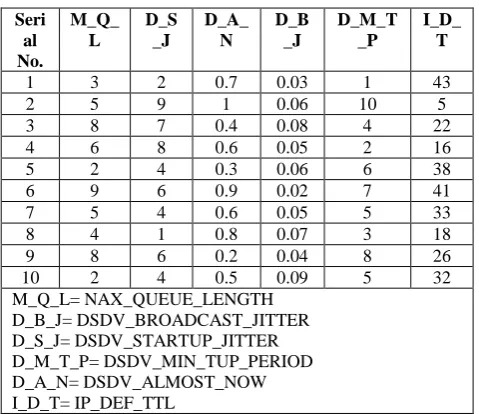
Despite all properties discussed above, there is variability in the performance of DSDV which is controlled by DSDV’s control parameters significantly. Further, finding the optimal values for parameters configuration and understanding their impact on protocol performance is difficult task. Table 1 shows the main parameters with default values and its range [9]. It is evident from the table there would be more than 229 possible combinations of parameters. Testing each set of parameter configuration in ns-2 is unfeasible. This situation motivates us to use some metaheuristic to solve this combinatorial optimization problem. There are huge combinations of parameters configuration values, only some sets of parameters are shown in Table2. These sets are called search space or solution vectors. In order to compare default and optimized DSDV parameter configuration, we have measured the resulted network performance (QoS) by considering following three metrics.
Packet Delivery Ratio (PDR): This is ratio of the number of packet received complete and correct by the destination and number of packets originated by the source.
Average End to End delay (AEED): This is average time consumed by data packet in travelling from source to destination.
[image:2.595.317.538.427.636.2]Normalized Routing Load (NRL): It is the average number of routing packets that are transmitted for delivery of one data packet.
Table 2. Search Space(Combination of Values of Parameters)
Seri al No.
M_Q_ L
D_S _J
D_A_ N
D_B _J
D_M_T _P
I_D_ T
1 3 2 0.7 0.03 1 43
2 5 9 1 0.06 10 5
3 8 7 0.4 0.08 4 22
4 6 8 0.6 0.05 2 16
5 2 4 0.3 0.06 6 38
6 9 6 0.9 0.02 7 41
7 5 4 0.6 0.05 5 33
8 4 1 0.8 0.07 3 18
9 8 6 0.2 0.04 8 26
10 2 4 0.5 0.09 5 32
M_Q_L= NAX_QUEUE_LENGTH D_B_J= DSDV_BROADCAST_JITTER
D_S_J= DSDV_STARTUP_JITTER D_M_T_P= DSDV_MIN_TUP_PERIOD
D_A_N= DSDV_ALMOST_NOW I_D_T= IP_DEF_TTL
3.
FRAMEWORK OF OPTIMIZATION
Our framework of optimization consists of two parts one is an optimization algorithm and other is solution evaluation as shown in Figure 1. In optimization algorithm, 10 sets of solution vector (also called new population) is generated by PSO and used in simulation for performance evaluation. With the help of fitness function in equation (1) [6], PSO tries to find out an optimal parameters configuration in the search space (solution vector). After receiving a population from PSO, the simulation model passes one by one solution (values of parameters configuration) into DSDV. Now ns-2 takes VANET realistic instance, simulation parameters as shown in Table 3 and configures accordingly.
We have modified ns-2 in such a manner so that it can accept population from PSO automatically. After simulation, ns-2 produces global information known as simulation trace. With this information we calculate Packet Delivery Ratio (PDR), Average End-to-End Delay (AEED) and Normalized routing Load (NRL) of the whole mobile scenario. These three metric are used in calculation of the fitness function as follows [6]. Fitness = w1NRL+w2AEED-w3PDR (1)
From the equation it can be seen that PDR is used with negative sign so that PDR gets priority over others. The purpose of this equation is to maximize PDR and other two NRL and AEED is to be minimized. This equation is aggregate minimization function and weights w1, w2, and w3
(0.3, 0.2 and 0.5 respectively) are used to weigh the effect of each QoS parameters on the fitness value.
Table 3. Simulation Parameters for VANET
Parameters Value
Simulation time 3 Minutes Simulation area 1000X1000 m2 Number of vehicles 30 Vehicles
Vehicle speed 0-50 km/hr
Propagation model Two Ray Ground
Radio frequency 2.47GHz
Channel bandwidth 2Mbps
Mac protocol Mac/802_11
Transmission range of vehicles 250m
[image:2.595.48.288.556.763.2]Figure 1: The optimization framework DSDV using PSO. PSO invokes the ns-2 simulator for each solution evaluation.
4.
VANET SCENARIO AND MOBILITY
MODEL
Since generation of an actual VANET scenario needs a large number of resources and people, we have used traffic/ network simulator to generate movement of vehicles as well as communication activity. With the help of digital map available [9] we have generated a realistic VANET environment. In this map we have considered actual road direction, signal lights, and traffic rules.
Figure. 2. Ghaziabad [9] Real VANET Scenarios. The maximum selected Area is 1000 X 1000 m2.
For the simulation we selected a real map of Ghaziabad UP India (1000 X 1000 m2) using Java OpenStreetMap editor (JOSM) [10]. Then map is converted into SUMO supported format with the help of netconvert [11]. The map of the area referenced in simulation is shown in Figure 2. On this map we have generated traffic in terms of number of vehicles, connection, turn and flows. The output of SUMO simulator is tcl script, which works as input for ns-2 simulator. In this simulation CBR is used as network application and UDP as source agent in vehicles. The packet size of CBR is 1000 bytes and bit rate is 64 kb per second. In this simulation we performed 15 sessions.
5.
EXPERIMENTAL SETUP
The PSO algorithm is implemented in C++. To integrate PSO with ns-2, we have used shell programming. For experiment, we have made 50 independent run of PSO on machine with Pentium IV, 2.4 GHz core, 2Gb RAM, and Linux Ubuntu 12.05 LTS. For the generalization of the result each independent run performed different communication pattern and vehicular mobility.
5.1 Problem mapping into PSO
PSO Algorithm [11]Input: 10 sets of 6 parameters value
Output: Optimized 10 sets of 6 parameters value Begin:
1. Initialize a population array of particles with random positions and velocities on D dimensions in the search space.
2. loop
a. For each particle, evaluate the desired optimization fitness function in D variables. b. Compare particle's fitness evaluation with its
pbesti. If current value is better than pbesti,
then set pbesti equal to the current value, and
pi equal to the current location xi in the
D-dimensional space.
[image:3.595.58.278.486.598.2]d. Change the velocity and position of the particle according to the equations in 2 and 3. vi = vi + U(0, ϕ1) ⊗ (pi-xi) + U(0, ϕ2) ⊗
(pg-xi) (2)
xi = xi + vi (3)
e. If a criterion is met, exit loop. 3. end loop
End
Modified PSO according to our Problem
Begin
1. Initialize the population as 10 random sets of 6 parameters. Here search dimension is 6. Where i=1, 2, 3…10.
2. Loop
a. Value of the fitness function of 10 sets (xi)
is evaluated by ns-2 in the form of communication cost (ci) as mentioned in
figure1. Where i=1, 2, 3, …10.
b. In first generation, value of pbesti is equal
to communication cost (ci) and pi is set to
xi. The xi denotes the current position of
ith set in 6 dimension search space. For successive generations the fitness value ci
for xi is comparedwith pbesti. If ci is better
than pbesti, set pbesti equal to ci and pi
equal to the current location xi in the
6ndimentional space. Where i= 1, 2, 3,…10.
c. The value of i corresponding to minimum pbesti is selected and assigned to g.
d. The initial velocity of first generation is set to zero. The successive velocity and position are calculated according to equation 2 and 3 respectively. The value of ϕ1 and ϕ2 is setequal to 2. The symbol
⊗ denotes the component wise multiplication. U(0,ϕk) represents a
random number between 0 and ϕk. Where
k=1,2.
e. Here condition is checked to terminate the loop after evaluating 50 successive generations.
3. The loop terminates after successful evaluation of 50 generations.
End
5.2 Result Analysis
Above experiment is conducted for 10 different seed values on the map. PSO has been performed for 50 iteration or generation and it gives a solution corresponding to each seed. Now, out of 10 solutions on different seed, we have taken best solution along with default parameters of DSDV which is shown in table 4.
Table 4. Optimized and default value of parameters
Parameter Default
Value
Optimal value
MAX_QUEUE_LENGTH 5 3
DSDV_STARTUP_JITTER 2.0 1
DSDV_ALMOST_NOW 0.1 1
DSDV_BROADCAST_JITTER 0.01 1
DSDV_MIN_TUP_PERIOD 1.0 3
IP_DEF_TTL 32 18
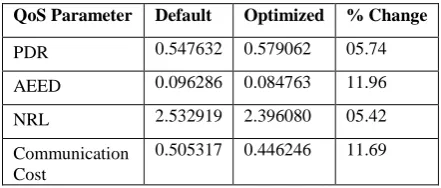
[image:4.595.318.539.412.506.2]A comparative analysis of different QoS parameters is shown in Table 5. It is evident from the table that there is 5.74% increment in PDR, 11.96% drop in AEED, 5.42% drop in NRL and 11.69% drop in communication cost.
Table 5. Comparative analysis of different QoS parameters
QoS Parameter Default Optimized % Change
PDR 0.547632 0.579062 05.74 AEED 0.096286 0.084763 11.96 NRL 2.532919 2.396080 05.42 Communication
Cost
0.505317 0.446246 11.69
6.
CONCLUSIONS & FUTURE WORK
7.
REFERENCES
[1] H¨arri, J., Filali, F., Bonnet, C.: Mobility Models for Vehicular Ad Hoc Networks: A Survey and Taxonomy. Research Report RR-06-168 (March 2007).
[2] Blum, C., Roli, A.: Metaheuristics in combinatorial optimization: Overview and conceptual comparison. ACM Computing Surveys 35(3), 268–308 (2003) [3] E. Alba, B. Dorronsoro, F. Luna, A. Nebro, P. Bouvry,
and L. Hogie, “A Cellular MOGA for Optimal Broadcasting Strategy in Metropolitan MANETs,” Computer Communications , vol. 30, no. 4, pp. 685 – 697, (2007)
[4] Vanhatupa, T., H¨annik¨ainen, M., H¨am¨al¨ainen, T.: Optimization of mesh WLAN channel assignment with a configurable genetic algorithm. In: WiMeshNets 2006 (2006)
[5] Di Caro, G.A., Ducatelle, F., Gambardella, L.M.: AntHocNet: An Adaptive Nature-Inspired Algorithm for Routing in Mobile Ad Hoc Networks. European Transactions on Telecommunications 16(5), 443–455 (2005)
[6] Garc a-Nieto, J. Toutouh, and E. Alba, “Automatic Parameter Tunning with Metaheuristics of the AODV Routing Protocol for Vehicular Ad-hoc Networks,” EvoApplications, part II. LNCS 6025, pp. 21-30, 2010. [7] Huang, C., Chuang, Y., Hu, K.: Using particle swarm
optimization for QoS in ad-hoc multicast. Eng. Appl. of Artificial Intelligence (2009) (in Press)
[8] Perkins, C.E., Bhagwat, P.: Highly Dynamic Destination-Sequenced Distance-Vector Routing (DSDV) for Mobile Computers. In: ACM SIGCOMM 1994, London, UK, pp. 234–244 (1994)
[9] ©OpenStreetMapcontributors(www.openstreetmap.org/c opyright).
[10] Java OpenStreetMap editor," [online] http:// josm. openstreetmap.de
![Figure. 2. Ghaziabad [9] Real VANET Scenarios. The maximum selected Area is 1000 X 1000 m2](https://thumb-us.123doks.com/thumbv2/123dok_us/8030862.768718/3.595.103.497.71.313/figure-ghaziabad-real-vanet-scenarios-maximum-selected-area.webp)