5
IV
April 2017
Magnitude and Phase Response of Low Pass Fir
Filter Using Rectangular, Blackman, Hanning &
Bartlett Window Techniques
Sumit Chakravorty 1, Pooja Pandey 2, Pranay Kumar Rahi3
1, 2
B.E. Scholar, 3Assistant Professor, Department of Electrical & Electronics Engineering Institute of Technology Korba, Chhattisgarh, India.
Abstract: a digital signal processing is a main branch of electronics. It is concerned with the representation by sequence of number or symbol and the processing of these signals. Dsp have many more applications which are useful in our life i.e. Telecommunication, image processing, speech processing, medical diagnostic instrumentation and signal filtering etc. Signal filtering is the most important application of dsp. In this process we can remove all the unwanted background noise and interference. In this paper we are concentrating on low pass fir filter design by using rectangular, blackman, hanning and bartlett window techniques. By the comparative analysis of all the window technique we conclude that, rectangular window technique possess the better magnitude and phase response as when compared with blackman, hanning and bartlett window technique.
Keywords: dsp, digital filter, fir filter, hanning, blackman, rectangular, matlab.
I. INTRODUCTION
Signals play a major role in our life. In general, a signal can be function of time, distance, position, temperature, pressure, etc, and it represents some variable of interest associated with a system. For example, in an electrical system the associated signals are electric current and voltage. In a mechanical system, the associated signal may be force, speed, torque etc. In addition to these, some examples of signals that we encounter in our daily life are speech, music, pictures and video signals. A signal can be represented in a number of ways. Most of the signals that we come across are generated naturally. However, there are some signals that are generated synthetically. In general, a signal carries information, and the objective processing is to extract this information.
Signal processing is a method of extracting information from the signal which in turn depends on the type of signal and the nature of information it carries. Thus signal processing is concerned with signals in mathematical terms and extracting the information by carrying out the algorithmic operations in the signal. Mathematically, a signal can be represented in terms of basic function in the domain of the original independent variable or it can be represented in terms of basic functions in a transform domain. Similarly, the information contained in the signal can also be extracted either in the original domain or in the transform domain [5].
Most signals we encounter are generated by natural means. However, a signal can also be generated synthetically or computer simulation. A signal carries information, and the objective of signal processing is to extract useful information carried by the signal. The method of information extractions depends on the type of signal and the nature of the information being carried by the signal. Thus, roughly speaking signal processing is concerned with the mathematical representation of the signal and the algorithmic carried out on it to extract the information present. The representation of the signal can be in terms of basic functions in the domain of the original independent variable(s), or it can be in terms of basis function in a transform domain. Likewise, the information extraction process may be carried out in the original domain of the signal or in transform domain [2].
There are two major types of digital filters are
A. Infinite Impulse response (IIR) filters
B. Finite Impulse response (FIR) filters.
Technology (IJRASET)
II. WINDOW TECHNIQUE
Most digital signals are infinite, or sufficiently large that the data set cannot be manipulated as a whole. Sufficiently large signals are also difficult to analyze statically, because statistical calculation require all points to be available for analysis. In order to avoid these problems, engineers typically analyze small subsets of the total data, through a process called windowing. The window design method does not produce filters that are optimal (in the sense of meeting the design specifications in the most computationally efficient fashion), but the method is easy to understand and does produces filters that are reasonably good. Off all the hand design methods the window method is the most popular and effective [7].
A. Rectangular Window
The rectangular window (sometimes known as the boxcar or Dirichlet( window) is the simplest window, equivalent to replacing all but N values of a data sequence by zeros, making it appear as though the waveform suddenly turns on and off:
Other windows are designed to moderate these sudden changes, which reduces scalloping loss and improves dynamic range. The rectangular window is the 1st order B-spine window as well as the 0th power cosine window [4].
WR (n) =
1 | |≤
0 , ℎ ... (1) B. Blackman Window
Blackman windows are defined as:
By common convention, the unqualified term Blackman window refers to α = 0.16, as this most closely approximates the "exact Blackman", with a0 = 7938/18608 ≈ 0.42659, a1 = 9240/18608 ≈ 0.49656, and a2 = 1430/18608 ≈ 0.076849.These exact values
place zeros at the third and fourth side lobes [4].
W (n) = a0-a1cos +a2cos ... (2)
Where;
a0=
a1=
a2= [8]
C. Hanning Window
The window function of a causal hanning window is given by WHann(n)=0.5−0.5 2 −1... (3)
Where; 0 ≤ n ≤ M-1
D. Bartlett Window
In Bartlett window technique the pass band and stop band ripples are occurs & we get sampling frequency by the help of this window technique. We can calculate the order of filter and find the filter coefficient
wBart=
1 + ,− < < 1
1− , 1 < <
III. DESIGN SIMULATION
Table 1.1 Filter parameters and value
PARAMETER VALUE(Hz)
Sampling frequency(fs) 48000
Fig 1.1 Magnitude Response of Rectangular Window Technique.
Fig 1.2 Magnitude Response of Blackmann Window Technique.
Fig 1.3 Magnitude Response of Hanning Window Technique.
Fig 1.4 Magnitude Response of Bartlett Window Technique.
Technology (IJRASET)
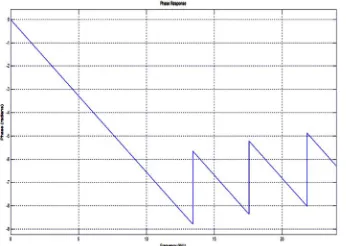
Fig1.6 Phase Response of Blackmann Window Technique.
Fig1.7 Phase Response of Hanning Window Technique.
Fig1.8 Phase Response of Bartlett Window Technique.
Fig 1.9 Filter Coefficients for Rectangular Window Technique.
Fig 1.11 Filter Coefficients for Hanning Window Technique.
Fig 1.12 Filter Coefficients for Bartlett Window Technique.
Fig1.13 Time Domain & Frequency Domain of Rectangular Window.
Technology (IJRASET)
Fig1.15 Time Domain & Frequency Domain of Hanning Window.
Fig1.16 Time Domain & Frequency Domain of Bartlett Window.
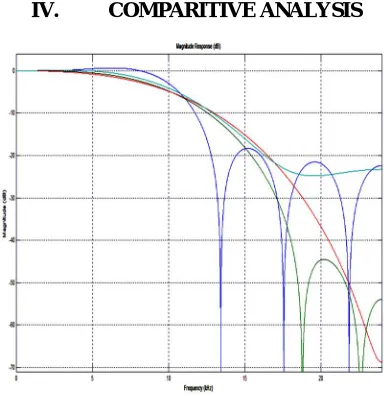
IV. COMPARITIVE ANALYSIS
[image:7.612.208.400.338.536.2]Chart 1.1 Magnitude and Frequency plot of Rectangular Window Technique.
Chart 1.2 Magnitude and Frequency plot of Blackman Window Technique.
Chart 1.3 Magnitude and Frequency plot of Blackman Window Technique.
-4 -3 -2 -1 0 1
1 3 5 7 9
M ag n it u d e (i n d B )
Frequency (in kHz)
Rectangular Window Technique -6 -5 -4 -3 -2 -1 0
1 3 5 7 9
M ag n it u d e (i n d B )
Frequency (in kHz)
Blackman Window Technique -6 -5 -4 -3 -2 -1 0
1 3 5 7 9
M ag n it u d e (i n d B )
Frequency (in kHz)
Technology (IJRASET)
Chart 1.4 Magnitude and Frequency plot of Bartlett Window Technique.
[image:9.612.198.418.81.229.2]V. RESULT
Table 1.2 Simulation results from MATLAB.
Window technique Relative side lobe attenuation Main lobe width (-3dB) Leakage factor Rectangul
ar window -13dB 0.1718 0% Blackman
window -64.6dB 0.3598 9.2% Hanning
window -31.8dB 0.3125 0.04% Bartlett
[image:9.612.188.429.505.724.2]window -25.8dB 0.2812 0.29%
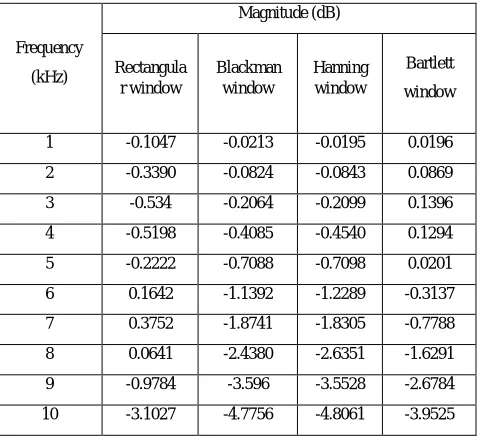
Table 1.3 Magnitude and Frequency results of Rectangular Blackman and Hanning Window Technique.
Frequency (kHz) Magnitude (dB) Rectangula r window Blackman window Hanning window Bartlett window
1 -0.1047 -0.0213 -0.0195 0.0196
2 -0.3390 -0.0824 -0.0843 0.0869
3 -0.534 -0.2064 -0.2099 0.1396
4 -0.5198 -0.4085 -0.4540 0.1294
5 -0.2222 -0.7088 -0.7098 0.0201
6 0.1642 -1.1392 -1.2289 -0.3137
7 0.3752 -1.8741 -1.8305 -0.7788
8 0.0641 -2.4380 -2.6351 -1.6291
9 -0.9784 -3.596 -3.5528 -2.6784
-5 -4 -3 -2 -1 0 1
1 3 5 7 9
M ag n it u d e (i n d B )
Frequency (in kHz)
48000 Hz and cut-off frequency (fc) 10800 Hz.
VI. CONCLUSION
In this research paper Low pass FIR filter has been designed using MATLAB Rectangular, Blackman, Hanning and Bartlett window technique. It concludes by comparative analysis of these designed filter are compared in respect of magnitude and phase response for the same frequency i.e.
fs=48000Hz and fc=10800Hz.
In first window technique i.e. Rectangular window shows better and sharp magnitude response in pass band region with some unwanted frequency component in th form of ripples.
In second window technique i.e. Blackman window shows lesser magnitude response as compared to Rectangular, Hanning and Bartlett window technique and having no ripples in stop band region.
In third window technique i.e. Hanning window shows moderate magnitude response in pass band region and lesser attenuation in compared with Rectangular window.
In context of above it concluded Rectangular window technique posses the better magnitude and phase response as when compared with Blackman, Hanning and Bartlett window technique.
REFRENCES
[1] Alan V. Oppenheim and Ronald W. Schafer “Digital Signal Processing” Eastern Economy Edition [2] Sanjit K Mitra “Digital Signal Processing” 3rd Special Indian Edition.
[3] S. Salivahanan & C. Gnanapriya “Digital Signal Processing” 2nd edition Mc. Graw Hill publications
[4] https://en.wikipedia.org/wiki/Window_function [5] Pooja Pandey, Sumit Chakravorty, Durgesh Sahu “Magnitude and Phase Response of Low Pass FIR filter using Rectangular and Blackman Window Techniques” IJISET , Vol. 3 Issue 8, August 2016 ISSN (Online) 2348 – 7968.
[5] Math works, “Users Guide Filter Design Toolbox 4”, March-2011.
[6] Sumit Chakravorty, Pooja Pandey, Shaswat Vohra, Mukesh Chandra, Pranay Kumar Rahi “High Pass FIR filter Design and Performance Analysis using Rectangular and Blackman Window Techniques” IJISET , Vol. 3 Issue 8, August 2016 ISSN (Online) 2348 – 7968.
AUTHORS
Sumit Chakravorty pursuing Bachelor of Engineering in Electrical & Electronics Engineering in 6th semester from Institute of Technology, Korba, affiliated from Swami Vivekanand Technical University, Chhattisgarh, India. He has authored two international research paper in IJISET - International Journal of Innovative Science, Engineering & Technology.
Pooja Pandey pursuing Bachelor of Engineering in Electrical & Electronics Engineering, in 6th semester from Institute of Technology, Korba, affiliated from Swami Vivekanand Technical University, Chhattisgarh, India. She has authored two international research paper in IJISET - International Journal of Innovative Science, Engineering & Technology.