2017 2nd International Conference on Artificial Intelligence and Engineering Applications (AIEA 2017)
ISBN: 978-1-60595-485-1
Simulation Analysis of OFDM System Demodulation
Algorithm Based on Hierarchical Decision Feedback
TAO WEI
ABSTRACT
According to the problem that the channel is very sensitive to intersymbol interference of multipath propagation and decline feature for orthogonal frequency division multiplexing(OFDM) system on the receiver, which seriously affects the quality of communication. A hierarchical decision feedback equalization algorithm is proposed based on the analysis of spatial diversity and frequency diversity. The algorithm based on subcarrier and each antenna signal is detected by hierarchical frequency domain equalization method until all signals on the antenna are detected, and then MMSE is used to detect the best subcarrier of the signal. The simulation results show that the proposed layered detection technology can effectively improve the performance of the communication system.
KEYWORDS
OFDM, decision feedback equalization, frequency domain hierarchical detection
INTRODUCTION
In modern communication systems, Intersymbol interference (Inter-Symbol Interference, ISI) caused by multipath fading and channel distortion makes the transmission signal distorted and generates error code at the receiver, which seriously affects the quality of communication. Traditional equalization techniques need to periodically transmit training sequences, which consume limited bandwidth resources. The layered equalization techniques do not need to send the known training sequences, which can detect the signal of the antenna through the layered iterative technique, and can save the bandwidth and improve communication efficiency. In order to counteract the effect of channel distortion, Many researches have been carried out to deal with signal fading problems. One of the effective methods is utilized by the equalizer, which can be designed by completely opposite to the channel characteristic through equalization technique in the Refs. [1-3]. and the SNR is improved or signal can be eliminate fading with the introduction of space diversity in Refs. [4]. in Refs [5], the iterative equalization problem for MIMO system is discussed, but the closed-form expression for the feedforward coefficients and the feedback coefficients of equalization is not obtained. In the space diversity receiving system, the signals arriving at the array must be independent of each other.
_________________________________________
Multiple antennas are used to receive signals to overcome the spatial deep fading of the signal arriving at the receiver in Refs. [6], Adaptive equalization technique can effectively overcome the influence of intersymbol interference in Refs.[7-8], but the error rate of data detection is also high when the SNR of receiver is low. Thus, the independent adaptive equalization technology is affected by channel fading. Spatial diversity and frequency diversity techniques widely used in radio communications are used to transmit digital information detection in Refs [9-10], which combined with the judgment feedback equalizer to improve SNR. Therefore, On the basis of combining the maximum ratio space diversity technique, frequency domain diversity technique and decision feedback equalization technique, we propose a new approach which is a hierarchical decision feedback for OFDM system detection algorithm. Finally, simulation results show that the proposed algorithm can not only find the antenna with good signal quality quickly, but also have low bit error rates, which is an effective feedback decision algorithm.
SYSTEM MODEL
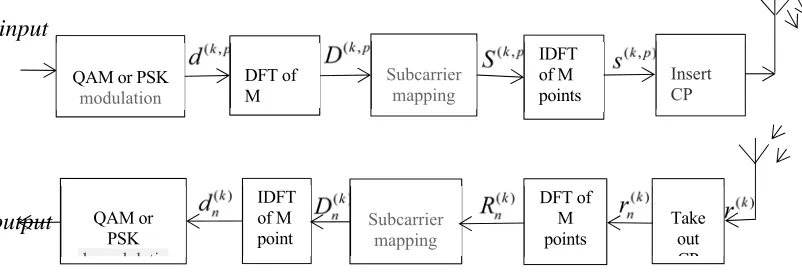
The baseband OFDM system model is shown in Fig.1. At the transmitter, The serial input data is serialized and converted into a set of parallel data streams, and then the modulation symbols are obtained by baseband PSK modulated or QAM modulation, which forms the original time domain transmission vector (k,p)
d . The vector is
transmitted to the frequency domain (k,p)
D after the DFT transform of the M point. and
then the frequency domain transmission vector of the transmitting antenna is formed after subcarrier mapping in the frequency domain. The time domain vector (k,p)
s is
obtained by transforming the signal into the time domain with M point IDFT transform, then the signal in the time domain before sending the symbol vector is inserted the CP. After that, the signal is sent from the antenna. At the receiver, the signal vector in the frequency domain (k)
n
[image:2.612.93.494.527.666.2]R is obtained after performing DFT transform of M point and carrying out subcarrier solution mapping. After demodulation, the sequence is restored. For the MIMO-OFDM systems. In multipath transmission, the superposition of the signals at the receiver is superimposed by malformed signals because of the interference.
Figure 1. OFDM system model based on Frequency domain equalization.
QAM or PSK
modulation
DFT of M
Subcarrier mapping
Insert CP
IDFT of M points
QAM or PSK
d d l ti
IDFT of M
point Subcarrier mapping
Take out CP DFT of
M points input
Figure 2. Processing of hierarchical decision feedback balanced at receiver.
HIERARCHICAL DECISION FEEDBACK ALGORITHM
It can be seen that the frequency domain signal of the system is equivalent to multiple antenna multiplexing on each orthogonal subcarrier in Fig. 1. Therefore, the MIMO frequency domain equalization technique as the subcarrier as the unit can be used to detect in the equalization process of the receiver. The basic idea of hierarchical linear frequency domain equalization is that it is detected by dividing the signal intop
layer. When p(1 pP)layer signal is detected, the best performing transmitting antenna in the undetected transmit antenna signals are selected for signal detection firstly, and then the influence of the transmit antenna is subtracted from the original received signal. After that, the reception channel is updated for detection withp1layer signal, until all signals on the transmitting antenna are detected. Frequency domain is equalized by using the layered MMSE and the signals are demodulated after balance. Finally, the bits sequence of the original sending are restored. The structure of the feedback decision equalizer is shown in Fig. 2.
In Fig.2 , it is assumed that pk t k t k t k T
l l
l
l) [ p (), p (), , P ()]
( ( ,) ( , ) ( ,)
) ,
( 1
, which
represents the equivalent MIMO channel matrix of the p(1 pP) layer on the
) 1 1
( lQ
l subcarrier of the kuser, andR(p,k)represents the equivalent reception
vector of the player of thekuser. when the first layer of thelsubcarrier of thekuser is detected. The equivalent MIMO signal matrix can be denoted as
T k t k
t k t k
l H l H l H
l) [ ( ), ( ), , P ()]
( ( , ) ( , ) ( , )
) , 1
( 1 2
(1)
And equivalent receive signal vector can be represented as
) (
) ( )
, 1 (
l R l
R k() k (2)
The first iteration
Update the received signal and the channel matrix
Feedforward filter M points DFT
M points IDFT
Feedback filter
) , 1 ( 1
k
it can be seen from Fig.2 that judgment feedback equalization of the p(1 pP) layer of thekuser include feedforward frequency domain equalizer and feedback time domain equalizer. It is assumed that the feedforward frequency domain equalization filter vector on the first subcarrier of the first layer of the user can be given by
)] ( , ), ( ), ( [ ) ( ( , ) ( , ) 2 ) , ( 1
, l W l W l W l
W pk
N k p k p k
p )
( (3)
The feedback time domain equalization filter coefficients can be given by
) )]( ( , ), ( ), ( [ ) ( ( , ) ( , ) ( , ) 2 ) , ( 1 ) ,
( kp
B k p P k p k p k p F i i f i f i f i
f (4)
In this case, (kp)
B
F , represents the feedback filter order collection of the p
transmitting antenna of thekuser. There areiBorders. it is assumed that the player
detects the signal of the tptransmission antenna, and theqoutput signal of the player of thekuser after the hierarchical decision feedback equalization can be expressed as
Q l k p k t k t F i k t k t k t k t Q lq j l R l W Q q y i q d i f q y q d p p k p t B p p p p 0 ) , ( ) , ( ) , ( ) , ( ^ ) ( ) , ( ) ( ~ ) 2 exp( ) ( ) ( 1 ) ( ) ( ) ( ) ( ) ( ) , ( , , (5)
Where ( , )( ) [ 1( ,)(), 2( ,)( ), , ( ,)( )] l R l R l R l
R pk pk pk Npk , which is the receiving signals of the
player on thelsubcarrier of thekuser, and T
k P k k k q d q d q d q
d ( ) [ ( ), ( ), , ( )]
) , ( ^ ) , 2 ( ^ ) , 1 ( ^ ) ( ^
is theq
decision signal vector. When theplayer is detected, the feedforward frequency domain
equalization filter vector on the l subcarrier of the kuser can be expressed as
P p j N k t k t k t k p k t I l l l l F l W j j p p 2 * ) , ( ) , ( * ) , ( ) , ( ) , ( )] ( )[ ( )] ( )[ ( ) ( (6)Where t k T
N k t k t k t l l l
l j j j
j ( ) [ (), ( , )(), , ( , )()]
2 ) , ( 1 ) , (
, Which is the MIMO channel
vector for the l subcarrier of the tjantenna for the luser of theplayer, and feedback filter aggregate function can be expressed as
) , ( ) 2 exp( ) ( 1 ) ( ( , ) , p k B F i k p K P Q il j i f lF( ) (7)
When the player is detected, the feedback time-domain equalization filter vector
) ( ) , ( i
f pk of theptransmission antenna of the k user can be deduced as ) , ( ) , ( ) ,
(pk p k pk
v
f
Where T k p i k p i k p i k p T B k p k p k p k p k p B k p k
p v v
v v i f i f i f f ] , , , [ ] )] ( [ , , )] ( [ , )] ( [[ ) , ( ) , ( ) , ( ) , ( * ) , ( * 2 ) , ( * 1 ) , ( ) , ( ) , ( ) , ( 2 ) , ( 1 (9)
And feedback filter coefficients can be written as
) , ( 0 ) , ( ) , ( ) , ( 0 ) , ( ) , ( ) , ( ) , ( 0 ) , ( , , , , , , , ) , ( 1 ) , ( ) , ( ) , ( 2 ) , ( 1 ) , ( 2 ) , ( ) , ( 1 ) , ( 2 ) , ( 1 k p k p i i k p i i k p k p i i k p i i k p i i k p k p v v v v v v v v V k p k p B k p B k p k p k p k p B k p k p k p (10)
The signal from the tp transmitting antenna on the lsubcarrier of thek user is equalized by the equation (8), and then (tp,k)
D is converted to time domain (tp,k)
d through
normalized M point IDFT. The signal d(tp,k)(q)on the transmission antenna p
t of the
userkis obtained by hard decision, and updating the received signal R(p1,k)(l)and the channel matrix ( 1, )( )
l
k p
on the lsubcarrier of the kuser. Then the time domain signal
) , (tpk
d is demodulated to recover the original sending information bit sequence. Finally,
the signal of all antennas is found by iterative calculation, and the antenna with the strongest signal is found, which ensures that each sub-carrier of the receiver demodulation is the best one in the same amount of information, so as to decrease or eliminated the noise and the S/N is improved.
SIMULATION RESULTS
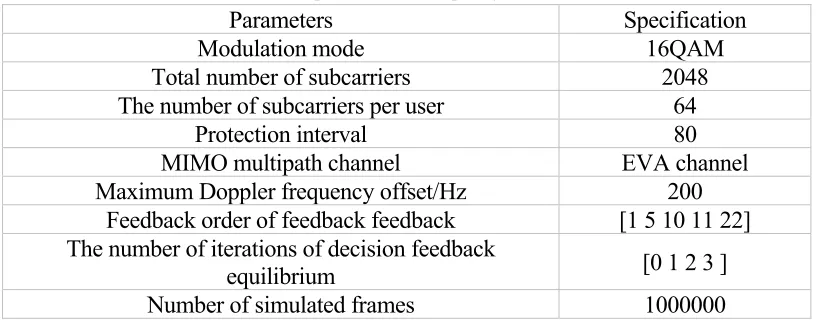
[image:5.612.94.502.562.725.2]In order to verify the validity of the proposed algorithm, the corresponding simulation experiments is carried by software Matlab .The main parameters of the system are shown in Table 1.
Table 1. Simulation parameters of frequency domain balanced receiver.
Parameters Specification
Modulation mode 16QAM
Total number of subcarriers 2048
The number of subcarriers per user 64
Protection interval 80
MIMO multipath channel EVA channel
Maximum Doppler frequency offset/Hz 200
Feedback order of feedback feedback [1 5 10 11 22]
The number of iterations of decision feedback
equilibrium [0 1 2 3 ]
In this paper, we mainly consider 2×2 and 4×4 MIMO–OFDM systems, where NT
× NR = 2 × 2 or NT × NR = 4 × 4. The gold code is selected to generate the
pseudo-noise codes used in the proposed training sequence arrangement with the spreading factor equal to 1. The corresponding results are shown in Fig. 3. With increasing in SNR, the MSE of the three kinds of methods are all gradually reduced. Compared with the ZF method, the proposed method with a finer delay grid enjoys superior performance in over all SNR ranges. Fig.4 shows the BER performance of the three kinds of detection methods. It can be seen the BER performance shows a similar trend with the MSE performance. More space diversity gain can be obtained because the hierarchical receiver using the optimal sorting interference cancellation method. With the increase in the number of antennas, the performance gain of the hierarchical decision feedback equalizer is more pronounced.
Figure 3. The algorithm MSE comparison(22).
Figure 4. The algorithm BER comparison (44).
0 2 4 6 8 10 12 10-1
100
SNR/dB
ME
R
ZF
Normal MMSE Proposed method MMSE
-10 -5 0 5 10 15 10-6
10-5 10-4 10-3 10-2 10-1 100
SNR-dB
BE
R
ZF
CONCLUSION
In this paper, a new algorithm based on hierarchical decision feedback is proposed, which uses the combination of spatial diversity and frequency diversity. The best signal corresponding to the antenna is found out based on layered processing with Sub-carrier and the principle of feedback decision. Simulation results show that The algorithm proposed in this paper can effectively improve the system noise suppression ability.
ACKNOWLEDGEMENTS
This work was supported by the Young Teachers' Basic Ability Improving Project of Guangxi (KY2016LX342), the Scientific Research Technology Project of Guangxi University (KY2015ZD118).
REFERENCES
1. Givens M. Enhanced-convergence normalized LMS algorithm [J]. IEEE Signal Processing Magazine, 2009, 26(3): 81-82,95.
2. M.S. Alfiad, D. van den Borne, M. Kuschnerov, et al. FFE,DFE and MLSE equalizers in phase modulated transmission systems. Proc. of the 22nd Annal Meeting of the IEEE Lasers and Electro-Optics Society, 2009: 193–194.
3. R. Nabar, H.B. Olcskei, "Fading relay channels: performance limits and space-time signal design" IEEE J. Sel. Areas Commun., vol. 22, no. 6, pp. 1099-1109, Aug. 2004.
4. Zhu Y., Letaief K.B. Single carrier frequency domain equalization with time domain noise prediction for wideband wireless communications. IEEE Transactions on Wireless Communications, 2006, 5(12): 3548-3557.
5. Guvensen, G.M., Yilmaz, A.O. A General Framework for Optimum Iterative Blockwise Equalization of Single Carrier MIMO Systems and Asymptotic Performance Analysis. IEEE Transactions on Communications, 2013, 61(2): 609–619.
6. Shuling Che; Peng Wang; Li Ping; Xinmei Wang. Low-complexity soft-input soft-output demodulation of orthogonal modulation. IEEE Communications Letters, 2007, 11(12): 919-921. 7. W Shieh. Maximum-likelihood phase estimation and channel estimation for coherent optical OFDM
[J]. Photon Echnol Lett, 2008, 20(8): 605-607.
8. Xu Jin-biao, Wang Yu-min, Du Li-min. Blind maximum likelihood sequence estimation with decision feedback [J]. Acta Electronica Sinica, 1999, 27(4): 47-50.
9. C. Zhang, Z.C. Wang. Low-complexity iterative frequency domain decision feedback equalization. IEEE Trans. on Vehicular Technology, 2011, 60(3): 1295–1299.