Finding Meanings for ‘Faith in Development’: An Examination of
the Applied Theology of World Vision and Its Broader Implications
for the Development Sector and Practice
By
Robert Mitchell
LLB, MPhil, Grad Dip Tax, Grad Dip Theol, MThSt
A thesis submitted in fulfilment of the requirements for the degree of
Doctor of Philosophy
University of Divinity
May 2014
Abstract
Key words: Applied theology – international development – organisational theology – meaning of faith in development – World Vision – Qualitative analysis of evaluation reports and interviews – revelatory case study – grounded theory – implications for sector and development practice – risks of church engagement.
This research in applied theology articulates the key theological motifs of a leading international development organisation, World Vision. A revelatory case study was undertaken using largely qualitative research techniques to assess how these motifs were reflected in the organisation’s development work and practice. A corpus of evaluation reports and interview transcripts were provided by World Vision which related to the integration of faith in international development projects. The materials examined covered eight country contexts from Africa, the Balkans, the Middle East and Eurasia.
Grounded theory was applied to explore the dataset. This process revealed many linkages and identified 37 different ways in which World Vision’s theology influenced its praxis. A basic quantitative analysis was undertaken to provide a general indication of prevalence and distribution of the links identified. Key risks associated with World Vision’s development approach were also identified, especially through its work with churches.
Some particular emphases of World Vision’s development work were identified, including a consistent, spiritually based interiority, a strong people-centeredness (reflecting ideas about incarnational love) and a pervasive emphasis on positive inter-faith relationships arising from a vested theological position. Overall, World Vision’s approach to development was assessed as cohesive and distinctive.
The research for this study moved beyond high-level theological motivations to the role of organisational theology and its more concrete impact on development work. In this way, the study has responded to calls in the literature for greater knowledge and transparency when it comes to faith-based approaches to development. It raises some significant implications for the development sector and development practice, indicating that theology itself can be an important resource in responding to poverty and disadvantage.
Acknowledgements
Rev. Rob Kilpatrick, Ashley Goode and Andrew Newmarch must be thanked for their pioneering work in conducting the evaluations which laid the foundation for this thesis. So must World Vision Australia for agreeing to make those reports and the records of interviews available.
I have been blessed by Dr Richard Copland, who has helped open up a new set of
challenges that have changed my world. I am also grateful to my colleague Sheldon Rankin for his enthusiasm, friendship and insights.
My supervisors, Dr Greg Elsdon and Dr Andrew Menzies, have been a constant
encouragement to me as this research has been shaped and reshaped. Dr Paul Woods must be recognised for his thoughtful comments on the manuscript. I am also grateful to Dr Alan Niven for taking the time to read it.
Dr Kristin Argall of Wordthreads Editing provided editing services according to the Institute for Professional Editors’ Guidelines for Editing Research Theses.
Finally, and most importantly, I wish to thank my wife Anita, and three children Brendan, Anna and Phillipa, who have each generously allowed me to pursue this research at their own cost. Some debts can never be repaid.
Table of Contents
Abstract 2
Acknowledgements 3
Table of Contents 4
List of Tables 9
List of Figures 10
List of Abbreviations 12
1. Introduction: Setting the Scene 15
1.1 What is development? 15
1.2 The research problem: going below the surface of faith-based organisations 16
1.3 Parallel queries in social science 16
1.4 Locating myself in the narrative 17
1.5 The case study 18
1.6 Organisational theology as the entry point 18
1.7 Broader implications and importance 18
1.8 Statement of thesis 19
1.9 Method 20
1.10 Flow of chapters 21
2. Why There is a Need to Map Organisational Theology: The Literature Surrounding the
Problem 23
2.1 Overview of literature 23
2.2 Theological support for Christian involvement in development 23
2.2.1 Implications for the proposed research 30
2.3 Attempts to categorise faith-based development non-government organisations 31
2.3.1 Typologies 31
2.3.2 Indexes and frameworks 33
2.3.3 Vanderwoedt’s proposal 36
2.3.4 Implications for the proposed research 37
2.4 The exclusion of religion from development studies on theoretical grounds 37
2.4.1 Marginalisation of faith within development studies 38
2.4.2 The influence of modernity on development discourse 40
2.4.3 The resurgent interest in faith and development 42
2.4.4 Utilitarian and instrumental perspectives about religion 44
2.4.5 Explaining and maintaining an integrated values base 46
2.4.6 Implications for the proposed research 47
3. Theological Reflection on Prevalent Theories of Change 49
3.1 Theories that emphasise rationality, science and technology as drivers of change 50 3.2 Theories which emphasise that social change occurs through participation
and empowerment 53
3.3 Human rights-based theories of change 57
3.4 Theories that conceive of change as an emergent, complex process 60
4. Research Background and Methodology 64
4.1 Why a case study on a single subject? 64
4.2 About World Vision 65
4.3 World Vision as a research subject 66
4.3.1 A reputation for quality work and an unambiguous faith commitment in operational life 66
4.3.2 Scale and location of operations 68
4.3.3 Accessing internal World Vision data 73
4.3.4 The methodology 74
4.3.5 Some specific methodological issues 87
4.3.6 Disclosures 93
5. An Articulation of Characteristic Theological Motifs of World Vision 94
5.1 Motifs expressing holism 94
5.1.1 An holistic worldview, including the spiritual 94
5.1.2 The importance of inner transformation 96
5.2 Vocational motifs 100
5.2.1 Understanding work as ministry 100
5.2.2 Promotion of a devotional culture 102
5.3 Values motifs 104
5.3.1 Living for the kingdom 104
5.3.2 Standing against evil 108
5.4 Foundational motifs 110
5.4.1 A commitment to prayer and scripture 110
5.5 Ecclesial motif 112
5.5.1A special relationship with the churches 112
5.6 Conclusion 115
6. Data and Preliminary Analysis: Motifs Expressing Holism 116
6.1 Biblical holism and spiritual worldview 116
6.1.1 Topic code A1: Leveraging community goodwill from an existing spiritual worldview 116
6.1.2 Topic code A2: Sustainability and community access 118
6.1.3 Topic code A3: Program accentuation through holism 121
6.1.4 Topic code A4: Using spirituality to develop social meanings 123
6.2 Imperative of inner transformation 125
6.2.1 Topic code E1: Using camps, Sunday Schools and specific programs to
encourage inner change 125
6.2.2 Topic code E2: Inner strength in times of crisis 127
6.2.3 Topic code E3: Promulgating Christian morals and ethics through staff and general
field interactions 129
6.2.4 Topic code E4: Transfiguring inter-ethnic and inter-faith relationships 131
6.2.5 Topic code E5: Enquiry and conversion 132
6.3 Conclusion 134
7. Data and Preliminary Analysis: Vocational Motifs 135
7.1 Understanding work as a ministry 135
7.1.1 Topic code B1: A relational/incarnational style of engagement 135
7.1.2 Topic code B2: Work as an expression of love 137
7.1.3 Topic code B3: Vocation over career. 139
7.1.5 Topic code B5: A sense of being supported by God’s presence 142 7.1.6 Topic code B6: Embedded organisational presence and commitment to subsidiarity 143
7.2 Promotion of a devotional culture 145
7.2.1 Topic code F1: Nurture and sustaining staff 145
7.2.2 Topic code F2: Encouraging quality field work 147
7.2.3 Topic code F3: Building teams and a shared sense of mission 149 7.2.4 Topic code F4: Modelling respectful interfaith and interdenominational relationships 150
7.3 Conclusion 153
8. Data and Preliminary Analysis: Values Motifs 155
8.1 Living for the kingdom 155
8.1.1 Topic code C1: A strong values base and a commitment to living it out 155 8.1.2 Topic code C2: An emphasis on interfaith respect and co-operation 158
8.1.3 Topic code C3: Standing against corruption 161
8.1.4 Topic code C4. Building hope and resilience in the present 163
8.2 Standing against evil 167
8.2.1 Topic code D1: Overcoming systemic injustice 167
8.2.2 Topic code D2: Responding to the demonic/occult 169
8.2.3 Topic code D3: Challenging harmful animistic practices 170
8.3 Conclusion 174
9. Data and Preliminary Analysis: Foundational Motifs 175
9.1 Prayer and scripture 175
9.1.1 Topic code G1: The role of public prayer in validating community development work 175 9.1.2 Topic code G2: Prayer in building deeper community relationships 177
9.1.3 Topic code G3: Prayer and discernment in operational life 179
9.1.4 Topic code G4: Prayer and the locus of spiritual power 180
9.1.5 Topic code G5: Use of scripturally based programmatic resources 182 9.1.6 Topic code G6: Support for developmentally focussed Christian publishing 185
9.2 Conclusion 186
10. Data and Preliminary Analysis: Ecclesial Motifs 187
10.1 Special relationship with the church 187
10.1.1 Topic code H1: Leveraging organisational influence 187
10.1.2 Topic code H2: Leveraging personal influence of church leaders 192
10.1.3 Topic code H3: Reaching isolated areas 195
10.1.4 Topic code H4: Promoting developmental understandings 196
10.1.5 Topic code H5: Unity and co-operation 199
10.2 Conclusion 201
11. Data and Preliminary Analysis: Risks from World Vision’s Theology for its Development
Work and Practice 202
11.1 Overarching risk: developmental compromise based on insularity or religious conviction 202 11.2 Risks associated with non-church topic codes 205
11.2.1 Risk of partner disengagement due to removal of faith content 205
11.2.2 Risk of overt evangelism 206
11.2.3 Risks from being too exclusive in employment 207
11.2.4 Risk of being culturally insensitive and imperialistic 208
11.3 Risks of leveraging relationships with the church and its leaders 210
11.3.1 Risks concerning the passivity of the church 210
11.3.2 Risks relating to ecumenism 211
11.3.3 Risk of partnering with churches which are politically or nationalistically aligned 213
11.3.4 Risks relating to doctrine 214
11.3.5 Risk of engaging with churches with no real capacity to be self-critical 215 11.3.6 Risk of becoming involved with religious leaders who are disreputable 215
11.4 Responding to the difficulties of church relationships 216
11.5 Closing remarks 216
12. Analytical Overview: Has the Thesis Been Established? 219
12.1 Has it been possible to articulate characteristic theological motifs of World Vision? 219 12.2 Does this theology inform World Vision’s development work in particular and
significant ways? 220
12.3 Can World Vision’s faith-informed approach to development work be described as
distinctive and cohesive? 221
12.4 Does the data indicate some possible areas of comparative advantage? 224 12.5 Has the data highlighted risks and disadvantages of World Vision’s approach? 226 12.6 Were World Vision’s theological motifs nuanced in relation to local culture
and tradition? 227
12.7 Summary 228
13. Implications: General Implications of the Research 230
13.1 Theology reconsidered as a development asset 230 13.1.1 Organisational effectiveness and fidelity 231
13.1.2 Theological engagement and anti-developmental views 232
13.1.3 Linking religious teaching with development goals 233
13.2 What type of organisation is World Vision? 236
13.2.1 Typologies 237
13.2.2 Literature about World Vision 238
13.3 Resurgent interest in faith-based approaches to development 242
13.3.1 An enlightened secularism? 246
13.3.2 The conversation about ‘development’ 248
13.4 Conclusion 250
14. Implications: Specific Implications for Development Practice 252
15. Overview and Areas for Further Research 271
15.1 Expanding the World Vision taxonomy to cover non-Abrahamic faith settings 272 15.2 Comparing the theologies of other FBOs and the impact of those theologies on
development work 273
15.3 The role of World Vision in brokering psycho-social care in developing communities 274 15.4 Comparative research on specific faith-based programmatic tools 274 15.5 Research to confirm potential areas of comparative advantage for FBOs 274 15.6 Research to improve methods and protocols for engaging with churches 275 15.7 Researching possible shifts in public policy to engage faith institutions more effectively
in development 276
15.8 Theological reflection about the role of the Holy Spirit within other faith traditions 276
15.9 Final reflection 277
Appendices 279
Appendix A A List of Catholic Social Justice Teachings and Sources Concerning
Development 279
Appendix B Statement by Ashley Goode – World Vision Australia Spiritual Engagement
Consultant 282
Appendix C Complete list of key informant interviews and focus group discussions 284
Appendix D List of all connecting propositions and sub-propositions for each theological
motif 295
Appendix E Linkages between various topic codes 301
List of Tables
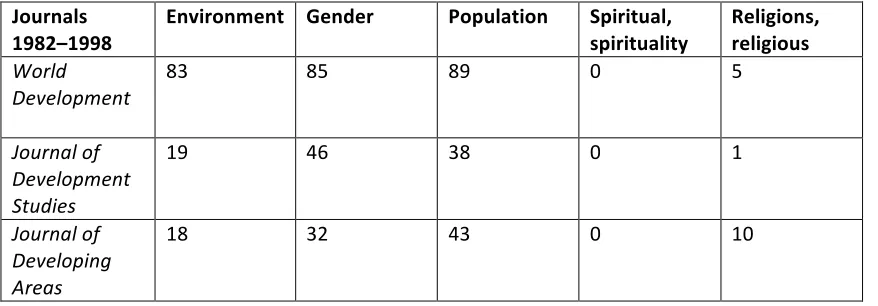
Table 2.1 Number of articles with reference to listed keywords, by journal 38
Table 4.1 Characteristic motifs of World Vision’s theology 75
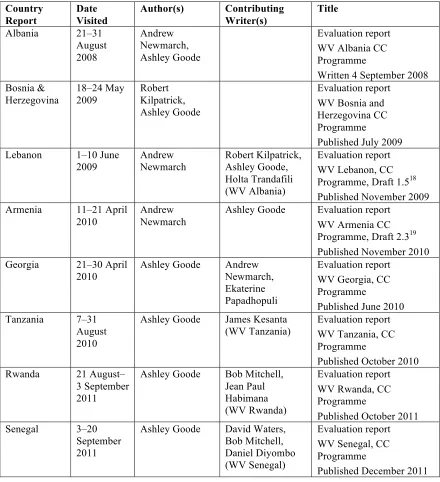
Table 4.2 Details of analysed World Vision Christian Commitments evaluation reports 77
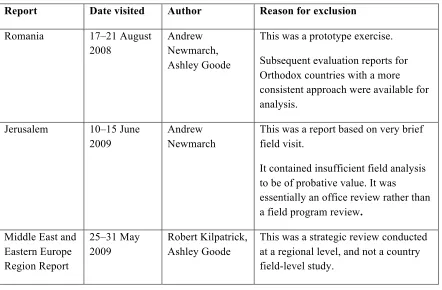
Table 4.3 List of reports excluded from consideration 78
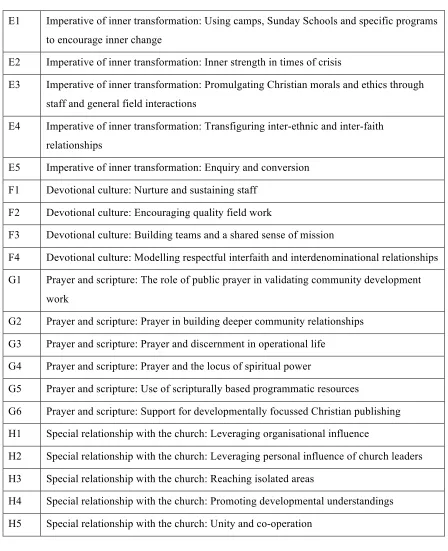
Table 4.4 A taxonomy of 37 topic codes linking World Vision’s theological motifs with its
development work. 81
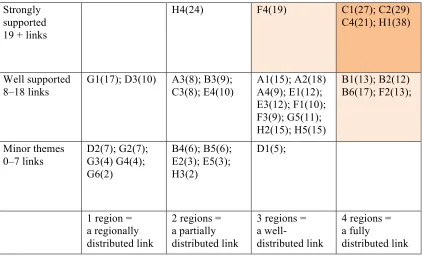
Table 4.5 A matrix showing the distribution and strength of individual links 83
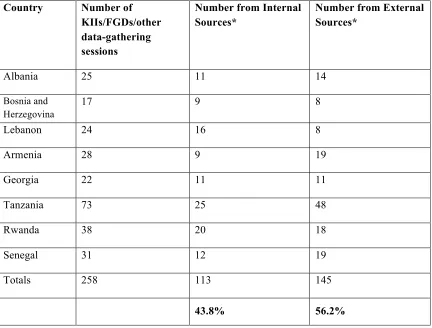
Table 4.6 The proportion of internal and external data sources in each evaluation report 89
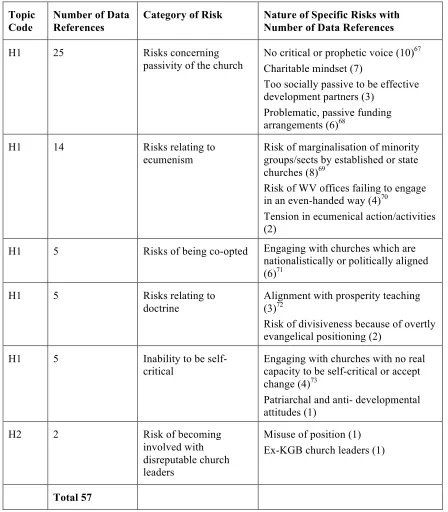
Table 11.1 Breakdown of data references for topic codes H1 and H2 by specific risk 217
Table A1: Complete list of key informant interviews and focus group discussions 284
Table A2 Listing of all connecting propositions and sub-propositions for each theological motif 295
Table A3 Linkages between various topic codes 301
List of Figures
Figure 2.1 Jeavon’s framework for the examination of religious organisations 34
Figure 2.2 Two dimensions of organisational religiousness 36
Figure 4.1 Graph showing all links by topic code and region 84
Figure 6.1 Topic code A1 snapshot 116
Figure 6.2 Topic code A2 snapshot 119
Figure 6.3 Topic code A3 snapshot 121
Figure 6.4 Topic code A4 snapshot 123
Figure 6.5 Topic code E1 snapshot 125
Figure 6.6 Topic code E2 snapshot 127
Figure 6.7 Topic code E3 snapshot 129
Figure 6.8 Topic code E4 snapshot 131
Figure 6.9 Topic code E5 snapshot 133
Figure 7.1 Topic code B1 snapshot 135
Figure 7.2 Topic code B2 snapshot 137
Figure 7.3 Topic code B3 snapshot 139
Figure 7.4 Topic code B4 snapshot 141
Figure 7.5 Topic code B5 snapshot 142
Figure 7.6 Topic code B6 snapshot 143
Figure 7.7 Topic code F1 snapshot 145
Figure 7.8 Topic code F2 snapshot 147
Figure 7.9 Topic code F3 snapshot 149
Figure 7.10 Topic code F4 snapshot 151
Figure 8.1 Topic code C1 snapshot 156
Figure 8.2 Topic code C2 snapshot 158
Figure 8.3 Topic code C3 snapshot 161
Figure 8.4 Topic code C4 snapshot 163
Figure 8.5 Topic code D1 snapshot 167
Figure 8.6 Topic code D2 snapshot 169
Figure 8.7 Topic code D3 snapshot 170
Figure 9.1 Topic code G1 snapshot 176
Figure 9.3 Topic code G3 snapshot 179
Figure 9.4 Topic code G4 snapshot 180
Figure 9.5 Topic code G5 snapshot 182
Figure 9.6 Topic code G6 snapshot 185
Figure 10.1 Topic code H1 snapshot 188
Figure 10.2 Topic code H2 snapshot 192
Figure 10.3 Topic code H3 snapshot 195
Figure 10.4 Topic code H4 snapshot 196
Figure 10.5 Topic code H5 snapshot 199
List of Abbreviations
ADP Area Development Program: the suite of development activities facilitated by World Vision within a particular geographic area. The communities where ADPs are located range in population from 20,000 to 100,000. The ADP is World Vision’s characteristic development model. The life of an ADP is 12 to 15 years
AI Appreciative Inquiry
AOG Assemblies of God
ATR African Traditional Religion
AusAID The executive agency responsible for delivering the Australian Government’s international aid and development program. This agency was dissolved and collapsed into the Department of Foreign Affairs and Trade from 1 November 2013
BOND British Organisation for NGOs in Development
CC Christian Commitments: refers to the functional area within World Vision which takes administrative responsibility for promoting and developing its faith-based policies. CC also provides pastoral care for staff, spiritual nurture activities (including devotional programs) and oversees church relationships
CEDC Children in Especially Difficult Circumstances
CEO Chief Executive Officer
CoH CoH: World Vision’s scripturally based Channels of Hope program. This is an integrated series of workshops on HIV or gender issues in which traditional paradigms are challenged by reference to sacred sources.
CoHG Channels of Hope for Gender
DFID Department for International Development(UK government)
DME Design, monitoring and evaluation
F&A Finance and Administration
FBO Faith-based organisation
FGD Focus group discussion
FGM Female genital mutilation
GOC Georgian Orthodox Church
HEA Humanitarian and emergency assistance
HIV/AIDS Human Immunodeficiency Virus/Acquired Immune Deficiency Syndrome (also ‘HIV and AIDS’)
HPR Healing, peace and reconciliation
HR Human Resources
INGO International non-government organisation
KII Key informant interview
MQ Ministry Quality
ND National Director
NGO Non-government organisation
NO National office: refers to a World Vision national office located in a developing country
Partnership The World Vision partnership – a global federation of separately incorporated bodies who have covenanted together to fight poverty. National Office entities are located in developing countries, and Support Office entities are typically located in Western donor counties. The partnership identifies itself as a partnership of Christians
PNG Papua New Guinea
reports
RPS Religious Practices Scale
UK United Kingdom
UN United Nations
UNDP United Nations Development Program
WHO World Health Organization
WV World Vision partnership or a World Vision National Office (depending on context)
WVI World Vision International: the entity coordinating accountability, compliance, and international policy formation within the global World Vision partnership and which provides treasury functions to member entities
YBC Youth Bible Curricula
1. Introduction: Setting the Scene
This thesis sits in the field of applied or practical theology. Specifically, it looks at the way Christian theology can influence or inform international development work.
Parachurch organisations have been major players in international development work for as long as international development has been recognised as an academic discipline or profession. These organisations actively engage with the communities they serve. On a daily basis they are concerned with questions of justice, compassion, achieving fullness of life, advocacy, and at times, political action. Despite the longevity of their involvement, there has been very little attempt to reflect critically on how an organisation’s theology informs its development practice. Instead, according to Linden, faith-based organisations (FBOs) have been viewed with a level of condescension and curiosity. They have been boxed as
‘interesting or irritating marginal players in the struggle for human emancipation from poverty.’1 This dismissive view contrasts with their status as some of the world’s largest development NGOs.2 It is now time for a deeper examination.
1.1 What is development?
The idea of ‘development’ is a contested term, both as to its meaning and how it may be achieved within communities. It is commonly accepted that the objective of development is ‘to advance human dignity, freedom, social equity and self-determination’3 and that a lack of development involves ‘social exclusion, poverty, ill-health, powerlessness and a shortened life-expectancy.’4 While these lofty goals are shared by many, there are lively debates about how they may be achieved. This research will show that a more holistic approach to
development, which takes religious beliefs of communities seriously, can offer some significant benefits. Furthermore, as this happens, some established understandings of ‘development’ may be challenged.
1 Linden, A 2008, ‘The language of development: what are international development agencies talking about?’
in Clarke, G & Jennings, M (eds), Development, civil society and faith-based organisations: bridging the sacred and the secular,Palgrave Macmillan, Basingstoke, pp. 72–93, at 90.
2 Jones, B & Petersen, M 2011, ‘Instrumental, narrow, normative? Reviewing recent work on religion and
development’, Third World Quarterly, vol. 32, no. 7, pp. 1291–1306, at 1293.
3 Clarke, M 2013, in Clarke, M 2013 (ed.), The handbook of research on development and religion, Edward
Elgar, Cheltenham UK, p. 1.
1.2 The research problem: going below the surface of faith-based organisations
Before 2000, the idea of religious faith having a positive role in development was
downplayed by the academy or even seen as anathema.5 Since then, research in this area has gained momentum, although there are still major gaps. One gap exists because the potential contribution of religion tends to be viewed in narrow, instrumental ways. According to King, this has led to the superficial labelling of actors in the sector according to their donor
constituencies, rather than to addressing religious identity in terms of its distinctive
development models and contributions. He argues that to be meaningful, a religious identity should tell us ‘how religion actually functions in religiously motivated relief and
development.’6 In a similar vein, Jones and Petersen note that very little research has addressed the question of ‘the different ways in which faith or religion is signified and practiced within these organisations [FBOs].’7
1.3 Parallel queries in social science
Similarly, in a related area of social science, Ferguson observes that ‘Multiple studies
conclude that faith-based services are effective, yet relatively few aim to identify the specific faith components related to successful outcomes.’8 It is argued that in international
development there is a parallel need to define which elements of faith-based operational practice contribute to or impede successful outcomes. The present research aims to show how
the religious identity of a development organisation actually contributes to its development work in particular contexts. This will move the discourse beyond viewing religion as a
private motivation for a cohort of staff or a donor category. This kind of research is important because it is recognised that the links between religions and development have been
neglected in social science research and existing studies and proven methodologies are scarce.9
5 Lunn, J 2009, ‘The role of religion, spirituality and faith in development: a critical theory approach’, Third World Quarterly, vol. 30, no. 5, pp. 937–951, at 940. This topic is discussed in more detail at 2.4.1
‘Marginalisation of faith within development studies’ post.
6 King, DP 2011, ‘World Vision: Religious identity in the discourse and practice of global relief and
development’, The Review of Faith and International Affairs, vol. 9, no. 3, pp. 21–28, at 23.
7 Jones & Petersen,p. 1298.
8 Ferguson, KM, Wu, Q, Spruijt-Metz, D & Dyrness, G2007, ‘Outcomes evaluation in faith-based social
services: are we evaluating faith accurately?’, Research on Social Work Practice, vol. 17, no. 2, p. 265.
9 University of Birmingham 2011, ‘Religions and development in India, Pakistan, Nigeria and Tanzania:
1.4 Locating myself in the narrative
Raising questions about the role of faith in international community development overlaps with my own personal journey. My background is in law, with most of my professional life spent as a tax partner at PricewaterhouseCoopers. During and after that period I began the serious study of theology. From 2002 I also began a series of life-changing journeys to Timor Leste, which introduced me to some of the challenges of community development practice. In that time I established a small non-government organisation (NGO) and after a few years retired from my professional practice. Since then, I have been a board member of two faith-based development organisations. From 2009–2012 I was a senior executive of World Vision Australia, and I am presently the Chief Executive Officer (CEO) of Anglican Overseas Aid. I am now an Anglican minister. These roles have provided many occasions to reflect on the distinctive contribution that Christian faith may make to international development work.
Over this period a range of views have been expressed to me by development sector colleagues about the integration of faith in development work. A common perspective is that FBOs do essentially the same ‘stuff’ as secular ones, and there is no real difference. Others locate the distinctive contribution of FBOs in the area of personal motivation. This may mean that while development work is inspired by faith convictions, it is not materially different from other organisations in terms of its execution. A few colleagues have argued that
Christian faith influences both the motivation and the execution of development work. More ambitiously, some have posited that faith-based approaches must inform the understandings of what ‘development’ is, claiming that such approaches speak to a more comprehensive notion of personhood which takes spiritual life seriously.
Some detractors of faith-based approaches see them as introducing far too many ethical problems, especially when mixed with an evangelical agenda. Another group describe faith-based approaches as well meaning but sometimes amateurish. They point out that faith-faith-based actors occasionally transgress accepted norms of development practice, and divert attention from more important ideas about universal human rights.
This multiplicity of perspectives has been exercising my critical faculties for several years. My hunch is that many of these perspectives are correct when viewed from the experience of particular organisations. This has instilled a desire to unpack the meaning of faith in
1.5 The case study
My contention is that there is a benefit in Christian FBOs reflecting specifically and
intentionally on how their theology informs their development work because this can expose both the benefits and risks in terms of development practices. Such information may benefit other FBOs and be of interest to the development sector more generally. This study’s research addresses this contention by illustrating how it has been possible to articulate key elements of the organisational theology of one leading organisation and, in doing so, provide a rubric for examining the influence of those motifs on its development work.
For this purpose World Vision kindly granted access to a corpus of recent internally published evaluation reports and interviews that examined, in a broad way, the integration of faith within a number of its country development programs. This was a rare opportunity, as materials of this kind are not publicly available. It was possible to identify the main themes of World Vision’s theology based, among other things, on a series of official policy documents. This opened up the opportunity for a revelatory case study.
1.6 Organisational theology as the entry point
The faith connection of some FBOs is very loose or tenuous. Other organisations simply choose more open systems, or diverse methodologies or personnel. There are good reasons why an examination of organisational theology is an effective entry point in exploring what faith means to an organisation and its development practice. By mapping a working theology, it becomes possible to expose what ‘faith in action’ means for an organisation. This process may identify areas of potential comparative advantage or disadvantage in terms of praxis. It is argued that as organisations become more intentional about mapping their theology, they can gain a better understanding of theology as a potential resource in responding to disadvantage.
1.7 Broader implications and importance
The case study permitted observations to be made about a particular organisation, with a particular theology, operating in particular settings. This kind of research is important
because while international development has discovered religion, ‘it has yet to investigate its diverse meanings for faith-based organisations.’10 It is not suggested that World Vision is a representative of all FBOs, although it is likely that there will be others like it. The intent of
the case study was to shine light on what faith means for a particular organisation, not to claim a representative status for the subject.
Having said that, while a case study does enable a more specific analysis, this does not necessarily delimit its usefulness. On the contrary, the firm anchor of a case study allows well-grounded observations to be drawn that may have a more general application. The experience of this case study is that significant implications did emerge which will hopefully contribute to the growing discourse about the roles of faith in development. The penultimate chapters sketch out those implications for the sector, the literature and development practice.
This kind of research is also essential to improve the transparency of FBOs. To this extent, the thesis responds to James’ clarion calls for research which will promote greater ‘faith literacy’ for donors and other stakeholders.11 Unless more is known about faith-based approaches, it will not be possible to optimise their benefits nor mitigate their risks. Accordingly, this type of research is of fundamental concern to both the development profession and the world’s poor.
1.8 Statement of thesis
At the outset of this research, the question of what faith may mean to World Vision was open ended. I did not have a very detailed hypothesis in mind. On the contrary, the hypothesis was deliberately broad. I wanted to see if World Vision’s theology was capable of thematic articulation, and, if so, to then examine how its theological motifs were reflected in its development work and practice. I wanted to let the data speak to the maximum extent
possible, forming its own connections. In this way a more organic and authentic picture could emerge. Against this background, the hypothesis that this thesis explores can be presented as follows:
• World Vision has a number of key theological emphases which frame its development
work
• these theological motifs inform its development work in significant and particular
ways
• taken as a whole, its approach to development can be considered as cohesive and
distinctive
• it is possible to identify potential advantages and disadvantages arising from this
theologically informed approach to development
11 James, R 2010, ‘Handle with care: engaging with faith-based organisations in development’, online at
• the application of World Vision’s theological framework will be nuanced to reflect
local culture, traditions and development needs.
1.9 Method
Grounded theory was considered the most suitable method of research for this thesis. This is a leading method used in the social sciences that operates differently from many approaches. Instead of embarking on research with a detailed and preconceived hypothesis to test, and then selecting a method considered apt to prove it, grounded theory allows more room for the data to speak in the construction of theory. Theory is allowed to develop organically from the data under review as linkages are formed by exhaustive coding, sub-coding and grouping.
Grounded theory provided a corrective to the extreme positivism that was incipient in social science research up to the 1960s.12 The proponents of this method, Glasser and Strauss, recognised that knowledge was not an external, objective reality to be uncovered through a detached scientific process.13 They rejected the sterile and more limiting notions of
falsification and hypothesis testing. They instead proposed a more organic process of theory emergence from the data. At the same time, they recognised a need for a systematic approach to counter the at times uncontrolled subjectivism of phenomenological research.14
Their approach allowed for a creative yet systematic interplay between the researcher and the data being collected and analysed. This approach highlighted the steady emergence and constant refining of conceptual categories, in contrast with data assessment against pre-conceived hypotheses. In this way, Glasser and Strauss ‘offered a compromise between extreme empiricism and complete relativism by articulating a middle ground in which systematic data collection could be used to develop theories that address the interpretive realities of actors in social settings.’15
The purpose of grounded theory is to elicit understandings about patterned relationships. It is an interpretive process, not a logico-deductive one. It relies on the constant and reflective interplay between the researcher, the data and the emerging theoretical categories. Grounded theory is unsuited to narrow hypothesis testing.16 The hypothesis under examination in the
12 Suddaby, R 2006 ‘What Grounded Theory is not’, Academy of Management Journal, vol. 49, no. 4, pp. 633–
642, at 633.
13 Glaser, BG & Strauss, A 1967, Discovery of grounded theory: strategies for qualitative research, Sociology
Press.
14 Suddaby, p. 635. 15 Ibid., p. 634
16 Suddaby observes that ‘where grounded theory is used to “test” preconceived notions of what is likely to be
present research is wide-ranging, positing very broadly that an FBO’s characteristic theological motifs can influence its development work, presenting areas of comparative advantage and risk. Grounded theory is well suited to this kind of spacious inquiry.
The researcher’s own insights and professional experience, as well as the literature and data all feed the interpretative process at the heart of grounded theory. Glasser very much emphasised openness, flexibility and emergence as the founding principles of this process. This contrasts with a more prescriptive forms of the theory promoted at a later stage by Strauss in an effort to promote greater standardisation and rigour in qualitative analysis.17 Suddaby cautions against using grounded theory techniques in a highly mechanistic way, especially ‘a neutrotic over-emphasis on coding.’18 He observes: ‘although the rigid
application of grounded theory technique might produce passable results, such a mechanical approach usually lacks the spark of creative insight upon which exemplary research is based.’19 By adhering to Glasser’s founding principles, it has been possible to leverage the helpful tension between ‘art and science’ inherent in the original methodology, and to maintain what Glasser refers to as ‘theoretical sensitivity’.20
In this study, eight research domains were established by stating some of the key themes of World Vision’s theology. Data was coded to these domains, and grounded theory was used to establish whether there were any relevant linkages among the data in each domain. The result was the production of a taxonomy describing how World Vision’s theology informs its development work in 37 different ways.
A possible methodological weakness was that the research relied on internally produced reports and interviews. It was not possible to exclude the risk of tendentiousness in the production of the secondary sources which comprised the dataset. Nevertheless, the dataset covered a broad range of contexts and sources and these were sufficiently voluminous to enable particular themes to be drawn out.
1.10 Flow of chapters
• Chapter 2 examines three distinct bodies of literature that provide context for the
thesis.
17 Strauss, A 1987, Qualitative analysis for social scientists, Cambridge University Press, Cambridge, England. 18 Suddaby, p. 638.
19 Ibid.
20 Glaser, BG 1978, Theoretical sensitivity: advances in the methodology of grounded theory, University of
• Chapter 3 provides additional background, and it will outline some of the prevalent
theories of change used in the development sector. The main differences between faith-based and other types of development agencies do not lie in their selection of a theory or theories of change, but in other factors that flow from their organisational culture. In the case of World Vision, these factors are strongly informed by its organisational theology.
• Chapter 4 sets out the reasons why World Vision was selected as a research subject
and the proposed methodology.
• Chapter 5 attempts to articulate thematically the main elements of World Vision’s
theology and related faith practices.
• Chapters 6–10 analyse a series of internal World Vision evaluation reports (and
supporting documents and data) covering eight countries in Africa, the Balkans, Eurasia and the Middle East. The analysis will be looking for evidence of how World Vision’s theology and related faith practices are reflected in its development work in these places.
• Chapter 11 examines the significant risks associated with World Vision’s
theologically informed development approach.
• Chapter 12 considers whether the thesis has been established.
• Chapter 13 examines some of the general implications from the research, including
for the surrounding literature.
• Chapter 14 considers an eclectic range of implications to arise from the research for
development practice.
• Chapter 15 will provide a brief overview and outline some prospective areas for
further research.
2. Why There is a Need to Map Organisational Theology:
The Literature Surrounding the Problem
2.1 Overview of literature
This chapter outlines three distinct bodies of literature which all suggests that a careful examination and articulation of a development organisation’s theology can provide a helpful analytical foundation. The first body of literature shows that there are diverse high-level theological reasons that may motivate Christians to engage in development work. However, the sheer variety of these reasons, and the fact that international development work is
mediated through organisations with their own corporate structure and identity, suggests that FBOs should be considered on a case-by-case basis. There are multiple theologies of
development that reflect a diverse range of development organisations.
In corollary, a second body of literature shows that attempts to generically categorise Christian faith-based development and community service organisations have been largely unsuccessful. One of the reasons for this is that insufficient attention has been paid to the internal theology of organisations in accounting for their differences. The focus has been on attempts to measure external features, rather than core theological beliefs, which can produce a misleading picture.
A third body of literature highlights that there has been a consistent under-representation in the academic literature of the role of religious faith within development studies. This is partly as a result of modernity thinking, and it has led to a lack of understanding about the way faith functions in carrying out development work. Together, these three bodies of literature suggest that a case study examining an organisation’s theology and associated development praxis is long overdue. This type of study may highlight important connections in terms of how an organisation can use its theological underpinnings to respond to the challenge of international development work.
2.2 Theological support for Christian involvement in development
One powerful motif is that Christians have a role in working for the coming kingdom of God.1 The kingdom is a rich collation of ideas that looks forward to a time when God will reign fully in all things and the heavens and earth will be renewed. The corresponding Old Testament notion of shalom pictures the whole of creation taking its right order and relationship before God. In this new kingdom, the sinful and selfish exercise of power by humans over others will give way to godly relationships and the whole of creation is reconciled with its Creator and with itself.
In terms of human relationships, important biblical metaphors associated with the idea of the coming kingdom include the nations streaming to Mount Zion to learn of God’s ways and the beating of instruments of war into ploughshares.2
The renewal of the world is alluded to in St Paul’s writing, which speaks of all of creation groaning, awaiting its rebirth.3 There are other images that point to a time when the existing enmities within creation will be removed. In Isaiah, a striking picture is given of a new era of peace associated with the messianic descendant of David: ‘6The wolf shall dwell with the lamb, and the leopard shall lie down with the kid, and the calf and the lion and the fatling together, and a little child shall lead them. 7The cow and the bear shall feed; their young shall lie down together; and the lion shall eat straw like the ox’ (Isa 11:6–7).
Establishing the kingdom of God is seen by Christians as a global task requiring a
fundamental transfiguring of relationships within creation. The coming of God’s kingdom is foreshadowed by the resurrection of Christ from the dead, and it is usually understood to reach fulfilment with the return of Christ to earth. Theologians such as NT Wright believe that the physical resurrection of Jesus Christ is emblematic of the Christian call to work for this kingdom.4 Most Christians believe that they exist in the in-between time, sometimes described as a ‘now-but-not-yet’ period of history. This refers to a time when Christians look for signs of God’s in-breaking rule, while holding firm to a vision of the ultimate fulfilment of his purposes. Development work is conceived by many Christians as a way to help communities experience a more abundant life in the present, as a foretaste of this coming kingdom. Dewi Hughes from TEAR Fund is an exponent of this view in his book God of the
poor: a biblical vision of God’s present rule.5
1 See Episode 1 of The Faith Effect DVD series produced by World Vision Australia in which NT Wright is
interviewed.
2 Isa 2:2–4. 3 Rom 8:22.
4 Wright, T 2007, Surprised by hope, SPCK, London.
While the kingdom of God is seen as the sovereign work of God alone, Christians are invited by God to live in anticipation of what he is doing. In this sense, God’s people may be seen as having an active role in joining in the expression of the Creator’s redemptive
purposes. According to one view, God’s people may be seen as co-creators with God in a joint enterprise of restoring the world. International development work – which has an emphasis on social equity, health and prosperity, peace and reconciliation, and care for the environment – has many points of resonance with the motif of global restoration contained in the idea of the coming kingdom.
Jurgen Moltmann, a theologian in the reformed tradition, sees the kingdom as a future event, but one that comprehensively informs the present. In his view, Christian eschatology is a vital area of doctrine because it should comprehensively shape the way the followers of Jesus live in the present. Christians are said to comprise an eschatological community of salvation: ‘This eschatological orientation is seen in everything from which and for which the Church lives.’6 On this analysis, ‘mission is not carried out within the horizon of expectation provided by the social roles which society concedes to the Church, but it takes place within its own peculiar horizon of the eschatological expectation of the coming kingdom of God, of the coming righteousness and the coming peace, and of the coming freedom and dignity of man.’7 For Moltmann, the first intercession in the Lord’s Prayer – which enlists disciples in God’s service, ‘Thy kingdom come on earth, as it is in heaven’8 – is as much a statement of call as it is of invocation. As Christ’s disciples orient themselves towards this future vision, they will actively seek God’s rule within their communities and the world. Development work is one way to give expression to this Christian hope of a renewed world.
Another theological basis for undertaking international development work is social Trinitarianism. The work of Miroslav Volf is one example of a contemporary theologian has explored the social implications of the Trinity in human affairs.9 Broadly, social
Trinitarianism highlights the relationship between the members of the eternal Godhead as being prototypical of God’s aspirations for humans. The Trinity is seen as a community of self-giving love that is the paradigmatic example. The Father’s love is made manifest in the costly surrender of the Son. The Son’s love for the Father is demonstrated through faithful
6 Moltmann, J 1967, Theology of Hope, SCM Press, London, p. 325; see also Kung, H 1968, The church, Burns
& Oates, London pp. 79 ff.
7 Ibid, p. 327. 8 Mt 6:10.
obedience and service. The Holy Spirit is also imbued with these qualities, indwelling the Godhead in a living social relationship known as perichoresis.
Social Trinitarianism contends that humans were made in this social or relational image of God. They are intended to emulate the kind of self-giving and faithful community displayed within the Godhead. International development work is one way for humans to express relational solidarity with each other – through mutuality and service, and by seeking to build true community. The understanding that all humans are made in the image of God also lays an important foundation for Christians in understanding and promoting human rights.
Another basis for Christian development work is responding to the prophetic call to defend vulnerable communities. The public commencement of Jesus’ own ministry recalled the prophet call of Isaiah. Jesus described his mission in Luke’s gospel in these terms: ‘18The Spirit of the Lord is on me, because he has anointed me to proclaim good news to the poor. He has sent me to proclaim freedom for the prisoners and recovery of sight for the blind, to set the oppressed free, 19to proclaim the year of the Lord’s favour.’10
Development work focusses on impoverished communities, and often communities which have experienced some kind of oppression or trauma. A key thrust of development work is to move beyond a merely compassionate response to sustainable improvements and justice. The prophetic call throughout scripture to defend the widow and the orphan11 may at times imbue development work with a more political character.12 Important aspects of development practice are concerned with ensuring that vulnerable groups obtain justice and their human rights are respected. This resonates with the ancient injunction to ensure justice in the gate.13
The focus on justice and rights has received attention in recent decades with the
emergence of liberation theology. This is a form of political theology emanating from Latin America in the 1960s and 1970s. It interpreted the teachings of Jesus as calling for active liberation from unjust social economic and political conditions, and it is sometimes
associated with the application of a Marxist pedagogy to Christian scriptures. International development work and liberation theology share a common impetus in that both respond to
10 Lk 4:18–19, quoting Isa 61:1–2.
11 The phrase ‘widow and orphan’ can be understood as biblical code for any disenfranchised group. 12 Richard Shaull is one prominent example of a theologian who, in his earlier writings, emphasized the
horizontal dimension of salvation. For him, salvation meant ‘liberation, which could only be achieved by overthrowing the existing order’. Harvey Cox, at an earlier stage also stressed that ‘God is first of all present in political events, in revolutions, upheavals, invasions and defeats’ since ‘it is the world, the political world … which is the arena of God’s renewing and liberating activity’ (Cox, H 1965, God’s revolution and man’s responsibility, Valley Forge, Judson, pp. 23, 25.
13 Amos 5:15. The gate refers to the city gate, which was traditionally the place in ancient Israel where an
circumstances in which oppressed or impoverished peoples seek liberation. The emphasis on community empowerment and participation, which is a consistent feature of development theory, has strong resonances with liberation theology. As well as addressing similar contexts, liberation theology recognises the important role of political advocacy and social mobilisation in bringing about change.
More generally, Christian social ethics suggest that the followers of Jesus should be willing to carry each other’s burdens. This reflects the second great command to love neighbour as self.14 Theologians like Bonhoeffer emphasise that compassionate action and mutuality underpin real community, and are based on the unity and reconciliation humans can experience in Jesus Christ.15
Jesus also disabuses attempts to narrowly circumscribe our personal responsibilities. In an acclaimed exegesis of the parable of the Good Samaritan, theologian Ken Bailey adopts a cultural critical hermeneutic. He points out that the victim in the parable is set up by Jesus to be an anonymous, generic person. The removal of the victim’s clothes by the robbers
deprives the passers-by of the opportunity to determine his ethnicity based on traditional dress.16 The fact that he is beaten to unconsciousness means that his identity cannot be established by accent, language or direct questioning. The parable illustrates that responding to the needs of a fellow human constitutes true neighbourliness and transcends narrower formal categories.
Another reason for Christian engagement in international development work is a broad missiology based on an understanding of God’s universal presence within communities. This view acknowledges the self-bestowal by God on all of creation. According to theologians like Boff, the Holy Spirit is ‘the first missionary’ in every community. While acknowledging that humans are sinful and broken, God nonetheless provides signs of his life and presence, witnessing to himself within in every human context.
The self-bestowal of God on all communities means that development work can be based on the notion of human reciprocity. Because all peoples are made in the image of God, then they will reflect, albeit imperfectly, something of his goodness expressed within their own community life. This provides a firm and positive foundation in seeking to carry out development based on existing community strengths.
14 Mt 22:39.
15 Bonhoeffer, D 1979, ‘Christ, the church, and the world’, in Anderson, RS (ed.), Theological foundations for ministry, T&T Clark, Edinburgh.
16 Lk 10:30. See Bailey, KE 1976, Poet and peasant and Through peasant’s eyes,(combined edn),William B
A contrast can be drawn with the self-understanding of many Christian missionaries in the colonial era. The idea of the self-bestowal of God on all creation was not well understood or accepted. Such missionaries have been caricatured as seeking to ‘bring God in their suitcase’ in their attempts to ‘reach’ various ‘unregenerate’ people groups. If God is already present in developing communities, then it becomes possible to discern what God is already doing, or perhaps seeking, within those settings. Ways of building up and strengthening communities can then be identified and leveraged. These can be understood as authentic expressions of God’s grace. It is also becomes possible to learn from communities rather than instructing communities in an asymmetric way.
If God is understood as already at work in the world, then this can lead to a richer and fuller understanding of his redemptive agenda. Typically, faith-based development work may see salvation as less about the afterlife and more about seeking to give expression to the fullness of life in the present. This may involve affirming human life through programs that are holistic, temporal, broad-based and inclusive. There are resonances here with the
Christian understanding of the in-breaking kingdom of God. However, these emphases also help to shape the idea of salvation itself. In particular, a broader understanding of salvation can emerge which is not primarily individualistic, nor deferred. The United Kingdom’s (UK’s) development agency Christian Aid captures this well in its by-line ‘We believe in life
before death.’
So-called Catholic Social Justice Teaching provides another collection of teachings that support engagement in international development efforts. God’s ‘preferential option for the poor’ and ideas about the global ‘human family’ lie at the heart of this teaching. God’s affinity with the poor and outcast is so deep that to neglect the poor is to neglect our human obligation towards God. This line of teaching was clearly articulated through papal
encyclicals in the 19th and 20th centuries. It is also very holistic in its approach. Most recently, Pope Benedict XVI has reiterated that ‘love for widows and orphans, prisoners, and the sick and needy of every kind, is as essential as the ministry of the sacraments and preaching of the Gospel.’17 Deneulin explains: ‘A Christian vision of development does not separate the material from the spiritual dimensions of life. Christians believe that humans are made in the image of God and only reach their fulfillment in God. Development, working for social justice and protection of the environment goes hand in hand with conversion of the heart.’18
17Dues Caritas Est, paragraph 22.
Catholic teaching is nuanced when it comes to international development, which is not seen as an end in itself. Bertina has traced its evolution to a careful doctrine of ‘integrated human development’ resting upon the three pillars of social consideration, moral behaviour and reconcilliation with God.19 Earlier papal encyclicals embraced the potential of technology and trade as means of social uplift, but later reflections noted the incipient dangers of
technocracy and utilitarian absolutism.20
While holistic, Catholic teaching makes it plain that the idea of development is always subordinated to the pursuit of historical reconciliation between humanity and God.21 Acording to Deneulin,‘Christians believe that humans become more human when they are closer to God. To reflect this reality, Catholic Social Teaching refers to integral human development. The development of the whole person is not complete without spiritual considerations.’22 Therefore, the secular ‘religion of development’ practised by some institutions is seen as idolatry. Progress is possible only because God has decided from the beginning to make humans a sharer of his glory.23 Bertina states that ‘It is hoped that humanity’s wholehearted recognition of the human family and pursuit of its realisation – aspects of the divine plan – will prefigure the advent of the Kingdom of God.’24
An appreciation of the broad human family, seeking the common good and promoting economic justice are all elements of the Catholic understanding of integral human
development. So are expressing solidarity, promoting civic and social participation, and upholding the principle of subsidiarity. An excellent summary of some of the main elements of Catholic teaching as applied to development work is set out in Appendix 1. It has been prepared by Caritas Australia.25
Finally, it can be argued that all theology should involve an iterative dialogue between the theoretical and the practical. This can prevent theology from becoming too abstract or
divorced from reality. The present research will examine how the praxis of a leading
development organisation is informed by theological motifs, opening up an important area of Christian ministry to critical analysis.
19 Bertina, L 2013, ‘The Catholic doctrine of ‘Integral Human Development’ and its influence on the
international development community’, in Carbonnier, G (ed.), International development policy: religion and development, Palgrave Macmillan, Basingstoke,UK, pp. 115–127.
20 Ibid., p. 118. 21 Ibid., pp. 119ff. 22 Deneulin, p. 58.
23 Bertina, referencing John Paul II 1987, Sollicitudo Rei Socialis paragraph 31. 24 Bertina, p. 120.
Theologians, like Schleiermacher, have recognised that the teleological goal and crown of theology as a discipline is to be found in practical concerns.26 Like most theologians, he argued from theory to practice and examined how theology was applied in given settings. More recent theologians, like Browning,27 argue for the analysis to proceed in the reverse direction, seeing all theology as fundamentally practical. He argues that a consideration of real-life issues provides the necessary hermeneutic to construct and (re)appraise theological thought. This research sees movement in both directions: seeking evidence of pre-defined theological themes, but also entering into a dialogue about how field data poses risks and challenges for an important area of ministry. This calls for a reappraisal in some areas.
2.2.1 Implications for the proposed research
This literature suggests a wide variety of theological reasons for why Christians may be motivated to undertake development work. These motivations help explain the large number of different Christian traditions represented in FBOs undertaking development work. The over-representation of Christian organisations in development work has been noted in the literature.28
It follows that many Christian FBOs will respond to the challenges of development work within a framework of organisational theological emphases which directly inform or
influence day-to-day practice. This thesis aims to complete a picture that moves beyond high-level theological motivations to the role of organisational theology and its more concrete impact on development work.29 In practical terms this will involve a consideration of the way faith actually functions in the carrying out of development work.
26 Schleiermacher, F 1983, Brief outline of the study of theology, John Knox Press, Richmond, pp. 91–126. 27 Browning, DS 1996, A fundamental practical theology, Fortress Press, Minneapolis.
28 Berger, J 2003, ‘Religious non-governmental organisations: an exploratory analysis’, unpublished paper,
Harvard University. Online at
http://citeseerx.ist.psu.edu/viewdoc/download?doi=10.1.1.112.5589&rep=rep1&type=pdf.
29 International development work involves complex logistics, support, and scale. It is invariably mediated
2.3 Attempts to categorise faith-based development non-government organisations
A second body of literature speaks to attempts that have been made to categorise FBOs according to type. It will be argued that these attempts have been of limited use.
James argues that the current catch-all term ‘faith-based organisation’ is confusing because no consistent idea exists of what it means to be faith-based.30 The extraordinarily heterogeneous nature of FBOs can be bewildering and makes an analysis difficult.31
Likewise, Vanderwoerd observes that scholars in many disciplines have struggled to define organisational religiousness while recognising the need to move beyond ‘dichotomous groupings of non-profits as simply “religious” or “secular”.’32
2.3.1 Typologies
Typologies are one approach to avoid dichotomous characterisations, because they attempt to describe a broader spectrum. James has prepared a summary of two recent typologies that attempt to provide an overall picture of different types of FBOs. These are reproduced here to give an indication of two possible approaches.
Sider’s typology
• Faith-permeated: the connection is evident at all levels of mission, staffing,
governance and support. The religious dimensions [are] essential to program effectiveness.
• Faith-centred: founded for religious purpose, remain strongly connected but
participants can readily opt out of religious elements.
• Faith-affiliated: retain influence of founders, but do not require staff to affirm
religious beliefs or practices (except for some board and leaders). They may incorporate little or no explicitly religious content, may affirm faith in a general way and make spiritual resources available to participants.
• Faith-background: look and act like secular NGOs. They have a historical tie to
a faith tradition. Religious beliefs may motivate some staff, but this is not considered in selection.
• Faith-secular partnership: whereby an FBO works together with secular
agencies to create a temporary hybrid that resembles a faith background.33
30 Sider, RJ and Unruh, HR 2004, ‘Typology of religious characteristics of social service and educational
organizations’, Nonprofit and Voluntary Sector Quarterly, vol. 33, pp. 109–134, 110; see also James, R 2009,
What is distinctive about FBOs, International NGO Training and Research Centre, Praxis Paper 22, p. 5.
31 Vanderwoerd, JR 2008, ‘Religious characteristics of government-funded faith related social service
organizations’, Social Work and Christianity, vol. 35, no. 3, pp. 258–286; see also Sider and Unrah, pp. 109– 110, about some of the difficulties caused by the poor understanding of different types of faith-based organisation.