Volume 2007, Article ID 31314,15pages doi:10.1155/2007/31314
Research Article
Analysis of Transient and Steady-State Behavior
of a Multichannel Filtered-
x
Partial-Error Affine
Projection Algorithm
Alberto Carini1and Giovanni L. Sicuranza2
1Information Science and Technology Institute, University of Urbino “Carlo Bo”, 61029 Urbino, Italy 2Department of Electrical, Electronic and Computer Engineering, University of Trieste, 34127 Trieste, Italy
Received 28 April 2006; Revised 24 November 2006; Accepted 27 November 2006
Recommended by Kutluyil Dogancay
The paper provides an analysis of the transient and the steady-state behavior of a filtered-xpartial-error affine projection algo-rithm suitable for multichannel active noise control. The analysis relies on energy conservation arguments, it does not apply the independence theory nor does it impose any restriction to the signal distributions. The paper shows that the partial-error filtered-x affine projection algorithm in presence of stationary input signals converges to a cyclostationary process, that is, the mean value of the coefficient vector, the mean-square error and the mean-square deviation tend to periodic functions of the sample time.
Copyright © 2007 A. Carini and G. L. Sicuranza. This is an open access article distributed under the Creative Commons Attribution License, which permits unrestricted use, distribution, and reproduction in any medium, provided the original work is properly cited.
1. INTRODUCTION
Active noise controllers are based on the destructive inter-ference in given locations of the noise produced by some primary sources and the interfering signals generated by
some secondary sources driven by an adaptive controller [1].
A commonly used strategy is based on the so-called
feed-forwardmethods, where some reference signals measured in the proximity of the noise source are available. These signals are used together with the error signals captured in the prox-imity of the zone to be silenced in order to adapt the con-troller. Single-channel and multichannel schemes have been proposed in the literature according to the number of ref-erence sensors, error sensors, and secondary sources used. A single-channel active noise controller makes use of a sin-gle reference sensor, actuator, and error sensor and it gives, in principle, attenuation of the undesired disturbance in the proximity of the point where the error sensor is located. In the multichannel approach, in order to spatially extend the silenced region, multiple reference sensors, actuators and er-ror sensors are used. Due to the multiplicity of the signals in-volved, to the strong correlations between them and to the long impulse response of the acoustic paths, multichannel
active noise controllers suffer the complexity of the coeffi
-cient updates, the data storage requirements, and the slow
convergence of the adaptive algorithms [2]. To improve the
convergence speed, different filtered-xaffine projection
(FX-AP) algorithms have been used [3,4] in place of the usual
filtered-xLMS algorithms, but at the expense of a further,
even though limited, increment of the complexity of updates. Various techniques have been proposed in the literature to keep low the implementation complexity of adaptive FIR fil-ters having long impulse responses. Most of them can be use-fully applied to the filtered-x algorithms, too, especially in the multichannel situations. A first approach is based on the so-called interpolated FIR filters [5], where a few impulse re-sponse samples are removed and then their values are derived using some type of interpolation scheme. However, the suc-cess of this implementation is based on the hypothesis that practical FIR filters have an impulse response with a smooth predictable envelope, which is not applicable to the acous-tic paths. Another approach is based on data-selective up-dates which are sparse in time. This approach can be suit-ably described in the framework of the set-membership fil-tering (SMF) where a filter is designed to achieve a specified
bound on the magnitude of the output error [6]. Finally, a
set of well-established techniques is based on selective partial
updates (PU) where selected blocks of filter coefficients are
the partial update strategies, a simple yet effective approach
is provided by thepartial error (PE) technique, which has
been first applied in [7] for reducing the complexity of linear
multichannel controllers equipped with the filtered-x LMS
algorithm. The PE technique consists in using sequentially at
each iteration only one of theKerror sensor signals in place
of their combination and it is capable to reduce the
adap-tation complexity with a factorK. In [9], the PE technique
was applied, together with other methods, for reducing the computational load of multichannel active noise controllers
equipped with filtered-xaffine projection (AP) algorithms.
When dealing with novel adaptive filters, it is important to assess their performance not only through extensive simu-lations but also with theoretical analysis results. In the lit-erature, very few results deal with the analysis of filtered-x,
affine projection or partial-update algorithms. The
conver-gence analysis results for these algorithms are often based on the independence theory (IT) and they constrain the proba-bility distribution of the input signal to be Gaussian or
spher-ically invariant [10]. The IT hypothesis assumes statistical
independence of time-lagged input data vectors. As it is too strong for filtered-xLMS [11] and AP algorithms [12], dif-ferent approaches have been studied in the literature in order to overcome this hypothesis. In [11], an analysis of the mean
weight behavior of the filtered-xLMS algorithm, based only
on neglecting the correlation between coefficient and signal
vectors, is presented. Moreover, the analysis of [11] does not impose any restriction on the signal distributions. Another
analysis approach that avoids IT is applied in [12] for the
mean-square performance analysis of AP algorithms. This relies on energy conservation arguments, and no restriction is imposed on the signal distributions. In [4], we applied and
adapted the approach of [12] for analyzing the convergence
behavior of multichannel FX-AP algorithms. In this paper,
we extend the analysis approach of [4] and study the
tran-sient and steady-state behavior of a filtered-x partial error
affine projection (FX-PE-AP) algorithm. The paper shows
that the FX-PE-AP algorithm in presence of stationary input signals converges to a cyclostationary process, that is, that the
mean value of the coefficient vector, the mean-square-error,
and the mean-square-deviation tend to periodic functions of the sample time. We also show the FX-PE-AP algorithm is
capable to reduce the adaptation complexity with a factorK
with respect to an approximate FX-AP algorithm introduced in [4], but it also reduces the convergence speed by the same factor.
The paper is organized as follows. Section 2 reviews
the multichannel feedforward active noise controller
struc-ture and introduces the FX-PE-AP algorithm. Section 3
discusses the asymptotic solution of the FX-PE-AP algo-rithm and compares it with that of FX-AP algoalgo-rithms and with the minimum-mean-square solution of the ANC prob-lem. Section 4 presents the analysis of the transient and
steady-state behavior of the FX-PE-AP algorithm.Section 5
provides some experimental results. Conclusions follow in
Section 6.
Throughout this paper, small boldface letters are used to denote vectors and bold capital letters are used to denote
ma-trices, for example,xandX, all vectors are column vectors,
the boldface symbolIindicates an identity matrix of
appro-priate dimensions, the symboldenotes linear convolution,
diag{· · · }is a block-diagonal matrix of the entries,E[·]
de-notes mathematical expectation, · 2Σis the weighted
Eu-clidean norm, for example,w2
Σ=wTΣwwithΣa
symmet-ric positive definite matrix, vec{·}indicates the vector oper-ator and vec−1{·}the inverse vector operator that returns a
square matrix from an input vector of appropriate
dimen-sions,⊗denotes the Kronecker product,a%bis the
remain-der of the division of aby b, and |a|is the absolute value ofa.
2. THE PARTIAL-ERROR FILTERED-xAP ALGORITHM
The schematic description of a multichannel feedforward
ac-tive noise controller (ANC) is provided in Figure 1.I
ref-erence sensors collect the corresponding input signals from
the noise sources andK error sensors collect the error
sig-nals at the interference locations. The sigsig-nals coming from these sensors are used by the controller in order to
adap-tively estimateJ output signals which feedJ actuators. The
corresponding block diagram is reported in Figure 2. The
propagation of the original noise up to the region to be si-lenced is described by the transfer functions pk,i(z)
repre-senting the primary paths. The secondary noise signals prop-agate through secondary paths, which are characterized by the transfer functionssk,j(z). We assume there is no feedback
between loudspeakers and reference sensors. The primary source signals filtered by the impulse responses of the sec-ondary paths model, with transfer functionssk,j(z), are used
for the adaptive filter update, and for this reason the adap-tation algorithm is called filtered-x.Figure 2illustrates also the delay-compensation scheme [13] that is used through-out the paper. To compensate for the propagation delay in-troduced by the secondary paths, the output of the primary pathsd(n) is estimated withd(n) by subtracting the output of the secondary paths model from the error sensors signals
d(n), and the error signale(n) betweend(n) and the output of the adaptive filter is used for the adaptation of the filter
w(n). A copy of this filter is used for the actuators’ output estimation.
Preliminary and independent evaluations of the sec-ondary paths transfer functions are needed. For generality purposes, the theoretical results we present assume imper-fect modelling of the secondary paths (we considersk,j(z)=
sk,j(z) for any choice ofjandk), but all the results hold also
for perfect modelling (i.e., forsk,j(z)=sk,j(z)). Indeed, the
experimental results ofSection 5refer to ANC systems with
perfect modelling of the secondary paths. When necessary,
we will highlight in the paper the different behavior of the
system under perfect and imperfect estimations of the sec-ondary paths.
Very mild assumptions are posed in this paper on the
adaptive controller. Indeed, we assume that any inputiof the
controller is connected to any outputjthrough a filter whose
output depends linearly on the filter coefficients, that is, we
Noise source
Primary paths
. . . . . . Reference
microphones
x1(n) x2(n) xi(n)
Secondary paths
y1(n) y2(n)
yJ(n)
. . . I
J
K ... Adaptive
controller
Error microphones
e1(n)
e2(n) . . .
eK(n)
Figure1: A schematic description of multichannel feedforward active noise control.
Iprimary
signalsx(n) Primary paths
pk,i(z)
d(n)
Jsecondary signalsy(n)
Secondary paths
sk,j(z)
Adaptive filter copyw(n)
Secondary paths modelsk,j(z)
Secondary paths modelsk,j(z)
Filtered-x
signalsu(n) Adaptive filter
w(n)
+ +
Kerror sensor signalse(n) +
++
d(n) +
+ +
Kerror signals
e(n) Adaptive controller
Figure2: Delay-compensated filtered-xstructure for active noise control.
vector equation:
yj(n)= I
i=1
xiT(n)wj,i(n), (1)
wherewj,i(n) is the coefficient vector of the filter that
con-nects the inputito the output jof the adaptive controller,
andxi(n) is theith primary source input signal vector. In
particular,xi(n) is here expressed as a vector function of the
signal samplesxi(n) whose general form is given by
xi(n)=
f1
xi(n)
,f2
xi(n)
,. . .,fN
xi(n) T
, (2)
where fi[·], for anyi = 1,. . .,N, is a time-invariant
func-tional of its argument. Equations (1) and (2) include
lin-ear filters, truncated Volterra filters of any orderp[14], ra-dial basis function networks [15], filters based on functional
expansions [16], and other nonlinear filter structures. In
Section 5we provide experimental results for linear filters, where the vectorxi(n) reduces to
xi(n)=
xi(n),xi(n−1),. . .,xi(n−N+ 1) T
, (3)
and for filters based on a piecewise linear functional expan-sion with the vectorxi(n) given by
xi(n)=
xi(n),xi(n−1),. . .,xi(n−N+ 1), xi(n)−a,. . .,xi(n−N+ 1)−aT
, (4)
To introduce the PE-FX-AP algorithm analyzed in
subse-quent sections, we make use of quantities defined inTable 1.
Our objective is to estimate the coefficient vectorwo =
wT
1,wT2,. . .,wTJ]Tthat minimizes the cost function given in
Jo=E K
k=1
dk(n) + J
j=1
sk,j(n) wTjx(n) 2
. (5)
Several adaptive filters have been proposed in the literature to estimate the filterwo. In [4], we have analyzed the
conver-gence properties of the approximate FX-AP algorithm with adaptation rule given by
w(n+ 1)=w(n)−μ
K
k=0
Uk(n)R−k1(n)ek(n), (6)
where
Rk(n)=UTk(n)Uk(n) +δI. (7)
In this paper, we consider the FX-PE-AP algorithm charac-terized by the adaptation rule of
w(n+ 1)=w(n)−μUn%K(n)Rn%K−1 (n)en%K(n), (8)
wheren%Kis the remainder of the division ofnbyK. The
adaptation rule in (8) has been obtained by applying the PE
methodology to the approximate FX-AP algorithm of (6).
At each iteration, only one of theK error sensor signals is
used for the controller adaptation. The error sensor signal employed for the adaptation is chosen with a round-robin
strategy. Thus, compared with (6), the FX-PE-AP adaptation
in (8) reduces the computational load by a factorK. The exact value of the estimated residual errorek(n) is
given by
ek(n)=dk(n) + J
j=1
sk,j(n)−sk,j(n)
wT
j(n)x(n)
+
J
j=1
wTj(n)uk,j(n).
(9)
In order to analyze the FX-PE-AP algorithm, we introduce in (9) the approximation
J
j=1
sk,j(n)−sk,j(n)
wTj(n)x(n)
∼ =
J
j=1
wT j(n)·
sk,j(n)−sk,j(n)
x(n),
(10)
which allows us to simplify (9) and to obtain
ek(n)=dk(n) + J
j=1
wTj(n)uk,j(n). (11)
Note that the expression in (11) is correct when we
per-fectly estimate the secondary paths or whenw(n) is constant,
that is, when we work with small step-size values. On the
contrary, the expression in (11) is only an approximation
for large step-sizes and in presence of secondary path estima-tion errors, but it allows an insightful analysis of the effects of these estimation errors.
By introducing the result of (11) in (8), we obtain the following equation:
w(n+ 1)=w(n)−μUn%K(n)R−n%K1 (n)
× dn%K(n) +UT
n%K(n)w(n)
, (12)
which can also be written in the compact form of
w(n+ 1)=Vn%K(n)w(n)−vn%K(n), (13)
with
Vk(n)=I−μUk(n)R−k1(n)UTk(n),
vk(n)=μUk(n)R−k1(n)dk(n).
(14)
By iteratingKtimes (13) fromn=mK+itilln=mK+
i+K−1, withm∈Nand 0≤i < K, we obtain the expression of (15), which will be used for the algorithm analysis,
w(mK+i+K)=Mi(mK+i)w(mK+i)−mi(mK+i),
(15)
where
Mi(n)=V(i+K−1)%K(n+K−1)V(i+K−2)%K(n+K−2)
× · · ·Vi%K(n),
(16)
mi(n)=V(i+K−1)%K(n+K−1)· · ·V(i+1)%K(n+ 1)vi%K(n)
+V(i+K−1)%K(n+K−1)· · ·V(i+2)%K(n+ 2)
×v(i+1)%K(n+ 1)
+· · ·+v(i+K−1)%K(n+K−1).
(17)
3. THE ASYMPTOTIC SOLUTION
Foriranging from 0 toK−1, (15) provides a set ofK
in-dependent equations that can be separately studied. The sys-tem matrixMi(n) and excitation matrixmi(n) have different
statistical properties for different indexesi. For everyi, the
recursion in (15) converges to a different asymptotic
coef-ficient vector and it provides different values of the steady-state mean-square error and the mean-square deviation. If the input signals are stationary and if the recursion in (15)
is convergent for everyi, it can be shown that the algorithm
converges to a cyclostationary process of periodicityK. For every indexi, the coefficient vectorw(mK+i) tends
form→+∞to an asymptotic vectorw∞,i, which depends on
the statistical properties of the input signals. In fact, by taking the expectation of (15) and considering the fixed point of this equation, it can be easily deduced that
w∞,i= E
Mi(n)
−I−1Emi(n)
Table1: Quantities used for the algorithms definition.
Quantity Dimensions Description
I 1 Number of primary source signals.
J 1 Number of secondary source signals.
K 1 Number of error sensors.
L 1 AP order.
N 1 Number of elements of vectorsxi(n) andwj,i(n).
M=N·I·J 1 Number of coefficients ofw(n).
sk,j(n) 1 Impulse response of the secondary path that connects
thejth secondary source to thekth error sensor.
sk,j(n) 1 Estimated secondary path impulse response from the
jth secondary source to thekth error sensor.
xi(n) N×1 ith primary source input signal vector.
x(n)=[xT
1(n),. . .,xTI(n)]T, N·I×1 Full primary source input signal vector.
wj,i(n) N×1 Coefficient vector of the filter that connects the inputi
to the outputjof the ANC.
wj(n)=[wTj,1(n),. . .,wTj,I(n)]T N·I×1 Aggregate of the coefficient vectors related to the output
jof ANC.
w(n)=[wT1(n),. . .,wTI(n)]T M×1 Full coefficient vector of ANC.
yj(n)=wTj(n)x(n) 1 jth secondary source signal.
dk(n) 1 Output of thekth primary path.
dk(n)=[dk(n),. . .,dk(n−L+ 1)]T L×1 Vector of theLpast outputs of thekth primary path.
d(n)=[dT
1(n),. . .,dTK(n)]T L·K×1 Full vector of theLpast outputs of the primary paths.
dk(n)=dk(n) +
J
j=1(sk,j(n)−sk,j(n))yj(n) 1 Estimated output of thekth primary path. uk,j(n)=sk,j(n)x(n) N·I×1 Filtered-xvector obtained by filtering, sample by
sample,x(n) withsk,j(n).
uk(n)=[uTk,1(n),. . .,uTk,J(n)]T M×1 Aggregate of the filtered-xvectors associated with outputk.
Uk(n)=[uk(n),uk(n−1),. . .,uk(n−L+ 1)] M×L Matrix constituted by the lastLfiltered-xvectorsuk(n).
uk,j(n)=sk,j(n)x(n) N·I×1 Filtered-xvector obtained by filtering, sample by
sample,x(n) withsk,j(n).
uk(n)=[uTk,1(n),. . .,uTk,J(n)]T M×1
Aggregate of the filtered-xvectors associated with
estimated outputk.
Uk(n)=[uk(n),uk(n−1),. . .,uk(n−L+ 1)] M×L Matrix constituted by the lastLfiltered-xvectorsuk(n).
ek(n)=dk(n) +Jj=1uTk,j(n)wj(n) 1 kth error signal.
ek(n)=[ek(n),. . .,ek(n−L+ 1)]T L×1 Vector ofLpast errors onkth primary path.
e(n)=[eT1(n),. . .,eTK(n)]T L·K×1 Full vector of errors.
Since the matricesE[Mi(n)] and [mi(n)] vary withi, so do
the asymptotic coefficient vectorsw∞,i. Thus, the vectorw(n)
forn → +∞tends to the periodic sequence formed by the
repetition of theKvectorsw∞,iwithi=0, 1,. . .,K−1.
The asymptotic sequence varies with the step-sizeμand
with the estimation errorssk,j(z)−sk,j(z) of the secondary
paths. As we already observed for FX-AP algorithms [4],
the asymptotic solution in (18) differs from the
minimum-mean-square (MMS) solution of the active noise control problem, which is given by (19) [17],
whereRuuandRudare defined, respectively, in
Ruu=E K
k=1
uk(n)uTk(n)
,
Rud=E K
k=1
uk(n)dk(n)
.
(20)
Moreover,w∞,ifor every idiffers also from the asymptotic
solutionw∞of the adaptation rule in (6), which is given by
[4]
w∞= −E
K
k=1
Uk(n)Rk−1(n)UTk(n) −1
×E
K
k=1
Uk(n)Rk−1(n)dk(n)
.
(21)
Nevertheless, whenμtends to 0, the vectorsw∞,itend to the
same asymptotic solutionw∞of (6). In fact, it can be verified
that the expression in (18), whenμtends to 0, converges to
the following expression:
w∞,i= −E K
k=1
U(i+K−k)%K(n+K−k)R−(i+K1 −k)%K(n+K−k)
×UT(i+K−k)%K(n+K−k)
−1
×E
K
k=1
U(i+K−k)%K(n+K−k)R−(i+K1 −k)%K(n+K−k)
×d(i+K−k)%K(n+K−k)
,
(22)
which in the hypothesis of stationary input signals is equal to the expression in (21).
4. TRANSIENT ANALYSIS AND
STEADY-STATE ANALYSIS
The transient analysis aims to study the time evolution of the expectation of the weighted Euclidean norm of the co-efficient vectorE[w(n)2
Σ]=w(n)TΣw(n) for some choices
of the symmetric positive definite matrixΣ[12]. Moreover,
the limit forn →+∞of the same quantity, again for some
appropriate choices of the matrixΣ, is needed for the steady-state analysis. For simplicity, in the following we assume to work with stationary input signals and, according to (15), we separately analyze the evolution ofE[w(mK+i)2
Σ] for the
different indexesi.
4.1. Energy conservation relation
We first derive a recursive relation forw(mK+i)2
Σ. By
sub-stituting the expression of (15) in the definition ofw(mK+ i+K)2
Σ, we obtain the relation of
w(mK+i+K)2
Σ=wT(mK+i+K)Σw(mK+i+K)
=wT(mK+i)Σ
i(mK+i)w(mK+i)
−2wT(mK+i)q
Σ,i(mK+i)
+mTi(mK+i)Σmi(mK+i),
(23)
where we have introduced the quantitiesΣi(n) andqΣ,i(n)
which are defined, respectively, in
Σ
i(n)=MTi(n)ΣMi(n),
qΣ,i(n)=MTi(n)Σmi(n).
(24)
Equation (23) provides an energy conservation relation,
which is the basis of our analysis. The relation of (23) has
the same role of the energy conservation relation employed
in [12]. No approximation has been used for deriving the
ex-pression of (23).
4.2. Transient analysis
We are now interested in studying the time evolution of E[w(mK+i)2
Σ] whereΣis a symmetric and positive
defi-nite square matrix. For this purpose, we follow the approach of [12,18,19].
In the analysis of filtered-xand AP algorithms, it is
com-mon to assumew(n) to be uncorrelated with some functions
of the filtered input signal [11,12]. This assumption provides good results and is weaker than the hypothesis of the inde-pendence theory, which requires the statistical indeinde-pendence of time-lagged input data vectors.
Therefore, in what follows, we introduce the following approximation.
(A1) For everyiwith 0≤i < Kand form∈N, we assume
w(mK+i) to be uncorrelated withMi(mK+i) and with
qΣ,i(mK+i).
In the appendix, we prove the following theorem that de-scribes the transient behavior of the FX-PE-AP algorithm.
Theorem 1. Under the assumption (A1), the transient behav-ior of the FX-PE-AP algorithm with updating rule given by (15)is described by the state recursions
Ew(mK+i+K)=MiE
w(mK+i)−mi,
Wi(mK+i+K)=GiWi(mK+i) +yi(mK+i),
where
Mi=EMi(n),
mi=E
mi(n)
,
Gi= ⎡ ⎢ ⎢ ⎢ ⎢ ⎢ ⎢ ⎣
0 1 0 · · · 0
0 0 1 · · · 0
..
. ... ... . .. ...
0 0 0 · · · 1
−p0,i −p1,i −p2,i · · · −pM2−1,i
⎤ ⎥ ⎥ ⎥ ⎥ ⎥ ⎥ ⎦ ,
Wi(n)= ⎡ ⎢ ⎢ ⎢ ⎢ ⎢ ⎢ ⎢ ⎢ ⎣
Ew(n)vec−1{σ}
Ew(n)vec−1{F iσ}
.. .
Ew(n)vec−1{FM2−1 i σ}
⎤ ⎥ ⎥ ⎥ ⎥ ⎥ ⎥ ⎥ ⎥ ⎦ ,
yi(n)= ⎡ ⎢ ⎢ ⎢ ⎢ ⎢ ⎢ ⎢ ⎢ ⎣
gTi −2EwT(n)Q i
σ gT
i −2E
wT(n)Q i
Fiσ
.. .
gTi −2EwT(n)Q i
FMi 2−1σ
⎤ ⎥ ⎥ ⎥ ⎥ ⎥ ⎥ ⎥ ⎥ ⎦ , (26)
theM2×M2matrixF
i =E[MTi(n)⊗MTi(n)], theM×M2
matrix Qi = E[mTi(n)⊗MTi(n)], the M2×1 vector gi =
vec{E[mi(n)miT(n)]}, thepj,iare the coefficients of the
charac-teristic polynomial ofFi, that is,pi(x)=xM 2
+pM2−1,ixM2−1+
· · ·+p1,ix+p0,i=det(xI−Fi), andσ=vec{Σ}.
Note that since the input signals are stationary,Mi,mi,
Gi,Fi,Qi, andgi, are time-independent. On the contrary,
yi(n) depends from the time samplenthroughE[w(n)].
According toTheorem 1, for every indexithe transient
behavior of the FX-PE-AP algorithm is described by the
cas-cade of two linear systems, with system matrices Mi and
Gi, respectively. The stability in the mean sense and in the
mean-square sense can be deduced by the stability proper-ties of these two linear systems. Indeed, the FX-PE-AP
al-gorithm will converge in the mean for any step-sizeμsuch
that for every i, |λmax(Mi)| < 1. The algorithm will
con-verge in the mean-square sense if, in addition, for everyiit is
|λmax(Fi)|<1.
It should be noted that the matricesMiandFiare
ma-trix polynomials inμwith degreesK and 2K, respectively.
Therefore, with the mild hypotheses ofTheorem 1, an
up-per bound on the step-size that guarantees the mean and mean-square stabilities of the algorithm cannot be trivially
determined. Nevertheless, the result ofTheorem 1could be
used together with other more restrictive assumptions, for example on the statistics of the input signals, for deriving fur-ther descriptions of the transient behavior of the FX-PE-AP algorithm.
It should also be noted that the matrices Mi and Fi
are nonsymmetric for both perfect and imperfect secondary path estimates. Thus, the algorithm could originate an oscil-latory convergence behavior.
4.3. Steady-state behavior
We are here interested in the estimation of the mean-square error (MSE) and the mean-square deviation (MSD) at steady state. The adaptation rule of (15) provides different values of
MSE and MSD for the different indexesi. Therefore, in what
follows, we define
MSDi=mlim→+∞Ew(mK+i)−w∞,i2
= lim
m→+∞E
wT(mK+i)w(mK+i)−w∞,i 2
, (27)
MSEi=mlim→ +∞E
K
k=1
e2
k(mK+i)
. (28)
Note that the definition of the MSD in (27) refers to the
asymptotic solutionw∞,iinstead of the mean-square solution
woas in [11,12,20]. We adopt the definition in (27) because
whenμtends to zero, also the MSD in (27) converges to zero, that is, limμ→0MSDi=0 for alli.
Similar to [4], we make use of the following hypothesis: (A2) We assumew(n) to be uncorrelated withKk=1uk(n)×
uTk(n) and withKk=1dk(n)uk(n).
By exploiting the hypothesis in (A2), the MSE can be ex-pressed as
MSEi=Sd+2RTudw∞,i+ limm→+∞E
wT(mK+i)Ruuw(mK+i)
, (29)
where
Sd=E K
k=1
d2 k(n)
, (30)
andRuuandRudare defined in (20), respectively.
The computations in (27) and (29) require the
evalua-tion of limm→+∞E[w(mK+i)Σ], whereΣ=Iin (27) and
Σ =Ruuin (29). This limit can be estimated with the same
methodology of [12].
If we assume the convergence of the algorithm, when
m→+∞, the recursion in (A.1) becomes
lim
m→+∞E
w(mK+i)2vec−1{σ}
= lim
m→+∞E
w(mK+i)2vec−1{F iσ}
−2w∞T,iQiσ+gTiσ,
(31)
which is equivalent to
lim
m→+∞E
w(mK+i)2vec−1{(I−F i)σ}
= −2wT∞,iQiσ+gTiσ.
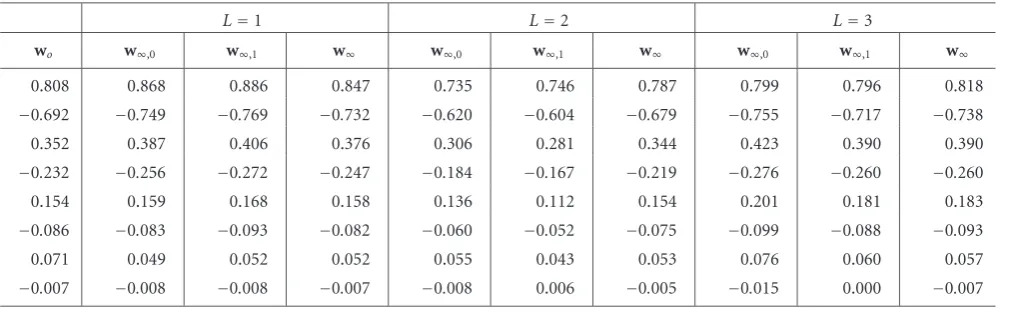
Table2: First eight coefficients of the MMS solution (wo) and of the asymptotic solutions of FX-PE-AP (w∞,0,w∞,1) and of FX-AP algorithm (w∞) with the linear controller.
L=1 L=2 L=3
wo w∞,0 w∞,1 w∞ w∞,0 w∞,1 w∞ w∞,0 w∞,1 w∞
0.808 0.868 0.886 0.847 0.735 0.746 0.787 0.799 0.796 0.818 −0.692 −0.749 −0.769 −0.732 −0.620 −0.604 −0.679 −0.755 −0.717 −0.738 0.352 0.387 0.406 0.376 0.306 0.281 0.344 0.423 0.390 0.390 −0.232 −0.256 −0.272 −0.247 −0.184 −0.167 −0.219 −0.276 −0.260 −0.260 0.154 0.159 0.168 0.158 0.136 0.112 0.154 0.201 0.181 0.183 −0.086 −0.083 −0.093 −0.082 −0.060 −0.052 −0.075 −0.099 −0.088 −0.093 0.071 0.049 0.052 0.052 0.055 0.043 0.053 0.076 0.060 0.057 −0.007 −0.008 −0.008 −0.007 −0.008 0.006 −0.005 −0.015 0.000 −0.007
To estimate the MSE, we have to chooseσsuch that (I−
Fi)σ=vec{Ruu}, that is,σ=(I−Fi)−1vec{Ruu}. Therefore,
the MSE can be evaluated as in
MSEi=Sd+ 2RTudw∞,i+ gTi −2wT∞,iQi I−Fi −1
vecRuu
. (33)
To estimate the MSD, we have to chooseσsuch that (I−
Fi)σ=vec{I}, that is,σ=(I−Fi)−1vec{I}. Thus, the MSD
can be evaluated as in
MSDi= gTi −2wT∞iQi I−Fi −1
vec{I} −w∞,i2. (34)
5. EXPERIMENTAL RESULTS
In this section, we provide a few experimental results that compare theoretically predicted values with values obtained from simulations.
We first considered a multichannel active noise controller
with I = 1,J = 2,K = 2. The transfer functions of the
primary paths are given by
p1,1(z)=1.0z−2−0.3z−3+ 0.2z−4,
p2,1(z)=1.0z−2−0.2z−3+ 0.1z−4,
(35)
and the transfer functions of the secondary paths are
s1,1(z)=2.0z−1−0.5z−2+ 0.1z−3,
s1,2(z)=2.0z−1−0.3z−2−0.1z−3,
s2,1(z)=1.0z−1−0.7z−2−0.2z−3,
s2,2(z)=1.0z−1−0.2z−2+ 0.2z−3.
(36)
For simplicity, we provide results only for a perfect estimate of the secondary paths, that is, we considersi,j(z)=si,j(z).
The input signal is the normalized logistic noise, which has
been generated by scaling the signalξ(n) obtained from the
logistic recursionξ(n+ 1) = λξ(n)(1−ξ(n)), withλ = 4
andξ(0)=0.9, and by adding a white Gaussian noise to get
a 30 dB signal-to-noise ratio. It has been proven for single-channel active noise controllers that in presence of a nonmin-imum phase secondary path, the controller acts as a predic-tor of the reference signal and that a nonlinear controller can
better estimate a non-Gaussian noise process [15,21]. In the case of our multichannel active noise controller, the exact so-lution of the multichannel ANC problem requires the
inver-sion of the 2×2 matrixSformed with the transfer functions
sk,j. The inverse matrixS−1is formed by IIR transfer
func-tions whose poles are given by the roots of the determinant ofS. It is easy to verify that in our example, there is a root out-side the unit circle. Thus, also in our case the controller acts as a predictor of the input signal and a nonlinear controller can better estimate the logistic noise. Therefore, in what fol-lows, we provide results for (1) the two-channel linear
con-troller with memory lengthN =8 and (2) the two-channel
nonlinear controller with memory lengthN =4 whose
in-put data vector is given in (4), with the constantaset to 1.
Note that despite the two controllers have different memory
lengths, they have the same total number of coefficients, that
is,M=16. In all the experiments, a zero mean, white
Gaus-sian noise, uncorrelated between the microphones, has been
added to the error microphone signalsdk(n) to get a 40 dB
signal-to-noise ratio and the parameterδwas set to 0.001.
Tables2and3provide with three-digits precision the first eight coefficients of the MMS solution,wo, and of the
asymp-totic solutions of the FX-PE-AP algorithm at even samples,
w∞,0, and odd samples,w∞,1, and of the approximate FX-AP
algorithm of (6),w∞, forμ=1.0 and for the AP ordersL=1,
2, and 3.Table 2refers to the linear controller andTable 3to the nonlinear controller, respectively. From Tables2and3, it is evident that the asymptotic vector varies with the AP or-der and that the asymptotic solutionsw∞,0,w∞,1, andw∞are
different. However, we must point out that their difference
reduces with the step-size, and for smaller step-sizes it can be difficulty appreciated.
Figure 3diagrams the steady-state MSE, estimated with
(33) or obtained from simulations with time averages over
ten million samples, versus step-size μ and for AP orders
L=1, 2, and 3. Similarly,Figure 4diagrams the steady-state
MSD, estimated with (34) or obtained from simulations with
time averages over ten million samples. From Figures3and4,
Table3: First eight coefficients of the MMS solution (wo) and of the asymptotic solutions of FX-PE-AP (w∞,0,w∞,1) and of FX-AP algorithm (w∞) with the nonlinear controller.
L=1 L=2 L=3
wo w∞,0 w∞,1 w∞ w∞,0 w∞,1 w∞ w∞,0 w∞,1 w∞
0.566 0.699 0.673 0.644 0.445 0.481 0.560 0.600 0.602 0.625 −0.352 −0.448 −0.459 −0.415 −0.259 −0.259 −0.333 −0.394 −0.354 −0.370 0.172 0.163 0.169 0.168 0.216 0.175 0.173 0.194 0.152 0.141
0.042 −0.005 0.021 0.022 0.029 0.048 0.039 0.030 0.044 0.039 −0.877 −0.755 −0.745 −0.816 −1.021 −0.991 −0.884 −0.801 −0.809 −0.736 0.755 0.865 0.792 0.821 0.659 0.754 0.731 0.636 0.711 0.682 −0.230 −0.434 −0.406 −0.367 0.005 −0.122 −0.201 −0.177 −0.234 −0.247 0.268 0.269 0.307 0.292 0.276 0.255 0.266 0.269 0.229 0.220
MSD, respectively, whenL = 2 andL =3. The estimation
errors can be both positive or negative depending on the AP order, the step-size, and the odd or even sample times. On
the contrary, for the AP orderL=1, the estimations are
in-accurate. The large estimation errors forL = 1 are due to
the bad conditioning of the matricesMi−Ithat takes to a
poor estimate of the asymptotic solution. For larger AP or-ders, the data reuse property of the AP algorithm takes to
more regular matricesMi. Indeed,Table 4compares the
con-dition number, that is, the ratio between the magnitude of the largest and the smallest of the eigenvalues of the matrix
Mi−I of the nonlinear controller at even-time indexes for
the AP ordersL=1, 2, and 3 and for different values of the
step-size.
Figures5and6diagram the ensemble averages, estimated
over 100 runs of the FX-PE-AP and the FX-AP algorithms with step-size equal to 0.032, of the mean value of the resid-ual power of the error computed on 100 successive samples for the nonlinear and the linear controllers, respectively. In the figures, the asymptotic values (dashed lines) of the
resid-ual power of the errors are also shown. From Figures5and
6, it is evident that the nonlinear controller outperforms the linear one in terms of residual error. Nevertheless, it must be observed that the nonlinear controller reaches the steady-state condition in a slightly longer time than the linear con-troller. This behavior could also be predicted by the
maxi-mum eigenvalues of the matricesMi andFi, which are
re-ported inTable 5. Since the step-sizeμassumes a small value
(μ=0.032), in the table we have the same maximum
eigen-value forM0andM1and forF0andF1. Moreover, as already
observed for the filtered-xPE LMS algorithm [2], from
Fig-ures5and6it is apparent that for this step-size, the FX-PE-AP algorithm has a convergence speed that is half (i.e., 1/K) of the approximate FX-AP algorithm. In fact, the diagrams on the left and the right of the figures can be overlapped but the time scale of the FX-PE-AP algorithm is the double of the FX-AP algorithm. The same observation applies also when a larger number of microphones are considered. For example,
Figures7 and8plot the ensemble averages, estimated over
100 runs of the FX-PE-AP and the FX-AP algorithm with
step-size equal to 0.032, of the mean value of the residual power of the error computed on 100 successive samples for
the nonlinear controller withI =1,J =2,K =3, and with
I =1,J = 2,K =4, respectively. In the caseI =1,J = 2,
K = 3, the transfer functions of the primary paths, p1,1(z)
andp2,1(z), and of the secondary paths,s1,1(z),s1,2(z),s2,1(z),
ands2,2(z), are given by (35)-(36), while the other primary
and secondary paths are given by
p3,1(z)=1.0z−2−0.3z−3+ 0.1z−4,
s3,1(z)=1.6z−1−0.6z−2+ 0.1z−3,
s3,2(z)=1.6z−1−0.2z−2−0.1z−3.
(37)
In the caseI = 1,J = 2,K = 4, the transfer functions of
the primary paths,p1,1(z),p2,1(z), andp3,1(z), and of the
sec-ondary paths,s1,1(z),s1,2(z),s2,1(z),s2,2(z),s3,1(z), ands3,2(z),
are given by (35)–(37), and the other primary and secondary paths are given by
p4,1(z)=1.0z−2−0.2z−3+ 0.2z−4,
s4,1(z)=1.3z−1−0.5z−2−0.2z−3,
s4,2(z)=1.3z−1−0.4z−2+ 0.2z−3.
(38)
All the other experimental conditions are the same of the case
I =1,J =2,K =2. Figures7and8confirm again that for
μ=0.032, the FX-PE-AP algorithm has a convergence speed
that is reduced by a factorKwith respect to the approximate
FX-AP algorithm. Nevertheless, we must point out that for larger values of the step-size, the reduction of convergence speed of the FX-PE-AP algorithm can be even larger than a factorK.
L=1 10 1
10 2
10 1 100
L=2 10 1
10 2
10 1 100
L=3 10 1
10 2
10 1 100
(a)
10 1
10 2
10 1 100
10 1
10 2
10 1 100
10 1
10 2
10 1 100
(b)
10 1
10 2
10 1 100
10 1
10 2
10 1 100
10 1
10 2
10 1 100
(c)
10 1
10 2
10 1 100
10 1
10 2
10 1 100
10 1
10 2
10 1 100
(d)
L=1 100
10 1 10 2 10 3 10 4 10 5
10 1 100
L=2 100
10 1 10 2 10 3 10 4 10 5
10 1 100
L=3 100
10 1 10 2 10 3 10 4 10 5
10 1 100
(a)
100 10 1 10 2 10 3 10 4 10 5
10 1 100
100 10 1 10 2 10 3 10 4 10 5
10 1 100
100 10 1 10 2 10 3 10 4 10 5
10 1 100
(b)
100 10 1 10 2 10 3 10 4 10 5
10 1 100
100 10 1 10 2 10 3 10 4 10 5
10 1 100
100 10 1 10 2 10 3 10 4 10 5
10 1 100
(c)
100 10 1 10 2 10 3 10 4 10 5
10 1 100
100 10 1 10 2 10 3 10 4 10 5
10 1 100
100 10 1 10 2 10 3 10 4 10 5
10 1 100
(d)
10 1
10 2
Re
si
d
u
al
p
o
w
er
0 50 100 150 200
Time
L=3 L=2
L=1
10 3
(a)
10 1
10 2
Re
si
d
u
al
p
o
w
er
0 25 50 75 100
Time
L=3 L=2
L=1
10 3
(b)
Figure5: Evolution of residual power of the error of (a) the FX-PE-AP algorithm and (b) FX-AP algorithm with a nonlinear controller and I=1,J=2,K=2. The dashed lines diagram the asymptotic values of the residual power.
10 1
10 2
Re
si
d
u
al
p
o
w
er
0 50 100 150 200
Time
L=3 L=2
L=1
10 3
(a)
10 1
10 2
Re
si
d
u
al
p
o
w
er
0 50 100 150 200
Time
L=3 L=2
L=1
10 3
(b)
Figure6: Evolution of residual power of the error of (a) the FX-PE-AP algorithm and (b) FX-AP algorithm with a linear controller and I=1,J=2,K=2. The dashed lines diagram the asymptotic values of the residual power.
10 1
10 2
Re
si
d
u
al
p
o
w
er
0 75 150 225 300
Time
L=3 L=2
L=1
10 3
(a)
10 1
10 2
Re
si
d
u
al
p
o
w
er
0 25 50 75 100
Time
L=3 L=2
L=1
10 3
(b)
10 1
10 2
Re
si
d
u
al
p
o
w
er
0 100 200 300 400
Time
L=3 L=2
L=1
10 3
(a)
10 1
10 2
Re
si
d
u
al
p
o
w
er
0 25 50 75 100
Time
L=3 L=2
L=1
10 3
(b)
Figure8: Evolution of residual power of the error of (a) the FX-PE-AP algorithm and (b) FX-AP algorithm with a nonlinear controller and I=1,J=2,K=4. The dashed lines diagram the asymptotic values of the residual power.
Table4: Condition number of the matrixM0−Ifor different step-sizes and for the AP ordersL=1, 2, and 3 with the nonlinear con-troller.
L μ=1.0 μ=0.25 μ=0.0625 L=1 33379 36299 36965 L=2 6428 9711 10575
L=3 2004 3290 3623
Table5: Maximum eigenvalues of the matricesMiandFifor the AP
ordersL=1, 2, and 3 with the linear and the nonlinear controllers.
Controllers L=1 L=2 L=3
Nonlinear λmax(Mi) 0.999999 0.999996 0.999987 λmax(Fi) 0.999998 0.999992 0.999974
Linear λmax(Mi) 0.999991 0.999972 0.999957 λmax(Fi) 0.999981 0.999944 0.999914
6. CONCLUSION
In this paper, we have provided an analysis of the transient and the steady-state behavior of the FX-PE-AP algorithm. We have shown that the algorithm in presence of station-ary input signals converges to a cyclostationstation-ary process, that
is, the asymptotic value of the coefficient vector, the
mean-square error and the mean-mean-square deviation tend to peri-odic functions of the sample time. We have shown that the
asymptotic coefficient vector of the FX-PE-AP algorithm
dif-fers from the minimum-mean-square solution of the ANC problem and from the asymptotic solution of the AP algo-rithm from which the FX-PE-AP algoalgo-rithm was derived. We have proved that the transient behavior of the algorithm can be studied by the cascade of two linear systems. By studying the system matrices of these two linear systems, we can pre-dict the stability and the convergence speed of the algorithm. Expressions have been derived for the steady-state MSE and MSD of the FX-PE-AP algorithm. Eventually, we have
com-pared the FX-PE-AP with the approximate FX-AP algorithm
introduced in [4]. Compared with the approximate FX-AP
algorithm, the FX-PE-AP algorithm is capable of reducing
the adaptation complexity with a factorK. Nevertheless, also
the convergence speed of the algorithm reduces of the same value.
APPENDIX
PROOF OFTHEOREM 1
If we apply the expectation operator to both sides of (23),
and if we take into account the hypothesis in (A1), we can derive the result of
Ew(mK+i+K)2Σ
=Ew(mK+i)2Σi
−2EwT(mK+i)EqΣ,i(mK+i)
+EmTi(mK+i)Σmi(mK+i)
,
(A.1)
where
Σ i=E
MT
i(n)ΣMi(n)
. (A.2)
Moreover, under the same hypothesis (A1), the evolution of the mean of the coefficient vector from (15) is described by
Ew(mK+i+K)=EMi(mK+i)
Ew(mK+i)
−Emi(mK+i)
.
(A.3)
We manipulate (A.1), (A.2), and (A.3) by taking advan-tage of the properties of the vector operator vec{·}and of the
Kronecker product,⊗. We introduce the vectorsσ=vec{Σ}
andσ=vec{Σ}. Since for any matricesA,B, andC, it is
vec{ABC} = CT⊗Avec{B}, (A.4)
we have from (A.2) that
σ=F
whereFiis theM2×M2matrix defined by
Fi=E
MTi(n)⊗MTi(n). (A.6)
The productE[qTΣ,i(n)]E[w(n)] can be evaluated as in
EwT(n)Eq Σ,i(n)
=TrEwT(n)Eq
Σ,i(n)
=EwT(n)vecEqΣ,i(n)
, (A.7)
with
vecEqΣ,i(n)
=vecEMTi(n)Σmi(n)
=EmT
i(n)⊗MTi(n)
σ=Qi,σ,
(A.8)
and theM×M2matrixQ
iis given by
Qi=E
mT
i(n)⊗MTi(n)
. (A.9)
Moreover, the last term of (A.1) can be computed as in
TrEmT
i(n)Σmi(n)
=gT
iσ, (A.10)
where
gi=vec
Emi(n)mTi(n)
. (A.11)
Accordingly, introducingσ andσ instead ofΣ andΣ
and using the results of (A.5), (A.7), (A.8), and (A.10), the recursion in (A.1) can be rewritten as follows:
Ew(mK+i+K)2vec−1{σ}
=Ew(mK+i)2vec−1{F
iσ}
−2EwT(mK+i)Qiσ+gTiσ.
(A.12)
The recursion in (A.12) shows that in order to evaluate
E[w(mK+i+K)2
vec−1{σ}], we needE[w(mK+i)2vec−1{F iσ}].
This quantity can be inferred from (A.12) by replacingσwith
Fiσ, obtaining the following relation:
Ew(mK+i+K)2vec−1{F iσ}
=Ew(mK+i)2vec−1{F2
iσ}
−2EwT(mK+i)Q
iFiσ+giTFiσ.
(A.13)
This procedure is repeated until we obtain the following ex-pression [12,18,19]:
Ew(mK+i+K)2vec−1{FM2−1 i σ}
=Ew(mK+i)2vec−1{FM2
i σ}
−2EwT(mK+i)QiFM
2−1
i σ+gTiFM 2−1 i σ.
(A.14)
According to the Cayley-Hamilton theorem, the matrix Fi
satisfies its own characteristic equation. Therefore, if we in-dicate withpi(x) the characteristic polynomial ofFi,pi(x)=
det(xI−Fi), for the Cayley-Hamilton theorem we have that
pi(Fi) = 0. The characteristic polynomial pi(x) is an order
M2polynomial that can be written as in
pi(x)=xM 2
+pM2−1,ixM 2−1
+· · ·+p0,i, (A.15)
where we indicate with{pj,i}the coefficients of the
polyno-mial. Sincepi(Fi)=0, we deduce that [12,18,19]
Ew(n)2vec−1{FM2 i σ}
= − M2−1
j=0
pj,iE
w(n)2vec−1{Fj iσ}
.
(A.16)
The results of (A.3), (A.12)–(A.14), and (A.16) prove
Theorem 1that describes the transient behavior of the FX-PE-AP algorithms.
ACKNOWLEDGMENT
This work was supported by MIUR under Grant PRIN 2004092314.
REFERENCES
[1] P. A. Nelson and S. J. Elliott,Active Control of Sound, Academic Press, London, UK, 1995.
[2] S. C. Douglas, “Fast implementations of the filtered-X LMS and LMS algorithms for multichannel active noise control,” IEEE Transactions on Speech and Audio Processing, vol. 7, no. 4, pp. 454–465, 1999.
[3] M. Bouchard, “Multichannel affine and fast affine projection algorithms for active noise control and acoustic equalization systems,”IEEE Transactions on Speech and Audio Processing, vol. 11, no. 1, pp. 54–60, 2003.
[4] A. Carini and G. L. Sicuranza, “Transient and steady-state analysis of filtered-xaffine projection algorithms,”IEEE Trans-actions on Signal Processing, vol. 54, no. 2, pp. 665–678, 2006. [5] Y. Neuvo, C.-Y. Dong, and S. K. Mitra, “Interpolated finite
im-pulse response filters,”IEEE Transactions on Acoustics, Speech, and Signal Processing, vol. 32, no. 3, pp. 563–570, 1984. [6] S. Werner and P. S. R. Diniz, “Set-membership affine
projec-tion algorithm,”IEEE Signal Processing Letters, vol. 8, no. 8, pp. 231–235, 2001.
[7] S. C. Douglas, “Adaptive filters employing partial updates,” IEEE Transactions on Circuits and Systems II: Analog and Digi-tal Signal Processing, vol. 44, no. 3, pp. 209–216, 1997. [8] K. Do˘ganc¸ay and O. Tanrikulu, “Adaptive filtering algorithms
with selective partial updates,”IEEE Transactions on Circuits and Systems II: Analog and Digital Signal Processing, vol. 48, no. 8, pp. 762–769, 2001.
[9] G. L. Sicuranza and A. Carini, “Nonlinear multichannel active noise control using partial updates,” inProceedings of IEEE In-ternational Conference on Acoustics, Speech, and Signal Process-ing (ICASSP ’05), vol. 3, pp. 109–112, Philadelphia, Pa, USA, March 2005.
[10] E. Bjarnason, “Analysis of the filtered-X LMS algorithm,”IEEE Transactions on Speech and Audio Processing, vol. 3, no. 6, pp. 504–514, 1995.
[12] H.-C. Shin and A. H. Sayed, “Mean-square performance of a family of affine projection algorithms,”IEEE Transactions on Signal Processing, vol. 52, no. 1, pp. 90–102, 2004.
[13] M. Bouchard and S. Quednau, “Multichannel recursive-least-squares algorithms and fast-transversal-filter algorithms for active noise control and sound reproduction systems,”IEEE Transactions on Speech and Audio Processing, vol. 8, no. 5, pp. 606–618, 2000.
[14] V. J. Mathews and G. L. Sicuranza,Polynomial Signal Process-ing, John Wiley & Sons, New York, NY, USA, 2000.
[15] P. Strauch and B. Mulgrew, “Active control of nonlinear noise processes in a linear duct,”IEEE Transactions on Signal Process-ing, vol. 46, no. 9, pp. 2404–2412, 1998.
[16] D. P. Das and G. Panda, “Active mitigation of nonlinear noise processes using a novel filtered-s LMS algorithm,”IEEE Trans-actions on Speech and Audio Processing, vol. 12, no. 3, pp. 313– 322, 2004.
[17] S. J. Elliott, I. Stothers, and P. A. Nelson, “A multiple error LMS algorithm and its application to the active control of sound and vibration,”IEEE Transactions on Acoustics, Speech, and Sig-nal Processing, vol. 35, no. 10, pp. 1423–1434, 1987.
[18] A. H. Sayed,Fundamentals of Adaptive Filtering, John Wiley & Sons, New York, NY, USA, 2003.
[19] T. Y. Al-Naffouri and A. H. Sayed, “Transient analysis of data-normalized adaptive filters,”IEEE Transactions on Signal Pro-cessing, vol. 51, no. 3, pp. 639–652, 2003.
[20] S. Haykin,Adaptive Filter Theory, Prentice-Hall, Englewood Cliffs, NJ, USA, 2002.