©2014 JNAS Journal-2014-3-8/839-851 ISSN 2322-5149 ©2014 JNAS
Synchronization of SA and AV Node Oscillators
using PSO optimized RBF-based controllers and
Comparison with SMC
Morteza Sharafi
1*, Hossein Mokhtarian Daluei
2, Esmat Asaei
3, Ali Barbar
4and
Abdol Hossein Ayyobi
51- Young Researchers Club, Gonabad branch, Islamic Azad University,Gonabad,Iran 2- Department of basic science, Islamic Azad University, Gonabad Branchm Gonabad,Iran
3- Assistant professor of Cardiology, Arya Hospital ,Islamic Azad University , Mashhad Branch, Mashhad, Iran
4- Department of physical Education, Islamic Azad University, Gonabad Branchm Gonabad,Iran 5- Ms student of Medical Information Technology Biomedical Engineering Department Amirkabir University of
Technology
Corresponding author:
Morteza Sharafi
ABSTRACT: This paper studies the synchronization of SA and AV Node Oscillators using PSO optimized RBF-based controllers systems. High levels of control activities may excite unmodeled dynamics of a system. This changes the rules for controlling the system and achieving an acceptable control performance. In fact, the objective here is to reach a trade-off between tracking performance and parametric uncertainty. Two methods are proposed to synchronize the general forms of Van Der Pol (VDP) Model, and their performance. These methods use the radial basis function (RBF)- based neural controllers for this purpose. The first method uses a standard RBF neural controller. Particle swarm optimization (PSO) algorithm is used to derive and optimize the parameters of the RBF controller. In the second method, with the aim of increasing the robustness of the RBF controller, an error integral term is added to the equations of RBF neural network. For this method, the coefficients of the error integral component and the parameters of RBF neural network are also derived and optimized via PSO algorithm. For better comparison Simulation results show the effectiveness and superiority of the proposed methods in both performance in comparison with SMC controller.
Keywords: Synchronization, Van der Pol Model, SA and AV Node Oscillators, SMC.
INTRODUCTION
840
2. An Overview of Cardiovascular Physiology
The heart will not be able to pump unless it receives an electrical excitation which originates pumping. Generation and transmission of electrical impulses depend on automaticity, excitability, conductivity, and contractibility of cardiac cells. Transmission of cardiac impulses creates depolarization-repolarization cycles in cardiac cells. When at rest, the cardiac cells are polarized, i.e. they show no sign of electrical activity. The cell membranes separate different concentrations of such ions as K+ and Na+ and create larger negative charges inside the cell. The phenomenon is
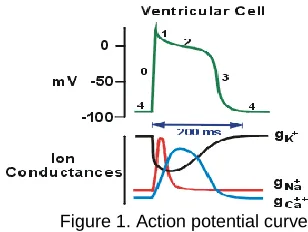
known as resting membrane potential. As soon as an electrical excitation arrives, the ions are transported at either side of the cell membrane leading to action potential or depolarization. Once a cell is completely depolarized, it tries to return to its initial conditions or resting state. This process is referred to as repolarization. The electrical charges are reversed and return to the normal state. A typical depolarization-repolarization cycle consists of five phases (0 to 4) (Fig. 1 presents action potential curve and variations in voltage in these five phases):
Phase 0:
A cell receives an impulse from its adjacent cell and becomes depolarized.
Phase 1:
An initial immediate repolarization takes place.
Phase 2:
This slow repolarization step is also known as plateau phase. In Phase 1, Phase 2, and early in Phase 3, cardiac cells are at total inexcitability state. In this phase, not every stimulus with any intensity can result in cellular response.
Phase 3:
This phase is known as rapid repolarization. At this time, the cell returns to its initial state. At the last one-third of this phase, when the cell enters the relative excitability state, very strong excitations can depolarize it.
Phase 4:
This step is the resting state for action potential. By the end of the fourth phase, the cell is ready for next excitations. All these activities can be recorded on electrocardiogram (ECG).
Figure 1. Action potential curve
2-1. Electromechanical Conduction mechanism of the Heart
841
Figure 2. Pacemakers and impulses routes
3. Introduction to Synchronization
The word “synchronous” has its origin in the Greek word meaning “sharing the same time period”, and since its origin, the word has been used in everyday applications to denote agreement or dependency of the different processes in terms of time. Historically, analysis of synchronization of dynamic systems has received considerable attention as a very important subject in physics. The phenomenon dates back to the 17th century when Hyugens
patented two synchronized pendulum clocks with very weakly coupled oscillations.
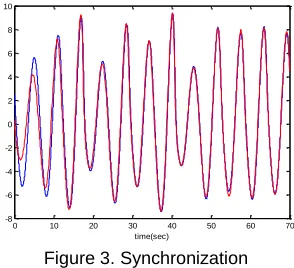
In synchronization of oscillatory systems, two identical systems oscillate simultaneously. If one system is designated as master and another identical system is assigned as slave, when a proper control input is applied to the slave, the dynamic behavior or the two systems will become identical after a period of time. The slave, which often has to become synchronized with the master, is usually referred to as the response system or received while the master is sometimes called the drive or sender. The figure below, for example, shows synchronization of state trajectories of two systems after a few seconds.
Figure 3. Synchronization
As mentioned earlier, the objective here is to synchronize the slave with the master. For this purpose, a nonlinear control system must be designed to receive the control signals from the master and control the slave.
Figure 4. A schematic of master-slave combination
Fig. 4 presents a schematic of a master-slave system. Here, behavior of the slave is clearly controlled by the master. In addition, the slave may have conditions different from those of the master.
3-1- Van Der Pol (VDP) Model
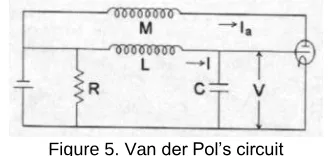
The first attempts to explain oscillatory behavior of the heart cells was made in 1926 by Van der Pol [34]. Balthasar van der Pol was a German physicist and an electronic engineer. He was able to discover stable oscillations, now called limit cycle. Van der Pol was the first person to examine relaxation oscillations by studying an electrical
0 10 20 30 40 50 60 70 -8
-6 -4 -2 0 2 4 6 8 10
time(sec)
m
a
s
te
r
a
n
d
s
la
v
e
s
ig
n
a
842
circuit which had self-entertained oscillations with the amplitude independent of initial conditions. The schematic of this circuit is shown in Fig. 5.Figure 5. Van der Pol’s circuit
The equations of the voltages and currents in this circuit are
)
(
V
C
I
a
, 3 1 3
V V Ia
, d
dI M V RI d
dI
L a
)1) where
L C R LC M c
, t LC M
C R x V 1
(2)
By substitution x, t, and c from (2) into the current-voltage equations in (1), the following differential equation, known as Van der Pol’s equation, is obtained:
This circuit serves as an essential model for self-entertained oscillations in physics, electronic engineering, biology, neurology, and many other sciences. Since c is the control parameter in this equation, different periodic responses can be initiated by changing the value of c with large values of c resulting in relaxation oscillations.
For some important properties, Van der Pol nonlinear equations are used to model the oscillations in the heart. First, Van der Pol oscillator adjusts its natural frequency to the frequency of the input signal without changing the oscillation amplitude. This is critically important as the low-frequency slave oscillator has to adjust itself to the dominant high-frequency pacemaker of the heart.
Therefore, Van der Pol model used in this project to model the oscillators at SA and AV nodes. Each oscillator at SA node and AV node is modeled using Van der Pol differential equations. The interaction between the oscillators of the heart is modeled by the following Van der Pol equations. The coupling between these interacting oscillators is modeled as follows:
)
4
(
)
(
)
(
:
)
3
(
)
(
)
(
:
4 2 2 4 2 3 2
3 2 2 4
4 3
2 4 1 2 2 1 1
1 2 1 2
2 1
u
x
x
R
x
x
c
x
w
x
x
x
AV
x
x
R
x
x
c
x
w
x
x
x
S A
The first equation, which models SA oscillations, is the drive in the present synchronization problem while the second equation, for modeling AV oscillations, represents the response system.
4. Generating Action Potential by the Model
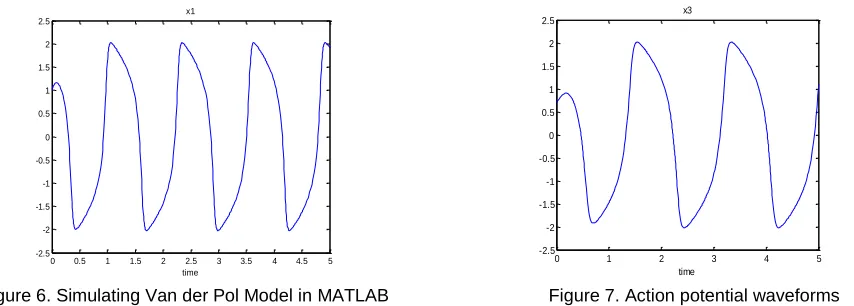
The rhythm of the heart is determined by a series of electric impulses (action potential) which travel throughout the heart. The figures below show action potentials for SA and AV cells obtained through.
0 )
1 ( 2
2 2
x
dt dx x
c dt
843
Figure 6. Simulating Van der Pol Model in MATLAB Figure 7. Action potential waveforms
These figures demonstrate the validity of the Van der Pol model used here in terms of how these waveforms match the actual forms generated in the heart.
5. Designing Sliding Mode Controller
Sliding mode control provides a robust controller for nonlinear dynamic systems, although it involves a discrete-time control factor which may lead to chattering in a neighborhood of the sliding surface. One common solution to reduce chattering is to introduce a boundary layer in the vicinity of the sliding surface [11]. This can improve closed-loop stability and resolve chattering, but a finite steady-state error will exist as a result of finite steady-state error gain in the control algorithm.
The proposed controller provides a desirable transient state as well as a robust performance. In addition, it combines PI control and SMC to prevent chattering. It will be demonstrated that the closed-loop system is globally stable in the sense of Lyapunov (i.s.L.) and that the output of the system can asymptotically track the reference input by modeling uncertainties and disturbances.
6.Problem Definition
A typical nonlinear SISO system of order n can be shown as
x
y
t
a
u
t
x
g
t
x
f
x
n
(
,
)
(
,
)
(
)
) (
(5)
where f and g are unknown nonlinear functions, and
n T n T
n x x x R
x x x
x[ ,,..., ( 1)] [ 1, 2,..., ]
is the state vector of
the system, assumed to be measurable.
u
R
andy
R
represent the system input and output, respectively and d(t) is an unknown outer disturbance. It is assumed that d(t) is bounded by the upper bound D; i.e. d(t) ≤ D. For the system (5) to be controllable, we must have 𝑔(𝑥, 𝑡) ≠ 0. Therefore, we assume that 𝑔(𝑥, 𝑡) > 0. The control problem is to find the state x for tracking the desirable state xd in the presence of uncertainties and outer disturbances withthe following tracking error:
𝑒 = 𝑥 − 𝑥𝑑 [𝑒, 𝑒̇, … , 𝑒(𝑛−1)]𝑇 ∈ 𝑅𝑛 (6) The sliding surface for the state error can be determined as
𝑠(𝑒) = 𝑐1𝑒 + 𝑐2𝑒̇ + ⋯ + 𝑐𝑛−1𝑒(𝑛−2)+ 𝑒(𝑛−1)= 𝑐𝑇𝑒 (7)
where c = [c1, c2, … , cn−1, 1]Trepresents the coefficients of the Hurwitz polynomial ℎ(𝜆) = 𝜆𝑛−1+ 𝑐𝑛−1𝜆𝑛−2+ ⋯ + 𝑐1. All roots lie in the left-hand plane and λ is the Laplace operator. If the initial condition e(0)=0 holds, in the tracking problem 𝑥 = 𝑥𝑑, an error vector on the state space may be defined on the sliding surface s(e)=0 for all t>0. A sufficient condition for this, is to choose a control strategy as
1 2 𝑑 𝑑𝑡𝑠
2(𝑒) ≤ −𝜂|𝑠| , 𝜂 ≥ 0 (8)
The state of the controlled system always moves toward the sliding surface. The sign of the control signal must switch based on the state trajectory and the sliding surface. Consider the nonlinear control problem shown in (5). If 𝑓(𝑥, 𝑡) and 𝑔(𝑥, 𝑡) are known, the SMC input u* satisfies the sliding condition (8).
(9)
0 0.5 1 1.5 2 2.5 3 3.5 4 4.5 5 -2.5
-2 -1.5 -1 -0.5 0 0.5 1 1.5 2 2.5
x1
time
0 1 2 3 4 5
-2.5 -2 -1.5 -1 -0.5 0 0.5 1 1.5 2 2.5
x3
844
𝑢∗= 1𝑔(𝑥, 𝑡)[− ∑ 𝑐𝑖𝑒
(𝑖)− 𝑓(𝑥, 𝑡) + 𝑥 𝑑
(𝑛)− 𝜂𝑠𝑛𝑔(𝑠) 𝑛−1
𝑖=1
]
where
𝑠𝑛𝑔(𝑠) = {
1 𝑓𝑜𝑟 𝑠 > 0 0 𝑓𝑜𝑟 𝑠 = 0 −1 𝑓𝑜𝑟 𝑠 < 0
(10)
A Lyapunov candidate function is defined as: 𝑉1=
1 2s
2(e) (11)
By differentiating (11) with respect to time, 𝑉̇for the system trajectory is obtained: 𝑉̇ = 𝑠. 𝑠̇ = 𝑠. (𝑐1𝑒̇ + 𝑐2𝑒̈ + ⋯ + 𝑐𝑛−1𝑒(𝑛−1)+ 𝑥(𝑛)+ 𝑥𝑑(𝑛)) (12)
= 𝑠. (∑ 𝑐𝑖𝑒(𝑖)+ 𝑓(𝑥, 𝑡) + 𝑔(𝑥, 𝑡)𝑢 + 𝑑(𝑡) − 𝑥𝑑(𝑛) 𝑛−1
𝑖=1
) ≤ −𝜂|𝑠|
Therefore, the SMC input u* satisfies the sliding condition (8). Clearly, to satisfy this condition, an impulsive
control condition must be added in the form of 𝑢∗= 𝑢
𝑒𝑞− 𝑢𝑠𝑤
where
𝑢𝑒𝑞= 𝑔(𝑥, 𝑡)−1[− ∑ 𝑐𝑖𝑒(𝑖)− 𝑓(𝑥, 𝑡) + 𝑥𝑑 (𝑛) 𝑛−1
𝑖=1 ] (13) 𝑢𝑠𝑤= −𝑔(𝑥, 𝑡)
−1
. 𝜂𝑠𝑛𝑔(𝑠) (14)
But since f and g are still unknown, it is difficult to apply the control law (9) to an unknown nonlinear system. Moreover, the switching type condition usw will create chattering.
7. Synchronization Using SMC
Using the SMC technique, the problem of the controller design is divided into two independent steps: Step 1: Selecting a sliding surface for desirable sliding movement
Step 2: Designing a controller to move any trajectory within the state space toward the sliding surface, where a non-continuous controller can be used to maintain the ultimate state on this surface. A special characteristic of this control mechanism is that while it is in the sliding mode, the system is robust with respect to parameter uncertainty and outer disturbances.
For this purpose, first a sliding surface must be selected; i.e. a time-varying surface s(t) defined as
1
1
j j je e k s
(15)
where ej is the state error and ρ is relative degree, and the positive constants k are chosen so that the following
polynomial becomes a Hurwitz polynomial:
1 2
1
1k ...k
(16)
This condition ensures that the movements will be limited to the surface s=0 and, therefore, the tracking errors e=x-xd (where xd represents the desirable states) will converge to zero. Sliding mode or sliding state refers to the
behavior of the system on the sliding surface.
A feedback control law u is selected in a way that satisfies the sliding condition. However, in order to account for uncertainties in modeling and disturbances, the control law must be non-continuous on s(t). Since the switching control law may not be implemented perfectly (for example, the switching does not occur instantly and s is not known with infinite accuracy), this results in chattering which is not desirable in practical applications because it increases control activities and may also excite high-frequency dynamics (e.g. unmodeled structural modes, neglected delays, etc) which have not been considered during modeling.
We show the sliding mode dynamics as s0.
By solving the equation above, an expression, known as equivalent control ueq, is found for u. it can be thought
of as a continuous control law which satisfies
s
0
if the dynamics are known.845
u
x
x
R
x
x
c
x
x
AV
x
x
c
x
x
SA
d d d d d
)
(
)
1
(
:
)
1
(
:
2 2 2 1
(17) where c2 is assumed to contain uncertainty.The objective in the synchronization problem is to make AV oscillator tracj SA oscillator. Therefore, for the system
above to track x(t) xd(t), sliding surface is defined as
d
x
x
x
x
x
x
dt
d
S
~
~
~
~
)
(
( 1)
(18) where s(t) is both a dynamic and a locus.
0 ~ ~ ) 1 ( ~ ~ ~ 2
2
x x u x R x x c x x x x x x S d d d
(19) Then we have:x
x
x
R
x
x
c
x
u
eq
2(
1
2)
d
d
~
(20)
Thus, equivalent control is obtained. The above value for u cannot be calculated since c2 is unknown. Suppose that
2 2 2
ˆ c c
c
, where
c
2represents parameter uncertainty. Hence, for u we have:0
)
1
)(
ˆ
(
~
~
)
1
(
ˆ
ˆ
2 2 2 2 2
x
x
c
c
S
x
x
x
R
x
x
c
x
u
eq d d
(21)In order for the sliding condition to hold, despite of the uncertainties in the system dynamics, a discontinuous term is
added to uˆeqon the surface s=0:
)
sgn(
)
1
)(
ˆ
(
)
sgn(
ˆ
2 22
c
x
x
k
S
c
S
S
k
u
u
eq
(22)where sgn is the sign function, and k is defined as follows in a way that the sliding conditions are met and sliding mode movement occurs.
0 , ) 1 )( ˆ
( 2 2 2
c c x x
k
(23)
As seen here, discontinuity of k on the surface s=0 increases with the parameter uncertainty. By choosing a proper value for k, it is possible to reduce chattering as well as the time needed for attaining sliding mode [52]. This ensures that s will converge to zero within a finite time and will remain at this value for all subsequent times, and therefore, the errors e1 and e2 will asymptotically approach zero. However, this technique my lead to excitation of
unmodeled high-frequency dynamics or improper switching within the system, thereby deteriorating the system performance or even causing instability. Researchers, therefore, always tried to address this issue. For this purpose, different methods have been employed to reduce or eliminate this type of excitation. One common technique used to resolve this problem is to replace discontinuous control with a continuous approximation. In this way, the discontinuous function sgn(s) is replaced with its continuous approximation sat(s). This technique works well in resolving the problem but often at the expense of a non-zero steady-state error. Here, we propose an appropriate method for synchronizing two oscillators with parameter uncertainty and even with different structures.
7-1 Stability
To observe dynamic stability of error in the proposed controller, the Lyapunov candidate function V=s2/2 was
chosen. The derivative of V is given by
846
Note that sgn(s) is always positive as long as k>0 and e≠0.Since V is a positive and decrescent function and
V
is negative definite, the equilibrium point(
e
i
0
,
i
1
,
,
n
)
is uniformly stable; that is,
e
i(
t
)
L
. It can be easily shown thate
i(
t
)
,
i
1
,
,
n
are square-integrable withrespect to t; i.e.
e
i
L
2. According to Barbalat's Lemma [53], and for any initial conditions, we havee
i(
t
)
L
,which means
e
i(
t
)
0
ast
. Thus, S asymptotically converges to zero. Therefore, xxd whent
. This shows that the SMC has synchronized the two systems.7-2 Simulation Results
To demonstrate the capabilities of the proposed method, in this section synchronization is carried out for two sample systems. The descriptive equations for the SA and AV oscillators are:
u
x
x
R
x
x
c
x
w
x
x
x
AV
x
x
c
x
w
x
x
x
SA
)
(
)
1
(
:
)
1
(
:
4 2 4 2 3 2 3 2 2 4 4 3 2 2 1 1 1 2 1 2 2 1
(25)The initial conditions for the master and slave are (1,4) and (0.7, 2), respectively. Based on the physiological facts, a one-way coupling is considered here. The frequency is 60 pulses per minute for the first oscillator and 40
pulses per minute for the second oscillator. It is assumed that c2 contains uncertainty and cˆ2 c2c2where
c
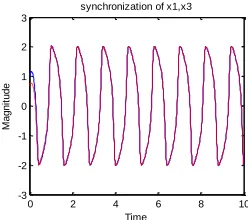
2represents uncertainty. SA and AV oscillators, synchronized by the proposed method despite parameter uncertainty, are shown in Fig. 8.
Figure 8. Synchronization using SMC Figure 9. presents synchronization error which has diminished over time
8. PSO algorithm
PSO is a population-based stochastic optimization technique, which does not use the gradient of the problem being optimized, so it does not require being differentiable for the optimization problem as is necessary in classic optimization algorithms. Therefore, it can also be used in optimization problems that are partially irregular, time variable, and noisy. In PSO algorithm, each bird, referred to as a “particle”, represents a possible solution for the problem. Each particle moves through the D-dimensional problem space by updating its velocities with the best solution found by itself (cognitive behavior) and the best solution found by any particle in its neighborhood (social behavior). Particles move in a multidimensional search space, and each particle has a velocity and a position as follows:
)
27
(
)
1
(
)
(
)
1
(
)
26
(
)
(
)
(
)
(
)
1
(
1 2
k
v
k
x
k
x
k
x
G
k
x
P
k
v
k
v
i i i i i i i i ii
0 2 4 6 8 10
-2.5 -2 -1.5 -1 -0.5 0 0.5 1 1.5 2 2.5
Sync of x1,x3
Time(sec) 0 2 4 6 8 10
847
where i is the particle index, k is the discrete-time index, vi is the velocity of ith particle, xi is the position of ith particle, Pi is the best position found by i th particle (personal best), G is the best position found by swarm (globalbest), and γ1,2 are random numbers in the interval [0, 1] applied to ith particle. In our simulations, the following equation is used for velocity:
(
)
]
[
(
)
]
(
28
)
[
)
(
)
(
)
1
(
k
k
v
k
1 1P
x
k
2 2G
x
k
v
i
i
i i
i
i i
iin which ϕ is inertia function and β1, β2 are acceleration constants. The flowchart of the standard PSO algorithm is depicted in Fig. 10.
9.Proposed synchronization schemes
As mentioned before, the synchronization scheme consists of two systems: the master and the slave (Fig. 11). In this scheme, an RBF- or “RBF + error integral”-based controller is used to make the states of the slave system follow the states of the master system, in the presence of uncertainties and external disturbances. It should be noted that in Fig. 11 h(·) can be any continuous function. In this section, two proposed methods of systems synchronization are described: (14) RBF-based nonlinear controller, (15) “RBF + error integral” model in which an integral term is added to RBF model to improve the robustness of the proposed controller. To optimize the parameters of these controllers, PSO as a continuous evolutionary algorithm is also used. The mathematical formulation:
Figure 10. Flowchart of PSO algorithm
of the proposed methods is stated in the following subsections:
10. control by RBF model
Consider the control system in (15), for this system the following RBF-based controller is proposed:
)
29
(
)
(
)
(
t
W
e
u
T
in which u(t)is the control signal, and
i im is imT
n
e
x
x
i
n
x
e
e
e
e
1,
2,...,
,
,
1
,
2
,...,
,
and
x
is,
i
1
,
2
,...
n
are the states of masterand slave systems, respectively.
M T M
w
w
w
W
1,
2,...,
is the weight matrix, and
T MM
e
e
e
e
)
(
),
(
),...,
(
)
(
1
2
is a set of basis functions of the corresponding RBF model. The basis
function
M
i
(
e
)
of ith node in the hidden layer is considered a Gaussian function as:
)
30
(
exp
)
(
2 2
i i i
c
e
e
in which ci and δi are the center and the width, respectively. Considering
n T n
c
c
c
c
[
1,
2,...,
]
and
T nn
R
1,
2,...,
the goal is to find the optimizedW
W
*,
c
c
*and
*such that the following cost848
)31 ( )
(
0
dt t e IAE
T
Where
.
is the Euclidean norm of a vector. To find the optimized parameters* *
,
c
c
W
W
and
*, the PSO algorithm is used.
11. “RBF + error integral” model
As mentioned before, there may be modeling uncertainties and external disturbances in the control problem.Therefore, the controller should be robust enough such that it can cope with these uncertainties. Now, as a modification of the method proposed, the integral components are added to the basis function vector to increase the robustness of the system. Therefore, the following controller is proposed:
)
32
(
)
(
)
(
t
W
1e
u
IT
Where
1,
2,...,
,
1,
2,...,
,
(
)
[
1(
),
2(
),...,
(
),
]
33
T nM I I
I I
n M T n M m
M M
I
w
w
w
w
w
w
e
e
e
e
edt
W
M
i
e
e
iiI
(
)
(
)
,
1
,
2
,...,
and
edt[
e1dt,
e2dt,...,
endt].The goal in this scheme is to find the
optimized
* *
,
c
c
W
W
and
*such that the cost functional (31) is minimized.
Figure 11. Block diagram of synchronization scheme
12. Simulation and experimental results
Figure 3 illustrates the block diagram of system. As mentioned before, the system consists of a master and a
slave. Considering
h
(.)
to be any continuous function, in system masking scheme, the message signal m(t) is added to the output of the master system, h(xm). The controller is designed such that the master and the slave systems aresynchronized. Thus by subtracting the output of the slave system, h(xs), from the resulted signal, the message signal
can be thoroughly recovered. It should be noted that the controller should be designed such that it can cope with uncertainties and external disturbances.
Figure 12. Block diagram of system masking scheme
The descriptive equations for the SA and AV oscillators are:
u x x R x x c x w x
x x AV
x x c x w x
x x SA
) ( ) 1 ( :
) 1 ( :
4 2 4 2 3 2 3 2 2 4
4 3
2 2 1 1 1 2 1 2
2 1
849
pulses per minute for the second oscillator. It is assumed that c2 contains uncertainty and cˆ2 c2c2where
c
2represents uncertainty.
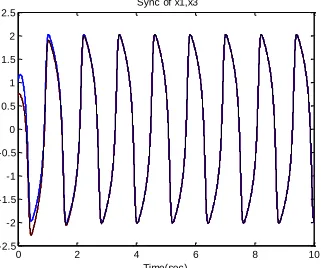
SA and AV oscillators, synchronized by the proposed method despite parameter uncertainty, are shown in Fig. 14.
Figure 13. presents synchronization error which has diminished over time
Eventually, as seen in Fig. (14), the system output converges to the desirable output.
Figure 14. Synchronization using PSO optimized RBF-based controllers
As seen in this figure, the SA and AV oscillators have become synchronized once a time period is passed.
Figure 15. Synchronization error
The figure above presents the synchronization error. This error vanishes over time indicating that the two oscillators have become synchronized.
13. Two-way coupling
If two-way coupling is used for the two oscillators - which in physiological sense means that AV oscillator impacts SA oscillator as well, sometimes in a relatively weak manner – the equations become:
u x x R x x c x w x
x x AV
x x R x x c x w x
x x SA
) ( ) 1 ( :
) ( ) 1 ( :
4 2 2 4 2 3 2 3 2 2 4
4 3
2 4 1 2 2 1 1 1 2 1 2
2 1
0 2 4 6 8 10 -1
-0.5 0 0.5 1 1.5 2
Time(sec)
e1 e2
0 2 4 6 8 10
-3 -2 -1 0 1 2 3
synchronization of x1,x3
Time
M
a
g
n
it
u
d
e
0 2 4 6 8 10
-0.5 0 0.5
error of x1,x3
Time(sec)
M
a
g
n
it
u
d
e
0 2 4 6 8 10
-2 0 2
error of x2,x4
Time(sec)
M
a
g
n
it
u
d
850
First, we select a value for R1 which was about the one tenth of R2. The computation results indicated that two-waycoupling has no effect on synchronization time. The value of R1 was then increased, but no impact was observed on
synchronization time. This is in line with physiology of heart as AV oscillator has negligible effect on SA oscillator.
CONCLUSION
The table below shows the results for the two methods. As seen from the table, PSO optimized RBF-based controllers outperforms in terms of synchronization time and variance of error.
Control effort (min) Control effort(max)
Error variance Synchronization
Time(sec) SA and AV Node Oscillators
-149 149+
0.001152 0.2
PSO optimized RBF-based controllers
-31 7.2
3300 / 3 3.7
SMC Control
REFERENCES
Abbas R, Aziz W and Arif M. 2004. " Prediction of Ventricular Tachyarrhythmia in Electrocardiogram Signal using Neuro-Wavelet Approach", National Conference on Emerging Technologies, pp. 82-87.
Andrievskii BRand Fradkov AL. 2003. “Control of Chaos: Methods and Applications. I. Methods”, Automation and Remote Control, Vol. 64, No. 5, pp. 673-713.
Bernardo DD. 1998. "A Model of two Nonlinear Coupled Oscillators for the Study of Heart Beat Dynamics", International Journal of Bifurcation and Chaos, Vol. 8, No. 10, pp. 1975-1985.
Berstecher RG, Palm R and Unbehauen HD. 2001. “An adaptive fuzzy sliding-mode controller,” IEEE Trans. Industrial Electron., vol. 48, pp. 18-31.
Boccaletti S, Grebogi C, Lai YC, Mancini H and Maza D. 2000. “The control of chaos: theory and applications”, Physics Reports, Vol.329, pp. 103-197.
Buric N and Todorovic D. 2003. "Dynamic of Fitzhugh-Nagumo excitable systems with delayed coupling", Physical review. E, Statistical, nonlinear, and soft matter physics, Vol. 67, No.2, pp. 066222-1-066222-13.
Demir S, Clark J and Giles W. 1997. "Effects of Hyperpolarizing Pulses on a Cardiac Pacemaker Cell", IEEE Transaction on Computer in Cardiology, Vol. 24, pp. 713-716.
Dragoi V and Grosu I. 1998. "Synchronization of locally coupled neural oscillators", Neural Processing Letters, Vol. 7, No.3, pp. 199-210.
El-sherif N, Denes P, Katz R, Capone R, Brent L, Carlson M and Reynolds R. 1995."Definition of the Best Prediction Criteria of the Time Domain Signal-Averaged Electrocardiogram for Serious Arrhythmic Events in the Postinfarction Period", Journal of American College ofCardiology , Vol. 25, No. 4, pp. 908-14.
Gebber GL, Zhong S, Zhou SY and Barman SM. 1997. "Nonlinear dynamics of the frequency locking of baroreceptor and sympathetic rhythms", American Journal of Physiology., Vol. 273, No.6, pp. 1932-1945.
Gebber GL, Zhong S and Barman SM. 1995. "Synchronization of cardiac-related discharges of sympathetic nerves with inputs from widely separated spinal segments", American Journal of Physiology, Vol. 268, No.6, pp. 1472-1483.
Gebber GL, Zhong S, Barman SM and Orer HS. 1994. "Coordination of cardiac-related discharges of sympathetic nerves with different targets", American Journal of Physiology, Vol. 167, No.2, pp. 400-407.
Govindan RB, Narayanan K and Gopinathan MS. 1998. "On the evidence of deterministic chaos in ECG: Surrogate and predictability analysis", Journal of Chaos ,Vol. 8, No. 2, pp. 495-502.
Sato S, Doi S and Nomura T. 1994. "Bonhoeffer-van der Pol Oscillator Model of the SinoAtrial Node: A Possible Mechanism of Heart Rate Regulation", Method of Information in Medicine, Vol. 33, No. 1, pp. 116-119, March.
Verheijck E, Wilders R, Joyner R, Golod D, Kumar R, Jomgsma H, Bouman L and Ginneken A. 1998. "Pacemaker Synchronization of Electrically Coupled Rabbit Sinoatrial Node Cell", Journal of General physiology, Vol. 111, No.1, pp. 95-112, January. Ikeda N. 1982. "Model of Bidirectional Interaction Between Myocardial Pacemakers Based on the Phase Response Curve",
Journal of Biological Cybernetics, Vol.43, No. 43, pp. 157-167, April.
Sivan SA and Akselrod S. 1999. "Simulation of atrial activity by a phase response curve based model of two-dimensional pacemaker cells array: the transition from a normal activation to atrial fibrillation” ", Journal of Biological Cybernetics, Vol. 80,No. 2, pp. 41-153.
Sivan SA and Akselrod S. 1998. "A pacemaker cell pair model based on the phase response curve", Journal of Biological Cybernetics, Vol. 79,No. 1, pp. 77-86.
Sivan SA and Akselrod S. 1998. "A single pacemaker cell model based on the phase response curve", Journal of Biological Cybernetics,Vol. 79, No. 1, pp. 67-76.
Sivan SA and Akselrod S. 1998. "A Phase Response Curve Based Model: Effect of Vagal and Sympathetic Stimulation and Interaction on Pacemaker cell ", Journal of Theoretical Biology, Vol. 192, No.4, pp. 567-579.
Grudzinski K and Zebrowski J. 2004. “Modeling cardiac pacemakers with relaxation oscillators ", journal of Physica A: Statistical and Theoretical Physics, Vol.336, No.1, pp. 153-162.
851
Hartley TT. 1989. “The duffing double scroll”, Proceedings of the American Control Conference, Pittsburgh, pp. 419–423. Hoyer D, Hoyer O and Zwiener U. 2000. "A new approach to uncover dynamic phase coordination and synchronization", IEEE
Transaction on biomedical Engineering, Vol.47, No. 1, pp. 68-73.
Humg JY, Gao W and Hung JC. 1993. “Variable structure control: A survey,” IEEE Trans. Industrial Electron., vol. 40,pp. 2-22. Jitao S. 2004. “Global synchronization criteria with channel time-delay for chaotic time-delay system”, Chaos, Solitons and
Fractals, Vol. 21, No.1, pp. 967–975.
Jungi L and Parlitz U. 2001. "synchronization using dynamic coupling", Physical review. E, Statistical, nonlinear, and soft matter physics, Vol. 64, No.2, pp.055204-1-055204-4.
Kaplan BZ, Gabay I, Sarafian G and Sarafian D. 2007. "Biological application of filtered van der pol oscillator", Journal of the Franklin Institute.
Kim SW and Lee JJ. 1995. “Design of a fuzzy controller with fuzzy sliding surface,” Fuzzy Sets and Systems, vol. 71, no 3, pp. 359-367.
Lee H, Kim E, Kang HJ and Park M. 2001. “A new sliding-mode control with fuzzy boundary layer,” Fuzzy Sets and Systems, vol. 120, no 1, pp. 135-143.
Luo CH and Rudy Y. 1991. “A model of the ventricular cardiac action potential. Depolarization, repolarization, and their interaction”, Circulation Research, Vol. 68, No. 6, pp.1501-1562.
Pecora L and Caroll T. 1990. “Synchronization in Chaotic Systems”, Physics Review Letters, Vol. 64, No.8, pp. 821-824. Schafer K, Rosenblum MG, Kurths J and Abel HH. 1998. "Heartbeat synchronized with ventilation", Nature, Vol. 392, pp.
239-240.
Sivan SA and Akselrod S. 2000. "A Simulation of the SA Node by a Phase Response Curve-Based Model of a Two-Dimensional Pacemaker Cells Array", IEEE Transaction on biomedical Engineering, Vol. 47, No 4, pp. 426-434.
Slotine JJE and Li W. 1991. Applied nonlinear control. Prentice-Hall International Editions, Prentice-Hall International Edition. Sundes J, Lines G and Tveito A. 2002. “Efficient solution of ordinary differential equation modeling electrical activity in cardiac
cells” Mathematical Biosciences, Vol. 72, pp. 55-72.
Su CY and Stepanenko Y. 1994. “Adaptive control of a class of nonlinear systems with fuzzy logic,” IEEE Trans. Fuzzy Syst., vol.2, pp.285-294.
Timo H, Ma¨kikallio MD, Heikki V, Huikuri MD FACC, Anne Ma¨kikallio MD, Leif B, Sourander MD, Raul D, Mitrani MD FACC, Agustin Castellanos MD FACC, Robert J and Myerburg MD FACC. 2001. " Prediction of Sudden Cardiac Death by Fractal Analysis of Heart Rate Variability in Elderly Subjects", Journal of the American College of Cardiology Vol. 37, No. 5. Thong T and Goldstein B. 2002. "Prediction of Tachyarrhythmia Episodes", Joint Meeting of the IEEE EMBS and the BMES,
Houston, Texas.
Thong T, McNames J, Aboy M and Goldstein B. 2004."Prediction of Paroxysmal Atrial Fibrillation by Analysis of Atrial Premature Complexes", IEEE Transaction on biomedical Engineering, Vol. 51, No. 4, pp. 561-569.
Thong T, McNames J, Aboy M and Goldstein B. 2003. "Paroxysmal Atrial Fibrillation Prediction Using Isolated Premature Atrial Events and Paroxysmal Atrial Tachycardia", proceedings ofAnnual International Conference of the IEEE Engineering in Medicine and Biology, pp. 163-166.
Tsagalou EP, Anastasiou-Nana MI, Karagounis LA, Alexopoulos GP, Batziou C, Toumanidis S, Papadaki E, Nanas JN and Stamatelopoulos SF. 2002. "Dispersion of QT and QRS in Patients with Severe Congestive Heart Failure: Relation to Cardiac and Sudden Death Mortality", The Hellenic Journal of Cardiology, Vol. 43, pp. 209-215.
Van der pol & Van der mark. 1928. "The heartbeat considered as a relaxation oscillation and an electrical model of the heart" , Philosophical Magazine 6, pp 763-775.
Vibe K, Vesin JM and Pruvot E. 1997. "Chaos and Heart Rate Variability", International Conference of IEEE-EMBS and CMBEC, Physiological Systems/Modeling and Identification, pp.1481-1482.
Volkov EI. 2005. "Limit cycles arising in a chain of inhibitory coupled identical relaxation oscillators near the self-oscillation threshold", Radiophysics and Quantum Electronics, Vol. 48, No. 3, pp. 212-22.
Wang Y, Guan ZH and Wen X. 2004. "Adaptive synchronization for Chen chaotic system with fully unknown parameters", Chaos solution and fractals, Vol. 19, No.4, pp. 899-903.
Wang J, Rad AB and Chan PT. 2001. “Indirect adaptive fuzzy sliding mode control: Part I-Fuzzy Switching,” Fuzzy Sets and Systems, vol. 122, no 1, pp. 21-30.
Wang LX. 1993. “Stable adaptive fuzzy control of nonlinear systems,” IEEE Trans. Fuzzy Syst., vol.1, pp.146-155.
Yoo B and Ham W. 1998. “Adaptive fuzzy sliding mode control of nonlinear system,” IEEE Trans. Fuzzy Syst., vol.6, pp.315- 321. Yu Y and Zhang S. 2004. “The synchronization of linearly bidirectional coupled chaotic systems”, Chaos, Solitons and Fractals,
Vol. 22, No. 1, pp. 189–197.