Multi-objective Assignment Problem with Generalized
Trapezoidal Fuzzy Numbers
Surapati Pramanik
Department of Mathematics, Nandalal Ghosh B.T. College, Panpur, P.O.- Narayanpur, District –
North 24 Parganas, Pin code-743126, West Bengal, India,
Pranab Biswas
Sardanga High School, Sardanga, P.O.- Chakdaha, District-Nadia, Pin code-741222, West
Bengal, India,
ABSTRACT
The aim of this paper is to study multi-objective assignment problem with imprecise costs, time and ineffectiveness instead of its precise information. Here, elements of cost matrix, consumed time matrix and ineffectiveness level matrix have been represented by generalized trapezoidal fuzzy numbers as it is suitable way to represent the impreciseness of values provided by the decision makers due to time pressure or limited information and poor information processing capabilities. A priority based fuzzy goal programming method has been developed for generalized trapezoidal fuzzy numbers and it is applied for multi-objective assignment problem. Euclidean distance function is used to identify the most appropriate priority structure of fuzzy goals among the different priorities of the fuzzy goals. An illustrative numerical example is provided to demonstrate the effectiveness of the proposed approach.
General Terms
Priority based fuzzy goalprogramming.
Keywords
Fuzzy sets; Generalized trapezoidal fuzzy numbers; Multi-objective assignment problem; Priority based fuzzy goal programming
1.
INTRODUCTION
The assignment problem (AP) is a well studied tropic in combinatorial optimization. It has a well connection in production planning, telecommunication, VLSI design, economics etc., where it deals with the question how to set n assignee to m tasks in an injective way for which an optimal assignment can be made in the best possible way. Depending on the objectives one has to optimize different problems ranging from linear assignment problem to quadratic and higher dimensional AP. The linear assignment problem is a special type of linear programming problem where assignees are being assigned to perform tasks in one to one basis such that the assignment cost (or profit) is minimum (or maximum). The best assignee for the task is a perfect description of the assignment problem, where number of rows and columns are identical. In 1955, Kuhn proposed an algorithm for linear assignment problem known as Hungarian method [1]. It is used for solving single objective assignment problem in crisp environment. Linear programming method can also be used to solve single objective assignment problem. Basically, single-objective assignment problem deals with the problem of cost minimizing or time minimizing.
We often come in close contact with an assignment problem where, cost and time are jointly co-related. Geetha et al [2] first formulated cost-time assignment problem as the multi-criteria problem. However, in our real life, assigning tasks based on only cost and time cannot properly reflect the real situation as decision maker cannot ignore the importance of quality of tasks. Bao et al. [3] developed a multi-objective assignment problem (MOAP). They used 0-1 programming method to convert multi-objective assignment problem to single objective assignment problem.
However, assignment problem representing real-world situations involves a set of parameters whose values are assigned by decision makers (DMs). In the conventional approach, DMs are required to fix exact values to the said parameters. In that case, DMs do not precisely know the exact value of those parameters. If exact values are suggested these are only statistical inference from past data and their stability is doubtful, so the parameters of the problem are usually defined by the DM in an uncertain way. Therefore, the DMs can easily express their opinions based on fuzzily described parameters.
Lin and Wen [4] solved assignment problem with fuzzy interval costs by the labeling algorithm. They showed that assignment problem can usually be simplified into either a linear fractional programming problem or a bottleneck assignment problem. Chen [5] proposed a fuzzy assignment problem by assuming that all the individuals involved have same skills.
by using Yager’s ranking method after transforming MOAP to single-objective assignment problem.
Pramanik and Roy [14] studied multi-objective transportation model with normal trapezoidal fuzzy numbers based on priority based fuzzy goal programming. They solved it with different priority structure and determined the most satisfactory solution by using Euclidean distance function. In this paper, we propose a priority based fuzzy goal programming method for generalized trapezoidal fuzzy numbers (TrFNs). Euclidean distance function is used to identify the most appropriate priority structure of fuzzy goals among the different priorities of the fuzzy goals. An illustrative numerical example of multi-objective assignment problem with TrFNs is provided to demonstrate the effectiveness of the proposed approach.
Rest of the paper is organized in the following way: Section 2 describes the preliminaries of fuzzy sets required for the paper. Section 3 presents the formulation of priority based fuzzy goal programming with generalized trapezoidal fuzzy numbers. In Section 4 the formulation of multi-objective assignment problem has been provided. Section 5 provides the formulation of multi-objective assignment problem with generalized trapezoidal fuzzy numbers. Section 6 is devoted to present proposed priority based fuzzy goal programming method to fuzzy multi-objective assignment. Section 7 deals with the selection of appropriate priority structure using Euclidean distance function. Numerical example has been solved in Section 8 to show the efficiency of the proposed method. Finally, Section 9 presents the concluding remarks.
2.
PRELIMINARIES OF FUZZY SETS
In 1965, Zadeh [15] introduced the concept of fuzzy sets.2.1 Definition: Fuzzy set:A fuzzy set~in a universe of discourse X is defined by~ = { x, A~(x) x X}, whereA~(x): X [0, 1] is called the membership function of
~
and A~(x)is the degree of membership to which x~.2.2 Definition: Normal fuzzy set: A fuzzy set q~ is said to normal if there exists a point x in X such that q~(x) = 1. Otherwise, q~ is said to be the subnormal fuzzy set.
2.3 Definition: Trapezoidal fuzzy number (TrFN): A trapezoidal fuzzy number q~is denoted by (q1,q2,q3,q4) where q1,q2,q3,q4are real numbers and its membership
function ) x (
q ~
is defined byq~(x) =
4 4 3 3 4
4 U
3 2 1 2 1 2
1 L
1
q x ,
0
, q x q , q q
x q x
, q x q ,
1
, q x q , q q
q -x x
, q x ,
0
(1)
) x (
q ~
satisfies the following conditions.
(i) q~(x)is a continuous mapping from to closed interval [0, 1]
(ii) q~(x)= 0 for every x ∈ (-∞, q ] 1
(iii) q~(x)is strictly increasing and continuous on [q ,1 q ] 2
(iv) q~(x)=1 for every x ∈[q , 2 q ] 3
(v) q~(x)is strictly decreasing and continuous on [q ,3 q ] 4
(vi) ~q(x)= 0 for every x ∈ [q , ∞) 4
2.4 Definition:Generalized trapezoidal fuzzy number: A generalized TrFN ~qis denoted by (q1,q2,q3,q4) where
4 3 2 1,q ,q ,q
q and w[0,1] are real numbers and its membership function is represented by q~(x)and it is defined by
) x (
q ~
=
4 4 3 3
4 4 U
3 2
1 2 1
2 1 L
1
q x ,
0
, q x q ,
q q
x q w x
, q x q ,
1
, q x q ,
q q
q -x w x
, q x ,
0
(2)
2.4 Definition: The cutset of a fuzzy set q~ is a crisp set defined byq~{xX/~q(x)}.
2.5 Arithmetic Operation:
The arithmetic operations [16] of addition, subtraction, multiplication, and division of generalized TrFNs are defined as follows:
2.5.1Addition: Let A~= (a1, a2, a3, a4; w1) and B ~
= (b1, b2,
b3, b4; w2) be two generalized TrFNs, then
A~ +B~= (a1, a2, a3, a4; w1) + (b1, b2, b3, b4; w2)
= (a1+ b1, a2+ b2, a3+ b3, a4+ b4; min (w1, w2))
2.5.2 Subtraction: A~ B~= (a1, a2, a3, a4; w1)(b1, b2, b3,
b4; w2) = (a1b4, a2b3, a3b2, a4b1; min (w1, w2))
2.5.3 Multiplication: Ã1 Ã2= (a1, a2, a3, a4; w1) (b1, b2,
b3, b4; w2)
= {min (a1b1, a1b4, a4b1, a4b4), min (a2b2, a2b3, a3b2, a3b3), max
(a2b2, a2b3, a3b2, a3b3), max (a1b1, a1b4, a4b1, a4b4); min (w1,
1
w
q1 q2 q3 q4
Figure1. A generalized trapezoidal fuzzy number
) q , q , q , q ( q ~
4 3 2 1
3.
FORMULATION OF PRIORITY
BASED FUZZY GOAL PROGRAMMING
WITH GENERALIZED TRFNS
We consider the following multi-objective problem with TrFNs.
Minimize ~k
x =
~c1x,~c2x,...,~ckx
T (3) subject to xX
xn/A~x~b,x0
, (4) where, ~ (k = 1, 2,…, K) denotes n-dimensional row ck vector, b~ denotes an m- dimensional column vector, A~represents an mnmatrix and x(x1,x2,...,xn)T. c~, b~, and A~are all generalized trapezoidal TrFNs. Here, the symbol
denotes the symbol ,, and respectively. Now we consider the problem represented by (3) has fuzzy coefficients with possibilistic distribution. We assume thatx
be a solution of (11), where, [0,1]represents the possibility at which all the fuzzy co-efficient is feasible. Let
q~ be the cutof a fuzzy number q~defined by
~q
=
qSupp(~q)/q~(q),[0,1]
where Supp( q~) is the support of q~. (5) Let
q~Land
q~Ube the lower and upper bound ofcut
of q~such that
~qL
q
~qU. (6) For maximization type objective function, for anypre-assigned value of, ~k
x (k = 1, 2,…, K) can be replaced by the upper bound of itscut that is
j n1 j
U kj U
kx ~c x
~
(7)
Similarly, for minimization type of objective function ~k
x (k = 1, 2,…, K), we consider the lower bound of itscut
i.e.
j nj
L kj L
k
x
c
x
1
~
~
(8)Now we can rewrite for the inequality constraints as:
j j n
1 j ij
b ~ x A~
, i = 1, 2,…
m
1 (9)and n j j
1 j ij
b ~ x A~
, i =
m
1
1
, …,m
2 (10)by the following way L
n 1 j
U ij b)
~ ( ) A~
(
, i = 1, 2,…m (11) 1U n
1 j
L ij b)
~ ( ) A~
(
, i =
m
1
1
, …,m
2. (12)For fuzzy equality constraints
j j n
1 j ij
b ~ x A~
, i = m21,...,m (13)
can be represented by two equivalent constraints
U n
1 j
L ij b)
~ ( ) A~
(
(14)
and L
n 1 j
U ij b)
~ ( ) A~
(
(15)
For proof of the equivalency of (13) with (14) and (15), see Lee and Li [17]
Therefore, for any pre-assigned value of
, the problem represented by (3) can be transformed into an equivalent form as:Minimize
jn 1 j
L kj L
k ~c x
~
, k = 1, 2,…, K (16)
Subject to n L
1 j
U ij b)
~ ( ) A~
(
, i = 1, 2,…, m1, m2+1, …,
m, (17)
U n
1 j
L ij b)
~ ( ) A~
(
, i = m1+1, …,
m
2, m2+1, …, m, (18). n ..., , 2 , 1 j , 0
xj (19) For simplicity, we denote the system of constraints (17), (18) and (19) as. We notice that, for any prescribed value of, the problem (16) reduces to a deterministic multi-objective linear programming problem. It can be solved by applying fuzzy goal programming technique.
Now we construct the membership function for minimization type objective function as:
,~ ~
x c ~ ~
~
0 k k
n 1
j j
L kj k
L k k
k = 1, 2,…,K (20)
Where, the aspired level
k 0 and highest acceptable level
k are ideal and anti- ideal solutions, respectively. It can be obtained by solving the following problem:
~ min n (c~ )Lxj,1 j kj X
0
k
(21)
k
~
, x ) c ~ ( max n U j
1 j
kj X
k =1, 2,…, K. (22)
Similarly, for the maximization type objective function, we can also determine ideal and anti-ideal solutions. To deal with the problem (3), we assume that all the fuzzy coefficients are generalized trapezoidal fuzzy numbers. Then from definition 2.4, the cutrepresentation of generalized trapezoidal fuzzy number~q
q1,q2,q3,q4;w
, we can write it byfollowing interval
x
L
xU
q,q
q q
w
w q q q ~ , q ~ q ~ 3 4 4 1 1 2 UL
(23) Now, for a prescribed value of, the fuzzy goal programming model of the problem under a pre-emptive priority structure [18] can be presented as
Minimize
~
P1(d),P2(d),...,Ps(d),...,PS(d)
, (24)subject to
d 1, ~ ~ x c ~ ~ k o k k n 1 j j L kj k k = 1, 2,…, K,
L n
1 j
U ij b)
~ ( ) A~ (
, i = 1, 2,…
m
1,m21,...,m,U n
1 j
L ij b)
~ ( ) A~ (
, i =
m
1
1
, …,m
2,m
2
1
,
...,
m
,
. n ..., , 2 , 1 j , 0 xj
. K ..., , 2 , 1 k , 0
dk (25)
Using the interval expression, the problem (25) can be written as:
Minimize
~
P1(d),P2(d),...,Ps(d),...,PS(d)
, subject to,
d 1, ~ ~ x w ) c c ( c ~ k o k k n 1j kj j
1 kj 2 kj 1 kj k k =1, 2,…,K. , w ) b b ( b x w ) A A ( A ij 3 i 4 i 4 i j ij 1 ij 2 ij 1
ij
i = 1
m1 , …, m ,2 m21,...,m, . n ..., , 2 , 1 j , 0 xj
4.
FORMULATION OF
MULTI-OBJECTIVE ASSIGNMENT PROBLEM
(MOAP)
For a single objective assignment problem (AP), n jobs are to be performed by n persons depending on their efficiency to do the job in one to one basis such that the assignment cost is minimal. Now if the objective of an AP is to minimize operation cost, operation time, and bad quality, etc then we treat this type of problem as a multi objective AP. Now considering this type of criterion which has an imprecise value, presented as a trapezoidal fuzzy number, we formulate a fuzzy multi-objective assignment problem (FMOAP) as:
Min k(x) n c x ,
1 i n 1 j ij k ij
k= 1, 2,…, K. (26)
subject to x 1,
n 1 i
ij
j= 1, 2, .., n. (27)
x 1,
n 1 i
ij
i= 1, 2,…, n (28)
x
ij
[0, 1], wherex
ij =
.
otherwise
,
0
.
job
th
j
to
assigned
is
person
th
i
if
,
1
(29)5.
MULTI-OBJECTIVE ASSIGNMENT
PROBLEM WITH GENERALIZED
TRAPEZOIDAL FUZZY NUMBERS
In this section we discuss a FMOAP defined in (26) where, all the coefficients have been considered as generalized trapezoidal fuzzy numbers. Therefore, to keep impreciseness, the trapezoidal fuzzy number
ijk(4) ij
) 3 ( k ij ) 2 ( k ij ) 1 ( k
ij ,c ,c ,c ;w
c
can be nimize ~k(x) n
ij1 i n 1 j ij ) 4 ( k ij ) 3 ( k ij ) 2 ( k ij ) 1 ( k
ij ,c ,c ,c ;w x
c
,
k=1,2,...K (30)
subject to x 1,
n 1 i ij
j = 1, 2, .., n. (31)
, 1 x n 1 i ij
i =1, 2, …, n. (32)
ij
x
[0, 1], wherex
ij =
.
otherwise
,
0
.
job
th
j
to
assigned
is
person
th
i
if
,
1
(33)Then the problem can be reduced to,
Minimize ~k(x) n
ij1 i n 1 j ) 1 ( k ij ) 2 ( k ij ) 1 ( k
ij c c w x c
k = 1, 2,…, K.
subject to x 1,
n 1 i
ij
j = 1, 2, .., n (34)
n x 1
1 j ij
, i = 1, 2,.., n. (35)
6. PRIORITY BASED FUZZY GOAL
PROGRAMMING FORMULATION OF
MOAP WITH FUZZY
PARAMETERS
With the help of equation (20), we obtain the membership function for minimization of objective function as:
0 k k n 1 i n 1j kj j
1 kj 2 kj 1 kj k k
k ~ ~
x w ) c c ( c ~ ~ (36)
Where, the aspired level
~k0 is ideal solution which can be obtained by solving the following problem
0 k ~
, x w c c c Min n 1 i n 1j kj ij
) 1 ( k kj ) 2 ( k kj ) 1 ( k kj s x
for k
=1, 2,…, K (37)
k
~
n 1 i
n 1
j kj ij
) 3 ( k kj ) 4 ( k kj ) 4 ( k kj s
x
x w c
c c
Max ,
for k =1, 2,…, K (38)
Now the fuzzy goal programming model of the given problem under the mini-sum goal programming (GP), we can formulate for any pre-assigned value of
as the following way:Minimize
~
P1(d),P2(d),...,Ps(d),...,PS(d)
,
D 1~ ~
x w ) c c ( c ~
k 0
k k n
1
j kj j
1 kj 2 kj 1 kj k
(39)
. K ..., , 2 , 1 k , 0
dk xij[0,1] for i= 1, 2, …, n and j= 1, 2, …, n. Here is the vector of s-th priority achievement
functions. D is connected with k-th goal as a negative k deviational variable. Pi(d)is a linear function of the weighted negative deviational variables. Here Ps(d) =
K
1 i sk sk
d
w (k= 1, 2, …, K; SK. For simplicity, we replace
sk
d by d at the s-th priority level. k
w
sk is the numerical weight associated with dskthat represent the weight of importance for achieving the aspired level of k-th goal with respect to other goals, which are grouped together at the s-th priority level. This weight can be determined as:
s 0 k k sk ~ ~1 W
, for k = 1, 2,…, K. (40)
Where
s 0 k k~ ~
is the symbolic representation
of
0 k k
~ ~
at the s-th priority level.
In preemptive priority fuzzy goal programming, Ps denotes the
s-th priority which is preferred to next priority level Ps+1 for
any possible imposed weight on Ps+1. Thus the relationships
among the priorities are P1 >> P2 >>….>>Ps >>…>>PS .
This indicates that the higher priority level is regarded as infinitely more important than lower priority level. This process will be continued till the last priority is considered. It is to be noted that not more than five priority level should be used in the priority based fuzzy goal programming as it would be unusual to find a practical situation with more than five mutually non comparable priorities.
7.
SELECTION
OF
APPROPRIATE
PRIORITY
STRUCTURE
USING
EUCLIDEAN DISTANCE FUNCTION
The concept of distance function for group decision analysis was introduced by Yu [19]. In this paper Euclidean distance function is used for identifying proper priority structure for priority based fuzzy goal programming model [14]. The Euclidean distance function can be defined as:
12 N1 n
t n 2 1
L
(41)
Where t
n
represents the achieved membership value of the n-th goal under the t-th priority structure of the goals. Now the minimal Euclidean distance function for those achieved solution would correspond the most satisfying solution. Here it should be noted that the solution which is closest to the ideal point must correspond to s MS ..., , 2 ,
1min L L where,
. S M 1
It indicates the M-th priority structure can be identified as an appropriate priority structure to achieve the desired result.
8. ILLUSTRATIVE EXAMPLE
A manufacturing company manufactures machinery parts with four different machines for construction purposes. The company official has been given an order to execute the four different Tasks. To complete these tasks with these four machines, they have imprecise information about cost, time and ineffectiveness of each machine to perform the task (out of four) in one to one basis. Here these imprecise information (treated as TrFNs) about cost, time and ineffectiveness of each machine with respect to each Task are given in Table 1. Determine the optimal assignment.
The problem can be re-written as:
Minimize ~1
x (4,6,7,9; .833)x
11+ (3,5,7,10; .933)x
12+ (6,7,10,12; .891)x
13+ (3,4,6,9; .822)x
14+ (2,3,5,7; .947)21
x
+ (5,7,8,11; .848)x
22+ (5,6,7,10; .800)x
23+ (4,7,9,11; .988)x
24+ (6,8,10,12; .878)x
31+ (5,7,12,14; .900)x
32+ (6,7,9,10; .867)x
33+ (4,5,7,9; .913)x
34+ (3,7,10,12; .911)x
41+ (6,7,10,12; .864)x
42+ (7,10,11,13; .790)x
43+ (5,7,10,14; .814)x
44;Minimize ~2
x (7,9,11,13; .944)x
11+(6, 9, 10, 12; .818)12
x
+ (9, 10, 11, 12; .708)x
13+ (8, 11, 13, 15; .761)x
14+ (6, 7, 10, 12; .953)x
21+(9, 12, 14, 17; .792)x
22+ (7, 8, 10, 11; .887)x
23+ (6, 8, 12, 13; .901)x
24+ (3, 4, 5, 7; .938)31
x
+ (4, 5, 7, 9; .946)x
32+ (6, 7, 8, 11; .826)x
33+ (3, 4, 6, 7; .901)x
34+ (4, 6, 8, 10; .857)x
41+ (5, 7, 8, 10; .804)42
x
+ (4, 5, 7, 8; .867)x
43+ (5, 9, 11, 15; .857)x
44;Minimize ~3
x (0.15,0.16,0.19,0.21; .888)x
11+ (0.10,0.11,0.13,0.14; .778)x
12+ (0.14,0.16,0.18,0.20; .714)x
13+ (0.05,0.07,0.09,0.11; .667)x
14+(0.09,0.12,0.15,0.18; .778)
x
21+ (0.14,0.16,0.18,0.20; .750)x
22+ (0.20,0.21,0.23,0.25; .888)x
23+.667)
x
31+ (0.13,0.15,0.17,0.19; .778)x32+(0.20,0.22,0.24,0.27; .667)x33+ (0.15,0.16,0.18,0.20; .625)x34+ (0.15,0.18,0.20,0.22; .750)
x
41+(0.19,0.21,0.23,0.25; .888)
x
42+ (0.12,0.13,0.14,0.15; .778)x43+ (0.10,0.14,0.16,0.18; .750)x44;subject to,
1 x x x
x11 12 13 14 ; x11x21x31x411, 1
x x x
x21 22 23 24 ; x12x22x32x421, 1
x x x
x31 32 33 34 ; x13x23x33x431, 1
x x x
x41 42 43 44 ; x14x24x34x441,
where, xij
0,1 . For i= 1, 2, 3, 4 and j= 1, 2, 3, 4. (42) Now we replace all generalized fuzzy coefficient of the objective function by their corresponding cuts. Then the problem can be transformed into the following problem:Minimize
~1
x L (4 + 2.400
)x
11+(3 + 2.144
)12
x
+ (6 + 1.122
)x
13+ (3 + 1.216
)x
14+ (2 +1.055
)x
21+(5 + 2.358
)x
22+ (5 + 1.25
)x
23+ (4 + 3.036
)x
24+ (6 + 2.278
)x
31+ (5 + 2.222
)x
32+ (6 +1.153
)x
33+ (4 + 1.095
)x
34+ (3 + 4.390
)41
x
+ (6 + 1.157
)x
42+ (7 + 3.797
)x
43+ (5 + 2.457
)x
44;Minimize
~2
x L(7 + 2.119
)x
11+(6 + 3.667
)12
x
+ (9 + 1.412
)x
13+ (8 + 3.942
)x
14+ (6 + 1.049
)x
21+(9 + 3.788
)x
22+ (7 +1.127
)x
23+ (6 + 2.220
)x
24+ (3 + 1.066
)x
31+ (4 + 1.057
)x
32+ (6 + 1.210
)x
33+ (3 + 1.110
)x
34+ (4 + 2.334
)41
x
+ (5 + 2.487
)x
42+ (4 + 1.153
)x
43+ (5 + 4.667
)x
44;Minimize
~3
x L (.15 + .0111
)x
11+(.10 + .0128
)12
x
+ (.14 + .0280
)x
13+ (.05 + .0300
)x
14+ (.09 + .0386
)x
21+(.14 + .0267
)x
22+ (.20 + .0112
)x
23+ (.15 + .0343
)x
24+ (.18 + .0300
)x
31+ (.13 + .0257
)x
32+ (.20 + .0300
)x
33+ (.15 + .0160
)34
x
+ (.15 + .0400
)x
41+ (.19 + .0225
)x
42+ (.12 + .0129
)x
43+ (.10 + .0533
)x
44;subject to,
1 x x x
x11 12 13 14 ; x11x21x31x411, 1
x x x
x21 22 23 24 ; x12x22x32x421, 1
x x x
x31 32 33 34 ; x13x23x33x431, 1
x x x
x41 42 43 44 ; x14x24x34x441,
where, xij
0,1 .For i= 1, 2, 3, 4 and j= 1, 2, 3, 4. (43) For different values of
we have some result, listed in the table- by the following procedure discussed in section 3. We have for =.5,
~144.6567,
~1019.2905,
a
2
~
48.8970,
~2022.4895,
~3 0.9178,
0
3
~
.4435.
Then the membership function corresponding to the objective function can be constructed
3662 . 25
x ~ 44.6567 2905
. 19 44.6567
x ~ 44.6567 x
~ 1 L
L 1 1
1
(44)
4075 . 26
x ~ 22.4895 22.4895
48.8970 x ~ 48.8970 x
~ 2 L
L 2 2
2
(4
5)
4743 .
x ~ 0.9178 .4435
0.9178 x ~ 0.9178 x
~ 3 L
L 3 3
(46)
Then the priority based fuzzy goal programming for multi-objective assignment problem can be written as
= [P1
d,P1d,...,Psd,...,PSd ]subject to
d 1, 3662. 25
x ~ 44.6567
1 L 1
d 1, 4075. 26
x ~ 22.4895
2 L 2
d 1,4743 .
x ~ 0.9178
3 L 3
subject to,
1 x x x
x11 12 13 14 ; x11x21x31x411, 1
x x x
x21 22 23 24 ; x12x22x32x421, 1
x x x
x31 32 33 34 ; x13x23x33x431, 1
x x x
x41 42 43 44 ; x14x24x34x441, 0
dk for (t = 1, 2, 3)
where, xij
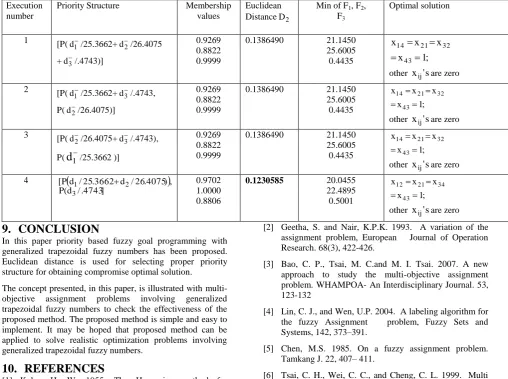
0,1 . For i= 1, 2, 3, 4 and j= 1, 2, 3, 4.In this example we consider three priorities factor P (i = 1, 2, i 3) for achievement of aspired levels of the assigned fuzzy goals. Under different priority structure using LINGO 11.0, we solve this problem with our proposed priority based FGP of MOAP with fuzzy parameter, discussed in section 6 and the results are provided in Table 2.
From Table 2 we see that the minimum Euclidean distance is 0.1230585. This result reflects that the priority structure under the execution 2 and 5 is appropriate one to obtain the most satisfactory solution. Thus the optimal assignment schedule can be written as x*12= x*21=x*34=x*43=1 and others variables
Table 1. A three objective Assignment problem
C, T, I/ Mi
Task-A Task-B Task-C Task-D
M1
(4,6,7,9; .833) (7,9,11,13; .944) (0.15,0.16,0.19,0.21; .888)
(3,5,7,10; .933) (6,9,10,12; .818) (0.10,0.11,0.13,0.14; .778)
(6,7,10,12; .891) (9,10,11,12; .708) (0.14,0.16,0.18,0.20; .714)
(3,4,6,9; .822) (8,11,13,15; .761) (0.05,0.07,0.09,0.11; .667)
M2
(2,3,5,7; .947) (6,7,10,12; .953) (0.09,0.12,0.15,0.18; .778)
(5,7,8,11; .848) (9,12,14,17; .792) (0.14,0.16,0.18,0.20; .750)
(5,6,7,10; .800) (7,8,10,11; .887) (0.20,0.21,0.23,0.25; .888)
(4,7,9,11; .988) (6,8,12,13; .901) (0.15,0.18,0.22,0.25; .875)
M3
(6,8,10,12; .878) (3,4,5,7; .938) (0.18,0.20,0.22,0.24; .667)
(5,7,12,14; .900) (4,5,7,9; .946) (0.13,0.15,0.17,0.19; .778)
(6,7,9,10; .867) (6,7,8,11; .826) (0.20,0.22,0.24,0.27; .667)
(4,5,7,9; .913) (3,4,6,7; .901) (0.15,0.16,0.18,0.20; .625)
M4
(3,7,10,12; .911) (4,6,8,10; .857) (0.15,0.18,0.20,0.22; .750)
(6,7,10,12; .864) (5,7,8,10; .804) (0.19,0.21,0.23,0.25; .888)
(7,10,11,13; .790) (4,5,7,8;.867) (0.12,0.13,0.14,0.15; .778)
(5,7,10,14; .814) (5,9,11,15; .857) (0.10,0.14,0.16,0.18; .750)
Note: Here, C indicates cost, T indicates time, I indicates ineffectiveness of the machine, Mi presents i-th machine.
Table 2. Sensitivity analysis for solutions with different priority structure
Execution number
Priority Structure Membership values
Euclidean DistanceD 2
Min of F1, F2,
F3
Optimal solution
1 [P( 1
d /25.3662+d /26.4075 2 +d /.4743)] 3
0.9269 0.8822 0.9999
0.1386490 21.1450 25.6005
0.4435
x
1
;
x
x
x
43
32 21 14
other
x
ij'
s
are zero 2 [P( 1
d /25.3662+d /.4743, 3
P(d /26.4075)] 2
0.9269 0.8822 0.9999
0.1386490 21.1450 25.6005
0.4435 x 1; x x x
43
32 21 14
other
x
ij'
s
are zero3 [P( 2
d /26.4075+d /.4743), 3 P(
d
1/25.3662 )]0.9269 0.8822 0.9999
0.1386490 21.1450 25.6005
0.4435 x 1; x x x
43
32 21 14
other
x
ij'
s
are zero4
] 4743 . / d ( P
, ) 4075 . 26 / d 3662 . 25 / d P [
3
2
1 0.9702
1.0000 0.8806
0.1230585 20.0455 22.4895
0.5001 x 1; x x x
43
34 21 12
other
x
ij'
s
are zero9.
CONCLUSION
In this paper priority based fuzzy goal programming with generalized trapezoidal fuzzy numbers has been proposed. Euclidean distance is used for selecting proper priority structure for obtaining compromise optimal solution. The concept presented, in this paper, is illustrated with multi-objective assignment problems involving generalized trapezoidal fuzzy numbers to check the effectiveness of the proposed method. The proposed method is simple and easy to implement. It may be hoped that proposed method can be applied to solve realistic optimization problems involving generalized trapezoidal fuzzy numbers.
10.
REFERENCES
[1] Kuhn, H. W. 1955. The Hungarian method for assignment problem, Naval Research Logistics Quarterly. 2, 83-97.
[2] Geetha, S. and Nair, K.P.K. 1993. A variation of the assignment problem, European Journal of Operation Research. 68(3), 422-426.
[3] Bao, C. P., Tsai, M. C.and M. I. Tsai. 2007. A new approach to study the multi-objective assignment problem. WHAMPOA- An Interdisciplinary Journal. 53, 123-132
[4] Lin, C. J., and Wen, U.P. 2004. A labeling algorithm for the fuzzy Assignment problem, Fuzzy Sets and Systems, 142, 373–391.
[5] Chen, M.S. 1985. On a fuzzy assignment problem. Tamkang J. 22, 407– 411.
[7] Belacela, N. and Boulasselb, M. R. 2001. Multi criteria fuzzy assignment problem: a useful tool to assist medical diagnosis. Artificial intelligence in Medicine 21, 201-207.
[8] Majumder, J., and Bhunia, A.K. 2007. Elitist genetic algorithm for assignment problem with imprecise goal, European Journal of Operation Research. 177, 684-692. [9] Kumar, A., and Gupta, A. 2011. Methods for solving
fuzzy assignment problems and fuzzy travelling salesman problems with different membership functions, Fuzzy Information and Engineering. 3(1), 3-21.
[10] Yager, R. R. 1981. A procedure for ordering fuzzy subsets of the unit interval, Information Sciences. 24, 143-161.
[11] Emrouznejad, A., Angiz, M. Z., and L, W. Ho. 2012. An alternative formulation for the fuzzy assignment problem. Journal of the Operational Research Society. 63, 59-63.
[12] Haddad, H., Mohammadi, H., and Pooladkhan, H. 2012. Two models for the generalized assignment problem in uncertain environment, Management Science Letters. 2, 623–630
[13] Biswas, P. and Pramanik, S. 2011. Multi-objective Assignment Problem with Fuzzy Costs for the Case Military Affairs, International Journal of Computer Applications. 30(10), 7-12.
[14] Pramanik, S., and Roy, T. K. 2008, Multi-objective transportation model with fuzzy parameters: a priority based fuzzy goal programming approach, Journal of transportation System Engineering and Information Technology. 8(3), 40-48.
[15] Zadeh, L. A. 1965. Fuzzy sets, Information and Control. 8, 338–353.
[16] Kaufmann, A., and Gupta, M. M. 1988. Fuzzy mathematical models in engineering and management science, Elsevier Science Publishers, B.V.
[17] Lee, E. S. And Li, R.J. 1993. Fuzzy multiple objective programming and compromise programming with Pareto optimum. Fuzzy Sets and Systems. 53(2), 275-288. [18] Pramanik, S., and Dey, P. 2011, A Priority based Fuzzy
Goal Programming to Multi-Objective Linear Fractional Programming Problem, International Journal of Computer Applications. 30(10), 1-6.