Kent Academic Repository
Full text document (pdf)
Copyright & reuse
Content in the Kent Academic Repository is made available for research purposes. Unless otherwise stated all
content is protected by copyright and in the absence of an open licence (eg Creative Commons), permissions
for further reuse of content should be sought from the publisher, author or other copyright holder.
Versions of research
The version in the Kent Academic Repository may differ from the final published version.
Users are advised to check
http://kar.kent.ac.uk
for the status of the paper.
Users should always cite the
published version of record.
Enquiries
For any further enquiries regarding the licence status of this document, please contact:
[email protected]
If you believe this document infringes copyright then please contact the KAR admin team with the take-down
information provided at
http://kar.kent.ac.uk/contact.html
Citation for published version
Otero, Fernando E.B. (2017) MYRA: A Java Ant Colony Optimization Framework for Classification
Algorithms. In: Genetic and Evolutionary Computation Conference (GECCO 2017), 15-19
July 2017, Berlin, Germany.
DOI
https://doi.org/10.1145/3067695.3082471
Link to record in KAR
http://kar.kent.ac.uk/62289/
Document Version
Author's Accepted Manuscript
Classification Algorithms
Fernando E. B. Otero
School of Computing University of Kent Chatham Maritime, Kent, UK
ABSTRACT
This paper introduces MYRA, an open-source Java framework that provides the implementation of several ant colony optimization clas-sification algorithms. The algorithms are ready to be used from the command-line or can be easily called from custom Java code. The framework is implemented using a modular architecture, therefore algorithms can be easily extended to incorporate different proce-dures and/or use different parameter values. The paper gives par-ticular attention to the common architecture from which the algo-rithms are built on, highlighting the shared classes among the differ-ent implemdiffer-ented algorithms. The source code and documdiffer-entation of MYRA are available for download at https://github.com/febo/myra.
CCS CONCEPTS
•Computing methodologies→Machine learning algorithms;
KEYWORDS
classification, data mining, ant colony optimization
ACM Reference format:
Fernando E. B. Otero. 2017. MYRA: A Java Ant Colony Optimization Framework for Classification Algorithms. InProceedings of GECCO ’17 Companion, Berlin, Germany, July 15-19, 2017,8 pages.
DOI: http://dx.doi.org/10.1145/3067695.3082471
1
INTRODUCTION
The advances in computer technologies, allowing the storage of virtually any kind of data, have led to an exponential growth of available information and, consequently, to an increased interest in (semi-)automated data analysis techniques. The research area concentrated in applying computation models to extract knowledge from real-world structured data is called data mining [5]. One of the most studied data mining tasks in the literature is the classifi-cation task. In essence, the classificlassifi-cation task consists of learning a predictive relationship between input values and a desire out-put. Each instance (data point) is described by a set of attributes (features)—referred to as predictor attributes—and a class attribute.
Permission to make digital or hard copies of all or part of this work for personal or classroom use is granted without fee provided that copies are not made or distributed for profit or commercial advantage and that copies bear this notice and the full citation on the first page. Copyrights for components of this work owned by others than the author(s) must be honored. Abstracting with credit is permitted. To copy otherwise, or republish, to post on servers or to redistribute to lists, requires prior specific permission and/or a fee. Request permissions from [email protected].
GECCO ’17 Companion, Berlin, Germany
© 2017 Copyright held by the owner/author(s). Publication rights licensed to ACM. 978-1-4503-4939-0/17/07. . . $15.00
DOI: http://dx.doi.org/10.1145/3067695.3082471
Given a set of instances, a classification algorithm aims at creating a model, which represents the relationship between predictor at-tributes values and class values, capable of predicting the class of an instance based on the values of its predictor attributes.
Since the goal of a classification algorithm is to find the best pre-dictive model, a classification problem can be cast as an optimisation problem. A wide range of techniques have been used to design classification algorithms—e.g., statistical algorithms, artificial neu-ral networks, evolutionary algorithms, ant colony optimization, among others. A good collection of machine learning algorithms for classification task can be found in the Waikato Environment for Knowledge Analysis (WEKA) workbench [6], probably the most popular open source data mining tool.
Ant colony optimization (ACO) [4] is a metaheuristic inspired by the behaviour of real ant colonies. Many ant colonies are able to cooperate to perform complex tasks despite the lack of a central control mechanism and a relative simple individual behaviour—e.g., there are ant species with limited or no vision that are able to find the shortest path between the nest and a food source. All interaction between individual ants, and between the environment, is accom-plished in an indirect way by dropping pheromone on the ground to create a pheromone trail. Trails with higher pheromone concen-tration are more likely to be followed by ants. Since the shorter trail is traverse faster, its pheromone concentration is higher, which eventually will result in the colony converging to using predomi-nantly the shorter path. ACO algorithms mimic the behaviour of ant colonies to perform a global search, where the search is guided to better regions of the search space based on the quality of the solutions. In the context of the classification task in data mining, ACO algorithms have the advantage of performing a flexible robust search for a good combination of predictor attributes, less likely to be affected by the problem of attribute interaction [7].
Parpinelli et al. [24] proposed the first ACO algorithm for clas-sification, called Ant-Miner, to createIF-THENclassification rules. TheIFpart corresponds to the antecedent of the rule and it con-tains (attribute, value) terms representing tests on attributes’ val-ues; theTHEN part corresponds to the consequent of the rule and it contains a class value prediction. An instance that satis-fies all terms in the antecedent of a rule is said to be covered by the rule and it has the class value in the consequent of the rule predicted. After the introduction of Ant-Miner, research on ACO classification algorithms attracted greater attention—the original Ant-Miner paper has more than 990 citations according to Google Scholar—and a large number of variations have been proposed in the literature [14]. While the vast majority ACO algorithms for classification are focused on creating classification rules, there
GECCO ’17 Companion, July 15-19, 2017, Berlin, Germany Fernando E. B. Otero
are also works focused on creating decision trees [2, 22], hierar-chical classification [18, 21], learning bayesian network classifiers [25] and training artificial neural networks [1]. Despite the large number of publications proposing ACO classification algorithms, the algorithms’ implementations are not publicly released in most cases. The few exceptions to the best of our knowledge are Ant-Miner (https://sourceforge.net/projects/guiantminer/), AntAnt-Miner+
[13] (http://www.antminerplus.com) and PSO/ACO2 [10] (https: //sourceforge.net/projects/psoaco2)—although PSO/ACO2 is not apureACO algorithm, since it combines an ACO and a particle swarm optimization procedures.
This paper introduces MYRA, a freely available, open source, object-oriented software framework for ACO classification algo-rithms, written in Java. The framework provides the implementa-tion for several ACO classificaimplementa-tion algorithms: Ant-Miner,c Ant-Miner [19, 20],cAnt-MinerPB[23], UnorderedcAnt-MinerPB[16,
17] and Ant-Tree-Miner [22]. MYRA has generated 8,950 downloads to date, since its first version released in 2008. The framework has been through two major refactorings—the last one on June 2015—in order to improve its modularity and computational time. The most recent version is 4.5 and it is the one discussed in this paper. The paper gives particular attention to the common architecture from which the algorithms are built on, highlighting the shared classes among the different implemented algorithms. While the framework has been exclusively used to design classification algorithms, there are architectural and design elements that can be used in the de-sign of ACO algorithms for other problems. MYRA source code, documentation and a binary package are available for download at https://github.com/febo/myra, licensed under the Apache License (version 2.0).1The framework is self-contained—only depends on standard Java libraries—and requires Java version 1.7+. Javadoc is used throughout the source code and Apache Maven2is used to manage the framework’s build, reporting and documentation. Note that this paper does not provide a discussion of the results achieved by the algorithms—a detailed statistical analysis can be found in the algorithms’ original publications, where they have been compared against state-of-the-art algorithms from the literature.
The reminder of the paper is structured as follows. Section 2 dis-cusses the core ACO classes of the framework. Section 3 disdis-cusses the implementation of ACO classification algorithms included in MYRA. Instructions on how to run the algorithms and visualise their output are given in Section 4. Finally, Section 5 presents conclusions and future development ideas.
2
ACO ALGORITHMIC COMPONENTS
In this section, we discuss the core ACO classes present in MYRA and the rationale for their design choice. ACO algorithms have three main caracteristics [12]: (i) they are population-based algorithms, wheremants create solutions to the problem at hand, mimicking a colony of ants; (ii) solutions are created by a probabilistic procedure, where solution components are selected based on pheromone and heuristic information values; (iii) pheromone values are updated 1Previous MYRA 1.x, 2.x and 3.x versions can be found at https://sourceforge.net/
projects/myra/. Readers interested in hierarchical classification algorithms [18, 21] (MYRA 3.x) should check this repository.
2http://maven.apache.org
1. Initialise();
2. whiletermination condition not metdo 3. ConstructAntSolutions();
4. ApplyLocalSearch();
5. UpdatePheromones();
6. end while
Figure 1: High-level pseudocode of an ACO algorithm.
at each iteration using the quality of the candidate solutions as (positive) feedback.
Figure 1 presents the high-level pseudocode of an ACO algorithm. There are four main operations:
(1) Initialise: this procedure is responsible to initialise all data structures (e.g., pheromone values, heuristic information) and parameters of the algorithm;
(2) ConstructAntSolutions: this procedure mimics the move-ment of artificial ants over the construction graph to create candidate solutions. Solutions are created in a probabilistic fashion, where solution components are selected based on pheromone and heuristic information values—the higher the values, the more likely is the selection probability; (3) ApplyLocalSeach: this is an optional procedure used to
further refine candidate solutions. Its main purpose is to introduce small modifications to solutions in order to explore neighbouring solutions. Modifications that lead to a decrease in quality are usually discarded;
(4) UpdatePheromones: this procedure updates the pheromone associated with solution components. There are two stages in the update: (i) pheromone values are decreased due to evaporation, allowing ants to forget choices made at earlier stages of the search; (ii) pheromone values of the best candidate solution(s) are updated to increase the selection probability of good components (positive feedback). The basic structure of an ACO algorithm, shown in Figure 1, is rep-resented by theSchedulerclass (packagemyra) in the framework. ASchedulerimplementation is inspired by atemplate method de-sign pattern [9], where the order of operations is defined but their individual implementations are delegated to theActivityinterface. Therefore, the implementation of an ACO algorithm is defined by an
Activity, which is then executed by theScheduler. AScheduler
will execute anActivityin itsrunmethod:
public void run() { initialise(); while (!terminate()) { create(); search(); update(); } }
Each method on theScheduler(initialise,terminate,create,
searchandupdate) will delegate the call to the encapsulated
Activityobject. As can be seen in the code listing, therunmethod closely implements the pseudocode shown in Figure 1.
One motivation for decoupling the implementation of the op-erations and the structure (order of opop-erations) of the algorithm is that differentSchedulerimplementations can be used to exe-cute the sameActivity. For example, the framework includes a
ParallelSchedulerthat executes anActivityin a parallel fash-ion, taking advantage of multi-threading environments—the only requirement is that the implementation of theActivityis thread-safe. TheActivityinterface defines the following methods:
public interface Activity<T extends Comparable<T>> {
// creates a single solution to the problem public T create();
// applies local search to candidate solutions public boolean search(Archive<T> archive);
// performs the initialisation step public void initialise();
// indicates if the algorithm should stop public boolean terminate();
// updates the state of the activity public void update(Archive<T> archive);
}
The generic parameter typeTis the type of the solution created by the algorithm; and anArchiveholds the solutions ordered by quality—if adding a new solution exceeds its capacity, the new so-lution is only added if it is better than the lowest soso-lution in the archive. The framework provides an abstractActivity implemen-tation, theIterativeActivityclass. This class can be used as a base class for algorithms that are controlled by a maximum number of iterations. It provides an implementation for theterminateand
updatemethods: in theterminate, it checks whether the maxi-mum number of iterations has been reached; and in theupdate, it increments the number of iterations.
TheParallelScheduleris a subclass of theSchedulerand it overrides itscreatemethod implementation. While theScheduler
implementation creates a solution for each ant in the colony se-quentially by iterating over the number of ants calling thecreate
method of the encapsulatedActivity, theParallelScheduler
uses aCountDownLatch(packagejava.util.concurrent) to ex-ecute the creation in parallel. In aCountDownLatch, multiple op-erations are executed in threads while the current (main) thread awaits. The rationale of using aCountDownLatchis to encapsulate each call to thecreatemethod as aRunnableobject and use a set of threads to execute them. Note that only thecreatemethod perform parallel operations—i.e., only the creation of solutions is
Input: Training Instances
1. RuleList← {};
2. while|Instances|>thresholddo
3. Rule←LearnOneRule(Instances);
4. Instances←Instances−Covered(Rule, Instances);
5. RuleList←RuleList∪Rule;
6. end while
Figure 2: High-level pseudocode of the iterative rule learn-ing process.
in parallel. This is a straightforward way to parallelise ACO al-gorithms and more complex strategies are likely to deliver better performance gains. The choice between the sequentialScheduler
andParallelScheduleris done as a command-line argument, as it is the number of executor threads.
While MYRA was not designed to be a generic ACO framework, aSchedulercan execute any ACO algorithm, as long as it is imple-mented as anActivity; theArchivecan store any type of solution, as long as the class representing the solution type implements the
Comparableinterface so theArchiveis able to maintain the order of solutions.
3
CLASSIFICATION ALGORITHMS
This section discusses the implementation of ACO classification algorithms included in MYRA. The algorithms presented can be divided into three categories in terms of their strategy to cre-ate a classification model: iterative rule learning (Ant-Miner and
cAnt-Miner), Pittsburgh-based rule learning (cAnt-MinerPBand
Un-orderedcAnt-MinerPB) and decision tree learning (Ant-Tree-Miner).
An overview of the different strategies is presented together with the details of the algorithms’ implementations.
A classification algorithm is represented as a subclass of the
Classifierclass (packagemyra.datamining). It aims at training a classification model (Modelinterface). TheClassifierclass is an abstract class—subclasses are required to implement the descrip-tionandtrainmethods. ADatasetobject is given as a parameter to thetrainmethod, representing the input (training) data. It con-tains a collection ofInstanceobjects, each describing the values of the predictor and class attributes (Attributeclass). Thetrain
method is responsible for executing anActivity, which represents the ACO procedure.
3.1
Iterative rule learning
Both Ant-Miner andcAnt-Miner follow an iterative rule learning approach to create classification rules from the training data. In this approach, a list of rules is created in a sequential covering fashion: at each iteration a rule that covers some training instances is created; training instances covered by the rule are removed and the rule is added to the list; the process is then repeated until the number of training instances is lower than a user-specified thresh-old. Figure 2 presents the high-level pseudocode of the iterative rule learning. In Ant-Miner andcAnt-Miner, theLearnOneRule
procedure is implemented as an ACO procedure to search for the best rule given a set of instances.
GECCO ’17 Companion, July 15-19, 2017, Berlin, Germany Fernando E. B. Otero
In MYRA, theSequentialCoveringclass (package myra.ru-le.irl) implements the iterative rule learning approach. The rule creation procedure is implemented asFindRuleActivity, which is a subclass of theIterativeActivityclass, and it is executed by aSchedulerat each iteration of the sequential covering. Each iteration is actually executing an independent ACO procedure to create a classification rule and, since the training instances are different, they create different classification rules.
TheFindRuleActivitymakes use of four important compo-nents: (1)Graph, representing the ACO construction graph from where ants choose solution components; (2)RuleFactory, repre-senting the probabilistic procedure to select components from the construction graph to create a rule; (3)PheromonePolicy, repre-senting the strategy to control pheromone values during the ACO execution; and (4)Pruner, representing a procedure to remove irrelevant terms from the antecedent of rules.
TheGraph(packagemyra.rule) is created using the informa-tion from the predictor attributes. Given a set of nominal attributes X={x1, . . . ,xn}, where the domain of each nominal attributexiis a set of valuesVi ={vi1, . . . ,vidi}(wheredi equals to the number
of values in the domain of attributexi), the construction graph con-sists of an almost fully connected graph. For each pair of nominal attributexi and valuevi j(wherexi is thei-th nominal attribute andvi jis thej-th value belonging to the domain ofxi), a vertex representing the termxi =vi jis added to the construction graph.
Then, vertices are connected by edges to every other vertex of the construction graph, with the restriction that there are no edges between vertices referring to the same attribute to avoid inconsis-tent terms such as ‘gender=maleANDgender=female’ being
included in the same rule; otherwise the rule would cover no exam-ples. Ant-Miner only copes with nominal attributes, therefore any attempt to load a dataset with continuous attributes will generate an exception.cAnt-Miner, on the other hand, can cope with both nominal and continuous attributes. For each continuous attribute
yi, a vertex is added to the graph representing the termyi. Then, the newly created vertexyiis connected to all previous vertices of the construction graph. Note that theGraphclass supports both nominal and continuous vertices, therefore there is a singleGraph
implementation in the framework. Each vertex has associated a pheromone and heuristic values (asdoublevalues). Heuristic in-formation can be specified implementing theHeuristicinterface. TheRuleFactory(packagemyra.rule.irl) is a probabilistic procedure to select vertices from the construction graph to create a rule, mimicking the action of an ant traversing the graph. Each ant starts with an empty rule—i.e., a rule with an empty antecedent— and iteratively selects vertices to add to its partial rule based on their values of the amount of pheromoneτand a problem-dependent heuristic informationη. The probability of antkselecting a partic-ular vertexciat each iteration of the rule construction process is given by pkci = [τci]α ·[ηci]β P cj∈ Nk [τcj]α ·[ηcj]β , ifci ∈ N k, (1)
whereτci andτcj are the amount of pheromone associated with neighbouring verticesciandcj;ηciandηcjare the values of heuris-tic information associated with neighbouring verheuris-ticesci andcj;
Nkis the feasible neighbourhood of antk—i.e., the set of vertices that (1) the antkhas not visited and (2) do not correspond to terms associated with attributes already used by current terms in the antecedent of antk;αandβare user-defined weight parameters that indicate the relative importance of the pheromone and heuris-tic information. This process is repeated until all feasible verheuris-tices have been visited or any vertices added to the antecedent would make the rule cover fewer training instances than a user-defined minimum value. The latter restriction is used to avoid too specific and unreliable rules.
After aRule(packagemyra.rule) is created, it undergoes a pruning procedure (Prunerclass). The pruning aims at removing irrelevant terms from the antecedent of a rule, added as a con-sequence of the probabilistically nature of the rule construction. Terms are removed while the quality of the rule does not decreases. The pruning procedure can be seen as an ACO local search operator. There are two pruning procedures implemented in the framework: a greedy pruner (GreedyPrunerclass), which removes one-term-at-a-time term of the rule until the rule quality decreases [24]; and a backtrack pruner (BacktrackPrunerclass), which removes the last term of the rule until the rule quality decreases [20]. The quality of a rule is determined using an evaluation function represented by a
RuleFunctionobject—the framework provides several implementa-tions of evaluation function in themyra.rule.functionpackage. ThePheromonePolicy(packagemyra.rule.irl) is responsible for the pheromone update and evaporation. Pheromone update is implemented by increasing the pheromone values by a value proportional to the quality of the iteration-best rule. Pheromone evaporation is implemented by normalising pheromone values after the update—values that have not been increased during the update will decrease as a result of the normalisation.
At the end of theFindRuleActivity, usually controlled by a maximum number of iterations, the best rule created by the ACO procedure is returned to the iterative rule learning procedure. Given the modular architecture of the framework, any of these implemen-tation classes can be easily replaced by custom ones. Therefore, it is straightforward to create variations of the algorithms. Figure 3 presents a simplified class diagram illustrating the dependencies among main classes used in Ant-Miner andcAnt-Miner implemen-tation.
3.2
Pittsburgh-based rule learning
As aforementioned, the creation of each rule is an independent execution of an ACO procedure in the iterative rule learning. In a Pittsburgh-based approach, a complete list of rules is created by each ant instead of single rule. It has two main advantages when compared to iterative rule learning: (i) it copes better with rule interaction problem3; (ii) the ACO algorithm is guided by the qual-ity of a complete list of rules. MYRA includes the implementation of two Pittsburgh-based classification algorithms:cAnt-MinerPB
and UnorderedcAnt-MinerPB. While both algorithms follow a
Pittsburgh-based strategy, as their name suggest, they differ on the
3The problem of rule interaction in iterative rule learning derives from the order in
which rules are created—the outcome of a rule influences the rules that can be created by subsequent iterations [8].
model representation:cAnt-MinerPBproduces aRuleList
(pack-agemyra.rule), where the order of rules is important to make pre-dictions; UnorderedcAnt-MinerPBproduces aRuleSet, where the
order of rules is not important. These algorithms are implemented reusing many classes from thecAnt-Miner implementation—the main difference is on theirActivityimplementation.
Ordered Rules.ThecAnt-MinerPB procedure to create a
com-plete list of rules is implemented by theFindRuleListActivity
class (packagemyra.rule.pittsburgh). Differently than the iter-ative rule learning approach, the ACO procedure implemented by
FindRuleListActivityis responsible to create a complete list of rules. Therefore, no multiple executions of the ACO procedure are required. AFindRuleListActivityworks in a sequential cover-ing fashion, but rules created at each iteration do not necessarily cor-respond to the best rule. Therefore, theLearnOneRuleis replaced by a probabilistically construction process (LevelRuleFactory
class) that is not optimised to create the best possible rule since the list of best rules is not necessarily the best list of rules. The quality quality of the individual rules is not important incAnt-MinerPB,
as long as the quality of the list of rules improves, since the entire list is created at once and the best list is chosen to guide the ACO search. TheFindRuleListActivityuses aLevelRuleFactoryto create rules at different positions (levels) of the list. In essence, a
LevelRuleFactoryworks as aRuleFactory, with the difference that it uses pheromone values indexes by the position of the rule— i.e., the first rule uses pheromone values at index 0, the second at index 1 and so forth. In this way, ants are able to identify good vertices for multiple rules.
Given the use of multiple pheromone values, a LevelPheromo-nePolicyclass is used. It updates the pheromone values in the same way as thePheromonePolicyfrom Ant-Miner, with the differ-ence that it takes aRuleListobject as a parameter, corresponding to the iteration-best list of rules. Each rule in the list is used to increment the pheromone values of its associated level. The incre-ment is proportional to the quality of the iteration-best list of rules, measured by aListMeasure—the framework provides different implementation of measures in themyra.classification.rule
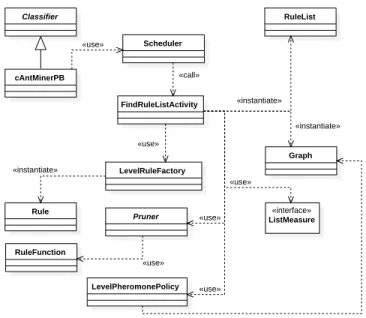
package. Pheromone evaporation is implemented by decreasing the pheromone values by a user-defined factorρ. Figure 4 presents a simplified class diagram illustrating the dependencies among main classes used incAnt-MinerPBimplementation. As can be seen, there
are many classes shared betweencAnt-MinerPBandcAnt-Miner
(Figure 3) implementations.
Unordered Rules.The UnorderedcAnt-MinerPBimplementation
follows a similar structure, with the difference that the order in which the rules are created is not important to make predictions— i.e., it creates a set of rules. This is implemented by the FindRule-SetActivityclass (package myra.classification.rule.unor-dered). Rules are created in a (non-optimised) sequential covering fashion, as incAnt-MinerPB. TheFindRuleSetActivityuses a
FixedClassRuleFactoryto create rules for each class value. The prefix ‘Fixed’ in the class name indicates that the class value of the rule is decided in advance, before the rule is created, and it guarantees that the algorithm will create at least one rule for each class value. While the order of rules is not important to make predictions, pheromone values are indexed by the position of the
AntMiner SequentialCovering FindRuleActivity PheromoneUpdate RuleFactory Graph ÇinstantiateÈ ÇuseÈ cAntMiner Classifier Pruner ÇcallÈ Rule ÇinstantiateÈ RuleList ÇinstantiateÈ RuleFunction ÇuseÈ Scheduler ÇuseÈ ÇcallÈ ÇuseÈ ÇuseÈ ÇuseÈ
Figure 3: A simplified class diagram illustrating the
depen-dencies among main classes used in Ant-Miner and
cAnt-Miner implementation. cAntMinerPB FindRuleListActivity LevelPheromonePolicy LevelRuleFactory Graph ÇuseÈ Classifier Pruner ÇcallÈ Rule ÇinstantiateÈ RuleList RuleFunction ÇuseÈ Scheduler ÇcallÈ ÇuseÈ ÇuseÈ ÇinstantiateÈ ÇinstantiateÈ ÇuseÈ ÇinterfaceÈ ListMeasure ÇuseÈ
Figure 4: A simplified class diagram illustrating the
depen-dencies among main classes used incAnt-MinerPB
imple-mentation.
rule, the same way ascAnt-MinerPB. It also uses a
LevelPheromo-nePolicyto control the update of pheromone values. It should be noted that aRuleSetis a subclass ofRuleList, therefore the same
ListMeasuremeasures can be used to evaluate aRuleSet. The implementation of UnorderedcAnt-MinerPB includes an
option to use aFunctionSelector(package myra.classificati-on.rule.function) to dynamically select aRuleFunctionfor pru-ning [15]. The motivation for this is that evaluation functions
GECCO ’17 Companion, July 15-19, 2017, Berlin, Germany Fernando E. B. Otero UcAntMinerPB FindRuleSetActivity LevelPheromonePolicy FixedClassRuleFactory Graph ÇuseÈ Classifier Pruner ÇcallÈ Rule ÇinstantiateÈ RuleList RuleFunction ÇuseÈ Scheduler ÇcallÈ ÇuseÈ ÇuseÈ ÇinstantiateÈ ÇinstantiateÈ ÇuseÈ FunctionSelector ÇuseÈ RuleSet ÇinterfaceÈ ListMeasure ÇuseÈ
Figure 5: A simplified class diagram illustrating the
de-pendencies among main classes used in Unorderedc
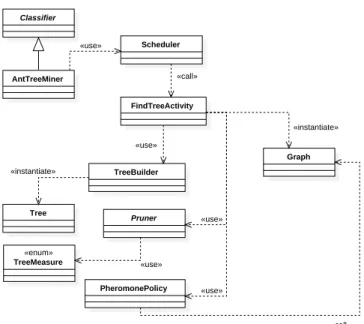
Ant-MinerPBimplementation. AntTreeMiner FindTreeActivity PheromonePolicy TreeBuilder Graph ÇuseÈ Classifier Pruner ÇcallÈ Tree ÇinstantiateÈ ÇenumÈ TreeMeasure ÇuseÈ Scheduler ÇcallÈ ÇuseÈ ÇuseÈ ÇinstantiateÈ ÇuseÈ
Figure 6: A simplified class diagram illustrating the depen-dencies among main classes used in Ant-Tree-Miner imple-mentation.
have different bias and capture different aspects of a rule. The procedure to choose an evaluation function is similar to a vertex selection, where the pheromone associated with each function bias the selection. Hence, the algorithm is not only identifying which vertices are more suitable to create rules, but also the evaluation function more suitable to prune each individual rule.
Figure 5 presents a simplified class diagram illustrating the de-pendencies among main classes used in UnorderedcAnt-MinerPB
implementation. It is clear that there are many shared classes be-tweencAnt-MinerPB(Figure 4) and the unordered version.
3.3
Decision Trees
In addition to algorithms that produce classification rules as a model, MYRA includes the implementation of Ant-Tree-Miner, an ACO algorithm to create decision trees. Ant-Tree-Miner follows the traditional top-down approach, often referred to as divide-and-conquer. In this approach, a decision tree is created iteratively, from the top (root node) to the bottom (leaf nodes). In the first iteration, an attribute is selected to represent the root node of the tree. Then, a branch is created for each different value in the domain of the attribute. Each branch represents a test on a particular attribute value. The data is then split into subsets according to the instances’ values of the selected attribute—each subset is then associated with its corresponding branch. The attribute selection is then recursively repeated for each branch created until one of the following conditions is met: (i) all instances on a subset are associated with the same class value; or (ii) the number of instances in a subset is smaller than a user-defined minimum value. At this point, a leaf node predicting the majority class value—the class value associated with the majority of instances in the subset—is added to the tree and the recursive process stops.
As can been seen, the crucial step in the top-down strategy is the selection of attributes to create the nodes of the decision tree. In other words, the problem of creating a decision tree is divided into smaller problems of selecting an appropriate attribute given a subset of data. Ant-Tree-Miner employs an ACO procedure to select at-tributes during the decision tree construction. This is implemented by aFindTreeActivity(packagemyra.classification.tree). The first difference between Ant-Tree-Miner and Ant-Miner (and variations) is the construction graph structure: vertices in Ant-Tree-Miner’s graph represent attributes instead of (attribute, value) terms. At each step of the tree construction procedure, an ant probabilisti-cally selects vertex to visit based on the amount of pheromone and the heuristic information, in the same way as Equation 1. When an ant creates a candidate decision tree (Treeclass), internal nodes are represented byInternalNodeobjects and leaf nodes are rep-resented byLeafNodeobjects. APrunerclass is used to remove nodes that lead to an improvement in the quality of the tree. While Ant-Tree-Miner uses a differentPheromonePolicyimplementation, since the construction graph and the solution representation are different, it works in a similar fashion: each internal node is used to increment the pheromone values of its associated level (depth of the node in the decision tree). The increment is proportional to the quality of the decision tree, measured by aTreeMeasureenum.
Given that Ant-Tree-Miner is a population-based algorithm, mul-tiple decision trees are created at each iteration of the ACO proce-dure. Similarly to Ant-Miner and variations, the FindTreeActivi-tyis controlled by a maximum number of iterations. At the end, the bestTreeobject created is returned as the output of the algorithm.
Figure 6 presents a simplified class diagram illustrating the de-pendencies among main classes used in Ant-Tree-Miner implemen-tation. It should be noted that Ant-Tree-Miner implementation has little overlap to the implementation of other rule-based algorithms, apart from ACO algorithmic components discussed in Section 2.
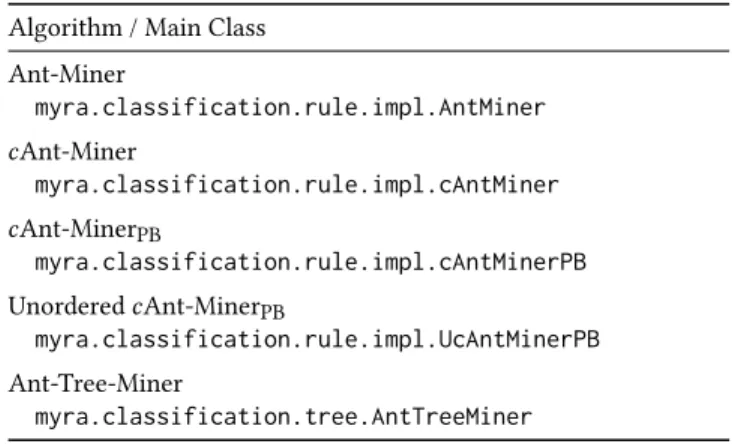
Table 1: Main class for the algorithms included in MYRA.
Algorithm / Main Class Ant-Miner myra.classification.rule.impl.AntMiner cAnt-Miner myra.classification.rule.impl.cAntMiner cAnt-MinerPB myra.classification.rule.impl.cAntMinerPB UnorderedcAnt-MinerPB myra.classification.rule.impl.UcAntMinerPB Ant-Tree-Miner myra.classification.tree.AntTreeMiner
ItsGraph,PheromonePolicyandPrunerare different, since Ant-Tree-Miner uses aTreeas a solution representation instead of a list/set of rules.
4
RUNNING THE ALGORITHMS
The framework includes main classes to run the algorithms directly from the command-line. These are presented in Table 1. In order to run the algorithms from the command-line, the following template can be used:
java -cp myra-<version>.jar <main class> -f <file>
where<version>is MYRA jar version number (e.g., 4.5),<main class>is the main class name of the algorithm and<file>is the path to the attribute-relation file format (ARFF)4 to be used as training data. The minimum requirement to run an algorithm is a training data file. If no training data file is specified, the list of line switches is printed. Figure 7 shows the command-line options for Ant-Miner algorithm.
The parameters of an algorithm can be tweaked using command-line options. Experiments can be reproduced by setting the same seed value (-soption), since ACO algorithms are stochastic and a pseudorandom number generator is used during their execution. Note that when running the algorithm in parallel (--parallel
option), there is no guarantee that it will have the same behaviour even if the same seed value is used, since the thread allocation is not controlled in the code. Figure 8 shows an example of a run ofcAnt-Miner. The output generated includes the values of the parameters to facilitate replicating an execution.
The algorithms can also be executed by instantiating the cor-responding main class and calling thetrainmethod, which is specified by the abstractClassifierclass. This method returns a
Modelobject that can be used to make predictions.
5
CONCLUSIONS
This paper introduced MYRA, a Java ant colony optimization frame-work for classification algorithms. It provides the implementation of several popular ant colony optimization algorithms. The algo-rithms are ready to be used from the command-line or can be easily called from your own Java code. They are implemented using a 4http://www.cs.waikato.ac.nz/ml/weka/arff.html
Usage: AntMiner -f <file> [-t <test file>] [options]
The minimum required parameter is a training file to build the model from. If a test file is specified, the model will be tested at the end of training. The results are presented in a confusion matrix.
The following options are available:
-c <size> specify the size of the colony
-g enables the dynamic
heuristic computation
-h <method> specify the heuristic method
-i <number> set the maximum number of iterations
-m <number> set the minimum number of covered examples per rule
-p <method> specify the rule pruner
-r <function> specify the rule quality function
-s <seed> Random seed value
-u <number> set the allowed number of uncovered examples
-x <iterations> set the number of iterations for convergence test
--parallel <cores> enable parallel execution in multiple cores
Figure 7: Command-line options of Ant-Miner algorithm. When options are not specified, the algorithm is executed using the default values.
modular architecture, so they can be easily extended to incorporate different procedures and/or use different parameter values.
The current version 4.x is a complete rewrite from version 3.x, although it was not possible to maintain backward compatibility. The overall architecture of the framework is very similar, but most data structures have changed. The computational time has been significantly improved—tasks that used to take minutes, now are done in seconds. In addition, there is an initial support for ant colony optimization regression algorithms [3].
Not all algorithms and features from version 3.x are implemented in current version. Namely, hierarchical multi-label algorithms, support for output of predictions and the GUI interface are not
GECCO ’17 Companion, July 15-19, 2017, Berlin, Germany Fernando E. B. Otero
cAnt-Miner rule induction [build v4.5]
_________________________________________________
Training file: /uci/datasets/iris/iris.arff
[Runtime default values] -s 1490115439698 -c 60 -i 1500 -m 10 -u 10 -x 10 -p backtrack -r sen_spe -h gain -d mdl Relation: iris Instances: 150 Attributes: 4 Classes: 3 Random seed: 1490115439698 === Discovered Model ===
IF petal-width <= 0.8 THEN Iris-setosa IF petal-length > 5.15 THEN Iris-virginica IF petal-width <= 1.45 THEN Iris-versicolor IF petal-width > 1.75 THEN Iris-virginica IF <empty> THEN Iris-versicolor
Number of rules: 5 Total number of terms: 4 Average number of terms: 0.80
Classification accuracy on training set: 97.33%
Running time (seconds): 0.24
Figure 8: Output ofcAnt-Miner when executed on the iris data from the UCI Machine Learning repository [11].
present. These will eventually be refactored into a future release. Currently the framework does not have a standard way of organ-ising experiments—e.g., run an algorithm over multiple datasets, performn-fold cross-validation or visualise results of multiple runs. Users are required to provide their own wrapper code/scripts. It would be interesting to incorporate a facility to perform multiple experiments into the framework. Additionally, the framework does not provide any feedback regarding the progress of the execution of an algorithm—this is an important future development. Another important future development is to include MYRA as a package into WEKA.
REFERENCES
[1] C. Blum and K. Socha. 2005. Training feed-forward neural networks with ant colony optimization: An application to pattern classification. InCD-ROM Pro-ceedings of Hybrid Intelligent Systems Conference (HIS-2005).
[2] U. Boryczka and J. Kozak. 2010. Ant Colony Decision Trees – A New Method for Constructing Decision Trees Based on Ant Colony Optimization. InProceedings of the ICCCI. 373–382.
[3] J. Brookhouse and F.E.B. Otero. 2015. Discovering Regression Rules with Ant Colony Optimization. InProceedings of the International Conference on Genetic and Evolutionary Computation Companion (GECCO’15 Companion). ACM, 1005– 1012.
[4] M. Dorigo and T. St¨utzle. 2004.Ant Colony Optimization. MIT Press. 328 pages. [5] U.M. Fayyad, G. Piatetsky-Shapiro, and P. Smith. 1996. From data mining to knowledge discovery: an overview. InAdvances in Knowledge Discovery & Data Mining, U.M. Fayyad, G. Piatetsky-Shapiro, P. Smith, and R. Uthurusamy (Eds.). MIT Press, Cambridge, MA, USA, 1–34.
[6] E. Frank, M.A. Hall, and I.H. Witten. 2016. The WEKA Workbench: Online Appendix for “Data Mining: Practical Machine Learning Tools and Techniques” (4th ed.). Morgan Kaufmann.
[7] A.A. Freitas. 2001. Understanding the crucial role of attribute interaction in data mining.Artificial Intelligence Review16, 3 (2001), 177–199.
[8] A.A. Freitas. 2002. Data Mining and Knowledge Discovery with Evolutionary Algorithms. Springer-Verlag. 264 pages.
[9] E. Gamma, R. Helm, R. Johnson, and J. Vlissides. 1995.Design patterns : elements of reusable object-oriented software. Addison-Wesley. 395 pages.
[10] N. Holden and A.A. Freitas. 2008. A hybrid PSO/ACO algorithm for discovering classification rules in data mining.Journal of Artificial Evolution and Applications (JAEA), special issue on Particle Swarms: The Second Decade(2008). http://dx.doi. org/10.1155/2008/316145 11 pages.
[11] M. Lichman. 2013. UCI Machine Learning Repository. (2013). http://archive.ics. uci.edu/ml
[12] M. L´opez-Ib´a ˜nez, M. Dorigo, and T. St¨utzle. 2015. Ant Colony Optimization: A Component-Wise Overview. Technical Report TR/IRIDIA/2015-006, IRIDIA, Uni-versit´e Libre de Bruxelles, http://iridia.ulb.ac.be/IridiaTrSeries/link/IridiaTr2015-006.pdf. (2015).
[13] D. Martens, M. De Backer, R. Haesen, J. Vanthienen, M. Snoeck, and B. Bae-sens. 2007. Classification With Ant Colony Optimization.IEEE Transactions on Evolutionary Computation11, 5 (2007), 651–665.
[14] D. Martens, B. Baesens, and T. Fawcett. 2011. Editorial survey: swarm intelligence for data mining.Machine Learning82, 1 (2011), 1–42.
[15] M. Medland, F.E.B. Otero, and A.A. Freitas. 2012. Improving thecAnt-MinerPB
Classification Algorithm. InSwarm Intelligence (Lecture Notes in Computer Sci-ence), Marco Dorigo, Mauro Birattari, Christian Blum, Anders Lyhne Christensen, Andries P. Engelbrecht, Roderich Groß, and Thomas St¨utzle (Eds.), Vol. 7461. Springer Berlin Heidelberg, 73–84.
[16] F.E.B. Otero and A.A. Freitas. 2013. Improving the Interpretability of Classifica-tion Rules Discovered by an Ant Colony Algorithm. InProceedings of the Genetic and Evolutionary Computation Conference (GECCO’13). ACM Press, 73–80. [17] F.E.B. Otero and A.A. Freitas. 2016. Improving the Interpretability of
Clas-sification Rules Discovered by an Ant Colony Algorithm: Extended Results. Evolutionary Computation24, 3 (2016), 385–409.
[18] F.E.B. Otero, A.A. Freitas, and C.G.Johnson. 2009. A Hierarchical Classification Ant Colony Algorithm for Predicting Gene Ontology Terms. InProceedings of the 7th European Conference on Evolutionary Computation, Machine Learning and Data Mining in Bioinformatics (EvoBio 2009), LNCS 5483. Springer-Verlag, 68–79. [19] F.E.B. Otero, A.A. Freitas, and C.G. Johnson. 2008.cAnt-Miner: an ant colony
classification algorithm to cope with continuous attributes. InProceedings of the 6th International Conference on Swarm Intelligence (ANTS 2008), Lecture Notes in Computer Science 5217, M. Dorigo, M. Birattari, C. Blum, M. Clerc, T. St¨utzle, and A.F.T. Winfield (Eds.). Springer-Verlag, 48–59.
[20] F.E.B. Otero, A.A. Freitas, and C.G. Johnson. 2009. Handling continuous attributes in ant colony classification algorithms. InProceedings of the 2009 IEEE Symposium on Computational Intelligence in Data Mining (CIDM 2009). IEEE, 225–231. [21] F.E.B. Otero, A.A. Freitas, and C.G. Johnson. 2010. A Hierarchical Multi-Label
Classification Ant Colony Algorithm for Protein Function Prediction.Memetic Computing2, 3 (2010), 165–181.
[22] F.E.B. Otero, A.A. Freitas, and C.G. Johnson. 2012. Inducing decision trees with an ant colony optimization algorithm.Applied Soft Computing12, 11 (2012), 3615–3626.
[23] F.E.B. Otero, A.A. Freitas, and C.G. Johnson. 2013. A New Sequential Covering Strategy for Inducing Classification Rules with Ant Colony Algorithms.IEEE Transactions on Evolutionary Computation17, 1 (2013), 64–74.
[24] R.S. Parpinelli, H.S. Lopes, and A.A. Freitas. 2002. Data Mining with an Ant Colony Optimization Algorithm.IEEE Transactions on Evolutionary Computation 6, 4 (2002), 321–332.
[25] K.M. Salama and A.A. Freitas. 2013. Learning Bayesian network classifiers using ant colony optimization.Swarm Intelligence7, 2 (2013), 229–254.