Available online throug
ISSN 2229 – 5046
FINITE ELEMENT SOLUTIONS OF MAGNETOHYDRODYNAMIC CHEMICALLY REACTING
FREE CONVECTIVE FLUID FLOW PAST VERTICAL POROUS PLATE
WITH THERMAL RADIATION AND VISCOUS DISSIPATION
G. ARUNA*
Department of Mathematics, GITAM University,
Hyderabad Campus, Rudraram, Medak (Dt.), 502329, Telangana State, India.
(Received On: 12-10-16; Revised & Accepted On: 15-11-16)
ABSTRACT
T
his is a theoretical investigation on the chemical reaction and thermal radiation effects on unsteady magnetohydrodynamic free convective on a viscous, incompressible, electrically conducting fluid flow past a vertical plate embedded in porous medium in presence of viscous dissipation, heat and mass transfer. The chemical reaction has been assumed to be homogeneous of first-order. The basic non-linear coupled partial differential equations governing the flow have been solved numerically using an efficient, flexible finite element method. Graphical results for velocity, temperature and concentration profiles have been obtained, to show the effects of different parameters entering in the problem. Such flow problems are important in many processes, in which there is combined heat and mass transfer with chemical reaction, such as drying, evaporation at the surface of water body etc.Key words: Thermal radiation; MHD; Chemical Reaction; Viscous dissipation; Finite element method;
NOMENCLATURE
List of Variables:
A
A constanto
B
Magnetic field component alongy
′
−
axis,Tesla
p
C
Specific heat at constant pressure, J/kg-KGr
Grashof numberGc
Modified Grashof numberg
Acceleration of gravity, 9.81 m/s2K
′
The permeability of mediumK
The permeability parameterM
Hartmann numberPr
Prandtl numberSc
Schmidt numberN
Thermal radiation parameterEc
Eckert numberD
Chemical molecular diffusivity, m2/sT
′
Temperature of fluid near the plate, Kw
T
′
Temperature of the fluid far away of the fluid from the plate, K∞
′
T
Temperature of the fluid at infinity, KC
′
Concentration of fluid near the plate, Kg/m3w
C
′
Concentration of the fluid far away from the plate, Kg/m3Corresponding Author: G. Aruna*
∞
′
C
Concentration of the fluid at infinity, Kg/m3t
′
Time inx
′
,y
′
coordinate system, Secondst
Time in dimensionless co-ordinates, Secu
′
Velocity component inx
′
−
direction, m/su
Dimensionless velocity component inx
′
−
direction, m/sNu
Nusselt numberSh
Sherwood numberr
q
Radiative heat fluxx e
R
Reynold’s number1
k
Mean absorption coefficientK
Chemical reaction of first order with rate constanty
x
′
,
′
Co-ordinate system, my
x
,
Dimensionless coordinates, mo
U
Reference velocity, m/sGreek symbols:
β
Coefficient of volume expansion for heat transfer, K-1*
β
Coefficient of volume expansion for mass transfer, m3/Kgκ
Thermal conductivity of the fluidσ
Electrical conductivity of the fluid, mho/mθ
Non-dimensional temperature, Kφ
Concentration of the fluid, Kg/m3ρ
Density of the fluid, kg/m3τ
Skin-frictionµ
Viscosity, Ns/m2λ
Chemical reaction parameterSuperscripts:
Dimensionless Properties
Subscripts:
p
Platew
Wall condition∞
Free stream condition1. INTRODUCTION
In several problems related to demanding of efficient transfer of mass over inclined beds related to geophysical, petroleum, chemical, bio-mechanical, chemical technology and in situations the viscous drainage over an inclined porous plane is a subject of considerable interest to both theoretical and experimental investigators. Especially, in the flow of oil through porous rock, the extraction of geo-thermal energy from the deep interior of the earth to the shallow layers, the evaluation of the capability of heat removal from particulate nuclear fuel debris that may result from hypothetical accident in a nuclear reactor, the filtration of solids from liquids, flow of liquids through ion exchange beds, drug permeation through human glands, chemical reactor for economical separation or purification of mixtures flow through porous medium has been the subject of considerable research activity in recent years due to its notable applications. An important application in the petroleum industry where crude oil is trapped from natural underground reservoirs in which oil is entrapped since the flow behavior of fluids in petroleum reservoir rock depends to a large extent on the properties of the rock, techniques that yield new or additional information on the characteristics of the rock would enhance the performance of petroleum reservoirs. An important bio-medical application is the flow of fluids in lungs, blood vessels, arteries and so on, where the fluid is bounded by two layers which are held together by a set of fairly regularly spaced tissues. Slurry adheres to the reactor vessel and gets consolidated in many chemical processing industries, as a result of which chemical compounds within the reactor vessels percolates through the boundaries. Thus adhered substance within the reactor vessel acts as a porous boundary. The problem assumes greater importance in all such situations. The thin film adhering to the surfaces of the container must be taken into account for the purpose of precise chemical calculations in all such situations wherein hear and mass transfer occurs. Failure to do so leads to severe experimental errors. Hence, there is a need for such an analysis in detail. A mathematical model related to such a situation has been studied in detail. Anand Rao et al. ([1]-[11]) discussed Soret, Dufour, Hall current on an unsteady magnetohydrodynamic free convective fluid flow past a vertical plate filled in porous medium in presence of heat and mass transfer using finite element method. Dharmendar Reddy et al. ([12] and [13]) studied the chemical reaction, heat and mass transfer effects on an unsteady MHD natural convective fluid flow past an infinite vertical porous plate in presence of Hall current. Srinivasa Raju et al. ([14]-[31]) and his co-workers found the numerical solutions of unsteady magnetohydrodynamic free convective flow past an infinite vertical porous plate in presence of Soret, Dufour, thermal radiation, Chemical reaction, Hall current, heat and mass transfer using finite element technique. Jithender Reddy et al. ([32]-[39]) studied the simultaneous effects of viscous dissipation, thermal diffusion, diffusion thermo, chemical reaction on an unsteady magnetohydrodynamic free convective fluid flow past an infinite vertical plate filled in porous medium in presence of heat and mass transfer using numerical solutions by an efficient finite element method. Sudhakar et al. ([40]-[42]) studied the joint effects of thermal diffusion and diffusion thermo on an unsteady MHD natural convective fluid flow along a porous plate in presence of viscous dissipation, heat and mass transfer using finite element technique. Ramya et al. ([43]-[45]) found the numerical solutions of magnetohydrodynamic free convective nanofluid flow over a nonlinearly-stretching sheet in presence of thermal radiation, heat absorption/generation and thermal wall slips using Keller-box method. Aruna et al. [46] studied the combined influence of Soret and Dufour effects on unsteady hydromagnetic mixed convective flow in an accelerated vertical wavy plate through a porous medium. Unsteady MHD free convection flow near on an infinite vertical plate embedded in a porous medium with chemical reaction, Hall current and thermal radiation studied by Sarada et al. [47].
Hence, motivate by above reference work, the aim of the present work is to investigate the effect of thermal radiation on MHD free convection flow past an impulsively started semi-infinite porous plate with variable temperature in the presence of chemical reaction and viscous dissipation by finite element method which is more economical from computational view point. It is also assumed that temperature of the plate and concentration near the plate varies linearly with time.
2. MATHEMATICAL FORMULATION
Consider a two-dimensional unsteady MHD free convection flow of a viscous, incompressible, electrically conducting fluid past a semi-infinite tilted porous plate with chemical reaction and thermal radiation. In Cartesian coordinate system, let
x
′
−
axis is taken to be along the plate and they
′
−
axis normal to the plate. Since the plate is consideredinfinite in
x
′
−
direction, hence all physical quantities will be independent ofx
′
−
direction. The wall is maintained atconstant temperature
(
T
w′
)
and concentration(
C
′
w)
higher than the ambient temperature(
T
∞′
)
and concentration)
(
C
∞′
respectively. A uniform magnetic field of magnitudeB
o is applied normal to the plate. The transverse appliedmagnetic field and magnetic Reynold’s number are assumed to be very small, so that the induced magnetic field is
negligible. The homogeneous chemical reaction of first order with rate constant
K
between the diffusing species and the fluid is assumed. It is assumed that there is no applied voltage which implies the absence of an electric field. The fluid has constant kinematic viscosity and constant thermal conductivity, and the Boussinesq's approximation have been adopted for the flow. The fluid is considered to be gray absorbing-emitting radiation but non-scattering medium and the Roseland’s approximation is used to describe the radiative heat flux. It is considered to be negligible inx
′
−
direction as compared in
y
′
−
direction. At timet
′
>
0
the plate is given an impulsive motion in the direction of flow i.e. alongx
′
−
axis against the gravity with constant velocityU
o, it is assumed that the plate temperature and concentration at the plate are varying linearly with time. The concentration of the diffusing species in the binary mixture is assumed to be very small in comparison with the other chemical species, which are present and hence Soret and Dufour effects are negligible. Under these assumptions the equations governing the flow are:Momentum Equation:
(
)
(
)
u
K
B
y
u
C
C
g
T
T
g
t
u
o′
′
+
−
′
∂
′
∂
+
′
−
′
+
′
−
′
=
′
∂
′
∂
∞ ∞ν
ρ
σ
ν
β
β
* 2 2 2(1) Energy Equation: 2 2 2
′
∂
′
∂
+
′
∂
∂
−
′
∂
′
∂
=
′
∂
′
∂
y
u
y
q
y
T
t
T
C
rp
κ
ν
ρ
(2)Species Diffusion Equation:
(
′
−
∞′
)
−
′
∂
′
∂
=
′
∂
′
∂
C
C
K
y
C
D
t
C
r 2 2 (3)With the following initial and boundary conditions:
(
)
(
)
∞
→
′
→
′
→
′
→
′
=
′
′
′
−
′
+
′
=
′
′
′
−
′
+
′
=
′
=
′
>
′
′
′
=
′
′
=
′
=
′
≤
′
∞ ∞ ∞ ∞ ∞ ∞y
as
C
T
u
y
at
t
A
C
C
C
C
t
A
T
T
T
T
U
u
t
y
all
for
C
C
T
T
u
t
w w o0
,
0
,
0
0
,
,
,
:
0
,
,
0
:
0
(4) Whereν
2 oU
A
=
. The radiative heat fluxq
r, under Rosseland approximation has the formy
T
q
r′
∂
′
∂
−
=
1 2 43
4
κ
σ
(5)
It is assumed that, the temperature differences within the flow are sufficiently small such that
T
′
4may be expressed asa linear function of the temperature
T
∞′
. This is obtained by expandingT
′
4in a Taylor series aboutT
∞′
and neglecting higher order terms. Thus, we get4 3
4
3
4
∞′
′
−
∞′
≅
′
T
T
T
T
(6)By using equations (5) and (6), equation (2) reduces to
2 2 1 3 1 2 2
3
16
y
T
C
k
T
y
T
C
t
T
pp
∂
′
′
∂
′
−
′
∂
′
∂
=
′
∂
′
∂
∞ρ
σ
ρ
κ
(7)Introducing the following non-dimensional parameters in equations (1), (2), (3) and (7) quantities:
(
)
(
)
(
)
* ' 3 3 2 22 2 2
2 2 3 2
1
, , , , , , ,
Pr , ,
, , , ,
4
w w
o o
o w w o o
p o
o
o o o r
p w o
g T T g C C
y U t U u T T C C
y t u Gr Gc
U T T C C U U
C B
M
U
U K U U K
Ec Sc K N
C T T D T U
βν β ν
θ ϕ
ν ν
µ σ ν
κ ρ
κ ν
ν λ
ν ν σ
In equations (1), (2), (3) and (7) reduces to
( ) ( )
Gr
θ
Gc
φ
u
K
M
y
u
t
u
−
+
+
+
∂
∂
=
∂
∂
)
1
(
2 2 (9)( )
22 2)
(Pr)(
3
4
1
Pr
∂
∂
+
∂
∂
+
=
∂
∂
y
u
Ec
y
N
t
θ
θ
(10)λφ
φ
φ
−
∂
∂
=
∂
∂
2 21
y
Sc
t
(11)The corresponding initial and boundary conditions in dimensionless form are:
∞
→
→
→
→
=
=
=
=
>
=
=
=
≤
y
as
u
y
at
t
t
u
t
y
all
for
u
t
0
,
0
,
0
0
,
,
1
:
0
0
,
0
,
0
:
0
φ
θ
φ
θ
φ
θ
(12)All the physical parameters are defined in the nomenclature. It is now important to calculate the physical quantities of primary interest, which are the local wall shear stress, the local surface heat and mass flux. Given the velocity field in the boundary layer, we can now calculate the local wall shear stress (i.e., skin-friction) is given by and in dimensionless form, we obtain Knowing the temperature field, it is interesting to study the effect of the free convection and radiation on the rate of heat transfer.
This is given by which is written in dimensionless form as
0 2
0
2
,
(
0
)
= = ′
∂
∂
=
′
=
∂
∂
=
=
y o y w w wy
u
u
U
y
u
u
τ
µ
ρ
ρ
τ
τ
(13)The dimensionless local surface heat flux (i.e., Nusselt number) is obtained as
0
)
(
)
(
= ′ ∞
′
∂
′
∂
′
−
′
′
−
=
′
y w uy
T
T
T
x
x
N
then 0)
(
=
∂
∂
−
=
′
=
y e uy
R
x
N
Nu
xθ
(14)The definition of the local mass flux and the local Sherwood number are respectively given by with the help of these equations, one can write
0
)
(
)
(
= ′ ∞
′
∂
′
∂
′
−
′
′
−
=
′
y w hy
C
C
C
x
x
S
then 0)
(
=
∂
∂
−
=
′
=
y e hy
R
x
S
Sh
xφ
(15) Whereν
x
U
R
o ex′
−
=
is the Reynold’s number.3. NUMERICAL SOLUTIONS BY FINITE ELEMENT TECHNIQUE
Step 1:Discretization of the Domain: The fundamental concept of the FEM is to divide the region of the problem into small connected pieces, called finite elements. The group of elements is called the finite element mesh. These finite elements are associated in a non overlapping manner, such that they completely cover the entire space of the problem.
Step 2:Invention of the Element Equations:
i) A representative element is secluded from the mesh and the variational formulation of the given problem is created over the typical element.
ii) Over an element, an approximate solution of the variational problem is invented, and by surrogating this in the system, the element equations are generated.
iii) The element matrix, which is also known as stiffness matrix, is erected by using the element interpolation functions.
Step 3: Assembly of the Element Equations: The algebraic equations so achieved are assembled by imposing the inter element continuity conditions. This yields a large number of mathematical equations known as the global finite element model, which governs the whole domain.
Step 4: Imposition of the Boundary Conditions: On the accumulated equations, the Dirichlet's and Neumann boundary conditions (12) are imposed.
Step 5: Solution of Assembled Equations: The assembled equations so obtained can be solved by any of the numerical methods, namely, Gauss elimination technique, LU decomposition technique, and the final matrix equation can be solved by iterative technique. For computational purposes, the coordinate y varies from 0 to 10, where ymax
represents infinity external to the momentum, energy and concentration edge layers.
In one-dimensional space, linear and quadratic elements, or element of higher order can be taken. The entire flow province is divided into 11000 quadratic elements of equal size. Each element is three-noded, and therefore the whole domain contains 21001 nodes. At each node, three functions are to be evaluated; hence, after assembly of the element equations, we acquire a system of 81004 equations which are non-linear. Therefore, an iterative scheme must be developed in the solution. After striking the boundary conditions, a system of equations has been obtained which is solved mathematically by the Gauss elimination method while maintaining a correctness of 0.00001. A convergence criterion based on the relative difference between the present and preceding iterations is employed. When these differences satisfy the desired correctness, the solution is assumed to have been congregated and iterative process is terminated. The Gaussian quadrature is applied for solving the integrations. The computer cryptogram of the algorithm has been performed in MATLAB running on a PC. Excellent convergence was completed for all the results.
4, RESULTS AND DISCUSSION
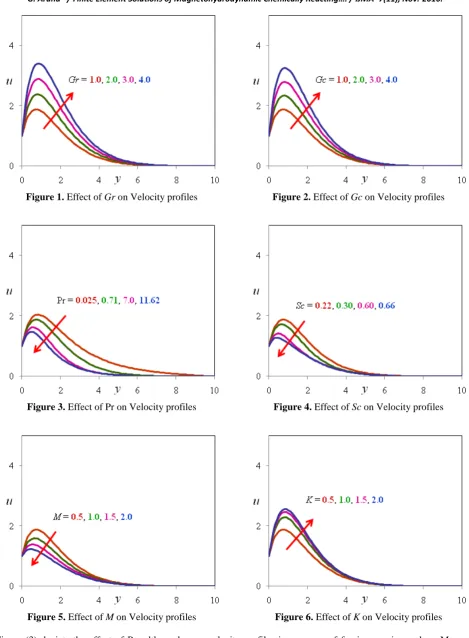
Figure 1. Effect of Gr on Velocity profiles Figure 2. Effect of Gc on Velocity profiles
Figure 3. Effect of Pron Velocity profiles Figure 4. Effect of Sc on Velocity profiles
Figure 5. Effect of M on Velocity profiles Figure 6. Effect of K on Velocity profiles
Figure (3) depicts the effect of Prandtl number on velocity profiles in presence of foreign species such as Mercury ( Pr = 0.025), Air ( Pr = 0.71), Water ( Pr = 7.00) and Water at
4
oC
( Pr = 11.62) are shown in figure (3). It is observed that from figure (3), the velocity decreases with increasing of Prandtl number
( )
Pr
. The nature of velocityforce called the Lorentz force, which acts against the flow if the magnetic field is applied in the normal direction, as in the present study. This resistive force slows down the fluid velocity component as shown in figure (5). The effect of Permeability parameter is presented in the figure (6). From this figure it observe that, the velocity is increases with increasing values of K.
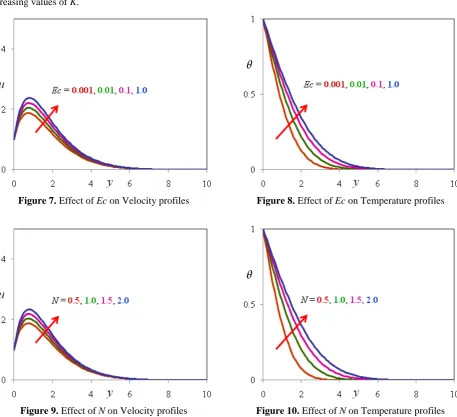
Figure 7. Effect of Ec on Velocity profiles Figure 8. Effect of Ec on Temperature profiles
Figure 9. Effect of N on Velocity profiles Figure 10. Effect of N on Temperature profiles
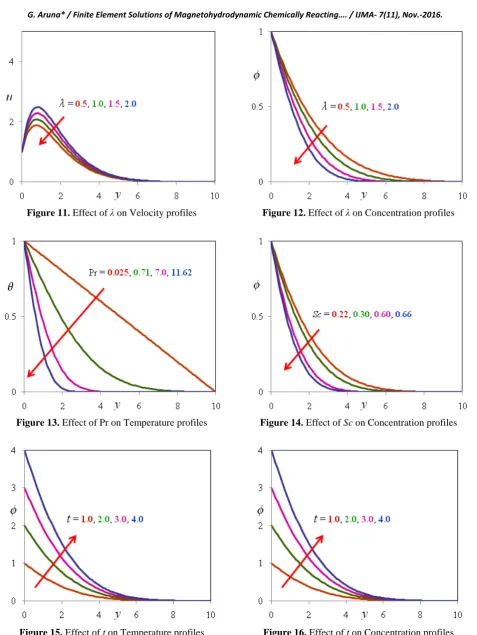
Figure 11. Effect of λ on Velocity profiles Figure 12. Effect of λ on Concentration profiles
Figure 13. Effect of Pron Temperature profiles Figure 14. Effect of Sc on Concentration profiles
Figure 15. Effect of t on Temperature profiles Figure 16. Effect of t on Concentration profiles
fluid medium decreases significantly in the boundary layer region and thereafter not much of variation is noticed. Figures (15) and (16) display the effect of the time on temperature and concentration profiles respectively. From these two figures it observed that, both temperature and concentration are increasing with increasing values of time.
The profiles for skin-friction due to velocity under the effects of Grashof number, Modified Grashof number, Prandtl number, Schmidt number, Hartmann number, Eckert number, Permeability parameter, Thermal radiation parameter and Chemical reaction parameter are presented in the table-1 respectively. It is observed from this table-1, the skin-friction rises under the effects of Grashof number, Modified Grashof number, Eckert number, Permeability parameter and Thermal radiation parameter. And falls under the effects of Prandtl number, Schmidt number, Hartmann number and Chemical reaction parameter.
Table-1: Skin-friction results
( )
τ
for the values ofGr
,
Gc
,
Pr,
Sc
,
M
,
K
,
Ec N
,
andλ
Gr
Gc
Pr
Sc
M
K
Ec
N
λ
τ
1.0 1.0 0.71 0.22 1.0 1.0 0.001 1.0 1.0 1.35831592 2.0 1.0 0.71 0.22 1.0 1.0 0.001 1.0 1.0 2.55841064 1.0 2.0 0.71 0.22 1.0 1.0 0.001 1.0 1.0 3.20690598 1.0 1.0 7.00 0.22 1.0 1.0 0.001 1.0 1.0 1.21241232 1.0 1.0 0.71 0.30 1.0 1.0 0.001 1.0 1.0 1.22361664 1.0 1.0 0.71 0.22 2.0 1.0 0.001 1.0 1.0 1.15888106 1.0 1.0 0.71 0.22 1.0 2.0 0.001 1.0 1.0 1.41703941 1.0 1.0 0.71 0.22 1.0 1.0 0.100 1.0 1.0 1.36513887 1.0 1.0 0.71 0.22 1.0 1.0 0.001 2.0 1.0 1.38441964 1.0 1.0 0.71 0.22 1.0 1.0 0.001 1.0 2.0 1.31157298
The profiles for Nusselt number due to temperature profile under the effect of Prandtl number, Eckert number, Thermal radiation parameter and time are presented in the table-2. From this table it observed that, the Nusselt numberdue to temperature profiles rises under the effect of Eckert number, Thermal radiation parameter and time. And temperature profiles falls under the effects of Prandtl number. The profiles for Sherwood number due to concentration profiles under the effect of Schmidt number, Chemical reaction parameter and time are presented in the table-3. From this table, the Sherwood number due to concentration profiles decreases under the effects of Schmidt number and Chemical reaction parameter and increases with the increasing values of time.
Table-2: Rate of heat transfer (
Nu
) values for different values ofPr,
Ec
,
N
andt
Pr
Ec
N
t
Nu
0.71 0.001 1.0 1.0 0.68749421 7.00 0.001 1.0 1.0 0.55419631 0.71 0.100 1.0 1.0 0.72594852 0.71 0.001 2.0 1.0 0.71434208 0.71 0.001 1.0 2.0 0.70157693
Table-3: Rate of mass transfer (
Sh
) values for different values ofSc
,
λ
andt
Sc
λ
t
Sh
0.22 1.0 1.0 1.42919663 0.30 1.0 1.0 1.32481477 0.22 2.0 1.0 1.36825118 0.22 1.0 2.0 1.44576324
6. CONCLUSIONS
The author summarize below the following results of physical interest on the velocity, temperature and concentration distributions of the flow field and also on the skin-friction, rate of heat and mass transfer at the wall.
1 A growing Hartmann number or Prandtl number or Schmidt number or Chemical reaction parameter retards the velocity of the flow field at all points.
2 The effect of increasing Grashof number or Modified Grashof number or Permeability parameter or Eckert number or Thermal radiation parameter is to accelerate velocity of the flow field at all points.
3 A growing Prandtl number decreases temperature of the flow field at all points and increases with increasing of Eckert number or Time or Thermal radiation parameter.
5 A growing Hartmann number or Prandtl number or Schmidt number or Chemical reaction parameter decreases the skin-friction while increasing Grashof number or Modified Grashof number or Permeability parameter or Eckert number or Thermal radiation parameter increases the skin-friction.
6 The rate of heat transfer is decreasing with increasing of Prandtl number and increases with increasing of Eckert number and Thermal radiation parameter.
7 The rate of mass transfer is decreasing with increasing of Schmidt number and Chemical reaction parameter.
REFERENCES
1. J. Anand Rao and R. Srinivasa Raju, Hall Effect on an unsteady MHD flow and heat transfer along a porous flat plate with mass transfer and viscous dissipation, Journal of Energy, Heat and Mass Transfer, Vol. 33, pp. 313-332, 2011.
2. J. Anand Rao and R. Srinivasa Raju, The effects of Hall currents, Soret and Dufour on MHD flow and heat transfer along a porous flat plate with mass transfer, Journal of Energy, Heat and Mass Transfer, Vol. 33, pp. 351-372, 2011.
3. J. Anand Rao, P. Ramesh Babu, R. Srinivasa Raju, Galerkin finite element solution of MHD free convection radiative flow past an infinite vertical porous plate with chemical reaction and hall current, International Journal of Mathematical Archive, Vol. 6, No. 9, pp. 164-177, 2015.
4. J. Anand Rao, R. Srinivasa Raju, S. Sivaiah, Finite Element Solution of MHD transient flow past an impulsively started infinite horizontal porous plate in a rotating fluid with Hall current, Journal of Applied Fluid Mechanics, Vol. 5, No. 3, pp. 105-112, 2012.
5. J. Anand Rao and R. Srinivasa Raju, Applied magnetic field on transient free convective flow of an incompressible viscous dissipative fluid in a vertical channel, Journal of Energy, Heat and Mass Transfer, Vol. 32, pp. 265-277, 2010.
6. J. Anand Rao, G. Jithender Reddy, R. Srinivasa Raju, Finite element study of an unsteady MHD free convection Couette flow with Viscous Dissipation, Global Journal of Pure and Applied Mathematics, Vol. 11, No. 2, pp. 65-69, 2015.
7. J. Anand Rao, P. Ramesh Babu, R. Srinivasa Raju, Finite element analysis of unsteady MHD free convection flow past an infinite vertical plate with Soret, Dufour, Thermal radiation and Heat source, ARPN Journal of Engineering and Applied Sciences, Vol. 10, No. 12, pp. 5338-5351, 2015.
8. J. Anand Rao, P. Ramesh Babu, R. Srinivasa Raju, Siva Reddy Sheri, Heat and Mass transfer effects on an unsteady MHD free convective chemical reacting fluid flow past an infinite vertical accelerated plate with constant heat flux, Journal of Energy, Heat and Mass Transfer, Vol. 36, pp. 237-257, 2014.
9. J. Anand Rao, R. Srinivasa Raju, S. Sivaiah, Finite Element Solution of heat and mass transfer in MHD Flow of a viscous fluid past a vertical plate under oscillatory suction velocity, Journal of Applied Fluid Mechanics, Vol. 5, No. 3, pp. 1-10, 2012.
10. J. Anand Rao, S. Sivaiah, R. Srinivasa Raju, Chemical Reaction effects on an unsteady MHD free convection fluid flow past a semi-infinite vertical plate embedded in a porous medium with Heat Absorption, Journal of Applied Fluid Mechanics, Vol. 5, No. 3, pp. 63-70, 2012.
11. J. Anand Rao, S. Sivaiah, Sk. Nuslin Bibi, R. Srinivasa Raju, Soret and Radiation effects on unsteady MHD free convective fluid flow embedded in a porous medium with Heat Source, Journal of Energy, Heat and Mass Transfer, Vol. 35, pp. 23-39, 2013.
12. Y. Dharmendar Reddy, R. Srinivasa Raju, S. Hari Prasad, L. Anand Babu, Chemical Reaction effect on an unsteady MHD free convective flow past a vertical porous plate with Hall Current, Proceedings of International Conference on Mathematical Computer Engineering (ICMCE-2013), pp. 1206-1219 with ISBN 978-93-82338-91-8 © 2013 Bonfring.
13. Y. Dharmendar Reddy, R. Srinivasa Raju, V. Srinivasa Rao, L. Anand Babu, Hall Current effect on an unsteady MHD free convection flow past a vertical porous plate with heat and mass transfer, International Journal of Scientific and Innovative Mathematical Research, Vol. 3, Special Issue 3, pp. 884-890, 2015. 14. R. Srinivasa Raju, G. Anitha and G. Jitthender Reddy, Influence of Transpiration and Hall effects on unsteady
MHD free convection fluid flow over an infinite vertical plate, International Journal of Control Theory and Applications, 2016 (In Press).
15. R. Srinivasa Raju, M. Anil Kumar, N. Venkatesh, Transpiration Influence On An Unsteady Natural Convective Fluid Flow Past An Infinite Vertical Plate Embedded In Porous Medium In Presence Of Hall Current Via Finite Element Method, ARPN Journal of Engineering and Applied Sciences, 2016 (In Press). 16. R. Srinivasa Raju, S. Sivaiah, J. Anand Rao, Finite Element Solution of Heat and Mass transfer in past an
impulsively started infinite vertical plate with Hall Effect, Journal of Energy, Heat and Mass Transfer, Vol. 34, pp. 121-142, 2012.
17. R. Srinivasa Raju, S. Sivaiah, J. Anand Rao, Radiation effects on unsteady MHD free convection with Hall current near on an infinite vertical porous plate, Journal of Energy, Heat and Mass Transfer, Vol. 34, pp. 163-174, 2012.
19. R. Srinivasa Raju, B. Mahesh Reddy, M. M. Rashidi, Rama Subba Reddy Gorla, Application of Finite Element Method to Unsteady MHD Free Convection Flow Past a Vertically Inclined Porous Plate Including Thermal Diffusion And Diffusion Thermo Effects, Journal of Porous Media, Vol. 19, Issue. 8, pp. 701-722, 2016.
20. R. Srinivasa Raju, Combined influence of thermal diffusion and diffusion thermo on unsteady hydromagnetic free convective fluid flow past an infinite vertical porous plate in presence of chemical reaction, Journal of Institution of Engineers: Series C, pp. 1-11, 2016, DOI: 10.1007/s40032 –016-0258-5.
21. R. Srinivasa Raju, G. Jitthender Reddy, J. Anand Rao, M. M. Rashidi, Thermal Diffusion and Diffusion Thermo Effects on an Unsteady Heat and Mass Transfer MHD Natural Convection Couette Flow Using FEM,
Journal of Computational Design and Engineering, Vol. 3, Issue 4, pp. 349-362, DOI: 10.1016/j.jcde. 2016.06.003, 2016.
22. R. Srinivasa Raju, G. Aruna, N. V. Swamy Naidu, S. Vijay Kumar Varma, M. M. Rashidi, Chemically reacting fluid flow induced by an exponentially accelerated infinite vertical plate in a magnetic field and variable temperature via LTT and FEM, Theoretical Applied Mechanics, Vol. 43, Issue 1, pp. 49-83, 2016. 23. R. Srinivasa Raju, Transfer Effects On An Unsteady MHD Free Convective Flow Past A Vertical Plate With
Chemical Reaction, Engineering Transactions Journal, 2016 (In Press).
24. R. Srinivasa Raju, M. Anil Kumar, Y. Dharmendar Reddy, Unsteady MHD Free Convective Flow Past A Vertical Porous Plate With Variable Suction, ARPN Journal of Engineering and Applied Sciences, 2016 (In Press).
25. R. Srinivasa Raju, Application of Finite Element Method to MHD mixed convection chemically reacting flow past a vertical porous plate with Cross Diffusion and Biot number Effects, American Journal Of Heat And Mass Transfer, 2016 (In Press).
26. R. Srinivasa Raju, M. Anil Kumar, K. Sarada, Y. Dharmendar Reddy, Influence of thermal radiation on unsteady free convection flow of water near 4oC past a moving vertical plate, Global Journal of Pure and Applied Mathematics, Vol. 11, No. 2, pp. 237-240, 2015.
27. R. Srinivasa Raju, G. Anitha, G. Aruna, S. Vijay Kumar Varma, Viscous dissipation impact on chemically reacting flow past an infinite vertical oscillating porous plate with magnetic field, Global Journal of Pure and Applied Mathematics, Vol. 11, No. 2, pp. 146-150, 2015.
28. R. Srinivasa Raju, G. Jithender Reddy, J. Anand Rao, P. Manideep, Application of FEM to free convective flow of Water near 4˚ C past a vertical moving plate embedded in porous medium in presence of magnetic field, Global Journal of Pure and Applied Mathematics, Vol. 11, No. 2, pp. 130-134, 2015.
29. R. Srinivasa Raju, K. Sudhakar, M. Rangamma, The effects of thermal radiation and Heat source on an unsteady MHD free convection flow past an infinite vertical plate with thermal diffusion and diffusion thermo,
Journal of Institution of Engineers: Series C, Vol. 94, Issue 2, pp. 175-186, DOI: 10.1007/s40032-013-0063-3, 2013.
30. R. Srinivasa Raju, G. Jithender Reddy, M. Anil Kumar, N. V. Swamy Naidu, Finite element analysis of chemically reacted fluid flow over an exponentially accelerated vertical plate, Proceedings of International Conference on Computers Aided Engineering (CAE-2015), pp. 243-249, 2015.
31. R. Srinivasa Raju, G. Jithender Reddy, Y. Dharmendar Reddy, J. Anand Rao, Hydromagnetic free convection heat transfer Couette flow of water at 4oC in rotating system, Proceedings of International Conference on Mathematical Computer Engineering (ICMCE-2015), 2015.
32. G. Jithender Reddy, J. Anand Rao, R. Srinivasa Raju, Chemical reaction and radiation effects on MHD free convection from an impulsively started infinite vertical plate with viscous dissipation, International Journal of Advances in Applied Mathematics and Mechanics, Vol. 2, No. 3, pp. 164-176, 2015.
33. G. Jithender Reddy, J. Anand Rao, R. Srinivasa Raju, Finite element Analysis of MHD free convective Couette flow with Thermal Radiation And Viscous Dissipation, Proceedings of International Conference on Computers Aided Engineering (CAE-2015), pp. 250-255, 2015.
34. G. Jithender Reddy, P. Veera Babu, R. Srinivasa Raju, Finite element analysis of Heat and Mass transfer in MHD radiative free convection from an impulsively started infinite vertical plate, Proceedings of 59th Congress of ISTAM, Vol. 59-istam-fm-fp-150, pp.1-8, 2014.
35. G. Jithender Reddy, R. Srinivasa Raju, Siva Reddy Sheri, Finite Element Analysis of Soret and Radiation effects on an transient MHD free convection from an impulsively started infinite vertical plate with Heat absorption, International Journal of Mathematical Archive, Vol. 5, No. 4, pp. 211-220, 2014.
36. G. Jitthender Reddy, R. Srinivasa Raju, J. Anand Rao, Influence Of Viscous Dissipation On Unsteady MHD Natural Convective Flow Of Casson Fluid Over An Oscillating Vertical Plate Via FEM, Ain Shams Engineering Journal, 2016 (In Press).
37. G. Jitthender Reddy, R. Srinivasa Raju, J. Anand Rao, Thermal Diffusion and Diffusion Thermo Effects on Unsteady MHD Fluid Flow Past A Moving Vertical Plate Embedded in Porous Medium in the Presence of Hall Current and Rotating System, Transactions of A. Razmadze Mathematical Institute Journal, Vol. 170, pp. 243-265, DOI: http://dx.doi.org/ 10.1016/j.trmi.2016.07.001, 2016.
39. G. Jithender Reddy, R. Srinivasa Raju, J. Anand Rao, Finite element analysis of Hall current and Rotation effects on free convection flow past a moving vertical porous plate with Chemical reaction and Heat absorption, Proceedings of 59th Congress of ISTAM, Vol. 59-istam-fm-fp-29, pp.1-11, 2014.
40. K. Sudhakar, R. Srinivasa Raju, M. Rangamma, Chemical reaction effect on an unsteady MHD free convection flow past an infinite vertical accelerated plate with constant heat flux, thermal diffusion and diffusion thermo, International Journal of Modern Engineering Research, Vol. 2, Issue 5, pp. 3329-3339, 2012.
41. K. Sudhakar, R. Srinivasa Raju, M. Rangamma, Effects of thermal diffusion and diffusion thermo on an unsteady MHD mixed convection flow past an accelerated infinite vertical plate with viscous dissipation,
International Journal of Mathematical Archive, Vol. 3, No. 8, pp. 2929-2942, 2012.
42. K. Sudhakar, R. Srinivasa Raju, M. Rangamma, Hall effect on an unsteady MHD flow past along a porous flat plate with thermal diffusion, diffusion thermo and chemical reaction, Journal of Physical and Mathematical Sciences, Vol. 4, No. 1, pp. 370-395, 2013.
43. Ramya Dodda, R. Srinivasa Raju, J. Anand Rao, Influence Of Chemical Reaction On MHD boundary Layer flow Of Nano Fluids Over A Nonlinear Stretching Sheet With Thermal Radiation, Journal of Nanofluids, Vol. 5, No. 6, pp. 880-888, 2016.
44. Ramya Dodda, R. Srinivasa Raju, J. Anand Rao, Slip Effect of MHD Boundary Layer Flow of Nanofluid Particles over a Nonlinearly Isothermal Stretching Sheet in Presence of Heat Generation/Absorption,
International Journal of Nanoscience and Nanotechnology, 2016 (In Press).
45. Ramya Dodda, A. J. Chamkha, R. Srinivasa Raju, J. Anand Rao, Effect of velocity and thermal wall slips on MHD boundary layer viscous flow and heat transfer of a nanofluid over a nonlinearly-stretching sheet: A Numerical study, Propulsion and Power Research Journal, 2016 (In Press).
46. G. Aruna, S. Vijay Kumar Varma, R. Srinivasa Raju, Combined influence of Soret and Dufour effects on unsteady hydromagnetic mixed convective flow in an accelerated vertical wavy plate through a porous medium, International Journal of Advances in Applied Mathematics and Mechanics, Vol. 3, No. 1, pp. 122-134, 2015.
47. K. Sarada, R. Srinivasa Raju, B. Shankar, Unsteady MHD free convection flow near on an infinite vertical plate embedded in a porous medium with Chemical reaction, Hall Current and Thermal radiation,
International Journal of Scientific and Innovative Mathematical Research, Vol. 3, Special Issue 3, pp. 795-801, 2015.
48. M. V. Ramana Murthy, R. Srinivasa Raju, J. Anand Rao, Heat and Mass transfer effects on MHD natural convective flow past an infinite vertical porous plate with thermal radiation and Hall Current, Procedia Engineering Journal, Vol. 127, pp. 1330-1337, 2015.
49. P. Maddilety, R. Srinivasa Raju, Hall effect on an unsteady MHD free convective Couette flow between two permeable plates, Global Journal of Pure and Applied Mathematics, Vol. 11, No. 2, pp. 125-129, 2015. 50. S. Sivaiah, R. Srinivasa Raju, Finite Element Solution of Heat and Mass transfer flow with Hall Current, heat
source and viscous dissipation, Applied Mathematics and Mechanics, Vol. 34, No. 5, pp. 559-570, 2013. 51. S. Venkataramana, K. Anitha, R. Srinivasa Raju, Thermal radiation and rotation effect on an unsteady MHD
mixed convection flow through a porous medium with Hall current and Heat absorption, International Journal of Mathematical Sciences, Technology and Humanities, Vol. 2, Issue 4, pp. 593-615, 2012.
52. S. Sivaiah, G. Murali, M. C. K. Reddy, R. Srinivasa Raju, Unsteady MHD Mixed Convection Flow past a Vertical Porous Plate in Presence of Radiation, International Journal of Basic and Applied Sciences, Vol. 1, No. 4, pp. 651-666, 2012.
53. Siva Reddy Sheri, R. Srinivasa Raju, S. Anjan Kumar, Transient MHD free convection flow past a porous vertical plate in presence of viscous dissipation, International Journal of Advances in Applied Mathematics and Mechanics, Vol. 2, No. 4, pp. 25-34, 2015.
54. V. Srinivasa Rao, L. Anand Babu, R. Srinivasa Raju, Finite Element Analysis of Radiation and mass transfer flow past semi-infinite moving vertical plate with viscous dissipation, Journal of Applied Fluid Mechanics, Vol. 6, No. 3, pp. 321-329, 2013.
55. K. J. Bathe, Finite Element Procedures (Prentice-Hall, New Jersy), 1996.
56. J. N. Reddy, An Introduction to the Finite Element Method (McGraw-Hill, New York), 1985.
Source of support: Nil, Conflict of interest: None Declared