Clinical Audit
Dove
press
O r i g i n A L r e s e A r C h open access to scientific and medical research
Open Access Full Text Article
An audit on the management of patients
with acute shoulder dislocation
Oliver Chan
Darent Valley hospital, Dartford, Kent, UK
Correspondence: Oliver Chan Darent Valley hospital, Darenth Wood road, Dartford, Kent DA2 8DA, UK email [email protected]
Abstract: Acute shoulder dislocation is a common presenting complaint to the emergency
department. Acute shoulder dislocation is a surgical emergency and demands urgent relocation. The aims of the audit were to assess the current performance in the management of patients with acute shoulder dislocation in relation to standards set by the College of Emergency Medicine (CEM). These standards relate to prompt administration of analgesia, diagnosis, and attempt at shoulder reduction. A retrospective audit was carried out at a district general hospital and identified 76 patients presenting with acute shoulder dislocation over a 6-month period. The results showed that patient care could be improved in relation to administration of analgesia and through earlier attempt at shoulder reduction. By suspecting a dislocated shoulder, the triage nurse has the potential to expedite the appropriate investigations and initiate the appropriate management. Through departmental training and the introduction of a management protocol, the treatment of such patients can be optimized.
Keywords: shoulder, dislocation, audit
Introduction
Acute shoulder dislocation is a common presenting complaint to the Emergency Department, accounting for 17 per 100,000 population cases per year in the United Kingdom.1 Acute shoulder dislocation is a surgical emergency and demands urgent
relocation.2
The patient with an acute shoulder dislocation is usually distressed, in severe pain, and unable to move the affected shoulder. Acute shoulder dislocation is usually amenable to closed reduction in the department. The aim of treatment is to reduce the shoulder joint as soon as possible. Not only is this the best method of reducing the patient’s pain but failure to reduce a dislocated shoulder properly within 24 hours carries the risk that it will be impossible to achieve a stable reduction without opera-tive intervention.3
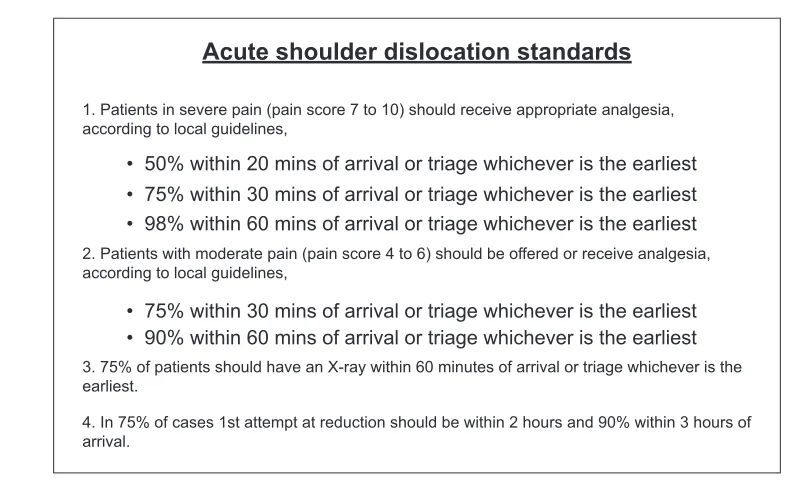
Early and appropriate administration of analgesia, prompt diagnosis, and an early attempt at shoulder reduction are paramount in providing the best care to these patients. As such the College of Emergency Medicine (CEM) has published recom-mendations4 in relation to these areas that Emergency departments in the UK should
be meeting (Figure 1).
The aim of this audit was therefore to measure current performance in relation to these CEM standards at a district general hospital and to identify any areas for improvement.
Clinical Audit downloaded from https://www.dovepress.com/ by 118.70.13.36 on 20-Aug-2020
For personal use only.
Number of times this article has been viewed
This article was published in the following Dove Press journal: Clinical Audit
Dovepress
Chan
Methods
The audit was carried out at the author’s institution, which is a busy district general hospital. Patients presenting to accident and emergency between January and June 2009 were identi-fied retrospectively via booking software in the department. This was done by searching for “shoulder dislocation” as a diagnosis. The respective notes were examined by a single observer and the time the patient booked into the department was noted. PACS (picture archiving and communication system) was used to identify the time at which the diagnos-tic x-ray occurred and the documentation in the notes was used to obtain patient’s pain score, the wait for analgesia, and attempt at reduction. It was assumed that the patient was not offered analgesia by the emergency department if there was no documentation relating to analgesia and if there was no documentation of when shoulder reduction was first attempted, this was assumed to be the time at which a check x-ray was undertaken.
Results
Eighty patients were identified presenting with acute shoulder dislocation between January and June 2009. Four patients were excluded from the audit; three patients were chronic shoulder dislocations, which were not amenable to shoulder reduction, one due to spontaneous reduction prior to being assessed by an accident and emergency doctor.
The results show that the department was performing well in terms of time before a diagnosis with 84% of patients
receiving a diagnostic x-ray within 60 minutes of presenta-tion (Figure 2).
However only 5 case notes (7%) had a pain score documented and the results obtained were below the recom-mended standards with 19%, 38%, and 74% of patients were offered or received analgesia within 20, 30, and 60 minutes of presentation respectively (Figure 3).
Meanwhile the first attempt at shoulder reduction occurred within 3 hours of presentation in all 76 patients (Figure 4).
Discussion
The results of this audit show that the department is meeting less than half the standards set by the College of Emergency Medicine. The department is underperforming with regards to analgesia delivery for patients with acute shoulder dis-location. In general pain scores are not being documented and the notes assessed during this audit suggest that some patients did not receive any analgesia until an attempt at relocation was undertaken. It should however be noted that it is unclear whether any patients declined analgesia as no documentation was found regarding this issue. At the time of writing, the College Of Emergency Medicine has released new recommendations in that documentation should be clear should patients refuse analgesia.
The department appears to be performing well in terms of obtaining a diagnostic x-ray for patients suspected of hav-ing acute shoulder dislocation, with 84% of patients receiv-ing an x-ray within 60 minutes of presentation. This however
1. Patients in severe pain (pain score 7 to 10) should receive appropriate analgesia, according to local guidelines,
2. Patients with moderate pain (pain score 4 to 6) should be offered or receive analgesia, according to local guidelines,
3. 75% of patients should have an X-ray within 60 minutes of arrival or triage whichever is the earliest.
4. In 75% of cases 1st attempt at reduction should be within 2 hours and 90% within 3 hours of arrival.
• 98% within 60 mins of arrival or triage whichever is the earliest
• 90% within 60 mins of arrival or triage whichever is the earliest • 75% within 30 mins of arrival or triage whichever is the earliest
• 75% within 30 mins of arrival or triage whichever is the earliest • 50% within 20 mins of arrival or triage whichever is the earliest
Acute shoulder dislocation standards
Figure 1 CeM standards for acute shoulder dislocation.
Clinical Audit downloaded from https://www.dovepress.com/ by 118.70.13.36 on 20-Aug-2020
Dovepress Acute shoulder dislocation
does not appear to correlate completely with an early attempt at shoulder reduction by an emergency department doctor. A possible explanation for this is that a patient with an acute shoulder dislocation may not be being flagged up by the triaging team despite a swift request for a diagnostic x-ray.
In order to improve the treatment of patients presenting with an acute shoulder dislocation, emergency department staff received consultant-led training on how to recognize and manage an acute shoulder dislocation. A management protocol (Figure 5) was also designed and introduced into
the department. The aim of the protocol was to expedite the diagnosis and pain relief for such patients as well as promoting better communication between the triaging staff and emergency department doctors so that this cohort of patients receives an attempt at shoulder reduction as soon as possible.
Re-audit
The department was re-audited for compliance with the CEM guidelines two months after the introduction of the manage-ment protocol. Data were collected retrospectively by a single
Standard Result
100 90 80 70 60 50 40 30 20 10 0
%
75
84
X-ray within 60 mins
Figure 2 Percentage of patients receiving a diagnostic x-ray within 60 minutes, compared to the standard.
20 mins 30 mins 60 mins
98
74 75
38 50
19
%
Analgesia offered within 20, 30 and 60
minutes
100
80
60
40
20
0
Standard
Result
Figure 3 Percentage of patients receiving analgesia within 20, 30, and 60 minutes compared to the standards.
Clinical Audit downloaded from https://www.dovepress.com/ by 118.70.13.36 on 20-Aug-2020
Dovepress
Chan
2 hours 3 hours
% Standard
Result
75 72
90
100 100
80
60
40
20
0
Attempt at shoulder reduction within 2 and 3 hours
Figure 4 Percentage of patients receiving an attempt at shoulder reduction within 2 hours and 3 hours.
Suspected shoulder dislocation: - primary presenting complaint + ABCs stable - acute shoulder pain AND any of the following:
• loss of shoulder contour • unable to move shoulder joint
• previous history of shoulder disclocation
Ensure pain score documented AND offer immediate analgesia according to local analgesia guidelines
Discuss with A and E Doctor. Request x-ray of shoulder
Confirmed dislocated shoulder. - Doctor to attempt reduction as soon as possible
If successful, confirm reduction with x-ray. Collar and Cuff. Book Fracture Clinic F/U
If unsuccessful after 2 attempts, discuss with
Orthopedic team
If suggestive of old
dislocation, discuss with Orthopedic team
Figure 5 Management protocol for patients with acute shoulder dislocation.
observer over a 6-month period. 62 patients were identified presenting with an acute shoulder dislocation. The results of the re-audit are comparable with regards to a diagnostic x-ray and an attempt at shoulder reduction, with 54 (87%) patients receiving a diagnostic x-ray within 60 minutes, and
50 (81%) and 61 (98%) patients receiving an attempt at shoulder reduction within 2 and 3 hours respectively. Such results meet the CEM standards.
The results of the re-audit also show an improvement with regards to patients receiving analgesia (Figure 6).
Clinical Audit downloaded from https://www.dovepress.com/ by 118.70.13.36 on 20-Aug-2020
Clinical Audit
Publish your work in this journal
Submit your manuscript here: http://www.dovepress.com/clinical-audit-journal Clinical Audit is an international, peer-reviewed, open access journal focusing on the processes and outcomes of clinical audit in any area of healthcare. All aspects of patient care are addressed within the journal and practitioners from all disciplines are invited to submit their work. Areas covered include: Publication of audits; How an audit has changed practice;
Practical tips on how to do audits and to avoid pitfalls; How audits have changed patient care; Calls and justifications for new audits. The manuscript management system is completely online and includes a very quick and fair peer-review system, which is all easy to use. Visit http://www.dovepress. com/testimonials.php to read real quotes from published authors. Dovepress
Dove
press
Acute shoulder dislocation
Analgesia offered within 20, 30 and 60 minutes
Standard
Results before recommendations
Results after recommendations
60 mins 30 mins
20 mins 50
19 37
75
38 63
98
74 98 100
90
80
70
60
50
40
30
20
10
0
%
Figure 6 Percentage of patients receiving analgesia within 20, 30, and 60 minutes compared to the standards before and after the introduction of the management protocol.
Fifty-six percent of case notes identified had a pain score documented. This was up from just 7% in the initial audit. Figure 6 shows that the percentage of patients with an acute shoulder dislocation receiving analgesia within 20, 30, and 60 minutes has improved substantially, however the depart-ment is still failing to meet the standards set for analgesia within 20 and 30 minutes despite the management protocol circulating in the department. A possible reason for this is the high turnover of accident and emergency staff. It is unknown whether new staff have received training with regards to the management of acute shoulder dislocation and whether they are aware of the management protocol. It is therefore important that new staff are informed about the protocol and receive appropriate training during job induction.
Conclusion
The treatment of the patient with an acute shoulder disloca-tion can be optimized by establishing a diagnosis early on,
prompt delivery of analgesia, and effective communication and teamwork between different members of the emergency department staff. As shown from this audit, the use of a management protocol can be used to facilitate these areas and ultimately improve the management of patients such as those presenting with acute shoulder dislocation.
Disclosure
No conflicts of interest to report.
References
1. Krøner K, Lind T, Jensen J. The epidemiology of shoulder dislocations. Arch Orthop Trauma Surg. 1989;108(5):288–290.
2. Cutts S, Prempeh M, Drew S. Anterior shoulder dislocation. Ann R Coll Surg Engl. 2009;91:2–7.
3. Hovelius L, Augustini BG, Fredin H, Johansson O, Norlin R, Thorling J. Primary anterior dislocation of the shoulder in young patients. A ten-year prospective study. J Bone Joint Surg Am. 1996;78:1677–1684. 4. 2010 CEM Clinical Standards [online]. Accessed 2010 Sep 6.
Avail-able from: http://secure.collemergencymed.ac.uk/asp/document. asp?ID=4688
Clinical Audit downloaded from https://www.dovepress.com/ by 118.70.13.36 on 20-Aug-2020