Practical Dynamic Searchable Encryption
with Small Leakage
Emil Stefanov
UC Berkeley [email protected]Charalampos Papamanthou
University of MarylandElaine Shi
University of MarylandAbstract—Dynamic Searchable Symmetric Encryption (DSSE) enables a client to encrypt his document collection in a way that it is still searchable and efficiently updatable. However, all DSSE constructions that have been presented in the literature so far come with several problems: Either they leak a significant amount of information (e.g., hashes of the keywords contained in the updated document) or are inefficient in terms of space or search/update time (e.g., linear in the number of documents).
In this paper we revisit the DSSE problem. We propose the first DSSE scheme that achieves the best of both worlds, i.e., both small leakage and efficiency. In particular, our DSSE scheme leaks significantly less information than any other previous DSSE construction and supports both updates and searches in sublinear time in the worst case, maintaining at the same time a data structure of only linear size. We finally provide an implementation of our construction, showing its practical efficiency.
I. INTRODUCTION
Searchable Symmetric Encryption (SSE) [31] enables a client to encrypt her document collection in a way that keyword search queries can be executed on the encrypted data via the use of appropriate “keyword tokens”. With the advent of cloud computing (and the emerging need for privacy in the cloud), SSE schemes found numerous applications, e.g., searching one’s encrypted files stored at Amazon S3 or Google Drive, without leaking much information to Amazon or Google. However, the majority of SSE constructions that have been presented in the literature work for static data: Namely there is a setup phase that produces an encrypted index for a specific collection of documents and after that phase, no additions or deletions of documents can be supported (at least in an efficient manner).
Due to various applications that the dynamic version of SSE could have, there has recently been some progress on
Dynamic Searchable Symmetric Encryption (DSSE) [12], [20], [21], [36]. In a DSSE scheme, encrypted keyword searches should be supported even after documents are arbitrarily inserted into the collection or deleted from the collection. However, to assess the quality of a DSSE scheme, one must precisely specify the information leakage during searches and updates.
Minimizing the leakage for DSSE can be achieved by using ORAM [3], [10], [13], [15], [17]–[19], [23]–[25], [27], [30], [35], [37], [38] to hide every memory access during searches and updates. However, applying ORAM is costly in this setting (see Section II). In order to avoid expensive ORAM techniques, one could allow for some extra leakage. Ideally, the DSSE leakage should only contain:
a) The hashes of keywords we are searching for, referred to as search pattern in the literature [9].
b) The matching document identifiers of a keyword search and the document identifiers of the added/deleted docu-ments, referred to asaccess patternin the literature [9]. c) The current number of document-keyword pairs stored
in our collection, which we callsize pattern.
Note that the above DSSE leakage implies a strong property called forward privacy: If we search for a keyword w and later add a new document containing keywordw, the server does not learn that the new document has a keyword we searched for in the past. It also implies backward privacy, namely queries cannot be executed over deleted documents.
Unfortunately, existing sublinear DSSE schemes [20], [21], [36] not only fail to achieve forward and backward privacy, but also leak a lot of additional information during updates such as the keyword hashes shared between docu-ments (not just the hashes of the queried keywords). Our main contribution is the construction of a new sublinear DSSE scheme whose leakage only contains (a), (b) and (c) from above (but, like any other existing scheme, it does not achieve backward privacy). In particular:
1) Our DSSE scheme has small leakage: Apart from the search, access and size patterns, it also leaks (during searches) the document identifiers that were deleted in the past and match the keyword. As such, our scheme achieves forward privacy (but not backward privacy). 2) Our DSSE scheme is efficient: Its worst-case search
complexity isO(min{α+ logN, mlog3N}), whereN Permission to freely reproduce all or part of this paper for noncommercial
purposes is granted provided that copies bear this notice and the full citation on the first page. Reproduction for commercial purposes is strictly prohibited without the prior written consent of the Internet Society, the first-named author (for reproduction of an entire paper only), and the author’s employer if the paper was prepared within the scope of employment. NDSS ’14, 23-26 February 2014, San Diego, CA, USA
is the size of the document collection (specifically, the number of document-keyword pairs),mis the number of documents containing the keyword we are searching for and α is the number of times this keyword was historicallyadded to the collection (i.e., forα= Θ(m)
the search complexity is O(m+ logN); in any other case it cannot go beyondO(mlog3N)). The scheme’s worst-case update complexity is O(klog2N), where k is the number of unique keywords contained in the document of the update (insertion or deletion). Finally, the space of our data structure is optimal (i.e.,O(N)).
To the best of our knowledge, no other DSSE scheme in the literature achieves Properties (1) and (2) simultaneously. See the paragraph of SectionIIthat refers to DSSE related work for details. Further contributions of our work include:
3) Our DSSE scheme is the first one to support dynamic keywords. As opposed to previous DSSE schemes that require storing information about all the possible keywords thatmayappear in the documents (i.e., all the dictionary), our scheme stores only information about the keywords thatcurrentlyappear in the documents. 4) We implement our DSSE scheme on memory and we
show that our scheme is very efficient in practice, achieving a query throughput of 100,000 search queries per second (for result size equal to 100). To achieve practical efficiency, our implementation is fully parallel and asynchronous and we can parallelize queries along with updates at the same time.
Technical highlights. Our technique departs from existing index-based techniques for SSE (e.g., [9], [20], [21], [31], [36]) that use an encrypted inverted index data structure. Instead it stores document-keyword pairs in a hierarchical structure of logarithmic levels, which is reminiscent of algo-rithmic techniques used in the ORAM literature (e.g., [15], [16], [32], [34], [37]). A similar structure was also recently used by the authors to construct very efficient dynamic Proofs of Retrievability [33].
Specifically, in our scheme, when a documentx contain-ing keywordwis added to our collection, we store in a hash table an encryption of the tuple(w, x,add, i), where iis a counter indicating that x is the i-th document containing keyword w. When a document x containing keyword w is deleted from our collection, an encryption of the tuple
(w, x,del, i) is stored. During the encrypted search for a certain keyword w, all hash table keys of addition/deletion entries referring to w are retrieved (and decrypted) via an appropriate token forw (generated by the client).
Storing both addition and deletion entries can however lead to linear worst-case complexity for search, e.g., first we add some documents containing keywordw, then we delete all documents containingwand then we search for keyword w. In this case the search will have to iterate through all the addition/deletion entries in order to conclude that no document contains keywordw.
To avoid this scenario, we need to rebuild the data struc-ture periodically (so that opposite entries can be canceled out), which is again a linear cost. To reduce that rebuilding cost from linear to logarithmic, we use the multilevel struc-ture that we mentioned above (instead of storing everything in a flat hash table). Forward privacy is derived from the fact that every time we rebuild a level of the above data structure, we use afreshkey for encrypting the entries within the new level—this makes old tokens unusable within the new level.
II. RELATEDWORK
Static SSE. In the static setting, Curtmola et al. [9] gave the first index-based SSE constructions to achieve sublinear search time. A similar construction was also described by Chase and Kamara [8], but with higher space complexity. Finally, recent work by Kurosawa et al. [22] shows how to construct a (verifiable) SSE scheme that is universally composable (UC). While UC-security is a stronger notion of security, their construction requires linear search time. Finally, Cash et al. [5] recently presented an SSE scheme for conjunctive queries over static data. An extension of this protocol that allows the data owner to authorize third parties to search in the encrypted static database was recently also proposed by Cash et al. [6].
Dynamic SSE. Song et al. [31] were the first to explicitly consider the problem of searchable encryption and presented a scheme with search time that is linear in the size of the data collection. Their construction supports insertions/deletions of files in a straightforward way. Goh [12] proposed a dynamic solution for SSE, which again requires linear search time and results in false positives. Chang and Mitzen-macher [7] proposed a construction with linear search time but without false positives—their solution also achieves forward privacy.
The recently introduced dynamic scheme of Kamara et al. [21] was the first one with sublinear search time, but it does not achieve forward privacy and reveals hashes of the unique keywords contained in the document of the update. The scheme of Kamara and Papamanthou [20] overcomes the above limitation (still not achieving forward privacy) by increasing the space of the used data structure.
Finally, the work of van Liesdonk et al. [36] has the limitations of both [21] and [20], with leaky updates and a large index. Also, the number of updates supported by their scheme is not arbitrary.
Dynamic SSE through ORAM. The DSSE problem can
be solved by using oblivious RAM (ORAM) [3], [10], [13], [15], [17]–[19], [23]–[25], [27], [30], [35], [37], [38] as a black box. ORAM provides the strongest levels of security, namely the server only learns the size of the document collection.
In order to handle small block sizes such as document-keyword pairs, those ORAM techniques would end up using a lot more client storage (because the ORAM would consist of many more but smaller blocks). Those schemes can be re-parameterized to use less client storage (e.g., by using recursion as in [34], [35]), but that would drastically increase bandwidth and might in some cases result in multiple round-trips of communication.
Other related work. Related to searchable encryption is also functional encryption [4], [11], [28], where one encrypts the documents in a way that one can issue tokens that would allow testing whether a specific keyword is contained in the document, without decrypting the document. However such solutions incur linear cost for search (however it is straightforward to address updates). Aiming at more efficient schemes, Boneh et al. [2] presented functional encryption schemes for specific functionalities such as keyword search and Shi et al. [29] presented functional encryption schemes for multidimensional queries, with linear cost for searches.
III. PRELIMINARIES
The notation((c out,s out)←protocol((c in,s in))is used to denote a protocol between a client and a server, wherec inandc outare the client’s input and output; s in ands out are the server’s input and output.
Definition 1 (DSSE scheme). A dynamic searchable sym-metric encryption (DSSE) scheme is a suite of three proto-cols that are executed between a client and a server with the following specification:
• (st, D)←Setup((1λ, N),(1λ,⊥)). On input the
secu-rity parameterλand the number of document-keyword pairs N, it outputs a secret state st (to be stored by the client) and a data structureD(to be stored by the server);
• ((st0,I),⊥) ← Search((st, w), D). The client input’s
include its secret statestand a keywordw; and server’s input is its data structure D. At the end of theSearch protocol, the client outputs a possibly updated statest0 and the set of document identifiersI that contain the keyword w. The server outputs nothing.
• (st0, D0)←Update((st,upd), D). The client has input st, and an update operation upd := (add,id,w) or upd:= (del,id,w)where idis the document identifier to be added or removed, and w := (w1, w2, . . . , wk)
is the list of unique keywords in the document. The server’s input is its data structure D. The Update protocol adds (or deletes) the document to (or from) D, and results in an updated client secret statest0 and
an updated server data structureD0.
We note that in our construction,SetupandSearch can be performednon-interactively, i.e., involving only a single-round tripbetween the server and client. In our construction theUpdateprotocol isinteractive, but the client can always answer a search query in a single round by storing a
small buffer of documents currently being updated in the background until the updates finish.
A. Security Definition
We define security using the standard simulation model of secure computation [14], requiring that a real-world execution “simulates” an ideal-world (reactive) functionality. For clarity of presentation, we first present a scheme secure in the semi-honest model, where the adversary (i.e., server) faithfully follows the prescribed protocol, but is curious. Then, in Section VI we show how to make our protocol work in the malicious model as well. We now define the following experiments:
Ideal-world execution IDEALF,S,Z. An environment Z
sends the client a message “setup”. The client then sends an ideal functionalityF a message “setup”. The ideal-world adversary S (also referred to as a simulator) is notified of N, an upper bound on the number of document-keyword pairs.
In each time step, the environmentZ specifies a search or update operation to the client. For a search operation, Z picks a keyword w to search. For an update operation, Z picksupd:= (add,id,w)or upd:= (del,id,w). The client sends the search or update operation to the ideal functional-ityF.F notifiesS of leaks(w)for a search operation, and leaku(upd)for an update operation (see SectionIII-Bfor the
definition of the leakage functions).S sendsF eitherabort or continue. As a result, the ideal-functionalityF sends the client⊥(to indicate abort), “update success”, or the indices of matching documents for a search query. The environment Z gets to observe these outputs.
Finally, the environmentZ outputs a bitb∈ {0,1}.
Real-world execution REALΠF,A,Z. An environment Z sends the client a message “setup”. The client then performs the Setup protocol (with input N) with the real-world adversary A.
In each time step, an environment Z specifies a search or update operation to the client. For a search operation, Z picks a keyword w to search. For an update operation, Z picksupd:= (add,id,w)or upd:= (del,id,w). The client then executes the real-world protocols Search or Update with the server on the inputs chosen by the environment. The environmentZ can observe the client’s output in each time step, which is either ⊥ (indicating protocol abortion), “update success”, or the indices of matching documents to a search query.
Finally, the environmentZ outputs a bitb∈ {0,1}.
Definition 2 (Semi-honest/malicious security). We say that a protocol ΠF emulates the ideal functionality F in the
semi-honest (or malicious) model, if for any probabilistic, polynomial-time semi-honest (or malicious) real-world ad-versary A, there exists an simulator S, such that for all non-uniform, polynomial-time environments Z, there exists a negligible function negl(λ)such that
Specifically, in the above definition, a semi-honest ad-versary always faithfully follows the prescribed protocol, whereas a malicious adversary can arbitrarily deviate from the protocol. Informally, with a malicious adversary, we would like to detect any deviation from the prescribed protocol, i.e., any deviation can be detected and is equivalent to aborting.
The above definition simultaneously captures correctness and privacy. Correctness is captured by the fact that the ideal-world client either receives the correct answer of the query, or receives an abort message. Privacy is captured by the fact that the ideal-world adversary (i.e., simulator) has no knowledge of the client’s queries or dataset, other than the leakage explicitly being given to the simulator.
B. Defining Leakage
An updateupd= (op,id,w)leaks the type of the update op, the identifier of the documentid that is being updated, the number of keywords |w|in the document and the time t of of the update (i.e., when a document is added or removed). Therefore we defineleaku(upd) = [op,id,|w|, t]. As opposed to [21], our update protocols do not leakwhich keywords are contained in the updated file.
A search for a keywordwi leaks a setI containing the
identifiers of documents matching keyword wi that were
added or removed in the past (referred to as access pattern in [21]). It also leaks a vector vwi of i entries such that
vwi(j) = 1 iff there was a search for wi at time j < i
(referred to as search pattern in [21]). Therefore we define leaks(wi) = [I, vwi].
Note that this definition of leakage captures forward privacy, in that the set of indices matching I leaked con-tains only documents that were added in the past, but no future documents. Our definition of leakage does not satisfy backward privacy, since the set of matching I leaked also contains documents that were previously added but then deleted.
IV. BASICCONSTRUCTION
In this section, we first describe a (relatively inefficient) basic scheme whose search complexity is linear in the number of documents that have been historically added, containing the keywordw. Later, in SectionV, we describe a new technique to reduce the search cost to roughly the number of matching documents, instead of all documents that have been historically added containing the keyword— note that some of these documents may already have been removed at the time of the search. Our second construction is built on top of the basic one and we present it as two parts for clarity.
A. Server-Side Data Structure
Hierarchical levels. The server stores a hierarchical data structure containing logN + 1 levels, denoted
T0,T1, . . . ,TL, where L= logN. For each level0≤`≤
L, level ` can store up to 2` entries. Each entry encodes
the information (w,id,op,cnt), wherew is a keyword; op encodes the op-code taking a value of eitheraddor del; id is a document identifier containing the keywordw; andcnt
denotes the current counter for keyword wwithin level T`.
Intuitively, we can think of each levelT`as the permuted encoding of a tableΓ`. Henceforth, we use the notation Γ`
to denote the conceptual, unencoded data structureat level `, and we use the notationT` to denote the encoded table at level ` that is actually stored on the server.
The conceptual data structure at level `.The conceptual, unencoded data structure at level `is as follows:
Γ`:w→
(id,add,0),(id,add,1), . . . ,(id,add,cntadd),
(id,del,0),(id,del,1), . . . ,(id,del,cntdel)
In other words, for each wordw, each level stores add anddeloperations associated with the wordw: Specifically, an (id,add,cnt)tuple means that a document identified by id containing the word w is added; an (id,del,cnt) tuple means that a document identified byidcontaining the word w is deleted.
We ensure that within the same level the same (w,id)
pair only appears once for an add operation or a del operation, but not both—if both appear, they cancel each other out during the level rebuilding as explained later.
Furthermore, we ensure that all(w,id,op, cnt)tuples are lexicographically sorted based on the key(w,id,op).
Encoding the conceptual data structure. The conceptual tableΓ`is encoded and its entries are then permuted, before being stored on the server. We now describe how to encode each tableΓ` satisfying the following requirements.
• Confidentiality.The idea is to “encrypt” it in such a way such that it does not leak any information normally. • Tokens allow conditional decryption. However, when
the client needs to search a keyword w, it can release a tokentoken`(w)for each level`, such that the server can then decrypt all entriesΓ`[w]without learning any
additional information. Each token corresponds to a (keyword, level) pair.
• Constant table lookup time. Not only can the server decrypt all entries inΓ`[w], giventoken`(w), the server
can readid:= Γ`[w,op,cnt]inO(1)time.
B. Algorithms for Encoding the Level Data Structure
We now explain how to encode a conceptual table Γ`
into an encoded tableT`that is actually stored on the server.
For this the client is going to use a secret key ki for each
level i= 0,1, . . . , ` and a secret keyesk to be used for a randomized symmetric encryption scheme.
The conceptual table Γ` can be thought of as a
Algorithm EncodeEntryesk,k`(w,id,op,cnt)
1. token`:=PRFk`(h(w)). 2. hkey:=Htoken`(0||op||cnt). 3. c1:=id⊕Htoken`(1||op||cnt). 4. c2:=Encryptesk(w,id,op,cnt).
5. Output(hkey, c1, c2).
Fig. 1: The algorithm for encoding an entry.
Algorithm Lookup(token,op,cnt)
1. hkey:=Htoken(0||op||cnt).
2. Ifhkey∈/ T`, output⊥.
3. Else, outputid:=T`[hkey].c1⊕Htoken(1||op||cnt).
Fig. 2: The algorithm for looking up an entry.
built, all these encoded entries are randomly permuted by the client (using an oblivious sorting algorithm as explained later). Our construction is using a keyed hash functionHk:
{0,1}∗× {0,1}∗ → {0,1}∗ (this is modeled as a random
oracle in our proof of security in SectionVIII-B—we show how to avoid using the random oracle in Section VI by increasing the client computation and the communication). Also, we use h(·) to denote a standard hash function (e.g., SHA256).
All encoded and permuted entries are stored on the server in a hash table indexable byhkey, denoted
T`[hkey] = (c1, c2).
This hash table allows the server to achieve constant lookup: With an appropriatetoken for a keyword w, the server can decrypt thec1part, and read off the entryid:= Γ[w,op,cnt]
inO(1)time. TheLookupalgorithm is detailed in Figure2.
We also quickly note that the termc2 in the above will
later be used by the client during updates.
C. Basic Searchable Encryption Scheme
We now give the detailed description (Figure 3) of the three protocols that constitute a dynamic searchable encryption scheme, as defined in Definition 1.
D. Rebuilding Levels During Updates
Every update entry that the client sends to the server causes a rebuild of levels in the data structure. The basic idea of the rebuild is to take consecutively full levels
T0,T1, . . . ,T`−1, as well as a newly added entry, and merge them (e.g., via protocolSimpleRebuild) into the first empty level T`. Since protocol SimpleRebuild has O(NlogN)
complexity (see below), it is easy to see that every update takesO(log2N)amortized time, for large levels are rebuilt
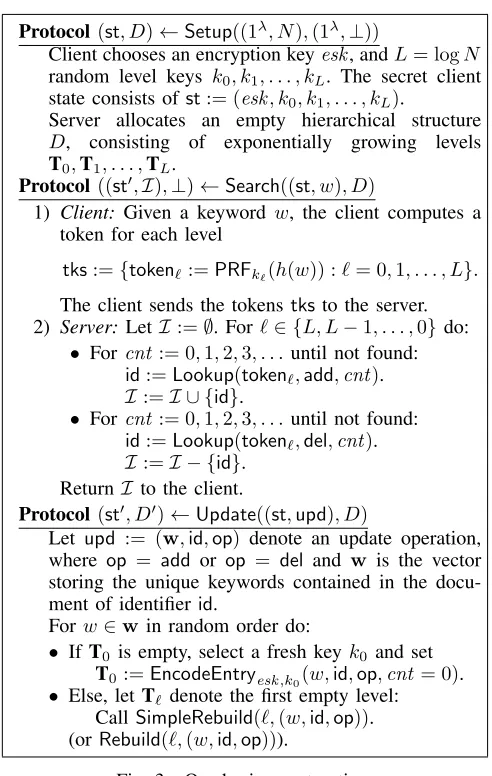
Protocol(st, D)←Setup((1λ, N),(1λ,⊥))
Client chooses an encryption keyesk, andL= logN random level keys k0, k1, . . . , kL. The secret client
state consists ofst:= (esk, k0, k1, . . . , kL).
Server allocates an empty hierarchical structure D, consisting of exponentially growing levels
T0,T1, . . . ,TL.
Protocol((st0,I),⊥)←Search((st, w), D)
1) Client: Given a keyword w, the client computes a token for each level
tks:={token`:=PRFk`(h(w)) :`= 0,1, . . . , L}.
The client sends the tokenstks to the server. 2) Server:LetI :=∅. For `∈ {L, L−1, . . . ,0} do:
• Forcnt := 0,1,2,3, . . .until not found: id:=Lookup(token`,add,cnt).
I:=I ∪ {id}.
• Forcnt := 0,1,2,3, . . .until not found: id:=Lookup(token`,del,cnt).
I:=I − {id}. ReturnI to the client.
Protocol(st0, D0)←Update((st,upd), D)
Let upd := (w,id,op) denote an update operation, where op = add or op = del and w is the vector storing the unique keywords contained in the docu-ment of identifierid.
Forw∈win random order do:
• If T0is empty, select a fresh key k0 and set T0:=EncodeEntryesk,k0(w,id,op,cnt = 0). • Else, letT` denote the first empty level:
CallSimpleRebuild(`,(w,id,op)). (or Rebuild(`,(w,id,op))).
Fig. 3: Our basic construction.
a lot less frequently than small levels (note however that the bandwidth required for each update is O(logN)). In particular, over a course of N = 2` operations, level 0 is rebuilt N/2 times, level 1 is rebuilt N/4 times and level `−1 is rebuiltN/2`= 1 times.
We note here that we can use standard de-amortization techniques (e.g., [15], [16], [37]) to turn these complexities into worst-case. Namely, each update in our scheme (and in our implementation) inducesO(logN)bandwidth and takes O(log2N)time in theworst-case.
Concerning the SimpleRebuild protocol in Figure 4, note the sorting performed in Step 3 before the entries are processed in Step 4: The reason for this sorting is to ensure that Step 4 can be performed in O(N) time via a sequential scan (instead of O(N2) time). Finally, there
ProtocolSimpleRebuild(`,(w,id,op)) (AssumingO(N)client working storage)
1) Client creates local bufferB= (w,id,op,cnt = 0). 2) For eachentry= (hkey, c1, c2)∈T0∪T1∪. . .∪T`−1:
Let(w,id,op,cnt) :=Decryptesk(c2). LetB:=B∪(w,id,op,cnt).
// Client: download and decrypt all entries, store in localB.
3) SortBbased on lexicographical sorting key(w,id,op).
// All entries with the same keyword now appear sequentially.
4) For eache:= (w,id,op,cnt0)∈B(in sorted order):
• If emarks the start of a new word w, for an operation op ∈ {add,del}, then set cntop,w := 0 and update e:= (w,id,op,0)inB.
• If e and its adjacent entry are add anddel operations for the same (w,id) pair, suppress the entries by updating both entries with ⊥.
• Else, updatee:= (w,id,op,cntop,w++)inB.
5) Select a fresh new level key k`.
T`:={EncodeEntryesk,k`(entry)}entry∈B.
// Dummy entries marked⊥are also encoded as part ofT`.
UploadT` to the server in the order of increasinghkey. Empty all the old levelsT0,T1, . . . ,T`−1.
Fig. 4: The simple rebuilding algorithm.
ProtocolRebuild(`,(w,id,op))
(AssumingO(Nα)client working storage, 0< α <1)
1) Letentry∗:=EncodeEntryesk,k0(w,id,op,cnt = 0). LetBˆ :={entry∗} ∪T0∪T1∪. . .∪T`−1.
2) For eachentry= (hkey, c1, c2)∈Bˆ:
Let(w,id,op,cnt) :=Decryptesk(c2).
OverwriteentrywithEncryptesk(w,id,op,cnt).
// Wrap entries inBˆin a randomized encryption scheme to prepare for oblivious sorting. During the execution of oblivious sorting, an entry is re-encrypted in a randomized fashion each time upon write.
3) Bˆ :=o-sort(ˆB), based on the lexicographical sorting key(w,id,op).
// Now, all entries with the same keyword appear sequentially.
4) For each entrye:=Encryptesk(w,op,id,cnt0)∈Bˆ (in sorted order):
• If emarks the start of a new word w, for an operation op ∈ {add,del}, then set cntop,w := 0 and update e:=
Encryptesk(w,id,op,0)inBˆ.
• If e and its adjacent entry are add anddel operations for the same (w,id) pair, suppress the entries by updating both entries with Encryptesk(⊥).
• Else, updatee:=Encryptesk(w,id,op,cntop,w++)inBˆ.
5) Randomly permute Bˆ :=o-sort(ˆB), based onhkey. 6) Select a new level keyk`.
For eachentry∈Bˆ:
(w,id,op,cnt) :=Decryptesk(entry). AddEncodeEntryesk,k
`(w,id,op,cnt)toT`.
Fig. 5: The main rebuilding algorithm.
For clarity, we first describe in Figure 4 the SimpleRebuild algorithm for the case when the client has sufficient (i.e., linear in the size of the dataset) local storage. Then, in Figure5we will describe protocolRebuildfor the same purpose. The difference between the SimpleRebuild and the Rebuildprotocol is that in the SimpleRebuild pro-tocol, the client downloads the entire level from the server,
locally computes the result, and then uploads the result to the server. In theRebuildprotocol, we assume that the client has small local storage, and is not able to download the entire level at once.
client computes everything in the same manner as before— however, instead of accessing its local memory, the client now reads and writes data from and to the server’s ORAM as necessary, in an oblivious manner. However, as we argued in Section II, ORAM is not practical for the case of small blocks used by our scheme.
We note that theRebuild protocol of Figure 5 uses an oblivious sorting protocol to optimize the above generic ORAM scheme.
E. Oblivious Sorting
The oblivious sorting (o-sort) algorithm used in Figure5 reorders the entries in the level. Theo-sortalgorithm allows the client to re-sort the entries based on their plaintext values without the server learning the plaintexts and their order before and after sorting.
We use a standard o-sort algorithm (e.g., see the al-gorithm described in [17]). On a high level, o-sort works as follows. The client downloads a small subsets of the entries, sorts them locally, and uploads them back to the server (possibly to different locations). After several rounds of sorting subsets of entries, the entire level becomes sorted.
Our construction ensures that during sorting entries are wrapped in a non-deterministic encryption layer. Every time an entry is uploaded back to the server, it is re-encrypted with a different nonce so the server cannot link the positions of the reordered entries to their original and intermediate positions before and during sorting.
Furthermore, locations of the entries that the client accesses are independent of the entry values and their sorting order, so the server is not able to learn anything about the entries by observing theo-sort.
We use ano-sortalgorithm that usesO(Na)client
mem-ory for 0 < a < 1 (e.g., about 210 MB of client memory in our experiments—see SectionVII) to obliviously sort N elements with O(N)entry I/O operations and O(NlogN)
client-side computation. Note that even though the number of entry I/O operations isO(N), the number of comparison performed by the client is still O(NlogN) so this does not violate the lower bound for sorting. For a more detailed description of theo-sortalgorithm please refer to [17].
V. SUBLINEARCONSTRUCTION
As mentioned in the introduction, we would like to achieve at mostO(mlog3N)cost for search queries, where mis the number of matching documents. Unfortunately, our basic construction described in Section IV fails to achieve this. Consider the following counter-example:
Example.Suppose documents1,2,3, . . . κare added (κ=
O(N)), all of which contain a keyword w. Then, suppose documents1,2,3, . . . , κ−1are deleted. At this point, running a search query onwshould return only one document (document κ). However, in our basic construction, it is possible that the top level contains the
addoperations for documents1,2,3, . . . κ, and then the lower levels contain the del operations for documents
1,2,3, . . . κ−1. In this case, the search query would take timeO˜(κ)(which can be as large asO˜(N)), even though the result set is of size1.
In this section, we will extend the basic construction to guarantee that a search operation takes sublinear time O(mlog3N)even in the worst case, wheremis the number of matching documents.
A. Extensions to the Main Construction
In the main protocol, we store the tuple(w,id,op,cnt), for each(w,id)pair that was either added or deleted. In the following we describe one extra piece of information that we need to store with each tuple.
Storing target levels. In the new protocol, with each tuple
(w,id,op,cnt)stored at the level`of the data structure, we are going to store the target level`∗ such that
• If op=add, then `∗ is the level of the data structure that the tuple (w,id,op,cnt)is stored, i.e.,`∗=`; • If op = del, then`∗ is the level of the data structure
that the respective addition tuple (w,id,add,cnt) is stored, i.e., `∗ > ` (since deletions happen only after additions).
We note here that the client can easily compute the target level of each new entry (w,id,op). Specifically, if op =
add, the target level `∗ (which is the level of the entry) is the first empty level. Otherwise (i.e., when op = del), the client can retrieve the timestamp of the respective addition entry(w,id,add)and can compute its level `(which is the target level of (w,id,del)), since the data structure is built deterministically and is not dependent on the values of w andid.
Finally, we are going to maintain the invariant that all tuples(`∗, w,id,op,cnt)with target level`∗ stored at level ` are going to be lexicographically sorted based on the key
(`∗, w,id,op)(instead of just(w,id,op)).
New encoding.Note now that the target level for each entry is encoded in the same way as the identifierid. Basically, for an entry(w,id,op)of level`and target level`∗, we modify Line 3 of theEncodeEntryalgorithm to the following:
c1:= (`∗,id)⊕PRFtoken`(1||op||cnt),
where` is the level of the tuple(`∗, w,id,op). In this way,
given an appropriate token for a keywordwand level`, the server can decrypt the entry
(`∗,id) := Γ`[w,op,cnt]
in constant time. For simplicity, we write the new tuple as
(`∗, w,id,op,cnt).
the tuples appear in lexicographic ordering based on the key
(w,id,op) (note that we show some of the entries of the levels and not allthe entries of the levels):
• Level 5:
(w,1,add,0),(w,4,add,1),(w,13,add,2)
• Level 4:
(w,3,add,0)
• Level 3:
(w,1,del,0),(w,3,del,1),(w,4,del,2),(w,19,add,0)
In the above example, documents1,4,13,3 containing key-wordwwere added, then documents1,3,4were deleted and finally document19containing keywordwwas added. With the new encoding (`∗, w,id,op,cnt), the levels are going to be as below (the tuples appear in lexicographic ordering based on the key(`∗, w,id,op)):
• Level 5:
(5, w,1,add,0),(5, w,4,add,1),(5, w,13,add,2)
• Level 4:
(4, w,3,add,0)
• Level 3:
(3, w,19,add,0),(4, w,3,del,0),(5, w,1,del,1),
(5, w,4,del,2)
The main difference to note is that in Level 3, the deletions are sorted according to their target level, and not simply according to the document identifiers. In general, in the new encoding, each level has a region in which it contains deletions for each level above it. Within that region, the deletions are in the same order as the additions appear in the corresponding upper level. This will enable us to execute an encrypted search very efficiently.
B. Detailed Protocol
In the previous section, we mentioned that given an appropriate token token`(w), the server can decrypt the subtable at level ` corresponding to keyword w, denoted
Γ`[w]. This means:
1) The server can also look up an entryΓ`[w,op,cnt] in O(1)time.
2) Since for the same keywordw, the pairs(`∗,id)appear in increasing order with respect to cnt in each level, the server can also perform a binary search on the field of(`∗,id)(without knowing the respectivecnt values). For example, given token`(w), the server can decide
whether an (`∗, w,id,op, cnt) tuple exists in level ` in logarithmic time. This will be helpful later in the protocol.
Therefore, in this section, we will use the shorthand
Γ`[w,op,cnt] to denote a correspondingLookupoperation.
We also explicitly write operations to the conceptual table
Γ` for simplicity—but keep in mind that while we write
w and operations to the Γ` table in the clear, the server performs these operations using the appropriate token`(w)
instead,without actually seeing the search keyword w.
Protocol((st0,I),⊥)←Search((st, w), D)
1) Client: Given a keyword w, the client computes a token for each level
tks:={token`:=PRFk`(h(w)) :`= 0,1, . . . , L}.
The client sends the tokenstks to the server. 2) Server: LetI:=∅. For`∈ {L, L−1, . . . ,0}do:
a) Find all tuples (`, w,id,add) in level `, such that the corresponding delete operation (`, w,id,del)
does not appear in levels `0≤`. b) Set I:=I ∪ {id}.
ReturnI to the client.
Fig. 6: The new and efficient search protocol.
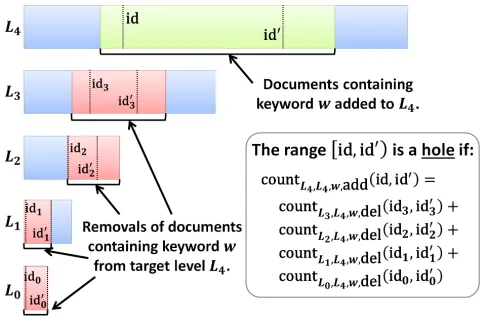
Fig. 7: The green region in level L4 corresponds to
all add entries of keyword w. The red regions in levels L3, L2, L1, L0 correspond to all del entries of keyword w
that were added in level L4 (that is why their target level
is L4). The goal of the SkipHole(`,token`,id)algorithm is
to find the largest green region (i.e., the largest hole) that contains entries that were all deleted in the lower levels. In the example above, [id,id0) is a hole because for all x ∈ [id,id0), there exists a (L4, w, x,del) entry in some
lower levelLi fori= 0,1,2,3. This condition is efficiently
checked through the test in the box.
Finally, for any tuple(`∗, w,id,op, cnt)stored at level` we define
count`,`∗,w,op(id) =cnt .
For tuples (`∗, w,id1,op, cnt1) and (`∗, w,id2,op, cnt2)
withid2≥id1 stored at level `we also define
count`,`∗,w,op(id2,id1) =cnt2−cnt1.
New search protocol.In Figure6we present the new search protocol for a keywordwthat operates on the data structure storing entries with the new encoding:
that we propose in the previous paragraphs and perform Step 2a a lot more efficiently, i.e., in O(mlog3N) time. For that purpose we replace Step2a and2bwith algorithm ProcessLevel(`,token`)of Figure8.
The central idea of algorithm ProcessLevel(`,token`)
is the following: Suppose a client has issued a token for keyword w and level `. Instead of accessing all the add entries (`, w,id,add, cnt) one-by-one by using successive values of the counter cnt = 0,1,2, . . . (as would happen in the search protocol of Section IV), the new protocol efficiently finds the new value ofcntthat the server should use, so that to avoid accessing add entries that have been deleted in the lower levels. This set of entries are referred to as a hole. Finding the new value of cnt is performed in O(log3N) time by algorithm SkipHole(`,token`,id) of
Figure8.
Algorithm SkipHole(`,token`,id) matches a collection
of successive “addition” identifiers appearing in level`with a collection of successive “deletion” identifiers in lower levels. When a match is found (seecount`,`,w,add(id,id0) = DeletedSum(`,id,id0) in Figure 8), it can safely ignore the specific collection of addition identifiers and get the new value of the counter. A graphical representation of the SkipHole(`,token`,id)algorithm in shown in Figure7.
Time complexity. The complexity of the new search al-gorithm is O(mlog3N), where m is the number of the documents that contain the keyword that is searched for and N is the current number of document-keyword pairs. This is because, for every one of the mdocuments in the search result, there are two cases:
• Either the algorithm encountered anadd entry for the document and performed an unsuccessful binary search for the respective del entry in every level of the data structure, which clearly takes O(log2N)time; • Or the the binary search for the respective del entry
was successful. In this case the hole must be computed. To compute the hole, the algorithm performs a binary search on the level of theaddentry, every step of which takesO(log2N)time, since the algorithm needs to go through all the levels below and perform a binary search within each level in order to compute the deleted sum. The overall task clearly takesO(mlog3N)time.
Thus the running time of the new search algorithm is O(mlog3N)in the worst case.
Achieving theO(min{α+logN, mlog3N})bound.In the introduction, we stated that the worst-case time complexity of the final search protocol isO(min{α+logN, mlog3N}). To achieve this bound, we use a hybrid of the two search protocols that we described. AssumeS1 is the search
proto-col of Section IV (withO(N)worst-case complexity) and S2 is the search protocol of this section (withO(mlog3N)
worst-case complexity). The hybrid algorithm for searching for a keyword wis as follows:
1) Execute S1 until O(log2N) addition entries for
key-wordware encountered.
2) Through binary search at each level ` find the total numberαof addition entries referring to keywordw. 3) If α=ω(log3N), then executeS2; Else executeS1.
The above algorithm runs inO(min{α+ logN, mlog3N})
worst-case time. To see that, we distinguish two cases. If the total number of addition entries α = O(log2N), the algorithm will terminate at Step 1 in O(α+ logN) time. Otherwise, the algorithm will compute the exact numberαin Step2, which takesO(log2N)time. Then Step3computes the minimum. The reason we do not compute αfrom the very beginning is to avoid the O(log2N)cost.
Modifications to the Rebuildalgorithm.We note here that we slightly need to modify theRebuildalgorithm presented in Section IV, to accommodate for the new encoding. Let ` be the level that is being rebuilt.
Specifically, we need to update the target level of all the entries that will be shuffled into the new level T`. This is
easy to do with a sequential pass that takes place before the oblivious sorting. During this sequential pass, we set the target level of all entries (bothaddanddel) to be `except
for the delentries whose current target level is `0 > ` (we then accordingly re-encrypt the whole entry).
VI. EXTENSIONS AND OPTIMIZATIONS
In this section we describe various extensions and opti-mizations for our scheme.
Supporting a passive server. Our algorithm can easily be transformed such that we can use a passive server, i.e., a server that only allows us to read and write data blocks and does not perform any computation. We can do this by having the client do the server’s computation and accessing the data in storage that the server would have accessed. This has the negative impact of introducing more rounds into the protocol. For example, the search algorithm of our protocol is non-interactive because the server can perform binary search himself. In a passive server scenario, the binary search would have to be performed by the client, leading to a polylogarithmic number of rounds.
Achieving security in the malicious model. To make the sublinear construction work in the malicious model, the client stores a MAC of each data structure entry at the server, along with the entry itself. The MAC also includes the timestampt and thecurrent level `of the entry.
Algorithm ProcessLevel(`,token`)
1) cnt := 0.
2) (`,id) := Γ`[w,add,cnt].
3) Repeat until(w,add,cnt)not inΓ`.
• If(`, w,id,del)is not found in any lower levels:
// through a binary search for each lower level
◦ I :=I ∪ {id}. ◦ cnt++.
◦ (`,id) := Γ`[w,add,cnt].
• If(`, w,id,del)is found in some lower level (this is referred to as the start of a hole): ◦ Callcnt :=SkipHole(`,token`,id)+ 1.
Algorithm SkipHole(`,token`,id)
1) Through binary search, compute the maximum identifierid0>idin level `such that
count`,`,w,add(id,id0) =DeletedSum(`,id,id0).
2) Return the correspondingcnt value forid0.
Algorithm DeletedSum(`,id,id0)
1) sum:= 0.
2) For each level`0 < `:
• Find the region[(`,idx),(`,idy)] that falls within the range[(`,id),(`,id0)](through binary search), and compute
r:=count`0,`,w,del(idy,idx).
• sum:=sum+r. 3) Returnsum.
Fig. 8: Algorithms for processing the level efficiently.
For the verification of a search operation, the server needs to prove to the client that it has (1) returned the correct results, and (2) returned all of the results. To achieve these guarantees, recall that when the client performs a search for a keyword w, it sends search tokens that allows the server to unlock a set of entries in each level that correspond to the keywordw. To protect against a possibly malicious server, we require that the server send the following to the client for each level`.
• Each addentry in level ` which has not been deleted (i.e., via adelentry in a lower level). Also, a MAC for each such entry along with its timestamp.
• A proof of each hole. Recall that a hole is a set of consecutive add entries each of which have been deleted (i.e., via adelentry in a lower level). The proof of the hole consists of thedelentries at the edge of each deletion region in the lower levels, along with a MAC for each suchdelentry.
After receiving this information, the client can recon-struct the sums of each deletion region (by using the counters) below a certain level and verify that the sum of those sums is equal to the sum of entries in the hole.
Removing the random oracle.Our scheme uses the random oracle. We can however replace the random oracle by a PRF:
For the encoding of the entry, the client computes
hkey:=PRFk`(w||0||op||cnt)
and
c1:=id⊕PRFk`(w||1||op||cnt).
When searching for a keyword w, the client now needs to provide more tokens: For each level `, it gives the PRF outputsPRFk`(w||0||op||cnt)andPRFk`(w||1||op||cnt)for
cnt = 0,1, . . ., instead of O(logN) tokens that would enable the server to compute such values. However the drawback of this method is that the client needs to do more computation now and also the client-server communication increases.
Since the time to rebuild the data structure is O(NlogN), the bandwidth for the rebuild isO(N)and the rebuild happens every at leastN operations, it follows that the asymptotic worst-case update time and the asymptotic worst-case update bandwidth is not influenced.
VII. EXPERIMENTALRESULTS
We implemented our sublinear construction (SectionV) in C# consisting of about 4000 lines of code. Our experi-ments were performed on Amazon EC2 on a cr1.8xlarge instance running Windows Server 2008 R2 containing two Intel Xeon E5-2670 2.6GHz processors and 244GB of RAM. All experiments were performed on the same machine using inter-thread RPC with simulated network round-trip latencies ranging from 25ms to 100ms.
Number of trials. Each data point in the graphs is an average of 10 trials. We omitted error bars because the variance was low enough that error bars are too small.
Client storage.In all of our experiments, we configured our implementation to use less than 210 MB of client storage at all times. All of the storage except for the level keys is transient and is only needed to perform updates. The transient storage can always be discarded if necessary and level rebuilding can be restarted. Even many mobile clients today can afford such client storage. It is also a tunable parameter which can be adjusted in practice.
Dataset. The search performance of a query depends only on the number of results of matching this query and the number of keyword-document pairs of the database. It does not depend on any other parameters, such as the contents of the database (as should be the case to ensure privacy). Hence, we describe the performance of our system in terms of dataset content-independent metrics. We measure our performance based on the size of the database, number of results per query, and network latency. In our experiments, the dataset and server data structures are stored in RAM on our machine.
Deamortization. Our implementation uses the deamortized Rebuild (not SimpleRebuild) algorithm and is constantly ”rebuilding”, to spread the rebuilding work over time and avoid a large worst-case cost. Searches can occur at any time and the client and server do not have to wait for a rebuild to complete before performing a search.
A. Adding and Removing Documents
We now evaluate the performance of update operations (i.e., adding and removing documents) in our scheme.
Update throughput.Because of our hierarchical data struc-ture, the update time is proportional to O(log2N) where N is the current size of the database (i.e., the number of document-keyword pairs already in the database).
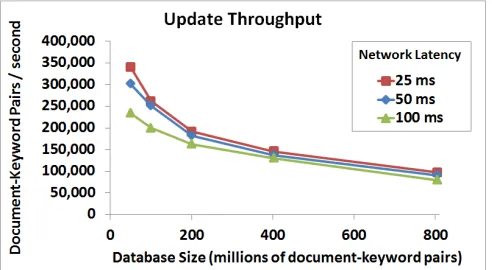
Figure9 shows the maximum sustainable rate at which our implementation can perform updates on the database.
Fig. 9:Update throughput of our sublinear construction.
The update time is specified in keyword-document pairs per second. For example, adding or removing a document with 100 unique keywords results in 100 document-keyword pair updates.
Fig. 10:Update Bandwidth. The bandwidth used to add or remove a document-keyword pair from the database. Typical network latencies have a small effect on throughput.
We are able to add or delete document-keyword pairs at the rate from 100,000 pairs per second for an 800 million pair database to over 300,000 pairs per second for a 50 million pair database. Note that adding and removing a pair results in the same kind of operation so the performance is the same.
The rate at which documents can be added and removed depends on the size of the documents. For example, adding or removing a document with 100 unique keywords will result in 100 document-keyword pair updates.
In the above throughput experiment, we assume a setup with sufficient client-server bandwidth. The overhead is therefore dominated by the client-side computation cost of performing decryption and encryption, and sorting of the entries. Below we measure how much bandwidth is required for update operations.
document-Fig. 11:Query throughput of our sublinear construction.
Our system is able to execute queries at a rate of up to 100,000 queries/second. For large result sets, the query throughput depends inverse proportionally to the number of results (note that both axis are log-scale).
keyword pair, triggers O(log2N) work on average for rebuilding some of the existing levels in the database as described in Sections IV and V. Even though the average computation per update is O(log2N), the average amount of bandwidth consumed per update is actually O(logN)
as mentioned in Section IV-D. Figure 10 shows our mea-surements for the average update bandwidth cost for sev-eral databases sizes. Note that since we use standard de-amortization techniques [15], [16], [37], we are able to perform a partial level rebuilds so that our worst case com-putation and bandwidth update costs are within a constant factor of the average costs.
Effect of network latency. We tested the throughput un-der 25ms, 50ms, and 100ms simulated network round-trip latencies. For large databases (e.g., larger than 400 million keyword-document pairs), the throughput was only slightly affected by network latency. For smaller databases (e.g., 20 million pairs) the throughput decreased by about 30 percent as a result of increasing the latency from 25ms to 100ms.
B. Searching
In Figure11, we measure the rate at which our database can sustain different sized queries. For queries with less than 1,000 results, we can execute them at about 100,000 queries per second. The rate is fairly constant for these small queries because the search RPC cost dominates the running time.
For larger queries, our throughput is inversely propor-tional to the number of results. We can achieve a rate of 9,000 queries per second each with 10,000 results per query and over 100 queries per second with 1 million results per query.
The search time for larger queries is mostly unaffected by the database size because the work done is proportional to the number of entries accessed regardless of how they are
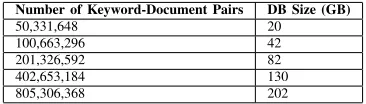
Number of Keyword-Document Pairs DB Size (GB) 50,331,648 20
100,663,296 42 201,326,592 82 402,653,184 130 805,306,368 202
TABLE I: Database size.Measured while performing up-dates. The ratio between the number of keyword-document pairs and the size varies slightly as our de-amortized updater is running.
distributed within the levels of the data structure. Because every level must be accessed at least once, smaller queries are slightly less efficient on larger databases as can be seen in the Figure 11.
C. Database Size
As shown in Table I, our database sizes varied form 20GB to 202GB for databases with 50 million to 805 million document-keyword pairs. The databases stores about 250 to 400 bytes per keyword-document pair. The number of bytes varies throughout the lifetime of the system due to the temporary storage allocated and deallocated for rebuilding levels.
D. RAM vs. Disk
One interesting question to ask is that if we were to support a desired throughput, whether RAM or disk will be more economical as the storage medium for large-scale searchable encryption systems like ours.
RAM is more economical. We found that in scenarios where queries are frequent, a RAM based approach is several orders of magnitude more economical than using disks for the same query throughput. For example, we show that using 244 GB RAM, we can sustain a search throughput of 100,000 queries per second.
We performed a back-of-the-envelope calculation on how many disks are needed to sustain the same throughput, partly based on the performance numbers reported by Cash et al. [5] who implemented a static, conjunctive searchable en-cryption scheme on enterprise-grade rotational hard-drives. They are able to process about 1 query (with 10,000 results) per second with 6 enterprise-grade disks [1]. In fact, in order to get 1 query per second performance they use a document-grouping trick which leaks additional information about key-word frequencies in the database [1], [5]. Without resorting to this extra leakage, one query would take about 10 seconds to execute. In contrast, our RAM based implementation is able to achieve over 9,000 queries per second (90,000 times faster) without this extra leakage.
s-term (i.e., the size of the result set if a single keyword is searched). For large result sets, our schemes would require a similar (in the ballpark) number of disk I/O operations per search query, we anticipate similar search performance if we implemented it on disk.
We can now do a back-of-the-envelope calculation to see how many parallel disks are required to sustain the throughput of our RAM-based implementation—in fact, this would require about 500K (in the ballpark) enterprise-grade disks. Hence using RAM when queries are frequent is more economical.
Cash et al. also report their performance results under RAM storage. Under a single keyword search, and a result set of 1000, their RAM response time is 0.1s. For our scheme, at 1000-sized result set, our throughput is more than50,000queries per second. Our system has a maximum degree of parallelism at 32, with 16 cores (with hyper-threading). This means that absent any queuing and network delay, the (computational) response-time of our scheme is under1ms.
Practical considerations. One potential concern with stor-ing the database in RAM is that power loss or system failure could lead to data loss (because RAM is volatile memory). New systems such as RAMCloud [26] have been proposed to offer both persistent storage as well as the fast random access of RAM. We can also address this issue as follows. Our level rebuilding algorithm results in a highly sequential workload when reading and writing entries in the levels (including the oblivious sorts). Therefore we could efficiently perform the updates on disk (with few seeks) while still caching an in-memory copy of the database for processing search queries (which would require many seeks if done on disk).
VIII. PROOF OFBASICCONSTRUCTION
We now build a simulator S, which given the leakages leaku(upd)leaks(wi)(as defined in Section III-B) for each update and search operation respectively, simulates the in-teractions with a real-world, semi-honest serverA.
A. Simulation of theUpdate Protocol
1)SimpleRebuildCase: The simulatorSlearns only the leakageleaku(upd)for each updateupd, including the iden-tifier of the added/deleted document, the type of operation, the number|w|of keywords of the added/deleted document as well as the time that the operation was performed.
For i ∈ {1,2, . . . ,|w|}, the simulator simulates the Rebuildprotocol|w|number of times.
For each Rebuild protocol, suppose level ` is being rebuilt. The simulator simply creates a “random” level T`
as follows: for each entry in T`, the simulator creates a “random” encoded entry := (hkey, c1, c2). Specifically,
the hkey and c1 terms of the entry will be generated at
random. Thec2term is a semantically-secure ciphertext, and
therefore can be simulated by simply encrypting the0string.
2)Rebuild Case: We now show that if there exists a simulator that can simulate the SimpleRebuild case, then we can build a simulator to simulate the Rebuildprotocol. We recall that in the oblivious sorting algorithm (the only difference between SimpleRebuild and Rebuild), the client downloads a small subsets of the entries (O(Nα)), sorts
them locally, and uploads them back to the server (possibly to different locations). After several rounds of sorting subsets of entires, the entire level becomes sorted. Therefore the simulator for the Rebuild case calls the SimpleRebuild simulator to simulate the processing of each O(Nα)-sized
subset. By the existence of a simulator for theSimpleRebuild case and by the obliviousness of the sorting algorithm, it follows the new simulator can successfully simulate the Rebuildprotocol.
B. Simulation of the SearchProtocol
For theSearchprotocol for wordwi, the simulator learns
leakageleaks(wi)as defined in SectionIII-B, that includes
the number of matching documents {id1,id2, . . . ,idr}, as
well as when keyword wi was searched previously.
For each filled level`, the simulator computes a random token` and sends it to the real-world adversary A—note
that due to the pseudorandomness of the PRF function, the adversary cannot distinguish a random token from a pseudorandom one.
For the server to be able answer the search query, we need to program the random oracle as below.
Programming the random oracle. First, note that the probability that the adversary queries the random oracle for token`beforetoken` is given to the adversary is negligible.
Second, for all random oracle queries that have been made before, the simulator just returns the same answer.
After the adversary gets token` for a specific filled
level `, the adversary can query the random oracle for Htoken`(0||op||cnt) and Htoken`(1||op||cnt) for various cnt
values.
Now, from the search leakage, the simulator knows the matching set of document identifiers, the time that each document was added and removed, and the number of keywords in each document.
Given this information, for each matching document id, the simulator must compute which level T` the tuple
(w,op,id) will appear, for both add and del operations. Specifically, since, for all update operations it knows the order of their execution and the number of unique keywords contained in the document of every update, it can replay these updates and figure out the levels that specific tuples
(w,id,op) occupy for the same (id,op) field. Specifically, we have two cases:
1) All tuples (w,id,op) with the same (id,op) field oc-cupy one levelT`. Then, the simulator outputs levelT`
2) All tuples(w,id,op)with thesame(id,op)field span multiple consecutive levels Tj,Tj+1, . . . ,Tj+k such that there are xi occurrences of such tuples in Ti for
i=j, . . . , j+k. Then, the simulator outputs level Tr
(j ≤r≤j+k) as the level that id (contained in the search output) is stored with probability
pr=
xr
Pj+k
i=j xi
.
Note that the level computed above is indistinguishable from the level of the real execution because all tuples(w,id,op)
with thesame(id,op)are added withrandomorder during the update protocol, and therefore they can end up in the different levelsTr with the probabilitiespr shown above.
Therefore, the simulator can determine that for a specific level `, the matching entries are:
(id,add,0),(id,add,1), . . . ,(id,add,cntadd),
(id,del,0),(id,del,1), . . . ,(id,del,cntdel)
In other words, for each(op,cnt)pair, the simulator knows the appropriate documentid.
Therefore, if the adversary queriesHtoken`(b||op||cnt)for
some cnt > cntop, the simulator just returns random bit-strings.
Suppose the adversary queries Htoken`(b||op||cnt) for
some 0 ≤ cnt ≤ cntop. The simulator knows the corre-spondingidfor(op,cnt)in levelT`. The simulator picks a
random, “unassigned” entry in levelT`—if it hasn’t already done so for the tuple(w,op,cnt). This entry now is marked as “assigned”, and will now be the entry associated with the tuple (w,op,id,cnt). Suppose this selected entry is entry := (hkey, c1, c2). The simulator returns hkey for the
random oracle queryHtoken`(0||op||cnt), andid⊕c1for the
random oracle queryHtoken`(1||op||cnt).
IX. PROOF OF THEFULLCONSTRUCTION Given the proof of the basic construction, the proof for the full scheme is straightforward.
Note that the only difference between the full and basic scheme is the following:
• In the full scheme, we add a target level `∗ which is encoded in the same way as the document identifierid. • The full scheme releases the same token to the server during each search operation, and no additional infor-mation. The full scheme is more efficient only because the server implements a more efficient algorithm to locate the desired information—in terms of information revealed to the server, there is no difference from the basic scheme.
• The rebuild algorithm has to additionally compute the new target levels.
Therefore, the simulation of the full scheme is almost the same as the basic scheme. The only difference is that
the simulator needs to take the target level `∗ into account when answering random oracle queries (i.e., the oracle does not output only document identifiers).
Note again, that the chance that the adversaryAmakes a random oracle query on sometokenbeforetokenis given to Ais negligible. Therefore, we can assume that the adversary only makes a random oracle on some token after token is given theAin a search query. At this moment, the matching set of documents (bothaddanddelentries) for the searched keyword wis revealed to the simulator. The simulator also knows when each document is added and/or deleted, and how many keywords are in each document. Therefore, at this moment, the simulator can emulate the (w,id,op)tuples in each level T`—note that the simulator can do this after the set of documents matching w is revealed to the simulator. Therefore, the simulator can compute the target levels related to the searched keywordwfor every level,op∈ {add,del}, and for all matching document identifiers (for existing or removed documents).
Namely, given the identifiers of the documents matching a keyword w (both add and delete entries)—which are included in the leakage, the simulator can directly compute the correct target levels and return those in the output of the random oracle.
REFERENCES
[1] Personal communication with Hugo Krawczyk, Michael Steiner, and Marcel Rosu.
[2] D. Boneh, G. D. Crescenzo, R. Ostrovsky, and G. Per-siano. Public key encryption with keyword search. In EUROCRYPT, pages 506–522, 2004.
[3] D. Boneh, D. Mazieres, and R. A. Popa. Remote oblivious storage: Making oblivious RAM practical. Manuscript, http://dspace.mit.edu/bitstream/handle/ 1721.1/62006/MIT-CSAIL-TR-2011-018.pdf, 2011. [4] D. Boneh, A. Sahai, and B. Waters. Functional
en-cryption: Definitions and challenges. In TCC, pages 253–273, 2011.
[5] D. Cash, S. Jarecki, C. Jutla, H. Krawczyk, M. Rosu, and M. Steiner. Highly-scalable searchable symmet-ric encryption with support for boolean queries. In CRYPTO, 2013.
[6] D. Cash, S. Jarecki, C. Jutla, H. Krawczyk, M. Rosu, and M. Steiner. Outsourced symmetric private infor-mation retrieval. InCCS, 2013.
[7] Y. Chang and M. Mitzenmacher. Privacy preserving keyword searches on remote encrypted data. In Ap-plied Cryptography and Network Security (ACNS ’05), volume 3531 of Lecture Notes in Computer Science, pages 442–455. Springer, 2005.
[8] M. Chase and S. Kamara. Structured encryption and controlled disclosure. In Advances in Cryptology -ASIACRYPT ’10, volume 6477 of Lecture Notes in Computer Science, pages 577–594. Springer, 2010. [9] R. Curtmola, J. Garay, S. Kamara, and R. Ostrovsky.
Computer and Communications Security (CCS ’06), pages 79–88. ACM, 2006.
[10] I. Damg˚ard, S. Meldgaard, and J. B. Nielsen. Perfectly secure oblivious RAM without random oracles. In TCC, 2011.
[11] S. Garg, C. Gentry, S. Halevi, M. Raykova, A. Sahai, and B. Waters. Candidate indistinguishability obfusca-tion and funcobfusca-tional encrypobfusca-tion for all circuits. InFOCS, 2013.
[12] E.-J. Goh. Secure indexes. Cryptology ePrint Archive, Report 2003/216, 2003. http://eprint.iacr.org/2003/ 216/.
[13] O. Goldreich. Towards a theory of software protection and simulation by oblivious RAMs. InSTOC, 1987. [14] O. Goldreich.Foundations of Cryptography: Volume 2,
Basic Applications. Cambridge University Press, New York, NY, USA, 2004.
[15] O. Goldreich and R. Ostrovsky. Software protection and simulation on oblivious RAMs. J. ACM, 1996. [16] M. T. Goodrich and M. Mitzenmacher. Mapreduce
parallel cuckoo hashing and oblivious ram simulations. CoRR, abs/1007.1259, 2010.
[17] M. T. Goodrich and M. Mitzenmacher. Privacy-preserving access of outsourced data via oblivious RAM simulation. In ICALP, 2011.
[18] M. T. Goodrich, M. Mitzenmacher, O. Ohrimenko, and R. Tamassia. Oblivious RAM simulation with efficient worst-case access overhead. InACM Cloud Computing Security Workshop (CCSW), 2011.
[19] M. T. Goodrich, M. Mitzenmacher, O. Ohrimenko, and R. Tamassia. Privacy-preserving group data access via stateless oblivious RAM simulation. In SODA, 2012. [20] S. Kamara and C. Papamanthou. Parallel and dynamic
searchable symmetric encryption. In Financial Cryp-tography (FC), 2013.
[21] S. Kamara, C. Papamanthou, and T. Roeder. Dynamic searchable symmetric encryption. InACM Conference on Computer and Communications Security, pages 965–976, 2012.
[22] K. Kurosawa and Y. Ohtaki. UC-secure searchable symmetric encryption. In Financial Cryptography, pages 285–298, 2012.
[23] E. Kushilevitz, S. Lu, and R. Ostrovsky. On the (in)security of hash-based oblivious RAM and a new balancing scheme. In SODA, 2012.
[24] R. Ostrovsky. Efficient computation on oblivious RAMs. In ACM Symposium on Theory of Computing (STOC), 1990.
[25] R. Ostrovsky and V. Shoup. Private information storage (extended abstract). In STOC, pages 294–303, 1997. [26] J. Ousterhout, P. Agrawal, D. Erickson, C. Kozyrakis,
J. Leverich, D. Mazi`eres, S. Mitra, A. Narayanan, D. Ongaro, G. Parulkar, M. Rosenblum, S. M. Rumble, E. Stratmann, and R. Stutsman. The case for ramcloud. Commun. ACM, 54(7):121–130, July 2011.
[27] B. Pinkas and T. Reinman. Oblivious RAM revisited. In CRYPTO, 2010.
[28] E. Shen, E. Shi, and B. Waters. Predicate privacy in encryption systems. InTCC, pages 457–473, 2009.
[29] E. Shi, J. Bethencourt, H. T.-H. Chan, D. X. Song, and A. Perrig. Multi-dimensional range query over encrypted data. In IEEE Symposium on Security and Privacy, pages 350–364, 2007.
[30] E. Shi, T.-H. H. Chan, E. Stefanov, and M. Li. Obliv-ious RAM with O((logN)3) worst-case cost. In
ASIACRYPT, pages 197–214, 2011.
[31] D. X. Song, D. Wagner, and A. Perrig. Practical tech-niques for searches on encrypted data. InProceedings of the 2000 IEEE Symposium on Security and Privacy, Washington, DC, USA, 2000. IEEE Computer Society. [32] E. Stefanov and E. Shi. Oblivistore: High performance oblivious cloud storage. InIEEE Symposium on Secu-rity and Privacy, pages 253–267, 2013.
[33] E. Stefanov, E. Shi, and C. Papamanthou. Dynamic proofs of retrievability without oblivious RAM. In CCS, 2013.
[34] E. Stefanov, E. Shi, and D. Song. Towards practical oblivious RAM. InNDSS, 2012.
[35] E. Stefanov, M. van Dijk, E. Shi, C. Fletcher, L. Ren, X. Yu, and S. Devadas. Path oram: An extremely simple oblivious ram protocol. InCCS, 2013. [36] P. van Liesdonk, S. Sedghi, J. Doumen, P. H. Hartel,
and W. Jonker. Computationally efficient searchable symmetric encryption. In Secure Data Management, pages 87–100, 2010.
[37] P. Williams and R. Sion. Round-optimal access privacy on outsourced storage. InCCS, 2012.