R E S E A R C H
Open Access
Frequency domain equalization space-time
block-coded CDMA transmission system
César Augusto Medina
*and Raimundo Sampaio-Neto
Abstract
In this work we propose a space-time block-coded (STBF) CDMA transmission system suitable for use with frequency domain equalization (FDE) algorithms. We illustrate the FDE by implementing the maximal ratio combining, the zero forcing and the minimum mean squared error single user detection algorithms. A diversity gain analysis is developed and some interesting results are pointed out. It is shown through computer simulations that the proposed transmission system exhibits good performance in terms of bit error rate when compared to previously proposed STBC CDMA transmission systems.
Keywords:frequency domain equalization (FDE), space-time block-codes (STBC), single carrier CDMA transmission systems, multicarrier CDMA transmission systems
1 Introduction
Space-time block-codes (STBC) schemes have emerged as a powerful transmit diversity technique to combat fading in wireless communications. One of the most successful space-time coding scheme was first proposed by Alamouti [1] for the case of two transmit and multi-ple receive antennas. Further developments for more than two transmit antennas were later reported on [2,3], and it was shown that the Alamouti’s scheme is the only existing complex orthogonal design, with full rate, full diversity and minimal delay. STBC was applied for direct-sequence code division multiple access (DS-CDMA) transmission system in [4,5]. All the aforemen-tioned systems [1,5], assume flat-fading channels and suffer performance degradation in frequency-selective channels. Some STBC schemes to deal with frequency selectivity have been proposed for orthogonal frequency division multiplexing (OFDM) [6], single-carrier (SC) time-domain equalization [7] and single-carrier fre-quency-domain equalization (SC-FDE) systems [8,9].
The complexity and performance of SC-FDE systems are comparable to that of OFDM systems while avoiding drawbacks associated with multicarrier (MC) implemen-tation. On the other hand, SC systems cannot certainly offer the same flexibility as OFDM in the management
of bandwidth and energy resources [10] and FDE does not represent an optimal solution to signal detection over frequency-selective channels due to intersymbol interference (ISI). In [11], adaptive algorithms to miti-gate ISI effects for frequency domain equalization (FDE) in frequency-selective channels were proposed.
STBC CDMA-based transceivers for frequency-selective channels have been studied in [12-16], using a structure similar to the one proposed in [4,5] for the case of flat-fading channels. A different structure for STBC single carrier CDMA transmission system based on chip-inter-leaved block-spread (CIBS) CDMA [17] was proposed in [18]. The structure in [18], though promising excellent performance, incurs in a relatively high computational complexity to update the equalizer coefficients [19]. In [20], time-reversal is used to provide FDE capabilities to STBC single carrier CDMA transmission system.
In this work a structure for FDE STBC CDMA-based transmission system is proposed. In this structure, trans-mit symbols are spread in a symbol-by-symbol basis and the self-interference in the receiver is avoided by the use of permutation matrices [21,22] in the transceiver, which also allow us to decode each transmit symbol separately. We present the proposed transmission system in a gen-eral framework, which allows us to perform an unified analysis and to present a fair comparison between com-monly used CDMA-based block transmission systems. Also, as we show through computer simulations, FDE
* Correspondence: [email protected]
Centro de Estudos em Telecomunicações (CETUC), Pontifícia Universidade Católica do Rio de Janeiro (PUC-Rio), Rio de Janeiro, RJ, Brazil
algorithms used with single user detection results in a simple receiver design with good performance in terms of bit error rate (BER) when compared with previously proposed STBC CDMA transmission systems. A diversity gain analysis of the proposed transmission system is per-formed providing interest results.
This paper is organized as follows: Section 2 describes the baseband system model, addressing the definitions and properties of the employed matrices. In Section 3 we present and point out some properties of the receiver design, while in Section 4 different approaches for FDE are applied in the proposed scheme. Section 5 presents the results obtained through computer simulations and Section 6 gives some conclusions. A diversity and coding gain analysis is included as an appendix.
Notation. In what follows,Ikrepresents ak×kidentity
matrix,0m×n, anm×nnull matrix, (·)T, (·)H, (·)* and (·)†
denote transpose, Hermitian transpose, complex conju-gated and Moore-Penrose matrix inverse, respectively,⊗ is the Kronecker product, diag(x) is a diagonal matrix with the components ofxas its nonzero elements,rank
(·) is the rank of a matrix, det(·) denotes determinant, the operatorE[·] stands for ensemble average and ℂ(ℝ) represents the field of the complex (real) numbers.
2 System model
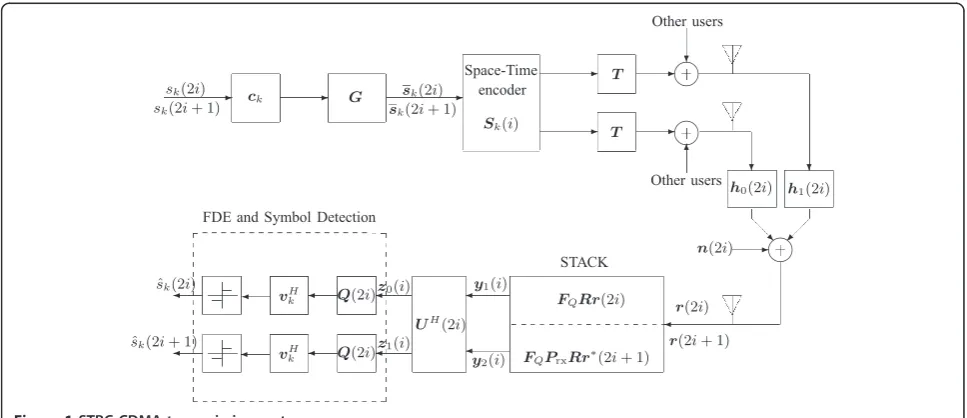
Consider the discrete-time equivalent baseband model of a synchronous downlink STBC CDMA system shown in Figure 1 (for convenience only one user is shown). For simplicity, in this paper we will focus on the case of two transmit antennas and one receive antenna, although this schema could be easily extended to config-urations with more receive antennas, provided an
appropriate combiner, such as maximal ratio combiner (MRC), would be used.
In the proposed system each of the Kusers transmits symbolssk(i)Î ℂ, which are first spread by theM-chip
spreading codeckÎ ℂM, ||ck||2 = 1, and then grouped
in vectorscksk(i) of sizeM. It is assumed that symbols sk
(i) are drawn from some constellation with zero mean and unit average symbol energy and they are indepen-dent and iindepen-dentically distributed (i.i.d.).
Then, the spread symbols are linearly precoded by the matrix G Î ℂM×M and fed into the Alamouti-based space-time encoder [1] to get the space-time symbol
Sk(i) =
operation used to combat deleterious channel effects and to simplify equalizer designs. PtxÎ ℝM×Mis a per-mutation matrix whose design depends on the overall system and it is used to decouple, in the receiver, the transmitted symbols, as we will show later.
It should be noted that a guard interval is necessary to avoid interblock interference (IBI) in the received signal. The guard interval insertion is performed by the matrix
TÎ ℝP×M
, where P =M +Lgiand Lgi is the length of
the guard interval. For the most commonly used guard intervals, cyclic prefix (CP) and zero padding (ZP), the matrixTis defined as [23]:
Tcp=
The frequency-selective channel from thejth (j= 1, 2) transmission antenna to the receiver can be modeled
- -
-FDE and Symbol Detection
using a finite-impulse response (FIR) filter with Ltaps, whose gains are samples, taken at the chip rate, of the equivalent baseband complex channel impulse response. Assuming that during two symbol periods the impulse response of both channels remain constant, that is, hj
(2i) =hj(2i+ 1) = [hj,0(2i) ...hj,L-1(2i)]T,E[||hj(2i)||2] =
1, the transmission through the frequency-selective MIMO channel can be represented by aP×Plower tri-angular Toeplitz convolution matrix Hj(2i), whose first
column is [hj,0(2i) ...hj,L-1(2i) 0 ... 0]T.
As we assume a downlink scenario, where the users experience the same channel condition, the received sig-nal collected over two consecutive symbol periods is represented by the twoP-dimensional vectors:
r(2i) =H0(2i)T¯s(2i)
wheren(i) is a complex white Gaussian noise vector with zero mean and covariance matrix E[n(i)nH(i)] =
N0IP, N0 is the noise spectral density, h(i) denotes the
IBI present in non-ZP systems (h(i) =0in ZP systems)
energy, with Ekbeing the energy of the kuser signal,
ρk=
Ek/2E˜s, r=diag(r1; ... rK), C= [c1 ···cK],s(i) =
[s1(i) ...sK(i)]T.
If CP is used as guard interval at the transmitter, the receiver must remove the guard interval from the received signal to eliminate IBI. If ZP is used at the transmitter the IBI is null, and then, the guard interval removal is not necessary. This operation is represented by the matrixR, whereR=Rcp= [0M×Lgi|IM]for CP sys-tems andR =Rzp=IPfor ZP systems.
Finally, the space-time decoding is performed by first stacking the received signals over two consecutive sym-bol periods, as:
is a permutation matrix whose design depends on the overall system, and in conjunction with
Ptx it is used to perform symbol decoupling in the received STBC symbols, as will be detailed below.FQis a
Q × Qmatrix that implements aQ-point discrete Fourier transform, normalized such that,FHQFQ=FQFHQ=IQ. Note that the termh(i) in (2), which accounts for IBI in non-ZP guard interval systems, is removed by the joint operation of matrices T and R. It should be stressed that the guard interval length must be at least the channel order in order to avoid IBI, i.e.,Lgi≥ L - 1
[23].
The choice of ZP or CP as the guard interval is conve-nient, since it allows us the use of the following well known properties:
in (p1) and (p2), can be decomposed as
Hj(2i) =FHQj(2i)FQ and HHj (2i) =FHQ∗j(2i)FQ, where
Λj(2i) is a diagonal matrix whose entries are the
fre-quency response of the transmission channelhj(2i), i.e., j(2i) =diag(F˜Q×Lhj(2i)), where F˜Q×L is a Q × L
matrix formed with the first L columns of the matrix that implements the (non-normalized)Q-point discrete Fourier transform.
In order to decouple the transmitted symbols and to provide FDE capabilities to the system, we choosePtx and Prx as in [21], where they are drawn from a set {P(Jn)}nJ−=01, where J is the dimension ofP. EachP(Jn) per-forms a reverse cyclic shift that depends on n when applied to a J ×1 vector. This set of matrices has two useful properties:
(p4) Pre- and post-multiplying a circulant matrix,
Then, if for CP systems we choosePrx=Ptx=P(0)M and
In the same way, for ZP systems we can choose Prx=P(PM)and Ptx=P(0)M, then using (p2), (p5), (p4) and
Now, using the results (8)-(11), the space-time decoded vector in (5), can be expressed as
y(i) =
theQ×Kmatrix defined in connection with (8)-(11). Note that the noise vectorn¯(i)in (5) and (12) is still Gaussian with zero mean and covariance matrixN0I2Q.
3 Receiver Design
Assuming that perfect channel estimation is performed at the receiver, we can define an orthogonal matrix U(2i) =(2i)(I2⊗−011(2i)) of dimension 2Q × 2Q,
thus, U(2i) decouples the received vector allowings (2i) ands(2i+ 1) to be demodulated separately from: an orthogonal matrix, it does not alter the statistical properties of the noise vectorn¯(i).
With zj(i) (j = 0, 1), as in (15), symbol detection can
adopt different approaches as illustrated next.
3.1 Multiuser maximum likelihood (ML) detection
The optimal solution of the proposed system is to jointly detect the transmitted symbol of the different users within the transmitted vector, based on the received vector. Thus, the optimum receiver is a multiu-ser (MU) maximum likelihood (ML) receiver, implemen-ted, in this case, by the minimum distance receiver, such that, forj= 0, 1:
As shown in the appendix, the maximum diversity gainGd= 2L, is attained for this receiver when ||Λ01(2i) Ve||2≠0,∀e≠0. Then, a sufficient condition for maxi-mum diversity gain, is to guarantee that, for any e≠0, at leastLelements fromVeare different from zero.
Proof: In the following, we drop the time index to sim-plify the notation. Letl01,lbe the real and non-negative lth element of the diagonal ofΛ01andelthe lth element
discrete Fourier transform of a vector of sizeLcan have at mostL- 1 zero elements, it then results that at most
L - 1 values of l01,l can be equal to zero. Then, if el=V ehas at least L elements different from zero, we have thatQl=0−1λ2
01,l|el|2 = 0and the maximum
diver-sity gain is achieved.■
3.1.1 ZP systems
For the ZP systems, V = FPTzpGCr. Now using
V e=F˜P×Me0, where F˜P×M=FPTzp is P × M matrix
formed with the firstMcolumns ofFPande0=GCreis a M-dimensional vector, if the user codes are linearly inde-pendent, and provided thatGis non-singular, thenGCis full column rank and thereforee0≠0for anye≠0. Again, since the P-points discrete Fourier transform of a sequence ofMpoints can have at mostM- 1 zeros, then
˜
FP×Me0has at leastP- (M- 1) =L+ 1 elements different from zero, thus maximum diversity gain is achieved.
the precoding matrix and the number of users on the system, provided thatGCis full column rank.
3.1.2 CP systems
For CP systemsV=FMGCr, then, in general, we cannot
guarantee that the maximum diversity gain is achieved by the system. However, proper choices of the precoding matrix and spreading codes, can lead to full diversity gain. For example, ifFMGC is a Vandermonde matrix
(e.g.,G=FH
Mand the codesckare columns of a
Vander-monde matrix1), andGC is full column rank, then for any Kdimensional vector e≠0, Ve has at mostK - 1 zeroes, or equivalently, it has at least M - K+ 1 ele-ments different from zero. Then, maximum diversity gain is achieved provided thatK≤M-L+ 1.
3.2 Minimum mean squared error single user detection Using zj(i) (j = 0, 1), from (15), thekth user minimum
mean squared error (MMSE) receiver for each symbol,
wk,j, is obtained by minimizing the mean-squared error
criterion
whose solution is given by [24]:
wk,j=R−zjzj1pzjsk, (19) Symbol detection is performed forj= 0, 1 as:
ˆ
wheredisc{n} returns the symbol constellation closer ton.
From (15) is easy to conclude that
Rz0z0 =Rz1z1 =E˜s01(2i)VV
HH
01(2i) +N0IQ (21)
andpz0sk =pz1sk =E˜s01(2i)vk, wherevk is thekth
col-umn ofV. It follows thatwk,0=wk,1.
As we assume downlink transmission, in practical situations only thekth column ofVis known to thekth user receiver. Then, an iterative procedure, like the recursive least squares (RLS) algorithm [24] or conju-gated gradient algorithm [25], must be used to compute the desired solution (19).
4 Frequency domain equalization
From (15) one can see that FDE can be performed by applying an one-tap chip-equalizer to each component of the vectors zj(i) (j = 0, 1). Such operation is
repre-sented by the pre-multiplication of the vectorszj(i) (j=
0, 1) by a diagonal matrix Q(2i) Î ℂQ×Q, whose ele-ments are the weights of the one-tap chip-equalizer.
Symbol detection is then performed over the fre-quency equalized and despread signal:
ˆ
s(2i+j) =discV†Q(2i)z j(i)
j= 0, 1 (22) where disc{n} is the vector whose components are the symbols of the signal constellation closer to the components of vector n and (·)† represent the Moore-Penrose matrix inverse. In order to avoid high computational complexity algorithms, it is desired to have V† = VH, which is true, for example, if G is an orthogonal matrix and the spreading codes are orthogonal.
As in the downlink the receiver is only interested in thekth user, symbol detection is performed as
ˆ
Now, let us consider the noiseless part of the decision variable,vH
and for the ZP case
cHkGHTHzp FPH˜I(2i)FP
introduce code distortion and inter-chip interference in the equalization process.
So, one can design the precoding matrix, G, in order to mitigate such undesired effects. Two simple approaches are commonly used. The first one is to choose the identity matrix as the precoding matrix, resulting into the well-known single-carrier block trans-mission systems. In both cases, CP and ZP systems, sin-gle carrier modulation presents code distortion and inter-chip interference, produced by the circulant matrix ˜
I(2i).
The second approach is to chooseG=FH
M, leading the
so-called multicarrier block transmission systems. In this case, for CP systems, the noiseless decision variable (24) reduces tocH
k˜I(2i)C s(2i+j), that states the absence
of inter-chip interference (as˜I(2i)is a diagonal matrix), however, code distortion is present.
We next consider the design of the one-tap equaliza-tion matrix Q(2i) = diag(q0(2i),..., qQ(2i)) following
4.1 MRC single user detection
This receiver weights each sub-channel by its respective complex conjugate equivalent sub-channel coefficient, leading in the present case to
ql(2i) =λ01,l(2i) =
|λ0,l(2i)|2+|λ1,l(2i)|2 (26)
wherel01,l(2i) is the real and non-negativelth element
of the diagonal ofΛ01(2i) andlj,l(2i) (j= 0, 1) is thelth
element ofF˜Q×Lhj(2i).
Whit this choice, Q(2i) = Λ01(2i) and then
˜
I(2i) =201(2i). Thus, this equalize the spreading code distortion introduced by the transmission channel and may enhance the multiple access interference (MAI).
4.2 Zero forcing (ZF) single-user receiver
Zero forcing applies channel inversion so that Q(2i) =−011(2i) and I˜(2i) =IQ. Thus, this equalizer
eliminates code distortion, and for the case of multicar-rier with CP transmissions systems also removes the inter-chip interference and can, therefore, eliminate MAI (if user codes are orthogonal). The equalizer coeffi-cients are chosen as
ql(2i) = 1 λ01,l(2i)
. (27)
The main drawback of this equalizer is that whenl01,l
(2i)≈0, the noise effects are enhanced.
4.3 MMSE single-user detection
The equalization coefficient based on the MMSE criter-ion for the proposed system results in [26]:
ql(2i) = λ01,l (2i) λ2
01,l(2i) +σ2
(28)
where s2 is the variance of the noise. We have Q(2i) = (201(2i) +σ2I)−1
01(2i) and
˜
I(2i) = (201(2i) +σ2I)−12
01(2i), thus, as with the MRC this equalizer does not eliminate code distortion. How-ever, it offers a good trade off between code distortion reduction and noise enhancement.
5 Simulation results
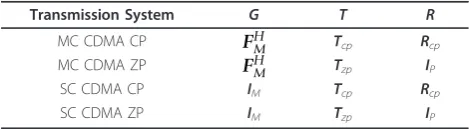
We consider the downlink scenario of the proposed STBC CDMA transmission system with two transmit and one receive antenna. The data symbols are binary phase-shift keying (BPSK) modulated and spreading by a length M = 16 spreading code. The system is loaded with K= 4 users and two types of guard intervals are considered in combination with two different choices of precoding matrix, G= IMand G=FHM, leading to four
different systems, as shown in Table 1 where MC stands for multicarrier and SC for single carrier.
In all the experiments, we obtain the average bit-error rate (BER) versus Eb/N0 (Ebis the energy per bit of the
desired user) as the performance measure. In each experiment we run 30, 000 Monte Carlo realizations, with 2,000 symbols transmitted per run. The trans-mitted symbols are randomly generated and it is assumed that the first 500 symbols are used as the train sequence for the equalizers.
5.1 Performance of the transceiver
In the first experiment we compare two different transcei-vers, the one proposed in [4], adapted to the systems in Table 1 as reported in [16], denoted as STBC in the fig-ures, and the transceiver proposed in this work. In order to allow a fair comparison between the transceivers, we employ a MMSE type of receiver (see Section 3.2), with a conjugated gradient [25] adaptive implementation. For comparison purposes, the performance of a single user MMSE type of receiver for a block CDMA-based system with only one antenna at the transmitter and one antenna at the receiver, denoted as SISO, is also presented.
The channel from each transmit antenna to the recei-ver is modeled here as a time-variant FIR filter, with coefficients given byhj,l(i) = pj,laj,l(i) (j= 1, 2 andl = 0,
1, 2,..., L - 1) where aj,l(i) is obtained with Clarke’s
model [27]. This procedure corresponds to the genera-tion of independent sequences of correlated unit power
complex Gaussian random variables(E
|α2
j,l(i)|
= 1)
with the path weights pj,l normalized so that L−1
l=0 |pj,l|2= 1. Here, the channel coefficients are kept
constant during two-symbol period and each channel has L= 4 transmission paths of equal weight, i.e., |pj,l|2
= 1/L, l= 0, 1, 2, 3. The guard interval length isLgi= 3.
The results depend on the normalized Doppler fre-quency (fdT), wherefdis the Doppler frequency andTis
the duration of two symbols. A valuefdT = 0.001 was
assumed in all simulations. The systems use Hadamard codes of length M = 16. In each run, the user codes were randomly chosen, but we avoid the use of the first and second Hadamard code, which corresponds to the first and second column of the Hadamard matrix.
Table 1 Transmission system considered
Transmission System G T R
MC CDMA CP FHM Tcp Rcp MC CDMA ZP FHM Tzp IP
SC CDMA CP IM Tcp Rcp
For the proposed transceiver, before the MMSE single user detection stage, decoupling of the received vector must be performed, as shown in (14), (15). For this pur-pose, two channel estimates were used. The first one is an ideally estimated channel, denoted as Proposed in the figures, while the second one, denoted ‘Proposed w/ Error’ in the figures, is a noisy channel estimate, ˆ
hj(2i) =hj(2i) +ζj(2i), whereζj(2i) is a complex white
Gaussian noise vector with zero mean and covariance
matrix E
ζj(2i)ζHj (2i)
=σζ2IL. In this experiment, we
set the mean squared relative error of the channel esti-mate to 10 dB. Note, that the conjugated gradient algo-rithm that follows the decoupling does not need the channel knowledge to reach the MMSE solution.
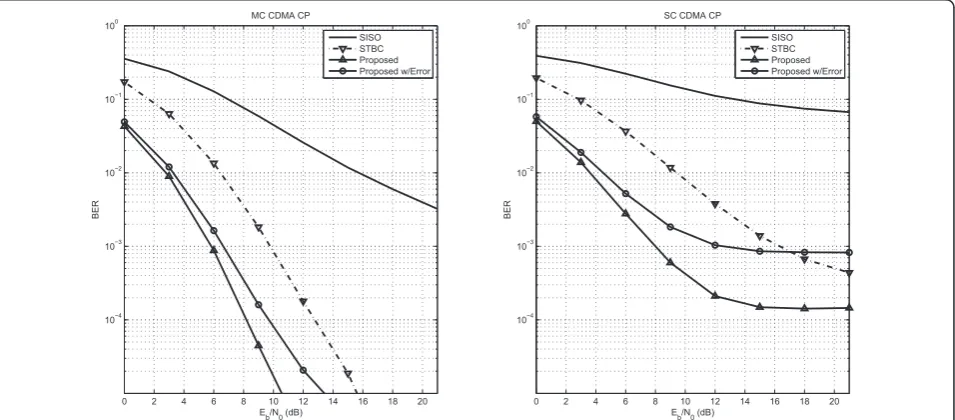
Figures 2 and 3 show the BER results versusEb/N0for
CP and ZP systems, respectively. As can be noted, for multicarrier systems, the proposed receiver performs better than the STBC receiver, even in the presence of channel estimation errors. When comparing multicarrier systems versus single carrier systems, we observe the BER floor for single carrier systems. This is due, in part, to the better recovering of the spreading codes per-formed by the multicarrier systems.
In the case of SC CDMA ZP system of the Figure 3, it was observed that the receiver restored some of the orthogonality between user codes, resulting in good signal to interference-plus-noise ratio, which in turn results in enhanced BER. For the case of SC CDMA CP of the Figure 2, the same receiver could not restore the orthogonality between user codes, resulting in poor signal to interference-plus-noise ratio and then in worst BER.
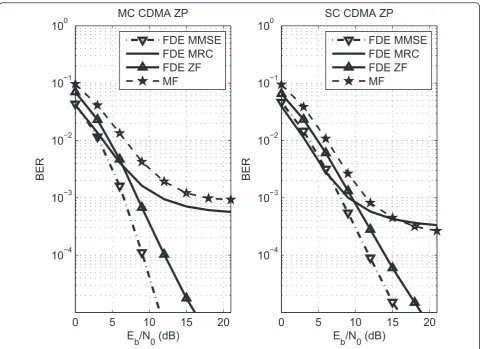
5.2 Performance of FDE algorithms
In this experiment we compare different FDE algorithms for the proposed structure (see Section 4): MRC single user receiver (FDE MRC), zero forcing single user recei-ver (FDE ZF), and MMSE single user receirecei-ver (FDE MMSE). We use the same time-variant channel used in the first experiment and we assume that the channel was perfectly estimated. The system uses Hadamard codes of lengthM = 16 and were chosen as in the first experiment. Results for a matched filter single user algorithm (MF) are also shown in the figures. In this algorithm the receiver filter is matched to the user spreading code at the receiver.
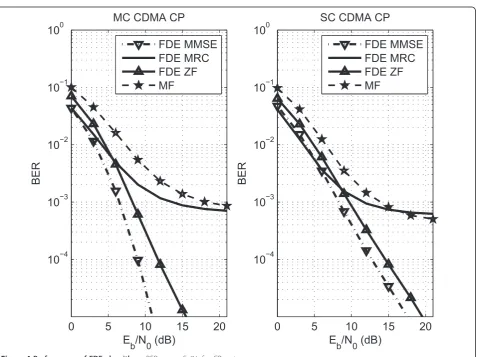
Figures 4 and 5 show the BER results versusEb/N0for
CP and ZP systems, respectively. As expected, the FDE MMSE receiver outperforms the FDE ZF, the FDE MRC and the MF receivers. Furthermore, all these receivers have similar computational complexity.
Also note that for FDE ZF and FDE MMSE receivers, multicarrier systems perform better than for single car-rier systems due to the small and even null inter-chip interference of multicarrier systems with FDE, as stated before in Section 4.
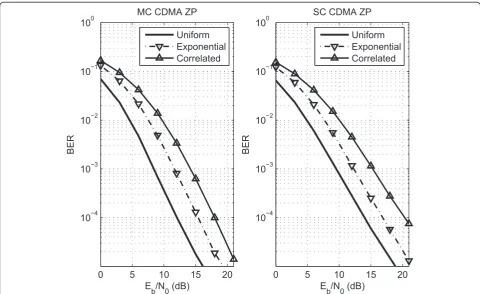
5.3 Performance with different channel covariance matrix In the third experiment we compare the performance of the systems for three different transmission channels, all with L = 4 paths but different channel covariance matrices.
The process to generate the time-variant channel for each user is as in the first experiment. The first channel assumes uncorrelated transmission paths of equal weight, i.e., |pj,l|2 = 1/L, j= 1, 2 andl= 0, 1, 2, 3, as in
0 2 4 6 8 10 12 14 16 18 20
10í4 10í3 10í2 10í1 100
Eb/N0 (dB)
BER
MC CDMA CP
SISO STBC Proposed Proposed w/Error
0 2 4 6 8 10 12 14 16 18 20
10í4 10í3 10í2 10í1 100
Eb/N0 (dB)
BER
SC CDMA CP
SISO STBC Proposed Proposed w/Error
0 2 4 6 8 10 12 14 16 18 20 10í4
10í3
10í2
10í1 100
Eb/N0 (dB)
BER
MC CDMA ZP
SISO STBC Proposed Proposed w/Error
0 2 4 6 8 10 12 14 16 18 20
10í4
10í3
10í2
10í1 100
Eb/N0 (dB)
BER
SC CDMA ZP
SISO STBC Proposed Proposed w/Error
Figure 3Performance of the transceiver. BER versusEb/N0for zero padding systems.
0
5
10
15
20
10
í410
í310
í210
í110
0E
b/N
0(dB)
BER
MC CDMA CP
0
5
10
15
20
10
í410
í310
í210
í110
0E
b/N
0(dB)
BER
SC CDMA CP
FDE MMSE
FDE MRC
FDE ZF
MF
FDE MMSE
FDE MRC
FDE ZF
MF
the first experiment. This type of channel is named Uni-form in the perUni-formance curves. For the second channel we assume that the average power of each path decays exponentially, such that|pj,l|2=σ02exp(−l), l= 0, 1, 2, 3, andσ2
0 = 1−exp(−1)/(1−e−L)[28]. This channel is named as Exponential in the figures. Finally, the third channel results from the multiplication of a matrixK˜ by the channel vector generated as in the Exponential channel case. Matrix K˜ was randomly generated and normalized such that the average power in each path is kept constant. This third channel is termed Correlated in the figures.
As in the two first experiments, we set a system with
K = 4 users using Hadamard codes of lengthM = 16 and the guard interval length isLgi = 3. FDE with zero
forcing single user receiver (FDE ZF) was employed. The BER results for CP systems are shown in Figure 6, and ZP systems results are shown in Figure 7. As expected, the receiver performs worst for Correlated channels due to smaller coding gain that the systems exhibit for this type of channels (see Appendix).
5.4 Performance for different user codes
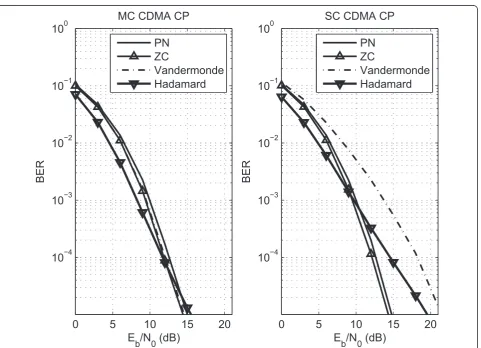
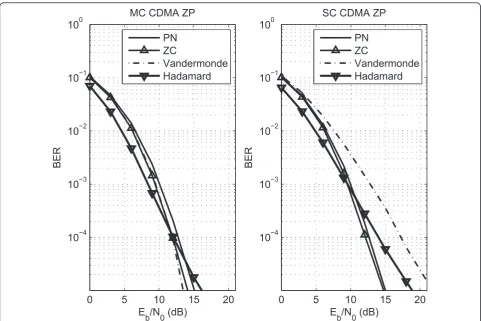
In this experiment we assess the BER for different codes. Four types of user codes are considered: Pseudo-noise sequences (PN), Walsh-Hadamard, Vandermonde and Zadoff-Chu (ZC) codes [29,30], all of length 16. Vander-monde codes are taken from the columns of the Vandermonde matrix:
C=√1
⎡ ⎢ ⎢ ⎢ ⎣
ε0 ε02 · · · ε0K
ε1 ε12 · · · ε1K
..
. ... . .. ... εM−1ε2M−1· · · εKM−1
⎤ ⎥ ⎥ ⎥
⎦ (29)
where √1 normalizes the codes, such that cH kck= 1.
The parameters εjcan be chosen as equispaced points
on the unit circle by settingεj=exp
−√−1j(2πM),
j = 0, 1, ..., M - 1 [31]. In this system
εj=exp
−√−1j(2πM),j= 0, 1, ...,M- 1.
We consider a scenario with K= 4 users and time-variant channels as in the first two experiments. In each run, the user codes were randomly chosen. BER results
0
5
10
15
20
10
í410
í310
í210
í110
0E
b/N
0(dB)
BER
MC CDMA ZP
0
5
10
15
20
10
í410
í310
í210
í110
0E
b/N
0(dB)
BER
SC CDMA ZP
FDE MMSE
FDE MRC
FDE ZF
MF
FDE MMSE
FDE MRC
FDE ZF
MF
0 5 10 15 20 10í4
10í3 10í2 10í1
100 MC CDMA CP
Eb/N0 (dB)
BER
0 5 10 15 20
10í4 10í3 10í2 10í1
100 SC CDMA CP
Eb/N0 (dB)
BER
Uniform Exponential Correlated
Uniform Exponential Correlated
Figure 6Performance for different type of channels. BER versusEb/N0for CP systems.
0 5 10 15 20
10í4 10í3 10í2 10í1
100 MC CDMA ZP
Eb/N0 (dB)
BER
Uniform Exponential Correlated
0 5 10 15 20
10í4 10í3 10í2 10í1
100 SC CDMA ZP
Eb/N0 (dB)
BER
Uniform Exponential Correlated
are shown in Figures 8 and 9 for the zero forcing single user FDE receiver (FDE ZF). We recall that for the mul-ticarrier transmission system with CP as guard interval, the use of Vandermonde codes allows the maximum diversity gain when multi-user maximum likelihood detection is employed. Note, however, that the consid-ered FDE ZF receiver (which is suboptimum) also exploits the diversity gain of the system in this case. For single carrier transmission system with CP as guard interval, it can be verified that the use of Vandermonde codes leads to a single carrier TDMA transmission sys-tem with ZP (in this case,V=FH
MC=IM×K, whereIM×K
is a truncated identity matrix), and the results in Figure 8 indicate that the FDE was not able to exploit the diversity gain.
The FDE ZF receiver for systems using Hadamard codes does not exploit the diversity gain of the system, but presents a better coding gain, as expressed by the offset on the BER curve. On the other hand, the use ZC or PN codes yields to better exploiting the coding gain of the systems, as shown by the bigger slope of the BER curve.
6 Conclusion
This work proposed a FDE STBC CDMA-based trans-mission system. The FDE algorithms used with single user detection resulted in a simple receiver design with reduced computational complexity. Simulations results have shown good performance in terms of BER when compared to previously proposed STBC CDMA systems. Diversity and coding gain analysis of the proposed struc-ture was performed and conditions to achieve their maximum values, with multiuser maximum likelihood detection, were identified.
Note
1
See equation (29).
Appendix
Diversity and Coding Gain Analysis
Let us drop the time index and use only one equation from (15). If for a given detection systemP(εk|h0,h1) is
the conditional error probability of userk, then
P(εk|h0, h1)≤PB(ε|h0,h1) (30)
0
5
10
15
20
10
í410
í310
í210
í110
0E
b/N
0(dB)
BER
MC CDMA CP
0
5
10
15
20
10
í410
í310
í210
í110
0E
b/N
0(dB)
BER
SC CDMA CP
PN
ZC
Vandermonde
Hadamard
PN
ZC
Vandermonde
Hadamard
where PB(·) is the block (block of symbols ofKusers)
error probability and is given by
PB(ε|h0, h1) =
s∈χ
ˆ
s∈χ
ˆ
s=s
P(ˆs|s,h0, h1)P(s|h0, h1) (31)
wherecrepresents the set of possible values forsand
P(sˆ|s, h0, h1)is the conditional probability of the event that the detected block issˆwhen the transmitted block is s(ˆs=s).
Using standard procedures, we arrive, for equiprobable symbols at
P(εk)≤ 1
|χ|
e=0
ϑ(e)f(e) (32)
where |c| denotes the cardinality ofc, e=ˆs−s,ϑ(e) is the number of occurrences of a given vectore, when ˆs andsspanc,f(e) =E[exp(-||Λ01Ve||2g)] andγ =E˜s/SN0.
LetK =E
hjhHj
be the covariance matrix of the chan-nel vector hj(j= 0, 1), where it was assumed that the
channelshjare identically distributed. SinceK is square
Hermitian, it always admits spectral decomposition, i.e.,
K=ΩDΩH, whereDis aL×Ldiagonal matrix whose entries are the eigenvalues of K and Ω is a unitary matrix whose columns are the normalized eigenvectors ofK.
If we assume thatKis non-singular and introduce the channel vector h˜j=D−1/2Hhj, which by construction
has a identity covariance matrix, then we can write
||01V e||2 = 1
j=0 ˜
hHj (e)h˜j. (33)
where
(e) = [D1/2]HH0(e)D1/2 (34)
0(e) =F˜
H
Q×LdiagH(V e)diag(V e)F˜Q×L. (35)
If the channelsh0 andh1 are modeled as statistically independent complex gaussian vectors, then after some algebraic manipulation, we obtain forf(e) in (32):
f(e) =
κ(e)−1
l=0
1 (1 +γ λl(e))
2
(36)
0 5 10 15 20
10í4 10í3 10í2 10í1
100
Eb/N0 (dB)
BER
MC CDMA ZP
0 5 10 15 20
10í4 10í3 10í2 10í1
100
Eb/N0 (dB)
BER
SC CDMA ZP
PN ZC
Vandermonde Hadamard
PN ZC
Vandermonde Hadamard
≤ ! 1
wheredet(·) denotes determinant.
We remark that since the diversity gain depends only onΓ0(e) given by (35), it does not depend on the
chan-nel covariance matrixK(provided that is non-singular). It depends, however, on the particular system employed and the relative power of the users.
From (34) we have that ifKis full rank,
det((e)) = det([D1/2]HHD1/2) det(0(e))
= det(D) det(0(e)) = det(K) det(0(e)).
It then results from (39) that for a system that attains maximum diversity gain:
det(K) is obtained when all the eigenvalues of K are
the same, i.e.,lK,i= 1/L(i= 1, 2, ...,L). In this casedet
(K) = (1/L)L, and therefore, for a system transmitting in a channel withLmultipath components
Gc≤g0
equality (maximum coding gain) is achieved, for example, when channel has uncorrelated equal power coefficients (K=L-1I).
Abbreviations
BER: bit error rate; CIBS: chip-interleaved block-spread; CP: cyclic prefix; DS-CDMA: direct-sequence code division multiple access; FDE: frequency domain equalization; FIR: finite-impulse response; IBI: interblock interference; ISI: intersymbol interference; MMSE: minimum mean squared error; MRC: maximal ratio combiner; OFDM: orthogonal frequency division multiplexing; RLS: recursive least squares; SC-FDE: single-carrier frequency-domain equalization; STBC: space-time block-coded; ZP: zero padding.
Acknowledgements
This study was supported by the Brazilian Council for Scientific and Technological Development (CNPq).
Competing interests
The authors declare that they have no competing interests.
Received: 1 December 2010 Accepted: 30 August 2011 Published: 30 August 2011
References
1. S Alamouti, A simple transmit diversity technique for wireless communications. IEEE J Sel Areas Commun.16(8), 1451–1458 (1998). doi:10.1109/49.730453
2. V Tarokh, H Jafarkhani, AR Calderbank, Space-time block codes from orthogonal designs. IEEE Trans Inf Theory45(5), 1456–1467 (1999). doi:10.1109/18.771146
3. V Tarokh, N Seshadri, AR Calderbank, Space-time codes for high data rate wireless communication: performance criterion and code construction. IEEE Trans Inf Theory44(2), 744–765 (1998). doi:10.1109/18.661517
4. B Hochwald, TL Marzetta, CB Papadias, A transmitter diversity scheme for wideband CDMA systems based on space–time spreading. IEEE J Sel Areas Commun.19, 1 (2001). doi:10.1109/JSAC.2001.909604
5. H Li, X Lu, GB Giannakis, Capon multiuser receiver for CDMA systems with space–time coding. IEEE Trans Signal Process.50(5), 1193–1204 (2002). doi:10.1109/78.995086
6. Z Liu, GB Giannakis, S Barbarossa, A Scaglione, Transmit antennae space– time block coding for general OFDM in the presence of unknown multipath. IEEE J Sel Areas Commun.19(7), 1352–1364 (2001). doi:10.1109/ 49.932702
7. E Lindsok, A Paulraj, A transmit diversity scheme for delay spread channels, inProceedings of the IEEE International Conference on Communications, New Orleans, USA, 307–311 (2000)
8. FW Vook, TA Thomas, Transmit diversity schemes for broadband mobile communication systems, inProceedings of the IEEE Vehicular Technology Conference Fall (VTC2000).6, 2523–2529 (2000)
9. N Al-Dhahir, Single-carrier frequency-domain equalization for space–time block-coded transmission over frequency-selective fading channels. IEEE Commun Lett.5(7), 304–306 (2001). doi:10.1109/4234.935750
10. F Pancaldi, GM Vitetta, R Kalbasi, N Al-Dhahir, M Uysal, H Mheidat, Single-carrier frequency domain equalization. IEEE Signal Process Mag.25(5), 37–56 (2008)
11. L Song, R de Lamare, AG Burr, Successive interference cancellation schemes for time-reversal space–time block codes. IEEE Trans Veh Technol.57(1), 642–648 (2008)
multipath channels. inProceedings of the IEEE International Symposium on Wireless Communication Systems (ISWCS’07), Trondheim, 686–690 (December 2007)
13. RC de Lamare, R Sampaio-Neto, Blind adaptive MIMO receivers for space– time block-coded DS-CDMA systems in multipath channels using the constant modulus criterion. IEEE Trans Commun.58(1), 21–27 (2010) 14. RC de Lamare, R Sampaio Neto, Space-time adaptive reduced-rank
processor for interference mitigation in DS-CDMA systems. IET Commun.
57(2), 388–397 (2008)
15. R de Lamare, A Hjorungnes, R Sampaio Neto, Adaptive MIMO decision feedback reduced rank equalization based on joint iterative optimization of adaptive RLS estimation algorithms, inProceedings of the IEEE Wireless Communications and Networking Conference, Las Vegas, USA, 413–418 (April 2008)
16. CA Medina, TTV Vinhoza, R Sampaio-Neto, A blind channel estimation algorithm for space–time coded MC-CDMA receivers. inProceedings of the IEEE International Conference on Communications, Dresden (June 2009) 17. S Zhou, GB Giannakis, C Le Martret, Chip-interleaved block-spread code
division multiple access. IEEE Trans Commun.50, 235–248 (2002). doi:10.1109/26.983320
18. F Petre, G Leus, L Deneire, M Engels, M Moonen, H De Man, Space-time block coding for single-carrier block transmission DS-CDMA downlink. IEEE J Sel Areas Commun.21(3), 350–361 (2003). doi:10.1109/JSAC.2003.809630 19. Y Yang, YH Chew, TT Tjhung, Adaptive frequency-domain equalization for
space–time block-coded DS-CDMA downlink, inProceedings of the IEEE International Conference on Communications (ICC, 2005)4, 2343–2347 (2005) 20. FW Vook, TA Thomas, KL Baum, Cyclic-prefix cdma with antenna diversity,
inProceedings of the IEEE Vehicular Technology Conference Spring (VTC2002) 2, 1002–1006 (2002)
21. S Zhou, G Giannakis, Single-carrier space–time block-coded transmission over frequency-selective fading channels. IEEE Trans Inf Theory49(1), 164–179 (2003). doi:10.1109/TIT.2002.806158
22. S Zhou, G Giannakis, Space-time coding with maximum diversity gains over frequency-selective fading channels. IEEE Signal Process Lett.48(10), 269–272 (2001)
23. Z Wang, GB Giannakis, Wireless multicarrier communications: where Fourier meets Shannon. IEEE Signal Process Mag.17(3), 29–47 (2000). doi:10.1109/ 79.841722
24. S Haykin, Adaptive Filter Theory (Prentice Hall, 2001)
25. PS Chang, AN Willson, Analysis of conjugated gradient algorithms for adaptive filtering. IEEE Trans Signal Process.48(2), 409–418 (2000). doi:10.1109/78.823968
26. K Fazel, S Kaiser, Multi-Carrier and Spread Spectrum Systems (Wiley, 2003) 27. TS Rappaport, Wireless Communications: Principles and Practice (Prentice
Hall PTR, 1996)
28. T Kaitz, Channel and interference model for 802.16b physical layer, IEEE 802.16 Broadband Wireless Access Working Group. (2001)
29. RL Frank, SA Zadoff, Phase shift pulse codes with good periodic correlation properties. IEEE Trans Inf TheoryIT-8, 381–382 (1962)
30. D Chu, Polyphase codes with good periodic correlation properties. IEEE Trans Inf Theory18(4), 531–532 (1972). doi:10.1109/TIT.1972.1054840 31. AS Cacciapuoti, G Gelli, F Verde, FIR zero-forcing multiuser detection and
code designs for downlink MC-CDMA. IEEE Trans Signal Process.55(10), 4737–4751 (2007)
doi:10.1186/1687-1499-2011-80
Cite this article as:Medina and Sampaio-Neto:Frequency domain equalization space-time block-coded CDMA transmission system.
EURASIP Journal on Wireless Communications and
Networking20112011:80.
Submit your manuscript to a
journal and benefi t from:
7Convenient online submission
7Rigorous peer review
7Immediate publication on acceptance
7Open access: articles freely available online
7High visibility within the fi eld
7Retaining the copyright to your article