Computational Linguistics and Chinese Language Processing
Vol. 9, No. 1 , February 2004, pp. 1-20 1 © The Association for Computational Linguistics and Chinese Language Processing
Bilingual Collocation Extraction Based on Syntactic and
Statistical Analyses
Chien-Cheng Wu
*, and Jason S. Chang
*Abstract
In this paper, we describe an algorithm that employs syntactic and statistical analysis to extract bilingual collocations from a parallel corpus. Collocations are pervasive in all types of writing and can be found in phrases, chunks, proper names, idioms, and terminology. Therefore, automatic extraction of monolingual and bilingual collocations is important for many applications, including natural language generation, word sense disambiguation, machine translation, lexicography, and cross language information retrieval.
Collocations can be classified as lexical or grammatical collocations. Lexical collocations exist between content words, while a grammatical collocation exists between a content word and function words or a syntactic structure. In addition, bilingual collocations can be rigid or flexible in both languages. Rigid collocation refers to words in a collocation must appear next to each other, or otherwise (flexible/elastic). We focus in this paper on extracting rigid lexical bilingual collocations. In our method, the preferred syntactic patterns are obtained from idioms and collocations in a machine-readable dictionary. Collocations matching the patterns are extracted from aligned sentences in a parallel corpus. We use a new alignment method based on punctuation statistics for sentence alignment. The punctuation-based approach is found to outperform the length-based approach with precision rates approaching 98%. The obtained collocations are subsequently matched up based on cross-linguistic statistical association. Statistical association between the whole collocations as well as words in collocations is used to link a collocation with its counterpart collocation in the other language. We implemented the proposed method on a very large Chinese-English parallel corpus and obtained satisfactory results.
*
Department of Computer Science, National Tsing Hua University Address: 101, Kuangfu Road, Hsinchu, Taiwan
2 Chien-Cheng Wu, and Jason S. Chang
1. Introduction
Collocations, like terminology, tends to be lexicalized and to have a somewhat more restricted meaning than the surface forms suggest [Justeson and Katz, 1995]. Collocations are recurrent combinations of words that co-occur more often than they normally would based on chance. The words in a collocation may appear next to each other (rigid collocations) or in other locations (flexible/elastic collocations). On the other hand, collocations can also be classified as lexical or grammatical collocations [Benson, Benson, Ilson, 1986]. Lexical collocations exist between content words, while a grammatical collocation exists between a content word and function words or a syntactic structure. Collocations are pervasive in all types of writing and can be found in phrases, chunks, proper names, idioms, and terminology. Collocations in one language are usually difficult to translate directlyinto another language word for word; therefore, they present a challenge for machine translation systems and second language learners alike.
Automatic extraction of monolingual and bilingual collocations is important for many applications, including natural language generation, word sense disambiguation, machine translation, lexicography, and cross language information retrieval. Hank and Church [1990] pointed out the usefulness of mutual information for identifying monolingual collocations in lexicography. Justeson and Katz [1995] proposed to identify technical terminology based on preferred linguistic patterns and discourse properties of repetition. Among the many general methods presented by Manning and Schutze [1999], the best results can be achieved through filtering based on both linguistic and statistical constraints. Smadja [1993] presented a method called EXTRACT, based on the mean variance of the distance between two collocates , that is capable of computing elastic collocations. Kupiec [1993] proposed to extract bilingual noun phrases using statistical analysis of the co-occurrence of phrases. Smadja, McKeown, and Hatzivassiloglou [1996] extended the EXTRACT approach to handle bilingual collocation based mainly on the statistical measures of the Dice coefficient. Dunning [1993] pointed out the weakness of mutual information and showed that log likelihood ratios are more effective in identifying monolingual collocations, especially when the occurrence count is very low.
Bilingual Collocation Extraction Based on Syntactic and Statistical Analyses 3
make statistical inferences between words than between phrases. Therefore, measuring the statistical association of collocations based on constituent words will help us cope with the data sparseness problem. We will be able to extract bilingual collocations with high reliability even when they appear together in aligned sentences only once or twice.
Example 1
They are stopping at nothing to get their kids into "star schools"
他們擠破頭也要把孩子送進明星小學
Source: 1995/02 No Longer Just an Academic Question: Educational Alternatives Come to Taiwan
Example 2
Not only haven't there been layoffs or pay cuts, the year-end bonus and the performance review bonuses will go out as usual .
不但不虞裁員、減薪,年終獎金、考績獎金還都照發不誤
Source: 1991/01 Filling the Iron Rice Bowl
Since collocations can be rigid or flexible in both languages, there are, in general, three types of bilingual collocation matches. In Example 1, (“擠破頭",“stop at nothing") is a pair of rigid collocation, and (“把…送進”, “get … into”) is a pair of elastic collocation. In Example 3 ,(“走…的路線’, “take the path of” ) is an example of a pair of elastic and rigid collocations.
Example 3
Lin Ku-fang, a worker in ethnomusicology, worries too, but his way is not to take the path of revolutionizing Chinese music or making it more "symphonic"; rather, he goes directly into the tradition, looking into it for "good music" that has lasted undiminished for a hundred generations.
民族音樂工作者林谷芳也非不感到憂心,但他的方法是:不走國樂改革或 「交響化」的路,而是直接面對傳統、從中尋找歷百代不衰的「好聽音樂」。
4 Chien-Cheng Wu, and Jason S. Chang
In this paper, we describe an algorithm that employs syntactic and statistical analyses to extract rigid lexical bilingual collocations from a parallel corpus. Here, we focus on bilingual collocations, which have some lexical correlation between them and are rigid in both languages. To cope with the data sparseness problem, we use the statistical association between two collocations as well as that between their constituent words. In Section 2, we describe how we obtain the preferred syntactic patterns from collocations and idioms in a machine-readable dictionary. Examples will be given to show how collocations matching the patterns are extracted and aligned for given aligned sentence pairs in a parallel corpus. We implemented the proposed method in an experiment on the Chinese-English parallel corpus of Sinorama Magazine and obtained satisfactory results. We describe the experiments and our evaluation in section 3. The limitations of the study and related issues are taken up in section 4. We conclude and give future directions of research in section 5.
2. Extraction of Bilingual Collocations
In this chapter, we will describe how we obtain bilingual collocations by using preferred syntactic patterns and associative information. Consider a pair of aligned sentences in a parallel corpus such as that shown in Example 4 below:
Example 4
The civil service rice bowl, about which people always said "you can't get filled up, but you won't starve to death either," is getting a new look with the economic downturn. Not only haven't there been layoffs or pay cuts, the year-end bonus and the performance review bonuses will go out as usual, drawing people to compete for their own "iron rice bowl."
以往一向被認為「吃不飽、餓不死」的公家飯,值此經濟景氣低迷之際, 不但不虞裁員、減薪,年終獎金、考績獎金還都照發不誤,因而促使不少 人回頭競逐這隻「鐵飯碗」。
Source: 1991/01 Filling the Iron Rice Bowl
We can extract the following collocations and translation counterparts:
(civil service rice bowl, 公家飯) (get filled up, 吃…飽) (starve to death, 餓…死) (economic downturn, 經濟景氣低迷)
Bilingual Collocation Extraction Based on Syntactic and Statistical Analyses 5
(year-end bonus, 年終獎金) (performance review bonuses, 考績獎金) (iron rice bowl, 鐵飯碗)
In section 2.1, we will first show how that process is carried out for Example 4 using the proposed approach. A formal description of our method will be given in section 2.2.
2.1 An Example of Extracting Bilingual Collocations
To extract bilingual collocations, we first run part of speech tagger on both sentences. For instance, for Example 4, we get the results of tagging shown in Examples 4A and 4B.
In the tagged English sentence, we identify phrases that follow a syntactic pattern from a set of training data of collocations. For instance, “jj nn” is one of the preferred syntactic structures. Thus, ”civil service,” “economic downturn,” “own iron” etc are matched. See Table 1 for more details. For Example 4, the phrases shown in Examples 4C and 4D are considered to be potential candidates for collocations because they match at least two distinct collocations listed in LDOCE:
Example 4A
The/at civil/jj service/nn rice/nn bowl/nn ,/, about/in which/wdt people/nns always/rb said/vbd "/`` you/ppss can/md 't/* get/vb filled/vbn up/rp ,/, but/cc you/ppss will/md 't/* starve/vb to/in death/nn either/cc ,/rb "/'' is/bez getting/vbg a/at new/jj look/nn with/in the/at economic/jj downturn/nn ./. Not/nn only/rb have/hv 't/* there/rb been/ben layoffs/nns or/cc pay/vb cuts/nns ,/, the/at year/nn -/in end/nn bonus/nn and/cc the/at performance/nn review/nn bonuses/nn will/md go/vb out/rp as/ql usual/jj ,/, drawing/vbg people/nns to/to compete/vb for/in their/pp$ own/jj "/`` iron/nn rice/nn bowl/nn ./. "/''
Example 4B
以往/Nd 一向/Dd 被/P02 認為/VE2 「/PU 吃/VC 不/Dc 飽/VH 、/PU 餓不死/VR 」/PU 的/D5 公家/Nc 飯/Na ,/PU 值此/Ne 經濟/Na 景氣/Na 低迷/VH 之際/NG ,/PU 不但/Cb 不虞/VK 裁員/VC 、/PU 減薪/VB ,/PU 年終獎金/Na 、/PU 考績/Na 獎金/Na 還都/Db 照/VC 發/VD 不誤/VH , /PU 因而/Cb 促使/VL 不少/Ne 人/Na 回頭/VA 競逐/VC 這/Ne 隻/Nf 「/PU 鐵飯碗/Na 」/PU
Example 4C
6 Chien-Cheng Wu, and Jason S. Chang
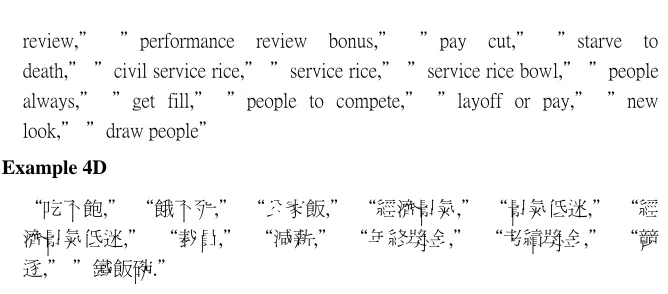
review," "performance review bonus," "pay cut," "starve to death," "civil service rice," "service rice," "service rice bowl," "people always," "get fill," "people to compete," "layoff or pay," "new look," "draw people"
Example 4D
“吃不飽," “餓不死," “公家飯," “經濟景氣," “景氣低迷," “經 濟景氣低迷," “裁員," “減薪," “年終獎金," “考績獎金," “競 逐," "鐵飯碗."
Although “new look” and “draw people” are legitimate phrases, they are more like “free combinations” than collocations. That is reflected by their low log likelihood ratio values. For this research, we proceed to determine how tightly the two words in overlapping bigrams within a collocation are associated with each other; we calculate the minimum of the log likelihood ratio values for all the bigrams. Then, we filter out the candidates whose POS patterns appear only once or have minimal log likelihood ratios of less than 7.88. See Tables 1 and 2 for more details.
In the tagged Chinese sentence, we basically proceed in the same way to identify the candidates of collocations, based on the preferred linguistic patterns of the Chinese translations of collocations in an English-Chinese MRD. However, since there is no space delimiter between words, it is at times difficult to say whether a translation is a multi-word collocation or a single word, in which case it should not be considered as a collocation. For this reason, we take multiword and singleton phrases (with two or more characters) into consideration. For instance, in tagged Example 4, we extract and consider these candidates shown in Tables 1 and 2 as the counterparts of English collocations.
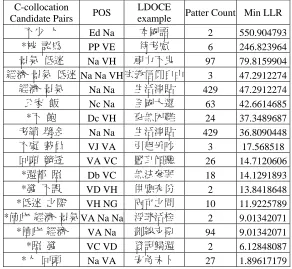
Notes that at this point, we have not pinned collocations down but allow overlapping and conflicting candidates such as “經濟景氣,” “景氣低迷,” and “經濟景氣低迷.” See Tables 3 and 4 for more details.
Table 1. The initial candidates extracted based on preferred patterns trained on collocations listed in LDOCE ( LDOCE example: the example for the POS pattern in LDOCE; Pattern Count: the number of POS patterns occurring in LDOCE ; Min LLR : the minimal LLR value of every two words in the candidate pairs.)
E-collocation
Candidate Pairs Part of Speech
LDOCE example
Pattern
Count Min LLR civil service jj nn hard cash 1562 496.156856
Bilingual Collocation Extraction Based on Syntactic and Statistical Analyses 7
iron rice bowl nn nn nn tin pan alley 8 66.3654678
filled up vbn rp set down 84 55.2837871
economic downturn jj nn hard cash 1562 51.8600979
*end bonus nn nn beef steak 1860 15.9977283
year - end bonus nn nn nn tin pan alley 12 15.9977283
go out vb rp bang out 1790 14.6464925
performance review nn nn beef steak 1860 13.5716459 performance review bonus nn nn nn tin pan alley 8 13.5716459
pay cut vb nn take action 313 8.53341082
starve to death vb to nn bring to bay 26 7.93262494 civil service rice jj nn nn high water mark 19 7.88517791 *service rice nn nn beef steak 1860 7.88517791 *service rice bowl nn nn nn tin pan alley 8 7.88517791 * people always nn rb hand back 24 3.68739176
get filled vb vbn stay put 3 1.97585732
* people to compete nn to vb order to view 2 1.29927068 * layoff or pay nn cc vb wine and dine 14 0.93399125
* new look jj nn hard cash 1562 0.63715518
* draw people vbg nn dying wish 377 0.03947748
* indicates invalid candidate (with human judgment )
Table 2. The candidates of English collocations based on both preferred linguistic patterns and log likelihood ratios.
E-collocation
Candidate Pairs Part of Speech
LDOCE
example Pattern Count Min LLR civil service jj nn hard cash 1562 496.156856
rice bowl nn nn beef steak 1860 99.2231161 iron rice bowl nn nn nn tin pan alley 8 66.3654678 filled up vbn rp set down 84 55.2837871 economic downturn jj nn hard cash 1562 51.8600979 *end bonus nn nn beef steak 1860 15.9977283 year - end bonus nn nn nn tin pan alley 12 15.9977283
go out vb rp bang out 1790 14.6464925
performance review nn nn beef steak 1860 13.5716459 performance review bonus nn nn nn tin pan alley 8 13.5716459 pay cut vb nn take action 313 8.53341082 starve to death vb to nn bring to bay 26 7.93262494 civil service rice jj nn nn high water mark 19 7.88517791
8 Chien-Cheng Wu, and Jason S. Chang
*service rice bowl nn nn nn tin pan alley 8 7.88517791
* indicates an invalid candidate(based on human judgment )
Table 3. The initial candidates extracted by the Chinese collocation recognizer.
C-collocation
Candidate Pairs POS
LDOCE
example Patter Count Min LLR
不少 人 Ed Na 本國語 2 550.904793
*被 認為 PP VE 待考慮 6 246.823964
景氣 低迷 Na VH 視力不良 97 79.8159904
經濟 景氣 低迷 Na Na VH宗教信仰自由 3 47.2912274
經濟 景氣 Na Na 生活津貼 429 47.2912274
公家 飯 Nc Na 全國大選 63 42.6614685
*不 飽 Dc VH 毫無困難 24 37.3489687
考績 獎金 Na Na 生活津貼 429 36.8090448
不虞 裁員 VJ VA 引起爭吵 3 17.568518
回頭 競逐 VA VC 豎耳傾聽 26 14.7120606
*還都 照 Db VC 無法參與 18 14.1291893
*發 不誤 VD VH 供應充份 2 13.8418648
*低迷 之際 VH NG 兩可之間 10 11.9225789
*值此 經濟 景氣 VA Na Na 浮球活栓 2 9.01342071
*值此 經濟 VA Na 劃線支票 94 9.01342071
*照 發 VC VD 登記歸還 2 6.12848087
*人 回頭 Na VA 安危未卜 27 1.89617179
* indicates an invalid candidate (based on human judgment )
Table 4. The result of Chinese collocation candidates which are picked out. (The ones which have no Min LLR are singleton phrases.)
C-collocation
Candidate Pairs POS
LDOCE
example Patter Count Min LLR
不少 人 Ed Na 本國語 2 550.904793
*被 認為 PP VE 待考慮 6 246.823964
景氣 低迷 Na VH 視力不良 97 79.8159904
經濟 景氣 低迷 Na Na VH宗教信仰自由 3 47.2912274
經濟 景氣 Na Na 生活津貼 429 47.2912274
公家 飯 Nc Na 全國大選 63 42.6614685
*不 飽 Dc VH 毫無困難 24 37.3489687
考績 獎金 Na Na 生活津貼 429 36.8090448
Bilingual Collocation Extraction Based on Syntactic and Statistical Analyses 9
回頭 競逐 VA VC 豎耳傾聽 26 14.7120606
*還都 照 Db VC 無法參與 18 14.1291893
*發 不誤 VD VH 供應充份 2 13.8418648
*低迷 之際 VH NG 兩可之間 10 11.9225789
*值此 經濟 景氣 VA Na Na 浮球活栓 2 9.01342071
*值此 經濟 VA Na 劃線支票 94 9.01342071
之際 NG 5
經濟 Na 1408
景氣 Na 1408
年終獎金 Na 1408
考績 Na 1408
獎金 Na 1408
鐵飯碗 Na 1408
公家 Nc 173
以往 Nd 48
值此 VA 529
裁員 VA 529
回頭 VA 529
減薪 VB 78
競逐 VC 1070
認為 VE 139
低迷 VH 731
不誤 VH 731
不虞 VJ 205
促使 VL 22
餓不死 VR 14
To align collocations in both languages, we employ the Competitive Linking Algorithm proposed by Melamed [1996] to conduct word alignment. Basically, the proposed algorithm CLASS, the Collocation Linking Algorithm based on Syntax and Statistics, is a greedy method that selects collocation pairs. The pair with the highest association value takes precedence over those with lower values. CLASS also imposes a one-to-one constraint on the collocation pairs selected. Therefore, the algorithm at each step considers only pairs with words that haven’t been selected previously. However, CLASS differs with CLA(Competitive Linking Algorithm) in that it considers the association between the two candidate collocations based on two measures:
10 Chien-Cheng Wu, and Jason S. Chang
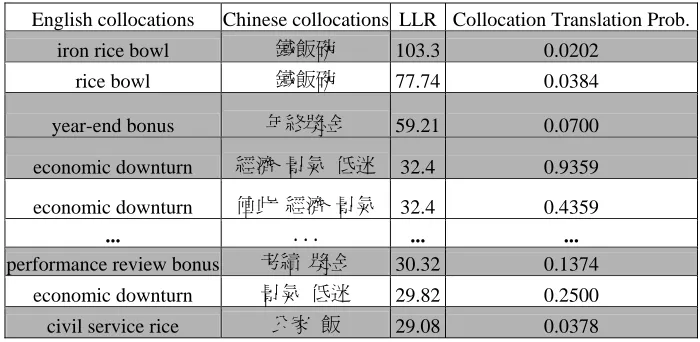
In the case of Example 4, the CLASS algorithm first calculates the counts of collocation candidates in the English and Chinese parts of the corpus. The collocations are matched up randomly across from English to Chinese. Subsequently, the co-occurrence counts of these candidates matched across from English to Chinese are also tallied. From the monolingual collocation candidate counts and cross language concurrence counts, we produce the LLR values and the collocation translation probability derived from word alignment analysis. Those collocation pairs with zero translation probability are ignored. The lists are sorted in descending order of LLR values, and the pairs with low LLR value are discarded. Again, in the case of Example 4, the greedy selection process of collocation starts with the first entry in the sorted list and proceeds as follows:
1. The first, third, and fourth pairs, (“iron rice bowl,” “鐵飯碗”), (“year-end bonus,” “年 終獎金”), and (“economic downturn,” “經濟景氣低迷”), are selected first. Thus, conflicting pairs will be excluded from consideration, including the second pair, fifth pair and so on.
2. The second entry (“rice bowl,” “鐵飯碗”), fifth entry (“economic downturn,” “值此經 濟景氣”) and so on conflict with the second and third entries that have already been selected. Therefore, CLASS skips over these entries.
3. The entries (“performance review bonus,” “考績獎金”), (“civil service rice,” “公家 飯”), (“pay cuts,” “減薪”), and (“starve to death,” “餓不死”) are selected next.
4. CLASS proceeds through the rest of the list and the other list without finding any entries that do not conflict with the seven entries previously selected.
5. The program terminates and outputs a list of seven collocations.
Table 5. The extracted Chinese collocation candidates which are picked out. The shaded collocation pairs are selected by CLASS (Greedy Alignment Linking E).
English collocations Chinese collocations LLR Collocation Translation Prob.
iron rice bowl 鐵飯碗 103.3 0.0202
rice bowl 鐵飯碗 77.74 0.0384
year-end bonus 年終獎金 59.21 0.0700
economic downturn 經濟 景氣 低迷 32.4 0.9359
economic downturn 值此 經濟 景氣 32.4 0.4359
... ... ... ...
performance review bonus 考績 獎金 30.32 0.1374
economic downturn 景氣 低迷 29.82 0.2500
Bilingual Collocation Extraction Based on Syntactic and Statistical Analyses 11
pay cuts 減薪 28.4 0.0585
year-end bonus 考績 獎金 27.35 0.2037
performance review 考績 27.32 0.0039
performance review bonus 年終獎金 26.31 0.0370
starve to death 餓不死 26.31 0.5670
... ... ... ...
rice bowl 公家 飯 24.98 0.0625
iron rice bowl 公家 飯 25.60 0.0416
… … … …
2.2
The Method
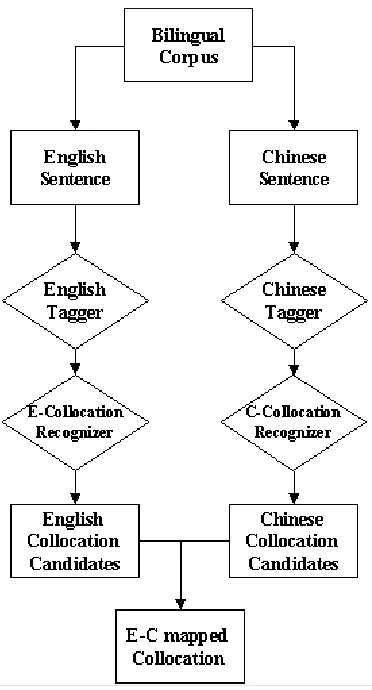
In this section, we describe formally how CLASS works. We assume the availability of a parallel corpus and a list of collocations in a bilingual MRD. We also assume that the sentences and words have been aligned in the parallel corpus. We will describe how CLASS extracts bilingual collocations from such a parallel corpus. CLASS carries out a number of preprocessing steps to calculate the following information:
1. lists of preferred POS patterns of collocation in both languages; 2. collocation candidates matching the preferred POS patterns; 3. n-gram statistics for both languages, N = 1, 2;
4. log likelihood ratio statistics for two consecutive words in both languages;
5. log likelihood ratio statistics for a pair of candidates of bilingual collocations across one language to the other;
6. content word alignment based on the Competitive Linking Algorithm [Melamed, 1997.]
12 Chien-Cheng Wu, and Jason S. Chang
Figure 1. The major components in the proposed CLASS algorithm.
Preprocessing: Extracting preferred POS patterns P and Q in both languages
Input: A list of bilingual collocations from a machine-readable dictionary Output:
1. Perform part of speech tagging for both languages.
2. Calculate the number of instances for all POS patterns in both languages. 3. Eliminate the POS patterns with instance counts of 1.
Collocation Linking Alignment based on Syntax and Statistics
14 Chien-Cheng Wu, and Jason S. Chang
Sinorama covered a wide range of topics, reflecting the personalities, places, and events in Taiwan for the previous three decades. We experimented on articles mainly dating from 1995 to 2002. Sentence and word alignment were carried out first to obtain the Sinorama Parallel Corpus.
Sentence alignment is a very important aspect of CLASS. It is the basis for good collocation alignment. We use a new alignment method based on punctuation statistics [Yeh & Chang, 2002]. The punctuation-based approach has been found to outperform the length-based approach with precision rates approaching 98%. With the sentence alignment approach, we obtained approximately 50,000 reliably aligned sentences containing 1,756,000 Chinese words (about 2,534,000 Chinese characters) and 2,420,000 English words in total.
The content words were aligned using the Competitive Linking Algorithm. Alignment of content words resulted in a probabilistic dictionary with 229,000 entries. We evaluated 100 random sentence samples with 926 linking types, and the achieved precision rate was 93.3%. Most of the errors occurred with English words having no counterpart in the corresponding Chinese sentence. Translators do not always translate word for word. For instance, with the word “water” in Example 5, it seems that there is no corresponding pattern in the Chinese sentence. Another major cause of errors was collocations that were not translated compositionally. For instance, the word “State” in the Example 6 is a part of the collocation “United States,” and “美國” is more highly associated with “United” than “States”; therefore, due to the one-to-one constraint “States” will not be aligned with “美國”. Most often, it will be aligned incorrectly. About 49% of the error links were of this type.
Example 5
The boat is indeed a vessel from the mainland that illegally entered Taiwan waters. The words were a "mark" added by the Taiwan Garrison Command before sending it back.
編按:此船的確是大陸偷渡來台船隻,那八個字只不過是警總在遣 返前給它加的「記號」!
Source: 1990/10 Letters to the Editor
Example 6
Bilingual Collocation Extraction Based on Syntactic and Statistical Analyses 15
由美國移民局發表的數字來看,中國移民以從廣東、香港出海者最多,故 到現在為止,美國華僑仍以原籍廣東者佔大多數。
Source: 1990/09 All Across the World: The Chinese Global Village
We obtained the word-to-word translation probability from the result of word alignment. The translation probability P(c|e) is calculated as followed:
P(c|e) =
) (
) , (
e count
c e
count , where
count(e,c) : the number of alignment links between a Chinese word c and an English word e;
count(e) : the number of instances of e in alignment links.
Take “pay” as an example. Table 6 shows the various alignment translations for “pay” and the translation probability.
Table 6. The aligned translations for the English word “pay” and their translation probability.
Translation Count Translation Prob. Translation Count Translation Prob.
代價 34 0.1214 花錢 7 0.025
錢 31 0.1107 出錢 6 0.0214
費用 21 0.075 租 6 0.0214
付費 16 0.0571 發給 6 0.0214
領 16 0.0571 付出 5 0.0179
繳 16 0.0571 薪資 5 0.0179
支付 13 0.0464 付錢 4 0.0143
給 13 0.0464 加薪 4 0.0143
薪水 11 0.0393 ... ... ...
負擔 9 0.0321 積欠 2 0.0071
費 9 0.0321 繳款 2 0.0071
給付 8 0.0286
16 Chien-Cheng Wu, and Jason S. Chang
we built N-grams for the Sinorama Parallel Corpus. There were 790,000 Chinese word bigrams and 669,000 distinct English bigrams. CLASS identified around 595,000 Chinese collocation candidates (184,000 distinct types) and 230,000 English collocation candidates (135,000 distinct types) through this process.
We selected 100 sentences to evaluate the performance. We focused on rigid lexical collocations. The average English sentence had 45.3 words, while the average Chinese sentence had 21.4 words. The two human judges, both master students majoring in Foreign Languages, identified the bilingual collocations in these sentences. We then compared the bilingual collocations produced by CLASS against the answer keys. The evaluation produced an average recall rate = 60.9 % and precision rate = 85.2 % (see Table 7).
Table 7. Experiment results of bilingual collocation from the Sinorama Parallel Corpus.
# keys #answers #hits #errors Recall Precision
382 273 233 40 60.9% 85.2%
4. Discussion
This paper describes a new approach to the automatic acquisition of bilingual collocations from a parallel corpus. Our method is an extension of Melamed’s Competitive Linking Algorithm for word alignment. It combines both linguistic and statistical information and uses it to recognize monolingual and bilingual collocations in a much simpler way than Smadja’s work does. Our approach differs from previous work in the following ways:
1. We use a data-driven approach to extract monolingual collocations.
2. Unlike Smadja and Kupiec, we do not commit to two sets of monolingual collocations. Instead, we consider many overlapping and conflicting candidates and rely on cross linguistic statistics to revolve the issue.
3. We combine both type of information related to the whole collocation as well as to the constituent words to achieve more reliable probabilistic estimation of aligned
collocations.
Bilingual Collocation Extraction Based on Syntactic and Statistical Analyses 17
Example 7
台灣幸而趕搭了一程獲利豐厚的順風車,可以將目前剛要起步的馬來西 亞、中國大陸等國家遠拋身後。T
Taiwan has had the good fortune to jump on this high-profit bandwagon and has been able to snatch a substantial lead over countries like Malaysia and mainland China, which have just started in this industry.
Source: Sinorama, 1996, Dec Issue Page 22, Stormy Waters for Taiwan's ICs
This limitation can be partially alleviated by matching nonconsecutive word sequences against existing lists of collocations for the two languages.
Another limitation has to do with bilingual collocations, which are not literal translations. For instance, “difficult and intractable” can not yet be handled by the program, because it is not a word for word translation of “桀傲不馴”.
Example 8
意思是說一個再怎麼桀傲不馴的人,都會有人有辦法制服他。
This saying means that no matter how difficult and intractable a person may seem, there will always be someone else who can cut him down to size.
Source: 1990/05 A Fierce Horse Ridden by a Fierce Rider
In the experiment, we found that this limitation may be partially solved by splitting the candidate list of bilingual collocations into two lists: one (NZ) with non-zero phrase translation probabilistic values and the other (ZE) with zero values. The two lists can then be sorted based on the LLR values. After extracting bilingual collocations from the NZ list, we could continue to go down the ZE list and select bilingual collocations that did not conflict with previously selection.
18 Chien-Cheng Wu, and Jason S. Chang
Example 9
一九七二年澳洲承認中共,中華民國即於此時與澳斷交。因為無正式邦 交,澳洲不能在台灣發簽證,而由澳洲駐香港的使館代辦,然後將簽證送 回台灣,簽證手續約需五天至一周。
The Republic of China broke relations with Australia in 1972, after the country recognized the Chinese Communists, and because of the lack of formal diplomatic relations, Australia felt it could not issue visas on Taiwan. Instead, they were handled through its consulate in Hong Kong and then sent back to Taiwan, the entire process requiring five days to a week to complete.
Source: 1990/04 Visas for Australia to Be Processed in Just 24 Hours
A number of mistakes are caused by erroneous word segments in the Chinese tagger. For instance, “大學及研究生出國期間” should be segmented as “ 大學 / 及 / 研究生 / 出國 / 期間” but instead is segmented as “大學 / 及 / 研究 / 生出 / 國 / 期間 / 的 / 學業.” Another major source of segmentation mistakes has to do with proper names and their transliterations. These name entities that are not included in the database are usually segmented into single Chinese characters. For instance, “...一書作者劉學銚指出...” is segmented as “ ... / 一 / 書 / 作者 / 劉 / 學 / 銚 / 指出 / ...,” while “...在匈牙利地區 建國的馬札爾人...” is segmented as “...在 / 匈牙利 / 地區 / 建國 / 的 / 馬 / 札 / 爾 / 人 / ....” Therefore, handling these name entities in a pre-process should be helpful to avoid segmenting mistakes and alignment difficulties.
5. Conclusion and Future Work
In this paper, we have presented an algorithm that employs syntactic and statistical analyses to extract rigid bilingual collocations from a parallel corpus. Phrases matching the preferred patterns are extracted from aligned sentences in a parallel corpus. These phrases are subsequently matched up based on cross-linguistic statistical association. Statistical association between the whole collocations as well as words in the collocations is used jointly to link a collocation with its counterpart. We implemented the proposed method on a very large Chinese-English parallel corpus and obtained satisfactory results.
Bilingual Collocation Extraction Based on Syntactic and Statistical Analyses 19
References
Benson, Morton., Evelyn Benson, and Robert Ilson.” The BBI Combinatory Dictionary of English: A Guide to Word Combinations. ” John Benjamins, Amsterdam, Netherlands, 1986.
Choueka, Y. “Looking for needles in a haystack”, RIAO, Conference on User-Oriented Context Based Text and Image Handling, Cambridge, 1988, pp. 609-623.
Choueka, Y.; Klein, and Neuwitz, E.. “Automatic retrieval of frequent idiomatic and collocational expressions in a large corpus.” Journal of the Association for Literary and Linguistic Computing, 4(1), 1983, pp34-38.
Church, K. W. and Hanks, P. “Word association norms, mutual information, and lexicography.” Computational Linguistics, 16(1) , 1990, pp. 22-29.
Dagan, I. and K. Church. “Termight: Identifying and translation technical terminology”. In Proc. of the 4th Conference on Applied Natural Language Processing (ANLP), 1994, pages 34-40.
Dunning, T. “Accurate methods for the statistics of surprise and coincidence”, Computational Linguistics 19:1, 1993, pp.61-75.
Haruno, M., S. Ikehara, and T. Yamazaki. “Learning bilingual collocations by word-level sorting.” In Proc. of the 16th International Conference on Computational Linguistics (COLING '96), 1996, pp. 525-530.
Huang, C.-R., K.-J. Chen, Y.-Y. Yang, “Character-based Collocation for Mandarin Chinese”, In Proc. of the 38th Annual Meeting of the Association for Computational Linguistics, 2000, pp. 540-543.
Inkpen, Diana Zaiu and Hirst, Graeme. “Acquiring collocations for lexical choice between near-synonyms.” In Proceedings of the Workshop on Unsupervised Lexical Acquisition, 40th Annual Meeting of the Association for Computational Lin- guistics (ACL 2002), 2002, pp. 67-76.
Justeson, J.S. and Slava M. Katz. “Technical Terminology: some linguistic properties and an algorithm for identification in text.” Natural Language Engineering, 1(1), 1995, pp. 9-27.
Kupiec, Julian. “An algorithm for finding noun phrase correspondences in bilingual corpora.” In Proceedings of the 31st Annual Meeting of the Association for Computational Linguistics, 1993, pp. 17-22.
Lin, D. “Using collocation statistics in information extraction.” In Proc. of the Seventh Message Understanding Conference (MUC-7), 1998.
Manning and H. Schutze. “Foundations of Statistical Natural Language Processing,” C., MIT Press, 1999.
20 Chien-Cheng Wu, and Jason S. Chang
Smadja, F. “Retrieving collocations from text: Xtract.” Computational Linguistics, 19(1) 1993, pp143-177.
Smadja, F., K.R. McKeown, and V. Hatzivassiloglou. “Translating collocations for bilingual lexicons: A statistical approach.” Computational Linguistics, 22(1) ,1996, pp 1-38. Yeh, “Using Punctuation Marks for Bilingual Sentence Alignment.” Master thesis, 2003,