Volume 2009, Article ID 150914,10pages doi:10.1155/2009/150914
Research Article
A Variable Step-Size Proportionate Affine Projection Algorithm
for Identification of Sparse Impulse Response
Ligang Liu,
1, 2Masahiro Fukumoto,
1Sachio Saiki,
1and Shiyong Zhang
21Department of Information Systems Engineering, Kochi University of Technology, 185 Miyanokuchi, Kochi 782-8502, Japan 2School of Computer Science, Fudan University, 220 Handan Road, Shanghai 200433, China
Correspondence should be addressed to Masahiro Fukumoto,[email protected]
Received 13 January 2009; Revised 19 May 2009; Accepted 5 August 2009
Recommended by Jose Carlos Bermudez
Proportionate adaptive algorithms have been proposed recently to accelerate convergence for the identification of sparse impulse response. When the excitation signal is colored, especially the speech, the convergence performance of proportionate NLMS algorithms demonstrate slow convergence speed. The proportionate affine projection algorithm (PAPA) is expected to solve this problem by using more information in the input signals. However, its steady-state performance is limited by the constant step-size parameter. In this article we propose a variable step-size PAPA by canceling the a posteriori estimation error. This can result in high convergence speed using a large step size when the identification error is large, and can then considerably decrease the steady-state misalignment using a small step size after the adaptive filter has converged. Simulation results show that the proposed approach can greatly improve the steady-state misalignment without sacrificing the fast convergence of PAPA.
Copyright © 2009 Ligang Liu et al. This is an open access article distributed under the Creative Commons Attribution License, which permits unrestricted use, distribution, and reproduction in any medium, provided the original work is properly cited.
1. Introduction
Adaptive filtering algorithms can find application in many real-world systems [1–3], such as wireless channel equalizers, echo cancelers, noise reduction, and speech enhancement, for example, an echo canceler is designed to identify an unknown echo path. Its output is a replica of the echo signal, which is then removed from the near-end signal to achieve echo cancellation. Nowadays, echo path is becoming longer and longer with the increased demand for higher-quality communication, especially for voice-over IP systems. For a network echo canceler, the number of coefficients varies from 512 to 2048 in order to deal with a total delay greater than 64 milliseconds [4]. Conventional adaptive algorithms, such as the least mean square (LMS) algorithm and the normalized LMS (NLMS) algorithm [2,5], suffer severely from slow convergence with this kind of long filter, especially for colored signals. Much effort has been made to design new algorithms to improve the convergence speed of adaptive filters with hundreds or thousands of coefficients.
A new kind of proportionate adaptive filtering algorithm has received much attention recently [6–8]. Proportionate adaptive algorithms are based on the fact that most long
MPNLMS algorithm is one of the fastest in the framework of proportionate adaptation. Instead of using magnitude directly, the logarithm of the magnitude is used as the step gain of each coefficient, so the MPNLMS algorithm can consistently converge to the steady state for sparse impulse response. The SPNLMS algorithm [15] is proposed to reduce the heavy computational complexity of MPNLMS without loss of fast convergence.
The step-size control matrix of MPNLMS was derived on the assumption that the input is white. For colored input signals, especially speech, convergence speed will depend on the eigenvalues of the input signal’s autocorrelation matrix. The proportionate affine projection algorithm (PAPA) is the natural extension of the PNLMS algorithm. It is expected to present faster convergence for highly correlated input signals at the cost of a modest increase in computational complexity. Besides convergence speed, another important aspect of the adaptive algorithm is its steady-state performance: low misalignment is desirable. Unfortunately, the design of the step-size control matrix cannot decrease the misalignment in the framework of proportionate adaptation. The steady-state misalignment of the proportionate algorithms is approxi-mately equal to that of their nonproportionate counterparts [9]. We know that the step-size parameter reflects a tradeoff between fast convergence and low misalignment. When step size is adjusted to obtain faster convergence, misalignment becomes larger, and vice versa. If we adaptively control the step size to be large in the transient state and to be small as convergence proceeds, both fast convergence and low misalignment can be achieved. Different adaptive step-size control approaches have been proposed and studied in literature relating to this concept. In [16], the squared instantaneous error was exploited as a criterion to change the step size. In [17], an optimal step size was proposed for NLMS algorithm by minimizing the mean-square deviation at each iteration. A variable step-size NLMS algorithm was described in [18] to improve the estimation of the power level of the disturbance signals. It was used to decide the optimal step size at each iteration. In [19], a steepest descent method was proposed to adaptively update the step size to minimize squared error. By combining the input vector and the instantaneous error vector, a variable step-size approach was proposed for APA in [20]. A nonparametric variable step-size NLMS algorithm, NPVSS-NLMS, was proposed in [21] by adjusting the step size to cancel a posteriori error. Recently, this approach was applied in the undermodeling acoustic echo cancellation system [22,23]. It was further extended to APA with a new perspective of signal enhancement in [24]. As can be seen, these approaches are only applicable to nonproportionate adaptive algorithms.
In this article, we propose a variable step-size pro-portionate affine projection algorithm (VSS-PAPA) for the identification of sparse impulse response. Theoretically, in a noise free environment, PAPA has optimal convergence speed and zero misalignment by canceling the a posteriori output estimation error at each iteration. However, with the presence of a disturbance signal, canceling the a posteriori estimation error will introduce additional noise into the coefficient update [21]. Taking the effect of background
noise into account, we derive a PAPA with variable step size parameter to cancel a posteriori estimation error at each iteration. The variable step size is large when the adaptive filter is in its transient state. Hence, it converges fast. Then the step size becomes small when the adaptive filter reaches the steady state, so misalignment is significantly decreased. The proposed algorithm demonstrates excellent performance by combining the fast proportionate algorithm with variable step-size technique for identification of sparse impulse response.
The organization of this article is as follows. InSection 2, we briefly overview the proportionate affine projection algorithm and various definitions of the step-size control matrix of proportionate adaptation. InSection 3, a variable step size approach is proposed for PAPA to achieve bet-ter performance. In Section 4, many computer simulation results are presented to illustrate the excellent performance of the proposed algorithm. Finally,Section 5concludes our research.
2. Overview of Proportionate
Adaptive Algorithms
Consider a system identification problem. Bold lowercase letters indicate vectors and bold uppercase letters denote matrices. All vectors are column vectors, (·)T indicates transpose, andtis the time index. Also,woptis an unknown sparse impulse response and w is an adaptive filter. The length ofwopt andwis supposed to be same,N. The input vectorx(t)=[x(t)x(t−1). . . x(t−N+ 1)]T, the output of the adaptive filter y(t) = wT
optx(t), and the desired signal d(t)= y(t) +v(t), wherev(t) is a disturbance signal, which may be background noise or/and measurement noise.
The APA achieves a faster convergence speed for cor-related input signals than the NLMS algorithm with only a modest increase in computational complexity. It exploits more information from the input signal, not only the current input vector but also the most recentP input vectors. The proportionate APA (PAPA) is expected to converge faster than the proportionate NLMS algorithms for colored input signals. DefinePas the projection order, the input matrix as thePsuccessive input vector,X(t)=[x(t)x(t−1). . .x(t−
P+ 1)], and the desired vector as thePsuccessive past value ofd(t),d(t) = [d(t)d(t−1)· · ·d(t−P+ 1)]T. The error vectore(t) can be written as
e(t)=d(t)−XT(t)w(t). (1)
The PAPA can be briefly summarized as follows:
w(t+ 1)=w(t) +αG(t)X(t)XT(t)G(t)X(t) +εI−1e(t),
(2)
whereαis a overall constant step size,is the regularization parameter, andIis aP×Pidentity matrix. The definition of the diagonal element of matrixG(t) can be summarized as
Lmax=max
δρ,F(w0(t)),. . .,F(wN−1(t))
, (4)
γn(t)=max
F(wn(t)),ρLmax
, (5)
gn(t)= γn
(t) (1/N)Ni=−01(t)
. (6)
Here, F is a real-valued function to map the current coefficient estimate into a certain value of the proportionate step-size parameter;δρis used to preventw(t) from stalling
at the beginning, and has a typical value of 0.01;ρis used to prevent the very small coefficients from stalling, and has typical values in the range from 1/N to 5/N [9]. Note that when P = 1, the PAPA degenerates into the PNLMS algorithm, and when all of the elements ofG(t) are identical, that is,g0(t)= · · · =gN−1(t)=1, the PAPA reduces to the standard APA.
The PNLMS algorithm [9] has proposed a simple function asF(wn(t)) = |wn(t)|. It has very fast initial
con-vergence speed. However, its concon-vergence slows thereafter. Furthermore, its convergence speed degrades greatly if the target impulse response is not sparse enough. The MPNLMS algorithm proposed in [15,25] achieves the fastest step size control matrixG(t) in the proportionate adaptation frame-work. Instead of using the absolute value of the coefficient magnitude directly, its logarithm is used as the step size. Hence, both large and small coefficients converge at the same rate, so that the overall convergence speed of the adaptive filter is greatly accelerated. For MPNLMS,F(wn(t))=ln(1 +
μ|wn(t)|), where μ is an objective convergence criterion,
typicallyμ=1000. Many simulation results have proved that the MPNLMS algorithm is one of the fastest proportionate algorithms [26]. The main disadvantage of MPNLMS is its heavy computation cost because of the presence of N logarithmic operations in every iteration. A line segment is proposed to approximate the mu-law function, which leads to a computation efficient algorithm, SPNLMS [25], where
F(wn(t))= ⎧ ⎨ ⎩
400|wn(t)|, |wn(t)|<0.005,
2, otherwise. (7)
The step-size control matrix defined by MPNLMS was derived on the assumption that the input is white. The mu-law PAPA (MPAPA) is expected to achieve faster convergence speed than MPNLMS for colored input signals. Its compu-tation efficient version, SPAPA, is favorable for real-world application because of its implementable low computational complexity.
3. Variable Step-Size Proportionate Affine
Projection Algorithms
3.1. Algorithm Formulation. Our objective is to find a variable step-size approach that is applicable to PAPAs. Unfortunately, because of the presence of G(t), it is very
difficult to analyze the transient performance of PAPAs. In this section, we propose a variable step size for PAPA.
The APA can be derived from the principle of least perturbation, that is, to maintain the next coefficient vector as close as possible to the current estimate, while forcing the a posteriori output estimation error to be zeros [2,5,27]. The a posteriori output estimation error vectorr(t) is defined as [5]
r(t)=d(t)−XT(t)w(t+ 1)=XT(t)w(t+ 1) +v(t),
w(t)=wopt−w(t),
(8)
where w(t) is the coefficient error vector and v(t) = [v(t)v(t−1)· · ·v(t−P+ 1)]T is the disturbance signal vector. Compared tor(t), the errore(t) in (1) plays the role of the a priori output estimation error vector.
The APA can satisfy the principle of least perturbation in a noise-free system. It has the fastest convergence speed and zero misalignment by cancelingr(t) at each iteration. The optimal step size isonein this case. However, in practical application, a disturbance signal is inevitable. Therefore, the adaptive algorithm cannot achieve zero misalignment. This could be explained by the fact that in the presence ofv(t), attempts to forcer(t) to be zero will introduce noise to the adaptive filter update [21]. Actually, what we would like is to force the a posteriori estimation error to be zero. That is
XT(t)w(t+ 1)=0, (9)
where0is aP×1 column vector whose elements are all zeros. Combining (8) with (9) implies that in a noisy environment we should update the coefficients to make the a posteriori error not to be zero, but to be the disturbance signal:v(t),
r(t)=v(t). (10)
In practical application, although the disturbance signal v(t) is not available, its power level can be estimated. For this reason, the optimal step-size parameter can be found in such a way that
Er2
p(t)
=Ev2
p(t)
, p=0· · ·P−1, (11)
whererp(t) is the pth element ofr(t), andvp(t) is the pth
element ofv(t). Note thatvp(t)=v(t−p).
Based on above notion, a VSS-PAPA can be derived as follows. Rewrite (2) with a P ×P time-varying step-size diagonal matrixα(t), ignoring the regularization termI, :
w(t+ 1)=w(t) +G(t)X(t)XT(t)G(t)X(t)−1α(t)e(t).
(12)
Subtractingwoptat both sides and rearranging the terms, we get
PremultiplyingXT(t) at both sides yields a relation between
the a posteriori estimation error and the a priori output estimation error:
rp(t)=
1−αp(t)
ep(t), (14)
whereαp(t) is the pth diagonal element ofα(t), andep(t)
is the pth element ofe(t). This result is very interesting in relation to PAPA. It can be observed that the a posteriori estimation errorr(t) is determined by the step size param-eter α(t) and error vector e(t) and is independent from G(t). Consequently, a simple variable step-size approach is expected for PAPA from this relation, following a procedure similar to [24].
Squaring and taking mathematical expectation at both sides of (14), and combining it with (11), give
Er2
p(t)
=1−αp(t) 2
Ee2
p(t)
=Ev2t−p. (15)
Solving the equation, the pth time-varying step-sizeαp(t) is
obtained with a simple expression as
αp(t)=1− σv2
t−p σ2
ep(t)
, (16)
whereσ2
v(t−p)=E{v2(t−p)}is the variance ofv(t−p) and
σ2
ep(t)=E{e
2
p(t)}is the variance ofep(t).
In the transient state of the adaptive filter, σ2
ep(t) will
be large, hence αp(t) is also large. Consequently, fast
convergence speed can be expected. After the adaptive filter reaches to within the immediate vicinity of its optimal value, σ2
ep(t) becomes small, henceαp(t) decreases. As a result, low
misalignment can be observed.
There are some practical considerations related to this expression. The first is the estimations ofσ2
ep(t) and σ
2
v(t).
The quantity of σ2
ep can be estimated using an exponential
window as
σ2
ep(t)=(1−λ1)σ
2
ep(t−1) +λ1e
2
p(t), (17)
where
λ1=1− 1 K1N,
(K1∈Z+,K1≥1). (18)
A largeK1can obtain a smooth estimate ofσe2p(t) but it will
reduce the tracking ability of the adaptive filter. In practical application, power estimation of the disturbance signal,
σ2
v(t), can be obtained during the silences in a network echo
cancellation system. An estimate of the disturbance signal,
v(t), can even be obtained using an additional adaptive filter, as proposed in [18]. Therefore, by using the same method withσ2
ep(t),σ
2
v(t) can be obtained by
σ2
v(t)=λ1σv2(t−1) + (1−λ1)v2(t). (19)
The second issue is stability. These estimates could lead to minor deviations from their theoretical values, which may result in a negative step size or a large one and force the
adaptive algorithm to diverge. It is necessary to restrictαp(t)
in range so that the stability of the adaptive algorithm is guaranteed, 0 ≤αmin ≤αp(t)≤αmax ≤2. Suitable choice ofαminandαmaxcan make the proposed algorithm robust to an inaccurate estimate ofσ2
v. More detailed discussions on
this issue will be presented in the following subsection. The third issue is the determination of G(t). Although it can be determined by any proportionate adaptive algo-rithm, it is preferable to adopt the segment proportionate version described in (3)–(6) and (7) because it has excellent performance and light computation load. We will use this definition throughout this article. The proposed algorithm with this definition ofG(t) will be referred as VSS-SPAPA for convenience sake. Note that whenG(t) is an identity matrix the proposed VSS-SPAPA degrades into the VSS-APA in [24]. It seems that the proposed variable step-size PAPA is similar to the set-membership PAPA (SM-PAPA) proposed in [28], whereαp(t) is replaced by
αsm,p(t)= ⎧ ⎪ ⎪ ⎨ ⎪ ⎪ ⎩
1−γ
ep(t)
, ifep(t)> γ,
0, otherwise.
(20)
Here, γ is a predetermined parameter as a bound on the noise. Since there is no averaging on, it is obvious that we cannot expect a lower misalignment than we propose in this article. The proposed variable step size described in (16) provides an optimal criteria ofγ for the SM-PAPA, that is, γshould choose according toσv.
3.2. Adaptive Estimate of σ2
v(t)and Its Influence. The
pro-posed VSS-SPAPA can obtain optimal αp(t) if an accurate
estimate of σ2
v(t) is available. As explained in the previous
subsection, a relatively accurate estimate can be easily obtained during silence in a network echo cancellation system, since there are many pauses in natural speech. However, if the power of the disturbance signals changes between two consecutive estimations, its new estimate will not be available immediately. A method was proposed to adaptively estimateσ2
v(t) only using the signals available in
the system, which can be described by [24]
σv2(t)=max
0,σd2(t)−σy2(t)
,
σ2
d(t)=λ2σd2(t−1) + (1−λ2)d2(t),
σ2
y(t)=λ2σy2(t−1) + (1−λ2)y2(t),
(21)
where y(t)= xT(t)w(t) is the output of the adaptive filter,
and
λ2=1− 1 K2N
, (K2∈Z+,K2≥K1). (22)
This estimate is approximately accurate after the adaptive filter has reached its steady state, because
Ev2(t)≈Ed2(t)−Ey2(t). (23)
The method provides a suboptimal solution ofσ2
v(t) if it is
the adaptive filter has converged to within the immediate vicinity of its optimal value, it can also be found that [22]
Ee2(t)≈Ed2(t)−Ey2(t). (24)
Therefore, the difference between σ2
ep(t) and σ
2
v(t) will be
insignificant in the steady state of the adaptive filter. As a result, αp(t) will be very small, and low steady-state
misalignment observed. However, this approach will lead to a slow convergence speed if this approach is applied during the transient period of the adaptive filter, for example, if the unknown impulse response changes suddenly, this approach is believed to present poor tracking ability because αp(t)
remains relatively small. To improve the adaptive filter’s tracking ability in this scenario, the value of αmin should not be too small, and the steady-state misalignment will be increased as a consequence. An alternative is to introduce a impulse response variation detector in the algorithm, see [24] and reference therein.
Let us discuss the influence of an inaccurate estimate of
σ2
v(t) on the convergence performance of the adaptive
algo-rithm. In the case ofσ2
v(t)σv2(t),αp(t) will be smaller than
its optimal value defined in (16). The convergence speed of the proposed algorithm will be slowed becauseαp(t) reaches
αminsoon. However, low misalignment will be achieved using more iterations. In the case ofσ2
v(t) = σv2(t),αp(t) will be
greater than its optimal value. Fast initial convergence speed will be observed but the misalignment will increase because αp(t) is close toαmax. For a modest inaccurate estimate of
σ2
v(t), the performance of the proposed algorithm is better
than that of the VSS-APA because it benefits from the fast proportionate adaptive algorithms. The simulation results in
Section 4show that the proposed algorithm can tolerate a largeσ2
v(t) estimate error.
The proposed variable step-size segment proportionate affine projection algorithm (VSS-SPAPA) is summarized in Algorithm1.
3.3. Computational Complexity. Compared to the standard APA, the additional computation load of the proposed VSS-SPAPA is composed of four parts. First, the calculation of G(t) costs 2N+ 2 multiplications or divisions,Nadditions, and 3N comparisons. Second, the calculation ofG(t)X(t) costsPN multiplications. Third, the estimate ofσ2
ep(t) and
calculation of α(t) will cost 4P + 6 multiplications or divisions, P square-root operations, and 2P + 2 additions or subtractions. Finally, the calculation ofα(t)e(t) costs P multiplication. The remaining operations are common with APA. In summary, the dominant additional computation cost of the proposed VSS-SPAPA is (P + 2)N + 5P + 8 multiplications or divisions operations and P square-root operations. For practical applications, such as network echo cancellation, the value of projection order P is usually in the range of 2–8. Therefore, the computational complexity of the proposed VSS-SPAPA is moderate. We propose that the additional computation load is worth the considerable performance improvement in sparse impulse response, and illustrate this in the following section.
Initialization:
w(0)=0; σ2
v(0)=0; σy2(0)=0;σd2(0)=0;
=PMσ2
x, (M∈Z+,M≥1)
λ1=1−1/(K1N), (K1∈Z+, K1≥1)
λ2=1−1/(K2N), (K2∈Z+, K2≥K1) forp=0, 1,. . .,P−1
σ2
ep(t)=(1−λ1)σe2p(t−1) +λ1e2p(t); For allt:
gn(t)= ⎧ ⎨ ⎩
400|wn(t)|, |wn(t)|<0.005
2, otherwise. Lmax=max{δρ,g0(t),. . .,gN−1(t)}
γn(t)=max{gn(t),ρLmax}
gn(t)=γn(t)/[1/NNi=−01γi(t)]
G(t)= diag{g0(t),g1(t),. . .,gN−1(t)}
y(t)=XT(t)w(t)
e(t)=d(t)−y(t) ifσ2
v(t) is not available,
σ2
d(t)=λ2σd2(t−1) + (1−λ2)d2(t)
σ2
y(t)=λ2σ2y(t−1) + (1−λ2)y2(t)
σ2
v(t)=max{0,σd2(t)−σ2y(t)} forp=0, 1,. . .,P−1
σ2
ep(t)=(1−λ1)σ
2
ep(t−1) +λ1e
2 p(t)
αp(t)=1−σ2
v(t−p)/σe2p(t)
ifαp(t)< αmin, αp(t)=αmin, ifαp(t)> αmax, αp(t)=αmax, α(t)= diag{α0(t),. . .,αP−1(t)}
w(t+ 1)=w(t) +G(t)X(t)[XT(t)G(t)X(t) +εI]−1α(t)e(t)
Algorithm1: The proposed VSS-SPAPA.
4. Simulation Results
To evaluate the performance of the proposed algorithm, many computer simulations were conducted in the context of system identification. Four algorithms are compared in numerous simulations, APA, SPAPA, VSS-APA [24], and the proposed VSS-SPAPA. The unknown system wopt is taken from a network echo path illustrated in Figure 1(a). Both woptand the adaptive filterwhave same length,N=512. For the proportionate algorithms,δρ=0.01,ρ=1/N. For
VSS-SPAPA,λ1=1−1/2N,λ2=1−1/4N,αmin=0.005.αmax= 1.0 is assigned because a large step size for SPAPA does not considerably improve its convergence speed but results in higher misalignment. The regularization parameters are chosen by=10Pσ2
xfor all the algorithms. The disturbance
signal v(t) is an independent white Gaussian noise. The convergence performance is evaluated using the normalized misalignment (in dB) defined by
10 log10
⎛ ⎜ ⎝
wopt−w(t) 2
2
wopt
2
2
⎞ ⎟
⎠. (25)
4.1. Simulations with Real Value of σ2
v(t). We first test the
performance of the proposed VSS-SPAPA with the real value ofσ2
v(t). The signal-to-noise rate (SNR) is adjusted to 20 dB
−0.4
−0.2 0 0.2 0.4
M
ag
nitude
0 10 20 30 40 50 60
Time (ms) (a)
−1 0 1
M
ag
nitude
0 2 4 6 8 10 12 14 16 18 20
Time (s) (b)
Figure 1: (a) A typical sparse network echo path used in the simulations. (b) A segment of speech signal with 8 k sampling rate used in the simulations.
the four algorithms is compared with three kinds of input signal: (a) white Gaussian noise signal, (b) highly colored signals generated by an AR(1) process, and (c) speech signals illustrated inFigure 1(b).
In the first set of simulations, the input sequence was zero-mean white Gaussian noise signal with σ2
x = 1. For
APA and SPAPA, a constant step α = 1 is assigned.
Figure 2(a) compares convergence speed in the first 15000 iterations of the related algorithms. The projection order
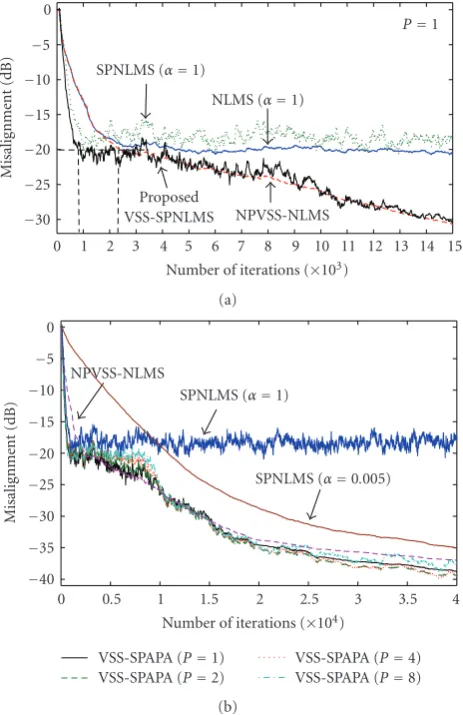
P=1. Therefore, the related algorithms degrade into their corresponding NLMS versions. It can be seen that the SPNLMS algorithm converges faster than the conventional NLMS algorithm with same step size. We can also find that they have almost the same steady-state misalignment. The proposed VSS-SPNLMS algorithm achieves almost the same fast initial convergence as the SPNLMS algorithm. However, it can obtain lower steady-state misalignment; about 18 dB improvement can be observed in 4×10⁴iterations, as shown in Figure 2(b). To achieve this low level misalignment, the SPNLMS requires a very small step size. However,αis 0.005 in this case, whose convergence speed is greatly degraded. Although the NPVSS-NLMS algorithm in [21] can achieve almost the same low misalignment, its convergence speed is significantly lower than the proposed algorithm. It can be seen from Figure 2(a) that the proposed VSS-SPNLMS algorithm reaches −20 dB misalignment in approximately 900 iterations but the NPVSS-NLMS algorithm reaches that level in about 2200 iterations. Figure 2(b) illustrates the results of different projection order. It can be seen that in the case of white input signal, the increase in the projection order from 2 to 8 does not considerably improve the convergence speed of the proposed VSS-SPNLMS. This suggests that the control matrix G(t) determined by SPNLMS is nearly optimal for white input signal. The proposed VSS-SPNLMS is preferred to obtain optimal convergence speed and lower misalignment with least computation cost.
−30
−25
−20
−15
−10
−5 0
Mi
sa
li
gn
m
en
t
(d
B
)
0 1 2 3 4 5 6 7 8 9 10 11 12 13 14 15 Number of iterations (×103)
P=1 SPNLMS (α=1)
NLMS (α=1)
Proposed
VSS-SPNLMS NPVSS-NLMS
(a)
−40
−35
−30
−25
−20
−15
−10
−5 0
Mi
sa
li
gn
m
en
t
(d
B
)
0 0.5 1 1.5 2 2.5 3 3.5 4 Number of iterations (×104)
SPNLMS (α=1)
SPNLMS (α=0.005) NPVSS-NLMS
VSS-SPAPA (P=1) VSS-SPAPA (P=2)
VSS-SPAPA (P=4) VSS-SPAPA (P=8) (b)
Figure 2: Misalignment of the algorithms with white Gaussian noise input. (a)P=1. (b) Comparison of different projection order, P=1, 2, 4, 8. SPNLMS and NPVSS-NLMS [21] are also illustrated.
−35
−30
−25
−20
−15
−10
−5 0
Mi
sa
li
gn
m
en
t
(d
B
)
0 0.5 1 1.5 2 2.5 3 3.5 4 4.5 5 Number of iterations (×104)
P=2 SPAPA (α=1)
SPAPA (α=0.005)
APA (α=1) Proposed
VSS-SPAPA VSS-APA
(a)
−35
−30
−25
−20
−15
−10
−5 0
Mi
sa
li
gn
m
en
t
(d
B
)
0 0.5 1 1.5 2 2.5 3 3.5 4 4.5 5 Number of iterations (×104)
SPAPA (P=2,α=1) SPAPA (P=2,α=0.005)
VSS-APA (P=2)
VSS-SPAPA (P=1) VSS-SPAPA (P=2)
VSS-SPAPA (P=4) VSS-SPAPA (P=8) (b)
Figure 3: Misalignment of the algorithms with highly colored input generated byG(z). (a)P=2. (b) Comparison with different projection order, P=1, 2, 4, 8. SPAPA and VSS-APA are also illustrated.
In the third set of simulations, the input is from a speech segment illustrated in Figure 1(b). The disturbance signal{v(t)}is uncorrelated zero-mean white Gaussian noise with SNR= 20 dB. Figure 4(a) illustrates the result with projection order P=8. The proposed VSS-SPAPA achieves almost the same fast initial convergence compared to the SPAPA, but it can achieve lower steady-state misalignment— -about 15 dB improvement can be observed in 15 seconds. In this case, VSS-APA cannot achieve this misalignment level (or it needs many more minutes to achieve it). The VSS-SPAPA outperforms VSS-APA both on convergence speed (approximately twice as fast) and on low misalignment (approximately 2 dB lower).Figure 4(b)compares the con-vergence of the proposed algorithm at different projection orders. In the case of speech signal input, with an increase in projection order from 1 to 8, the convergence speed of all the related algorithms was improved. Taking into account computational complexity, the performance ofP=4 is good enough in the case of speech signal input with a modest increase in computation load.
−30
−25
−20
−15
−10
−5 0
Mi
sa
li
gn
m
en
t
(d
B
)
0 1 2 3 4 5 6 7 8 9 10 11 12 13 14 15 Time (s)
P=8 SPAPA (α=0.005)
SPAPA (α=1)
Proposed VSS-SPAPA
VSS-APA
(a)
−30
−25
−20
−15
−10
−5 0
Mi
sa
li
gn
m
en
t
(d
B
)
0 1 2 3 4 5 6 7 8 9 10 11 12 13 14 15 Time (s)
SPAPA (P=8,α=0.005)
SPAPA (P=8,α=1)
VSS-APA (P=8)
VSS-SPAPA (P=1) VSS-SPAPA (P=2)
VSS-SPAPA (P=4) VSS-SPAPA (P=8) (b)
Figure4: Misalignment of the algorithms with speech signal. (a) P=8. (b) Comparison with different projection order,P=1, 2, 4, 8. SPAPA and VSS-APA are also illustrated.
The tracking ability of the adaptive algorithms is impor-tant in a nonstationary environment where the unknown impulse response may suddenly change. In a network echo cancellation system, the echo path is subject to shift backward or forward as a result of delay jitter. Figure 5
illustrates the result of the tracking ability of the relevant algorithms with speech signal input andP=4. The unknown impulse response suddenly shifted to the right by 12 samples. It can be seen from this figure that the proposed algorithm presents good tracking performance after the unpredicted change in the unknown impulse response. Furthermore, it outperforms its counterparts in low steady-state misalign-ment after reconvergence.
4.2. Simulations with Inaccurate Estimate of σ2
v(t). As
dis-cussed in the previous section, the estimated accuracy of
σ2
v(t) influences the convergence of APA and
−30
−25
−20
−15
−10
−5 0 5
Mi
sa
li
gn
m
en
t
(d
B
)
0 5 10 15 20 25 30
Time (s) APA (α=0.3)
SPAPA (α=0.3)
VSS-APA VSS-SPAPA
Figure5: Comparison of tracking ability of the relevant algorithms with speech signals,P=4. The unknown impulse response changes after 15 seconds.
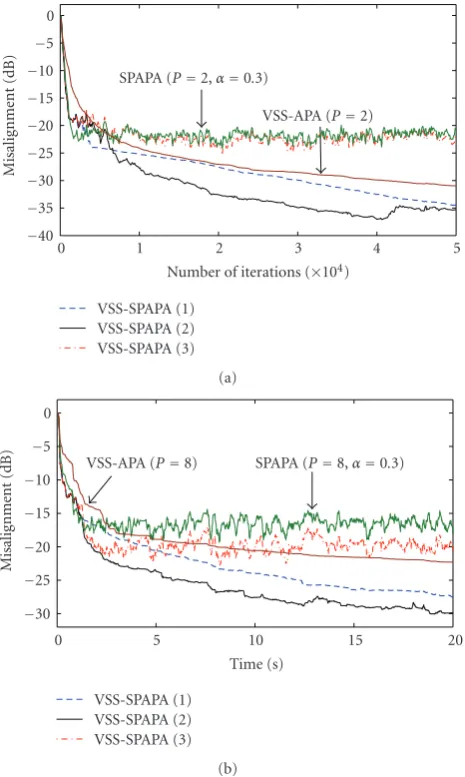
see that VSS-SPAPA with an accuracy ofσ2
v(t) is best among
the three cases: (1) the power estimate of the disturbance signal is greater than its real value, σ2
v(t) = 1.5σv2(t);
(2) σ2
v(t) = σv2(t); (3) σv2(t) is smaller than its real value,
σ2
v(t)=0.8σv2(t). In any case, VSS-SPAPA can maintain fast
convergence with both AR(1) signals and speech signals. In case (1), a large estimateσ2
v(t) will causeαp(t) to be small and
reachαminfaster than in case (2). In any cases,αminwarrants VSS-SPAPA to achieve low misalignment. It is obvious that this requires more iterations but is still faster than VSS-APA, as shown in the figure. However, ifσ2
v(t) is excessively smaller
than its real value, the steady-state misalignment of VSS-SPAPA is relatively higher, as shown in the figure, because αp(t) remains large in the steady state—around 0.25 in case
(3). The VSS-SPAPA does not behave worse than the SPAPA even with a large estimate error ofσ2
v(t). It can tolerate more
than +50% estimate error and about−20% estimate error ofσ2
v(t). The proposed VSS-SPAPA is robust to a relatively
inaccurate estimate ofσ2
v(t).
If an estimate of σ2
v(t) is not available in practical
application, it can be adaptively estimated according to (23). Figure 7 illustrates the results of the proposed VSS-SPAPA with this estimate method included. As discussed in the previous section, the problem with this adaptive estimate method is that the estimate is only effective when the adaptive filter has converged. Otherwise, the estimate will be very inaccurate and cause αp(t) to be very small.
Hence, the tracking ability of the proposed algorithms will be considerably worsened. So, the relevant algorithms are tested on the assumption that the unknown impulse response suddenly changes by shifting to the right 12 samples.
Figure 7(a)is with the highly colored AR(1) input (P=2) and
Figure 7(b)is with speech input signals (P=8). For SPAPA and APA, the constant step size isα=0.3, which is suitable for practical application. It can be seen that VSS-SPAPA can also quickly track the change in unknown impulse
−40
−35
−30
−25
−20
−15
−10
−5 0
Mi
sa
li
gn
m
en
t
(d
B
)
0 1 2 3 4 5
Number of iterations (×104) VSS-SPAPA (1)
VSS-SPAPA (2) VSS-SPAPA (3)
SPAPA (P=2,α=0.3)
VSS-APA (P=2)
(a)
−30
−25
−20
−15
−10
−5 0
Mi
sa
li
gn
m
en
t
(d
B
)
0 5 10 15 20
Time (s) VSS-SPAPA (1)
VSS-SPAPA (2) VSS-SPAPA (3)
SPAPA (P=8,α=0.3) VSS-APA (P=8)
(b)
Figure6: Misalignment of the relevant algorithms with inaccurate estimate ofσ2
v(t). (a) With highly colored input signals generated byG(z).P=2. (b) With speech input signals, P=8. (1) σ2
v(t) = 1.5σ2
v(t), (2)σv2(t)=σv2(t), and (3)σv2(t)=0.8σv2(t).
response and then achieve a lower misalignment after it has reconverged. It outperforms both the nonproportionate counterparts and the constant step-size algorithms. However, compared to the result with real value ofσ2
v(t), the
steady-state misalignment of VSS-SPAPA with adaptive estimate of σ2
v(t) is worse than that with real value of σv2(t). For
example, the misalignment of VSS-SPAPA inFigure 3reaches −34 dB in 3 ×10⁴ iterations, but in Figure 7(a) it only reaches about −30 dB. Figure 7(b) shows the result when the input is speech signal. The proposed VSS-SPAPA can achieve a lower steady-state misalignment than SPAPA, approximate 10 dB improvement was achieved. The steady-state misalignment of APA was the same as that of VSS-SPAPA, but it needs more time to reach that level. Compared to the scenario where the accurate estimate of σ2
v(t) is
−35
−30
−25
−20
−15
−10
−5 0 5
Mi
sa
li
gn
m
en
t
(d
B
)
0 1 2 3 4 5 6 7 8 9 10
Number of iterations (×104) APA (P=2,α=0.3)
SPAPA (P=2,α=0.3)
VSS-APA (P=2) VSS-SPAPA (P=2) (a)
−30
−25
−20
−15
−10
−5 0 5
Mi
sa
li
gn
m
en
t
(d
B
)
0 5 10 15 20 25 30
Time (s) APA (P=8,α=0.3) SPAPA (P=8,α=0.3)
VSS-APA (P=8) VSS-SPAPA (P=8) (b)
Figure7: Misalignment of the algorithms with adaptive estimate of
σ2
v(t). The unknown impulse response changes at 5×10⁴iteration. (a) With highly colored input generated byG(z).P=2. (b) With speech input signal,P=8.
both VSS-APA and VSS-SPAPA are slower than their non-VSS counterparts during the period from 15 seconds to 20 seconds. Nevertheless, the SPAPA outperforms VSS-APA in convergence speed with almost the same steady-state misalignment.
In brief, the proposed VSS-SPAPA achieves faster con-vergence and lower misalignment than the conventional algorithms for the identification of sparse impulse response in the tested cases of different input signals.
5. Conclusions
We have proposed a method for introducing a variable step-size approach into the proportionate affine projection algorithm for identification of the sparse impulse response. The proposed algorithm can achieve not only very fast convergence but also relatively low misalignment. It is particularly efficient for highly colored input signals, such as speech. It does not require many parameter adjustment so it is easy to use in practical application. It only requires an
estimate ofσ2
v(t), the power level of the disturbance signals.
If this estimate is not available, an adaptive estimate method is applicable with only a little performance loss. Simulations show that the proposed VSS-SPAPA outperforms the con-ventional adaptive algorithms for the identification of sparse impulse response.
References
[1] B. Widrow,Adaptive Signal Processing, Prentice-Hall, Upper Saddle River, NJ, USA, 1985.
[2] S. Haykin,Adaptive Filter Theory, Prentice-Hall, Upper Saddle River, NJ, USA, 4th edition, 2003.
[3] Y. Huang, J. Benesty, and J. Chen, Acoustic MIMO Signal Processing, Signals and Communication Technology, Springer, New York, NY, USA, 2006.
[4] ITU-T, “ITU-T recommendation G.168: digital network echo cancellers,” 2007.
[5] A. H. Sayed,Fundamentals of Adaptive Filtering, Wiley, New York, NY, USA, 2003.
[6] R. K. Martin, W. A. Sethares, R. C. Williamson, and C. R. Johnson Jr., “Exploiting sparsity in adaptive filters,” IEEE Transactions on Signal Processing, vol. 50, no. 8, pp. 1883–1894, 2002.
[7] Z. Chen, S. L. Gay, and S. Haykin, “Proportionate adaptation: new paradigms in adaptive filters,” inAdvances in LMS Filters, S. Haykin and B. Widrow, Eds., chapter 8, Wiley, New York, NY, USA, 2005.
[8] Y. Huang, J. Benesty, and J. Chen, “Sparse adaptive filters,” inAcoustic MIMO Signal Processing, chapter 4, Springer, New York, NY, USA, 2005.
[9] D. L. Duttweiler, “Proportionate normalized least-mean-squares adaptation in echo cancelers,”IEEE Transactions on Speech and Audio Processing, vol. 8, no. 5, pp. 508–517, 2000. [10] S. Gay, “An efficient, fast converging adaptive filter for network
echo cancellation,” inProceedings of the of the 32nd Asilomar Conference on Signals, Systems and Computers (ACSSC ’98), pp. 394–398, Pacific Grove, Calif, USA, November 1998.
[11] J. Benesty and S. L. Gay, “An improved PNLMS algorithm,” in Proceedings of the IEEE International Conference on Acoustics, Speech and Signal Processing (ICASSP ’02), pp. 1881–1884, Orlando, Fla, USA, May 2002.
[12] M. Nekuii and M. Atarodi, “A fast converging algorithm for network echo cancellation,”IEEE Signal Processing Letters, vol. 11, no. 4, pp. 427–430, 2004.
[13] J. Cui, P. A. Naylor, and D. T. Brown, “An improved IPNLMS algortihm for echo cancellation in packet-switched networks,” inProceedings of the IEEE International Conference on Acoustics, Speech and Signal Processing (ICASSP ’04), vol. 4, pp. 141–144, Montreal, Canada, May 2004.
[14] A. W. H. Khong, P. A. Naylor, and J. Benesty, “A low delay and fast converging improved proportionate algorithm for sparse system identification,”EURASIP Journal on Audio, Speech, and Music Processing, vol. 2007, Article ID 84376, 8 pages, 2007. [15] H. Deng and M. Doroslovacki, “Improving convergence of the
PNLMS algorithm for sparse impulse response identification,” IEEE Signal Processing Letters, vol. 12, no. 3, pp. 181–184, 2005. [16] R. H. Kwong and E. W. Johnston, “A variable step size LMS algorithm,”IEEE Transactions on Signal Processing, vol. 40, no. 7, pp. 1633–1642, 1992.
[18] J. Tanpreeyachaya, I. Takumi, and M. Hata, “Performance improvement of variable stepsize NLMS,”IEICE Transactions on Fundamentals of Electronics, Communications and Com-puter Sciences, vol. E78-A, no. 8, pp. 905–914, 1995.
[19] A. I. Sulyman and A. Zerguine, “Convergence and steady-state analysis of a variable step-size NLMS algorithm,”Signal Processing, vol. 83, no. 6, pp. 1255–1273, 2003.
[20] H. C. Shin, A. H. Sayed, and W. J. Song, “Variable step-size NLMS and affine projection algorithms,” IEEE Signal Processing Letters, vol. 11, no. 2, pp. 132–135, 2004.
[21] J. Benesty, H. Rey, L. R. Vega, and S. Tressens, “A nonparamet-ric VSS NLMS algorithm,”IEEE Signal Processing Letters, vol. 13, no. 10, pp. 581–584, 2006.
[22] C. Paleologu, S. Ciochina, and J. Benesty, “Variable step-size NLMS algorithm for under-modeling acoustic echo cancellation,”IEEE Signal Processing Letters, vol. 15, no. 10, pp. 5–8, 2008.
[23] C. Paleologu, S. Ciochina, and J. Benesty, “Double-talk robust VSS-NLMS algorithmfor under-modeling acoustic echo can-cellation,” inProceedings of the IEEE International Conference on Acoustic, Speech and Signal Processing (ICASSP ’08), pp. 245–248, Las Vegas, Nev, USA, 2008.
[24] C. Paleologu, J. Benesty, and S. Ciochina, “A variable step-size affine projection algorithm designed for acoustic echo cancellation,”IEEE Transactions on Acoustics, Speech, & Signal Processing, vol. 16, no. 8, pp. 1466–1478, 2008.
[25] H. Deng and M. Doroslovaˇcki, “Proportionate adaptive algorithms for network echo cancellation,”IEEE Transactions on Signal Processing, vol. 54, no. 5, pp. 1794–1803, 2006. [26] H. Deng,Adaptive algorithms of sparse impulse response
identi-fication, Ph.D. thesis, Department of Electrical and Computer Engineering, George Washington University, Washington, DC, USA, 2005.
[27] P. S. R. Dinz, Adaptive Filtering: Algorithms and Practical Implementation, Kluwer Academic Publishers, Norwell, Mass, USA, 1997.