R E S E A R C H
Open Access
Variable-step-size based sparse adaptive filtering
algorithm for channel estimation in broadband
wireless communication systems
Guan Gui
1*, Wei Peng
2, Li Xu
1, Beiyi Liu
1and Fumiyuki Adachi
3Abstract
Sparse channels exist in many broadband wireless communication systems. To exploit the channel sparsity,
invariable step-size zero-attracting normalized least mean square(ISS-ZA-NLMS) algorithm was applied in adaptive sparse channel estimation (ASCE). However, ISS-ZA-NLMS cannot achieve a good trade-off between the convergence rate, the computational cost, and the performance. In this paper, we propose avariable step-size ZA-NLMS(VSS-ZA-NLMS) algorithm to improve the ASCE. The performance of the proposed method is theoretically analyzed and verified by numerical simulations in terms of mean square deviation (MSD) and bit error rate (BER) metrics.
Keywords:Sparse channel; ZA-NLMS; Invariable step size; Variable step size; ASCE
1 Introduction
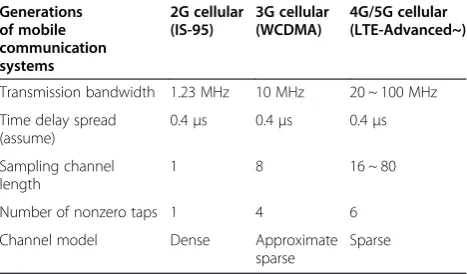
Broadband transmission is one of the key techniques in wireless communication systems [1-3]. To realize reli-able broadband communication, one challenge is accur-ate channel estimation in order to mitigaccur-ate inter-symbol interference (ISI). Conventional normalized least mean square (ISS-NLMS) algorithm using invariable step size was considered as one of the effective methods for chan-nel estimation due to its easy implementation [4]. How-ever, ISS-NLMS does not take the channel characteristic into consideration and cannot take the advantage of the inherent channel prior information. During the last few years, more and more channel measurements have vali-dated and indicated that broadband channels are most likely to have sparse or cluster-sparse structures [5-7], as shown in Figure 1 as an example. In particular, channel sparsity in different mobile communication systems are summarized in Table 1. Inspired by least absolute shrinkage and selection operator (LASSO) algorithm [8], an ℓ1-norm sparse constraint function can be used to take the advantage of channel sparsity in adaptive sparse channel estimation (ASCE); zero-attracting ISS-NLMS
(ZA-ISS-NLMS) has been proposed for ASCE [9,10] to improve the estimation performance.
It is well known that step size is a critical parameter which determines the estimation performance, conver-gence rate, and computational cost. However, ISS-NLMS and ZA-ISS-NLMS adopt a fixed step size, and as a re-sult, they are unable to achieve a good balance between steady-state estimation performance and convergence speed. Different from ISS-NLMS [4], variable step-size
NLMS (VSS-NLMS) was first proposed to improve the estimation performance [11] without sacrificing the con-vergence speed. Variable step size is controlled by the in-stantaneous square error of each iteration, i.e., lower error will decrease the step size and vice versa. To the best of our knowledge, the application of sparse
VSS-NLMS to simultaneously exploit the channel sparsity and control the step size has not been reported in the literature.
In this paper, we propose azero-attracting VSS-NLMS (ZA-VSS-NLMS) algorithm for sparse channel estima-tion. The main contribution of this paper is to propose the ZA-VSS-NLMS using VSS rather than ISS for esti-mating spare channels. In addition, the step size of the proposed algorithm is updated in each iteration accord-ing to the error information. In the followaccord-ing, conven-tional ZA-ISS-NLMS is introduced and its drawback is analyzed at first. ZA-VSS-NLMS is then proposed using * Correspondence:[email protected]
1
Department of Electronics and Information Systems, Akita Prefectural University, Akita 015-0055, Japan
Full list of author information is available at the end of the article
an adaptive step size to achieve a lower steady-state esti-mation error. To derive the adaptive step size, different from the traditional VSS-NLMS algorithm in [11], two practical problems are considered: sparse channel model and tractable independent assumptions [12]. At last, nu-merical simulations are carried out to evaluate the pro-posed algorithm in terms of two metrics: mean square deviation (MSD) and bit error rate (BER).
The remainder of this paper is organized as follows. A system model is described and ZA-ISS-NLMS algorithm is introduced in Section 2. In Section 3, ZA-VSS-NLMS algorithm is proposed. Numerical results are presented in Section 4 to evaluate the performance of the proposed ASCE method. Finally, we conclude the paper in Section 5.
2 ZA-ISS-NLMS algorithm
Consider a frequency-selective fading wireless communi-cation system where FIR sparse channel vector h= [h0,
h1, …,hN −1]Thas length Nand it is supported only by
K nonzero channel taps. Assume that an input training
signalx(t) is used to probe the unknown sparse channel. At receiver, equivalent-baseband observed signal y(t) at timetis given by:
y tð Þ ¼hTxð Þ þt z tð Þ; ð1Þ
where x(t) = [x(t), x(t −1), …, x(t−N +1)]T denotes the vector of training signal x(t); z(t) is the additive white Gaussian noise (AWGN), which is assumed to be inde-pendent to x(t); (⋅)T denotes the vector transpose oper-ation. The objective of ASCE is to adaptively estimate the unknown sparse channel vectorh using the training signal vectorx(t) and the observed signaly(t). According to Equation 1, instantaneous errore(n) is defined as,
e nð Þ ¼y tð Þ−y nð Þ
¼h−h~ð Þn Txð Þ þt z tð Þ
¼vTð Þnxð Þ þt z tð Þ; ð
2Þ
where vð Þ ¼n h−h~ð Þn denotes the channel estimation error in the n-th iteration. In the sequel, one can apply ZA-ISS-LMS algorithm to exploit channel sparsity in time domain. First of all, cost function of ZA-ISS-LMS is given by:
G nð Þ ¼1
2e
2ð Þ þn λh~ð Þn
1; ð3Þ
where λ is the regularization parameter to balance the updating square error e2(n) and sparse penalty of the
n-th updated channel estimator h~ð Þn ; k ⋅ k1 denotes ℓ1-norm operation, e.g., k kh 1¼XN−1l¼
0j jhl . The update
equation of ZA-ISS-LMS at timetis:
~
hðnþ1Þ ¼h~ð Þn −μ∂G nð Þ ∂h~ð Þn
¼h~ð Þ þn μe nð Þxð Þt −ρsgnh~ð Þn;
ð4Þ
where μ is the ISS which determines the convergence speed;ρ=μλis a parameter which depends on the step-sizeμand the regularization parameterλ; and sgn(⋅) is a component-wise function which is defined by:
sgnð Þ ¼h
Observing the update Equation 4, its second term at-tracts small-value channel coefficients to zero in high probability. In other words, most of the small-value channel coefficients can be replaced by zero. This will speed up the convergence and mitigate the noise on zero positions as well. However, the performance of the ZA-ISS-LMS is often degraded by random scaling of training signals. To avoid the randomness as well as to improve the estimation performance, we proposed an improved algorithm (i.e., ZA-ISS-NLMS) in our previous works in
1 2 3 4 5 6 7 8
Figure 1Two kinds of channel structures: dense and sparse.
Table 1 Channel structures in different mobile communication systems
Transmission bandwidth 1.23 MHz 10 MHz 20 ~ 100 MHz
Time delay spread
Number of nonzero taps 1 4 6
Channel model Dense Approximate
sparse
[9] and [10]. The update equation of ZA-ISS-NLMS [9] was proposed as follows
~
hðnþ1Þ ¼h~ð Þ þn μ e nð Þxð Þt
xTð Þt xð Þt −ρsgn h~ð Þn
: ð6Þ
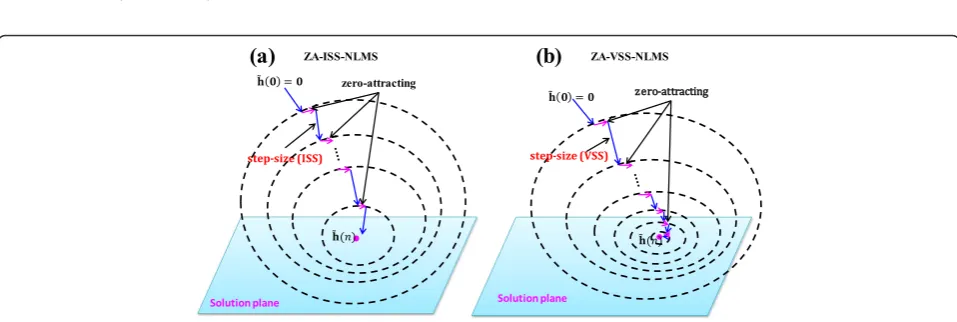
The ZA-ISS-NLMS algorithm in Equation 6 adopts one step size and its convergence speed is fixed as shown in Figure 2a. As a result, one drawback of ZA-ISS-NLMS is the lack of ability to trade off between the estimation performance and convergence speed.
3 Proposed algorithm
Recall that the ZA-ISS-NLMS algorithm in Equation 6 does not utilize VSS. It is well known that the step size is a critical parameter which determines the estimation per-formance, convergence speed, and computational cost. Inspirited by the VSS-NLMS algorithm in [11], VSS is in-troduced to make the step size adaptive to the estimation error to further improve the estimation performance. Based on the previous research [10] and [11], ZA-VSS-NLMS algorithm has the following update equation,
~
hðnþ1Þ ¼h~ð Þ þn μðnþ1Þ e nð Þxð Þt
xTð Þt xð Þt −ρsgn h~ð Þn
;
ð7Þ
where μ(n +1) is the VSS which is calculated from the estimation error and the variance of the additive noise. Comparing Equation 7 with Equation 4, it can be found that the step size is different, i.e., step size in Equation 4 is invariant while step size in Equation 7 is adaptively variant. There are two facts about μ(n) and ρ that should be no-ticed: 1) the variant step-size μ(n) is adopted to speed up the convergence speed in the case of large estimation error, while to ensure the stability in the case of small estimation error; 2) the parameterρ, which depends on the initial step-sizeμand regularization parameterλ, is utilized to exploit channel sparsity effectively. Otherwise, variant parameter
ρ(n) =μ(n)λmay cause extracomputational complexity and ineffectiveness use of the channel sparsity.
Optimal step-size μo(n +1) for the (n +1)-th iteration is derived based on the following assumptions:
(A1):Input vectorx(t)and the additive noise z(t)are mutually independent at time t.
(A2):Input vectorx(t)is a stationary sequence of independent zero mean Gaussian random variables with a finite varianceσ2x:
(A3):z(t)is an independent zero mean random variables with varianceσ2z:
(A4):h~ð Þn is independent ofx(t).
These assumptions provide a mathematically tractable analysis in the subsequent proposed algorithm. The pro-posed algorithm in Equation 7 can be rewritten in terms of the estimation error vectorv(n) as follows:
vðnþ1Þ ¼vð Þn−μðnþ1Þ e nð Þxð Þt
xTð Þt xð Þt þρsgn ~hð Þn
;
ð8Þ
Taking the expectation on the MSD of h~ð Þn , it can be written as:
E kvðnþ1Þk22
¼E
vð Þn k k2
2
þ
μ2ðnþ1ÞE e2ð Þn=xTð Þtxð Þt
þρ2Ensgnh~ð ÞnTsgnh~ð Þno
−2μðnþ1ÞE e nð ÞvTð Þnxð Þt=xTð Þtxð Þt
þ2ρEvTð Þnsgnh~ð Þn
−2μðnþ1ÞρEfe nð ÞxTð Þt sgnh~ð ÞnxTð Þtxð Þgt ≜D0−Dð Þμ;
ð9Þ
Based on the assumptions (A1)-(A4), we can get the following results:
E vTð Þn
sgnh~ð Þn
¼0; ð10Þ
E e nð ÞxTð Þt
sgnh~ð Þn=xTð Þt xð Þt
¼0; ð11Þ
D0¼E kvð Þnk22
According to Equation 9, MSD depends on parameters
μ andρ. However, the optimal value of ρ cannot be dir-ectly obtained since it is determined by channel sparsity and the additive noise. In order to find the optimal step-sizeμo(n+1), empirical parameterρis used to make a fair comparison with the traditional method in Equation 6. When ρ is fixed in Equation 7, findingμ(n+1) becomes
In other words, to find the optimal step-size μo(n +1) is equivalent to finding the largest gradient descend from the n-th iteration to the (n +1)-th iteration. By solving the convex problem in Equation 14, the (n +1)-th opti-mal step-sizeμo(n+1) is obtained by: optimal step size is determined byp(n+1) and the noise variance σ2
z. Unfortunately however, the optimal vector po(n+1) depends on the unknown channel vectorhand it is not available during adaptive updating process. Based on the assumption (A1), it can be found that:
Exð Þe nt ð Þ=xTð Þt xð Þt ¼Efxð Þðt xTð Þt vð Þn
þz tð ÞÞ=xTð Þt xð Þgt
¼Exð ÞtxTð Þt vð Þn=xTð Þt xð Þt :
ð16Þ
According to Equation 16, an alternative approximate vectorp(n+1) by time averaging is given as follows,
pðnþ1Þ ¼βpð Þ þn ð1−βÞ xð Þe nt ð Þ
xTð Þt xð Þt ; ð17Þ
where β ∈[0, 1) is the smoothing factor to control the value of VSS and the estimation error. Note that the VSS will reduce to ISS whenβ = 0. Therefore, approxi-mate step-sizeμ(n+1) for ZA-VSS-NLMS is given by:
μðnþ1Þ ¼μmax p
Tðnþ1Þpðnþ1Þ
pTðnþ1Þpðnþ1Þ þC; ð18Þ
whereCis a positive threshold parameter satisfying C∼ Oð1=SNRÞ, where SNR is the received signal noise ratio (SNR). To better understand the proposed algorithm in Equation7, Figure2is used to illustrate the two functions: zero attracting (for sparse constraint) and VSS (for conver-gence speed). According to Equation18, the range of VSS is given byμ(n+1)∈(0,μmax), whereμmaxis the maximal
step size. To ensure the stability of the adaptive algorithm, the maximal step size is usually set to be less than 2 [4]. Based on Equation18, step-sizeμfor ZA-ISS-NLMS is in-variable but the step-size μ(n +1) for ZA-VSS-NLMS is variable as depicted in Figure 3, where the maximal step-sizeμmaxand step-size μare set asμ=μmax∈{0.5, 1, 1.5}.
From this figure, it can be found that the value of VSS
0 0.5 1 1.5
Figure 3ISS is invariable but VSS is variable in different estimation errors.
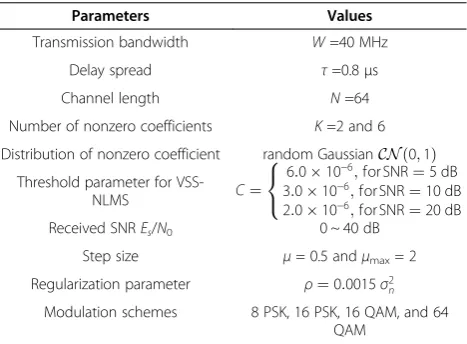
Table 2 Simulation parameters
Parameters Values
Transmission bandwidth W=40 MHz
Delay spread τ=0.8μs
Channel length N=64
Number of nonzero coefficients K=2 and 6
Distribution of nonzero coefficient random GaussianCNð0;1Þ
Threshold parameter for
VSS-NLMS C¼
Regularization parameter ρ¼0:0015σ2
n
Modulation schemes 8 PSK, 16 PSK, 16 QAM, and 64
μ(n+1) will decrease as the estimation error decreases and vice versa; on the other hand, ISS is invariant. Speci-fically, in the case of small step size, high performance can be achieved since small step size ensures the sta-bility of the algorithm; while in the case of large step size, low computation complexity can be achieved since large step size increases the convergence speed. That is to say, as the updating error decreases, ZA-VSS-NLMS reduces its step size adaptively to ensure the algorithm stability as well as to achieve better steady-state estima-tion performance.
4 Numerical simulations
To testify the effectiveness of the proposed method, two metrics are adopted, i.e., MSD and BER. Channel
estimators~h nð Þare evaluated by the average MSD which is defined as:
Average MSDh~ð Þn ¼E h−h~ð Þn22
n o
; ð19Þ
where h and h~ð Þn are the channel vector and its n-th iterative adaptive channel estimator, respectively. ‖·‖2 is the Euclidean norm operator and k kh 22 ¼XNi¼
1j jhi 2
. System performance is evaluated in terms of BER which adopts different data modulation schemes. The results are averaged over 1,000 independent Monte Carlo (MC) runs. The length of channel vectorhis set to beN= 64 and its number of dominant taps is set to beK= 2 and 6, respectively. Each dominant channel tap follows ran-dom Gaussian distribution CN 0;σ2
h
and subjects to a
0 200 400 600 800 1000 1200 10−2
10−1
Iteration times (n)
Average MSD
ISS−NLMS VSS−NLMS ZA−ISS−NLMS ZA−VSS−VNLMS
SNR=5dB
Channel sparsity: K=2 Channel length: N=64 Threshold parameter: C=6.0×10⁻⁶
Figure 4Average MSD performance versus received iterative times (n).
0 200 400 600 800 1000 120 10−2
10−1
Iteration times (n)
Average MSD
ISS−NLMS
VSS−NLMS
ZA−ISS−NLMS ZA−VSS−VNLMS
SNR=5dB
Channel sparsity: K=8 Channel length: N=64 Threshold parameter: C=6.0×10⁻⁶
Figure 5Average MSD performance versus received iterative times (n).
0 200 400 600 800 1000 1200 10−3
10−2 10−1
Iteration times (n)
Average MSD
ISS−NLMS
VSS−NLMS
ZA−ISS−NLMS
ZA−VSS−VNLMS
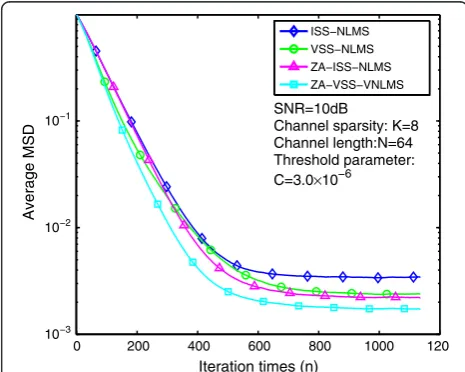
SNR=10dB
Channel sparsity: K=2 Channel length: N=64 Threshold parameter: C=3.0×10⁻⁶
Figure 6Average MSD performance versus received iterative times (n).
0 200 400 600 800 1000 120 10−3
10−2 10−1
Iteration times (n)
Average MSD
ISS−NLMS VSS−NLMS ZA−ISS−NLMS
ZA−VSS−VNLMS
SNR=10dB
Channel sparsity: K=8 Channel length:N=64 Threshold parameter: C=3.0×10⁻⁶
total power constraint Ek kh 22 ¼1 and positions ran-domly within the length ofh. The received signal-to-noise ratio (SNR) is defined as P0=σ2n, whereP0is the received power of the pseudo-random noise (PN) sequence for training. Numerical simulation parameters are listed in Table 2.
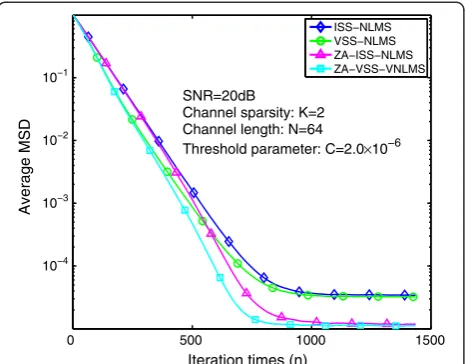
Average MSD performance of the proposed method is evaluated at first.K= 2 and 6 are used and the results are shown in Figures 4, 5, 6, 7, 8, and 9 under three SNR regimes, i.e. 5, 10, and 20 dB. The proposed algorithm, ZA-ISS-NLMS, is compared with three existing methods, i.e., ISS-NLMS [4], VSS-NLMS [11], and ZA-ISS-NLMS [9,10]. It can be observed from Figures 4, 5, 6, 7, 8, and 9 that ZA-VSS-NLMS achieved both faster convergence speed and better MSD performance than ZA-ISS-NLMS. The
reason is that VSS-based gradient descend of the proposed algorithm makes a good trade-off between the convergence speed and the MSD performance. In addition, to achieve better steady-state estimation performance, regularization parameter methods for ZA-NLMS-type algorithms are adopted [13,14] and set to be ρ¼0:0015σ2n. In different
SNR regimes, ZA-VSS-NLMS always achieves a better es-timation performance than ZA-ISS-NLMS. Furthermore, since ZA-VSS-NLMS takes the advantage of the channel sparsity as well, it obtains a better estimation performance than VSS-NLMS, especially in the extreme sparse channel case (e.g.,K= 2).
In the next, BER performance using the proposed chan-nel estimator is evaluated. The chanchan-nel is assumed to be a
0 500 1000 1500
10−4 10−3 10−2 10−1
Iteration times (n)
Average MSD
ISS−NLMS VSS−NLMS ZA−ISS−NLMS ZA−VSS−VNLMS
SNR=20dB
Channel sparsity: K=2 Channel length: N=64
Threshold parameter: C=2.0×10⁻⁶
Figure 8Average MSD performance versus received iterative times (n).
0 500 1000 1500
10−4 10−3 10−2 10−1
Iteration times (n)
Average MSD
ISS−NLMS VSS−NLMS ZA−ISS−NLMS ZA−VSS−VNLMS
SNR=20dB
Channel sparsity: K=20dB Channel length: N=64
Threshold parameter: C=2×10⁻⁶
Figure 9Average MSD performance versus received iterative times (n).
0 5 10 15 20 25 30 35 40
10−4 10−3 10−2 10−1 100
Es/N0 (dB)
Average BER
ISS−NLMS VSS−NLMS ISS−ZA−NLMS
VSS−ZA−NLMS
8PSK
16PSK
Figure 10Average BER performance versus received SNR (PSK).
0 5 10 15 20 25 30 35 40
10−4 10−3 10−2 10−1 100
E
s/N0 (dB)
Average BER
ISS−NLMS
ISS−ZA−NLMS
VSS−NLMS
VSS−ZA−NLMS
64QAM 16QAM
steady-state sparse channel with number of nonzero taps
K= 2 and SNR = 5 dB. Received SNR is defined byEs/N0, whereEsis the received signal power andN0is the noise power. Numerical result is shown in Figures 10 and 11. In Figure 10, multilevel phase shift keying (PSK) modula-tion, i.e., 8 and 16 PSK are used for data modulation. In Figure 11, multilevel quadrature amplitude modulation (QAM), i.e., 16 and 64 QAM, are used for data modulation. It is observed that the proposed algorithm can achieve a much better BER performance than ISS-NLMS and VSS-NLMS. Although there is no significant performance gain between our proposed algorithm and ISS-ZA-NLMS, fast convergence rate can be achieved by the proposed algorithm.
Therefore, it has been confirmed that the proposed algo-rithm can achieve the advantages of good performance and fast convergence speed.
5 Conclusions
Step size is a key parameter for NLMS-based adaptive fil-tering algorithms to balance the steady-state estimation performance and convergence speed. Either ISS-NLMS or ZA-ISS-NLMS cannot update their step size in the process of adaptive error updating. In this paper, a ZA-VSS-NLMS filtering algorithm was proposed for channel estimation. Unlike the traditional algorithms, the proposed algorithm utilizes VSS which can update the step size adaptively according to the updating error. Therefore, the proposed method can achieve a better steady-state per-formance while keeping a comparable convergence speed when compared with the existing methods. Simulation re-sults have been presented to confirm the effectiveness of the proposed method in terms of MSD and BER metrics.
Competing interests
The authors declare that they have no competing interests.
Acknowledgements
The authors would like to extend their appreciation to the anonymous reviewers for their constructive comments. This work was supported in part by the Japan Society for the Promotion of Science (JSPS) research activity start-up research grant (No. 26889050), Akita Prefectural University start-up research grant, as well as the National Natural Science Foundation of China under grants (Nos. 61401069, 61261048, and 61201273).
Author details
1Department of Electronics and Information Systems, Akita Prefectural
University, Akita 015-0055, Japan.2Department of Electronics and Information Engineering, Huazhong University of Science and Technology, Wuhan 430074, China.3Department of Communications Engineering, Graduate School of Engineering, Tohoku University, Sendai 980-8579, Japan.
Received: 17 December 2013 Accepted: 6 November 2014 Published: 22 November 2014
References
1. F Adachi, H Tomeba, K Takeda, Introduction of frequency-domain signal processing to broadband single-carrier transmissions in a wireless channel. IEICE Trans. Commun.E92-B(no. 9), 2789–2808 (2009)
2. F Adachi, E Kudoh, New direction of broadband wireless technology. Wirel. Commun. Mob. Comput.7(no. 8), 969–983 (2007)
3. L Dai, Z Wang, Z Yang, Next-generation digital television terrestrial broadcasting systems: Key technologies and research trends. IEEE Commun. Mag.50(6), 150–158 (2012)
4. B Widrow, D Stearns,Adaptive Signal Processing(Prentice Hall, New Jersey, 1985) 5. M Herdin, E Bonek, S Member, BH Fleury, N Czink, X Yin, H Ozcelik, Cluster
characteristics in a MIMO indoor propagation environment. IEEE Trans. Wirel. Commun.6(no. 4), 1465–1475 (2007)
6. S Wyne, N Czink, J Karedal, P Almers, F Tufvesson, A Molisch,A Cluster-Based Analysis of Outdoor-to-Indoor Office MIMO Measurements at 5.2 GHz,”IEEE 64th Vehicular Technology Conference (VTC-Fall)Montreal, Canada, 2006), pp. 1–5. doi:10.1109/VTCF.2006.15
7. L Vuokko, V-M Kolmonen, J Salo, P Vainikainen, Measurement of large-scale cluster power characteristics for Geometric channel models. IEEE Trans. Antennas Propag.55(no. 11), 3361–3365 (2007)
8. R Tibshirani, Regression Shrinkage and Selection via the Lasso. J. R. Stat. Soc.
58(no. 1), 267–288 (1996)
9. G Gui, W Peng, F Adachi, Improved adaptive sparse channel estimation based on the least mean square algorithm, inIEEE Wireless Communications and Networking Conference (WCNC), Shanghai, China, 2013, pp. 3130–3134 10. G Gui, F Adachi, Improved adaptive sparse channel estimation using least mean square algorithm. EURASIP J. Wirel. Commun. Netw.2013(no. 1), 1–18 (2013)
11. H Shin, AH Sayed, W Song, Variable step-size NLMS and affine projection algorithms. IEEE Signal Process. Lett.11(no. 2), 132–135 (2004)
12. E Eweda, NJ Bershad, Stochastic analysis of a stable normalized least mean fourth algorithm for adaptive noise canceling with a white Gaussian reference. IEEE Trans. Signal Process.60(12), 6235–6244 (2012) 13. Z Huang, G Gui, A Huang, D Xiang, F Adachi, Regularization selection
methods for LMS-Type sparse multipath channel estimation, inThe 19th Asia-Pacific Conference on Communications (APCC), Bali Island, Indonesia, 2013, pp. 1–5
14. G Gui, A Mehbodniya, F Adachi, Least mean square/fourth algorithm for adaptive sparse channel estimation, inIEEE International Symposium on Personal, Indoor and Mobile Radio Communications (PIMRC), London, UK, 2013, pp. 1–5
doi:10.1186/1687-1499-2014-195
Cite this article as:Guiet al.:Variable-step-size based sparse adaptive filtering algorithm for channel estimation in broadband wireless communication systems.EURASIP Journal on Wireless Communications and Networking20142014:195.
Submit your manuscript to a
journal and benefi t from:
7Convenient online submission
7Rigorous peer review
7Immediate publication on acceptance
7Open access: articles freely available online
7High visibility within the fi eld
7Retaining the copyright to your article