Collisionless driven reconnection in an open system
Ritoku Horiuchi1,2, Wenbing Pei2, and Tetsuya Sato1,2
1National Institute for Fusion Science, Toki 509-5292, Japan 2The Graduate University for Advanced Studies, Toki 509-5292, Japan
(Received May 30, 2000; Revised January 29, 2001; Accepted March 5, 2001)
Particle simulation studies of collisionless driven reconnection in an open system are presented. Collisionless reconnection evolves in two steps in accordance with the formation of two current layers, i.e., an ion current layer in the early ion phase and an electron current layer in the late electron phase. After the electron current layer is formed inside the ion current layer, the system relaxes gradually to a steady state when convergent plasma flow is driven by an external electric field with a narrow input window. On the other hand, when the convergent plasma flow is driven from the wide input window, magnetic reconnection takes place in an intermittent manner, due to the frequent formation of magnetic islands in the vicinity of neutral sheet.
1.
Introduction
Collisionless magnetic reconnection plays an essential role in energetic active phenomena observed in the solar corona (Priest, 1982), the Earth’s magnetosphere (Nishida, 1978) and the laboratory plasma (Onoet al., 1996; Yamada et al., 2000). Collisionless reconnection has been numer-ically studied based on two-fluid model (e.g. Biskamp et al., 1995), hybrid model (e.g. Shayet al., 1999), full par-ticle model (e.g. Hesse and Winske, 1998). They have dis-cussed the microscopic reconnection process such as recon-nection rate, current sheet structure, and particle kinetic ef-fects in the absence of an external driving source. The con-cept of an anomalous resistivity (Davidson and Gladd, 1975) which originates from the wave-particle interaction or the stochasticity of particle orbit (Horton and Tajima, 1990) has been introduced to explain collisionless reconnection. Re-cently three-dimensional full particle simulation (Zhu and Winglee, 1996; Horiuchi and Sato, 1999) has been carried out in order to clarify the relationship between an anomalous resistivity and collisionless reconnection.
In most of interesting reconnection phenomena the sys-tem is open and evolves dynamically with time. Therefore, microscopic kinetic process of collisionless reconnection is deeply connected with the dynamical evolution of a whole system. By carrying out two-dimensional particle simula-tion in the presence of an external driving source, Horiuchi and Sato (1994, 1997) have examined the kinetic process and have clarified that nonlinear evolution of collisionless reconnection is controlled not only by an internal micro-scopic process such as an electron dynamics or an ion dy-namics in a current sheet, but also by an external global condition such as energy input rate or external driving flow. However, these analyses are restricted to the initial growing phase of collisionless driven reconnection because a
peri-Copy right c The Society of Geomagnetism and Earth, Planetary and Space Sciences (SGEPSS); The Seismological Society of Japan; The Volcanological Society of Japan; The Geodetic Society of Japan; The Japanese Society for Planetary Sciences.
odic boundary condition is used at the downstream bound-ary.
Magnetic reconnection is often discussed with steady models. On the other hand, long time scale MHD simula-tions (Kitabataet al., 1996; Amoet al., 1995) have demon-strated that magnetic reconnection takes place intermittently when there exists a constant energy supply from the exterior region. Which situation is realized in collisionless recon-nection? It is believed that steady reconnection is realized when the flux input rate into the system is balanced with the reconnection rate. However, this balance condition is not always assured because magnetic reconnection is controlled by two different processes with different time scales, i.e., an external global process and an internal microscopic process. In order to study a long time scale behavior of collision-less driven reconnection we developed a new open bound-ary model in which a free condition is used at the down-stream boundary. By making use of both two-dimensional and three-dimensional kinetic open models, we will discuss the dynamics of collisionless driven reconnection in an open system that is subject to an external driving source.
The simulation model will be described in Section 2. Two types of open boundary models will be discussed in this pa-per: (a) semi-open model in which a periodic condition is used at the downstream boundary and plasma inflow exists at the upstream boundary, and (b) full open model in which a free condition is used at the downstream boundary and plasma inflow exists at the upstream boundary. The parti-cle kinetic effect on collisionless driven reconnection is pre-sented based on two-dimensional semi-open model in Sec-tion 3. SecSec-tion 4 is devoted to the discussion on a long time scale behavior of collisionless driven reconnection based on two-dimensional full open model. In Section 5 we will dis-cuss the relationship between an anomalous resistivity and collisionless reconnection by using three-dimensional semi-open model.
2.
Simulation Model
Three different types of electromagnetic particle codes are developed for the analyses of collisionless driven recon-nection in two-dimensional and three-dimensional Cartesian coordinate systems (Horiuchi and Sato, 1994, 1997, 1999). As an initial condition we adopt a one-dimensional equilib-rium with the Harris-type anti-parallel magnetic configura-tion as
B(y)=(Bx(y),0,0), (1)
Bx(y)=B0tanh(y/L), (2)
P(y)=B02/8πsech2(y/L), (3)
where B0is a constant and L is the scale height along the
y-axis. There is a magnetically neutral sheet at y = 0 in the initial equilibrium. The initial particle distribution is as-sumed to be a shifted Maxwellian with spatially constant temperature and average particle velocity, which is equal to the diamagnetic drift velocity.
The same input condition is used at the upstream bound-ary so that the plasma inflows are symmetrically driven from two input boundaries (y = ±yb) by the external electric
fields imposed in thezdirection. The distribution function of incoming particles at the input boundary is assumed to be a shifted Maxwellian with a constant temperature and the average velocity equal to theE×Bdrift velocity. The am-plitude of driving field Ezd(x,t)is set for zero att = 0,
and increases with time while keeping a bell-shaped pro-file near the center and a flat propro-file in the periphery for an initial short moment. After then a constant profile is kept with maximum flux input rate E0. Two types of
bound-ary conditions are considered at the downstream boundbound-ary (x = ±xb), i.e., (a) a periodic boundary condition, and (b)
a free boundary condition. For the free boundary case field quantities are assumed thatEx,Eyand∂Ez/∂xare
contin-uous atx= ±xb. The condition∂Ez/∂x=finite allows the
change in y-component of magnetic field which is the nec-essary condition for a magnetic island to go freely through the boundary. The boundary condition for particles is de-termined so as to keep the charge neutrality condition and the net number flux of particles associated with the fluid ve-locity in the vicinity of the downstream boundary. That is, there exist outgoing particles and incoming particles through the open boundary and their difference gives the net number flux. We can know the number flux of outgoing particles by observing them directly at the boundary. Under the assump-tions that the net number flux of ions is the same as that of electrons, and the incoming particles satisfy the same distri-bution function as that just inside the open boundary, we can calculate the number fluxes of incoming ions and electrons, and get their velocities and positions. Thus, the total number of particles is a function of time in this open model.
3.
Two-Step Evolution of Collisionless Driven
Re-connection
In this section we review briefly the results of two-dimen-sional particle simulation for the semi-open model with the
periodic downstream boundary (Horiuchi and Sato, 1994, 1997). Charged particles execute a complex thermal motion, which is called a meandering motion, in the vicinity of mag-netically neutral sheet. The orbit amplitude of meandering motion is given by the geometrical mean of Larmor radius and the scale height of magnetic field. When there exists an external driving source, the current sheet evolves dynam-ically with time. That is, physical parameters, which con-trol collisionless reconnection, becomes a function of time. In considering collisionless reconnection in the presence of an external driving source, it is important to examine the temporal evolution of physical parameters and their relation-ship.
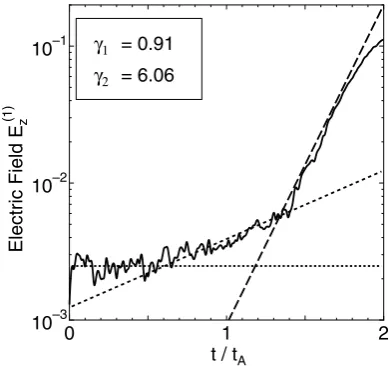
Figures 1 and 2 show (1) the temporal evolution of an electric field along equilibrium current at the reconnection point (“reconnection electric field”), and (2) those of four spatial scales for the case of mi/me = 50 and E0 =
−0.04B0, wheretA is the Alfven transit time, dh,dj z,lmi,
0 1 2
10–3
10–2
10–1
t / tA
Electr
ic Field E
z
(1)
γ1
γ2
= 0.91
= 6.06
Fig. 1. Temporal evolution of reconnection electric field for the case of periodic downstream boundary.
0 1 2
0 10 20 30
t / tA
Spatial Scales ( y )
djz
dh
lmi
lme
Δ
andlmeare the half-width of the mass density profile, that
of the current density profile, the average amplitude of ion meandering orbit, and that of electron meandering orbit, re-spectively. Figure 1 indicates that collisionless reconnection takes place in two steps, i.e., the slow reconnection in the early phase (0.6tA <t <1.3tA) and the fast reconnection in
the late phase (1.3tA <t <1.8tA). The electric field begins
to grow slowly as soon as bothdhanddj zstart decreasing as
a result of the compression by the convergent plasma flow in the slow reconnection phase. The width of the current layer is almost the same or a little larger than the ion thermal scale lmi in this phase.
Because most of the ions are unmagnetized in the cur-rent layer (“ion curcur-rent layer”) while the electrons are mag-netized, the input flow (Poynting flux) no longer works on thinning the ion current layer, but it continues to compress the electron profile. Thus, electron current layer is created inside the ion current layer due to the finite ion Larmor ra-dius effect. When the fast reconnection phase sets in, the inclination of the growth curve steepens suddenly and the half-width of electron current layer approaches the electron thermal scalelme. These results lead us to the conclusion
that the slow reconnection is triggered by the ion meander-ing motion effect while the fast reconnection is triggered by the electron meandering motion effect.
From the simulation runs with a various values of ion mass, electron mass, and the driving electric field (Horiuchi and Sato, 1994, 1997), it is found that the fundamental prop-erties of collisionless driven reconnection are determined by two physical processes, i.e., the external process which con-trols the flux input rate into the current layer, and the internal process which controls the particle kinetic mechanism lead-ing to collisionless driven reconnection in the current layer, and they are not independent processes but deeply connected to each other.
4.
Dynamics of Collisionless Reconnection in a
Long Time Scale
In this section we discuss the particle simulation in a long time scale based on the two-dimensional full open model with the free downstream boundary. The simulation is car-ried out on a 512×128 point grid by making use of 6.4 million particles. The main parameters are in the follow-ings: mi/me = 25,ωpe/ωce = 3.5, ωcet = 0.02, L =
0.8yb ≈ 3ρi, where ρi is the ion Larmor radius, and ωce
is defined by using a constant field B0 in the initial
equi-librium. Figure 3 shows the spatial profiles of the driving electric field imposed at the input boundary at five different time periods, i.e.,tωce =0, 10.2, 20.4, 81.6, and 143. Here,
the spatial size of initial bell-shaped profile isxd =0.84xb,
and the amplitude of the uniform profile in the late phase isE0 = −0.04B0. We call the parameterxd input window
size, because the input velocity is locally enhanced within this region. In order to examine the dependence of the re-connection process on the profile of driving electric field, we performed simulation runs with different values of E0
andxd and found that the long time scale behavior is
insen-sitive to the value of E0 and depends strongly on the value
of the window sizexd. In the following, we discuss the
sim-ulation results for the case ofE0= −0.04B0.
-0.05 -0.04 -0.03 -0.02 -0.01 0 0.01
-200 -100 0 100 200
External dri
ving f
ield E
zd
x/Δx
Fig. 3. Spatial profiles of driving electric field at five different time periods for the parametersxd=0.84xbandE0= −0.04B0.
Time=0
Time=122
Time=245
Time=327
Time=490
Time=735
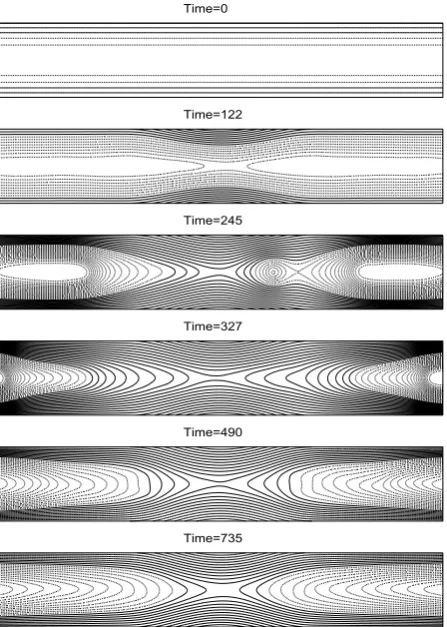
Fig. 4. Temporal evolution of magnetic field for the narrow window case ofxd/2xb=0.42.
First, let us consider the case of narrow input window (xd/2xb = 0.42 orxd = 18ρi). Figure 4 shows the
tem-poral evolution of the magnetic field. The convergent flow supplied from the top and bottom boundaries compresses the current sheet. Magnetic reconnection sets in at the center of the simulation domain at tωce ≈ 122 (second panel). A
-0.08 -0.06 -0.04 -0.02 0 0.02 0.04
0 100 200 300 400 500 600 700 800
Reconnection electric f
ield E
z
ωce t
Fig. 5. Temporal evolutions of reconnection electric field for the narrow window case ofxd/2xb=0.42.
0 10 20 30 40 50 60
0 100 200 300 400 500 600 700 800
Scale length (
Δ
y)
ωce t
lme
lmi
djz
Fig. 6. Temporal evolutions of three spatial scales for the narrow window case ofxd/2xb=0.42.
steady reconnection state.
Figure 5 plots the time history of an electric field at the re-connection point for the same case as Fig. 4 where the dotted line stands for the value of driving electric field. The behav-ior of the reconnection field for an initial growing phase is very similar to the simulation results discussed in Section 3. After over-shooting the field approaches the external driv-ing field. The reconnection field tends to fluctuate around the value of the external field with a small amplitude for tωce > 300. Figure 6 is the time history of three spatial
scales. The width of current layer approaches the electron meandering scalelme for an initial growing phase in
accor-dance with the formation of the electron current layer. How-ever, it tends to increase fortωce >160 and is kept nearly
equal to the ion meandering scalelmi in a steady state. The
electron current density is described by the superposition of an electron density profile and an average electron velocity profile. The electron density profile has an ion scale be-cause it takes almost the same form as the ion density pro-file. On the other hand, the electron velocity profile, which has an electron scale, is strongly dependent on the acceler-ation mechanism in the electron current layer. If a locally
enhanced profile of average electron velocity is formed, the electron current layer is clearly visible inside the ion current layer. Figure 6 suggests that the localized peaked profile of electron velocity formed in the initial growing phase is damped down and the electron current layer becomes invis-ible in the steady state. The mechanism controlling the cur-rent sheet structure is discussed in detail by Peiet al.(2001). This result is in good agreement with the experimental one of the MRX (Magnetic Reconnection Experiment) (Yamada et al., 2000).
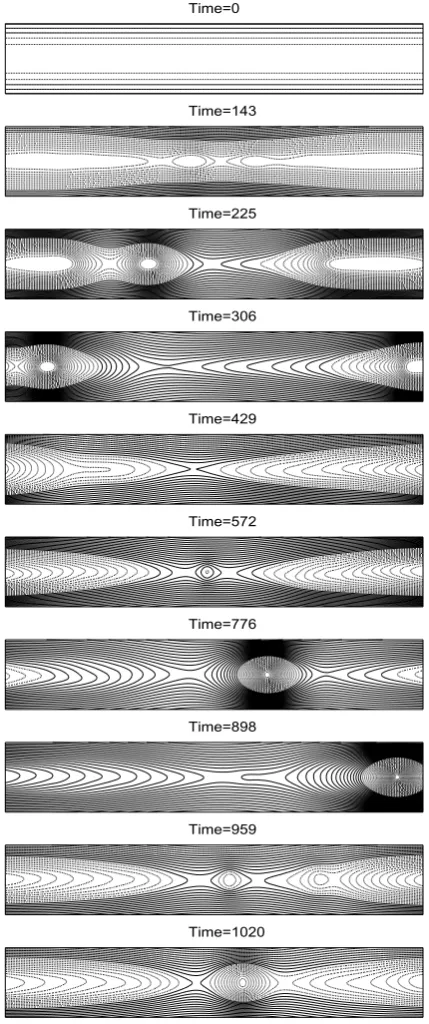
Now, let us discuss the simulation results for the wide window case (xd/2xb = 0.83 or xd = 36ρi). Figure 7
il-Time=0
Time=143
Time=225
Time=306
Time=429
Time=572
Time=776
Time=898
Time=959
Time=1020
Fig. 7. Temporal evolutions of magnetic field for the wide window case of
lustrates the spatial profile of magnetic field at ten different time periods. A small island is created at the center of cur-rent sheet attωce =143. This island grows with time while
moving to the left. The system relaxed to a state without any island after this island moves out through the left boundary (tωce = 429). After a short period a small island is
cre-ated again at the center attωce =572. This island moves
to the right while increasing its size and disappears through the right boundary. This process is repeated again and again. An elongated current sheet along thex-axis is created as a result of the plasma compression over a relatively long range for the wide window case. The length of the current sheet is roughly estimated as Lcs ≈ 10ρi. This means that the
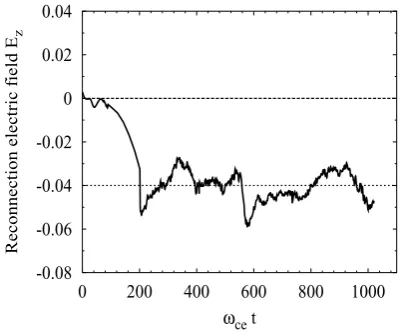
current sheet becomes unstable against a collisionless tear-ing instability. Consequently, the system cannot reach any steady state due to the frequent formation of magnetic is-lands in the current sheet. Figure 8 plots the temporal evo-lution of the reconnection electric field for the same case as Fig. 7. One can see in Fig. 8 that, compared with the narrow window case, the reconnection field is fluctuating around the value of the external field with a relatively larger amplitude during the simulation, and never reaches a constant value. It
-0.08
Fig. 8. Temporal evolutions of reconnection electric field for the wide window case ofxd/2xb=0.83.
Fig. 9. Temporal evolutions of three spatial scales for the wide window case ofxd/2xb=0.83.
is concluded that, for wide window case, collisionless recon-nection takes place intermittently, but not in a steady way.
We can see another interesting phenomenon of an inter-mittent reconnection in Fig. 9. The width of the current layerdj z changes between the ion scalelmi and the electron
scalelmein accordance with the fluctuation of the
reconnec-tion electric field. When the reconnecreconnec-tion field exceeds the driving field, the width decreases belowlmiand the electron
current layer becomes visible inside the ion current layer. It is interesting to note that this period corresponds to the growing phase of magnetic islands in the neutral sheet. On the other hand, when the reconnection field has a value close to the driving field, the width returns tolmi and the electron
current layer becomes invisible. In this way, collisionless reconnection takes place intermittently while changing the spatial structure of the current sheet dynamically for wide window case.
5.
Collisionless Driven Reconnection in Three
Di-mensions
Winske (1981), Tanaka and Sato (1981), and Ozakiet al. (1996) have found from two-dimensional particle simulation that two kinds of plasma instabilities grow in the current layer, i.e., the lower hybrid drift instability (LHDI) (Krall and Liewer, 1971) and the drift kink instability (DKI) (Zhu and Winglee, 1996; Daughton, 1999). The LHDI grows in the periphery of the current layer, but it cannot penetrate into a high beta region in the vicinity of the neutral sheet. Ozaki et al.(1996) have pointed out that the DKI is excited near the neutral sheet after the saturation of the LHDI and can be a cause of anomalous resistivity at the neutral sheet. Lin-ear analysis (Daughton, 1999) has revealed that the growth rate of the DKI has a peak around kzL ≈ 1.0 but it
de-creases with the mass ratiomi/mefor a fixedρi/L, where
kz is a wave number along an equilibrium current. Thus,
the growth rate for the real mass ratio andρi/L = 1.0 is
too small to explain substorm onset even for kzL ≈ 1.0.
Another important feature is that the DKI is driven by the velocity difference between ions and electrons and therefore its growth strongly depends on the ratio of ion Larmor ra-dius to the current sheet scale ρi/L in the Harris
equilib-rium (Daughton, 1999). Let us examine the dependence of the growth rate on the ratioρi/Lby changing the mass ratio.
Figure 10 shows the result of two-dimensional particle simu-lation without any background popusimu-lation where the growth rate is plotted as a function ofρi/L for three different ion
masses and kzL = 0.8. It is clear from Fig. 10 that the
growth rate increases with the ratioρi/L. It has a
remark-ably large value even for a large mass ratio ifρi/L >1.
0 1 2 3 0
0.2 0.4
γ/ω
/L m /m =200i e
i
e i
m /m =100
m /m =25i e
ρ
ci
Fig. 10. Growth rate of the drift kink mode as a function ofρi/Lfor three different ion masses.
0 200 400
10–2 10–1 100 101
0 2 4
t ce
F
our
ier Amplitude
ω
Bx,n=1,c
Ez,n=0,c
Spatial Scale
djz
Fig. 11. Temporal evolutions of the Fourier modes and the half-width of current layer for the three-dimensional simulation where the solid, dashed, and dotted lines stand for the drift kink mode, the reconnection electric field, and the half-width, respectively.
center of current sheet (solid), the reconnection electric field (dashed), and the half-width of the current layer (dotted) are plotted for the parametersmi/me = 100,ρi/L =1.2,
kzL ≈2, andE0= −0.02B0. From the simulation
parame-ters we expect that the growth rate of the DKI for the initial profile is too small to detect its growth during the simula-tion period. The Poynting flux, which is supplied into the simulation domain from the exterior region, moves towards the current layer together with the convergent plasma flow, while compressing the current profile. The compression by the convergent plasma flow increases the growth rate of the DKI. One can see the kink-like deformation of current sheet in the driven case as well as in the non-driven case. It is likely that this deformation is caused by the excitation of the DKI, although the characteristic features of this mode are slightly different from the DKI in the non-driven case. For example, the growth rate of this mode is estimated to
be γ /ωci ≈ 1.5 from the Fourier amplitude of Bx during
90 < ωcet < 190 whenρi/L = 1.5. This value is
sev-eral times as large as that in the non-driven case (Daughton, 1999). The reason may be partly due to the fact that the magnetic field is magnified twice through the compression by the convergent plasma flow, and the ion drift velocity along the equilibrium current is fairly large (kzvdi ≈ 6ωci
forn=1). Because most of ions inside the current layer are unmagnetized, the electric field or the Poynting flux, which is carried by the convergent plasma motion, penetrates into the current layer due to the particle kinetic effect (Horiuchi and Sato, 1994, 1997). When the Poynting flux reaches the neutral sheet, collisionless reconnection is triggered by the convective electric field.
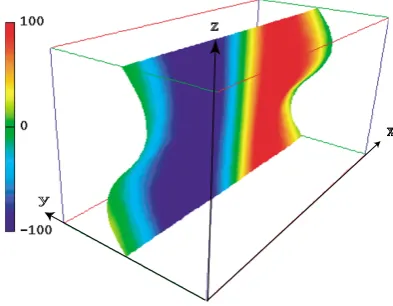
Once magnetic reconnection takes place, a generated fast plasma flow carries away the plasma near the reconnection point towards the downstream. One can see in Fig. 11 that, after the reconnection electric field reaches its saturation level, the amplitude of the DKI decreases and the width of the current layer increases. These phenomena indicate that the reconnection flow carries away the plasmas faster than the flux is accumulated at the reconnection point by the in-put flow. Consequently, the current profile is flattened in the vicinity of the reconnection point and the DKI becomes stable there. Figure 12 shows the perspective views of the current sheet attωce = 408 in the real space for the same
case as Fig. 11. Reconnection point appears almost along the straight midline (x=0) in the current sheet (see a green color in the central region). We cannot see any modification of the current sheet by the DKI in the vicinity of reconnec-tion point, although there appears the n = 1 modification of the current sheet along thez-axis in the downstream re-gion. The simulation is terminated attωce = 408 because
the reconnection plasma flow approaches the downstream boundary at which the periodic condition is adopted. The real frequency of the kink mode is observed asωr ≈4ωci,
and thus the simulation time corresponds to only three oscil-lation periods of the drift kink mode. This time is too short to judge whether the DKI works as an anomalous resistiv-ity leading to collisionless reconnection in an open system.
x
y
z
Fig. 12. Perspective views of the current sheet attωce = 408 for the same case as Fig. 11 where the current sheet is defined by the condition
However, it is not likely that the DKI is a primary cause of collisionless reconnection in the presence of an external driving source.
6.
Summary
Based on two-dimensional and three-dimensional kinetic models, we have investigated the dynamics of collisionless driven reconnection in an open system that is subject to an external driving source.
It is found from two-dimensional kinetic simulations with the periodic downstream boundary that collisionless recon-nection evolves in two steps in accordance with the forma-tion of two current layers, i.e., an ion current layer in the early phase and an electron current layer in the late phase. The slow reconnection in the early phase is triggered by the ion meandering motion effect while the fast reconnection in the late phase is triggered by the electron meandering mo-tion effect.
A long time scale behavior of collisionless reconnection is investigated by using two-dimensional open model with the free downstream boundary. When the convergent plasma flow is driven by an external electric field with a narrow in-put window (xd =18ρi), the system relaxes to a steady state
in which the reconnection rate is determined by the external electric field. On the other hand, when the input window is wide (xd =36ρi), magnetic reconnection takes place in an
intermittent manner due to the frequent formation of mag-netic islands in the neutral sheet.
The relationship between the anomalous resistivity asso-ciated with wave-particle interaction and collisionless re-connection has been investigated by means of three-dimen-sional particle simulation in the presence of an external driv-ing source. It is found that the drift kink instability, which is excited through the compression of current sheet by the divergent plasma flow in the early phase, is stabilized by the reconnection flow. Thus, it is likely that a primary cause of collisionless reconnection is not the drift kink instability, but the particle kinetic effect in the presence of an exter-nal driving source. However, full understanding of the drift kink instability in the presence of an external driving source needs the analysis in a much longer time scale with a larger simulation box in a three-dimensional open system. This problem will be solved in a near future.
References
Amo, H., T. Sato, A. Kageyama, K. Watanabe, R. Horiuchi, T. Hayashi, Y. Todo, T. H. Watanabe, and H. Takamaru, Intermittent energy bursts
and recurrent topological change of a twisting magnetic flux tube,Phys. Rev.,E51, 3838–3841, 1995.
Biskamp, D., E. Schwarz, and J. F. Drake, Ion-controlled collisionless mag-netic reconnection,Phys. Rev. Lett.,75, 3850–3853, 1995.
Daughton, W., The unstable eigenmodes of a neutral sheet,Phys. Plasmas, 6, 1329–1343, 1999.
Davidson, R. C. and N. T. Gladd, Anomalous transport properties associ-ated with the lower-hybrid-drift instability,Phys. Fluids,18, 1327, 1975. Hesse, M. and D. Winske, Electron dissipation in collisionless magnetic
reconnection,J. Geophys. Res.,103, 26479–26486, 1998.
Horiuchi, R. and T. Sato, Particle simulation study of driven magnetic reconnection in a collisionless plasma,Phys. Plasmas,1, 3587–3597, 1994.
Horiuchi, R. and T. Sato, Particle simulation study of collisionless driven reconnection in a sheared magnetic field,Phys. Plasmas,4, 277–289, 1997.
Horiuchi, R. and T. Sato, Three-dimensional particle simulation of plasma instability and collisionless reconnection in a current sheet,Phys. Plas-mas,6, 4565–4574, 1999.
Horton, W. and T. Tajima, Decay of correlations and the collisionless con-ductivity in the geomagnetic tail, Geophys. Res. Lett., 17, 123–126, 1990.
Kitabata, H., T. Hayashi, T. Sato, R. Horiuchi, K. Watanabe, A. Kageyama, T. H. Watanabe, Y. Todo, and H. Takamaru, Impulsive nature in mag-netohydrodynamic driven reconnection,J. Phys. Soc. Japan,65, 3208– 3214, 1996.
Krall, N. A. and P. C. Liewer, Low-frequency instability in magnetic pulses,
Phys. Rev.,4, 2094–2103, 1971.
Nishida, A., Geomagnetic Diagnostics of the Magnetoshpere, p. 38, Springer-Verlang, New York, 1978.
Ono, Y., M. Yamada, T. Akao, T. Tajima, and R. Matsumoto, Ion acceler-ation and direct ion heating in three-component magnetic reconnection,
Phys. Rev. Lett.,76, 3328–3331, 1996.
Ozaki, M., T. Sato, R. Horiuchi, and the Complex Simulation Group, Elec-tromagnetic instability and anomalous resistivity in a magnetic neutral sheet,Phys. Plasmas,3, 2265–2274, 1996.
Pei, W., R. Horiuchi, and T. Sato, Long time scale evolution of collisionless driven reconnection in a two-dimensional open system,Phys. Plasmas, 2001 (in press).
Priest, E. R.,Solar Magnetohydrodynamics, Reidel, Dordrecht, 1982. Shay, M. A., J. F. Drake, B. N. Rogers, and R. E. Denton, The scaling
of collisionless, magnetic reconnection for large systems,Geophys. Res. Lett.,26, 2163–2166, 1999.
Tanaka, M. and T. Sato, Simulations on lower hybrid drift instability and anomalous resistivity in the magnetic neutral sheet,J. Geophys. Res.,86, 5541–5552, 1981.
Winske, D., Current-driven microinstabilities in a neutral sheet,Phys. Flu-ids,24, 1069–1076, 1981.
Yamada, M., H. Ji, S. Hsu, T. Carter, and R. Kulsrud, Experimental inves-tigation of the neutral sheet profile during magnetic reconnection,Phys. Plasmas,7, 1781–1787, 2000.
Zhu, Z. and R. M. Winglee, Tearing instability, flux ropes, and the ki-netic current sheet kink instability in the Earth’s magnetotail: A three-dimensional perspective from particle simulations, J. Geophys. Res., 101, 4885–4897, 1996.