R E S E A R C H
Open Access
Low probability of intercept-based
adaptive radar waveform optimization in
signal-dependent clutter for joint radar and
cellular communication systems
Chenguang Shi
, Sana Salous, Fei Wang and Jianjiang Zhou
*Abstract
In this paper, we investigate the problem of low probability of intercept (LPI)-based adaptive radar waveform optimization in signal-dependent clutter for joint radar and cellular communication systems, where the radar system optimizes the transmitted waveform such that the interference caused to the cellular communication systems is strictly controlled. Assuming that the precise knowledge of the target spectra, the power spectral densities (PSDs) of signal-dependent clutters, the propagation losses of corresponding channels and the communication signals is known by the radar, three different LPI based criteria for radar waveform optimization are proposed to minimize the total transmitted power of the radar system by optimizing the multicarrier radar waveform with a predefined signal-to-interference-plus-noise ratio (SINR) constraint and a minimum required capacity for the cellular communication systems. These criteria differ in the way the communication signals scattered off the target are considered in the radar waveform design: (1) as useful energy, (2) as interference or (3) ignored altogether. The resulting problems are solved analytically and their solutions represent the optimum power allocation for each subcarrier in the multicarrier radar waveform. We show with numerical results that the LPI performance of the radar system can be significantly improved by exploiting the scattered echoes off the target due to cellular communication signals received at the radar receiver.
Keywords: Low probability of intercept (LPI), Radar waveform optimization, Orthogonal frequency division multiplexing (OFDM), Multicarrier radar, Cellular communication systems
1 Introduction
1.1 Background and related works
The increasing demand for radio frequency (RF) spectrum has pushed for new techniques that allow for a flexible and shared use of spectrum among different radar and wire-less communications systems, which has been attracting the interest of many scientists and engineers for the last decades [1–4]. As such, joint radar and wireless commu-nication system is considered as a coexistence solution to the RF spectrum congestion problem, due to services with high bandwidth requirements and the exponential increase in the number of wireless devices [5]. In such
*Correspondence: [email protected]
Key Laboratory of Radar Imaging and Microwave Photonics, Ministry of Education, Nanjing University of Aeronautics and Astronautics, 210016 Nanjing, China
joint systems, the radar and communication systems oper-ate in the same bandwidth, without causing too much interference to each other.
Due to many advantages over single carrier waveforms in radar systems, such as frequency diversity, short time on the target and agile waveform optimization, multicar-rier waveforms have been considered to be amongst the best candidates for radar systems. Reference [6] intro-duces a generalized multicarrier radar model, and novel multicarrier spread spectrum waveforms are proposed and generated utilizing the derived model. It is shown that such waveform outperforms well-known existing multi-carrier waveforms, which can lower the peak to average power ratio. In [7] and [8], it is stated that orthogonal fre-quency division multiplexing (OFDM) radar signals offer a better range and Doppler resolution than other radar signals. Motivated by the recent interest in multicarrier
waveforms for radar systems, [9] develops a new mech-anism for spectrum sharing between radar and OFDM communication systems, where the authors optimize the OFDM waveforms for radar and communication systems by appropriately allocating the subcarriers based on the importance of each channel. Bica et al. in [10] propose radar waveform design algorithms in spectrum sharing environments based on two different applications, target characterization and target detection, where the commu-nication signals scattered off the target are considered as interference in the objective functions. The work is further extended in [11] where the communication sig-nals scattered off the target can be exploited at the radar receiver, which significantly improves its target detection performance. In [12], the methods of coexistence between radar and communications systems are studied, where the authors derive achievable bounds on performance for a receiver that observes communications and radar return in the same frequency band. A new spectrum sharing system architecture and set of coexistence mechanisms that mitigate RF interference effects on the exchange of internal state information between radar and communi-cations systems are investigated in [13], which shrink the mimimum required standoff range between systems while sustaining the performance of each system. Overall, the previous studies lay a solid foundation for the problem of spectrum sharing in joint radar and communication systems, and it should be noted that the target detection performance can be improved by optimizing the radar transmission waveform while guaranteeing the quality of communication links.
The study of low probability of intercept (LPI) opti-mization in radar system has received sizeable impe-tus in recent years, due to its improvement for military operations in modern electronic warfare. A LPI radar is defined as a radar that utilizes a special emitted wave-form intended to prevent a non-cooperative intercept receiver from intercepting and detecting its emission [14]. In order to achieve better LPI performance, it is neces-sary to adaptively control the radiation of the radar sys-tem. Transmit power and dwell time management, pulse compression, ultra-low side lobe antenna, and waveform agility are widely used to guarantee the LPI require-ment. Thus, extensive research has been conducted in LPI optimization from various perspectives [15–28]. In [18], the authors propose an optimal sensor selection strategy based on passive sensor cooperation, where the results are extended in [20] and a time difference of arrival coop-eration based radar radiation control in multiple aircraft platforms is proposed. Shi et al. address the LPI optimiza-tion schemes in radar networks for the first time [21–24], and it has been demonstrated that radar network systems with multiple transmitters and multichannel receivers can provide significant LPI performance advantages over
traditional monostatic radar systems. In [25], the problem of robust waveform design for distributed multiple-radar systems based on LPI is studied, in which the true target spectrum is presumed to lie within an uncertainty class bounded by known upper and lower bounds. Simulation results are provided to show that the proposed robust waveform optimization methods are effective in enhanc-ing the LPI performance of the distributed multiple-radar systems in the worst possible scenario. The work in [26–28] investigates the sensor scheduling algorithm of selecting and assigning sensors dynamically for target tracking, which can obtain a good tradeoff between the target tracking accuracy and the LPI performance. The authors in [29] propose a novel resource scheduling algo-rithm of the radar network system for target tracking in clutter. The relationship model between radar resources and target tracking accuracy is built, and then the sam-pling interval, transmit power, and waveform parameters are selected for better LPI performance and tracking accu-racy.
1.2 Motivation and major contributions
Generally speaking, all previous studies on the coexis-tence between radar and communication systems aim at improving the target detection performance of the radar system as well as enhancing the quality of service in com-munication systems. However, to the best of our knowl-edge, the problem of LPI based adaptive radar waveform optimization in signal-dependent clutter for joint radar and cellular communication systems, which has not been considered, needs to be investigated. Hence, the focus of this paper is on the problem of LPI-based radar waveform design for spectrum sharing, in which the radar adaptively optimizes the transmission waveform such that the inter-ference caused to the cellular communications systems is strictly controlled. To this end, the total transmitted power of the radar system is minimized to improve its LPI performance. More specifically, our major contributions are listed as follows:
(a) By incorporating the radar transmitted signals, the communication signals, the target spectra, the power spectral densities (PSDs) of signal-dependent clutters, and the propagation losses of corresponding channels into the system model, various signal-to-interference-plus-noise ratios (SINRs) are derived to provide metrics for the tar-get detection performance in the joint radar and cellular communication systems. These expressions of SINRs dif-fer in the way the communication signals scattered off the target are considered as useful energy, as interference or ignored altogether at the radar receiver.
exact perfect knowledge of the target spectra, the clutter PSDs, the propagation losses of corresponding channels, and the communication signals either by sensing with a spectrum analyzer or provided by the cellular commu-nication systems. Then, different LPI-based criteria for radar waveform optimization are proposed, which min-imize the total transmitted power of the radar system by optimizing the multicarrier radar waveform in signal-dependent clutter with a given SINR constraint and a min-imum required capacity for the cellular communication systems.
(c) All the multicarrier radar waveform optimization criteria are formulated and proved to be convex, where the Karush-Kuhn-Tucker (KKT) conditions are derived to solve the resulting constrained problems.
(d) The numerical results demonstrate the importance of employing the communication signals scattered off the target for the improved LPI performance of the radar sys-tem via Monte-Carlo simulations. That is to say, the total transmitted power of the radar system can be reduced sig-nificantly by exploiting the scattering off the target due to communication signals for a predefined SINR threshold, which leads to better LPI performance to defend against the hostile passive intercept receivers.
The rest of this paper is organized as follows. The considered joint radar and cellular communication sys-tems model is introduced in Section 2. In Section 3, the LPI-based radar waveform optimization criteria are proposed and the associated optimization problems are formulated and solved analytically. The performance of the proposed methods is validated by Monte Carlo sim-ulations in Section 4. Finally, Section 5 concludes this paper.
Notation:The continuous time domain signal is denoted
by x(t); x[k] is the associated sampled discrete time domain signal; and the frequency domain representa-tion of the discrete samplex[k] isX[k]. A single lower case bold letter x represents a column vector with a given dimension. Byxk, we denote thekth element of a vectorx. The symbol⊗signifies the convolution opera-tor. The superscript(·)T and(·)∗indicate transpose and optimality.
2 Signal and system model
2.1 Signal model
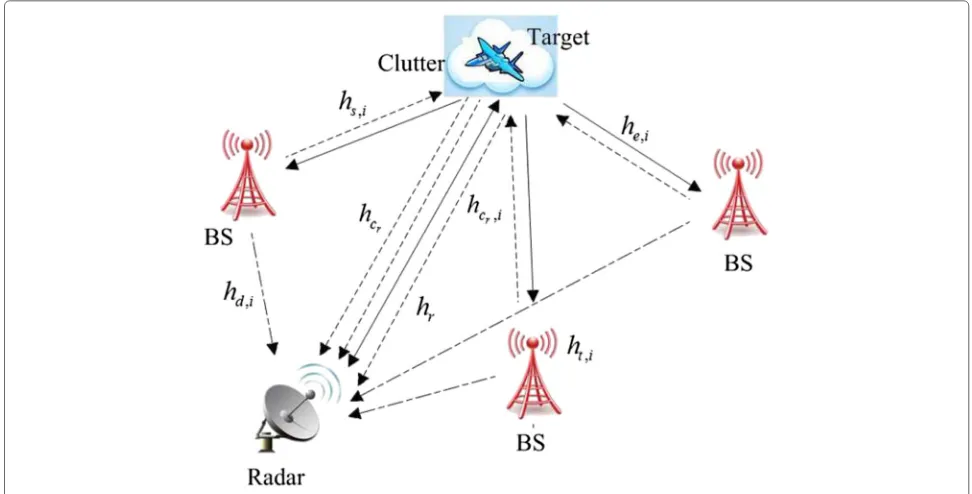
The joint radar and cellular communication systems model is depicted in Fig. 1, which is composed of one monostatic radar and Nt communication base stations (BSs) with a goal to detect the target [11]. To increase the spectral efficiency, we consider the coexistence of radar and cellular communication systems in the same fre-quency band. It is assumed that both the radar and the cellular communication systems use multicarrier OFDM signals with K subcarriers, whose main advantage is
separation of the frequency bandwidth into non-selective sub-bands [30]. The radar signalxr(t)can be given by [10]:
xr(t)=
K−1
k=0
Rkej2π(fc+kf)t, (1)
where Rk is the amplitude of thekth subcarrier for the radar signal,fcis the carrier frequency, andf is the sub-carrier spacing. For the cellular communication systems, it is supposed that each of them utilizes a portion of the entire frequency bandwidth, that is, for∀i∈ {1, 2,· · ·,Nt},
xs,i(t)=
k∈Fi
Ci,kej2π(fc+kf)t, (2)
whereFi ⊆ F = {0, 1,· · ·,K−1}, andF denotes the set of equal spaced discrete frequencies representing the operational range of the joint radar and cellular communi-cation systems.Ci,k is the amplitude of thekth subcarrier for theith BS signal.
2.2 System model
In Fig. 1, the radar receives the echo from the target due to the transmitted radar signals as well as the communica-tion signals from the BSs, both scattered off the target and through a direct path. The cellular communications sys-tems carry out their task of information transmission by broadcasting signals throughout the space. In addition, we assume that the radar antenna is directional and oriented towards the target, thus the target signal does not arrive at the cellular communication systems through a direct path, but only scattered off the target. ForNt communication BSs, the equation of the received signal at the radar sys-tem can be expressed in the continuous time domain as follows:
y(t)=r(t)+
Nt
i=1
[rs,i(t)+si(t)+rcs,i(t)]+rcr(t)+n(t),
(3)
where y(t) represents the received signal at the radar receiver,r(t)is the echo from the target due to the radar transmitted signal, rs,i(t) is the scattering off the target due to the communication signal corresponding to the
ith BS,si(t)is the communication signal arriving through a direct line of sight path at the radar receiver corre-sponding to the ith BS. rcr(t) denotes complex-valued, zero-mean Gaussian random process representing the signal-dependent clutter due to the radar transmitted sig-nal. Likewise, rcs,i(t) is the complex-valued, zero-mean Gaussian random clutter due to theith communication BS andn(t)stands for additive white Gaussian noise.
Fig. 1Joint radar and cellular communication systems model
theith direct BS-radar path,hcrfor the radar-clutter-radar path, hcs,i for the ith BS-clutter-radar path, ht,i for the communication inside theith BS cell. The communication signal xs,i(t) is supposed to be deterministic and known at the radar receiver after a previous estimation step. We assume that the channels are stationary over the observa-tion period. The channelshr(t),hs,i(t),hcr(t),hcs,i(t)and he,i(t), corresponding to the target scattering, as well as the communication channels hd,i(t) andht,i(t) are con-sidered random and only known statistically. The channel impulse responseshr(t)andhs,i(t)are assumed to be zero-mean Gaussian random processes. Thus, for the cellular communication systems withNtBSs, Eq. (3) is rewritten as:
y(t)=xr(t)⊗hr(t)+ Nt
i=1
xs,i(t)⊗hs,i(t)+xs,i(t)⊗hd,i(t)
+xs,i(t)⊗hcs,i(t)
+xr(t)⊗hcr(t)+n(t).
(4)
Applying the Fourier transform to (4), we can have:
Y(f)=Xr(f)hr(f)+
Nt
i=1
Xs,i(f)hs,i(f)+Xs,i(f)hd,i(f)
+Xs,i(f)hcs,i(f)
+Xr(f)hcr(f)+N(f). (5)
Then, the discrete signal spectrum can be equivalently written as:
Y[k]=Xr[k]hr[k]+ Nt
i=1
Xs,i[k]hs,i[k]+Xs,i[k]hd,i[k]
+Xs,i[k]hcs,i[k]
+Xr[k]hcr[k]+N[k] ,
(6)
where hr[k]∼ CN(0,σhr2[k]), hs,i[k]∼ CN(0,σhs,i2 [k]), and N[k]∼ CN(0,σn2[k]). σhr2[k] and σhs,i2 [k] are the spectral variances of the corresponding channels for the
kth subcarrier.σn2[k] is the variance of the noise. Pcr[k] andPcs,i[k] denote the PSDs of the signal-dependent clut-ters due to the radar and cellular communication BS transmitted signals for thekth subcarrier, respectively.
Therefore, the probabilistic model of the received radar signal is:
Y[k]∼CN(0,σY2[k]), (7)
where the spectral variance ofY[k] can be expressed as:
σ2
Y[k]= |Xr[k]|2σh2r[k]+ Nt
i=1
|Xs,i[k]|2σh2s,i[k]+|Xs,i[k]|2Ld,i[k]
+|Xs,i[k]|2Pcs,i[k]Lcs,i[k]
+ |Xr[k]|2Pcr[k]Lcr[k]+σ 2
n[k] ,
(8)
⎧
whereGtis the antenna gain of the radar,Gsis the antenna gain of the communication system,λk is the wavelength atkth subcarrier.dr,ds,i, anddb,irepresent the distances between the radar and the target, between theith commu-nication BS and the target, and between the radar and the
ith BS, respectively.
3 Problem formulation
In this section, we propose three different approaches to LPI-based adaptive radar waveform optimization for joint radar and cellular communication systems. It is assumed that the precise characteristics of the target spectra, the clutter PSDs, the propagation losses of corresponding channels, and the communication signals are known by the radar. Our goal here is to adaptively design the mul-ticarrier radar waveform in signal-dependent clutter with a predefined target detection constraint and a minimum required capacity for the cellular communication systems that optimizes the LPI performance of the radar system. In this paper, various SINRs are derived as metrics for target detection performance in the joint radar and cel-lular communication systems, which differ in the way the communication signals scattered off the target are con-sidered at the radar receiver: (1) as useful energy, (2) as interference, or (3) ignored altogether. Subsequently, we employ the presented LPI-based criteria to obtain the objective functions to be minimized in the optimization problems. The resulting optimization problems in this paper are solved analytically and their solutions represent the optimum power allocation for each subcarrier in the multicarrier radar waveform.
3.1 LPI based radar waveform optimization Criterion 1
Here, the SINR is utilized as a metric for target detection performance in the joint radar and cellular communica-tion systems. In this case, the scattered communicacommunica-tion signals from the target are considered as useful energy at the radar receiver. Based on the derivations in [10, 11], the achievable SINR can be described as follows:
It is worth pointing out that|Hr[k]|2Lr[k] denotes the spectral variance ofhr[k], i.e.,hr[k]∼(0,|Hr[k]|2Lr[k]), whereHr[k] is the target spectrum for the radar-target-radar path. Likewise, |Hs,i[k]|2Ls,i[k] denotes the spec-tral variance ofhs,i[k], i.e.,hs,i[k]∼ (0,|Hs,i[k]|2Ls,i[k]), whereHs,i[k] is the target spectrum for theith BS-target-radar path. The propagation losses of the corresponding channels for thekth subcarrier can be expressed as follows [30]:
We can notice from (10) that the SINR is related to the radar transmission waveform, the communication wave-form, the target spectra, the PSDs of signal-dependent clutters, and the propagation losses of corresponding channels.
In this paper, we concentrate on the LPI-based radar waveform optimization for the joint radar and cellular communication systems to minimize the radar transmit-ted power for a predefined target detection performance. We impose a minimum capacity constraint per channel for the cellular communication systems and for the radar system an upper bound on the transmit power per chan-nel. Eventually, the adaptive radar waveform optimization based on LPI can be formulated as:
min
where SINRmin denotes the predefined SINR threshold,
which is the minimum SINR requirement for the radar to satisfy its basic target detection need.tk is the minimum required capacity for the kth subcarrier in the commu-nication system. The transmitted power for thekth sub-carrier is constrained by a maximum valuePmax,k and a
minimum value 0.Lt,i[k] andLe,i[k] are the propagation losses of the corresponding channels [30]:
⎧
wheredt,iis the radius of theith communication cell. Note that the left-hand side of the second constraint in (12b) denotes the channel capacity of the communication sys-tems, which is related to the mutual information between the received signals at BSs and the transmitted commu-nication signals. The minimum capacity constraint per channel for the communication systems must be main-tained above a predetermined threshold tk inside a cell [5], which guarantees the quality of communication links. The communication channel inside the cell is represented by the impulse responseht,i(t). The interference is repre-sented by the radar signals that are scattered off the target and arrive inside the cell, whose spectrum is denoted by
He,i(t). After simplifying the constraints and using the notationxk = |Xr[k]|2, we can rewrite the optimization problem in (12) as:
min
it is shown that the SINR in (15) and (16) is increasing and concave with respect toxk. Hence, the first constraint in (14b) constitutes a convex feasible set overxk for all subcarriers, while the objective function is affine and the power constraint0 ≤ x ≤ dis the intersection of 2K
half-spaces. Therefore, the optimization problem (14) is convex.
Then, we define a modified convex minimization prob-lem by the method of Lagrange multipliers, which can be employed to solve the constrained optimization problem
in (14). The Lagrange of problem (14) can be equivalently expressed by:
ables. Due to the convex nature of problem (14), the KKT conditions are the sufficient and necessary conditions for the global optimality ofx∗k. Therefore, the KKT conditions can be developed as follows:
∂L
To be specific, ifx∗is the optimal solution, it must sat-isfy the stationarity condition ∂∂xkL = 0, primal feasibility
K−1
k=0
x∗kmk+ak
x∗knk+bk ≥ SINRmin, 0 ≤ x∗ ≤ d, dual feasi-bility λ∗1 ≥ 0, λ2∗ ≥ 0, λ∗3 ≥ 0 and complementary slackness which states that a primal constraint is satisfied with equality, if and only if, the associated dual variable is strictly greater than zero [10]. Thus, whenx∗is optimal, we obtain:
(a) If 0<x∗k <dk, thenλ∗1,k=λ∗2,k=0, we have:
whereλ∗3is a constant determined by the SINR constraint:
K−1
Therefore, the optimal power allocation solution can be derived as follows:
whereλ∗3is the Lagrange dual variable corresponding to the constraint on the SINR performance:
K−1
k=0
x∗kmk+ak
x∗knk+bk ≥
SINRmin. (28)
Remark 1:Note that our solution scheme is to choose
λ∗
3as a search variable, and use the results of (27) to
iden-tify the optimal power allocation for all the channels. The importance of the derived solution (27) lies in the fact that it provides an explicit relation between the power allocation in each subcarrier and the resulting value for λ∗
3. Criterion 1 defines a procedure which finally provides
optimal transmitting power allocation, and consequently, the optimum LPI performance. The iterative procedure is listed in Algorithm 1.
Remark 2:As aforementioned, the expression of SINR
in (10) is a function of the radar transmission waveform, the cellular communication waveforms, the target spectra, the PSDs of signal-dependent clutters, and the propaga-tion losses of corresponding channels. Thus, the precise characteristics of the communication signals, the target spectra, the clutter PSDs, and the propagation losses of corresponding channels are required to obtain the optimal solution (27). In practice, the transmitted cellular commu-nication signals and the target spectra can be provided by the communication systems and the target database based on the target-radar/BSs orientations, respectively [11, 25]. While the clutter PSDs and the propagation losses of cor-responding channels can be obtained by sensing with a spectrum analyzer or propagation modeling [25].
Algorithm 1 : LPI-based radar waveform optimization
Criterion 1
3.2 LPI-based radar waveform optimization Criterion 2
Next, if the communication signals scattered off the tar-get are received at the radar receiver and considered as interference, the overall SINR can be written as:
Similarly, the adaptive radar waveform optimization approach based on LPI can be given by:
min
We invoke the Lagrange multiplier technique yielding an objective function:
Taking the first derivative of (31) with respect toxk, and setting it to zero, we thus obtain:
∂L
After basic algebraic manipulations, we can reach the optimal solutionx∗kas a function of the Lagrange multipli-ers:
From complementary slackness, we must consider the following three cases:
whereλ∗3is a constant determined by the SINR constraint:
K−1
Thus, the optimal power allocation solution can be given by:
whereλ∗3is the Lagrange dual variable corresponding to the constraint on the SINR performance:
K−1
k=0
x∗kmk
x∗knk+ak+bk ≥
SINRmin. (42)
The iterative procedure of Criterion 2 is shown in Algorithm 2.
Algorithm 2 : LPI-based radar waveform optimization
Criterion 2
3.3 LPI-based radar waveform optimization Criterion 3
In this case, if the communication signals scattered off the target are ignored at the radar receiver, we thus haveak = 0. Then, the SINR expression is given by:
Proceeding as before, we can write the optimization
We employ again the approach of Lagrange multipliers as in (17), we obtain the objective function:
L(x,λ1,λ2,λ3)=
Taking the first derivative of (45) with respect toxk, and setting it to zero, we can obtain:
∂L
After basic algebraic manipulations, we can obtain the optimal solutionx∗kas a function of the Lagrange multipli-ers:
From complementary slackness, we must consider the following three cases:
whereλ3is a constant determined by:
K−1
Finally, the optimal power allocation solution can be obtained as:
whereλ∗3is the Lagrange dual variable corresponding to the constraint on the SINR performance:
K−1
k=0
x∗kmk
x∗knk+bk ≥
SINRmin. (56)
The iterative procedure of Criterion 3 is detailed as follows.
Algorithm 3 : LPI-based radar waveform optimization
Criterion 3
Remark 3:The complexity of Algorithm 1 is dominated
by the procedure of iterative search method and the num-ber of subcarriers. In Algorithm 1, the complexity of the loop inside the step 2 isO(K). The convergence rate of the
step 2 is based on the exhaustive search approach, which is given by O(λ∗3/). The total computational complex-ity of Algorithm 1 isO(Kλ∗3/). Moreover, we can notice
and to neither in (44) [11]. Thus, Algorithms 2 and 3 have the same complexity as Algorithm 1, i.e.,O(Kλ∗3/).
Remark 4: Note that the communication signals
scat-tered off the target would be an important component in target detection, which means that the energy corre-sponding to such scattering improves the detection per-formance of the radar system. While if the communication signals scattered off the target are not taken into account for the alternative hypothesis of the Neyman-Pearson (NP) detector, the detected energy would be reduced, resulting in a considerably lower target detection perfor-mance [10, 11]. In the following, it will be shown that the radar waveform optimization Criteria 2 and 3 offer inferior LPI performance for the radar system compared to the one that adopts Criterion 1 in the joint radar and cellular communication systems.
4 Numerical results
In this section, we provide numerical results to demon-strate the enhancement of the LPI performance brought by our proposed adaptive radar waveform optimization criteria. Throughout the simulations, the carrier fre-quency of the joint radar and cellular communication systems is 3 GHz. We set the total bandwidth to be 512 MHz, which is equally divided by K = 128 sub-carriers. A total ofNt = 3 communication systems are operating from channel 1 to 40, 41 to 80 and 81 to 128. In order for the cellular communication systems to function properly, the achievable capacity for each channel must be above a predetermined threshold, which is set to be
tk =1.0 nat/symbol(∀k). The system parameters are given as shown in Table 1.
Herein, we consider a scenario that the stealth target is illuminated from the front by the radar signals and from the side by the cellular communication signals. Hence, the communication signal scattered off the target would be a much more important component in target detec-tion than the scattered radar signal. The target spectra of the corresponding channels Hr[k], Hs[k], andHe[k] are shown in Fig. 2 respectively, which shows the target spectral impulse responses for each subcarrier. In a real-istic case, the target spectra can be provided by the target database based on the target-radar/BSs orientations. The PSDs of the signal-dependent clutters due to the radar and
Table 1System parameters
Parameter Value Parameter Value
Gt 30 dB Gs 0 dB
dr 12 km ds,i(∀i) 8 km
dt,i(∀i) 1 km db,i(∀i) 20 km
Pmax,k 200 W SINRmin 10 dB
λk(∀k) 0.10 m σn2[k](∀k) 1.66×10⁻¹⁴W
0 20 40 60 80 100 120
0 20 40 60 80 100 120 140
a
b
c
Channel number
Target spectrum [V]
Target spectrum
0 20 40 60 80 100 120
0 500 1000 1500 2000 2500 3000 3500
Channel number
Target spectrum [V]
Target spectrum
0 20 40 60 80 100 120
0 20 40 60 80 100 120 140
Channel number
Target spectrum [V]
Target spectrum
Fig. 2The target spectra of corresponding channels:aHr[k];bHs[k]; cHe[k]
0 20 40 60 80 100 120 0
2 4 6 8 10 12 14 16 18 20
Channel number
Clutter spectrum [W]
Radar clutter Communication clutter
Fig. 3Clutter spectra
power provided by the cellular communication systems. The red bars represent the transmit power of the commu-nication systems in each channel. Given the exact charac-teristics of the communication signals, the target spectra, the clutter PSDs, and the propagation losses of corre-sponding channels, we can obtain the optimal solutions of problems (14), (30), and (44).
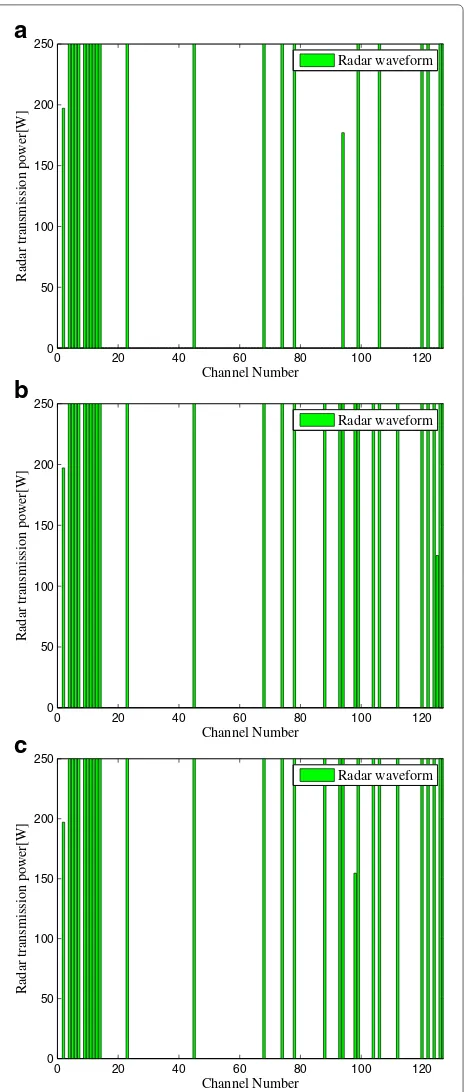
Figure 5 depicts the LPI-based radar waveform design results, which gives insight about the optimal power allo-cation for LPI performance in the radar system. For all the criteria presented here, more transmission power is allocated to the channels which have larger gain ofHr[k] and suffer less interference power provided by the cellu-lar communication systems. Specifically, to minimize the total transmitting power for a predefined SINR constraint and a minimum required capacity for the communications systems, the LPI-based transmission waveform criteria are
0 20 40 60 80 100 120 0
10 20 30 40 50 60 70 80 90
Channel number
Communication power [W]
Communication spectrum
Fig. 4Communication transmit power
0 20 40 60 80 100 120
0 50 100 150 200 250
a
b
c
Channel Number
Radar transmission power[W]
Radar waveform
0 20 40 60 80 100 120
0 50 100 150 200 250
Channel Number
Radar transmission power[W]
Radar waveform
0 20 40 60 80 100 120
0 50 100 150 200 250
Channel Number
Radar transmission power[W]
Radar waveform
Fig. 5LPI based radar waveform design results:aCriterion 1; bCriterion 2;cCriterion 3
Moreover, it is apparent that more transmit power is placed between the subcarrier 80 and 128 in Criteria 2 and 3 than that in Criterion 1. The results show that the total transmitted power of Criterion 1 is 5.6242 KW, while the transmitted power of Criteria 2 and 3 is 7.3223 and 7.1017 KW, respectively. It indicates that the LPI perfor-mance of Criterion 1 outperforms that of Criterion 2 by 30.19 % and that of Criterion 3 by 26.27 %, which is due to the fact that the communication signals scattered off the target would be a much more significant component in target detection than the radar signals [10, 11]. That is to say, if the communication waveform scattered off the target is not considered for target detection, the detected energy is reduced. We can conclude from Figs. 2, 3, 4, and 5 by stating that the LPI performance of the radar sys-tem benefits significantly from taking into consideration the communication signals scattered off the target at the radar receiver.
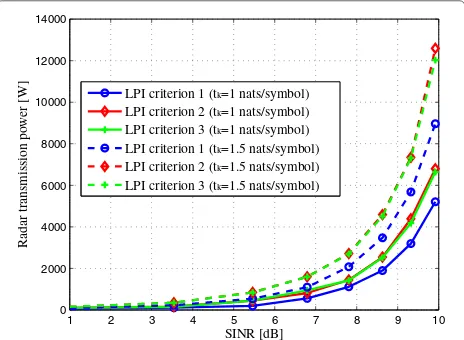
Figure 6 depicts the radar transmission power of the radar system versus SINR with differenttk employing the proposed optimal waveform optimization criteria, which are conducted 1000 Monte Carlo trials. It can be seen that the transmission power increases as the value of SINR goes up. In addition, one can observe that, as the required channel capacity for the communication system increases, more transmission power will be transmitted to satisfy the predetermined target detection performance of a radar system. Physically speaking, when the capacity threshold for each channel increases,ckis then reduced. Thus, there will be two power levels eitherdkwhen there is transmis-sion or zero otherwise. As a consequence, more channels will be allocated the maximum powerdkto guarantee the given SINR requirement.
It is shown in Fig. 7, the radar transmission power versus SINR in each Criterion with different waveform
1 2 3 4 5 6 7 8 9 10
0 2000 4000 6000 8000 10000 12000 14000
SINR [dB]
Radar transmission power [W]
LPI criterion 1 (tk=1 nats/symbol) LPI criterion 2 (tk=1 nats/symbol) LPI criterion 3 (tk=1 nats/symbol) LPI criterion 1 (tk=1.5 nats/symbol)
LPI criterion 2 (tk=1.5 nats/symbol)
LPI criterion 3 (tk=1.5 nats/symbol)
Fig. 6Radar transmission power of the radar system versus SINR with differenttkutilizing optimal waveform optimization criteria
1 2 3 4 5 6 7 8 9 10
0 0.5 1 1.5 2 2.5x 10
4
SINR [dB]
Radar transmission power [W]
Optimal waveform (Criterion 1) Optimal waveform (Criterion 2) Optimal waveform (Criterion 3) Predefined waveform (Criterion 1) Predefined waveform (Criterion 2) Predefined waveform (Criterion 3)
Optimal waveform Predefined waveform
Fig. 7Radar transmission power of the radar system versus SINR in each Criterion with different waveform optimization methods
optimization methods. As expected, the best achievable SINR can be obtained when utilizing the LPI-based opti-mal waveform optimization Criterion 1 with the same transmit power (see the pink dash-dot line), since the radar can make use of the communication signals scat-tered off the target for a better target detection capability [11]. Thus, it will in turn transmit the minimum power for a given threshold of SINR and offer the best LPI perfor-mance for the radar system. On the other hand, the radar waveform that employs Criterion 2 offers a slightly lower LPI performance than the waveform that uses Criterion 3. The reason is that Criterion 3 ignores the scattering off the target due to the communication signals rather than considers it as interference. The transmission power of the predefined waveform is also plotted, which allocates the transmission power uniformly in the whole frequency band without any prior knowledge of the target spec-tra, the clutter PSDs, and the communication signals. We can notice that the predefined waveform exhibits a much worse LPI performance than that of the optimal wave-form. Overall, the presented LPI-based radar waveform design criteria give insight about the optimal power allo-cation. These three techniques are easy to realize and will undoubtedly achieve much better LPI performance by exploiting the scattering off the target due to communica-tion signals.
5 Conclusions
and the associated optimization problem is formulated and solved analytically. Using numerical results, we have proven that the LPI performance of radar system can be considerably enhanced by exploiting the communication signals scattered off the target at the radar receiver. Future work will investigate the LPI-based robust radar wave-form design for joint radar and cellular communication systems.
Acknowledgements
This research is supported by the National Natural Science Foundation of China (Grant No. 61371170, No. 61671239), the Fundamental Research Funds for the Central Universities (Grant No. NP2015404, No. NS2016038), the National Aerospace Science Foundation of China (Grant No. 20152052028), the Priority Academic Program Development of Jiangsu Higher Education Institutions (PADA) and Key Laboratory of Radar Imaging and Microwave Photonics (Nanjing Univ. Aeronaut. Astronaut.), Ministry of Education, Nanjing University of Aeronautics and Astronautics, Nanjing, 210016, China.
Competing interests
The authors declare that they have no competing interests.
Received: 10 July 2016 Accepted: 7 October 2016
References
1. HT Hayvaci, B Tavli, inIEEE International Conference on Electromagnetics in Advanced Applications (ICEAA). Spectrum sharing in radar and wireless communication systems: A review, (Palm Beach, 2014), pp. 810–813 2. K Gerlach, Thinned spectrum ultrawideband waveforms using
stepped-frequency polyphase codes. IEEE Trans. Aerosp. Electron. Syst. 34(4), 1356–1361 (1998)
3. C Nunn, LR Moyer, Spectrally-compliant waveforms for wideband radar. IEEE Aerosp. Electron. Syst. Mag.27(8), 11–15 (2012)
4. A Aubry, A De Maio, Y Huang, M Piezzo, A Farina, A new radar waveform design algorithm with improved feasibility for spectral coexistence. IEEE Trans. Aerosp. Electron. Syst.51(2), 1029–1038 (2015)
5. M Bica, KW Huang, U Mitra, V Koivunen, inIEEE Global Communications, Conference (GLOBECOM). Opportunistic radar waveform design in joint radar and cellular communication systems (San Diego, 2015), pp. 1–7 6. M Bica, V Koivunen, Generalized multicarrier radar: models and
performance. IEEE Trans. Signal Proc.64(17), 4389–4402 (2016) 7. S Sen, A Nehorai, Adaptive design of OFDM radar signal with improved
wideband ambiguity function. IEEE Trans. Signal Proc.58(2), 928–933 (2010)
8. G Lellouch, P Tran, R Pribic, PV Gederen, inIEEE Radar Conference (RadarCon). OFDM waveforms for frequency agility and opportunities for Doppler processing in radar, (Rome, 2008), pp. 1–6
9. S Gogineni, M Rangaswamy, inIEEE Radar Conference (RadarCon). A Nehorai, Multi-modal OFDM waveform design, (Ottawa, 2013), pp. 1–5 10. KW Huang, M Bica, U Mitra, V Koivunen, inIEEE Radar Conference
(RadarCon). Radar waveform design in spectrum sharing environment: Coexistence and cognition, (Arlington, 2015), pp. 1698–1703
11. M Bica, KW Huang, V Koivunen, U Mitra, inIEEE International Conference on, Acoustics, Speech and Signal Processing (ICASSP). Mutual information based radar waveform design for joint radar and cellular communication systems, (Shanghai, 2016), pp. 3671–3675
12. AR Chiriyath, B Paul, GM Jacyna, DW Bliss, Inner bounds on performance of radar and communications co-existence. IEEE Trans. Signal Proc.64(2), 464–474 (2016)
13. A Lackpour, A Rosenwinkel, A Mody, inIEEE Radar Conference (RadarCon). Design and analysis of an information exchange-based
radar/communications spectrum sharing system (RCS3), (Philadelphia, 2016)
14. PE Pace,Deteting and classifying low probability of intercept radar. (Artech House, Boston, 2009)
15. DC Schleher, LPI radar: fact or fiction. IEEE Aerosp. Electron. Syst. Mag. 21(5), 3–6 (2006)
16. AG Stove, AL Hume, CJ Baker, Low probability of intercept radar strategies. IEE Proc. Radar Sonar Navig.151(5), 249–260 (2004) 17. DE Lawrence, Low probability of intercept antenna array beamforming.
IEEE Trans. Antennas Propag.58(9), 2858–2865 (2010)
18. ZK Zhang, JH Zhu, YB Tian, HL Li, Novel sensor selection strategy for LPI based on an improved IMMPF tracking method. J. Syst. Eng. Electron. 25(6), 1004–1010 (2014)
19. ZK Zhang, JH Zhu, inProceedings of the 2015 IEEE International Conference on Information and Automation. A novel power control method of phased array radar based on the predicted tracking Cramer-Rao lower bounds, (Lijiang, 2015), pp. 2888–2891
20. J Chen, F Wang, JJ Zhou, CG Shi, inIEEE China Summit and, International Conference on Signal and Information Processing (ChinaSIP). A novel radar radiation control strategy based on passive tracking in multiple aircraft platforms, (Xi’an, 2014), pp. 777–780
21. CG Shi, F Wang, M Sellathurai, JJ Zhou, LPI optimization framework for target tracking in radar network architectures using information-theoretic criteria. Int. J. Antennas Propag.2014, 1–10 (2014)
22. CG Shi, JJ Zhou, F Wang, inIEEE China Summit and, International Conference on Signal and Information Processing (ChinaSIP). Low probability of intercept optimization for radar network based on mutual information, (Xi’an, 2014), pp. 683–687
23. CG Shi, F Wang, JJ Zhou, H Zhang, inIEEE International Conference on, Acoustics, Speech and Signal Processing (ICASSP). Security information factor based low probability of identification in distributed multiple-radar system, (Brisbane, 2015), pp. 3716–3720
24. CG Shi, JJ Zhou, F Wang, inIEEE Radar Conference (RadarCon). LPI based resource management for target tracking in distributed radar network, (Philadelphia, 2016), pp. 1–5
25. CG Shi, F Wang, M Sellathurai, JJ Zhou, H Zhang, Robust transmission waveform design for distributed multiple-radar systems based on low probability of intercept. ETRI J.38(1), 70–80 (2016)
26. AS Narykov, OA Krasnov, A Yarovoy, inThe 16th International Conference on Information Fusion. Algorithm for resource management of multiple phased array radars for target tracking, (Istanbul, 2013), pp. 1258–1264 27. AS Narykov, A Yarovoy, inProceedings of the 43rd, European Microwave
Conference. Sensor selection algorithm for optimal management of the tracking capability in multisensor radar system, (Nuremberg, 2013), pp. 1811–1814
28. ZN Zhang, GL Shan, Non-myopic sensor scheduling to track multiple reactive targets. IET Signal Proc.9(1), 37–47 (2015)
29. ZK Zhang, YB Tian, A novel resource scheduling method of netted radars based on Markov decision process during target tracking in clutter. EURASIP J. Adv. Signal Proc.2016(1), 1–9 (2016)
30. A Turlapaty, YW Jin, inIEEE Radar Conference (RadarCon). A joint design of transmit waveforms for radar and communications systems in coexistence, (Cincinnati, 2014), pp. 315–319
Submit your manuscript to a
journal and benefi t from:
7Convenient online submission 7Rigorous peer review
7Immediate publication on acceptance 7Open access: articles freely available online 7High visibility within the fi eld
7Retaining the copyright to your article
![Fig. 2 The target spectra of corresponding channels: a Hr[ k]; b Hs[ k];c He[ k]](https://thumb-us.123doks.com/thumbv2/123dok_us/884709.1106315/10.595.305.541.85.616/fig-target-spectra-corresponding-channels-hr-k-hs.webp)