Western University Western University
Scholarship@Western
Scholarship@Western
Electronic Thesis and Dissertation Repository
8-7-2018 2:00 PM
Real-time Intrusion Detection using Multidimensional
Real-time Intrusion Detection using Multidimensional
Sequence-to-Sequence Machine Learning and Adaptive Stream Processing
to-Sequence Machine Learning and Adaptive Stream Processing
Gobinath Loganathan
The University of Western Ontario
Supervisor
Samarabandu, Jagath
The University of Western Ontario Co-Supervisor Wang, Xianbin
The University of Western Ontario
Graduate Program in Electrical and Computer Engineering
A thesis submitted in partial fulfillment of the requirements for the degree in Master of Engineering Science
© Gobinath Loganathan 2018
Follow this and additional works at: https://ir.lib.uwo.ca/etd
Part of the Digital Communications and Networking Commons, and the Systems and Communications Commons
Recommended Citation Recommended Citation
Loganathan, Gobinath, "Real-time Intrusion Detection using Multidimensional Sequence-to-Sequence Machine Learning and Adaptive Stream Processing" (2018). Electronic Thesis and Dissertation Repository. 5523.
https://ir.lib.uwo.ca/etd/5523
This Dissertation/Thesis is brought to you for free and open access by Scholarship@Western. It has been accepted for inclusion in Electronic Thesis and Dissertation Repository by an authorized administrator of
Abstract
A network intrusion is any unauthorized activity on a computer network. There are
host-based and network-host-based Intrusion Detection Systems (IDS’s), of which there are each
signature-based and anomaly-signature-based detection methods. An anomalous network behavior can be defined
as an intentional violation of the expected sequence of packets. In a real-time network-based
IDS, incoming packets are treated as a stream of data. A stream processor takes any stream
of data or events and extracts interesting patterns on the fly. This representation allows
ap-plying statistical anomaly detection using sequence prediction algorithms as well as using a
stream processor to perform signature-based intrusion detection and sequence extraction from
a stream of packets. In this thesis, a Multidimensional Sequence to Multidimensional
Se-quence (MSeq2MSeq) encoder-decoder model is proposed to predict seSe-quences of packets and
an adaptive and functionally auto-scaling stream processor: “Wisdom” is proposed to process
streams of packets. The proposed MSeq2MSeq model trained on legitimate traffic is able to
detect Neptune Denial of Service (DoS) attacks, and Port Scan probes with 100% detection rate
using the DARPA 1999 dataset. A hybrid algorithm using Particle Swarm Optimization (PSO)
and Bisection algorithms was developed to optimize Complex Event Processing (CEP) rules in
“Wisdom”. Adaptive CEP rules optimized by the above algorithm was able to detect FTP Brute
Force attack, Slow Header DoS attack, and Port Scan probe with 100% detection rate while
processing over 2.5 million events per second. An adaptive and functionally auto-scaling IDS
was built using the MSeq2MSeq model and “Wisdom” stream processor to detect and prevent
attacks based on anomalies and signature in real-time. The proposed IDS adapts itself to obtain
best results without human intervention and utilizes available system resources in functionally
auto-scaling deployment. Results show that the proposed IDS detects FTP Brute Force attack,
Slow Header DoS attack, HTTP Unbearable Load King (HULK) DoS attack, SQL Injection
attack, Web Brute Force attack, Cross-site scripting attack, Ares Botnet attack, and Port Scan
probe with a 100% detection rate in a real-time environment simulated from the CICIDS 2017
dataset.
Keywords: Intrusion Detection, MSeq2MSeq, Machine Learning, Stream Processing
Acknowlegements
I would first like to express my sincere gratitude to my supervisor Dr. Jagath Samarabandu
for the opportunity, guidance and continuous support throughout the research. Prof.
Samara-bandu was always there whenever I ran into a trouble spot or had a question about my research
or writing. Without his support, the work presented in this thesis would not be possible.
Fur-thermore, I would like to thank Dr. Xianbin Wang for his feedback on my writing and support
to find funding for this research.
I would also like to thank my labmates Nadun Rajasinghe and Wafaa Anani for their
valu-able feedback shared throughout the lab meetings and informal discussions we had. Friends
shape us and support us whenever we are in need. I have no words to thank Sayon, Malar,
Jerad, Sri, Vinothan, Sathya, Yogananth, and Kirubana for their support from the day one until
now. Though we were far away from each other, I would not be able to complete my research
without the moral and emotional support of my family. I would like to express my very
pro-found gratitude to my parents, aunt, sister, brother, and my fiance for their love and support.
I also would like to thank professors at Western including Dr. Vijay Parsa, Dr. Aleksander
Essex, Dr. Roy Eagleson, Dr. Roberto Solis-Oba, Dr. Olga Veksler, and Dr. Hamada Ghenniwa
who provided me knowledge and guidance. Last but not least, thank you very much for all the
staffin Western University for taking good care of me.
Contents
Abstract i
Acknowlegements iii
List of Figures viii
List of Tables x
List of Appendices xi
List of Abbreviations xii
1 Introduction 1
1.1 Motivation . . . 1
1.2 Contributions . . . 9
1.3 Document Structure . . . 10
2 Background 11
2.1 Intrusion Detection . . . 11
2.2 Sequence to Sequence Encoder Decoder Model . . . 12
2.3 Adaptive Stream Processor . . . 14
3 Problem Formulation 18
3.1 Map Intrusion Detection to Sequence Prediction . . . 18
3.2 Stream Processor Query Optimization . . . 20
4 Methodology 22
4.1 Dataset Selection and Preprocessing . . . 22
4.2 Sequence to Sequence Model . . . 25
4.3 Multidimensional Sequence to Multidimensional Sequence Model . . . 26
4.4 Wisdom Stream Processor . . . 29
4.5 Integrating the Stream Processor with Machine Learner . . . 34
4.6 Intrusion Detection System . . . 35
4.6.1 Adaptive Intrusion Detection System . . . 37
4.6.2 Functionally Auto-scaling Intrusion Detection System . . . 39
5 Evaluation 43 5.1 Phase 1 - Test the MSeq2MSeq model using DARPA 1999 dataset . . . 43
5.1.1 Test 1.1 - Validate the MSeq2MSeq model using legitimate TCP con-nections . . . 44
5.1.2 Test 1.2 - Determine the minimum accuracy threshold . . . 45
5.1.3 Test 1.3 - Test the ability of the MSeq2MSeq model in real-time intru-sion detection . . . 46
5.2 Phase 2 - Test the Intrusion Detection System using CICIDS 2017 dataset . . . 46
5.2.1 Test 2.1 - Test the integration of Wisdom Stream Processor with Ma-chine Learning model . . . 47
5.2.2 Test 2.2 - Test the self-tuning ability of Wisdom Stream Processor . . . 47
5.2.3 Test 2.3 - Test the complete Intrusion Detection System using CICIDS 2017 dataset . . . 48
5.3 Phase 3 - Test the functionally auto-scaling ability of Wisdom Stream Processor 50 5.3.1 Test 3.1 - Compare the memory consumption of functionally auto-scaling deployment with manual deployment . . . 50
6 Results 52
6.1 Phase 1 - Test the MSeq2MSeq model using DARPA 1999 dataset . . . 52
6.1.1 Test 1.1 - Validate the MSeq2MSeq model using legitimate TCP con-nections . . . 52
6.1.2 Hypothesis . . . 52
6.1.3 Test 1.2 - Determine the minimum accuracy threshold . . . 53
6.1.4 Test 1.3 - Test the ability of the MSeq2MSeq model in real-time intru-sion detection . . . 54
6.2 Phase 2 - Test the Intrusion Detection System using CICIDS 2017 dataset . . . 55
6.2.1 Test 2.1 - Test the integration of Wisdom Stream Processor with Ma-chine Learning model . . . 55
6.2.2 Test 2.2 - Test the self-tuning ability of Wisdom Stream Processor . . . 56
6.2.3 Test 2.3 - Test the complete Intrusion Detection System using CICIDS 2017 dataset . . . 57
6.3 Phase 3 - Test the functionally auto-scaling ability of Wisdom Stream Processor 59 6.3.1 Test 3.1 - Compare the memory consumption of functionally auto-scaling deployment with manual deployment . . . 59
7 Conclusion 61 Bibliography 63 A Signature-based Wisdom Rules 72 A.1 HTTP SlowHeader Detector . . . 72
A.2 FTP Brute Force Detector . . . 73
A.3 Port Scan Detector . . . 74
A.4 SQL Injection Detector . . . 75
B Anomaly-based Wisdom Rules 76 B.1 TCP Packets Filter . . . 76
B.2 UDP Packets Filter . . . 77
B.3 TCP Bucket Connector . . . 78
B.4 UDP Bucket Connector . . . 79
B.5 Processed Stream Filter . . . 80
Curriculum Vitae 81
List of Figures
1.1 TCP Three-way Handshake . . . 2
1.2 Direct SYN Flood . . . 3
1.3 Intrusion Detection System . . . 5
2.1 Sequence to Sequence Encoder Decoder Model . . . 13
3.1 HTTP Slow Header DoS Detector . . . 20
4.1 Multidimensional Sequence to Multidimensional Sequence Model . . . 27
4.2 Impact of Reversing Encoder Input . . . 28
4.3 Impact of Attention Layer . . . 29
4.4 Made-up Profit Function . . . 30
4.5 CEP Rule Optimization Algorithm . . . 31
4.6 Wisdom Optimizer Architecture . . . 32
4.7 Wisdom Java API . . . 33
4.8 Wisdom Query . . . 33
4.9 Wisdom Stream Processor and Machine Learner . . . 35
4.10 Predictive Wisdom Query . . . 36
4.11 Intrusion Detection System . . . 38
4.12 Self-tuning Intrusion Detection System . . . 39
4.13 Filter Query Used in Functionally Auto-scaling Deployment . . . 40
4.14 DoS Attack Detector Used in Functionally Auto-scaling Deployment . . . 41
5.1 Weighted Packet Distance Algorithm . . . 46
5.2 Loss Function to Tune “Wisdom” Rules . . . 48
5.3 Test 2.3 Deployment . . . 49
5.4 Distributed and Functionally Auto-scaling Deployment . . . 51
6.1 Sequence Prediction Accuracy . . . 53
6.2 Clusters of Predicted Connections . . . 54
6.3 Timestamp of Alarms Raised by FTP Bruteforce Detector . . . 57
6.4 Timestamp of Alarms Raised by HTTP Slow Header DoS Detector . . . 58
6.5 Timestamp of Alarms Raised by Port Scan Detector . . . 58
6.6 Memory Consumption in Manual Deployment . . . 60
6.7 Memory Consumption in Functionally Auto-scaling Deployment . . . 60
List of Tables
4.1 Buckets of Sequences . . . 24
4.2 Performance Comparison of Stream Processors . . . 30
4.3 Bayesian Optimization vs Particle Swarm Optimization . . . 31
6.1 Accuracy and Number of Packets . . . 55
6.2 Precision and Recall of Optimized Wisdom Rules . . . 56
6.3 Precision of Signature-based Rules . . . 57
List of Appendices
Appendix A Signature-based Wisdom Rules . . . 72
Appendix B Anomaly-based Wisdom Rules . . . 76
List of Abbreviations
BiRNN Bidirectional Recurrent Neural Network
BOA Bayesian Optimization Algorithm
CEP Complex Event Processing
DDoS Distributed Denial of Service
DoS Denial of Service
FTP File Transfer Protocol
GA Genetic Algorithm
HTTP Hypertext Transfer Protocol
HULK HTTP Unbearable Load King
ICMP Internet Control Message Protocol
IDS Intrusion Detection System
IoT Internet of Things
LSTM Long Short-Term Memory
MQTT Message Queuing Telemetry Transport
MSeq2MSeq Multidimensional-Sequence-to-Multidimensional-Sequence
NMT Neural Machine Translation
pcap packet capture
PSO Particle Swarm Optimization
RNN Recurrent Neural Network
Seq2Seq Sequence-to-Sequence
SQL Structured Query Language
TCP Transmission Control Protocol
TLS Transport Layer Security
UDP User Datagram Protocol
Chapter 1
Introduction
1.1
Motivation
The rise in popularity of cloud computing has caused data and software housed in local
work-stations to migrate to remote servers. The Internet of Things (IoT) and mobile devices heavily
rely on services provided over the Internet. Availability of user data in a central point and the
single point of failure attract attackers to breach servers. Intrusion Detection Systems are being
used to detect such attacks in a network or a host. However, these days there are a lot of tools
developed to automate attacks. New attacks are being invented by evading the detection
tech-niques used to prevent existing attacks. For example, GoldenEye Denial of Service (DoS) [1]
attack evades HTTP Unbearable Load King (HULK) DoS [2] detectors by adding randomness
to packets. Therefore, an Intrusion Detection System (IDS) should be able to detect unknown
attacks or at least should be able to adapt to detect evolving attacks.
There are host-based and network-based intrusion detection systems, of which there are
each signature and anomaly based methods [3]. Anomaly-based systems detect intrusions
based on anomalous behaviors observed in a network. There are no ideal machine learning
models to detect anomalous packets with a 0 prediction accuracy. Therefore a minimum
pre-diction accuracy threshold is used to classify anomalous packets. Such anomaly-based IDS’s
2 Chapter1. Introduction
require a large amount of anomalous traffic to detect attacks with enough confidence. For
example, in a SYN Flood DoS attack, the attacker sends a large number of SYN requests to
the victim, which is a noticeable anomalous traffic in a network. However, attacks targeting
selected system vulnerabilities using a few number of packets are hard to detect for
anomaly-based systems. Signature-anomaly-based systems detect attacks anomaly-based on predefined attack specific rules
regardless of the number of packets involved in the attack. For example, a Structured Query
Language (SQL) Injection attack is easy to detect by looking for SQL keywords in request
parameters.
Figure 1.1: TCP Three-way Handshake – a legitimate TCP sequence starts with SYN, fol-lowed bySYN-ACK and ends withACK.
In this research, an anomaly-based network intrusion is defined as an intentional violation
of expected behavior or network protocols. A network protocol is a well-defined sequence of
packets often represented by a state machine. For example, a Transmission Control Protocol
(TCP) handshake as shown in Figure 1.1 is a sequence of three TCP packets with TCP flags:
1.1. Motivation 3
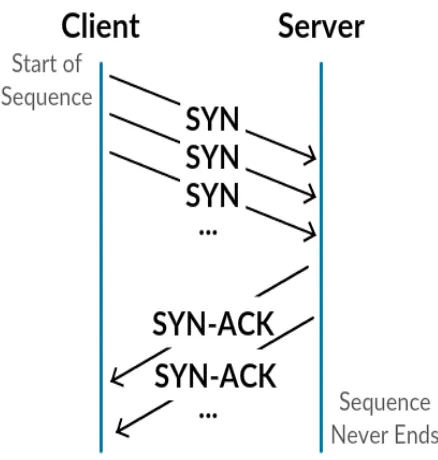
as depicted in Figure 1.2 is an anomalous sequence with a large number of (SYN, SYN-ACK,
SYN, SYN-ACK, ...) packets in which the order ofSYN-ACKmay differ. The ability of machine
learning algorithms trained on legitimate traffic to detect unseen attacks makes them suitable
for anomaly-based IDS’s. Researchers have already proposed several machine learning
algo-rithms to detect network intrusions [4, 5]. To the best of my knowledge, none of them except
Bontempset al. have taken advantage of the sequential relationship of packets in a legitimate
network connection to detect intrusions. Bontempset al. aligned packets arrived in a
prede-fined interval as a sequence and trained a stacked Long Short-Term Memory (LSTM) Recurrent
Neural Network (RNN) to predict lastn−3 packets using first 3 packets of a sequence where
n is the number of packets in a sequence [6]. However, their definition of the sequence may
include completely unrelated packets from different connections which can drastically reduce
the accuracy. Grouping packets arrived in a predefined interval as a sequence gives rise to
unrealistic sequences depending on external factors such as peak business time.
4 Chapter1. Introduction
Sommer and Paxson discussed some of the challenges in using machine learning for
in-trusion detection including a) high cost of errors, b) semantic gaps like alert generation and
organization-specific policies, c) diversity of network traffic, and d) lack of appropriate
pub-lic datasets [7]. Even though these problems still exist in machine learning based intrusion
detection, signature-based IDS’s like Snort [8] are less affected by these problems because a
carefully developed signature-based rule generates a relatively smaller number of false alarms
than machine learning methods [3]. Commercial signature-based IDS’s provide the necessary
infrastructure to send alarms to interested stakeholders. In addition, signatures developed by
domain experts do not require public datasets to define those rules. However, diversity of
net-work traffic is a problem for signature-based IDS’s. For example, receiving more traffic in a
peak season is normal for an online retail service but receiving a similar amount of traffic on
a regular day can be a symptom of DoS attack. Signature-based IDS’s must be able to adapt
according to external conditions to overcome this problem. In addition, existing IDS’s do not
utilize available resources other than network packets. Using all data sources like network
packets, application logs, system logs, and policy changes can improve the detection ratio.
Complex Event Processing (CEP) is a reactive programming paradigm used in
respond-ing to real-time events based on predefined rules. Stream processors provide the necessary
infrastructure to develop and deploy CEP rules for a wide range of applications including
intrusion detection [9], healthcare [10], fleet management [11], and power grid [12].
Com-mercial stream processors like Apache Flink [13], Esper [14], and WSO2 Stream Processor
[15] support different input sources and output sinks like File, Email, Hypertext Transfer
Pro-tocol (HTTP) connection, TCP connection, Message Queuing Telemetry Transport (MQTT)
connection, Databases, and Message Queues [16, 13]. Some products even support writing
custom receivers and producers with minimal effort [16, 13]. The ability of stream processors
to receive data from multiple sources and emit events to different receivers makes them a better
alternative to signature-based IDS’s. SQL like stream processing queries offered by most of
1.1. Motivation 5
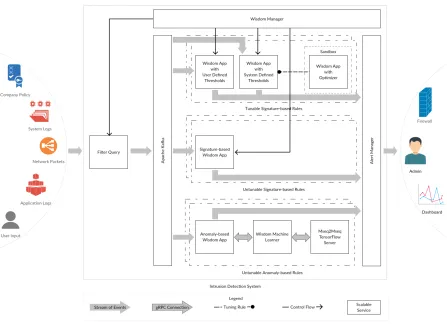
Figure 1.3: Intrusion Detection System– a high-level architecture of the adaptive and func-tionally auto-scaling IDS developed using Wisdom Stream Processor and MSeq2MSeq model.
weakness of existing stream processors is their inability to adapt according to external
condi-tions. There were several attempts made on dynamic query deployment [17], adaptive stream
processing [18], and automatic query mining with an intention to replace domain experts with
machines [19, 20, 21, 22]. However, none of them were used outside of research
environ-ments due to the unrealistic assumptions made by researchers such as raw events not being
complex, or a single CEP rule template being able to represent all complex events. Therefore,
stream processors still require manual deployment of new queries when there is a change in
requirement and do not address the challenge of “diversity of network traffic” when it comes
to intrusion detection using stream processors.
In this research, a network-based IDS was built using both anomaly-based and
6 Chapter1. Introduction
in real-time. Even though the proposed IDS is tested using network packets, the
signature-based rules of the proposed IDS can be used as a host-signature-based IDS. The proposed IDS can
be hosted anywhere in a network and fed with packets captured using network monitoring
tools like Wireshark [23] and other required information like application logs in real-time. The
anomaly-based intrusion detection problem is mapped to multidimensional sequential anomaly
detection problem (see chapter 3.1 for details) and a novel
Multidimensional-Sequence-to-Multidimensional-Sequence (MSeq2MSeq) model based on the traditional Sequence-to-Sequence
(Seq2Seq) model [24] is proposed for real-time anomaly-based intrusion detection [25]. The
model was trained using packets from regular network traffic split into sequences. In testing,
actual packets highly deviating from predicted packets are classified as anomalies. Training the
model on normal traffic instead of intrusion traffic gives access to large training data and lets the
model detect even new unknown attacks those are deviating from a regular pattern. Humans are
better than machines at designing logical CEP rules due to their cognition. However, expecting
a human to modify deployed rules in real-time based on the dynamics of the operating
envi-ronment is not practical. To address this, a new adaptive andfunctionally auto-scalingstream
processor: “Wisdom” has been developed which can optimize its queries automatically using
swarm intelligence1 [27]. We use the term“functionally auto-scaling” to mean the ability of
“Wisdom” stream processor to add more features by starting or to reduce resource consumption
by stopping unwanted rules. Using such a self-tuning stream processor in intrusion detection
solves the problem of “diversity of network traffic” by adjusting thresholds on the fly based
on the dynamics of the environment. Humans also need an expressive language to code their
knowledge in defining an attack signature. Semantics used to define rules in popular IDS’s like
Snort are not expressive enough and hard to interpret for a novice user. Therefore, “Wisdom”
supports SQL like “Wisdom Query” language which is expressive enough for humans to code
their knowledge. At the same time, “Wisdom Query” also provides variables and annotations
which are used by the stream processor itself to optimize the rule and to automate
deploy-1Intelligent behavior of a decentralized population emerged by intractability and non-representability of
1.1. Motivation 7
ment. “Wisdom” stream processor is used to build other core components of the IDS including
signature-based detectors. “Wisdom” stream processor supports the following input sources:
HTTP endpoints, gRPC [28] endpoints, Apache Kafka [29] Topics, CSV files, and packet
cap-ture (pcap) files from which events may be read. Output event sinks implemented in “Wisdom”
include: HTTP endpoints, gRPC endpoints, Apache Kafka Topics, Console and Text files. New
input sinks and output source can be developed with minimal effort using “Wisdom” extension
library2. Variety of sources and sinks let the IDS read data from multiple sources including raw
network packets, system logs, application logs, and user feedback and send alerts to different
stakeholders like system admin, network firewall or even a dashboard for statistical purposes.
However, within the IDS, Apache Kafka is used to provide loosely coupled communication
between “Wisdom” applications3. Quality of a self-tuning CEP rule is highly determined by
the data used to tune threshold values at the runtime. Since we do not have control over what
is received at the runtime, the self-tuned rule may miss some attacks which could be detected
with original user-defined thresholds. To overcome this problem, aMinimum Rate Guaranteed
deployment of tunable signature-based rules is proposed (see Figure 1.3) using two additional
clones of the actual CEP rule which are used to tune the CEP rule in a sandbox and to detect
attacks using tuned CEP rule along with the actual rule (discussed in chapter 4.6.1).
In addition to the adaptiveness of stream processor, particular attention was paid on utilizing
system resources for intrusion detection. Stream processors like Apache Flink [13] supports
distributed deployment of rules where each CEP operators can be scaled up and down. Even
though stream processors can distribute and scale operators, not all stateful operators are
hori-zontally scalable [30]. Especially when it comes to dynamic CEP operators, it is hard to track
and atomically update them in a horizontally scaled environment. Therefore, a novel
function-ally auto-scaling deployment of CEP rules in a distributed environment is proposed to utilize
the available resources. As depicted in Figure 1.3, each “Wisdom” rule deployed in the IDS
2How to write a Wisdom extension is explained at https://slgobinath.github.io/wisdom/
wisdom-extensions
3In this thesis, “Wisdom application”, “Wisdom rule” and “Wisdom query” are used interchangeably to refer
8 Chapter1. Introduction
is a standalone microservice [31] application. Therefore they can be scaled up and down
in-dividually depending on the requirement. The “Wisdom Manager” and “Filter Query” along
with other rules form a functionally auto-scaling infrastructure to reduce the overall resource
consumption of the IDS. In this deployment, “Wisdom” queries with low priority are kept off
by the “Wisdom Manager” until some events related to those queries are sent by the
“Fil-ter Query”. More details about functionally auto-scaling deployment is discussed in Chap“Fil-ter
4.6.2 and the minimum resource consumption of the proposed functionally auto-scaling IDS is
demonstrated in Chapter 5.3.
The proposed machine learning model itself cannot solve the problems addressed by
Som-mer and Paxson. However, the signature-based IDS built on top of the adaptive stream
proces-sor generates a smaller number of false positives, and false negatives and adapts at the runtime
based on the diversity of network traffic. The ability of “Wisdom” stream processor in
receiv-ing and sendreceiv-ing events through various protocols let the proposed IDS receive
organization-specific policies and send alerts to different stakeholders. Signature-based IDS’s do not require
datasets to define rules because attack signatures are developed by domain experts based on
how an attack works. It makes signature-based IDS’s not affected by the availability of public
dataset. Therefore, the proposed hybrid IDS supporting both signature-based detection and
anomaly-based detection successfully overcomes common challenges encountered in machine
learning based IDS’s. In Phase 1 evaluation, the proposed MSeq2MSeq model was compared
with the LSTM RNN model used by Bontempset al.[25]. The model developed by Bontemps
et al. was able to detect Neptune DoS attack with 100% detection rate and 63 false alarms in
DARPA 1999 dataset [6]. The MSeq2MSeq model along with the definition of sequence was
able to detect Port Scan probe and Neptune DoS attack with 100% detection rate and only a
single false alarm was produced in DARPA 1999 dataset [25]. The proposed IDS was tested
with four signature-based rules and an anomaly-based rule against CICIDS 2017 dataset [32].
It was able to detect File Transfer Protocol (FTP) Brute Force attack, HTTP Slow Header DoS
1.2. Contributions 9
attack, Ares Botnet [33] attack, and Port Scan probe with 100% detection rate.
1.2
Contributions
To summarize, this thesis presents the following contributions:
• A novel MSeq2MSeq model which can be used in any multidimensional sequence
pre-diction problem like intrusion detection, weather prepre-diction, and stock prepre-diction is
de-veloped.
• An adaptive and functionally auto-scaling stream processor: “Wisdom” is implemented
which can be used for any stream processing applications such as intrusion detection,
fraud detection, and fleet management.
• Suitability of Bayesian Optimization Algorithm (BOA) and Particle Swarm Optimization
(PSO) for CEP rule optimization is compared, and a hybrid algorithm using PSO and
Bisection algorithm is implemented as part of the “Wisdom” Stream Processor.
• Prototype of a distributed IDS using MSeq2MSeq model for anomaly-based intrusion
detection and “Wisdom” stream processor for signature-based intrusion detection is
de-veloped and tested using CICIDS 2017 dataset. The proposed IDS supports adaptive
rules and functionally auto-scaling deployment with the support of “Wisdom” stream
processor. Minimum Rate Guaranteeddeployment ensures that the adaptive rules will
never reduce the detection rate of initial rules with user-defined thresholds. Semantics
of the SQL like “Wisdom” query used in the proposed IDS is easy to learn than the
10 Chapter1. Introduction
1.3
Document Structure
The remainder of this thesis is organized as follows: The mathematical formulation of
map-ping intrusion detection to sequence prediction problem and CEP rule optimization problem
are presented in Chapter 3. A literature review is presented in Chapter 2 which describes
dif-ferent intrusion detection techniques and early research activities on building dynamic stream
processors. In Chapter 4, the methodology of the proposed method is described in detail. It
contains detailed description and architecture of the MSeq2MSeq model, “Wisdom” stream
processor and the proposed IDS. Tests conducted to evaluate the MSeq2MSeq model, the IDS,
and functionally auto-scaling deployment are elaborated in Chapter 5. Obtained results in all
test cases are presented and discussed in Chapter 6. Finally, the conclusion of the research and
Chapter 2
Background
2.1
Intrusion Detection
Maheshkumar and Gursel used nine different pattern recognition, and machine learning
al-gorithms to detect attacks in the KDD CUP 1999 dataset [4]. The authors proposed a
multi-classifier model using Multilayer Perceptron for probe attacks, K-means algorithm for DoS and
User-to-Root (U2R) attacks, and Gaussian classifier for Remote-to-Local (R2L) attacks based
on the results they obtained. The proposed multi-classifier was able to detect probe attacks,
DoS attacks, U2R attacks, and R2L attacks with 0.887, 0.973, 0.298, and 0.096 detection rates
respectively. Since KDD CUP 1999 is a pre-processed and flattened dataset, this work does
not take advantage of the sequential relationship of packets.
Bontempset al. used LSTM RNN based model to detect Neptune DoS attack with 100%
true positives and 63 false positives in the time series version of KDD CUP 1999 dataset using
collective anomalies in a network [6]. 63 false alarms in a five day period are not
accept-able for an IDS. In their research, the model was trained using attack-free traffic to predict a
sequence of packets using the first three packets. The average prediction error was used to
classify anomalies. Bontempset al. defined all packets arrived within a fixed time window as
a sequence. However, within a time window, there can be packets from multiple connections
12 Chapter2. Background
and multiple clients which are independent of each other. Furthermore, packets arrived within
a time window is depending on external factors like peak business hours which do not have
a constant pattern. Therefore their proposed solution may not give the claimed accuracy with
real datasets.
Lobato et al. used stream processors with machine learning algorithm to detect DoS and
probe attacks in real-time [34]. They used a stream processor to receive logs from applications
and packets from Bro Network Security Monitor [35]. The authors used Decision Tree,
Artifi-cial Neural Network (ANN), and Support Vector Machine (SVM) algorithms for unsupervised
classification and obtained above 90% accuracy with ANN and SVM algorithms. Though they
used stream processor, it was not used for signature-based detection. Furthermore, the ANN
used in this research is just a linear regression model which does not take advantage of the
sequential order of packets. Therefore it has no significant difference from Maheshkumaret
al.’s work [4].
Massimo and Luigi proposed a signature-based IDS using a stream processor [9]. In this
work, authors assumed that an attack requires some mandatory pre-steps to complete and
de-veloped CEP rules to detect those patterns. For example, they assumed that an SQL Injection
attack always starts with a Port Scan followed by Directory Traversal and Buffer Overflow
within a predefined time frame. However, the authors agree that it is hard to define an interval
which covers all these steps because an attacker may execute each of them at different times
depending on his level of patience. Furthermore, a hacker can attack a known public endpoint
using SQL Injection without scanning open ports. Therefore, this methodology is not suitable
for a real IDS.
2.2
Sequence to Sequence Encoder Decoder Model
Intrusion detection based on anomalies in a sequence of packets requires a machine learning
2.2. Sequence toSequenceEncoderDecoderModel 13
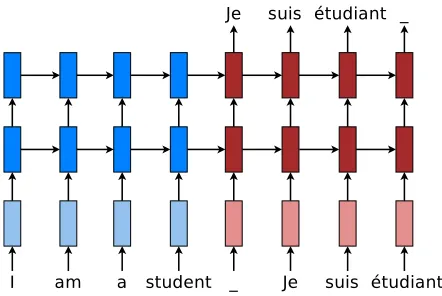
Figure 2.1: Sequence to Sequence Encoder Decoder Model– a stacking recurrent architec-ture for translating a source sequence “I am a student” into a target sequence “Je suis ´etudiant”. Here, marks the end of a sequence. [45]
addressed in Neural Machine Translation (NMT) in which source and translated sentences are
treated as sequences of words. NMT researchers have moved from LSTM RNN to Seq2Seq
Encoder-Decoder model since the work of Sutskeveret al. [24]. The model was later improved
by other researchers and became the state-of-the-art solution in NMT [24, 36, 37, 38, 39, 40].
For example, the sentence “I am a student” in English can be translated into “Je suis ´etudiant”
in French using Seq2Seq model as shown in Figure 2.1. The Seq2Seq model is also used in
object recognition in video [41, 42] and anomaly detection in series of events [43]. Malhotraet
al. used stacked LSTM RNN and Seq2Seq model to detect anomalous sensor data [43, 44]. In
their research, Seq2Seq model gave better results for unpredictable datasets, whereas stacked
LSTM RNN gave better results for predictable datasets [43].
The sequence in NMT is a sentence formulated by words in a given order. Similarly, the
sequence in video analysis is a grid of pixels aligned sequentially. In both cases, elements of
a sequence are one-dimensional items such as words or pixels. Datasets used by Malhotraet
al. also contain sequences of single dimensional sensor readings. However, in packet
predic-tion, both input and output are sequences of multidimensional packets. Selected attributes of
a packet may or may not have interdependencies. In such a multidimensional Seq2Seq
prob-lem, the model must learn those interdependencies and the contribution of each attribute in
14 Chapter2. Background
In NMT, some words are more important than others. Attention layers were introduced
to the Seq2Seq model to focus on the more relevant word in source sentence [37, 38, 39]. In
a video frame, some pixels may be more important than others. Such important pixels are
extracted using convolutional encoders [41, 42]. Sutskever et al. reversed the encoder input
to introduce short-term dependencies and obtained a better result in English to French NMT
because it reduces the average distance between target words [24]. Luonget al. also obtained
better results by reversing the input sentence in English to German NMT [38]. Bahdanauet al.
used Bidirectional Recurrent Neural Network (BiRNN) instead of LSTM in Seq2Seq model
which can read input sequence in both directions [37].
2.3
Adaptive Stream Processor
Machine learning algorithms for anomaly detection and publicly available stream processors do
not address the problem of “diversity of network traffic” as discussed in Chapter 1. Even though
several attempts were made to build adaptive stream processors, all of them were limited to
cer-tain domains and datasets due to the unrealistic assumptions made by researchers. This section
briefly analyzes such attempts and their applicability to intrusion detection. Mousheimishet al.
proposed automatic predictive CEP rule mining from classified multivariate time series dataset
[19]. Their learning algorithm first searches for subsequences across a time series input. The
length of possible subsequences is limited by user-defined lower and upper bounds. Later,
it prunes redundant parts of subsequences and builds a CEP rule using subsequence with the
highest accuracy. This approach is limited by user-defined sequence lengths and limited CEP
rule templates which are not guaranteed to fit all use cases.
Margaraet al.developed iCEP which can generate CEP rules using time window, selector,
logical operator, pattern, and aggregator [20]. iCEP learns interesting events and time frame
followed by aggregators and filters, and finally parameters and sequences in an independent
prop-2.3. AdaptiveStreamProcessor 15
agate and affect the following learners. For example, if “Time Window Learner” does not
capture all the necessary events, “Sequence Learner” cannot learn a sequence at the end of
the pipeline. Isolated learning phases of iCEP fail to address the correlation between CEP
operators. Therefore, a rule generated by iCEP may not perform well on a highly correlated
domain.
Leeet al. proposed CEP rule mining based on similarity match [21]. In this work, authors
clustered event sequences, extracted a complex event based on similarity across sequences from
the same cluster and finally generated a complex event pattern using Markov Transition model.
The proposed clustering algorithm calculates the distance between two sequences based on the
cosine similarity between individual events and their position in sequence. The attribute to
calculate cosine similarity is determined by domain experts.
Mehdiyevet al. used Elitist Pareto-based Multi-Objective Evolutionary Algorithm to select
event attributes and Fuzzy Unordered Rule Induction Algorithm to classify events [22].
Au-thors compared the proposed algorithm with other classification algorithms but did not propose
a way to generate CEP rules using the proposed algorithm. They also admit that generating
CEP rules from the output of their classifier is a difficult challenge to address.
All above CEP rule mining methodologies were developed with an intention to replace
do-main experts with machines. However, they rely on false assumptions like raw events not being
complex, TimeWindow being enough to collect events in all scenarios, or a single CEP rule
template being able to represent all complex events. These assumptions oversimplify the
prob-lem and do not capture the real world requirements. Furthermore, these solutions mainly focus
on generating rules for frequently occurring patterns. In anomaly driven domains like
intru-sion detection, such frequently occurring patterns represent legitimate traffic in training data.
Hence rules developed using frequently occurring patterns may not work well for detecting
anomalous traffic.
Turchinet al.defined CEP rules based on probability score of selected attributes and tuned
16 Chapter2. Background
The concept of tuning rule parameters and the application of adaptive rules to detect attacks in
DARPA 1999 dataset are close to this research. Therefore, Turchin et al.’s results have been
chosen as a benchmark to compare the results obtained in this research. However, their
contri-bution to CEP rule optimization may not be widely applicable because their rules neither use
any CEP operators like Filter1 orWindow2 nor follow CEP semantics. Therefore, their
solu-tion does not address any problems we raised in Chapter 3.2 such as correlated parameters or
discontinuous function. Instead, they calculate anomalous probability score of request length,
response length, possible “SYN” error, and hostname for each packet. A packet is classified as
an anomaly by comparing the total score of these four attributes with two threshold values.
Us-ing anomalous probability score of the hostname will give high accuracy in a simulated dataset
but not in an actual deployment. For example, in CICIDS 2017 dataset, Firewall translates the
hostnames of most of the attackers to the same IP address. Similarly, in DARPA 1999 dataset,
same hosts were reused multiple times to simulate different attacks. In both these datasets, the
anomalous probability score of attackers will be high and yield a high accuracy. In a real attack,
there is a high chance of an attacker to spoof the IP address so that the anomalous probability
score of that unknown IP will be close to zero which will reduce the accuracy of the system.
BOA [46] is widely being used by researchers for hyperparameter optimization and
black-box optimization [47]. In this method, an unknown objective function is mapped into a prior
belief and sequentially refined by a Bayesian posterior update [47]. Snoeket al. used BOA to
tune machine learning hyperparameters [48]. It is also used by Pooyanet al. to optimize the
performance of Apache Storm stream processor [49]. Among the population-based
optimiza-tion algorithms, Genetic Algorithm (GA) and PSO [50] are widely used for hyperparameter
tuning [51, 52]. GA and PSO optimized a selected set of problems with equal accuracy in
a test conducted by Hassan et al. [53]. Though GA has been successfully applied for
opti-mization problems, it is inefficient for applications with highly correlated parameters [52]. In
1A CEP operator used to filter events based on a given condition.
2A CEP operator used to subset events based on some conditions like a time frame or number of events per
2.3. AdaptiveStreamProcessor 17
addition, GA is much more complex to implement than PSO. Therefore, both BOA and PSO
are evaluated for suitability in this research due to their simplicity and popularity in similar
Chapter 3
Problem Formulation
3.1
Map Intrusion Detection to Sequence Prediction
Seq2Seq model is widely being used in NMT [24, 36, 37, 38, 39, 40]. In general, a Seq2Seq
problem can be defined as below:
X= (x1,x2,x3, ...xn)
Y = (y1,y2,y3, ...ym)
Y0 = (σs,y01,y02,y03, ...y0m, σe)
Yi0+1= f(X, i [
t=0
Yt0)
where X is the input sequence which is the source sentence in NMT, and Y is the expected
output sequence which is the ideal translated sentence in NMT.σsis a flag indicatingStart of
Sequenceknown as <S OS> in NMT and σe is a flag indicatingEnd of Sequence known as
<EOS>in NMT.Y0is the input to the decoder which starts withσsand ends withσe. Naively,
y0i is the predicted item for the decoder inputy0i−1. In teacher forcing method [54],yi−1is used
as the decoder input to predict y0i. f is the Seq2Seq encoder-decoder model which generates
3.1. MapIntrusionDetection toSequencePrediction 19
thei+1thitem of output sequence using the input sequenceXtogether with the firstielements
of decoder inputY0.
The intrusion detection problem can be mapped to the Seq2Seq prediction problem by
defining a sequence of packets Pas given below in which pi is theithpacket in the sequence.
The firstkpackets are used as input sequenceXand the remaining packets are treated as output
sequenceY. Sequences with a prediction accuracyαless than a thresholdT, are classified as
an anomaly.
P= (p1,p2,p3, ...pn)
X= (p1,p2,p3, ...pk)
Y = (pk+1,pk+2, ...pn)
Y0= (σs,p0k+1,p
0
k+2, ...p
0
n, σe)
α= 1−
n X
i=k+1
δ(pi,p
0
i)
Though the intrusion detection problem can be mapped to sequence prediction problem,
the traditional Seq2Seq algorithm cannot be directly applied for packet prediction. In NMT,
Seq2Seq model receives and generates sentences which are sequences of one-dimensional
items: words. A word can be encoded into a one-hot vector [55] with a size equal to the
number of words in the vocabulary. In intrusion detection problem, the model must receive
and generate a sequence of packets where a packet is a multidimensional item. Flattening all
selected attributes into a single one-hot vector requires a large vector and does not let the model
learn the contribution of each attributes in predicting the next packet. Therefore, a new
map-ping technique or a model to predict multidimensional sequence is required to apply Seq2Seq
20 Chapter3. ProblemFormulation
Figure 3.1:HTTP Slow Header DoS Detector– a Wisdom query to detect HTTP Slow Header DoS attack based on the fact that the attacker opens several incomplete connections simultane-ously to keep the server busy.
def stream PacketStream ; def stream AttackStream ;
@config ( trainable = true , minimum =100 , maximum =60000 , step = -1) def variable time_threshold = 101;
@config ( trainable = true , minimum =3 , maximum =1000 , step =1) def variable count_threshold = 998;
from PacketStream
filter ‘http ’ == app_protocol and
destPort == 80 and ‘\r\n\r\n ’ in data and ‘Keep - Alive : \\ d+’ matches data partition by destIp
window . externalTimeBatch (‘ timestamp ’, $time_threshold ) aggregate count () as no_of_packets
filter no_of_packets >= $count_threshold select srcIp , destIp , timestamp
insert into AttackStream ;
3.2
Stream Processor Query Optimization
Logical stream processor queries are developed by domain experts using their experience
and domain knowledge. Several recent studies have proposed automatic CEP rule
genera-tion using unsupervised machine learning algorithms to replace domain experts by machines
[19, 20, 21, 22]. Machine learning algorithms require a lot of preprocessed data and training
time. Instead, the traditional way of defining CEP rules based on human cognition and
domain-specific facts is easier than mining rules from training data. For example, HTTP Slow Header
DoS attacks open several incomplete connections to keep an HTTP server busy for a long time
[56]. A “Wisdom” CEP rule was developed based on the above definition to detect HTTP Slow
Header DoS attack as given in Figure 3.1. Though it is easy to define the filter condition (f ilter
keyword with boolean conditions in Figure 3.1) based on attack signature, determining
3.2. StreamProcessorQueryOptimization 21
training data. Humans are experts in logical reasoning using their experience and cognition but
poor in handling a large volume of numbers. Especially in intrusion detection, it is a tedious
task for a human to analyze raw pcap files and to determine those threshold values.
Threshold values in a CEP rule can be an integer, a real number or a constant. Considering
all possible constants as a list of candidates, they can be treated as integer values. These
num-bers may or may not have lower and upper bounds. For example, the minimumcount threshold
in Figure 3.1 has a lower bound 0 but not an upper bound because the number of packets in an
interval can be an arbitrarily large positive number but cannot be a negative number. However,
these parameters are correlated to each other in such way that they cannot take all possible
values in the space. According to these facts, a CEP rule optimization problem can be defined
as
max/min f(x1,x2,x3, ...,xn)
s.t AX ≤ B
xR
where A is a rational matrix, and B is a rational vector. CEP rule is a discontinuous
func-tion which takes streams of events as input and opfunc-tionally generates complex events as output.
Therefore, it is hard to fit a CEP rule itself in an optimization problem. Instead, f is a
continu-ous profit or loss function defined using the output of a CEP rule in such a way that optimizing f
will optimize the CEP rule. This way, optimizing a CEP rule can be defined as a Mixed Integer
Linear Programming (MILP) problem if f is linear or Mixed Integer Non-Linear Programming
(MINLP) problem if f is non-linear. Both MILP and MINLP are NP-Hard problems and as
Chapter 4
Methodology
The proposed IDS has two main components: (1) a machine learning model for anomaly-based
intrusion detection and (2) an adaptive stream processor for signature-based intrusion detection.
This section covers both these components and how the problems discussed in Chapter 3 have
been addressed in this research. In addition, the architecture of proposed IDS is explained in
this chapter.
4.1
Dataset Selection and Preprocessing
Available intrusion detection datasets such as DARPA 1999 [59], KDD CUP 1999 [60],
UNSW-NB15 [61] and CICIDS 2017 come with raw packet capture files and pre-processed data in text
or CSV format. Pre-processed datasets in human readable format do not capture the sequential
relationship of packets. For example, the KDD CUP 1999 dataset has 42 attributes but among
them, thedurationof a connection and thenumber o f connectionsin the last two seconds are
the only two attributes related to the temporal relationship of packets. Still, KDD CUP 1999
dataset does not provide any hint on packets which are part of each connection and how those
packets are aligned in the connection. Therefore, raw network packets1 were used to train
1The application developed to process raw packet capture files is available at https://github.com/
slgobinath/pcap-processor
4.1. DatasetSelection andPreprocessing 23
the MSeq2MSeq machine learning model. In Phase 1 evaluation, the model was trained and
tested using raw packets from DARPA 1999 dataset. However, the simulated traffic in DARPA
1999 dataset is highly unrealistic. For example, manual inspection of raw packets revealed
that some port scans were generated by iterating from port 1 to 1000 five times repetitively. In
addition, DARPA 1999 dataset is more than fifteen years old. On the other hand, CICIDS 2017
dataset is relatively newer than other datasets and covers the most common attacks based on
2016 McAfee report [32]. Therefore, raw packet capture files from CICIDS 2017 dataset were
chosen to train and test the IDS due to the availability of recent attacks in raw packet capture
format.
In the Phase 1 evaluation using DARPA 1999 dataset, a sequence of packetsPwas defined
as a TCP connection. However, it cannot be used with other connectionless protocols like
User Datagram Protocol (UDP). Therefore, in later evaluations, streams of packets transferred
between the same client and server were split into sequencesPi as given below:
Pi =(pi1,pi2,pi3, ...pin)
s.t T I ME(p(i+1)1)−T I ME(pin)≥ 1sec
and T I ME(pit+1)−T I ME(pit)< 1sec
and IP(pit+1)≡ IP(pit)
where pik is thek
thpacket in theithsequence,T I ME is the timestamp of the packet, andIPis
the hostname of the source or destination. Here an assumption was made that most of the time,
network traffic is generated directly or indirectly by humans. Therefore, a delay is expected
between two independent traffic generated by a person. For example, if a user clicks on a link,
there will be a delay before another click. In such a case, packets transferred for the first click
and the second click are treated as two separate sequences. In this research, a 1secdelay was
24 Chapter4. Methodology
watches more than a video from the same server, all the packets transmitted between the client
and server may be considered as a sequence because of the lack of significant delay between
those packets. No actions were taken to separate them because it is a legitimate scenario and
the model should be able to learn such patterns.
Splitting DARPA 1999 dataset based on the above definition led to sequences with packets
from several independent connections. It may be due to the way DARPA 1999 dataset was
created using continuously repeating scripts without concerning real human behavior. A model
trained using such a dataset will fail to differentiate the traffic generated by bots from legitimate
traffic. Compared to DARPA 1999, CICIDS 2017 is better in representing human behavior.
However, CICIDS 2017 dataset also has some pitfalls. For example, the creators of the dataset
claim that there are 21 SQL Injection attacks in the dataset; but only 15 packets related to SQL
Injection attack were found in the packet capture file. CICIDS 2017 dataset has only one
long-running simulation of every selected attack. Since the proposed IDS processes raw packets, the
labeled dataset cannot be used to compare the number of detections. Instead, the timestamp
and IP addresses of anomalous packets detected by the IDS were manually compared with raw
packets and labeled dataset to confirm the accuracy.
Bucket Protocol No of packets Encoder Input Decoder Input
1 TCP 4-10 3 7
2 TCP 11-20 7 13
3 TCP 21-40 13 27
4 TCP 41-80 27 53
5 TCP 81-160 53 107
6 TCP 161-320 107 213
7 UDP 4-10 3 7
8 UDP 11-20 7 13
9 UDP 21-40 13 27
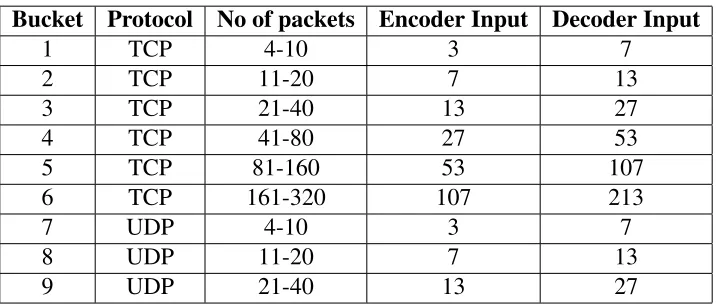
Table 4.1: Buckets of Sequences – sequences grouped based on transport protocol and the maximum number of packets per sequence. Sequences with less than 3 packets were ignored and sequences with more than 320 packets were pruned to 320.
4.2. Sequence toSequenceModel 25
split into sequences. In an initial experiment with CICIDS 2017 dataset, a single model was
unable to learn all sequences with enough accuracy. Therefore, the extracted sequences were
grouped into buckets based on transport protocol and the maximum number of packets as
shown in Table 4.1 and dedicated MSeq2MSeq models were developed for each bucket.
Us-ing different models per transport protocol lets each model learn a single pattern. Internet
Control Message Protocol (ICMP) packets were ignored because the dataset does not have
enough number of ICMP sequences to train the machine learning model. Sequences with
less than the maximum number of packets of a bucket were padded with max bucket size−
sequence lengthnumber ofE MPT Y PACKETs to meet the expected length of the input
vec-tor. Here,E MPT Y PACKET is a vector representing a packet with default values assigned to
each selected attributes. Sequences with less than four packets were ignored because the
en-coder required at least three to predict with enough accuracy in our preliminary test. Sequences
having more than 320 TCP packets were pruned to 320, and more than 160 UDP packets were
pruned to 160 because there were no enough TCP sequences with more than 320 packets and
UDP sequences with more than 160 packets to train a model with enough accuracy. From
each packet, following attributes were selected to be used with the proposed machine learning
model: transport layer, src ip, dst ip, ip f lag, transport f lag. Increasing the number of
selected attributes reduces the accuracy of the model. Above attributes were selected by trial
and error to obtain better accuracy.
4.2
Sequence to Sequence Model
Seq2Seq model has two RNN’s named encoder and decoder. The goal of the encoder is
con-verting an input sequence X = (x1, . . . ,xn), into a vector c and the goal of the decoder is
convertingcinto an output sequenceY = (y1, . . . ,yn).
At each time stept, hidden state of an RNNht is computed by (4.1) where f is a non-linear
26 Chapter4. Methodology
ht = f(xt,ht−1) (4.1)
Usually the non-linear activation function f is an LSTM and cis the final hidden statehn
of that LSTM. Decoder is another LSTM which generatesY = (yt, ...,yi) usingY =(y1, ...,yt−1)
as the input andcas the initial internal state. Hidden state of the decoder is computed by:
ht = f(ht−1,Yt−1,c) (4.2)
4.3
Multidimensional Sequence to Multidimensional Sequence
Model
Though Seq2Seq model is widely being used in NMT, it cannot receive or generate sequences
with multidimensional items as discussed in Chapter 3.1. Therefore the traditional Seq2Seq
model is improved in this research to receive and generate sequences with multidimensional
items as depicted in Figure 4.1. This figure depicts only a single layer of sigmoid
func-tions. However, there may be more than one layer depending on the problem. The proposed
MSeq2MSeq model hask number of input and output branches wherekis the number of
se-lected attributes in a packet. Depending on the problem, the number of branches of the encoder
and decoder can vary. This way, MSeq2MSeq model learns the contribution of every single
attribute in predicting the next packet and adjusts the weight in input and output branches.
Ex-cept for the first few layers and last few layers, the model reflects the exact traditional Seq2Seq
model. The attention layer proposed by Luong et al. [38] is used to obtain better results as
discussed later in this chapter.
Sutskeveret al. and Luonget al. obtained better results by reversing the encoder input in
NMT. The impact of reversing input sequence in packet prediction was tested by comparing the
dif-4.3. MultidimensionalSequence toMultidimensionalSequenceModel 27
Figure 4.1: Multidimensional Sequence to Multidimensional Sequence Model - an en-hanced Seq2Seq model to receive and generate sequences of multidimensional items. This model learns the individual contribution of each attribute of elements in predicting the se-quence.
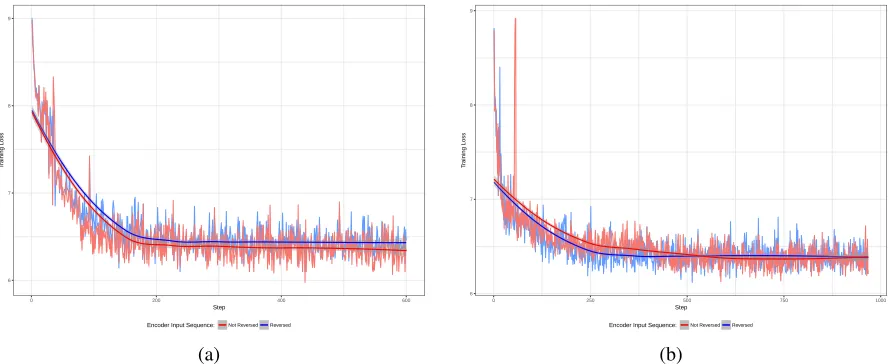
ference in prediction accuracy and training loss, the model trained with direct input sequences
learned slightly better than the model trained with reversed input sequence as shown in Figure
4.2. As shown in Table 4.1, the encoder input sequenceXis always guaranteed to be complete.
Furthermore, in a sequence of packets, thei+1thpacket is highly depending onithpacket than
the first packet. Therefore, reversing the encoder input is not necessary in packet prediction
problem.
The impact of attention layer in the proposed MSeq2MSeq model for packet prediction
was tested using the attention layer proposed by Luonget al. Two MSeq2MSeq models were
28 Chapter4. Methodology
6 7 8 9
0 200 400 600
Step
T
raining Loss
Encoder Input Sequence: Not Reversed Reversed
(a)
6 7 8 9
0 250 500 750 1000
Step
T
raining Loss
Encoder Input Sequence: Not Reversed Reversed
(b)
Figure 4.2: Impact of Reversing Encoder Input – comparison of the impact of reversing encoder input in (a) Bucket 1 (b) and Bucket 3 from Table 4.1. The model trained with not-reversed sequences with a maximum of 10 TCP packets learned slightly faster than the model trained with reversed sequences with a maximum of 10 TCP packets. As the number of packets in a sequence increases, the difference becomes less transparent.
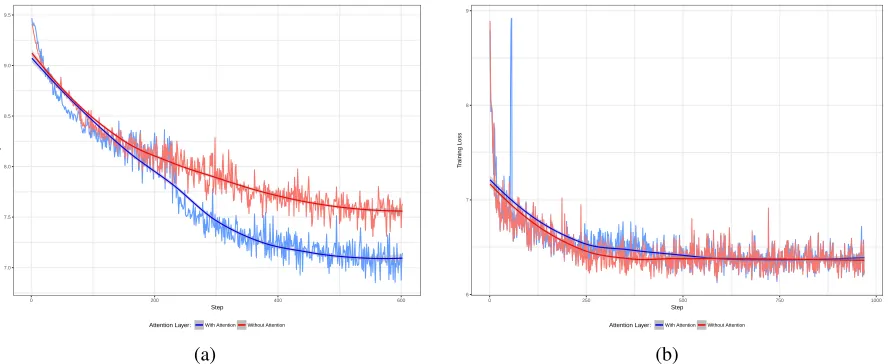
sequences from “Bucket 1” and “Bucket 3” respectively. As shown in Figure 4.3, the model
with attention layer learned faster than the model without attention layer while training
se-quences from “Bucket 1”. However, there is no significant difference in training the model
with sequences from “Bucket 3”. Sequences in “Bucket 1” has a maximum of ten packets and
sequences in “Bucket 3” has a maximum of 40 packets. Packets from a small network
connec-tion like TCP three-way handshake heavily rely on preceding packets compared to packets in a
long network connection like video streaming. As discussed earlier, the definition of sequence
allows a sequence to have packets from more than one connection. As the number of packets in
a sequence increases, there is a high chance of having packets from different network
connec-tions. Therefore, as the number of packets increases, the importance of reversing the encoder
4.4. WisdomStreamProcessor 29 7.0 7.5 8.0 8.5 9.0 9.5
0 200 400 600
Step
T
raining Loss
Attention Layer: With Attention Without Attention
(a)
6 7 8 9
0 250 500 750 1000
Step
T
raining Loss
Attention Layer: With Attention Without Attention
(b)
Figure 4.3: Impact of Attention Layer– comparison of the impact of attention layer in (a) Bucket 1 (b) and Bucket 3 from Table 4.1. The model with attention-layer learned significantly faster than the model without attention layer when training them using sequences with a max-imum of 10 TCP packets. As the number of packets in a sequence increases, the difference becomes less transparent.
4.4
Wisdom Stream Processor
Even though dynamic stream processors have been proposed in early works, commercial stream
processors do not support dynamic query modification at the runtime. Analysing the open
source stream processors: Apache Flink and WSO2 Siddhi revealed that their underlying data
structures that are being used to store events in memory do not support dynamic query
mod-ification. On the other hand, authors of iCEP dynamic complex event processor claim that
their complex event processor can analyze “thousands of events in a few minutes” [20] which
is much less than the throughput of commercial stream processors which typically can handle
several million events per second. Therefore, an adaptable and functionally auto-scaling stream
processor: “Wisdom”2 was developed without compromising the performance [27]. The
un-derlying architecture of “Wisdom” usingObserverdesign pattern andMediatordesign pattern
[62] to implement variables and dynamic CEP operators yields performance comparable to
commercial stream processors as shown in Table 4.2 and significantly better performance than
30 Chapter4. Methodology 20 0 20 40 60 80 100 125 150 175 200 225 250 275 300 0.0 0.2 0.4 0.6 0.8
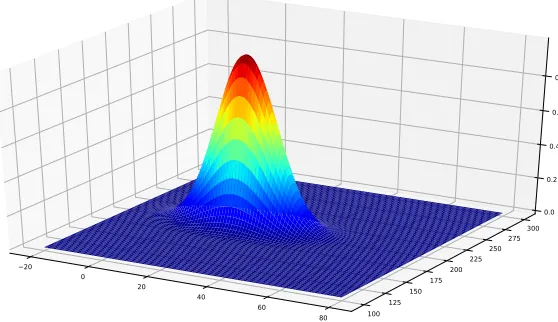
Figure 4.4: Made-up Profit Function– representing an imaginary CEP rule with two thresh-old values to test Bayesian Optimization and Particle Swarm Optimization algorithms. The imaginary CEP rule produces more accurate events when those threshold values are close to 20 and 200.
iCEP.
Stream Processor Throughput Latency
Apache Flink 6,711,544 events/sec 100 nanoseconds
WSO2 Siddhi 3,811,876 events/sec 216 nanoseconds
Wisdom 2,543,299 events/sec 332 nanoseconds
Esper 2,247,807 events/sec 334 nanoseconds
Table 4.2: Performance Comparison of Stream Processors – comparing “Wisdom” with commercial stream processors using a filter query in single thread setup.
The profit or loss function f defined in Chapter 3.2 is a black box of correlated variables
because its output depends on the underlying CEP rule. CEP rules looking for anomalies emit
output only for a limited set of threshold values. For any other values, they emit nothing. A
simple profit function was developed as shown in Figure 4.4 to simulate the behavior of an
imaginary CEP rule which generates output only if its threshold values are closed to 20 and
200. Both PSO and BOA were used to optimize this function. The accuracy and execution
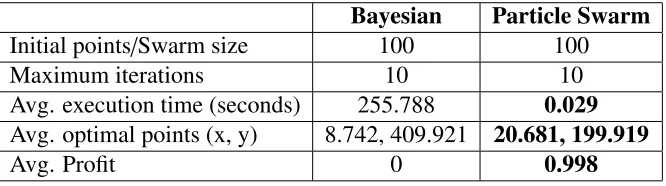
time were recorded for each optimization algorithms. As shown in Table 4.3, PSO outperforms
BOA in both accuracy and performance. PSO starts with random initial points and quickly
4.4. WisdomStreamProcessor 31
Figure 4.5:CEP Rule Optimization Algorithm– a hybrid optimization algorithm developed using PSO and Bisection algorithms. PSO algorithm is used to find an initial optimum point and Bisection algorithm is used to push the optimum point towards a desired boundary.
Input: f unction,constraints, steps
Output: optimal values
1: optimal values,loss← PS O(f unction,constraints)
2: for allval∈optimal valuesdo
3: val← Bisection(f unction,val,
constraints[val],step[val])
4: end for
5: return optimal values
some initial points close to the optimum, it was distracted by the plateau where profit is 0 and
spent more time in building the prior model. Therefore, the PSO algorithm has been chosen to
implement the actual CEP parameter tuning algorithm.
Bayesian Particle Swarm
Initial points/Swarm size 100 100
Maximum iterations 10 10
Avg. execution time (seconds) 255.788 0.029
Avg. optimal points (x, y) 8.742, 409.921 20.681, 199.919
Avg. Profit 0 0.998
Table 4.3: Bayesian Optimization vs Particle Swarm Optimization – comparison of Bayesian and Particle Swarm optimization algorithms using the profit function shown in Figure 4.4. The maximum obtainable profit is 1 for the optimum point (20, 200).
A real CEP rule can have more than one optimum points adjacent to each other. For
ex-ample, the above imaginary CEP rule may produce the same output for threshold values in
between 20−25 and 200−250. Depending on the requirement we may be interested in either
the upper bound or the lower bound of a threshold. For example, we prefer to have minimum
time threshold and maximum count threshold for the CEP rule given in Figure 3.1 to reduce
latency and false positives. Therefore, a hybrid optimization algorithm was implemented using
PSO and Bisection algorithms as shown in Figure 4.5. PSO is used to find the initial optimum
values, and Bisection algorithm is used to push them towards desired boundaries. In traditional
de-32 Chapter4. Methodology
Optimization Algorithm
Input Feeder
Loss Function
Wisdom
Application
Input
Total Loss
Output
Parameters
Figure 4.6: Wisdom Optimizer Architecture– a framework developed to optimize Wisdom rules. The Input Feeder and Loss Function must be defined by the user depending on the requirement and data format.
creases. To overcome this problem, the user-definedstepvalue (−1 and 1 in Figure 3.1) is used
as the step size if the actual step size is smaller than the user-defined step value. Sign of the
user-defined stepvalue indicates the desired direction to move the optimum threshold values.
The proposed optimization algorithm requires a domain expert to limit the range of
thresh-old variables to find a solution in polynomial time. Theminimumvalue,maximumvalue, and
stepsize are tailored to “Wisdom” query using @con f ig(trainable = true, ...) annotation as
shown in Figure 3.1. Figure 4.6 depicts the architecture of Wisdom Optimizer. In this
archi-tecture, “Input Feeder” and “Loss Function” must be defined by domain experts depending on
the domain requirements where “Input Feeder” feeds input events to the optimizer and “Loss
Function” converts the output of CEP rule to a real number. “Wisdom Application” is the
runtime environment compiled from a Wisdom query and the “Optimization Algorithm” is the
4.4. WisdomStreamProcessor 33
Figure 4.7: Wisdom Java API – a sample Wisdom application developed using Java API to filter TCP packets from PacketStream.
WisdomApp app = new WisdomApp (" TCPFilter ", "1.0.0")
app . defineStream (" PacketStream ") ; app . defineStream (" OutputStream ") ;
app . defineQuery (" FilterQuery ") . from (" PacketStream ")
. filter ( event -> " TCP ". equals ( event . get (" protocol ") )) . insertInto (" OutputStream ") ;
app . addCallback (" OutputStream ", EventPrinter :: print );
Figure 4.8: Wisdom Query – a sample Wisdom application developed using Wisdom Query Language to filter TCP packets from PacketStream.
@app ( name =‘ TCPFilter ’, version = ‘1.0.0 ’)
def stream PacketStream ;
@sink ( type =‘ console ’) def stream OutputStream ;
@query ( name =‘ FilterQuery ’) from PacketStream
filter symbol == ‘TCP ’ insert into OutputStream ;
“Wisdom” application.
“Wisdom” provides Java [63] API and Wisdom Query Language to develop CEP
applica-tions. For example, Figure 4.7 shows a Wisdom application developed in Java to filter TCP
packets from PacketS tream. The same application can be developed using Wisdom Query
Language as given in Figure 4.8. A rule defined using Wisdom Query Language can be still
parsed in Java to create a Java based application. Wisdom Stream Processor package provides
the necessary infrastructure to run “Wisdom” applications as a service using query files. Even
though “Wisdom” can be used as a Java library, running “Wisdom” application as a service is