STUDY OF α-DECAY AND CLUSTER DECAY OF
SUPERHEAVY ELEMENTS Z=120
Priya Dhuria
Assistant Professor, Jan Nayak Ch. Devi Lal Memorial College, Sirsa, Haryana, (India)
ABSTRACT
We have analyzed the different-decay chains of Z=120 element observed recently, by using the Preformed cluster model which is based on the Quantum Mechanical Fragmentation Theory. Not only the α-decay
characteristics have been studied but also the cluster decay calculation being studied first time. The α-decay
characteristics gives the information about the nuclear structure, and compared the results with the
experimental data of Dubna and the Generalized Liquid Drop Model (GLDM).The PCM calculations are in
good agreement with the observed data.The superheavy elements are expected to show extra stability at the shell closures. On this basis some α-decay chains are studied, we have found the most stable nuclei at Z=112,
N=161,163; Z=114, N=171,178,179; and at Z=124, N=194. Also, the possibility of heavy cluster emissions with respect to α-decays 301120 α-decay chain is studied. The calculated cluster decays show the large stability
at the 289114 parents against 10Be decay giving Z=114, N=175 proton and neutron number respectively. Another possibility of 14Cand 34Si cluster decay of the parent 301120 gives Z=114, N=173 and Z=106, N=161 daughter nucleus respectively. 49Ca is the most probable emitted cluster from the same parent giving Z=100, N=152 daughter nucleus.
Keywords: superheavy nuclei, Fragmentation, α-decay, Cluster decay, Preformed Cluster, model
(PCM) of Gupta and Collaborators, Preformation probability.
I. INTRODUCTION
In the past two decades, the synthesis of superheavy elements and their decay lifetime measurements have been
two major goals of nuclear physics. This field has gotten new impetus by recent synthesis of several heavy
elements and their subsequent reconfirmations [3, 8, 6, 7, 5] with the advent of radioactive ion beam facilities it
is now believed that ultimately it would be possible to reach the center of the island of superheavy elements. In this scenario, the study of decay properties of superheavy elements, primarily by α-emissions has become an
important domain of intense research. Discoveries of new superheavy elements have also provided a testing
ground for many theoretical formalism. It has been shown that half-life calculations in the WKB framework, it
was shown that the generalized liquid drop model including the proximity effects could reasonably estimates the
experimental data on superheavy nuclei when the experimental Q-values were used. In the recent experiments
detected, and the decay properties of these synthesized nuclei are claimed to be consistent with consecutive
α-decays originating from the parent isotopes of new element 115, 288115 and 287115, respectively. The RMF
calculation has been carried out using the model Lagrangian density with nonlinear terms. It has been observed
in this calculation that the isotopes of the element 115 are very deformed. For the measured α-decay energies of
the newly produced isotopes, one can estimate half-lives for allowed transitions and compare them with
experimental values under the Geiger-Nuttall treatment using the formula by Viola and Seaborg. Parameters are
obtained from fits to the Ta versus Qa values of 65 known even-even nuclei with Z > 82 and N > 126. The ratio
between the experimental Texpt and Tcal half-lives define the hindrance factors caused by odd numbers of protons
and or neutrons in the newly synthesized nuclei. The measured Texp values closely reproduce the calculated ones
for the first two nuclei of these chains: thus the element 115 and element 113 isotopes have rather low hindrance
factors, if any, for α-decay. The next magic numbers beyond the doubly magic nucleus 208Pb is a long standing
question in the nuclear structure physics. A number of theoretical calculations [12] -[20] have been made in the late 1960’s for the existence of long lived superheavy nuclei and about the next magic numbers and all of them
predict Z=114, 124, 164 for protons and N=184, 196, 236, 318 for neutrons as magic numbers. Recently, some
models [21, 22, 23] on the basis of Strutinsky approach, have found Z=114 more stable, whereas Hartree-Fock
calculation based models [24, 25] predict the highest stability at proton number Z=120,124, 126. The
macro-microscopic calculations predict spherical shell closures at Z=114 and N=184. In the relativistic mean field
calculations Rutz predicted Z=120 and N=172 as the next magic shells in the spherical RMF theory, meanwhile
Patra predicted Z=120 and N=184 in the axially deformed RMF theory as the next possible magic numbers for
superheavy elements. In the Skyrme Hartree-Fock calculations with parameters sets of SKI3 and SKI4 the most
pronounced shell effects at Z=120 and N=184 are obtained, while in the Hartree-Fock-Bouglibove calculations
with the finite range Gogny force one predicts Z=120, 126 and N= 172, 184 as the possible proton shell
closures. Very recently Tappa applied the new effective field theory to analyze the isotopic and isotonic chains
of superheavy nuclei and searched next shell closures. They predicted Z=120 and N=172 and Z=120 and N=258
as possible spherical doubly magic super heavy nuclei. As mentioned above, the most theoretical studies
predicted Z=120 as a possible magic number of proton in superheavy nuclei. Actually, the key role of the shell
stability of nuclei at Z=120 was first pointed out by Gupta et al. Recently Gupta et al used the Quantum
Mechanical Fragmentation theory to describe the interaction potential for some target-projectile combinations of
the elements as shown: 136Xe+166Dy→302120*,94Sr+208Pb→302120,50Ca+252→ 302120. The results obtained in the
QMFT illustrated that the interaction potential can provide the information of the synthesis of superheavy nuclei
at Z=120 in the fusion reaction. They predicted 94Sr+208Pb as a best cold fusion reaction for producing 302120
nucleus. During the last two decades evidences has been confirmed experimentally connected to superheavy
elements. The advancement in the accelerator technology has opened the door to synthesizing the new
superheavy elements. The Z=107-112 [26] superheavy elements are synthesized successfully using the lead and
bismuth targets in the cold fusion reactions. Since, elements Z=114 [27, 28] and 116 [29], identified by hot
fusion reactions. The hot fusion reactions are based on heavy actinide targets from Th to Cf with very light C to
S projectile. These heaviest iso..topes decay predominantly by groups of α particles (or α chains) as expected
reactions. A possibility of 50Ca has shown a better beam in [32] for the formation of superheavy nuclei by cold
fusion, since 50Ca is a radioactive nucleus.
In this work we have investigated the stability of superheavy nuclei by analyzing the various α-decay chains. Not only the α-decays but most probable heavy cluster also looked in this process. For this calculation we have
used the preformed cluster model of gupta and collaborators [33, 34, 35, 36, 37, 38]. The results of our
calculations, compared with recent works, are presented in here.
II. CALCULATIONS
The α-decay chain in superheavy nuclei
In this calculation we have pay more attention to the stability of superheavy elements, particularly, the effects of
spherical or deformed shells. Large half-lives or stability of superheavy nuclei being considered due to the shell
closure effects either they are proton number or neutrons. We have study some α-decay chains
289,291,297,301,303,305,309,311
120 and 320,326128, notice in the figure (1, 2) the maxima of the half-lives in the α-decay
chains 289,291,297120, connected to the (Z=112, N=161), (Z=112, N=163), and (Z=114, N=171) appears for the
ground state configurations of these nuclei.
277 281 285 289 293 297 301
-6 -4 -2 0 2 4 6 8
108 110 112 114 116 118 120 301120
PCM GLDM
log10
T1/2
(s
)
281 285 289 293 297 301 305
-6 -4 -2 0 2 4 6 8 10 12 14
108 110 112 114 116 118 120
305
120
PCM GLDM
265 269 273 277 281 285 289
-8 -6 -4 -2 0 2 4
A
Z (Parent nucleus mass) 108 110 112 114 116 118 120
289
120
PCM GLDM
287 291 295 299 303 307 311
0 2 4 6 8 10 12 14 16 18
108 110 112 114 116 118 120
311
120
PCM
Figure1: The calculated
-decay half-lives based on the preformed cluster model, are compared withavailable data of the GLDM model, and plotted as a function of the parent nucleus mass for various
267 271 275 279 283 287 291 -6
-4 -2 0 2 4
108 110 112 114 116
291
120
PCM GLDM
log10 T 1/2
(s
)
279 283 287 291 295 299 303 -8
-6 -4 -2 0 2 4 6 8 10 12
118 120 108 110 114 116 118 120
303120
PCM GLDM
273 277 281 285 289 293 297 -6
-4 -2 0 2 4 6 8 10
108 110 112 114 116 118 120
297120
PCM GLDM
285 289 293 297 301 305 309 -2
0 2 4 6 8 10 12 14
A
Z (Parent nucleus mass)
108 110 112 114 116 118 120
112
309120
PCM
Figure 2: The same as for fig.1.but for different
-decay chains.The maximum stability of neutron numbers at (N=161, N=163) are identified close to the N=162 which is a deformed magic number [162]. Similarly, the element (Z=114, N=171) is found more stable against α-decay.
Since (Z=114, N=184) predicted magic numbers, both for proton and neutron. After scanning a wide range of
superheavy nuclei [24] N=172 magicity is predicted with Z=120[9] proton number. From the figure (3, 4), the
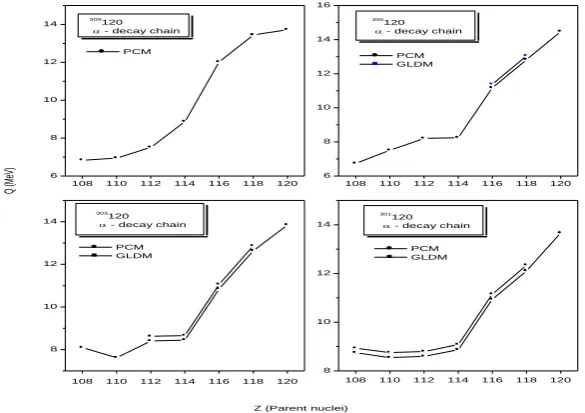
alpha decay energy Q_ are plotted against the charge number. In the 289,291,297120 _-decay chains the shell
closure effects are clearly visible and reflects the strength of the shell closure at (Z=112, N=161, 163) and
(Z=114, N=171).
108 110 112 114 116 118 120 6
8 10 12 14
Q
(M
eV
)
309120
- decay chain PCM
108 110 112 114 116 118 120 6
8 10 12 14 16
305120
- decay chain PCM GLDM
108 110 112 114 116 118 120 8
10 12 14
303
120
- decay chain PCM GLDM
108 110 112 114 116 118 120 8
10 12 14
Z (Parent nuclei)
301120
- decay chain PCM GLDM
Figure 3: The calculated Q-values on the basis of PCM compared with GLDM, plotted as a function of
108 110 112 114 116 118 120 10
12 14
Q
(M
eV)
297120
- decay chain PCM GLDM
108 110 112 114 116 118 120 6
8 10 12 14
311120
- decay chain PCM
108 110 112 114 116 118 120 10
12 14
PCM GLDM
291120
- decay chain
108 110 112 114 116 118 120 10
12 14
Z (Parent nuclei)
289
120
- decay chain PCM GLDM
Figure 4: the same as for fig.3, but for different
-decay chains.A very interesting point has been noticed in the study of these α-decay chains that the Q-values are almost same
at Z=120 with different neutron numbers, since a considerable difference has been noticed at Z=108 for the same. We have found in all the α-decay chains that for a fixed number of protons Z=114, the α-decay half-lives
are maximum around the N~178 relative to other neutron numbers. Not only the stability but a sharp change
also in the α-decay half-lives has been noticed in these 297,301,303,305120 α-decay chains at Z=114 within the
range of neutron numbers from N=171-179. The maximum α-decay half-lives occurs at (Z=114, N=179). The
calculated Q-values and α-decay half-lives are compared with recent calculations [163] based on the generalized
liquid drop model (GLDM). The results of both the calculations PCM and GLDM shows the similar trends.
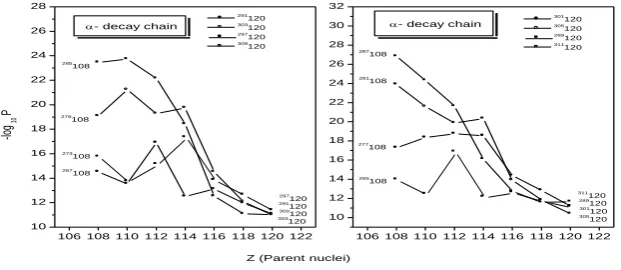
From the figure (5),
106 108 110 112 114 116 118 120 122 10
12 14 16 18 20 22 24 26 28
303
120
291120 309120 297
120
- decay chain
267
108
273108 279108 285108
Z (Parent nuclei)
291120 303120 297120 309120
-lo
g 10
P
106 108 110 112 114 116 118 120 122 10
12 14 16 18 20 22 24 26 28 30 32
265108 277108 281108 287108
289120 301120 305120 311120 - decay chain
301120 305120 289120 311120
Figure.5: The Calculated penetrability P on the basis of PCM, plotted as a function of the parent charge
number for various
-decay chainsInterested enough that the penetration probabilities of all the α-decay chains are almost same of the order 10−12
at Z=120, but it changes towards the lower atomic number rapidly. In this fig.5 element 305120 have the
maximum penetration probability than the 311120 element. Which means (Z=120, N=185) have more decay probability against the α-particle than the (Z=120, N=191) nucleus. Hence (Z=120, N=191) is more stable
106 108 110 112 114 116 118 120 122 6
8 10 12
14 -decay chain
291120 303120 297120 309
120
285108
309120
279108
303120 273108
297120 267108
291
120
- lo
g 10
P0
Z (Parent nuclei)
106 108 110 112 114 116 118 120 122 6
8 10 12 14 16 18
-decay chain
265108 277108 281108 287
108
289
120
301120 305120
311120 301120 305120 289120 311
120
Figure 6: The calculated preformation probability using the PCM model, plotted as a function of the
parent charge number for various
-decay chains.It is clear that the 289120 decay chain parents have largest preformation probabilities compare to other
α-decay chain parents. It also noticed that the preformation probability for the 305120 is larger compared to the
311
120 nucleus in many order.
III. POSSIBLE CLUSTER DECAY FROM 301120 DECAY CHAIN
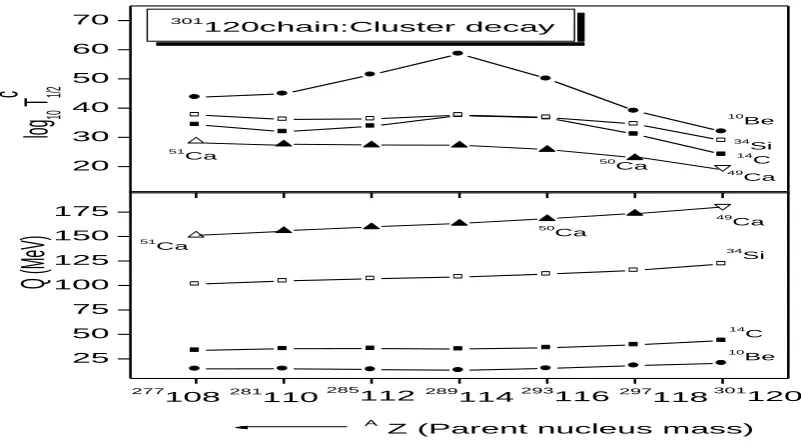
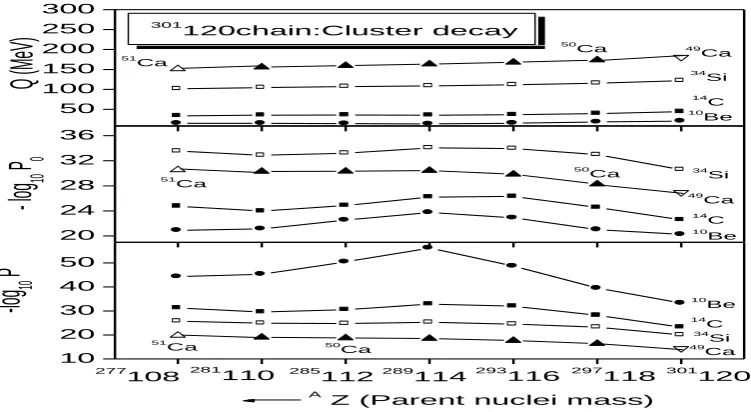
Figure (9, 10) shows the results of our calculation for heavy cluster decays.
277 281 285 289 293 297 301
20 30 40 50 60
70 301
120chain:Cluster decay
34
Si
14
C
10
Be
51
Ca 50
Ca
49
Ca
Q (
MeV
)
c
log
10T
1/2277 281 285 289 293 297 301
25 50 75 100 125 150 175
A
Z (Parent nucleus mass)
277
108 281110 285112 289
114293116 297
118301120
10Be 14
C
34
Si
51
Ca
50
Ca
49
Ca
Figure 9: The calculated decay half-lives and the Q-values on the basis of PCM for some cluster decays of
277 281 285 289 293 297 301
10 20 30 40 50
51
Ca 50
Ca 49
Ca
34
Si
14
C
10
Be
277
108 281110 285
112 289114 293116 297118 301120
-log
10P
A
Z (Parent nuclei mass)
277 281 285 289 293 297 301
20 24 28 32 36
51
Ca
50
Ca 34
Si
49Ca 14
C
10
Be
- log
10P
0277 281 285 289 293 297 301
50 100 150 200 250 300
301
120chain:Cluster decay
51
Ca
50
Ca 49
Ca
34
Si
14
C
10
Be
Q (
MeV
)
Figure 10: The PCM calculated Q-values, penetrability P and preformation factors
P
0 for some clusterdecays of the parents of
-decay chain for301120
, plotted as a function of the parent nucleus mass.We have found that 10Be is the most probable cluster because its have smaller penetration probability P and
larger pre-formation probability P0 in all the parents. For the 10Be, the logT1/2 is much larger compare to other
clusters, so that all parents are stable against 10Be decay. The Q-values are plotted against the mass number, of
all the possible clusters. It is clearly seen that the behavior of Q-values are completely independent from the
mass number. There is another interesting feature appear in this cluster decay calculation, the maximum half-life
of the parent Z=114, A=289 against the 10Be cluster decay. Clearly shell stabilizing effects appears in the
considered decay. So, (Z=114, N=175) nucleus are observed most stable in cluster radioactivity studies. The
decay of 10Be of parent 301120 give the daughter (Z=116, N=175) 291116 nucleus. The next excitement of this
study is the decay of 14C and 34Si of the parent 301120. The cluster 14C gives daughter (Z=114, N=173) and for
the cluster 34Si gives the (Z=106, N=161), a deformed magic nucleus 267106. Since, 34Si have lowest
pre-formation probability in all the cases the clusters, 49−51Ca shows more decay probability compare to others. The
decay of 49Ca from 301120 gives the (Z=100, N=152) deformed daughter [44].
Table 1: The calculated α-decay half lives and other characteristics for ground state decay of superheavy nuclei
in various α-decay chains, based on PCM, compare with GLDM calculations. Binding energies are taken from
the Audi-Wapstra & Moller et.al, (2003), data table. [10,11]
PCM GLDM
Parent Qα
(MeV)
Po P Log10Tα½
(a)
Qα
*(MeV)
Log10
Tα½
(a)
311
120
307
118
13.106
12.956
1.77* 10-16
3.4* 10-11
2.14* 10-12
7.9* 10-25
5.766
303 116 299 114 295 112 291 110 287 108 11.836 9.786 7.656 6.796 6.806
1.54* 10-10
1.07* 10-11
4.28* 10-12
3.48* 10-12
2.47* 10-12
1.7* 10-13
7.7* 10-17
2.37*10-22
4.6* 10-25
1.49*10-27 0.945 5.480 11.447 14.270 16.931 309 120 305 118 301 116 297 114 293 112 289 110 285 108 13.726 13.446 12.016 8.866 7.516 6.946 6.836
7.27* 10-14
1.21* 10-9
5.75* 10-10
1.486*10-11
5.92* 10-12
5.29* 10-12
4.386*10-12
9.62*10-12
8.12*10-12
2.85*10-13
3.71* 10-19
6.86*10-23 1.90*10-24 3.45*10-24 2.489 -1.658 0.144 7.681 11.867 13.468 13.292 305 120 301 118 297 116 293 114 289 112 285 110 281 108 14.476 12.826 11.166 8.246 8.206 7.506 6.746
1.83* 10-9
1.15*10-8
1.24*10-9
1.66*10-11
3.01* 10-11
1.64* 10-11
9.27*10-12
4.005*10-11
1.45*10-12
1.21*10-14
4.65* 10-21
1.36*10-20 2.539*10-22 1.27*10-24 -2.547 -1.877 1.191 9.549 8.820 10.832 13.402.
13.05 -6.72
11.38 -3.80
303 120 299 118 295 116 291 114 287 112 283 110 279 108 13.846 12.636 10.846 8.946 8.406 7.616 8.096
1.67* 10-8
1.68*10-8
2.74*10-12
3.08*10-11
5.66* 10-11
2.79*10-11 1.14*10-10 1.02*10-11 7.90*10-13 3.11*10-15 1.83*10-20 5.24*10-20 5.87*10-22 8.60*10-20 -2.905 -1.778 4.447 8.678 7.956 10.233 7.441
12.87 -6.37
11.06 -3.00
8.66 3.59
8.62 3.03
301 120 297 118 293 116 289 114 285 112 281 110 277 108 13.666 12.106 8.887 9.908 8.734 8.959 8.401
6.07* 10-8
1.68*10-8
1.67*10-9
3.25*10-8
7.03* 10-10
8.87*10-10 3.84*10-10 6.32*10-12 1.43*10-13 9.25*10-20 1.02*10-16 4.26*10-19 5.52*10-18 6.12*10-19 -3.254 -1.027 5.630 2.872 5.942 4.722 6.053
12.34 -5.32
11.15 -3.19
9.08 2.16
8.80 2.43
8.75 1.95
8.93 0.67
297 120 293 118 289 116 285 114 9.002 12.301 11.701 11.001
4.27* 10-11
9.73*10-12 6.99*10-12 8.13*10-12 1.32*10-20 2.34*10-13 6.57*10-14 1.10*10-14 8.666 1.991 2.696 3.415
12.49 -5.56
11.50 -3.94
281
112
277
110
273
108
10.281
10.301
9.901
4.55* 10-9
6.11*10-9
3.90*10-9
1.35*10-15
3.55*10-15
1.55*10-15
1.593
1.042
1.604
10.35 -2.20
10.89 -4.13
9.61 -1.36
291
120
287
118
283
116
279
114
275
112
271
110
267
108
13.916
12.876
11.866
12.046
9.38
10.871
10.121
1.73* 10-6
6.87*10-7
1.40*10-7
7.98*10-9
2.63* 10-9
1.69*10-7
4.71*10-8
8.32*10-12
1.04*10-12
7.70*10-14
3.17*10-13
1.34*10-17
2.59*10-14
3.16*10-15
-4.832
-3.521
-1.680
-3.057
3.850
-1.277
0.204
13.11 -6.65
12.03 -5.01
12.27 -5.97
11.70 -5.33
10.90 -4.05
10.12 -2.64
289
120
285
118
281
116
277
114
273
112
269
110
265
108
13.886
13.066
12.166
12.326
9.403
11.586
10.587
2.99* 10-6
1.29*10-6
4.98*10-7
1.02*10-6
6.52* 10-9
6.71*10-7
1.10*10-7
7.27*10-12
1.63*10-12
2.29*10-13
6.62*10-13
1.41*10-17
2.46*10-13
1.78*10-14
-5.017
-3.995
-2.713
-3.492
3.430
-2.870
-0.927
13.30 -6.91
12.39 -5.67
12.55 -6.48
11.72 -5.34
11.28 -4.88
10.47 -3.55
IV. SUMMARY OF OUR RESULTS
We have studied some α-decay chains of the superheavy nuclei 311,309,305,303
120, 301,297,291,289120 and 320,326128.
The calculation are completed using the preformed cluster decay model of Gupta and collaborators [33, 34, 35,
36, 37, 38], based on the Quantum Mechanical Fragmentation Theory (QMFT). The calculated half lives and the
Q-values are compared with the recent calculation based on Generalized Liquid Drop Model (GLDM).
Comparison shows the same trends in both the calculations. The maximum pre-formation probability of the
order 10−6 has been found for the parents of the 289120 α-decay chain. We conclude that the stability of the
superheavy nuclei based on their half-lives and Q-value are found for the nuclei at (Z=112, N=161,163),
(Z=114, N=171,178,179) or at (Z=124, N=194). Cluster decays are also studied for the 301120 α-decay chain.
The shell stabilizing effects appears in 10Be decay of the parent 289114 nucleus. A good indication seen in the
cluster radioactivity calculation, decay of 34Si from parent 301120, gives a deformed magic daughter (Z=106,
N=161), and 49Ca from the same parent gives (Z=100, N=152).
REFERENCES
[1] M.A. Stoyer, Nature 442, 876 (2006); also reference therein.
[2] S. Hofmann et al., Nucl. Phys. A 734, 93 (2004).
[3] H. Hofman and G. M¨unzenberg, rev. Mod. Phys.72, 733 (2000).
[5] Yu. Ts. Oganessian et al., Phys. Rev. C. 74,044602 (2006); and reference therin.
[6] Yu. Ts. Oganessian et al., Phys. Rev. C70, 064609 (2004); Phys. Rev. C 71, 029902 (E)(2005).
[7] K. Morita et al., J. Physics. Soc. Jpn. 73, 2593 (2004).
[8] Yu. Ts. Oganessian et al., Phys. Rev. C69, R021601 (2004).
[9] C Samanta, P Roy Chowdhruy and D N Basu, Nuclear Physics A 789, 142-154 2007).
[10] G. Audi and A. H. Wapstra, Nucl. Phys. A595,4 (2003).
[11] P. M¨oller, J. R. Nix, W. D. Myers and W. J. Swiatecki, At. Data Nucl. Data Tables 59, 185 (2003).
[12] W D Myers and W J Sewiatecki, Nucl. Phys. A81, 1 (1966).
[13] A Sobiczewski, F A Gareev, and B N Kalinkin, Phys. Lett. 22, 500 (1966).
[14] H Meldner, Ark. Fys. 36, 593 (1967).
[15] S G Nilsson et al., Nucl. Phys. A115, 545(1968).
[16] U Mosel, and W Greiner, Z. Phys. 222, 261(1969).
[17] J Grumann, U Mosel, B Frink, and W Greiner, Z. Phys. 228, 371(1969).
[18] S G Nilsson, C F Tsang, A Sobiczewski, Z Szymanski, S Wyeech, C Gustafsson, I L Lamm, P M¨oller,
and B Nilsson, Nucl. Phys. A131, 1(1969).
[19] E O Fiset and J R Nix, Nucl. Phys. A193, 647(1972).
[20] J Randrup, S E Larsson, P M¨oller, A Sobiczewski, and A Lukasiak, Phys. Scr. 10A, 60(1974).
[21] A Sobiczewski, Phys. of Particles and Nuclei 25, 295-311(1994).
[22] R Smolanczuk, J Skalski, and A Sobiczewski, Phys. Rev. C52, 1871-1880(1995).
[23] P M¨oller, and J R Nix, J. Phys. G: Nucl. Part. Phys. 20, 1681-1747(1994).
[24] K Rutz, M Bender, T B¨urvenich, T Schilling, P G Reinhard, J A Maruhn and W greiner, Phys. Rev. C56,
238-243(1997).
[25] S Cwiok, J Dobaczewski, P H Heenen, PMagierski, and W Nazarewicz, Nucl. Phys. A611,
211-246(1996).
[26] S Hofmann, Rep. Prog. Phys. 61, 639(1998).
[27] Y T Oganessian et al., Phys. Rev. Lett. 83, 3154(1999).
[28] Y T Oganessian et al., Phys. Rev. C62, 041604(R)(2000).
[30] S Cwiok, and A Sobiczewski, Z. Phys. A342, 203(1992).
[31] R Smolanczuk, Phys. Rev. C56, 812(1997).
[32] Sushil Kumar, M Balasubramanium, R K Gupta, G M¨unzenberg, and W Scheid, J Phys. G: Nucl. Part.
Phys. 29, 625-639(2003).
[33] S.S. Malik and R.K. Gupta, Phys. Rev. C 39 (1989) 1992.
[34] R.K. Gupta, W. Scheid, and W. Greiner, J. Phys. G 17 (1991) 1731.
[35] S. Kumar and R.K. Gupta, Phys. Rev. C 49 (1994) 1922.
[36] R.K. Gupta and W. Greiner, Int. J. Mod. Phys. E 3 (1994, Supp.) 335.
[37] R.K. Gupta, in Heavy Elements and Related New Phenomena, Eds. W. Greiner and R.K. Gupta, World
Scientific, Singapore, 1999, Vol. II, p. 730.
[39] R.K. Gupta, C. Pˆarvulescu, A. S˘andulescu and W. Greiner, Z. Physik A283 (1977) 217.
[40] R.K. Gupta, Proc. 5th Int. Conf. on Nuclear Reaction Mechanisms, Varenna 1988, p.416.
[41] R.K. Gupta, ibid [148], Vol. II, p. 730.
[42] S Hofmann, and G M¨unzenberg, Rev. Mod. Phys. 72, 733(2000).
[43] G Royer, J Phys. G: Nucl. Part. Phys. 26, 1149(2000).