IJEDR1702081 International Journal of Engineering Development and Research (www.ijedr.org) 465
Hierarchical Attribute-Based Encryption: A
Survey
V.S. Sajitha1, V. Reena Catherine2
1M.Phil scholar, 2Assistant Professor
Department of CS, Nanjil Catholic Collge of Arts and Science, Kaliyakkavilai, Tamilnadu, India.
Abstract:
Cloud computing, as a promising computing model, enables users to remotely storetheir data into a cloud so as to enjoy scalable services on-demand. However, allowing Cloud Service Providers (CSPs), which are not in the same trusted domains as enterprise users, to take care of confidential data, may raise potential security and privacy issues. To keep the sensitive user data confidential against entrusted CSPs, a usual way is to apply cryptographic approaches, by disclosing decryption keys only to authorized users. However, when enterprise users outsource confidential data for sharing on cloud servers, the adopted encryption system should not only support fine-grained access control, but also provide high performance, full delegation, and scalability, so as to best serve the needs of accessing data anytime and anywhere, delegating within enterprises, and achieving a dynamic set of users. In this paper, we propose a scheme to help enterprises to efficiently share confidential data on cloud servers. We achieve this goal by first combining the Hierarchical Identity- Based Encryption (HIBE) system and the ciphertext-policy Attribute-Based Encryption (CP-ABE) system.
Keywords
Cloud computing, hierarchical attribute-based encryption, fine-grained access control,
scalability
I. INTRODUCTION
IJEDR1702081 International Journal of Engineering Development and Research (www.ijedr.org) 466
IJEDR1702081 International Journal of Engineering Development and Research (www.ijedr.org) 467
II. LITERATURE SURVEY
Attribute-Based Encryption (ABE):
An attribute based encryption scheme was introduced by Sahai and Waters in 2005 and the goal is to provide security and access control Sahai et al 2007. Attribute-based encryption (ABE) is a public-key algorithm based one to many encryptions that allows users to encrypt and decrypt data based on user attributes. In their context, the role of the parties is taken by the attributes. Thus, the access structure will contain the authorized sets of attributes. They restrict the attention to monotone access structures. However, it is also possible to realize general access structures using the techniques by having the attribute as a separate attribute altogether. Thus, the number of attributes in the system will be doubled. From now on, unless stated otherwise, by an access structure we mean a monotone access structure.
Cipher Text Policy Attribute-Based Encryption
Another modified form of ABE called CP-ABE was introduced by Sahai. In a CP-ABE scheme, every ciphertext is associated with an access policy on attributes, and every user’s private key is associated with a set of attributes. A user is able to decrypt a ciphertext only if the set of attributes associated with the user’s private key satisfies the access policy associated with the ciphertext. CP-ABE works in the reverse way of Key Policy Attribute-Based Encryption (KP-ABE). The access structure built in the encrypted data can let the encrypted data choose which key can recover the data; it means the user's key with attributes just satisfies the access structure of the encrypted data. The concept of this scheme is similar to the traditional access control schemes. The encryptor specifies the threshold access structure for his/her interested attributes while encrypting a message. Based on this access structure, the message is then encrypted such that only those whose attributes satisfy the access structure can decrypt it.
Key Policy Attribute-Based Encryption (KP-ABE)
KP-ABE is the modified form of classical model of ABE. Users are assigned with an access tree structure over the data attributes. Threshold gates are the nodes of the access tree. The attributes are associated by leaf nodes. To reflect the access tree structure, the secret key of the user is defined, Changji Wang et al 2013. Ciphertexts are labeled with sets of attributes and private keys are associated with monotonic access structures that control which ciphertexts a user is able to decrypt. Key Policy Attribute Based Encryption (KP-ABE) scheme is designed for one-to-many communications
IJEDR1702081 International Journal of Engineering Development and Research (www.ijedr.org) 468
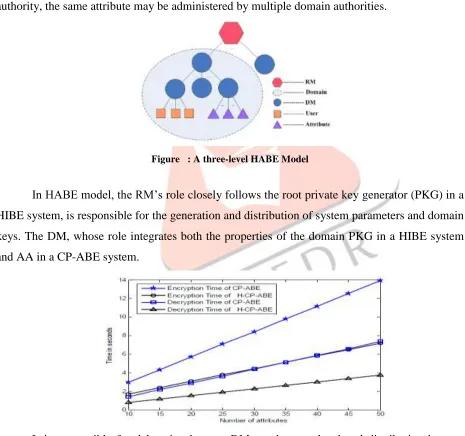
The Hierarchical Attribute-Based Encryption (HABE) is derived by Wang et al The HABE model consists of a Root Master (RM) that corresponds to the Third Trusted Party (TTP),Multiple Domain Masters (DMs) in which the top-level DMs correspond to multiple enterprise users, and numerous users that correspond to all personnel in an enterprise. This scheme used the property of hierarchical generation of keys in HIBE scheme to generate keys. This scheme can satisfy the property of fine grained access control, scalability and full delegation. It can share data for users in the cloud in an enterprise environment. Furthermore, it can apply to achieve proxy re-encryption. But in practice, it is unsuitable to implement. Since all attributes in one conjunctive clause in this scheme may be administered by the same domain authority, the same attribute may be administered by multiple domain authorities.
Figure : A three-level HABE Model
In HABE model, the RM’s role closely follows the root private key generator (PKG) in a HIBE system, is responsible for the generation and distribution of system parameters and domain keys. The DM, whose role integrates both the properties of the domain PKG in a HIBE system and AA in a CP-ABE system.
IJEDR1702081 International Journal of Engineering Development and Research (www.ijedr.org) 469
domain, just as the personnel office administers all personnel in an enterprise, and not to administer any attribute. Also other DMs administer an arbitrary number of disjoint attributes, and have full control over the structure and semantics of their attributes. In the HABE model, we first mark each DM and attribute with a unique identifier (ID), but mark each user with both an ID and a set of descriptive attributes. Then,as Gentry et al 2002, we enable an entity’s secret key to be extracted from the DM administering itself, and an entity’s public key, which denotes its position in the HABE model, to be an ID tuple consisting of the public key of the DM administering itself and its ID.
CONCLUSION
In this paper, we construct a scheme, which has several qualities such as high performance, fine-grained access control, scalability and full delegation. Our HABE scheme, which is also collusion resistant, can be proven to be semantically secure against adaptive chosen plaintext attacks under the Bilinear Diffie-Hellman (BDH) assumption and the random oracle model.
REFERENCES
1. J. Bettencourt, A. Sahai, and B.Waters ” Ciphertext-Policy Attribute Based Encryption “in Proceedings of IEEE Symposium on Security and Privacy, pp. 321V334, 2007.
2. Chase M., “Multi-Authority Attribute Based Encrypt-Ion,” in Proceedings of the 4th
Conference on Theory of Cryptography, Berlin, pp. 515-534, 2007.
3. X. Liu, J. Ma, J. Xiong, and G. Liu, “Ciphertext-policy hierarchical attribute-based encryption for fine-grained access control of encryption data,” International Journal of Network Security, vol. 16, no. 6, pp. 437–443, July 2014.
IJEDR1702081 International Journal of Engineering Development and Research (www.ijedr.org) 470
5. Changji Wang and Jianfa Luo,” An Efficient Key-Policy Attribute-Based Encryption Scheme with Constant Ciphertext Length”, Hindawi Publishing Corporation Mathematical Problems in Engineering, Volume 2013, Article ID 810969, 7 pages.
Volume 2013, Article ID 810969, 7 pages 6. V. Goyal, O. Pandey, A. Sahai, and B. Waters, “Attribute-based encryption for fine-grained access control of encrypted data,” Proceedings of the 13th ACM conference on Computer and communications security, pp. 89–98, October 2006.