Comparing the periodontal clinical effect
between conventional and self-ligating
brackets: Systematic review and meta-analysis.
Heber Arbildo,1,2,3 Luis Gamarra,4,5,6 Sandra Rojas,5 Edward Infantes,1,6 Fredy Cruzado2 & Hernán Vásquez.7
Affiliations:1Escuela de Estomatología, Universidad Señor de Sipán. Chiclayo, Perú.2Escuela de Odonto-logía, Universidad Particular de Chiclayo. Chiclayo, Perú. 3Centro de Salud Odontológico San Mateo. Trujillo, Perú. 4Escuela de Estomatología, Universi-dad Privada Antonio Guillermo Urrelu. Cajamarca, Perú.5Facultad de Estomatología, Universidad Nacio-nal de Trujillo. Trujillo, Perú.6Escuela de Estomatolo-gía, Universidad César Vallejo. Piura, Perú.7Facultad de Odontología, Universidad San Martín de Porres. Lima, Perú.
Corresponding author: Heber Arbildo. Av. Húsares de Junín 611. Trujillo, Perú. Phone: (044) 616644. E-mail: [email protected], [email protected]
Abstract: Introduction: Orthodontists constantly seek to reduce the duration of their provided treatments and the patient's time in the office. For this reason, different bracket systems are currently used in orthodontics; an example is self-ligating brackets (SLB) which are believed to offer advantages over conventional brackets (CB). Objective: To evaluate and compare the clinical periodontal effect of CB and SLB through a systematic review and a meta-analysis. Material and Method: A search of the literature was carried out until December 2017, in the biomedical databases: PubMed, Embase, SciELO, ScienceDirect, SIGLE, LILACS, BBO, Google Scholar and the Cochrane Central Register of Controlled Trials. The selection criteria of the studies were defined as such: randomized clinical trials, up to 5 years old and that report the clinical effects (probing depth, bleeding on probing, gingival index and plaque index) from the use of CB and SLB. The risk of study bias was analyzed through the Cochrane Handbook of systematic reviews of interventions. Results: The search strategy resulted in 12 articles, eight of which reported no difference in the reduction in probing depth, bleeding on probing, gingival index and plaque index (p>0.05) between CB and SLB. Conclusion: The literature reviewed suggests that there are no differences in the periodontal clinical effect among patients who received orthodontic treatment with CB or SLB.
Keywords: Self-ligating bracket; conventional bracket; periodontal health; review; meta-analysis.
INTRODUCTION.
Orthodontists constantly seek to reduce the duration of the treatments they provide and the time patients spend in the office. Although the average treatment lasts between 1 and 2 years, there is still a continuous attempt to reduce it. To achieve this, several techniques and devices have been recommended, including surgical procedures, vibration stimulation, greater use of individualized arches and brackets, as well as prescribing exodontia less frequently.1,2
Self-ligating brackets (SLB) are orthodontic devices that unlike conventional brackets (CB) do not require elastomeric ligation methods or ligature wires to keep the arch in place. They were first presented by Stolzenberg in 1935 and were discovered as an accessory of the Russell attachment fabricated in the 1930s; however, it was not until the last 20 years that they have had their greatest use.4-8
Currently, different types of SLB are used during orthodontic treatment. The manufacturers and proponents of SLB claim that these
Conflict of interests: The authors declare no conflict of interest in relation to published results.
Ethics approval: This study was self-financed.
Funding: Self-financing.
Authors’ contributions: Heber Arbildo: He planned the protocol of the exploratory systematic review, he supervised the advances made, he made the statistical analysis, he is the author of correspondence and he reviewed the final manuscript. Luis Gamarra: He extracted the data from the selected articles, assessed the methodological quality of the included studies and reviewed the final manuscript. Sandra Rojas: It extracted the data of the selected articles, it was the one that solved any discrepancy between the reviewers when evaluating the methodological quality of the included studies and reviewed the final manuscript. Edward Infantes: He extracted the data from the selected articles, collected the data, assessed the methodological quality of the included studies and reviewed the final manuscript. Fredy Cruzado: Performed the search of the articles, drafted the manuscript and reviewed the final manuscript. Hernán Vásquez: He carried out the search of the articles, drafted the manuscript and reviewed the final manuscript.
Acknowledgements: None.
Cite as:Arbildo H, Gamarra L, Rojas S, Infantes E, Cruzado F & Vásquez H. Comparing the periodon-tal clinical effect between conventional and self-liga-ting brackets: Systematic review and meta-analysis. J Oral Res 2018; 7(4):155-161.
doi:10.17126/joralres.2017.030
offer advantages over CBs, such as: reducing the friction between the arch and the bracket, faster alignment and reduction of gap space, greater expansion of the arch with a less incisor proclination, fewer extractions needed to gain space and relieve crowding, lower number of office appointments needed, shorter appointment time, shorter overall treatment time, greater patient comfort, better oral hygiene and greater patient cooperation and acceptance.3-6
However, despite the popularity and advantages commercially attributed to SLB for both orthodontists and patients, orthodontists are still wondering whether SLB really offer the supposed advantages over CB and whether the latter should be replaced by the SLB. To date, many studies have investigated the efficiency and clinical efficacy of SLB compared to CB through several methods, in an attempt to reach a conclusion, although these studies have varied greatly in methodology and results.8-10
While current literature offers conclusions regarding friction and the efficiency of treatments with the use of SLB compared to CB, it does not present conclusive remarks regarding the periodontal health differences. Therefore, the objective of this article is to evaluate and compare the clinical periodontal effect between the use of SLB and CB.
MATERIALS AND METHODS.
This review was carried out in accordance with a previously prepared research protocol following the guidelines of the PRISMA guidelines.11
Bibliographic search
A broad search strategy was carried out in the following biomedical databases: PubMed, Embase, SciELO, ScienceDirect, SIGLE (System for Information on Grey Literature in Europe), LILACS, BBO, Google Scholar and in the Cochrane Central Register of Controlled Trials, and a manual search was also performed in the journals of periodontics and orthodontics of greater impact such as: Periodontology 2000, Journal of Clinical Periodontology, Journal of Periodontology, American Journal of Orthodontics and Dentofacial Orthopedics, European Journal of Orthodontics, The Angle Orthodontics
and Dental Press Journal of Orthodontics, from January 2, 2012 up to December 1, 2017; using a combination of thematic headings using the following keywords: (“conventional bracket” OR “conventional brackets" OR
“self-ligating brackets” OR “self-ligating bracket” OR “bracket convencional” OR “bracket de autoligado”) AND (“periodontal” OR “periodontium” OR “gingival” OR “biofilm” OR “periodont” OR “plaque” OR “bleeding” OR “inflammation” OR “oral higiene” OR “placa” OR “sangrado” OR “inflamación”).
Selection criteria Inclusion criteria:
- Articles that report the use of CB and SLB in periodontally healthy patients.
- Articles that report the clinical effects on periodontal health parameters (probing depth, bleeding on probing, gingival index and plaque index) when using CB and SLB.
- Articles up to of 5 years old.
- Articles that are clinical trials, without language restriction.
Exclusion criteria:
- Articles from non-indexed journals.
- Articles reporting on children or elderly patients. Process of selection and extraction of data
We reviewed the titles and abstracts of each of the studies obtained with the inclusion and exclusion criteria described above, and the full texts of the articles that met these parameters were obtained in order to determine their bias risk.
A checklist was made in duplicate to assess the studies, in order to extract the information of interest and to compile the data. Two reviewers (LG and EI) independently performed the evaluation of the articles regarding name, author, year of publication, type of study, number of patients, patient ages, follow-up time, country where the study was performed, study groups, number of patients per study group, probing depth, bleeding on probing, gingival index, plaque index and risk of bias. For the resolution of any discrepancy between the reviewers, they met and discussed together with a third reviewer (SR) in order to reach an agreement.
Assessing the studies’ risk of bias
For the assessment of risk of bias, each study was analyzed according to the Cochrane Handbook of Systematic Reviews of Interventions.12
Analysis of results
Figure 2. Risk of bias of articles.
Random sequence generation (selection bias) Allocation concealment (selection bias)
Blinding of participants and personnel (performance bias) Blinding of outcome assessment (detection bias)
Incomplete outcome data (altrition bias) Selective reportinf (reporting bias) Others bias
Low risk of bias Unclear risk of bias High risk of bias 0% 25% 50% 75% 100%
A
tik
2
01
4
Random sequence generation (selection blas).
Allocation concealment (selection blas).
Blinding of participants and personnel (performance blas).
Blinding of outcome assessment (detection blas).
Incomplete outcome data (atrtrition blas).
Selective reporting (reporting blas).
Other blas.
Ba
ka
2
013
Be
rg
am
o 2
01
6
Card
os
o 2
01
5
Pe
jd
a 2
013
Fo
lc
o 20
14
Sh
i 2
013
Ka
yg
is
iz
2
01
5
Shre
sth
a 2
01
4
M
umm
ol
o 2
01
3
U
zu
ne
r 2
014
N
al
ça
ci
2
014
Figure 1. Article selection flowchart.
Articles identified in electronic searches (database) and journals.
n=87
Articles excluded for being repeated. n=35
Articles excluded after evaluating their titles. n=13
Articles excluded after evaluating their abstracts. n=27
- Reviews (n=9)
- Only conventional brackets were used (n=9) - Only self-ligating brackets were used (n=4) - No periodontal data (n=3)
- Does not mention what type of brackets is used (n=1) - Thesis (n=1)
Articles included in meta-analysis. n=8
Articles identified to read their titles n=52
Articles identified to read their abstracts. n=39
Study or Conventional Bracket Self-ligating Bracket Std.Mean difference
Subgroup Mean SD Total Mean SD Total Weight IV Random, 95% CI
Atik 2014 0.25 0.35 17 0.12 0.27 16 13.4% 0.40[-0.29, 1.09]
Baka 2013 0.68 0.32 20 0.72 0.31 20 16.6% -0.12[-0.74, 0.50]
Kaygisiz 2015 0.13 0.45 20 -0.02 0.48 20 16.4% 0.32[-0.31, 1.94]
Shi 2013 0.34 0.52 15 0.15 0.58 15 12.2% 0.34[-0.39, 1.06]
Shrestha 2014 0.27 0.23 50 0.28 0.31 50 41.5% -10.04[-0.43, 0.36]
Total (95% CI) 122 121 100.0% 0.11[-0.14, 0.36]
Heterogeneity: Tau2=0.00; Chi2=2.57, d
f =(p=0.63); I2=0%
Test for overall effect: Z=0.86 (p=0.39)
Study or Conventional Bracket Self-ligating Bracket Std.Mean difference
Subgroup Mean SD Total Mean SD Total Weight IV Random, 95% CI
Atik 2014 -0.08 0.62 17 0.16 0.39 16 14.4% -0.45[-1.14, 0.24]
Bergamo 2016 0.05 0.53 20 0 0.51 20 14.7% 0.09[-053, 071]
Cardoso 2015 -0.2 0.95 16 -0.4 0.74 16 14.4% 0.23[-0.47, 0.92]
Kaygisiz 2015 -0.02 0.6 20 0.32 0.64 20 14.7% 0.54[-1.17, 0.09]
Nalçaci 2014 0.69 0.12 23 0.17 0.08 23 12.0% -5.01[3.79, 6.23]
Shi 2013 1.17 0.87 15 0.69 0.72 15 14.3% 0.58[-0.15, 1.32]
Shrestha 2014 0.48 0.3 50 0.48 0.32 50 15.5% 0.00[-0.39, 0.30]
Total (95% CI) 161 160 100.0% 0.59[-0.25, 1.43]
Heterogeneity: Tau2=1.15; Chi2=70.71, d
f =6(p=0.00001); I2=92%
Test for overall effect: Z=1.37 (p=0.17)
Study or Conventional Bracket Self-ligating Bracket Std.Mean difference
Subgroup Mean SD Total Mean SD Total Weight IV Random, 95% CI
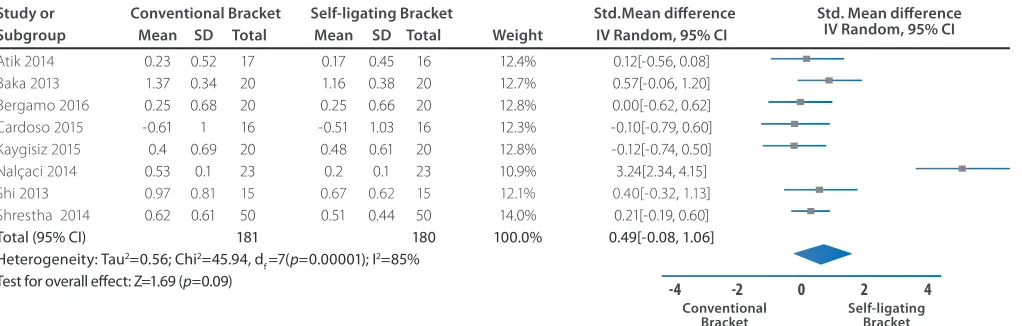
Atik 2014 0.23 0.52 17 0.17 0.45 16 12.4% 0.12[-0.56, 0.08]
Baka 2013 1.37 0.34 20 1.16 0.38 20 12.7% 0.57[-0.06, 1.20]
Bergamo 2016 0.25 0.68 20 0.25 0.66 20 12.8% 0.00[-0.62, 0.62]
Cardoso 2015 -0.61 1 16 -0.51 1.03 16 12.3% -0.10[-0.79, 0.60]
Kaygisiz 2015 0.4 0.69 20 0.48 0.61 20 12.8% -0.12[-0.74, 0.50]
Nalçaci 2014 0.53 0.1 23 0.2 0.1 23 10.9% 3.24[2.34, 4.15]
Shi 2013 0.97 0.81 15 0.67 0.62 15 12.1% 0.40[-0.32, 1.13]
Shrestha 2014 0.62 0.61 50 0.51 0.44 50 14.0% 0.21[-0.19, 0.60]
Total (95% CI) 181 180 100.0% 0.49[-0.08, 1.06]
Heterogeneity: Tau2=0.56; Chi2=45.94, d
f =7(p=0.00001); I2=85%
Test for overall effect: Z=1.69 (p=0.09)
Figure 3. Forest plot of the event "Depth of probing between conventional brackets and self-ligating brackets"
Std. Mean difference IV Random, 95% CI
Std. Mean difference IV Random, 95% CI
Std. Mean difference IV Random, 95% CI Conventional
Bracket Self-ligating Bracket
-0.5 0 0.5
-1 1
Study or Conventional Bracket Self-ligating Bracket Std.Mean difference
Subgroup Mean SD Total Mean SD Total Weight IV Random, 95% CI
Bergamo 2016 0 0.39 20 -0.05 0.42 20 25.1% 0.12[-0.50, 0.74]
Kaygisiz 2015 0.33 1.25 20 -0.16 1.61 20 25.1% 0.33[-0.29, 0.96]
Nalçaci 2014 0.15 0.04 23 0.05 0.02 23 23.6% 3.11[2.23, 3.99]
Shrestha 2014 0.05 0.12 50 0.09 0.09 50 26.1% 0.37[-0.77, 0.02]
Total (95% CI) 113 113 100.0% -0.37[-0.77, 0.02]
Heterogeneity: Tau2=1.45; Chi2=60.23, d
f =3(p<0.00001); I2=94%
Test for overall effect: Z=1.20 (p=0.23)
Figure 5. Forest plot of the event "Gingival index between conventional brackets and self-ligating brackets"
Figure 6. Forest plot of the event "Plaque index between conventional brackets and self-ligating brackets"
Figure 4. Forest plot of the event "Bleeding on probing between conventional brackets and self-ligating brackets"
Std. Mean difference IV Random, 95% CI
Conventional
Bracket Self-ligating Bracket
-2 0 2
-4 4
Conventional
Bracket Self-ligating Bracket
-2 0 2
-4 4
Conventional
Bracket Self-ligating Bracket
-2 0 2
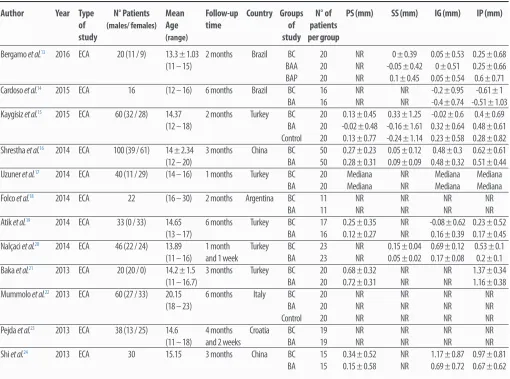
Author Year Type N° Patients Mean Follow-up Country Groups N° of PS (mm) SS (mm) IG (mm) IP (mm)
of (males/ females) Age time of patients
study (range) study per group
Bergamo et al.13 2016 ECA 20 (11 / 9) 13.3 ± 1.03 2 months Brazil BC 20 NR 0 ± 0.39 0.05 ± 0.53 0.25 ± 0.68
(11 – 15) BAA 20 NR -0.05 ± 0.42 0 ± 0.51 0.25 ± 0.66
BAP 20 NR 0.1 ± 0.45 0.05 ± 0.54 0.6 ± 0.71
Cardoso et al.14 2015 ECA 16 (12 – 16) 6 months Brazil BC 16 NR NR -0.2 ± 0.95 -0.61 ± 1
BA 16 NR NR -0.4 ± 0.74 -0.51 ± 1.03
Kaygisiz et al.15 2015 ECA 60 (32 / 28) 14.37 2 months Turkey BC 20 0.13 ± 0.45 0.33 ± 1.25 -0.02 ± 0.6 0.4 ± 0.69
(12 – 18) BA 20 -0.02 ± 0.48 -0.16 ± 1.61 0.32 ± 0.64 0.48 ± 0.61
Control 20 0.13 ± 0.77 -0.24 ± 1.14 0.23 ± 0.58 0.28 ± 0.82 Shrestha et al.16 2014 ECA 100 (39 / 61) 14 ± 2.34 3 months China BC 50 0.27 ± 0.23 0.05 ± 0.12 0.48 ± 0.3 0.62 ± 0.61
(12 – 20) BA 50 0.28 ± 0.31 0.09 ± 0.09 0.48 ± 0.32 0.51 ± 0.44
Uzuner et al.17 2014 ECA 40 (11 / 29) (14 – 16) 1 months Turkey BC 20 Mediana NR Mediana Mediana
BA 20 Mediana NR Mediana Mediana
Folco et al.18 2014 ECA 22 (16 – 30) 2 months Argentina BC 11 NR NR NR NR
BA 11 NR NR NR NR
Atik et al.19 2014 ECA 33 (0 / 33) 14.65 6 months Turkey BC 17 0.25 ± 0.35 NR -0.08 ± 0.62 0.23 ± 0.52
(13 – 17) BA 16 0.12 ± 0.27 NR 0.16 ± 0.39 0.17 ± 0.45
Nalçaci et al.20 2014 ECA 46 (22 / 24) 13.89 1 month Turkey BC 23 NR 0.15 ± 0.04 0.69 ± 0.12 0.53 ± 0.1
(11 – 16) and 1 week BA 23 NR 0.05 ± 0.02 0.17 ± 0.08 0.2 ± 0.1
Baka et al.21 2013 ECA 20 (20 / 0) 14.2 ± 1.5 3 months Turkey BC 20 0.68 ± 0.32 NR NR 1.37 ± 0.34
(11 – 16.7) BA 20 0.72 ± 0.31 NR NR 1.16 ± 0.38
Mummolo et al.22 2013 ECA 60 (27 / 33) 20.15 6 months Italy BC 20 NR NR NR NR
(18 – 23) BA 20 NR NR NR NR
Control 20 NR NR NR NR
Pejda et al.23 2013 ECA 38 (13 / 25) 14.6 4 months Croatia BC 19 NR NR NR NR
(11 – 18) and 2 weeks BA 19 NR NR NR NR
Shi et al.24 2013 ECA 30 15.15 3 months China BC 15 0.34 ± 0.52 NR 1.17 ± 0.87 0.97 ± 0.81
BA 15 0.15 ± 0.58 NR 0.69 ± 0.72 0.67 ± 0.62
Table 1. Characteristics of included articles.
NR: Not reported. RCT: Randomized clinical trial. BC: Conventional bracket. BA: Self-ligating bracket. BAA: Active self-ligating bracket. BAP: Passive self-ligating bracket. PS: Depth on probing. SS: Bleeding on probing. IG: Gingival index. IP: Plate index. mm: Millimeters.
RESULTS.
Study selectionThe initial search in the biomedical databases yielded a total of 87 titles, from January 2012 to December 2017, 35 of which consisted of repeated titles, with 52 unique ones remaining. The titles were read and 13 were excluded, leaving 39; subsequently their abstracts were read discarding those that did not meet the inclusion criteria. Twelve articles were selected for an exhaustive review of its content and methodology. Four articles were discarded as they did not report metadata related to periodontal health parameters or because these were reported using another measure of central tendency that was not the mean. (Figure 1)
Characteristics and results of studies
The number of patients ranged between 16 and 100 in the included studies with a follow-up time of between
1 month and 6 months.13-24 Nine studies13,15,16,19-24 reported patients aged between 13.3 and 20.15 years. Nine13,15-17,19-23 reported that the total number of patients in relation to their gender (men and women) was 175 and 242, respectively. Eleven studies13-23 reported that the age of patients ranged between 11 and 30 years. The countries where the studies were conducted were Brazil,13,14 Turkey,15,17,19-21 China,16,24 Argentina,18 Italy22 and Croatia.23 Periodontal treatments were performed prior to the placement of the brackets in all studies.13-23 (Table 1)
The total number of treated patients was 485. In two studies15,22 a control group was used and in one study 13 a group of active ligating brackets and a passive self-ligating bracket were considered. (Table 1)
studies,15,16,19, 21,24 bleeding on probing was reported in five studies,13,15,16, 20,21 gingival index was reported in seven studies,13-16,19,20,24 and plaque index was reported in eight studies;13-16,19-21,24 which ranged from -0.02 a 0.72mm, -0.24 a 0.33mm, -0.4 a 1.17mm and from -0.61 a 1.37mm respectively. (Table 1)
Analysis of the studies’ risk of bias
All studies13-24 showed a high risk of bias. (Figure 2) Summary of Results (Meta-analysis)
Probing depth:
- Depth of probing was determined in five studies15,16,19,21,24 revealing that there was not a significant difference. (Figure 3)
Bleeding on probing:
- Bleeding on probing was determined in four studies13,15,16,20 revealing that there was no significant difference. (Figure 4)
Gingival index:
- The gingival index was determined in seven studies13-16,19,20,24 revealing that there was no significant difference. (Figure 5)
Plaque index:
- The plaque index was determined in eight studies13-16,19-21,24 revealing that there was no significant difference. (Figure 6)
DISCUSSION.
Orthodontics and periodontics are inter-related as a correct teeth alignment facilitates good oral hygiene. However, the process of dental alignment through orthodontic therapy can have negative effects on the periodontium, causing gingival inflammation and decreasing the effectiveness of tooth brushing. Additionally, the biology of tooth movement requires creating an area of bone turnover adjacent to the teeth, which could increase the risk of losing support in that area. Therefore, it is important to understand that the relationship between periodontics and orthodontics is increasingly important since these two areas are clinically associated.25
An example of this relationship is illustrated by the increase in biofilm, which is a known and relevant problem occurring during the course of fixed orthodontic therapy and which could depend on the orthodontic system
used.15,19-21,23,26,27 Oral hygiene as a risk factor for plaque accumulation has been carefully reviewed in previous studies.27,28,29 For this reason, the aim of this systematic review and meta-analysis was to evaluate and compare the clinical periodontal effect of CB and SLBs in randomized clinical trials (RCTs). The results showed that SLB do not present any difference regarding its periodontal clinical effect (depth on probing, bleeding on probing, gingival index and plaque index) compared to CB.
In this study, a random effects model was used for the meta-analysis, in which it was additionally shown that there were differences between the parallel design15-20,22-24 and crossover13,14,21 randomized controlled trials (RCT), since positive periodontal clinical effects from CB were shown by some studies while others showed positive periodontal clinical effects from SLB; This is why, although no significant differences between the two bracket types were found, possibly this variation between studies marked a tendency towards the SLB in the results of each periodontal parameter analyzed.
One of the strengths of this systematic review was the selection of the studies because an exhaustive search was carried out in the most important databases and strict inclusion criteria were used. However, there is an important limitation, because all the incorporated RCTs present a high risk of bias. This limitation causes this study to have moderate quality of evidence, considering that most of the orthodontic meta-analyzes reported in the literature are of low or very low quality of evidence.27,28
Comparing the results obtained in the present study with those obtained in the systematic reviews carried out previously on this topic,27,30 confirms there is no difference in the periodontal clinical effect when using CB or SLB, taking into account that these reviews covered RCTs older than those presented in this study.
CONCLUSION.
Overall, no differences were detected in the periodontal
clinical effect of patients who received orthodontic treatment with conventional and self-ligating brackets.
REFERENCES.
1. Capistrano A, Cordeiro A, Siqueira DF, Capelozza Filho L, Cardoso Mde A, Almeida-Pedrin RR. From conventional to self-ligating bracket systems: is it possible to aggregate the experience with the former to the use of the latter? Dental Press J Orthod. 2014;19(3):139–57.
2. Fleming PS, O'Brien K. Self-ligating brackets do not
increase treatment efficiency. Am J Orthod Dentofacial Orthop. 2013;143(1):11–9.
3. Prettyman C, Best AM, Lindauer SJ, Tufekci E. Self-ligating vs conventional brackets as perceived by orthodontists. Angle Orthod. 2012;82(6):1060–6.
4. Arteche P, Echandia GO, Sierra Á, Aristizábal JF, Rey
D. Consideraciones importantes de la ortodoncia con brackets de autoligado versus ligado convencional. Rev Esp Ortod. 2015;45(2):93–100.
5. Liu Y, Wang PJ, Zhou S, Bai XF. Comparative study of self-ligating brackets and conventional brackets: direction and progress. Chin J Tissue Eng Res. 2014;18(25):4068–72.
6. Al-Thomali Y, Mohamed RN, Basha S. Torque expression in self-ligating orthodontic brackets and conventionally ligated brackets: A systematic review. J Clin Exp Dent. 2017;9(1):e123–8.
7. Muguruma T, Iijima M, Brantley WA, Ahluwalia KS, Kohda N, Mizoguchi I. Effects of third-order torque on frictional force of self-ligating brackets. Angle Orthod. 2014;84(6):1054–61.
8. Yang X, Xue C, He Y, Zhao M, Luo M, Wang P, Bai D. Transversal changes, space closure, and efficiency of conventional and self-ligating appliances : A quantitative systematic review. J Orofac Orthop. 2018;79(1):1–10.
9. Čelar A, Schedlberger M, Dörfler P, Bertl M. Systematic review
on self-ligating vs. conventional brackets: initial pain, number of visits, treatment time. J Orofac Orthop. 2013;74(1):40–51.
10. Zhou Q, Ul Haq AA, Tian L, Chen X, Huang K, Zhou Y. Canine
retraction and anchorage loss self-ligating versus conventional brackets: a systematic review and meta-analysis. BMC Oral Health. 2015;15(1):136.
11. Urrútia G, Bonfill X. [PRISMA declaration: a proposal to improve
the publication of systematic reviews and meta-analyses]. Med Clin . 2010;135(11):507–11.
12. Higgins JPT, Green S. Cochrane Handbook for Systematic
Reviews of Interventions. Version 5.1.0. The Cochrane: The Cochrane Collaboration; 2011.
13. Bergamo AZ, Nelson-Filho P, Romano FL, da Silva RA, Saraiva
MC, da Silva LA, Matsumoto MA. Gingival crevicular fluid volume and periodontal parameters alterations after use of conventional and self-ligating brackets. J Orthod. 2016;43(4):260–7.
14. Cardoso Mde A, Saraiva PP, Maltagliati LÁ, Rhoden FK,
Costa CC, Normando D, Capelozza Filho L. Alterations in plaque accumulation and gingival inflammation promoted by treatment with self-ligating and conventional orthodontic brackets. Dental Press J Orthod. 2015;20(2):35–41.
15. Kaygisiz E, Uzuner FD, Yuksel S, Taner L, Çulhaoğlu
R, Sezgin Y, Ateş C. Effects of self-ligating and conventional brackets on halitosis and periodontal conditions. Angle Orthod. 2015;85(3):468–73.
16. Shrestha B, Jin X, Chen L, Shrestha R. Comparative Study of
Periodontal Status of Early Orthodontic. Subjects treated with Self-ligating Brackets vs Conventional Edgewise Brackets. J Ind Orthod
Soc. 2014;48(4):365–9.
17. Uzuner FD, Kaygisiz E, Cankaya ZT. Effect of the bracket types
on microbial colonization and periodontal status. Angle Orthod. 2014;84(6):1062–7.
18. Folco AA, Benítez-Rogé SC, Iglesias M, Calabrese D, Pelizardi
C, Rosa A, Brusca MI, Hecht P, Mateu ME. Gingival response in orthodontic patients: Comparative study between self-ligating and conventional brackets. Acta Odontol Latinoam. 2014;27(3):120–4.
19. Atik E, Ciğer S. An assessment of conventional and self-ligating
brackets in Class I maxillary constriction patients. Angle Orthod. 2014;84(4):615–22.
20. Nalçacı R, Özat Y, Çokakoğlu S, Türkkahraman H, Önal S, Kaya
S. Effect of bracket type on halitosis, periodontal status, and microbial colonization. Angle Orthod. 2014;84(3):479–85.
21. Baka ZM, Basciftci FA, Arslan U. Effects of 2 bracket and
ligation types on plaque retention: a quantitative microbiologic analysis with real-time polymerase chain reaction. Am J Orthod Dentofacial Orthop. 2013;144(2):260–7.
22. Mummolo S, Marchetti E, Giuca MR, Gallusi G, Tecco S,
Gatto R, Marzo G. In-office bacteria test for a microbial monitoring during the conventional and self-ligating orthodontic treatment. Head Face Med. 2013;9:7.
23. Pejda S, Varga ML, Milosevic SA, Mestrovic S, Slaj M, Repic
D, Bosnjak A. Clinical and microbiological parameters in patients with self-ligating and conventional brackets during early phase of orthodontic treatment. Angle Orthod. 2013;83(1):133–9.
24. Shi J, Liu Y, Hou J, Yan Z, Peng H, Chang X. [Comparison
of periodontal indices and Porphyromonas gingivalis between conventional and self-ligating brackets]. Hua Xi Kou Qiang Yi Xue Za Zhi. 2013;31(3):228–31.
25. Davis SM, Plonka AB, Fulks BA, Taylor KL, Bashutski J.
Consequences of orthodontic treatment on periodontal health: Clinical and microbial effects. Semin Orthod. 2014;20:139.
26. Akgun OM, Altug H, Karacay S, Guven Polat G, Duyan S, Bedir
O. Effect of 2 elastomeric ligatures on microbial flora and periodontal status in orthodontic patients. Am J Orthod Dentofacial Orthop. 2014;145(5):667–71.
27. Arnold S, Koletsi D, Patcas R, Eliades T. The effect of bracket
ligation on the periodontal status of adolescents undergoing orthodontic treatment. A systematic review and meta-analysis. J Dent. 2016;54:13–24.
28. Koletsi D, Fleming PS, Eliades T, Pandis N. The evidence from
systematic reviews and meta-analyses published in orthodontic literature. Where do we stand? Eur J Orthod. 2015;37(6):603–9.
29. Migliorati M, Isaia L, Cassaro A, Rivetti A, Silvestrini-Biavati F,
Gastaldo L, Piccardo I, Dalessandri D, Silvestrini-Biavati A. Efficacy of professional hygiene and prophylaxis on preventing plaque increase in orthodontic patients with multibracket appliances: a systematic review. Eur J Orthod. 2015;37(3):297–307.
30. Yang X, Su N, Shi Z, Xiang Z, He Y, Han X, Bai D. Effects of
self-ligating brackets on oral hygiene and discomfort: a systematic review and meta-analysis of randomized controlled clinical trials. Int J Dent Hyg. 2017;15(1):16–22.
31. Cobos-Carbó A, Augustovski F. [CONSORT 2010 Declaration: