Design Of Customer Retention and Loyalty Integration System on
Android Based
Nia Rahma Kurnianda
[1], Yunita Sartika Sari
[2][1],[2]
Faculty of Computer Science, Universitas Mercu Buana, Jl. Meruya Selatan No. 1, Meruya Selatan, Kembangan, Jakarta, Indonesia
[1]
E-mail:[email protected]
[2]
Email: [email protected]
---
************************
---Abstract:
Information technology has a great influence in various aspects of people's lives because it is an integral part of everyday life. The facilities provided by information technology are no longer just secondary needs but have become primary needs, including business activities at Departement of Customer Retention and Loyalty at PT Indosat Ooredo. The problems that we found include, the implementation of customer retention and loyalty is still semi-computerized and still not integrated, every task is done by manual taskforce. Its hard when administrator want to file a report because the various of activity is not recorded properly. Then the need for mobile technology for sales and so on moved us to be able to do this research. However to solve those problems above, we can offer to make a single integrated design to work with existing system so that existing resources can be used as resources for the new systems.
Keywords — customer retention, customer loyalty, integrated system
---
************************
---I. INTRODUCTION
Information technology has a big influence in various aspects of people's lives because it is an integral part of everyday life. The technology is moving very quickly[1]
The facilities provided by information technology are no longer just secondary needs, but have become primary needs which are the main drivers in every area of people's lives. With the existence of information technology, daily activities are easier to implement.
Giving Customer Retention and Loyalty looks not important to do by a company. So that many companies do not consider doing so. But according to Zulkifli's research, 2012[2] customer trust is affected by the existence of Customer Retention activities. While Customer Retention has an influence on Customer Loyalty. Then according to
the findings of Jalal Rajeh Hanaysha, 2017[3] social media has an influence on customer retention, but sales promotions, corporate CSR activities and so on have more influence on customer retention towards positive effects. On the other hand, according to Annisa Indah Puspita, et al. 2018[4] concludes that customer loyalty affects customer retention. Until here, the author gets key information that customer retention activities and customer loyalty influence each other so that mutual integration is needed to facilitate management on the corporate side.
The activities managed require administrative support that is managed matrix by the Business Integration and Customer Loyalty divisions and tends to increase from year to year. Along with the increasing need for providing retention and loyalty activities to customers, the activities in the administrative sector are increasing. To maintain
the integrity and work performance of administrators, we are moved to develop and integrate retention and loyalty activities with the existing corporate level new customer registration system to facilitate the provision of retention and loyalty programs that are appropriate for eligible corporate customers
II. FUNDAMENTALTHEORIES 1. Unified Modeling Language
According to Alan Dennis, Unified Modelling Language (UML) is the standard language for visualization, specification, construction and documentation of the artefacts of a software, and can be used for all stages in the system development process from analysis, design to implementation, according to Denn [5].
UML provides some standard notation and diagrams that can be used as a communication tool for system developers in the process of system analysis and design. Diagrams in UML are defined as information in various forms that are used or produced in the software development process.
Based on the perspective in object-oriented analysis and design process with UML, there are several main diagrams in UML that can be used, namely: 1. Use Case Diagram. Describe the expected functionality of a system. 2. Activity Diagram. An analysis model used or describes an activity process 3. Sequence Diagram. ilustrates the objects in use cases and messages that run in a use case and 4. Class Diagram Describes the number of classes and relationships between classes in the system.
2. Administration
includes recording activities, correspondence, bookkeeping and letter archiving as well as other matters intended to provide information and make it easier to get information back if needed.[6]
3. Customer Retention and Loyalty
customer retention is an activity aimed at being able to maintain continuous interaction with customers through ongoing relationships, marketing loyalty, database marketing, marketing permissions, and advancements[7]
Customer loyalty or consumer loyalty according to Amin Widjaja Tunggal[8] is customer attachment to a brand, shop, manufacturer, service provider, or other entity based on favorable attitudes and good responses, such as repurchase. Based on this definition, it can be concluded that there is an element of behavior and attitude in customer loyalty.
Boulding[9] suggests that the occurrence of brand loyalty to consumers is caused by the influence of satisfaction and dissatisfaction with the brand which accumulates continuously in addition to the perception of product quality.
III. METHODOLOGY
In this research, we have 4 stage to complete all the series of the research.
First stage is introduction, on this stage, we had to review the problem and some possibilities solution.
Second stage, we gathered some literatures and studied the previous works to gather the solution and best practice to the give the best solution. In this stage, we also do some interview and observations to the business process to gathered some information, data, documentation.
Third stage, we started to analyze the data, information and the documentation we get to perform a grand design to the integrated system. The method we used to analyze the data, information and the documentation is based on Object Oriented Analysis, the output of these steps is some requirement for system integrated functional and non functional.
The fourth stage is design. The method we used to design the system model is object oriented design. We design the system in database modeling, user interface modeling, class diagram modeling and sequence diagram modeling.
IV. RESULT AND DISCUSSIONS 1. Analysis
a. Procedure Analysis
These are the procedure that running in the departement:
1) Budget Proposal
proposal. Proposal will made based on the purpose. There are event budget proposal, reimburstment proposal and sponsorship
For example, reimburstment proposal for customer entertaining. Customer entertaining is the way of account executive could make the PIC of the coorporate customer make themselves feel special so they’ll get happy to cooperate with the company.
Sales who have entertained customers, such as Lunch Meetings and so on, can do Reimburstment by filling out the Customer Entertainment Attachment Form and invoices obtained while carrying out entertainment to customers and then submitting them to the admin. Then the Admin will fill in the APF and attach the form. After that the Admin will submit the APF to the DH Business Integration and Customer Loyalty to be signed. After the APF is signed, the APF and its attachments will be submitted to the Finance department. Finance will transfer to the Sales account number printed on the APF. 2) Settlement proposal
Admin enters the expenditure records into the down payment usage details that listed on the proof of payment (receipts, invoices, etc.) obtained in each down payment transaction that comes out in financing an event, then prints the down payment usage details.
If the proposed Budget experiences excess budget, then the admin will deposit the remaining company money to the bank and attach proof of deposit, then the admin will fill in the APF settlement signed by the DH Business Integration and Customer Loyalty.
After the APF is signed, the Admin will submit the APF to Finance along with the attachment of proof of payment and the printout of down payment usage details.
If the proposed Budget has a shortage, then the admin will make Justification a shortage of advances signed by the Customer Retention Manager and Loyaty. Then the admin will fill the Reimburstment APF to submit a Reimburst request to the company.
After that, Admin will fill APF settlement. Both APFs are submitted to the DH Business Integration and Customer Loyalty to be signed. After the two APFs are signed, the Admin will submit the APF Accountability to Finance along with the attachment of proof of payment, printout of down payment usage details, APF Reimbursement and justification for the down payment. lastly, Finance will transfer to the admin account number that listed on the APF.
3) Retention and Loyalty Event Implementation
Sales will provide data of the guests who will attend the event, such as names, telephone numbers, and emails. The data will sent through the email and received by admin, then the Admin will input to the registration list and print it to be placed on the registration table, then admin will prepare the Souvenir / Promotional Item for a number of upcoming guests and record it as an item out.
From the data received, Admin prints an invitation label to be affixed to the invitation's front page addressed to the customer.
Then the invitation that has been labeled by the admin is submitted to the sales to be sent to the customer immediately
4) Existing system
b. Use Case
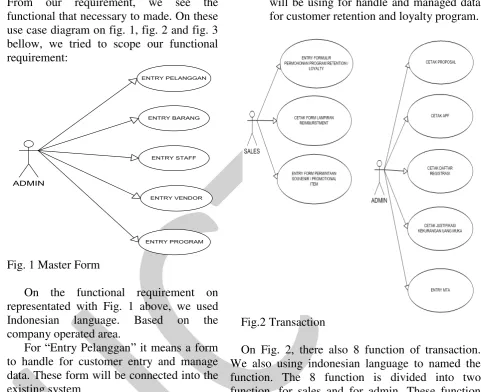
From our requirement, we see the functional that necessary to made. On these use case diagram on fig. 1, fig. 2 and fig. 3 bellow, we tried to scope our functional requirement:
ADMIN
ENTRY PELANGGAN
ENTRY BARANG
ENTRY STAFF
ENTRY VENDOR
ENTRY PROGRAM
Fig. 1 Master Form
On the functional requirement on representated with Fig. 1 above, we used Indonesian language. Based on the company operated area.
For “Entry Pelanggan” it means a form to handle for customer entry and manage data. These form will be connected into the existing system
For “Entry Barang” it means a form to handle for the goods that will be used on souvenir and promotional item. This form will be using to manage goods data.
For “Entry Staff” it will be used to handle the data for staff. The problem is, HR only have datas for full time employee. but some sales or account executive is a part-timer. So we proposed to connected the data from HR and from our database to recorded properly the part-timer’s data.
For “Entry Vendor” it means the form to handle vendor that will carry out the event mission. But also, the sales and account executive is also can be called vendor.
For “Entry Program” it means the form will be using for handle and managed data for customer retention and loyalty program.
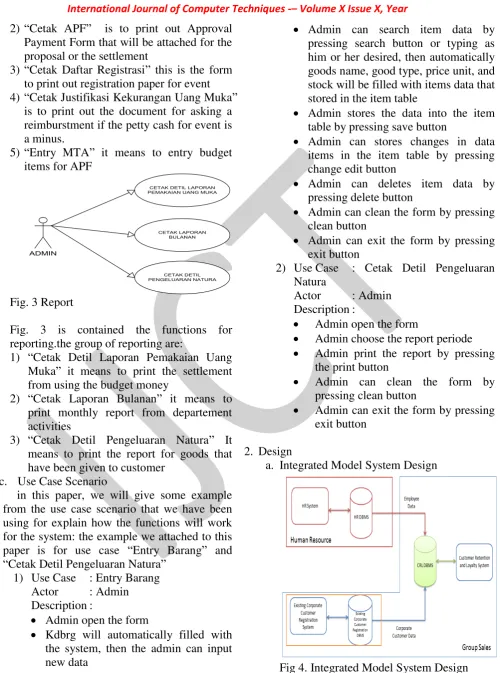
Fig.2 Transaction
On Fig. 2, there also 8 function of transaction. We also using indonesian language to named the function. The 8 function is divided into two function, for sales and for admin. These function for sales are:
1) “Entry Formulir Permohonan Retention and Loyalty” it means the form to file the proposal to hold an event or program for customer retention and loyalty
2) “Cetak Form Lampiran Reimburstment” it means to print out the form that will attached on reimburstment proposal
3) “Entry Form Permintaan Souvenir / Promotional Item” it means a form to file a request souvenirs or promotional items to marketing departement
These functions for admin are:
2) “Cetak APF” is to print out Approval Payment Form that will be attached for the proposal or the settlement
3) “Cetak Daftar Registrasi” this is the form to print out registration paper for event 4) “Cetak Justifikasi Kekurangan Uang Muka”
is to print out the document for asking a reimburstment if the petty cash for event is a minus.
5) “Entry MTA” it means to entry budget items for APF
ADMIN
CETAK DETIL LAPORAN PEMAKAIAN UANG MUKA
CETAK LAPORAN BULANAN
CETAK DETIL PENGELUARAN NATURA
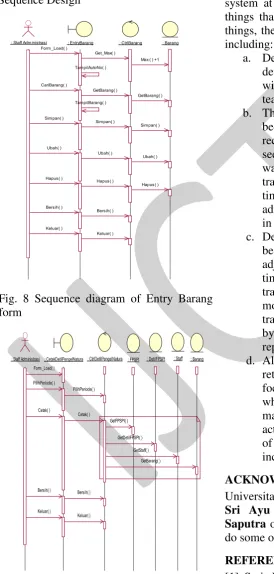
Fig. 3 Report
Fig. 3 is contained the functions for reporting.the group of reporting are:
1) “Cetak Detil Laporan Pemakaian Uang Muka” it means to print the settlement from using the budget money
2) “Cetak Laporan Bulanan” it means to print monthly report from departement activities
3) “Cetak Detil Pengeluaran Natura” It means to print the report for goods that have been given to customer
c. Use Case Scenario
in this paper, we will give some example from the use case scenario that we have been using for explain how the functions will work for the system: the example we attached to this paper is for use case “Entry Barang” and
“Cetak Detil Pengeluaran Natura” 1) Use Case : Entry Barang
Actor : Admin Description :
Admin open the form
Kdbrg will automatically filled with the system, then the admin can input new data
Admin can search item data by pressing search button or typing as him or her desired, then automatically goods name, good type, price unit, and stock will be filled with items data that stored in the item table
Admin stores the data into the item table by pressing save button
Admin can stores changes in data items in the item table by pressing change edit button
Admin can deletes item data by pressing delete button
Admin can clean the form by pressing clean button
Admin can exit the form by pressing exit button
2) Use Case : Cetak Detil Pengeluaran Natura
Actor : Admin Description :
Admin open the form
Admin choose the report periode Admin print the report by pressing
the print button
Admin can clean the form by pressing clean button
Admin can exit the form by pressing exit button
2. Design
a. Integrated Model System Design
b. Class Diagram Design 1 1..* 1..* auto_nopjustifikasi() cari() get_justifikasi() simpan() tampil_justifikasi() auto_noapf() cari() get_apf() simpan() tampil_apf() Terbilang() apf no_apf tgl_apf nik jenis_bayar mata_uang deskripsi_apf no_mta no_ref tgl_ref nilai_fef total_apf terbilang hutangpiutang persetujuan1 nama_persetujuan1 jabatan1 persetujuan2 nama_persetujuan2 jabatan2 persetujuan3 nama_persetujuan3 jabatan3 persetujuan4 nama_persetujuan4 jabatan4 auto_nik() cari_nama_staff() cari_staff() get_Staff() hapus() simpan() tampil_staff() ubah() nik nama_staff tgl_lahir jenis_kelamin agama alamat notel hp email direktorat subdir divisi departemen fungsi jabatan no_rek password staff auto_noreimburstment() cari() get_reimburstment() simpan() tampil_reimburstment() no_form tgl_pengajuan total_pengajuan nik reimburstment nomor_justifikasi tgl_justifikasi no_apf point_justifikasi nik justifikasi no_form no_pelanggan tgl_transaksi deskripsi_kegiatan jenis_reimburstment jpp jppl nilai_transaksi detil_reimburstment cari() get_dr() simpan() tampil_detilreimburstment() V-1 no_fpspi no_pelanggan fpspi no_fpspi tgl_permohonan nik kd_program persetujuan1 persetujuan2 status_p1 status_p2 auto_nofpsi() get_fpspi() simpan() tampil() pelanggan no_pelanggan tgl_bergabung nama_perusahaan tgl_berdiri bidang_usaha alamat notelp fax email status_pelanggan revenue nama_pic tgl_lahir_pic jk alamat_pic notel_pic no_hp email_pic auto_noplg() cari_namapelanggan() cari_pelanggan() get_pelanggan() hapus() simpan() tampil_pelanggan() ubah() detil_fpspi no_fpspi no_pelanggan kdbrg jumlah_minta cari() get_detilfpspi() simpan() tampil() program kd_program nama_program jenis_program keterangan auto_kdprogram() cari_nama_program() cari_program() get_program() hapus() simpan() tampil_program() ubah() fpprl no_fpprl tgl_permohonan no_pelanggan kd_program jml_peserta usulan_tempat usulan_tgl nik approver1 approver2 status_app1 status_app2 auto_nofpprl() cari_kd_program() cari_tgl_usulan() get_fpprl() simpan() tampil_fpprl() proposal no_proposal tgl_proposal judul_proposal no_mta point1_lb point2_lb point3_lb point4_lb tujuan1 tujuan2 tujuan3 tujuan4 total_nilai_estimasi auto_noproposal() cari() get_proposal() simpan() tampil_proposal() barang kdbrg nama_barang jenis_barang harga_satuan jumlah_stok auto_kdbrg() cari_barang() get_barang() hapus() simpan() tampil_barang() ubah() detil_fpprl no_fpprl kdbrg jumlah cari() get_detilfpprl() simpan() tampil_detilfpprl() daftar_registrasi no_dr no_fpprl total_undangan auto_noreimburstment() cari() get_reimburstment() simpan() tampil_reimburstment() detil_dr no_dr nama_tamu alamat cari() get_detildr() simpan() tampil_detildr() estimasi_biaya no_proposal keterangan nilai_estimasi cari() get_biaya() simpan() tampil_eb() mta no_mta deskripsi_mta no_cc auto_nomta() cari_deskripsi() cari_mta() cari_nocc() get_mta() hapus() simpan() tampi_mta() ubah() cost_center no_cc budget_holder auto_nocc() cari_budgetholder() cari_cc() get_cc() hapus() simpan() tampil_cc() ubah() detil_apf no_invoice tgl_invoice deskripsi_invoice nilai_invoice jenis_penerima_bayar penerima_bayar nama_penerima_bayar pelaksana_bayar nama_pelaksana_bayar no_apf cari() get_detilapf() simpan() tampil_detilapf() 1 0..1 1 1..* 1 1..* 1 1..* * * * * 1 1..* 1 1..* 1 1..* 1 1 1..* * * * * 0..1 1 1 1 1 * 1 1..* 1 1..*
Fig. 5 Class Diagram Design
c. User Interface Design
Fig. 6 Entry Barang Form Design
On Fig 6 and Fig 7 above, we attached the two example of the user interface that we made for this research.
d. Sequence Design
Fig. 8 Sequence diagram of Entry Barang form
Fig. 9 Sequence diagram of “Cetak Detil Pengeluaran Natura”
V. CONCLUTIONS
After analyzing and designing the customer retention and loyalty group sales administration system at PT. Indosat, tbk. There are many new things that the author has discovered. From these things, the author tries to draw several conclusions including:
a. Design Recording requests, become more detailed because it is supported together with the implementation of transactions and team activities.
b. The design of recording outgoing goods has been closed automatically with the recording of requests, making it easier to see the remaining stock of goods in the warehouse when going to make a transaction request of goods, this causes time efficiency so that it will be easier for administrators to be able to do other support in the new request
c. Design With the standardization of data to be stored, lifts the burden of thinking adjustments made by the admin at every time the transaction process, so that the transaction will run more smoothly and more quickly resolved. In addition, every transaction made is automatically recorded by the system making it easier to make reporting activities.
d. Allows the activities of the customer retention and loyalty team to become more focused on supporting activities to sales which become their main job to manage the management of retention and loyalty activities, so that sales can increase the level of customer satisfaction that results in increased revenue received by the company
ACKNOWLEDGEMENT
Universitas Mercu Buana Research Center.
Sri Ayu Lailatul Mardiyah dan Dicka Estu Saputra our dearest college student that help us to do some our task
REFERENCES
[1] Sari, Yunita Sartika. Prototype of Knowledge Management System (KMS) E-Procurement Web-Based: Case Study At PT. Sigma Pro 77
: EntryBarang : CtrlBarang : Barang : Staff Administrasi
Form_Load( )
Get_Max( )
Max ( ) +1 TampilAutoNo( )
CariBarang( )
GetBarang( )
GetBarang( ) TampilBarang( )
Simpan( )
Simpan( )
Simpan( )
Ubah( )
Ubah( )
Ubah( )
Hapus( )
Hapus( )
Hapus( )
Bersih( )
Bersih( )
Keluar( )
Keluar( )
: Staff Administrasi : CetakDetilPengelNatura : CtrlDetilPengelNatura : FPSPI : DetilFPSPI : Staff : Barang Form_Load( )
PilihPeriode( )
PilihPeriode( )
Cetak( )
Cetak( )
GetFPSPI( )
GetDetilFPSPI( )
GetStaff( ) GetBarang( )
Bersih( ) Bersih( )
Keluar( )
[2] Zulkifli. Relationship Marketing Terhadap Customer Retention dan Customer Loyalty pada Nasabah Bank Mega, Tbk Malang. Jurnal Manajemen dan Akuntansi Volume 1 Nomor 1. 2012
[3] Jalal Rajeh Hanaysha. Customer Retention and The Mediating Role of Perceived Value in Retail Industry. Emerald Insight, World Journal of Enterpreneurship, Management and Sustainable Development. 2017
[4] Annisa Indah Puspita, et al. Pengaruh Customer Satisfaction Terhadap Switching Barriers dan Customer Retention. Jurnal Administrasi Bisnis Volume 61 Nomer 1. 2018
[5] Dennis, Wixom, Roth. System Analysis & Design 5th Edition. United States of America: John Willey & Son, Inc. 2012
[6] Soewarno Handayaningrat. Pengantar Studi Ilmu Administrasi dan Manajemen. Jakarta: Gunung Agung. 2006
[7] Nia Rahma Kurnianda. Database Design for Customer Retention and Loyalty Administration Information System. International Journal of Computer Science and Mobile Computing. 2018 [8] Tunggal, Amin Widjaja. Dasar-Dasar Customer Relationship Management (CRM). Jakarta: Harvindo. 2008