Journal of Computing and Security
Improving Face Recognition Systems Security Using Local Binary
Patterns
Abdolhossein Fathi
a,∗
, Fardin Abdali-Mohammadi
aa Department of Computer and Information Technology, Faculty of Engineering, Razi University, Kermanshah, Iran.
A R T I C L E I N F O.
Article history:
Received:23 May 2015
Revised:22 June 2015
Accepted:30 November 2015
Published Online:7 February 2016
Keywords:
Face Recognition, Anti-Spoofing, Scene Texture Analysis
A B S T R A C T
Face recognition systems suffer from different spoofing attacks like photograph-based and video-based spoofing attacks. This paper presents a new method to empower the face recognition systems against video-based spoofing by employing efficient scene texture analyzing. To this end, the scene of input and reference images are divided into same non-overlapped blocks and the texture pattern of each block is extracted by local binary pattern (LBP) operator. To reduce the sensitivity of LBP to noise and also to increase the reliability of the proposed method, first input image transformed to YCbCr color space and then similarity of texture pattern in Y, Cb and Cr channels are extracted independently. The majority of similarity of three channels is used as the final similarity of each block. The ratio of same blocks in the input image and reference image is used as a measure for detecting video-based spoofing attacks. The performance of the proposed algorithm is evaluated using several scenarios. The obtained results show the effectiveness of the proposed algorithm against video-based spoofing attacks in real environments.
c
2015 JComSec. All rights reserved.
1
Introduction
Traditional authentication systems widely use knowledge-based and token-based mechanisms. The knowledge-based systems employ username and pass-word for authentication, and the token-based systems use tokens, namely, things usually carried by a person which can identify him, such as keys, passport, ID card, etc. The main drawbacks in the traditional sys-tems are: using simple passwords (which are simply guessed, disclosed or stolen by attackers), counterfeit-ing, losing ID documents, and the wear and tear of these documents. The new authentication systems are designed and manufactured based on biometric
∗ Corresponding author.
Email addresses:[email protected](A. Fathi),
[email protected](F. Abdali-Mohammadi)
ISSN: 2322-4460 c2015 JComSec. All rights reserved.
features. These systems use biological and behavioral information of persons such as face [1], fingerprint [2], voice [3], palm print [4], iris [5], ear [6] and gait [7] for identification and authentication purposes.
Face is a very prominent biometric feature that can be used to identify persons uniquely. Facial Images contain such important information as a persons iden-tity, gender, expression, age, ethnicity, etc. Thus, the idea of using face for identification purposes was initi-ated and later developed in the form of face-based bio-metric systems. During the past two decades, special focus has been placed on peoples face as a biometric feature for recognition and authentication purposes [8–12].
fingerprints are left everywhere, the spoofing attack is a fatal threat of the biometrical authentication systems.
Face recognition systems also suffer from different spoofing attacks like photograph-based, video-based and 3D model-based attacks [13]. The photograph-based attack is the most common way to spoof face recognition systems, because it is easy to obtain an im-age of the face of a valid user. The constructing of 3D model of valid user’s face is another way for spoofing face recognition systems. This way is more difficult than photograph-based methods. Video of valid user can also be obtained easily using high quality cam-eras. Video based spoofing is more difficult to detect, because videos have more physiological information like eye blink, head movements and facial expressions.
There are some efforts on anti-spoofing for face recognition systems [13–21]. Most of these methods only concentrated on the face liveness detection for photograph-based spoofing attacks. Eye blink detec-tion is the most convendetec-tional method used for face liveness detection [13–15]. Eye blink is a biological activity of eyes which some methods tried to use it as liveness measure. These methods detect and tract the persons eyes and if they have a blink, they assume the input subject is live user. However, simple eye blink detection method may fail when attackers use video-based spoofing.
Head and lips motion analysis are other techniques used for detecting face liveness [16–18]. Frischholz et al. [16] tried to estimate head position and extract head motion as a measure for face liveness when user moves and nods his/her head. Kollreider et al. [17] also tried to use the optical flow of face region as a measure of face liveness. Rua et al. [18] tried to detect the face liveness by measuring the degree of synchrony between the lips movement and the voice which is extracted from a video sequence.
Image quality degradation detection is also explored for photograph-based spoofing detection [19,20]. Li et al. [19] used the deference between the Fourier co-efficients of real images and imposter images to detect photograph-based spoofing from live faces. Maatta et al. [20] used the deference between the shape and texture of real images and imposter images to detect liveness. Thermogram of input image, which was ob-tained by infrared camera, was also used by Socolinsky et al. [21] for liveness measurement in photograph-based spoofing detection.
However, simple eye blink detection, head or lips motion extraction methods may fail when attackers use video-based spoofing, because videos have more physiological information like eye blink, head
move-ments and facial expressions.
In this paper, we improve face recognition system security by employing efficient scene texture analyz-ing method to overcome the video-based spoofanalyz-ing at-tacks. To this end, the scene of input and reference images are divided into same non-overlapped blocks and the texture pattern of each block is extracted by local binary pattern (LBP) operator. The similarity of LBP pattern of corresponding block in the input image and reference background image is used as a measure for detecting video-based spoofing attacks. To increase the reliability of proposed method and also to reduce the effect of noise on LBP operator, the texture pattern of Y, Cb and Cr color channels are extracted independently. The majority of similarity of corresponding channels in each block of the input image and reference image is used as the similarity measure of that block. By obtaining the similarity of all blocks, we can easily discriminate video-based attacks from live users.
This paper is organized as follows: the proposed scene texture analyzing method for video-based spoof-ing detection is described in Section2. Experimental results are reported in Section3. Conclusion will be given in Section4.
2
The proposed scene analyzing method
for video-base spoofing detection
In the video-based spoofing, attackers prepare a clip of valid user and play it back on the authentication camera using Laptop, Tablet or mobile devices. These equipment should be placed close to the camera and this causes to cover almost all the background of the system, in addition to the space covered by user body. Therefore, the backgrounds of the spoofing videos are different from the original (reference) background of the system based on their scene contexts. Also when spoofing videos are captured in the authentication environment, their camera angles have been different.
neighbor-hood points ({b0, b1, , bP−1}) with the value of central
pixel (bc):
BCP,R(i) =
1bi ≥bc
0bi < bc
i= 0· · ·P−1 (1)
In the classical LBP (proposed by Ojala et al. as LBPriu2 [22]) all patterns categorized into two classes:
uniform and non-uniform patterns; and only uniform patterns are selected as local texture features:
LBPP,Rriu2=
PP−1
i=0 BCP,R(i) if U(BCP,R)≤2
P+ 1 otherwise
(2) The uniform patterns contain at most two bitwise transitions from 0 to 1 or vice versa in the obtained binary code when it is considered as circular structure:
U(BCP,R) =|BCP,R(P−1)−BCP,R(0))|+ P−2
X
i=0
|BCP,R(i)−BCP,R(i+ 1))| (3)
Since in the LBPriu2non-uniform texture patterns are discarded, we employed a general extension of LBP operator (LBPGRI) , proposed by Fathi and Naghsh-Nilchi [23], that attends to use all uniform and non-uniform patterns using a proper rotation-invariant scheme:
LBPP,RGRI
=
PP−1
i=0 BCP,R(i)
P if λ(BCP,R) = 0
(P−1)(λ−1) + 1+
PP−1
i=0 BCP,R(i)if λ(BCP,R)>0
(4)
In the LBPGRI operator all local texture patterns
are clustered based on their roughness value (λ). The value of roughness is equal to half of uniformity mea-sure (U). This operator tried to describe texture pat-terns efficiently and has more compatibility with dis-tribution of patterns in real images (see [23]). Figure1 shows an example of extracting the LBP values.
To compare the scene of the input frames with the reference image, first we transform the input image
Start Point
1 1 0
0 0
0 1 1 154 136 105
95 110 103
99 115 115
BC8,1 = 11001100
U(BC8,1) = 4
LBPriu2 = 9 LBPGRI = 9
Figure 1. The details of obtaining the LBP value for LBPriu2 and LBPGRI operators.
(a) (b)
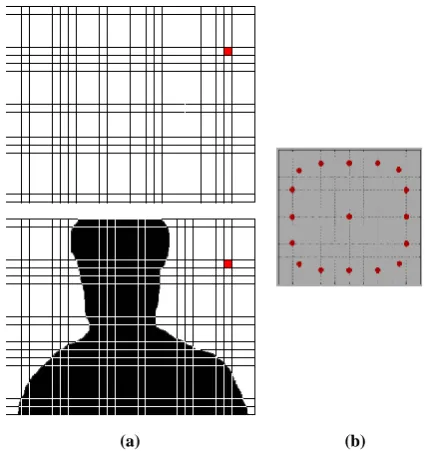
Figure 2. a) Divided the scene of reference and input images to non-overlap blocks with 10×10 pixels. b) The proposed LBP16,4for extracting the texture patterns of all blocks.
from RGB color space to YCbCr space, and then, we divide the whole image into non-overlapped blocks with 10×10 pixels. Then the texture patterns of Y, Cb and Cr channels of each block are extracted by applying LBPGRI16.4 at the center point of block. This
LBP used 16 points as shown in Figure2. The value of each point that not falls into a pixel will be computed by average of surrounded pixels.
To increase the speed of the proposed method, the LBP operator at one scale is applied on each block. Therefore by comparing the obtained LBP texture patterns of Y, Cb and Cr channel of all blocks in the input and reference images, the scenes similarity of them is determined and the video based spoofing can be detected. Two blocks is similar if at least the LBP patterns of two channels are equal. The scene similarity is obtained by calculating the similarity (or dissimilarity) of all blocks as below:
S(LBPR, LBPI) = 1−
1
T
X
m
X
n
(( X
C∈Y,Cb,Cr
LBPCR(m, n)6=LBPCI(m, n)
)>1) (5)
where T is the total number of blocks and operator returns one if the LBP patterns of color channel C (Y, Cb and Cr) of the (m,n)thblock in the input image
(LBPI) and reference image (LBPR) is not identical;
threshold Tβ (we experimentally set Tβ to 0.3, see
Section3).
3
Experimental Results
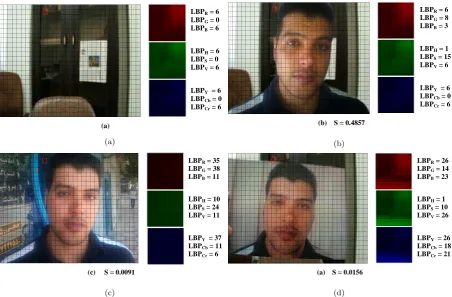
The performance of the proposed method against the photograph- and video-based spoofing attacks was evaluated on two datasets: real videos, and fake clips. The first dataset consists of 90 clips from 30 valid users that the system captured at three different times for each person. The second dataset was used for evaluating the anti-spoofing capability of the proposed method against video and photograph attacks. For each valid user two fake clips, one indoor and one outdoor, were captured in the place that its scene differ from the system environment. For each valid user also one photograph attack was simulated by moving the photo of it in the front of camera. Each video clip is captured with 30 fps and its frame size is 320×240 pixels. Some samples of these datasets along with similarity values and the obtained LBP of different color channel of RGB, HSV and YCbCr color spaces are shown in Figure3.
To evaluate the proposed method, the detection performance is measured using true positive (TP), false positive(FP), true negative(TN)and false neg-ative(FN)metrics.TP is defined as the number of real videos correctly detected;FP is defined as the number of fake clips detected as real video;TN is de-fined as the number of fake videos correctly detected; andFN is defined as the number of real videos not detected by the system. By using these metrics we can obtain more meaningful performance measures like sensitivity and specificity values as below:
Sensitivity=T P/(T P +F N) (6)
Specif icity=T N/(F P +T N) (7) We evaluated the ability of the proposed method by applying it to the all clips in two datasets. First we evaluated the effect of different color spaces and the value of scene similarity threshold (Tβ) on the
performance of the proposed method. To this end, the proposed method was applied on the three channels of RGB, HSV and YCbCr color spaces. In each color space the performance of the proposed method in detecting real and fake clips was calculated when different values for scene similarity threshold (Tβ) have
been used. The obtained results are shown in Figure4. From the obtained results, all three color spaces have similar sensitivity values in all range of threshold (Tβ). For similarity threshold Tβ greater than 0.4,
the specificity value of all color spaces are same. But
specificity value of YCbCr color space for similarity thresholdTβ less than 0.3 is better than other color
spaces. Therefore this color space was selected in final scene analyzing method.
The proposed scene texture analysis can resist against different spoofing attacks when the similarity threshold Tβ was set to 0.5 or greater. But in this
range ofTβ the sensitivity of the proposed method
for real videos is low, and not only all spoofing clips but also greater than 30% of real valid users will be rejected as spoofing cases. To increase the sensitivity of the proposed method, we set thresholdTβ to 0.3.
In this case both the sensitivity and specificity of the proposed method will be greater than 98%.
Although the spoofing attacks using the system background in the fake clips is theoretically possible, however, it sensitizes to viewpoint, scale, and illumi-nation. It is too hard to align the region of interest in a spoofing clip to corresponding region in the ref-erence image. Also from the viewpoint of the fixed camera, the scale and coordinate of objects in the reference image are different from the scale and co-ordinate of objects in the spoofing clips. However, if the backgrounds of the spoofing clip and reference image are very simple and similar, such as white wall background, it would be hard to separate them with background texture analysis. In this case we should change the background scene, use additional steps like facial motion analysis or employ multi camera scene analysis.
We also evaluated the robustness of the proposed method against Gaussian white noise that may affect the input images. In these experiments input clips were contaminated by Gaussian white noise at different standard deviations:σ= 5, 10, 15, 20 and 30. These noises only added to one channel of YCbCr color space. We also applied LBP on blocks of gray scale version of images, which was obtained from color image, and compared them to detect spoofing attacks. In these experimentsTβ was set to 0.15. The obtained results
are summarized in Table1.
From the obtained results, the proposed method for calculating the similarity measure using the majority of three channels of YCbCr color space shows high performance in all noisy conditions and can resist against noise. On the contrary, by extracting the LBP patterns and calculating similarity measure only from gray scale images, the sensitivity of the proposed method was decreased dramatically, especially for high intensity noises. But the specificity values remain high.
(a)
LBPR = 6
LBPG = 0
LBPB = 6
LBPH = 6
LBPS = 0
LBPV = 6
LBPY = 6
LBPCb = 0
LBPCr = 6
(a)
(b) S = 0.4857
LBPR = 6
LBPG = 8
LBPB = 3
LBPH = 1
LBPS = 15
LBPV = 6
LBPY = 6
LBPCb = 0
LBPCr = 6
(b)
(c) S = 0.0091
LBPR = 35
LBPG = 38
LBPB = 11
LBPH = 10
LBPS = 24
LBPV = 11
LBPY = 37
LBPCb = 11
LBPCr = 6
(c)
(a) S = 0.0156
LBPR = 26
LBPG = 14
LBPB = 23
LBPH = 1
LBPS = 10
LBPV = 26
LBPY = 26
LBPCb = 18
LBPCr = 21
(d)
Figure 3. Some samples of reference image (a), real video of valid user (b) and fake clips (c, d) along with similarity values (S) and the obtained LBP of different color channel of RGB, HSV and YCbCr color spaces.
0 20 40 60 80 100
0 0.1 0.2 0.3 0.4 0.5 0.6 0.7 0.8 0.9 1
Sensi tivit y % Threshold (TB) RGB YCbCr HSV (a) 0 20 40 60 80 100
0 0.1 0.2 0.3 0.4 0.5 0.6 0.7 0.8 0.9 1
Specifici ty % Threshold (TB) RGB YCbCr HSV (b)
Figure 4. The obtained results of the proposed method when different color spaces and different values for scene similarity threshold (Tβ) have been used. a) The obtained sensitivity values. b) The obtained specificity values.
Table 1. The obtained results (%) in the presence of Gaussian noise.
Color Noise 5 10 15 20 30 Noise Free
YCbCr Sensitivity 98.9 98.9 98.9 98.9 98.9 98.9
Specificity 100 98.9 97.8 98.9 97.8 98.9
Gray Sensitivity 93.3 88.9 82.2 72.2 47.8 96.7
Specificity 93.3 93.3 91.1 92.2 90.0 95.6
their paper on their datasets, because neither their datasets nor implementation codes available. The
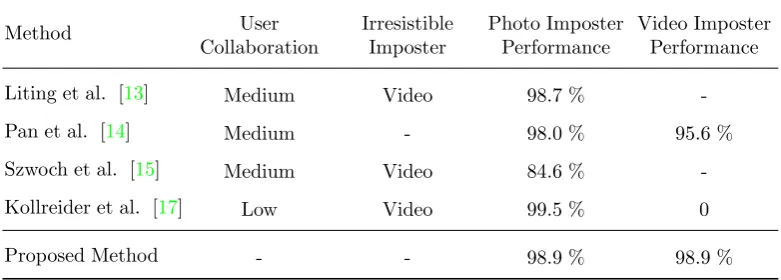
han-Table 2. The comparison of the proposed method with some existing methods.
Method User
Collaboration
Irresistible Imposter
Photo Imposter Performance
Video Imposter Performance
Liting et al. [13] Medium Video 98.7 %
-Pan et al. [14] Medium - 98.0 % 95.6 %
Szwoch et al. [15] Medium Video 84.6 %
-Kollreider et al. [17] Low Video 99.5 % 0
Proposed Method - - 98.9 % 98.9 %
dling both photograph- and video-based attacks.
4
Conclusion
This paper presents a new method to empower the face recognition systems against video-based spoof-ing by employspoof-ing efficient scene texture analysis. The scene of input and reference images are divided to 10×10 non-overlapped blocks and the texture pattern of three channels of YCbCr color space in each block are extracted by local binary pattern (LBP) operator. The majority of similarity of three channels is used as the similarity measure of each block. The similarity of all blocks in the input image and reference image is used as a measure for detecting video-based spoofing attacks. The proposed algorithm shows the sensitiv-ity and specificsensitiv-ity values greater than 98%, when it was evaluated against different video-based spoofing attacks in real environments especially in presence of noise. In the future work we can concentrate on the problem of simple backgrounds and photograph-based attack when the background of imposter image was cut. In this case we should employ multi camera scene analysis or additional steps like eye blink count detection or lip motion analysis.
Acknowledgements
This paper is a part of Research Plan entitled as Anti-Spoofing method for face recognition systems with Code 1987 at Engineering Faculty of Razi University.
References
[1] Yinjie Lei, Mohammed Bennamoun, and Amar A. El-Sallam. An efficient 3d face recognition approach based on the fusion of novel local low-level features. Pattern Recognition, 46(1): 24–37, 2013. doi: 10.1016/j.patcog.2012.06.023.
URL http://dx.doi.org/10.1016/j.patcog. 2012.06.023.
[2] Peng Li, Xin Yang, Hua Qiao, Kai Cao, Eryun Liu, and Jie Tian. An effective biometric cryptosys-tem combining fingerprints with error correction codes. Expert Syst. Appl., 39(7):6562–6574, 2012. doi: 10.1016/j.eswa.2011.12.048. URL http:// dx.doi.org/10.1016/j.eswa.2011.12.048. [3] Maycel Isaac Faraj and Josef Big¨un.
Syn-ergy of lip-motion and acoustic features in biometric speech and speaker recogni-tion. IEEE Trans. Computers, 56(9):1169– 1175, 2007. doi: 10.1109/TC.2007.1074. URLhttp://doi.ieeecomputersociety.org/ 10.1109/TC.2007.1074.
[4] O. Nibouche and J. Jiang. Palmprint matching using feature points and {SVD}
factorisation. Digital Signal Processing, 23(4):1154 – 1162, 2013. ISSN 1051-2004. doi: http://dx.doi.org/10.1016/j.dsp.2013. 02.011. URLhttp://www.sciencedirect.com/ science/article/pii/S105120041300033X. [5] Robert Szewczyk, Kamil Grabowski, Malgorzata
Napieralska, Wojciech Sankowski, Mariusz Zu-bert, and Andrzej Napieralski. A reliable iris recognition algorithm based on reverse biorthog-onal wavelet transform. Pattern Recognition
Letters, 33(8):1019–1026, 2012. doi: 10.1016/j.
patrec.2011.08.018. URLhttp://dx.doi.org/ 10.1016/j.patrec.2011.08.018.
[6] Banafshe Arbab-Zavar and Mark S. Nixon. On guided model-based analysis for ear biomet-rics. Computer Vision and Image Understanding, 115(4):487–502, 2011. doi: 10.1016/j.cviu.2010. 11.014. URL http://dx.doi.org/10.1016/j. cviu.2010.11.014.
2011.260. URLhttp://dx.doi.org/10.1109/ TPAMI.2011.260.
[8] Yu Su, Shiguang Shan, Xilin Chen, and Wen Gao. Hierarchical ensemble of global and local classifiers for face recognition. IEEE
Transac-tions on Image Processing, 18(8):1885–1896, 2009.
doi: 10.1109/TIP.2009.2021737. URL http:// dx.doi.org/10.1109/TIP.2009.2021737. [9] Francisco A. Pujol and Juan Carlos Garc´ıa.
Com-puting the principal local binary patterns for face recognition using data mining tools. Expert
Syst. Appl., 39(8):7165–7172, 2012. doi: 10.1016/
j.eswa.2012.01.074. URL http://dx.doi.org/ 10.1016/j.eswa.2012.01.074.
[10] Zhifeng Hao, Lifang He, Bingqian Chen, and Xi-aowei Yang. A linear support higher-order ten-sor machine for classification. IEEE
Transac-tions on Image Processing, 22(7):2911–2920, 2013.
doi: 10.1109/TIP.2013.2253485. URL http:// dx.doi.org/10.1109/TIP.2013.2253485. [11] Anbang Yao and Shan Yu. Robust face
repre-sentation using hybrid spatial feature interde-pendence matrix. IEEE Transactions on Image
Processing, 22(8):3247–3259, 2013. doi: 10.1109/
TIP.2013.2246523. URL http://dx.doi.org/ 10.1109/TIP.2013.2246523.
[12] Fadi Dornaika and Alireza Bosaghzadeh. Ex-ponential local discriminant embedding and its application to face recognition. IEEE T.
Cy-bernetics, 43(3):921–934, 2013. doi: 10.1109/
TSMCB.2012.2218234. URL http://dx.doi. org/10.1109/TSMCB.2012.2218234.
[13] Liting Wang, Xiaoqing Ding, and Chi Fang. Face live detection method based on physiological motion analysis. Tsinghua Science & Technology, 14(6):685 – 690, 2009. ISSN 1007-0214. doi: http: //dx.doi.org/10.1016/S1007-0214(09)70135-X. URL http://www.sciencedirect.com/ science/article/pii/S100702140970135X. [14] Gang Pan, Lin Sun, Zhaohui Wu, and
Yueming Wang. Monocular camera-based face liveness detection by combining eyeblink and scene context. Telecommunication Sys-tems, 47(3-4):215–225, 2011. doi: 10.1007/ s11235-010-9313-3. URLhttp://dx.doi.org/ 10.1007/s11235-010-9313-3.
[15] Mariusz Szwoch and Pawel Pieniazek. Eye blink based detection of liveness in biometric authentication systems using conditional ran-dom fields. In Computer Vision and Graph-ics - International Conference, ICCVG 2012, Warsaw, Poland, September 24-26, 2012.
Pro-ceedings, volume 7594 of Lecture Notes in
Computer Science, pages 669–676. Springer,
2012. ISBN 978-3-642-33563-1. doi: 10.1007/ 978-3-642-33564-8 80. URL http://dx.doi.
org/10.1007/978-3-642-33564-8_80.
[16] R.W. Frischholz and A. Werner. Avoiding replay-attacks in a face recognition system using head-pose estimation. In Analysis and Modeling of Faces and Gestures, 2003. AMFG 2003. IEEE
International Workshop on, pages 234–235, Oct
2003. doi: 10.1109/AMFG.2003.1240849. [17] Klaus Kollreider, Hartwig Fronthaler, and Josef
Big¨un. Non-intrusive liveness detection by face images. Image Vision Comput., 27(3):233– 244, 2009. doi: 10.1016/j.imavis.2007.05.004. URL http://dx.doi.org/10.1016/j.imavis. 2007.05.004.
[18] Enrique Argones-R´ua, Herv´e Bredin, Carmen Garc´ıa-Mateo, G´erard Chollet, and Daniel Gonz´alez-Jim´enez. Audio-visual speech asyn-chrony detection using co-inertia analysis and coupled hidden markov models. Pattern Anal.
Appl., 12(3):271–284, 2009. doi: 10.1007/
s10044-008-0121-2. URLhttp://dx.doi.org/ 10.1007/s10044-008-0121-2.
[19] Jiangwei Li, Yunhong Wang, Tieniu Tan, and Anil K. Jain. Live face detection based on the analysis of fourier spectra. In Nalini K. Ratha Anil K. Jain, editor, Biometric Technology for
Human Identification, volume 5404, 2004.
[20] J. Maatta, A. Hadid, and M. Pietikainen. Face spoofing detection from single images using tex-ture and local shape analysis. Biometrics, IET, 1(1):3–10, March 2012. ISSN 2047-4938. doi: 10.1049/iet-bmt.2011.0009.
[21] Diego A. Socolinsky, Andrea Selinger, and Joshua D. Neuheisel. Face recognition with visible and thermal infrared imagery.
Com-puter Vision and Image Understanding,
91(1-2):72–114, 2003. doi: 10.1016/S1077-3142(03) 00075-4. URL http://dx.doi.org/10.1016/ S1077-3142(03)00075-4.
[22] Timo Ojala, Matti Pietik¨ainen, and Topi M¨aenp¨a¨a. Multiresolution gray-scale and ro-tation invariant texture classification with local binary patterns. IEEE Trans. Pattern
Anal. Mach. Intell., 24(7):971–987, 2002. doi:
10.1109/TPAMI.2002.1017623. URL http: //doi.ieeecomputersociety.org/10.1109/ TPAMI.2002.1017623.
[23] Abdolhossein Fathi and Ahmad Reza Naghsh-Nilchi. General rotation-invariant local binary patterns operator with application to blood vessel detection in retinal images. Pattern
Anal. Appl., 17(1):69–81, 2014. doi: 10.1007/
Abdolhossein Fathi was born in Delfan, Iran, in 1978. He received his B.Sc. in Com-puter Engineering from Iran university of Sci-ence and Technology in 2001 and his M.Sc. in Computer Architecture from Sharif Univer-sity of Technology in 2003. He also received his Ph.D. Degree from the University of Is-fahan in 2012. He is an assistant professor at Razi University, Kermanshah, Iran. His re-search interests include Signal and Image Processing, Biomet-ric, Data Compression, Computer Vision, Pattern Recognition and Medical Image Analysis.