IJPSR (2018), Volume 9, Issue 4
(Review Article)
Received on 29 July, 2017; received in revised form, 29 October, 2017; accepted, 17 November, 2017; published 01 April, 2018
PROBIOTIC GENOMES: SEQUENCING AND ANNOTATION IN THE PAST DECADE
Joel P. Joseph
Department of Genetic Engineering, SRM University, Kattankulathur - 603203,
Tamil Nadu, India.
ABSTRACT:
Probiotics are live microorganisms that confer many health
benefits to the host when administered in adequate quantities. These health
benefits have garnered much attention towards Probiotics and have given an
impetus to their use as dietary supplements for the improvement of general
health and as adjuvant therapies for certain diseases. The increased demand
for probiotic products in the recent times has provided the thrust for probiotic
research applied to several areas of human biology. The advances in genomic
technologies have further facilitated the sequencing of the genomes of such
probiotic bacteria and their genomic analyses to identify the genes that
endow the beneficial effects they are known to exert. This work reviews the
application of genomic strategies on probiotic bacteria, while providing the
details about the probiotic strains whose genome sequences are available. It
also consolidates the Genomic tools used for the sequencing, assembly and
annotation of the probiotic genes and how it has helped in comparative
genomic analyses.
INTRODUCTION:
Probiotics can be defined as
live non-pathogenic microorganisms that present
health benefits to the host when administered in
adequate quantities
1, 2. They fall under the class of
functional foods
3, 4, and their health benefits
encompass multiple facets of human health
including improvement of intestinal health through
the regulation of gut microflora
4 - 6, prevention of
enteric, respiratory tract, and urogenital infections
2,4, 7, 8
, stimulation of immune system
9, anti-allergic
activity
2, anti-cancer effects
4, 7, anti-microbial
effects
10 - 12, and cholesterol-lowering effects
13 - 16.
The growth of the global probiotic market has in
turn served as an impetus to probiotic research
driving the adoption of modern scientific
technologies in studying the genetics and biology
of probiotic microorganisms
3.
QUICK RESPONSE CODE
DOI:
10.13040/IJPSR.0975-8232.9(4).1351-62
Article can be accessed online on:
www.ijpsr.com
DOI link: http://dx.doi.org/10.13040/IJPSR.0975-8232.9(4).1351-62
The term
Probiotic
finds its origin from the Greek
words
pro
meaning for and biotikos meaning
pertaining to life
17. With the earliest clues about
the involvement of probiotics in health benefits
dating back to the biblical times and the times of
the ancient civilizations like the Roman empire, the
history of probiotics go way back in time
18. The
identification and isolation of gut microflora
eventually paved way to the isolation of probiotic
species and the study of their health benefits
4, 5, 17,19, 20
. Among the bacterial species that fall under
the spectrum of probiotics are the non-pathogenic
species within the genera of
Lactobacillus,
Bifidobacterium, Clostridium, Bacillus, Escherichia
,
and
Enterococcus
17. However, since several years,
species within the genera of
Lactobacillus
and
Bifidobacterium
have
dominated
probiotic
market
21.
In the late 1990s and the early 2000, advances in
sequencing technologies facilitated whole genome
sequencing of several bacterial pathogens including
Mycobaterium tuberculosis, Pseudomons aeroginosa
,
and enterohaemorrhagic
Escherichia coli
22 - 24.
Keywords:Probiotics, Genome, Bacteria, Disease
Correspondence to Author: Joel P. Joseph
Department of Genetic Engineering, SRM University, Kattankulathur, - 603203, Tamil Nadu, India.
In the recent past, however, the demand for
probiotics has served as an impetus for the
application of sequencing strategies and genomic
technologies to obtain and analyze the whole
genome sequences of several probiotic bacteria
25-27
. Thus, advances in genomic technologies and
computational strategies have facilitated the
characterization
of
microbial
population,
particularly probiotic bacteria
28. The forthcoming
section of this review articulates predominant
probiotic species whose whole genome or draft
genome sequences have been made available in
public databases.
Genomic Technologies in Probiotic Research:
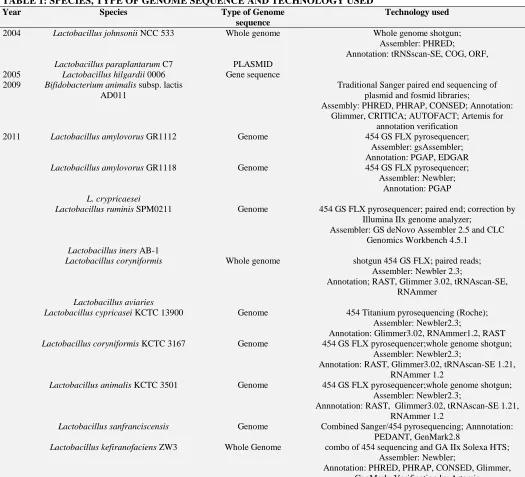
One of the earliest whole genome sequencing
projects of a probiotic species (
Lactobacillus
johnsonii
NCC 533) was published as early as 2004
27
. The sequencing strategy that was used for this
project was the whole genome shotgun sequencing
technology
27. There on, several sequencing
projects of probiotic genomes were published in the
years that followed, with a rise in the number of
such projects in the very recent years
25, 29 - 32.
Furthermore, there has been a gradual change in the
sequencing technologies adopted overtime for such
projects thus facilitating more genomes to be
sequenced, assembled and annotated in shorter
durations of time
25, 29 - 32.
While initial genome sequencing strategies
embraced the traditional Sanger sequencing
methods
25,
more
advanced
sequencing
technologies that are collectively referred to as the
Next Generation Sequencing (NGS) technologies
have been eventually adopted
26, 33- 35. The genome
sequencing of probiotic species until or before
2010 was accomplished by the traditional Sanger
sequencing method and shotgun sequencing
technique. These include the genome sequencing of
Lactobacillus
johnsonii
NCC
533
and
Bifidobacterium animalis
subsp.
lactis
AD011
25, 27.
Post 2010, NGS technologies have been adopted
for genome sequencing with the prominent ones
being 454 pyrosequencing technology, Illumina/
Solexa paired end sequencing technology, Ion
Torrent sequencing technology, and Pacific
BioSciences sequencing technology
26, 33-35.
In 2011, most of the probiotic genomes were
sequenced
using
Roche
454
GS
FLX
pyrosequencer.
These
include
the
genome
sequences of
Lactobacillus amylovorus
33, 36,
Lactobacillus ruminis
37,
Lactobacillus coryniformis
38
,
Lactobacillus
animalis
39,
Lactobacillus
cypricasei
40,
Lactobacillus sanfranciscensis
41, and
Lactobacillus kefiranofaciens
31among others. In
some cases, a combination of two different
sequencing technologies has been adopted. For
instance, in case of
Lactobacillus sanfranciscensis
genome sequencing, a combination of Roche 454
GS FLX pyrosequencing technology and Sanger
sequencing was adopted
41. Similarly, in case of
Lactobacillus kefiranofaciens
,
Roche 454 GS FLX
pyrosequencing technology was combined with
Illumina Genome Analyzer IIx Solexa high
throughput sequencing technology to sequence the
genome
31.
In most cases, genome assembly was done using
different versions of Newbler assembler
33, 39except in a few cases where gsAssembler
36, 37or
CLC Genomics Workbench
37Phred-Phrap-Consed
software package
41. Genome annotation was done
using the Rapid Assembly using Subsystems
Technology (RAST) server
38 - 40, often combined
with Glimmer
38, tRNAscan-SE
38, RNAmmer
38,
EDGAR
36, PEDANT
41, GeneMark
41, and NCBI
Prokaryotic
Genome
Automated
Annotation
Pipeline (PGAAP) analysis
33, 36.
The following year also had several probiotic
genomes
including
those
of
Lactobacillus
rhamnosus
26,
Lactobacillus vini
42,
Lactobacillus
curvatus
32,
Lactobacillus fructivorans
43, and
Lactobacillus helveticus
44were sequenced using
the
Roche 454 GS FLX Titanium pyrosequencing
technology, while the genome of
Lactobacillus
rossiae
34was sequenced using the Illumina HiSeq
2000 platform. Even here, genome assembly was
predominantly
carried
done
using
Newbler
Assembler with the exception of the use of whole
genome sequence assembler (wgs Assembler),
genome sequence assembler (gsAssembler) and GS
Reference
Mapper
for
the
assembly
of
Lactobacillus helveticus
,
Lactobacillus vini
, and
Lactobacillus rhamnosus
genomes respectively
26,42, 44
In 2013, probiotic genome sequencing witnessed a
more heterogeneous usage of sequencing platforms
with the Applied Biosystems ABI377 and 3700
automated sequencers
45, and the Ion Torrent
Personal Genome Machine
46entering the arena
where Roche 454 GS FLX
47, Illumina Genome
Analyzer Iix
48, and Illumina HiSeq 2000
49existed.
The species whose genomes were sequenced in this
period
include
Lactobacillus
pentosus
48,
Lactobacillus
helveticus
45,
Lactobacillus
shenzhenensis
49,
Lactobacillus ginsenosidimutans
50
,
Lactobacillus florum
51,
Lactobacillus pobuzihii
52
,
Lactobacillus jensenii
,
Lactobacillus gasseri
46,
and
Lactobacillus otakiensis
47. Additionally, with
heterogeneous usage of sequencing technologies
came the usage of multiple assembly and
annotation software. While most sequences that
came out of Roche 454 GS FLX platform were
assembled by different versions of Newbler
47,
sequence from Ion Torrent PGM were assembled
using Ion Torrent Assembler
46or CLC
de Novo
Genomics Workbench, while the output from
Illumina platforms were assembled using SOAP
deNovo
49or Velvet
48software. Annotation was
predominantly done by RAST and PGAAP
analysis, but ERGO, GTPS, RDP, Silva, and
ERGO were the new additions to the group
45, 47.
The year 2014 witnessed an increased use of
Illumina and Ion Torrent platforms for sequencing
probiotic
genomes.
While
genomes
of
Lactobacillus mucosae
53,
Lactobacillus sakei
54,
Bifidobacterium moukalabense
55,
Lactobacillus
sucicola
56,
Lactobacillus farraginis
57, and
Lactobacillus composti
57were sequenced using
Ion Torrent Personal Genome Machine, the
genomes of
Lactobacillus equi
58, Lactobacillus
animalis
59, Lactobacillus oryzae, Lactobacillus
fabifermentans
60, and Lactobacillus salivarius
61were sequenced by Illumina platforms. Roche 454
GS FLX pyrosequencer was used to sequence
Lactobacillus
gasseri
and
Lactobacillus
namurensis
62genomes.
In case of genome assembly, there was a diverse
use of assembly software that was perhaps used to
match the requirements of a particular genome.
While genomes sequenced using Roche 454 GS
FLX continued to be assembled using Newbler
assembler
62, genomes sequenced using Ion Torrent
systems were assembled using Newbler
57, NGen
(DNAStar)
53, or CLC Genomics Workbench
54,
and reads from Illumina platforms used Abyss
61, 63,
Velvet
59, 63, Platanus
60, AMOS
59, Hawkeye
59either in isolation or in concert. RAST server and
PGAAP continued to be the predominant
annotation platform, newer tools like GAMOLA
59,
MetaGene Annotator
60, MiGAP
60, SignalP
61,
InterPro
61, TMHMM
61, and Artemis being used
for annotation and curation.
In the next two years, a number of probiotic species
were sequenced. The year 2015 not only witnessed
the use of all types of sequencing technologies, but
also witnessed the combinatorial use of many of
them. The combinations were either a combination
of Roche 454 pyrosequencers with Illumina
platforms
64or with Sanger sequencing methods
65.
Single molecule real time (SMRT) Pacific
Biosciences
RSII
sequencer
was
another
technology that was used this year
66. The species
that were sequenced during this year include
Lactobacillus delbrueckii
67,
Bifidobacterium
catenulatum
68,
Bifidobacterium pseudolongum
66,
Lactobacillus
johnsonii
29,
Lactobacillus
rhamnosus
69,
Lactobacillus
reuteri
70,
Bifidobacterium angulatum
71,
Bifidobacterium
adolescentis
71,
Lactobacillus
kunkeei
72,
Lactobacillus
mucosae
64,
Bifidobacterium
scardovii
65,
Bifidobacterium
aesculapii
73,
Lactobacillus curieae
74,
Lactobacillus acidophilus
75
,
Bifidobacterium
actinocoloniiforme
76,
Lactobacillus curvatus
77,
Lactobacillus rhamnosus
69
,
Lactobacillus fermentum
78, 79,
Bifidobacterium
kashiwanohense
80, 81,
Lactobacillus paracasei
82,
Lactobacillus hokkaidonensis
83, and
Lactobacillus
farciminis
84.
The assemblers used included
Newbler
72, Velvet
29, gs Assembler
71, CLC
Genomics Workbench
85, SOAP deNovo
74, SPAdes
86
, Ngen
67, and Phred-Phrap-Consed
68as seen in
the previous years and annotation was done mostly
using RAST server and PGAAP pipeline
85,
complemented with Glimmer, tRNAscan-SE,
Prodigal, GenePRIMP
65, 72. One of the new
assemblers used in this year was MIRA
64.
In 2016 also, several probiotic genomes have been
sequenced mainly using Illumina platforms
87with
isolated use of Ion Torrent
88, Pacific BioSciences
35
include
Lactobacillus casei
30, 87,
Lactobacillus
sakei
89,
Lactobacillus plantarum
88, 90, 91,
Lactobacillus
equigenerosi
92,
Lactobacillus
crispatus
93,
Lactobacillus kunkeei
35,
Bifido
bacterium longum
94,
Lactobacillus farciminis
95,
Lactobacillus johnsonii
96,
Lactobacillus brevis
97,
and
Lactobacillus
collinoides
98.
Genome
assemblies were mostly done with the help of
software like Newbler
92, Ngen
91, SOAP deNovo
96
, SPAdes
88, Abyss
94, Ray Assembler
90, and
CLC Genomics Workbench
87. Annotation was
predominantly done using RAST server and
PGAAP pipeline
91with the additional use of
Glimmer, tRNAscan-SE, and RNAmmer
91.
With the explosive amount of genomic data
generated in the recent year, efforts towards their
analyses have also been slowly progressing. The
last two years have seen several comparative
genomic analyses of the strains belonging to the
aforementioned genera of probiotics
99 - 101.
[image:4.612.46.571.267.744.2]Furthermore, in the recent years, a special interest
is also observed in studies pertinent to carbohydrate
utilization in these organisms
102. Also, there has
been an impetus for the identification of novel
genes helpful in diagnostics
103, and genomic
characterization of important traits like motility
77.
TABLE 1: SPECIES, TYPE OF GENOME SEQUENCE AND TECHNOLOGY USED
Year Species Type of Genome
sequence
Technology used
2004 Lactobacillus johnsonii NCC 533 Whole genome Whole genome shotgun; Assembler: PHRED;
Annotation: tRNSscan-SE, COG, ORF,
Lactobacillus paraplantarum C7 PLASMID
2005 Lactobacillus hilgardii 0006 Gene sequence 2009 Bifidobacterium animalis subsp. lactis
AD011
Traditional Sanger paired end sequencing of plasmid and fosmid libraries;
Assembly: PHRED, PHRAP, CONSED; Annotation: Glimmer, CRITICA; AUTOFACT; Artemis for
annotation verification
2011 Lactobacillus amylovorus GR1112 Genome 454 GS FLX pyrosequencer;
Assembler: gsAssembler; Annotation: PGAP, EDGAR
Lactobacillus amylovorus GR1118 Genome 454 GS FLX pyrosequencer;
Assembler: Newbler; Annotation: PGAP L. crypricaesei
Lactobacillus ruminis SPM0211 Genome 454 GS FLX pyrosequencer; paired end; correction by Illumina IIx genome analyzer;
Assembler: GS deNovo Assembler 2.5 and CLC Genomics Workbench 4.5.1
Lactobacillus iners AB-1
Lactobacillus coryniformis Whole genome shotgun 454 GS FLX; paired reads;
Assembler: Newbler 2.3;
Annotation; RAST, Glimmer 3.02, tRNAscan-SE, RNAmmer
Lactobacillus aviaries
Lactobacillus cypricasei KCTC 13900 Genome 454 Titanium pyrosequencing (Roche);
Assembler: Newbler2.3;
Annotation: Glimmer3.02, RNAmmer1.2, RAST Lactobacillus coryniformis KCTC 3167 Genome 454 GS FLX pyrosequencer;whole genome shotgun;
Assembler: Newbler2.3;
Annotation: RAST, Glimmer3.02, tRNAscan-SE 1.21, RNAmmer 1.2
Lactobacillus animalis KCTC 3501 Genome 454 GS FLX pyrosequencer;whole genome shotgun; Assembler: Newbler2.3;
Annnotation: RAST, Glimmer3.02, tRNAscan-SE 1.21, RNAmmer 1.2
Lactobacillus sanfranciscensis Genome Combined Sanger/454 pyrosequencing; Annnotation: PEDANT, GenMark2.8
Lactobacillus kefiranofaciens ZW3 Whole Genome combo of 454 sequencing and GA IIx Solexa HTS; Assembler: Newbler;
2012 Bifidobacterium asteroids PRL 2011
Lactobacillus rhamnosus MTCC5462 Complete Genome Shotgun; Roche GS 454;
Assembler: GS Reference Mapper v 2.3;
Lactobacillus vini LMG 23202T, JP7.8.9 Genome Roche 454 GS FLX Titanium;
Assembler: gsAssembler2.3; Annotation: RAST
Lactobacillus curvatus CRL705 Draft 454 GS Titanium pyrosequencer;
Assembler: Newbler 2.5.3; Annotation: RAST
Lactobacillus rossiae DSM 15814T Genome Shotgun Illumina sequencing HiSeq 2000; paired end; Annotation: RAST
Lactobacillus fructivorans KCTC 3543 Genome 454 GS FLX Titanium pyrosequencer;
Assembler: Newbler 2.3;
Annnotation: RAST, Glimmer3.02, tRNAscan-SE 1.21, RNAmmer 1.2
Lactobacillus helveticus R0052 Complete Genome 454 GS FLX Titanium;
Assembler: wgsAssembler v6.0; Annotation: PGAAP
2013 Lactobacillus pentosus KCA1 Genome Paired end Next Gen Illumina GAII sequencing; Assembly: VELVET assembler; Mauve and Artemis
comparison tool
Lactobacillus helveticus CNRZ 32 Genome Shotgun sequencing; Applied Biosystems ABI377 and 3700 automated sequencers; PE 377 automated DNA
sequencers; Annotation: ERGO Lactobacillus shenzhenensis strain
LY-73
Whole Genome Illumina HiSeq 2000; paired end; Assembler: SOAP deNovo 1.05; Annotation: Glimmer 3.0, RAST Lactobacillus ginsenosidimutans sp
Lactobacillus florum Draft Paired end Illumina HiSeq 2000;
Assembler: Velvet 1.2.07; Annotation: RAST
Lactobacillus pobuzihii E100301T Draft Illumina GAIIx;
Assembler: Velvet; Annotation: RAST
Lactobacillus jensenii MD IIE-70 Draft Ion Torrent PGM;
Assembler: Ion Torrent Assembler and CLC Genomics Workbench deNovo assembler; Annotation: PGAP and
RAST
Lactobacillus gasseri Strain 2016 Draft Ion Torrent PGM;
Assembler: Ion Torrent Assembler and CLC Genomics Workbench deNovo assembler
Lactobacillus otakiensis JCM 15040 T Whole Genome 454 GS FLX pyrosequencer; whole genome shotgun; Assembler: Newbler 2.7;
Annotation: Glimmer3.02, GTPS, RDP, Silva, tRNAscan-SE
2014 Lactobacillus gasseri K7 Improved Draft 454 GS FLX+;
Assembler: Newbler 2.6;
Annotation: PGAAP, IMG-ER; Artemis and IMG-ER for curation
Lactobacillus mucosae CRL573 Draft Whole genome shotgun Ion Torrent Personal Genome
Machine (PGM); Assmbler: NGen (DNAStar); Annotation: PGAAP, tRNAscan-SE
Lactobacillus sakei wikim 22 Draft Ion Torrent and a 318 chip;
Assmbler: CLC Genomics Workbench v7.0.4; Validation of assembly by OSlay;
Annotation: GenemarkS, RNAmmer, tRNAscan, RAST Bifidobacterium moukalabense
DSM 27321
Genome GenProBio srl using Ion Torrent PGM
Lactobacillus salivarius Draft Illumina HiSeq2000;
Assembler: Abyss;
Annotation: Glimmer3, GeneMark, Artemis, InterPro, SignaalP, TMHM
Lactobacillus sucicola JCM 15457 T Draft Ion Torrent PGM system;
Lactobacillus fabifermentans T30PCM01 Genome Illumina MiSeq;
Assembler: Abyss 1.3.6 and Velvet 1.2.10; Assemblies aligned using Mauve;
Annotation: RAST, GeneMark.hmm 2.8,
Lactobacillus oryzae Strain SG293 T Draft Illumina MiSeq;
Assembler: Platanus v1.2.1;
Annotation: MiGAP, MetaGene Annotator 1.0, tRNAscan-SE 1.23, RNAmmer 1.2
Lactobacillus animalis 381-IL-28 Draft Illumina GAIIx and IonTorrent PGM;
Assembly: Velvet; manually validated with AMOS and Hawkeye;
Annotation: GAMOLA v2
Lactobacillus namurensis Chizuka 01 Draft Roche 454 GS FLX,
Assembler: Newbler 2.7; Annotation: MiGAP
Lactobacillus equi Genome Illumina HiSeq2000;
Annotation: Metagene Lactobacillus gorilla sp. Nov.
L. farraginis JCM 14108 T Draft Ion Torrent PGM;
Assembler: Newbler v 2.8; Annotation: RAST
L. composti JCM 14202 T Draft Ion Torrent PGM;
Assembler: Newbler v 2.8; Annotation: RAST 2015 Lactobacillus delbrueckii subsp. bulgaricus
CRL871
Draft Whole genome shotgun Ion Torrent (life technologies); Assembler: Ngen (DNASTAR);
Annotation: RAST Bifidobacterium catenulatum
JCM 1194T
Complete genome Whole genome shotgun with sanger sequencing; Assembly: Phred-Phrap-Consed; Annotation: Glimmer 3.0, tRNAscan-SE Bifidobacterium pseudolongum PV8-2 Genome Single molecule real time (SMRT) PacBio RSII;
Assembly: Heirarchical genome assembly process; Annotation: PGAP, RAST
Lactobacillus johnsonii strain 16 Draft Illumina Genome analyzer IIx; paired ends; Assembler was Velvet0.7.54; Mapping MAQ0.7.1 and BWA 0.5.8c Lactobacillus rhamnosus
CNCM I -3698
Draft Illumina GAIIx; paired end;
Assembler: deNovo CLC Genomics Workbench 5.0; Annotation: RAST and PGAP
Lactobacillus reuteri
Bifidobacterium angulatum GT102 Draft Whole genome shotgun Roche 454;
Assembler: gsAssembler v3.0
Bifidobacterium adolescentis 150 Draft Whole genome shotgun Roche 454; ;
Assembler: gsAssembler v3.0
Lactobacillus kunkeei Genome 454 GS FLX pyrosequencer Titanium;
Assembler: Newbler; Verified by BWA, Artemis, Artemis COMparison tool, Mauve; Annotation: DIYA, Prodigal, tRNAscan, RNAmmer,
genePRIMP
Lactobacillus mucosae DPC 6426 Draft/Genome 454 GS FLX and Illumina MiSeq;
Assembly: MIRA; Artemis Comparison Tool; Annotation: RAST, Prodigal, Glimmer 3.02 Bifidobacterium scardovii
JCM 12489T
Complete Genome Sanger and 454 GS FLX;
Assembly: Phred-Phrap-Consed, Newbler; Annotation: Glimmer 3.0, tRNAscan-SE
Bifidobacterium aesculapii DSM 26737 T
Draft Illumina MiSeq;
Assembler: Newbler v 2.8;
Lactobacillus kunkeei EFB6 HQ Draft Genome Analyzer II (Illumina); paired end; Assembler: SPAdes 2.5;
Annotation: Glimmer3, YACOP, IMG-ER Lactobacillus curieae
CCTCC M 2011381 T
Draft Illumina Solexa HiSeq2000;
Assembler: SOAP deNovo; Annotation: Glimmer 3, PGAP
Lactobacillus acidophilus ATCC 4356 Draft 454 GS Titanium;
Assembly: Newbler v 2.6; Annotation: RAST, PGAP Bifidobacterium actinocoloniiforme DSM
22766 T
Complete Genome MiSeq and HiSeq 2000; paired end
RAST
Lactobacillus curvatus Genome HiSeq 2000:
Assembly: Velvet 1.2.07; Annotation: Glimmer Lactobacillus acidophilus FSI4 Complete Genome Illumina GIIx; paired ends;
Assembler: Velvet; Error correction by Illumine HiSeq 2000
Lactobacillus sp. strain TCF032-E4 Draft Illumina HiSeq 2500; Contigs ordered by Mauve 2.3.1; Assembler: Velvet 1.2.10;
Annotation: RAST
Lactobacillus rhamnosus CLS17 Draft Roche 454 GS FLX Titanium;
Assembler: Newbler v 2.3;
Lactobacillus rhamnosus Draft Roche 454 GS FLX Titanium;
Assembler: Newbler 2.6; Annotation: RAST
Lactobacillus fermentum 3872 Genome Ion Torrent PGM 314 v2 chip;
Assembler: Torrent Assembler and CLC Genomics Workbench combined using CISA contig integrator;
Annotation: RAST, PGAP Bifidobacterium kashiwanohense
JCM 15439T
Complete Genome WGS Sanger and 454 GS FLX pyrosequencing; Assembler: Newbler, Phred-Phrap-Consed; Annotation:
Glimmer 3, tRNAscan-SE
Lactobacillus paracasei Genome Illumina Genome Analyzer II;
Assembler: Velvet deNovo; Annotation: MiGAP, tRNAscan-SE
Lactobacillus fermentum LfQi6 Draft Illumina MiSeq;
Assembler: Velvet and SPAdes; Lactobacillus hokkaidonensis
LOOC260(T)
Complete Genome PacBio SMRT RSII sequencer; Also, independent Illumina MiSeq;
Assembly: deNovo by HGAP method, Platanus; Annotation: APBRO
Lactobacillus farciminis CNCM-I-3699
Genome Illumina GAIIx; 454 GSFLX;
Assembly: CLC Genomics Workbench 5.0; Newbler 2.6; Annotation: RAST, GO and Pfmagainst UFO web
browser Bifidobacterium scardovii Strain
JCM 12489T
Genome Sanger and 454 GSFLX;
Assembler: Phred-Phrap-Consed; Annotation: Glimmer 3.0,
Lactobacillus gorillae KZ01 T Draft Illumina MiSeq;
Assembler: CLC Genomics Workbench 8.0.1; Annotation: PGAP, ARDB
Bifidobacterium kashiwanohense PV20-2 Complete Genome SMRT PacBio RSII;
Assembly: Heirarchical genome assembly; Annotation: PGAP, RAST
Lactobacillus curieae CCTCC M 2011381 T
Draft Illumina SOlexa HiSeq 2000;
Assembler: SOAP deNovo; Annotation: Glimmer 3.0, NCBI PGAP Lactobacillus plantarum P-8 Complete genome 454 GS FLX and Illumina Solexa GAIIx paired end
combined; Assembler: Newbler
Lactobacillus panis DSM 6035 T Draft Illumina MiSeq;
Assembly: Velvet; Annotation: RAST
2016 Lactobacillus casei N87 Draft Illumina HiSeq 1000;
Assembler: CLC Genomics Workbench v 8.0.3; Annotation: PGAP
Lactobacillus sakei FBL1 Draft Ion Torrent PGM;
Assembler: Ref based SPAdes v 3.1.0; Annotation: RAST
Lactobacillus plantarum 2025 Draft Ion Torrent PGM;
Assembler: SPAdes and GWB, consensus combined by CISA;
Annotation: RAST
Lactobacillus plantarum SF2A35B Draft WGS Illumina HiSeq 2000;
Assembly: deNovo by Ray Assembler; Annotation: RAST server
Assembler: Ngen (DNAStar);
Annotation; RAST, PGAP, tRNAscan-SE; RNAmmer Lactobacillus equigenerosi
NRIC 0697 T
Draft Illumina MiSeq;
Assembler: Newbler 2.8
Lactobacillus crispatus JCM5810 Draft Illumina MiSeq;
Assembler: CLC Genomics Workbench 8.5.1; scaffolds by Sanger seequencing
Lactobacillus casei DPC6800 Draft Roche 454 FLX;
Assembler: Ngen (DNAStar);
Annotation: Glimmer 3.0.2, RAS; verified by BLASTp and Artemis
Lactobacillus kunkeei MP2 Genome using one SMRT cell (P6-C4 Chemistry) on a PacBio
RSII sequencer (Pacific Biosciences)
Bifidobacterium longum infantis TPY12-1 Illumina HiSeq2500; paired ends;
Annotation Abyss v.1.9.0
Bifidobacterium longum suis BSM11-5 Illumina MiSeq; paired ends; annotation by RAST,
Annotation Abyss v.1.9.0
Lactobacillus farciminis NBRC 111452 Draft Ion Torrent PGM system;
Assembler: Newbler v2.8; Annotation: RAST server using Glimmer3
Lactobacillus johnsonii strain W1 Genome Illumina MiSeq; paired ends;
Assembler: SOAP denovo 2.04.r240; Annotation: PGAP analysis
Lacobacillus brevis strain D6 Whole genome Roche 454 GS FLX; Assembler: Newbler; Annotation: PGAAP analysis
Lactobacillus collinoides CUPV237 Draft Illumina GAIIx;
Assembler: Genomics Workbench v 7.0; Annotation: PGAP
CONCLUSION:
In conclusion, the application of
genomic technologies in probiotic research has
facilitated better understanding of probiotic
bacteria and the genes and the molecular
mechanisms that endow them with characteristic
traits. The advances in sequencing technologies
through the years, represented by the four
generations
of
high
throughput
sequencing
technologies, have eventually enabled easier and
faster acquisition of genome data as seen by the
reports of the genome sequences published over the
years. A parallel advance has also been witnessed
in the development of genome assembly and
annotation software and tools to facilitate the
analysis of the genome data. Furthermore, studies
pertinent to the biomolecule utilization and
comparative
genomics
studies
of
probiotic
genomes have been gaining momentum in the
recent years.
Future Work:
As understanding complete genome
maps of probiotic bacteria give us insights into the
characteristic traits of particular species, it is
important to analyze and understand the genomes
of these probiotics. It is also crucial that we look
deeper into the genome to see what they actually
possess. Comparative Genomics studies have to be
carried out as they could reveal genes that are
critical in rendering the probiotics non-pathogenic,
distinguishing them from the other bacteria. This
will also help us connect the similar traits present
in different probiotic species, helping us understand
the evolutionary relationship among the bacterial
communities that form the intestinal microbiota. It
is therefore, the need of the hour to develop
databases and tools that aid in the analysis of
probiotic genomes through comparative genomics
studies.
ACKNOWLEDGEMENT:
The author would like
to acknowledge the support of Department of
Genetic Engineering, SRM University.
CONFLICT OF INTEREST:
The author has no
conflict of interest to declare.
REFERENCES:
1. Food FWG: On drafting guidelines for the evaluation of probiottics in. Guidelines for the evaluation of probiotics in food 2002; 1–11.
2. Amalaradjou MAR and Bhunia AK: Bioengineered probiotics, a strategic approach to control enteric infections. Bioengineered 2013; 4: 379–387.
3. Di Cerbo A and Palmieri B: The market of probiotics: Pakistan Journal of Pharmaceutical Sciences 2015; 28: 2199–2206.
5. Dicks LMT and Botes M: Probiotic lactic acid bacteria in the gastro-intestinal tract: Health benefits, safety and mode of action. Beneficial Microbes 2010; 1: 11–29.
6. Salminen SJ, Gueimonde M and Isolauri E: Symposium: Innate Immunity and Human Milk Probiotics That Modify Disease Risk 1. Journal of Nutrition 2005; 135: 1294– 1298.
7. Thomas LV and Ockhuizen T: New insights into the impact of the intestinal microbiota on health and disease: a symposium report. British Journal of Nutrition 2012; 107: S1–S13.
8. Dasari S, Shouri RND, Wudayagiri R and Valluru L: Antimicrobial activity of Lactobacillus against microbial flora of cervicovaginal infections. Asian Pacific Journal of Tropical Disease 2014; 4: 18–24.
9. Ashraf R and Shah NP: Immune system stimulation by probiotic microorganisms. Critical Reviews in Food Science and Nutrition 2014; 54: 938–956.
10. Shokryazdan P, Sieo CC, Kalavathy R, Liang JB, Alitheen NB, Jahromi MF and Ho YW: Probiotic Potential of Lactobacillus Strains with Antimicrobial Activity against Some Human Pathogenic Strains. BioMed Research International 2014; 1–16.
11. Aween MM, Hassan Z, Muhialdin BJ, Noor HM and Eljamel YA: Evaluation on Antibacterial Activity of Lactobacillus acidophilus Strains Isolated from Honey. American Journal of Applied Science 2012; 9: 807-817. 12. Karska-Wysocki B, Bazo M and Smoragiewicz W:
Antibacterial activity of Lactobacillus acidophilus and Lactobacillus casei against methicillin-resistant Staphylococcus aureus (MRSA). Microbiological Research 2010; 165: 674–686.
13. Nguyen TDT, Kang JH and Lee MS: Characterization of Lactobacillus plantarum PH04, a potential probiotic bacterium with cholesterol-lowering effects. International Journal of Food Microbiology 2007; 113: 358–361. 14. Jones ML, Martoni CJ, Parent M and Prakash S:
Cholesterol-lowering efficacy of a microencapsulated bile salt hydrolase-active Lactobacillus reuteri NCIMB 30242 yoghurt formulation in hypercholesterolaemic adults. British Journal of Nutrition 2012; 107: 1505–1513. 15. Kumar M, Nagpal R, Kumar R, Hemalatha R, Verma V,
Kumar A, Chakraborty C, Singh C, Marotta F, Jain S and Yadav H: Cholesterol-lowering probiotics as potential biotherapeutics for metabolic diseases: Experimental Diabetes Research 2012; 2012: 1-14.
16. Jones ML, Martoni CJ and Prakash S. Cholesterol lowering and inhibition of sterol absorption by Lactobacillus reuteri NCIMB 30242: a randomized controlled trial: European Journal of Clinical Nutrition 2012; 66: 1234–1241.
17. Amalaradjou MAR and Bhunia AK. Modern Approaches in Probiotics Research to Control Foodborne Pathogens: Advances in Food and Nutrition Research 2012; 67: 185– 239.
18. Schrezenmeir J and deVrese M. Probiotics, prebiotics, and synbiotics-approaching a definition: The American Journal of Clinical Nutrition 2001; 73: 361S-364S.
19. Lim HJ, Kim SY and Lee WK. Isolation of cholesterol-lowering lactic acid bacteria from human intestine for probiotic use. Journal of Veterinary Science 2004; 5: 391– 395.
20. Vandenplas Y, Veereman-Wauters G, deGreef E, Peeters S, Casteels A, Mahler T, Devreker T, Hauser B: Probiotics and prebiotics in prevention and treatment of diseases in infants and children. Jornal de Pediatria 2011; 87: 292– 300.
21. FAO. Probiotics in food. Food Nutrition Papers 2001; 85: 71.
22. Perna NT, Plunkett G, Burland V, Mau Bob, Glasner Jeremy D, Rose Debra G, Mayhew GF, Evans PS, Gregor J, Kirkpatrick HA, Posfai G, Hackett J, Klink S, Boutin A, Shao Y, Miller L, Grotbeck EJ, Davis NW, Lim A, Dimalanta ET, Potamousis KD, Apodaca J, Anantharaman TS, Lin J, Yen G, Schwartz DC, Welch RA, Blattner FR: Genome sequence of enterohaemorrhagic Escherichia coli O157:H7. Nature 2001; 409: 529–533.
23. Cole ST, Brosch R, Parkhill J, Garnier T, Churcher C, Harris D, Gordon SV, Eiglmeier K, Gas S, Barry CE, Tekaia F, Badcock K, Basham D, Brown D, Chillingworth T, Connor R, Davies R, Devlin K, Feltwell T, Gentles S, Hamlin N, Holroyd S, Hornsby T, Jagels K, Krogh A, McLean J, Moule S, Murphy L, Oliver K, Osborne J, Quail MA, Rajandream MA, Rogers J, Rutter S, Seeger K, Skelton J, Squares R, Squares S, Sulston JE, Taylor K, Whitehead S and Barrell BG: Deciphering the biology of Mycobacterium tuberculosis from the complete genome sequence. Nature 1998; 393: 537–544.
24. Stover CK, Pham XQ, Erwin AL, Mizoguchi SD, Warrener P, Brinkman FS., Hufnagle WO, Kowalik DJ, Lagrou M, Garber RL, Goltry L, Tolentino E, Westbrock WS, Yuan Y, Brody LL, Coulter SN, Folger KR, Kas A, Larbig K, Lim R, Smith K, Spencer D, Wong GK, Wu Z, Paulsen IT, Reizer J and Sa O. Complete genome sequence of Pseudomonas aeruginosa PAO1, an opportunistic pathogen. Nature 2000; 406: 959–964.
25. Kim JF, Jeong H, Yu, DS, Choi SH, Hur CG, Park MS, Yoon SH, Kim DW, Ji GE, Park HS, Oh TK: Genome sequence of the probiotic bacterium Bifidobacterium animalis subsp. lactis AD011. Journal of Bacteriology 2009; 191: 678–679.
26. Prajapati JB, Khedkar CD, Chitra J, Suja S, Mishra V, Sreeja V, Patel RK, Ahir VB, Bhatt VD, Sajnani MR, Jakhesara SJ, Koringa PG and Joshid CG: Whole-genome shotgun sequencing of Lactobacillus rhamnosus MTCC 5462, a strain with probiotic potential. Journal of Bacteriology 2012; 194: 1264–1265.
27. Pridmore RD, Berger B, Desiere F, Vilanova D, Barretto C, Pittet AC, Zwahlen MC, Rouvet M, Altermann E, Barrangou R, Mollet B, Mercenier A, Klaenhammer T, Arigoni F and Schell MA: The genome sequence of the probiotic intestinal bacterium Lactobacillus johnsonii NCC 533. Proceedings of National Academy of Sciences, U. S. A. 2004; 101: 2512–2517.
28. Huang MCJ and Tang J: Probiotics in personal care products. Microbiological Discovery 2015; 3: 5.
29. Buhnik-Rosenbla K, Danin-Poleg Y, Elgavish S and Kashi Y: Draft Genome Sequence of Lactobacillus johnsonii Strain 16, Isolated from Mice. Genome Announcement 2011; 3: 2011–2012.
30. Stefanovic E, Casey A, Cotter P, Cavanagh D, Fitzgerald G, McAuliffe O: Draft Genome Sequence of Lactobacillus casei DPC6800, an Isolate with the Potential to Diversify Flavor in Cheese. Genome Announcements 2016; 4: 1-5. 31. Wang Y, Wang J, Ahmed Z, Bai X and Wang J: Complete
genome sequence of Lactobacillus kefiranofaciens ZW3. Journal of Bacteriology 2011; 193: 4280–4281.
32. Hebert EM, Saavedra L, Taranto MP, Mozzi F, Magni C, Nader EMF, deValdez GF, Sesma F, Vignolo G and Raya RR. Genome sequence of the bacteriocin-producing Lactobacillus curvatus strain CRL705. Genome Announcement 2012;. 194: 538–539.
isolated from pig ileum. Journal of Bacteriology 2011; 193: 3147–3148.
34. Di Cagno R, De Angelis M., Cattonaro F and Gobbetti M: Draft genome sequence of Lactobacillus rossiae DSM 15814T. Journal of Bacteriology 2012; 194: 5460–5461. 35. Asenjo F, Olmos A, Henríquez-Piskulich P, Polanco V,
Aldea P, Ugalde JA and Trombert AN: Genome sequencing and analysis of the first complete genome of Lactobacillus kunkeei strain MP2, an Apis mellifera gut isolate. PeerJ 2016; 4: 1–21.
36. Kant R, Paulin L, Alatalo E, DeVos WM and Palva A: Genome sequence of Lactobacillus amylovorus GRL1112. Journal of Bacteriology 2011; 193:789–790.
37. Lee S, Cho YJ, Lee AH, Chun J, Ha NJ and Ko GP: Genome sequence of Lactobacillus ruminis SPM0211, Isolated from a fecal sample from a healthy Korean. Journal of Bacteriology 2011; 193: 5034.
38. Nam SH, Choi SH, Kang A, Kim DW, Kim DS, Kim RN, Kim A and Park HS: Genome sequence of Lactobacillus coryniformis subsp. coryniformis KCTC 3167. Journal of Bacteriology 2011; 193: 1014–1015.
39. Nam SH, Choi SH, Kang A, Kim DW, Kim RN, Kim A, Kim DS and Park HS: Genome sequence of Lactobacillus animalis KCTC 3501. Journal of Bacteriology 2011; 193: 1280–1281.
40. Kim DS, Choi SH, Kim DW, Kim RN, Nam SH, Kang A, Kim A and Park HS: Genome sequence of Lactobacillus cypricasei KCTC 13900. Journal of Bacteriology 2011; 193: 5053–5054.
41. Vogel RF, Pavlovic M, Ehrmann M, Wiezer A, Liesegang H, Offschanka S, Voget S, Angelov A, Böcker G and Liebl W: Genomic analysis reveals Lactobacillus sanfranciscensis as stable element in traditional sourdoughs. Microbial Cell Factories 2011; 10 (Suppl 1):S6 1-11.
42. deLucena BTL, Silva GGZ, dos Santos BM, Dias GM, Amaral GRS, Moreira APB, deMorais Júnior MA, Dutilh BE, Edwards RA, Balbino V, Thompson CC and Thompson FL: Genome sequences of the ethanol-tolerant Lactobacillus vini strains LMG 23202T and JP7.8.9. Journal of Bacteriology 2012; 194: 3018.
43. Nam SH, Choi SH, Kang A, Lee KS, Kim DW, Kim RN, Kim DS and Park HS: Genome sequence of Lactobacillus fructivorans KCTC 3543. Journal of Bacteriology 2012; 194: 2111–2112.
44. Tompkins TA, Barreau G and Broadbent JR: Complete genome sequence of Lactobacillus helveticus R0052, a commercial probiotic strain. Journal of Bacteriology 2012; 194: 6349.
45. Broadbent JR., Hughes JE, Welker DL, Tompkins TA and Steele JL: Complete Genome Sequence for Lactobacillus helveticus CNRZ 32, an Industrial Cheese Starter and Cheese Flavor Adjunct. Genome Announcement 2013; 1: 1–2.
46. Karlyshev AV, Melnikov VG, Kosarev IV, Khlebnikov VC, Sukhikh GT, Abramov VM: Draft Genome Sequence of Lactobacillus gasseri Strain 2016. Genome Announcement 2013; 1: e00624-13.
47. Ohmori T, Akano H, Doi K and Ohshima T: Draft Genome Sequence of D-branched-Chain Amino Acid Producer Lactobacillus otakiensis JCM 15040 T, Isolated from a Traditional. Genome Annoucements 2013; 1: 1–2. 48. Anukam KC, Macklaim JM, Gloor GB, Reid G, Boekhorst
J, Renckens B, van Hijum SAFT, Siezen RJ: Genome Sequence of Lactobacillus pentosus KCA1: Vaginal Isolate from a Healthy Premenopausal Woman. PLoS One 2013; 8: 1–12.
49. Lin Z, Liu Z, Yang R, Zou Y, Wan D, Chen J, Guo M, Zhao J, Fang C, Yang R, Liu F: Whole-Genome Sequencing of Lactobacillus shenzhenensis strain LY-73. Genome Annoucements 2013; 1: 1998–1999.
50. Jung HM, Liu QM, Kim JK, Lee ST, Kim SC, Im WT: Lactobacillus ginsenosidimutans sp. nov., isolated from kimchi with the ability to transform ginsenosides. Antonie van Leeuwenhoek 2013; 103: 867–876.
51. Kim EB, Tyler C, Kopit LM and Marco ML: Draft Genome Sequence of Fructophilic Lactobacillus florum. Genome Announcements 2013; 1: 2650.
52. Chiu CM, Chang CH, Pan SF, Wu HC, Li SW, Chang CH, Lee YS, Chiang CM, Chen YS: Draft Genome Sequence of Lactobacillus pobuzihii E100301T. Genome Announcements 2013; 1: 1999–2000.
53. Bleckwedel J, Terán LC, Bonacina J, Saavedra L, Mozzi F, Raya RR: Draft Genome Sequence of the mannitol-Producing Strain Lactobacillus mucosae CRL573. Genome Annoucements 2014; 2: 1–2.
54. Lim HI, Lee J, Jang JY, Park HW, Choi HJ, Kim TW, Kang MR, Lee JH: Draft Genome Sequence of Lactobacillus sakei Strain wikim 22, Isolated from Kimchi in Chungcheong Province, South Korea. Genome Announcements 2014; 2: 195–196.
55. Lugli GA, Duranti S, Milani C, Turroni F, Viappiani A, Mangifesta M, van Sinderen D, Venturaa M: The Genome Sequence of Bifidobacterium moukalabense DSM 27321 Highlights the Close Phylogenetic Relatedness with the Bifidobacterium dentium Taxon. Genome Annoucements 2014; 2: 2013–2014.
56. Irisawa T, Oshima K, Suda W, Kitahara M, Sakamoto M, Kitamura K, Iida T, Hattori M, Ohkumaa M: Draft Genome Sequence of Lactobacillus sucicola JCM 15457 T, a Motile Lactic Acid Bacterium Isolated from Oak Sap. Genome Annoucements 2014; 2: 15457.
57. Yuki M, Oshima K, Suda W, Kitahara M, Kitamura K, Iida T, Hattori M, Ohkuma M: Draft Genome sequences of two Lactobacillus strains L. farraginis JCM 14108 T and L. composti JCM 14202 T, Isolated from Compost of Distilled Shochu Residue. Genome Announcements 2014; 2: 4–5.
58. O’Donnell M and Harris H: The genome of the predominant equine Lactobacillus species, Lactobacillus equi, is reflective of its lifestyle adaptations to an herbivorous host. Genome Announcements 2014; 2: 80360.
59. Karlyshev AV, Melnikov VG, Kosarev IV and Abramov M: Draft Genome Sequence of Lactobacillus animalis 381-IL-28. Genome Announcements 2014; 2: 12–13.
60. Tanizawa Y, Fujisawa T, Mochizuki T, Kaminuma E and Nakamura Y: Draft Genome Sequence of Lactobacillus oryzae Strain SG293 T. Genome Annoucements 2014; 2: 4–5.
61. MacKenzie DA, McLay K, Roos S, Walter J, Swarbreck D, Drou N, Crossman LC, Jugea N: Draft Genome Sequence of a Novel Lactobacillus salivarius Strain Isolated from Piglet. Genome Announcements 2014; 2: 1– 2.
62. Kato K, Toh H, Sakamoto N, Mori K, Tashiro K, Hibi N, Sonomoto K, Nakayamaa J: Draft Genome Sequence of Lactobacillus namurensis Chizuka 01, Isolated from Nukadoko, a Pickling Bed of Fermented Rice. Genome Announcements 2014; 2: 2–3.
Fermenting Grape Marc. Genome Announcements 2014; 2: 1–2.
64. Ryan PM, Guinane CM, London LEE, Kelleher PR, Fitzgerald GF, Caplice NM, Ross RP, Stanton C: Genome Sequence of the Heteropolysaccharide-Producing Strain Lactobacillus mucosae DPC 6426. Genome Annoucements 2015; 3: 2014–2015.
65. Toh H, Oshima K, Nakano A, Yamashita N, Iioka E, Kurokawa R, Morita H, Hattorib M: Complete Genome Sequence of Bifidobacterium scardovii Strain JCM 12489T, isolated from Human Blood. Genome Annoucements 2015; 3: 8–9.
66. Vazquez-Gutierrez P, Lacroix C, Chassard C, Klumpp J, Stevens MJA, Jansa C: Bifidobacterium pseudolongum Strain PV8-2, Isolated from a Stool Sample of an Anemic Kenyan Infant. Genome Announcements 2015; 3: 1. 67. Giori GS and Leblanc JG: Draft Genome Sequence of
Lactobacillus delbrueckii subsp. bulgaricus CRL871, a Folate-producing strain isolated from a Northwestern Yogurt. Genome Annoucements 2015; 3: 54–55.
68. Toh H, Hayashi JI, Oshima K, Nakano A, Takayama Y, Takanashi K, Morita H, Hattori M: Complete genome sequence of Bifidobacterium catenulatum JCM 1194T isolated from human feces. Genome Announcements 2015; 210: 25–26.
69. Kozhakhmetov SS, Kushugulova AR, Saduakhasova SA, Shakhabayeva GS, Khassenbekova ZR, Molkenov AB,. Kairov UE, Issayeva RB, Nurgozhin TS, Zhumadilov ZS: Draft Genome Sequence of Lactobacillus rhamnosus CLS17. Genome Announcements 2015; 3: 1-2
70. Wegmann U, MacKenzie DA, Zheng J, Goesmann A, Roos S, Swarbreck D, Walter J, Crossman LC and Juge N: The pan-genome of Lactobacillus reuteri strains originating from the pig gastrointestinal tract. BMC Genomics 2015; 16: 1-18.
71. Dyachkova MS, Klimina KM, Kovtun AS, Zakharevich NV, Nezametdinova VZ, Averina OV, Danilenko VN: Draft Genome Sequences of Bifidobacterium angulatum GT102 and Bifidobacterium adolescentis 150: Focusing on the Genes Potentially Involved in the Gut-Brain Axis. Genome Announcements 2015; 3: 4–5.
72. Tamarit1 D, Ellegaard KM, Wikander J, Olofsson T, Va´squez A and Andersson SGE: Functionally structured genomes in Lactobacillus kunkeei colonizing the honey crop and food products of honeybees and stingless bees. Genome Biology and Evolution 2015; 7: 1455–1473. 73. Toh H, Yamazaki Y, Tashiro K, Kawarai S, Oshima K,
Nakano A, Kim CNT, Mimura I, Arakawa K, Iriki A, Kikusui T, Morita H: Draft Genome Sequence of Bifidobacterium aesculapii DSM 26737 T, isolated from feces of baby common marmoset. Genome Annoucements 2015; 3: e01463-15.
74. Wang Y, Wang Y, Lang C, Wei D and Xu P: Genome Sequence of Lactobacillus curieae CCTCC M 2011381T, a Novel Producer of Gamma-aminobutyric Acid. Genome Annoucements 2015; 3: 7–8.
75. Palomino MM, Allievi MC, Martin JF, Waehner PM, Acosta MP, Rivas CS, Ruzal SM: Draft Genome Sequence of the Probiotic Strain Lactobacillus acidophilus ATCC 4356. Genome Annoucements 2015; 3: 7–8.
76. Chen X, Zhiguo E, Gu D and Lv L: Complete Genome Sequence of Bifidobacterium actinocoloniiforme Type Strain DSM 22766 T, Isolated from Bumblebee Digestive Tracts. Genome Annoucements 2015; 3: 14-15.
77. Cousin FJ, Lynch SM, Harris HMB, McCann A, Lynch DB, Neville BA, Irisawa T, Okada S, Endo A, O’Toole PW: Detection and genomic characterization of motility in
Lactobacillus curvatus: Confirmation of motility in a species outside the Lactobacillus salivarius clade. Applied Environmental Microbiology 2015; 81: 1297–1308. 78. Subhadra B, Krier J, Hofstee K, Monsul N and Berkes E:
Draft Whole-Genome Sequence of Lactobacillus fermentum LfQi6, Derived from the Human Microbiome. Genome Announcements 2015; 3: e00423-15.
79. Lehri B, Seddon AM and Karlyshev AV: Lactobacillus fermentum 3872 genome sequencing reveals plasmid and chromosomal genes potentially involved in a probiotic activity. FEMS Microbiology Letters 2015; 362: 1–5. 80. Morita H, Toh H, Nakano A, Oshima K, Takagi M, Suda
W, Tanabe S, Hattori M: Complete genome sequence of Bifidobacterium kashiwanohense JCM 15439T isolated from a healthy Japanese infant. Genome Announcements 2015; 210: 66–67.
81. Vazquez-Gutierrez P, Lacroix C, Chassard C, Klumpp J, Jans CSM: Complete and Assembled Genome Sequence of Bifidobacterium kashiwanohense PV20-2, Isolated from the Feces of an Anemic Kenyan Infant. Genome Annoucements 2015; 3: 2164.
82. Shiwa Y, Atarashi H, Tanaka N, Okada S, Yoshikawa H, Endo A, Miyaji T, Nakagawab J: Genome Sequences of Three Strains of Lactobacillus paracasei of Different Origins and with Different Cholate Sensitivities. Genome Annoucements 2015; 3: 1.
83. Tanizawa Y, Tohno M, Kaminuma E, Nakamura Y and Arita M: Complete genome sequence and analysis of Lactobacillus hokkaidonensis LOOC260(T), a psychrotrophic lactic acid bacterium isolated from silage. BMC Genomics 2015; 16: 2401-11.
84. Tareb R, Bernardeau M and Vernoux JP: Genome Sequence of Rough and Smooth Variants of Pleomorphic Strain Lactobacillus farciminis CNCM-I-3699. Genome Announcements 2015; 3: 5–6.
85. Guy E and Arlat M: Genome Sequence of Lactobaciluus rhamnosus Strain CNCM I-3698. Genome Annoucements 215; 1: 32–33.
86. Djukic M, Poehlein A, Strauß J, Tann FJ, Leimbach A, Hoppert M and Daniel R: High quality draft genome of Lactobacillus kunkeei EFB6, isolated from a German European foulbrood outbreak of honeybees. Standards in Genomic Sciences 2015; 10: 1–9.
87. Zotta T, Ricciardi A, Parente E, Reale A, Ianniello RG, Bassi D: Draft Genome Sequence of the Respiration-Competent Strain Lactobacillus casei N87. Genome Announcements 2016; 4: e00348-16
88. Karlyshev AV and Abramov VM: Draft genome sequence of Lactobacillus plantarum 2025. Genome Announcements 2016; 2: 1179–13.
89. Kim JH, Kim E, Kim CG, Choo DW and Kim HY: Draft Genome Sequence of Lactobacillus sakei Strain FBL1, a Probiotic Bacterium Isolated from Mukeunji, a Long-Fermented Kimchi, in South Korea. Genome Announcements 2016; 4: 1-2.
90. Karlyshev AV and Abramov VM. Draft genome sequence of Lactobacillus plantarum SF2A35B. Genome Announcements 2016; 2: 1179–13.
91. Saavedra L, Hebert EM, Albarracin L, Salva S, Alvarez S, Kitazawa H, Villena J: Draft Genome Sequence of Lactobacillus plantarum CRL1506, an Immunomodulatory Strain Isolated from Goat Milk. Genome Annoucements 2016; 4: 4–5.
Isolated from the Gastrointestinal Tracts of Healthy Thoroughbreds. Genome Annoucements 2016; 4: 4255. 93. Wooten J, Liu X and Miller MJ: Draft Genome Sequence
of Lactobacillus crispatus JCM5810, Which Can Reduce Campylobacter jejuni Colonization in Chicken Intestine. Genome Annoucements 2016; 4: 91-101.
94. Bunesova V, Lacroix C and Schwab C: Fucosyllactose and L-fucose utilization of infant Bifidobacterium longum and Bifidobacterium kashiwanohense. BMC Microbiology 2016; 16: 248.
95. Chiou TY, Oshima K, Suda W, Hattori M and Takahashi T: Draft Genome Sequence of Lactobacillus farciminis NBRC 111452, Isolated from Koso, a Japanese Sugar-Vegetable Fermented Beverage. Genome Announcement 2016; 4: 6–7.
96. Guy E and Arlat M: Genome Sequence of Lactobacillus johnsonii Strain W1, isolated from Mice. Genome Annoucements 2016; 1: 32–33.
97. Guy E and Arlat M: Genome Sequence of Lacobacillus brevis strain D6, isolated from fresh chees. Genome Annoucement 2-16; 1: 32–33.
98. Puertas AI, Capozzi V, Llamas MG, López P, Lamontanara A, Orrù L, Russo P, Spano G, Dueñas MT: Draft Genome Sequence of Lactobacillus collinoides CUPV237, an Exopolysaccharide and Riboflavin Producer Isolated from Cider. Genome Annoucements 4: 2014– 2015.
99. Odamaki T, Horigome A, Sugahara H, Hashikura N, Minami J, Xiao JZ and Abe F: Comparative Genomics
Revealed Genetic Diversity and Species/Strain-Level Differences in Carbohydrate Metabolism of Three Probiotic Bifidobacterial Species. International Journal of Genomics 2015; 567809.
100.Sun Z, Zhang W, Guo C, Yang X, Liu W, Wu Y, Song Y, Kwok LY, Cui Y, Menghe B, Yang R, Hu L, Zhang H: Comparative genomic analysis of 45 type strains of the genus bifidobacterium: A snapshot of its genetic diversity and evolution. PLoS One 2015; 10: 1–14.
101.Sun Z, Harris HMB, McCann A, Guo C, Argimo S, Zhang W, Yang X, Jeffery IB, Cooney JC, Kagawa TF, Liu W, Song Y, Salvetti E, Wrobe A, Rasinkangas P, Parkhi J, Rea MC, O’Sullivan O, Ritari J, Douillard FP, Ross RP, Yang R, Briner AE, Felis GE, deVos WM, Barrangou R, Klaenhammer TR, Caufield PW, Cui Y, Zhang H and O’Toole PW: Expanding the biotechnology potential of lactobacilli through comparative genomics of 213 strains and associated genera. Nature Communications 6: 1-13. 102.Ceapa C, Lambert J, van Limpt K, Wels M, Smokvina T,
Knol J, Kleerebezem M: Correlation of Lactobacillus rhamnosus genotypes and carbohydrate utilization signatures determined by phenotype profiling. Applications in Environmental Microbiology 2015; 81: 5458–5470.
103.Behr J, Geissler AJ, Schmid J, Zehe A and Vogel RF: The identification of novel diagnostic marker genes for the detection of beer spoiling Pediococcus damnosus strains using the BlAst diagnostic gene find Er. PLoS One 2016; 11: 1-23.
All © 2013 are reserved by International Journal of Pharmaceutical Sciences and Research. This Journal licensed under a Creative Commons Attribution-NonCommercial-ShareAlike 3.0 Unported License. This article can be downloaded to ANDROID OS based mobile. Scan QR Code using Code/Bar Scanner from your mobile. (Scanners are available on Google Playstore)
How to cite this article: