ISSN: 1992-8645 www.jatit.org E-ISSN: 1817-3195
TOWARD A NEW TREATMENT APPROACH OF LEARNING
CONTENT IN CLOUD ERA
B. FAQIHI1, N. DAOUDI2, R. AJHOUN3
Structure LeRMA, ENSIAS, UNIVERSITY, MED V –SOUISSI, RABAT, MOROCCO
E-mail : [email protected], [email protected], [email protected]
ABSTRACT:
Nowadays, Technological development of human beings is extremely related to information. This is proved on the manners and areas that life was computerized such as in trade, government services, medicine, education, learning etc.Nevertheless, the fast development of designing information systems has created several sub-systems in multiple contexts which are conceived by different communities and totally dispersed geographically but all undertaking the same area. Neither contents nor services that these subsystems are made are certainly in the same technology environments. In our research, the learning field goes through many key steps. Actually, new revolutionized practices were implemented due to technology innovation, so transition from classical learning towards distance learning or d-learning is more than possible, it’s desired. Consequently, this phenomenon has created more opportunities for learners and teachers but also several challenges; in many cases, the multitude of standards hinders the learner migration from a learning environment to another, so it hampers its learning development.In this paper, we will propose a framework of interoperability based on three levels. Since we are interested in semantic level, we propose a process of interoperability of learning content in the cloud era based on a global ontology. Like recommendation systems, we will start our process by acquisition, then validation and finally structuration of the learning content. This structuration way will give to both actors of learning environment a certain flexibility and access to other resources in Cloud environment. The basic principle is to collect content, to enrich it and to make it interoperable by using unified approach in star based on a comprehensive ontology. Our work is a part of MADAR project which is “Learning Architecture Adapted to Mobile Technology”
Keywords:Learning Content, Interoperability, Semantic Interoperability, Structuring, Ontology, MADAR Learning.
1. INTRODUCTION AND PROBLEMATIC:
Our subject aims to enrich MADAR learning project led by LeRMA structure. It is an acronym which stands: « Mobile Adaptable ARchitecture » learning[09]. It is a learning architecture adapted to the mobile technology. MADAR learning traces a continuous evolution according each member contribution.
The MADAR environment is designed in orbit shape to provide three major objectives dependent of each other: accessibility, adaptability and interoperability. [Konstantas and al. 05] defines interoperability as « the ability of systems to work together without effort of these systems’ users ». This definition, adopted by the European Network of Excellence (INTEROP), revolves around the
following main idea: the interoperability translates into the ability of systems to bear, transparently to users, constraints and consequences of integration needs.
ISSN: 1992-8645 www.jatit.org E-ISSN: 1817-3195
1.1 Characterization of interoperability:
The interoperability concepts encounter several types of barriers, these barriers include: conceptual barriers, technological and organizational. Therefore, the solutions that have been proposed in the literature deal with this problem of different angles. We will describe in this section the levels that characterize the concept of interoperability. Indeed, information systems distinguish themselves from standpoint of cultural, linguistic, business, technological... etc. Several research studies have focused on the framework that defines these levels. Among these frameworks, we can mention:
The frameworks IDEAS (Interoperability Development for Enterprise Applications and Software, IST-2001-37368) [29]: which is defined as an approach for the collection of visions and research challenges on interoperability. It is a framework that considers interoperability according four dimensions: three horizontals and one vertical (Fig-1-).
Business Se
m
an
ti
cs
Knowledge
ICT Systems
Fig-1- Simplified REPRESENTATION OF Ideas FRAMEWORK [Ideas 04]
Business: To define the business context and any collaborative processes of companies.
Knowledge: To characterize the organization, the sources of knowledge and skills in the company.
ICT systems: To define the data, communications infrastructure and applications.
Semantics: To ensure the same understanding at all levels described above.
The AIF framework (Athena Interoperability Framework) [30], [31] take a holistic approach that allows the understanding and analysis of the interoperability requirements. In this context, we define three levels:
Conceptual: To define the concepts, meta-models, languages and concepts useful for
Modeling Some Aspects Of Interoperability.
Application: To describe patterns, standards and methodologies that will be involved in developing solutions to ensure interoperability.
Technique: To set the platform for interconnecting information systems.
The framework EIF (European Interoperability Framework) [32] aims to structure guidelines for interoperability between European administrations and between administrations and citizens. It is represented on three levels:
Organizational: To describe the model processes, business aims and a companies description.
Semantic: It concerns the interpretation of information and corporate knowledge.
Technical: To define the tools to interconnect the systems and solutions.
1.2 Proposal For A New Framework Of Interoperability:
The frameworks presented above include the majority of approaches considering the interoperability problem in the industry (IDEAS and AIF) and administration (EIF). However, there are other frameworks which are more specific to certain areas such as: The E-Commerce Integration Framework Meta-framework (ECIMF) for trade, The Euro Shoe framework for footwear industry…Etc.
ISSN: 1992-8645 www.jatit.org E-ISSN: 1817-3195 operating modes. This exchange can be provided
using models and languages understandable by companies, which is defined in the AIF framework under the conceptual level.
Ultimately, the EIF and IDEAS frameworks used to define how companies can exchange at the organizational level or business level.
For cons, the conceptual level of the AIF framework describes the means to ensure this exchange. The semantic level is present in both the EIF and IDEAS framework to describe the meaning and information interpretation and knowledge of company. However, the IDEAS framework places more importance to semantic because it is positioned transversely. Finally, these three frameworks are agreed on the technical level to enterprise interoperability. According to [33], interoperability is primarily based on technological infrastructure, by specifying that the advances in the field are important. The best-known language XML (eXtended Markup Language) facilitated data integration projects. In addition, EAI type technologies and ESB (Enterprise Service Bus) have facilitated the application integration despite their technical specifications. However, it seems to us disproportionate considering that interoperability is based solely on the technical infrastructure. According to [7] « Interoperability should not only be considered a property of ICT systems, but also concerns the business processes and the business context of an enterprise ».
We note a convergence of different frameworks presented to take into account the following three levels: organizational, semantic and technical of EIF. Indeed, the semantic level of EIF retakes up the semantic problem quoted in IDEAS.
The technical level is present in all three frames. The business and knowledge levels of IDEAS match our opinion at EIF business level.
We therefore propose a new framework named OTS which considers that interoperability is seen by the three following levels: Organizational, Technical and Semantic. The following figure Fig-2- illustrates these levels:
Organizational
Technical
Semantic
Fig-2- The levels of the framework OTS.
I.3 MADAR Learning: Position of our research:
In literature, the learning field has gone through several phases to reach today distance learning or d-learning. Each learning mode has advantages and also limitations, while the mode which comes after provides solutions to these limits but also gives rise to new challenges. The MADAR environment that is our basic architecture, and to ensure technological implicit passage of e-learning to m-learning; also provides a deployment environment, a storage environment and learner interface. The figure Fig-3 shows the overall architecture of MADAR:
Interface learner
In
d
ep
e
n
d
e
n
t
L
ea
rn
in
g
S
er
v
ic
es
M-Learning
Specificities
D
a
ta
s
to
ra
g
e
E-Learning platform
Deployment environment Interoperability
Semantic interoperability based on ontologies.
Fig-3- Overall Architecture Of MADAR Learning Environment.
I.4 Learning content to the cloud era:
ISSN: 1992-8645 www.jatit.org E-ISSN: 1817-3195 However, the management of learning content
remains an important element in the learning curriculum. Our main goal is to make it interoperable regardless of structure, origin and type. In a cloud environment, we speak of a geographically dispersed content, conceptually and which has different educational aims. So the first action is how to collect, sort, filter and group this content enriched (See Fig-4- ) so as to communicate, to exchange and share in a cloud environment.
Fig-4- Design Of Learning Content Enriched In Cloud Era.
In cloud, it is more likely to have a varied and dispersed content, because we have systems in with several types of heterogeneity. The use of social networks has given more diversity to this content, because the users of these networks are learners or guardians who can also enrich this content.
2. NEW NEEDS FOR BETTER MANAGEMENT OF LEARNING CONTENT:
Today, when a tutor puts online an educational course, all cloud users can enrich it. How to ensure this? How can we integrate social networks exchanges in the learning groups? The cloud environment, as we specified before, allows geographical mobility for its users. So, how to ensure the interoperability of a learner curriculum when switching from a learning environment to another? The problem poses also for equivalency of diplomas obtained by a learner. Currently this action is based on the work of a Scientific Committee which meets on demand and studies the folders according the name of the course, its contents and the number of hours...
In deciding whether a student has the prerequisites for a course, we must first analyze the adequacy with its curriculum. The idea is whether the learner profile will also integrate its curriculum. The profile is complete and detailed enough to include all the characteristics of a learner in a learning environment? Otherwise, can we enrich? Can we also integrate the content of the learner extract from social networks? The objective is to create exchanges groups in these networks and follow their evolution. The learner, which is one of the actors of these groups, must be brought to communicate its identifier.
Therefore, we fixed three objectives for our topic. The first will focus on the learner, the second to learning content and third to the mixing of the two i.e. Interoperability of this content with other learning environments in a cloud environment. We will describe them as follows:
- How to manage a
dispersed and diverse learning content? - How to manage the curriculum of the student during the migration of a learning environment to another?
- How can we ensure the interoperability of outputs (certificates, validation of learning, modules or courses) of learners with other learning environments?
2.1 How to ensure semantic interoperability:
The resolution of the interoperability problem returns to resolve conflicts during exchange. The aim is to have similar interpretations of elements. This means it takes a description and formalism of these elements to facilitate sharing while keeping the same meaning. So, we must use “A set of data that characterizes other data to allow the research, management and conversion.” which means metadata. Both solutions based on the use of metadata are: ontology or standardization [20].
2.1.1 Standardization:
Based on metadata, standardization of structures is used to describe the contents. It is important to ensure the sharing of the meaning of the exchanged content. It is highly recommended in the following areas: health information systems, government management, education, etc. Thus, the joint structure and the metadata that describes the content shared and the heterogeneous entities will The enrichments of pairs
The enrichments of tutors.
ISSN: 1992-8645 www.jatit.org E-ISSN: 1817-3195 have the opportunity to share the meaning during
exchange according to standardized identical models. In her thesis, Ms Daoudi was interested in the problem of interoperability of learning environments based on standards [24] and analyzed the existing standards in e-learning field: LOM, SCORM and IMS-LD. She proposed a standards improvement to better manage the learning content, but in reality there are several types of content standardized or not.
2.1.2 Ontology:
In literature, there are several definitions. It defines the common vocabulary for the different entities that want to share information in a specific field. It is “An explicit formal description of concepts in a domain of discourse”. It allows two entities to exchange, to eliminate conflicts and improve communication and sharing of meaning.
3. APPROACHES TO INTEROPERABILITY BASED ON ONTOLOGIES:
In our context, one is obliged to choose the first solution that is the use of ontologies. The choice of standardization is interesting during the construction phase of information systems. Nowadays, many learning systems are not designed on standards. The integration of existing content 2.0 handicaps the choice of standardization.
In our context, the learning systems exist already and have a diversified and rich content so that we cannot convert them into norms.
The learning systems that wish to achieve semantic interoperability between them are obliged to use existing ontologies or create their own ontologies. Semantic interoperability between these systems finds correspondences between concepts of ontologies that represent them [28].
In literature, there are three main approaches that address interoperability based on ontologies: Integrated approach unified approach and federated approach [20]. We will give more details for each approach:
3.1. Integrated approach:
Named as Global ontology single ontology or simple ontology, its principle is to get set into
line with only one ontology by finding consensus on vocabulary, semantics, the viewpoint, etc. The other data sources must be connected to this ontology (Fig-5- ). In other words, it is to merge all ontologies into one. This approach is used when you have a global ontology with a shared vocabulary, or when multiple ontologies cover the same area with the same goal with a similar granularity. Instead, there are limits when the ontology integrates heterogeneous data and evolves independently. It is mandatory in this case, to maintain regular the global ontology and the other data sources.
Fig-5- Integrated Approach[03].
3.2. Federated Approach:
Sometimes named distributed mediation or multiple ontology. In this case, each source is described by its own ontology and ontologies are completely independent. The advantage of this approach is that the definition of each source ontology can be defined apart from the other. High flexibility is assured because ontologies can evolved independently and may have frequent updates. In addition, in case of removal of ontology the overall system is not blocked, simply delete the links concerned with ontology. However, the lack of a common vocabulary for the federated approach makes source ontologies comparison very difficult. To overcome this problem, a mapping formalism between ontologies is strongly recommended, it identifies semantic links, connections between different source ontologies. This action is extremely difficult because many problems will emerge: the semantic heterogeneity, synonyms, homonyms and especially the ambiguity due to lack of information [16].
Data sources
Data
source
Data
source
ISSN: 1992-8645 www.jatit.org E-ISSN: 1817-3195 LO: Local Ontology
DS: Data Source
Fig-6- Federated Approach [03]
Implementing this approach encounters a set of brakes. The ontologies OL1, OL2 and OL3 were independently created. Certainly, this approach allows scalability of ontologies without any obstacle. However, removing ontology with the information system it represents may impact the correspondence between other ontologies. Therefore, we propose cope with this problem a new approach called: “Ring approach” Fig-7-
Fig-7- Architecture Of “Ring Approach”
However, this approach experiences exponential number of connecting when we have multiple ontologies.
3.3. Unified approach:
Also named "hybrid", the principle is to establish connections between local ontologies concepts and also establish for each local ontology correspondences with an overall high level ontology. In this approach, the source and the ontology can grow without constraint provided, it is necessary to maintain connections during evolution. It first requires the establishment of a common vocabulary and the rules of combining terms. The
difference can be in terms of data sources but cannot be at the ontologies which use a unique language. The major advantage of this approach is that adding new ontology does not lead to the modification of the common vocabulary, which is why approach is more complicated to maintain. By cons, ontology management is not tedious because all the ontologies are linked to a global ontology. The communication is ensured because links are established with the reference. The links between ontologies are correspondences between concepts. The local ontologies are created by common concepts to the global ontology. The relations with the overall ontology are needed in this case. If we add ontology, do we need to add links with other ontologies? Perhaps we will win in terms of processing time. When working for a domain automatically there is an overall ontology. The ontologies must cover the same area. The language difference cannot be characterized.
GO: Global ontology LO: Local ontology DS: Data Source
Fig-8 Unified Approach [03]
By projecting this approach on the learning context, we can see that it is responding perfectly to our needs. If we assume that we have an overall ontology, local ontologies will be created on the basis of a common vocabulary. This is an open and scalable approach. Indeed, other data sources can be integrated and local ontologies can evolve independently. However, connections between local ontologies can slow the progress of each one. But, what is important is to have connections with the global ontology. Therefore, we propose a variant of this approach that we call: “star unified approach” Fig-9- :
LO1
DS1
LO2
DS2
LO3
DS3
LO1
DS1
LO2
DS2
LO3
ISSN: 1992-8645 www.jatit.org E-ISSN: 1817-3195
Fig-9- Star Unified Approach
This is a lighter approach from unified approach. Its advantages are: During the evolution of each ontology, it is sufficient to update also correspondence with overall ontology. Deleting a data source or overall ontology does not affect the other matches, unlike the unified approach where any addition or removal of an ontology creates a heavy processing on all ontologies.
The use cases have been studied to get the possible modes of each approach. For the federated approach, the lack of a global ontology for local ontologies O1 and O2 respectively relating to data sources S1 and S2, makes identification of correspondences a difficult task. Its creation will further improve this action since we have a common vocabulary. If created, it will respond or reduce the order of complexity of our problems. The unified approach requires the existence of an overall ontology. This situation does not exist in the university community. The enactment of Law Standards "001" is in this direction. Institutions should work in this logic to be in tune with the aspirations of the ministry of tutelage.
The following table summarizes the correspondence between the approaches and the integration mode possible depending on the use cases:
Approach Projection on our context
Integrated It is useful if we have several ontologies that cover the same field.
This approach cannot respond to our context because it assumes that the systems were created on the basis of an
overall ontology. This is not the case especially in the cloud environment.
federated This approach can respond to our context, but its implementation is extremely heavy. Indeed, for each new educational system, we must identify the correspondences with ontology.
Unified Suitable to our context because it supposes the creation of a global ontology and that each system is put in place must identify the correspondences only with comprehensive ontology. Its variant "Unified star approach" is very appropriate because it ignores correspondence with local ontology.
From this comparison, it seems clear that for our context where universities are considered to remote information systems that are represented by their ontologies, we must adapt one of the following approaches: federated or unified, but, because it has fewer connections to maintain, the “unified star approach” is more interesting.
Therefore, each university can develop its ontology in his way. It can also develop specific diplomas and identify modules, qualifications of learners and teachers involved independently from other ontologies. This approach uses ontology that evolves independently and frequently updated. This approach is not locked if one of the ontologies is deleted. If universities want to break the exchange, sharing and collaboration, this has no impact on others.
We recall that our aim is to manage learning content and ensure its interoperability in a cloud environment; educational content, whether digital or not, is the basis for teaching and learning.
4. PROCESS OF THE PROPOSED SOLUTION:
ISSN: 1992-8645 www.jatit.org E-ISSN: 1817-3195 structuring or restructuring. Figure Fig-10
[image:8.612.91.525.66.404.2]Illustrates this scenario we will explain in detail below:
Fig-10 Overall Process Of The Proposed Solution.
Our aim is to acquire any type of educational content whether it is structured or not. Then we will analyze, filter, classify and validate it, and finally we structure or restructure to be able to share, communicate and exchange. In what follows, we will give more detail to the actions performed each phase.
4.1 Acquisition:
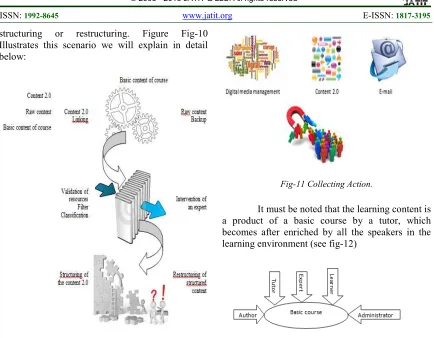
In this phase, we identify the pedagogic content that we will treat. In this step, the structure and the origin are not important. However, it is important to know whether this content respects the particular norm or not. Is it designed according to a standard or not as well as its usefulness for the curriculum? The content may be issue of different sources: experts’ proposal, learners, learners’ output and the results of the tutors’ researches. The fundamental idea of this phase is having a rich content, diversified and thick. The fig-11 schematizes the action of collection every type of content without caring about their characteristics:
Fig-11 Collecting Action.
[image:8.612.94.306.83.396.2]It must be noted that the learning content is a product of a basic course by a tutor, which becomes after enriched by all the speakers in the learning environment (see fig-12)
Fig-12 Speakers In The Process Of Enriching The Pedagogic Content
In principle, we are going to find ourselves in front of two types of content. A structured one :
- According to a norm or a standard existing, produced by professors, experts or tutors.
- Does not respect the norm using metadata: in other words, it is the content 2.0 containing TAG and products by authors, learners or results of researches.
[image:8.612.322.497.333.397.2]ISSN: 1992-8645 www.jatit.org E-ISSN: 1817-3195 ethical perspective, is it wise to copy this
content to his platform or create a link to this resource which means a relation within the educational data? We can equally find content freely accessible. Other contents are open but only to read not to edit. Finally, if we have the right to use it, we proceed to a backup in the learning platform to manage it better. However, if we do not have the right to use it, we can create a cyclical linking through that content or simply do forwards to that resource.
4.2 Validation:
The previous phase will allow us to have a varied content. Now, the aim is to make a pedagogic content with a specific goal. It is essential then to go through a step of validation of resources. This step may be automated, semi-automated or manual assigned to an expert.
In the context of distance learning, the human intervention which consists on the validation of the content, may be performed by one the d-learning’s authors: Author, Tutor, Expert, peers and even students can validate some contents by a group of valuator.
However, no matter what validation systems can exist, we think the human intervention is essential; which allows us to add the architecture MADAR, a manual validation layer with the use of scattered contents plus an automatic validation layer. We are going to base ourselves on the work results done by A. Belahcen who treats in his thesis the automatic validation of learning content regardless of its origin.
The choice of the manual method specifies that the task confined to an expert or a group of expert of the field.
4.3 Structuring and restructuring:
At the outcome of this phase, we have to have a structured content if it was not before. As we can have it restructured if it was but according to a norm or a standard different from that wished. The aim is making the content under the format the most generic possible in order to dilute the heterogeneity problems that exist in the learning
environment. We remind that we are treating two types of contents: structured and non-structured. For the structured content it is based on the indexation indicators and metadata by which it is structured. On the contrary, the non-structured content is based on TAGs added by web users and librarians. In this phase also, we are led to exchange with ontology of reference. This action might be done, through, comments, annotations or additions.
The following table below gathers all phases of the proposed process of our problematic. -analyze -Collect -Regroup -Sort -Select
-Sourcing A
cq u is it io n
-Pedagogic content (according to a norm or not): production of experts, learners, results of tutors’ researches.... -content 2.0 : sourcing
-Validate -Classify -Categorize R es o u rc es v al id at io n th ro u g h a p ed ag o g ic al p er sp ec ti v e
-Manual by an expert of the field, instructor or owner of the resource. -Automatic using the results of A. Belahcen
work ;
-Semi-automatic which regroups both previous steps. -Structuring Restructuring -Indexing S tr u ct u ri n g an d R es tr u ct u ri n g
Enrichment of pedagogic content ;
Annotations ; Labeling (Tagging) ; Marking up
ISSN: 1992-8645 www.jatit.org E-ISSN: 1817-3195 However, it is to note that by detailing
these phases, we can identify several under-phase.
The acquisition for instance which is the process point of entry will regroup many steps:
1- The classification: this phase consists on first level filtering. In the case where this process is executed by an individual, his mission will be filtering, scheduling and classifying the content acquired in function of chronology, of relevance and consistency. In contrast, in the context of modeling, this phase will be the outcome of PhD student A. BELAHCEN member of RMA team who has as a topic the automatic validation of content. For an already tagged content, we will add some appropriate elements for better categorization. For example: by field, chapter, field ontology, reference or total. The work output of Mr. Anas, is an automatic validated content 2.0, which we will validate pedagogically, then we will categorize it via stocking a physic linking with a total ontology to allow its reusing.
2- The indexation: by indexing, we hear always that representing under a form promoting a quick research. In our context, in this phase we will cover the structure and the restructure of the content. If the structuring takes a none-structured, the restructuring concerns a structured but non-standardized.
3- Stocking and/or Linking: Since the initial idea is to enrich the pedagogical resources from a raw content, this phase consists considerate the validated content as being a whole part of pedagogical content, which will enrich also the result during the search for a pedagogical resource.
4- Publication and/or Linking: In this phase, we predict to make the content, validated and structured from the previous step, accessible from other learning platforms in a Cloud environment.
5. CONCLUSION AND PERSPECTIVE:
The semantic interoperability of learning in the era Cloud created a new need for learners’ mobility, accessibility, exchange and sharing of pedagogic contents between the learning environments. In literature, there are multiple approaches of treating interoperability. It turned out according to our analysis that the unified approach star brings a great advantage to our problematic. Our solution is based on three steps: the acquisition, the validation and the structuring. In addition to our work, and to ensure the contents interoperability in the learning environments, we will apply our architecture on the three next types of contents: content 2.0, content according to the norm SCORM et a content according to the norm LOM. Thereby, we will create ontology of reference that we try to enrich as our works promote.
REFERENCES:
[1] Fabrice JOUANOT. Un modèle sémantique pour l’interopérabilité de systèmes d’information. In INFORSID, pages 347–364, 2000.
[2] Jos de BRUIJN, Marc EHRIG, Cristina FEIER, Francisco MARTIN-RECUERDA, François SCHARFFE et Mortiz WEITEN. Semantic Web Technologies, trends and research in ontology-based systems, chapter Ontology Mediation, Merging, and Aligning, pages 95–113. WILEY, 2006.
[3] Natalya NOY. Semantic integration: a survey of ontology-based approaches. SIGMOD Rec., 33(4):65–70, 2004.
[4] Alexander MAEDCHE, Boris MOTIK, Nuno SILVA et Raphael VOLZ. MAFRA - A Mapping Framework for Distributed Ontologies. In Proc. of 13th European Conference on Knowledge Engineering and Knowledge Management (EKAW), Siquenca, Spain, 2002.
ISSN: 1992-8645 www.jatit.org E-ISSN: 1817-3195 [6] Paolo BOUQUET, Fausto GIUNCHIGLIA,
Frank van HARMELEN, Luciano SERAFINI
et Heiner STUCKENSCHMIDT.
Contextualizing ontologiesstar, open. Web Semantic: Science, Services and Agents on the World Wide Web, 1(4):325–343, 2004. [7] A-J. Berre, B. Elveaster, N. Figay, C.
Guglielmina, S. G. Johnsen, D. Karlsen, T. Knothe and S. Lippe, The ATHENA Interoperability Framework, Enterprise interoperability: New challenges and approaches II, Springer edition. ISBN:978-1-84628-857-9, 2007
[8] Borys OMELAYENKO. Rdft: A mapping meta-ontology for web service integration. Pages 137–153. 2003.
[9] Choi NAMYOUN, Song IL-YEOL et Han HYOIL. A survey on ontology mapping. SIGMOD Rec., 35(3):34–41, September 2006. [10]Natalya Fridman NOY et Mark MUSEN.
Prompt: Algorithm and tool for automated ontology merging and alignment. pages 450– 455, 2000.
[11]Deborah MCGUINNESS, Richard FIKES, James RICE et Steve WILDER. The chimaera ontology environment. pages 1123–1124. AAAI Press / The MIT Press.
[12]Gerd STUMME et Alexander MAEDCHE. Fca-merge: Bottom-up merging of ontologies. In IJCAI, pages 225–234, 2001.
[13]Dejing DOU, Drew MCDERMOTT et Peishen QI. Ontology translation by ontology merging and automated reasoning, 2002.
[14]Erhard RAHM et Philip BERNSTEIN. A survey of approaches to automatic schema matching. The VLDB Journal, 10(4):334–350, 2001.
[15]Natalya NOY et Mark MUSEN. Anchor-prompt: Using non-local context for semantic matching, 2000.
[16]Fausto GIUNCHIGLIA, Pavel SHVAIKO et Mikalai YATSKEVICH. S-match: an algorithm and an implementation of semantic matching. In Y. KALFOGLOU, M. SCHORLEMMER, A. SHETH, S. STAAB et M. USCHOLD, réds., Semantic Interoperability and Integration, number 04391 in Dagstuhl Seminar Proceedings. Internationales Begegnungs und Forschungszentrum fuer Informatik (IBFI), Schloss Dagstuhl, Germany, 2005.
[17]AnHai DOAN, Jayant MADHAVAN, Pedro DOMINGOS et Alon HALEVY. Ontology matching:A machine learning approach. 2003.
[18]Marc EHRIG et Steffen STAAB. Qom quick ontology mapping. In International SemanticWeb Conference (ISWC2004), Japan, November 2004.
[19]Bach Thanh LE, Rose DIENG-KUNTZ et Fabien GANDON. On ontology matching problems - for building a corporate semantic web in a multi-communities organization. In ICEIS (4), pages 236–243, 2004.
[20]B. Faqihi, N. Daoudi, and R. Ajhoun,, “From the collaboration of companies to the interoperability of information systems (concepts and perspectives)” published in the International Journal of Information and Education Technology, Vol. 5, No. 3, March 2015.
[21]Naçima MELLAL. Réalisation de l’interopérabilité sémantique des systèmes, basée sur les ontologies et les flux d’information. Thèse de Doctorat, Université de SAVOIE, France, Décembre 2007.
[22]Abdeltif ELBYED. ROMIE, une approche d’alignement d’ontologies à base d’instances. Thèse de Doctorat, l’UNIVERSITE D’EVRY-VAL D’ESSONNE, France, Octobre 2009. [23]Séverine BLANC. Contribution a la
caractérisation et a l'évaluation de l'interopérabilité pour les entreprises collaboratives. Thèse de Doctorat, L'UNIVERSITE BORDEAUX 1, France, Décembre 2006.
[24]N. Daoudi « MADAR Learning : Environnement d’apprentissage interopérable entre le E-learning et le M-learning ». Thèse de doctorat en informatique. École Nationale Supérieure d’Informatique et d’Analyse des Systèmes, Maroc, 2009.
[25]Yannis KALFOGLOU et Marco SCHORLEMMER. If-map: an ontology mapping method based on information flow theory. Journal on Data Semantics, 1(1):98– 127, october 2003.
[26]Jon BARWISE et Jerry SELIGMAN. Information Flow: The Logic of Distributed Systems. Number 44. Cambridge University Press, 1997.
[27]B. Faqihi, N. Daoudi, and R. Ajhoun, “Semantic Interoperability in the d-learning in the era of cloud computing: Simplicity or complexity,” International Conference Learning ICL, Kazan, Republic of Tatarstan, Russia, 25-27 September 2013.
ISSN: 1992-8645 www.jatit.org E-ISSN: 1817-3195 technique of matching: Issue and prospective,”
7th International Conference on Interactive Mobile and Computer Aided Learning IMCL, Aman, Jordanie, November 2012.
[29]IDEAS, A gap Analysis –Required activities in Research, Technology andstandardisation to close the RTS Gap- Roadmaps and Recommendations on RTS activites, IDEAS, Deliverables, 2003.
[30]ATHENA, D.A1.3.1: Report on methodology description and guidelines definition Version 1.0, ATHENA Integrated Project, deliverable D.A1.3.1, March 2005.
[31]A-J. Berre, B. Elveaster, N. Figay, C. Guglielmina, S. G. Johnsen, D. Karlsen, T. Knothe and S. Lippe, The ATHENA Interoperability Framework, Enterprise interoperability: New challenges and approaches II, Springer edition. ISBN:978-1-84628-857-9, 2007.
[32]European Interoperability Framework, White Paper, Brussels, http://www.comptia.org, Feb 2004.
[33]C.M. Chituc and A. Azvedo, Towards a Self-Forming Business Networking Environment, Proceedings of the Seventh International Conference on Enterprise Information Systems, Miami, USA, May 25-28, 2005.