910
A MARKETING MANAGEMENT MODEL BASED ON
ENTERPRISE RESOURCE THEORY
XUE WU
Chongqing University of Science and Technology College of Business Administration, Chongqing, 400020,China
ABSTRACT
With the rapid development of the world economy, the marketing competitiveness of Chinese enterprises are facing a huge challenge. Based on the status quo, a marketing power management model based on the enterprise resource theory is introduced, the model introduced enterprise resource management theory, and building enterprise marketing evaluation index system according to the characteristics of the theory, then using the fuzzy evaluation method to establish model, last, the results will be shown by using octagonal assessment model. The experimental results show that, the model can reflect well the level of corporate marketing force and defects, and facilitate the evaluation and management of corporate marketing force.
Keywords: Enterprise Resource Theory, Marketing Power Management, Octagonal Assessment Model, Fuzzy Evaluation
1. INTRODUCTION
Chinese enterprises are facing a new era of marketing which is full of unknown and changing, a era with high-speed development of the information and the new era of Internet, the traditional marketing faces new challenges [1]. Standing in front of this new environment, if they want to enhance their competitiveness in the fierce market competition and keep an invincible position, they must have the stronger ability of effectively engagement in production and business activities than the competitors and create their own unique competitive advantage [2].
Enterprises’ competitive advantages root in resources advantages, capacity advantages, and environmental advantages in the final analysis, as well as the integrated effects of resources, capabilities, and environment [3]. In these three decisive factors in the competitiveness of enterprises, resources advantages play a most critical role [4]. Resources are the basis for
sustainable development of enterprises, the
potential productivity is also the basis for competitiveness of enterprises [5]. Whether a company has the ability to quickly adapt to the market, the ability to use internal and external resources in an efficient and integrated way to develop unique products, unique core technology, unique management style and a strong marketing network is the fundamental of enterprises to gain competitive advantage [6].
The resources and ability of enterprise has become the key for obtaining competitive advantages of an enterprise. For a long time, scholars and enterprises have been looking for the way of obtaining and maintaining competitive advantages of enterprise. In the 1950 s, the enterprise form competitive advantages mainly through the financial budget plan combined with
cash flow discount techniques, and the
establishment of general framework of controlling enterprise activities [7]. In the 60s, the enterprise used plan to control business, namely on the basis of medium term demand forecast, determining key points of plan, formulating strategic target and plans of products, market development to form competitive advantage [8]. In the 70 s, enterprises pay more attention to environment and enterprise status [9]. On the basis of industry organization and analysis, deciding enterprise's investment fields and cash flow distribution plan to form competitive advantage. But, people found that these theories cannot explain why in the same environment, some enterprises develop well, some enterprises got loss or even bankruptcy, and some statistical data which suggest the fact that the gap inter-industry is smaller than intra-industry, which make people strongly believe that the enterprise internal factors are the main factors of success or failure of enterprise. After the 80 s, foreign enterprise attaches great importance to the development of unique resources and ability, seeks the lasting competitive advantage and made effect [10].
Especially in today's knowledge economy
911 generalization and depth, technology develop rapidly, product innovation emerge in endlessly, consumer demand going diversification and individuation, product life cycle shorten, the development of information technology and financial innovation, which greatly promoting the liberalization of elements flow, make it more convenient than in the past for enterprise to obtain various resources (capital, technology, information, talents, etc.) [11]. Thus, it created the material foundation for the integration of resources and acquiring competitive advantage of enterprises. Under this circumstance, whether an enterprise has the ability of quickly adapting to the market, using the enterprise internal and external resources by business integration, and developing a unique product, unique core technology, creating the unique management style, having a strong marketing network, etc., has become the key point of obtaining competitive advantages of the enterprises.
Facing this statue quo, the article proposed a
marketing power of enterprise resource
management model based on the theory of enterprise resources , in order to evaluate and manage the marketing power of the enterprises.
2. OVERVIEW OF ENTERPRISE RESOURCE THEORY
Wernerfelt thinks resources include any
advantage or weakness of a given enterprise, which may be defined as tangible and intangible assets half permanent attached to enterprise. Barney thinks that "with traditional strategic analysis words, enterprise resource is the available power of an enterprise in the implementation of the strategy ", he divided enterprise resource into three categories: the material capital resources, human capital resources and organization capital resources. While Grant divided the enterprise resources into six types: financial resources, material resources, human resources, technology resources, goodwill resources and the resources of an organization. What can be found is that the definition of resources of enterprise resource theory is quite widely, its extension is very wide, almost all the enterprise factors which forming the enterprise competitive advantage can be seen as a resource, such as enterprise culture, technology level, financial strength, etc., so it is difficult to operate it in practice. But no matter how to divide, the key point is to distinguish those part of resources that can bring the enterprise the sustainable competitive advantages through carding and classification of the enterprise internal resources.
The enterprise resource theory is the theory of competitive advantage [12]. Enterprises as rent-seekers, the purpose of the corporate strategic management is through different strategies to build a sustainable competitive advantage, which has access to economic rents and excess profits. Different as homogenous of traditional neoclassical economics, the theory believes that the enterprise is a collection of resources, who shows heterogeneity due to
differences in resource endowments [13].
Enterprise's competitive advantage comes from corporate ownership and control of valuable, scarce, difficult to imitate and not alternative heterogeneous resources [14]. The heterogeneity of enterprises’ resource will exist for a long time, which favors a kind of sustainability of the competitive advantage. Identifying the advantages of resources and effectively develop, nurture, enhance and protect it become the important content of strategic management [15].
Enterprise resource-based theory has broken through the mode of formation of enterprises’ competitive advantage of the theory on industrial organization, and the theory thinks that the root causes of the differences in corporate performance come from the internal elements, but not depend on enterprise market structure of outside [16]. The emergence of this view make awareness of important impact of enterprise resource on the role of corporate value creation and strategy making, analysis of the competitive advantage of enterprises rose from the level of product market to the internal resource allocation level [17].
3. MARKETING FORCE MANAGEMENT MODEL BASED ON ENTERPRISE RESOURCE THEORY
912
Figure 1. Marketing Force Index System Diagram
3.2 Establishment of Model
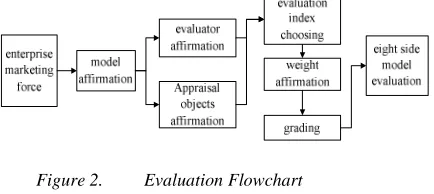
For the study of evaluation model of marketing power, the paper uses fuzzy evaluation method. The basic processes of Marketing power evaluation has a tremendous impact on the results of enterprise marketing force evaluation, the fuzzy evaluation method used in the article needs the main body, then determine the indicators and weights, at last, carried out the calculation, analysis and evaluation under the use of evaluation model , the basic process is shown in Figure below
Figure 2. Evaluation Flowchart
3.3 Weight Analysis
According to the different industries, the levels of importance of marketing force are also different,
this article take the same weight(5:5)as an
example. Decision makers compare ( 1)
2
n n−
, then
got the matrix:
11 12 1
21 22 2
1 2
... ...
... ... ... ...
...
n
n
n n nn
a a a
a a a
A
a a a
=
(1)
in
A, obviously there is
a11=5,
i=1, 2,...,n10
, 1, 2,...,
i ij
i j
w
a i j n
w w
= =
+
(2)
in which
wi,
j
w
are the weight of
i j,. If
satisfy
ij ij kj i k iji kj ji k j j
a a a w w w
a =a ⋅a =w ⋅w =w
, then we
say aijis the disposable estimate value.
The expert score mechanism: an effective index value augment, the program value augment, more
important of indicators, and greater the
corresponding scores; a cost index value augment,
program value reduce, and smaller the
corresponding scores. Weight coefficient formula:
1
1 1
n
ij j
i n n
kj
k j
a w
a =
= =
=
∑
∑ ∑
(3)
3.4 Octagonal Assessment Model Based Marketing Force Evaluation
AssumingXi is the weight of secondary indexes
of enterprise marketing force on i , Mi is the
evaluation value corresponding to the marketing force, thus the intensity of enterprise marketing force is:
6
1
i i i
MF X M
=
=
∑
(4)The evaluation of marketing force can be got in the same way , analyzing each element’s weight and confirm the value, then we can get the result as the evaluation to cultural force:
1 ( 11, 12, 13)( 11, 12, 13)
T
M = c c c M M M (5)
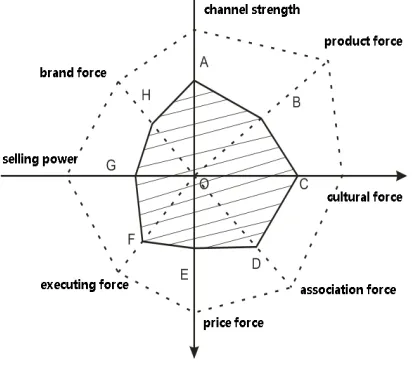
We can get eight basic scores of corporate marketing forces according to the calculation above, in fact, that is the strength of the corporate marketing force, thus, to draw maps of the strength of the enterprise marketing force, that is the octagonal assessment model. I.e. O as the center, the angles between the dotted lines drawn from the point O are equal of 45 degrees, connecting the endpoints of each segment , and the peripheral octagon can be obtained, the periphery of dashed octagon is marketing force border, on behalf of reference enterprise’ marketing force selected by the enterprise.
[image:3.612.90.307.385.482.2]913 the length of the dotted line can be got based on
calculation of the value of eight marketing
elements:
1 2 1 2
( , ,..., )( , ,..., )T
i i i i i i ij i i ij
L =X M =X x x x M M M (6)
4. MODEL TEST
[image:4.612.91.301.229.361.2]The article takes an evaluation of the company's marketing power as experimental subjects, his company's marketing force weighting diagram is shown below.
Figure 3: The Marketing Force Weight Figure
According to the weight proportion and expects’ evaluation, the marketing force strength octagon assessment model is shown as below.
Figure 4: The Octagonal Assessment Model Diagram
The establishment of Octagonal assessment model can analyze the strength of the marketing force, assess the overall level of marketing power,
grasp accurately the enterprise competitive
advantage in the market. The evaluation results are shown on the corresponding axis (A, B, C, D, E, F,
G, and H), which show the evaluation difference clearly, and easy to identify problems.
As can be seen from Figure 4, the score of level G H of the enterprise marketing force are close, but the C point score was higher, that indicates a stronger corporate culture, and the point E rated lower, indicating that the price force of the enterprise is the short board , so the nurture of price force is needed, thus can favor the play of the competitive advantage. Therefore, as can be seen by the graph model, nurture and enhance of the enterprise marketing force need to integrate various forces to find the strengths and weaknesses of the enterprise, to provide a basis for the development of strategic and tactical choices, and ultimately improve the overall level of profitability.
5. CONCLUSIONS
Based on the status quo, this paper has proposed a marketing force management model based on the enterprise resource theory, the model introduced the
enterprise resource theory, build enterprise
marketing evaluation index system according to the characteristics of the theory, and then use the fuzzy evaluation method to establish model, finally , use the eight-sided assessment model to show the results obtained, the experiments show that the model is effective.
REFERENCES:
[1] D. Li, “Diversified strategic choice analysis
based on the enterprise resource theory”. Modern Enterprise Culture. Vol. 8, No. 3, 2011, pp. 16-17.
[2] L. Ye, “The industrialization of agriculture
leading enterprise resource evolution path analysis—based on enterprise resource theory
view”. China Township Enterprises
Accountant. Vol. 11, No. 4, 2011, pp. 191-192.
[3] Y.J. Li, “Statement on the reference of
enterprise resource in accounting”. Finance and Accounting Monthly: Theory Versions. Vol.22, No. 1, 2010, pp. 92-94.
[4] S.J. Zhang, Y.F. Chen, etc al, “Research of
[image:4.612.92.298.435.618.2]914
[5] X.Q. Lu, “Discussion on international
business marketing strategy of the primary line”. Agriculture Development and Finance. Vol.2, No. 2, 2012, pp.108-108.
[6] Y.F. Zheng, “The marketing resources
discrimination under the Strategic Marketing
Perspective”. Journal of MINGJIANG
INSTITUTE. Vol. 32, No. 1, 2011, pp.42-46.
[7] Y.F. Zheng, “Enterprise marketing force
analysis based on marketing resource
allocation”. Journal of Quanzhou Normal
University. Vol.29, No. 1, 2011, pp.79-83.
[8] S.X. Chen, “Research on the relations of
enterprise marketing force and enterprise
performance”. Journal of YICHUN
INSTITUTE. Vol.33, No. 10, 2011, pp. 59-61.
[9] H. Yue, “Super execution facilitates super
marketing force”. Chinese Solar Energy Industry Information. Vol. 28, No. 10, 2011, pp. 17-17.
[10] X.L. Cao, P. Yu, etc al, “Research on
evaluation of SME entrepreneurial marketing
force”. Modern Business Trade Industry. Vol.
3, No. 2, 2011, pp. 27-28.
[11] Z.M. Hu, Y.L. Wang, J. Yang, “Corporate
marketing force evaluation based on fuzzy comprehensive evaluation”. Statistics and Decision -making. Vol. 52, no. 2, 2011, pp. 173-175.
[12] F. Zhang, “Research on enterprises’
individualized marketing management”.
Prices Monthly. Vol. 23, No. 7, 2012, pp. 72-75.
[13] W. Dang, “On the power supply enterprise
marketing management strategy”. Science Technology Enterprise. Vol. 1, No. 16, 2012, pp. 15-15.
[14] J. Zhao, “Enterprise marketing management
and innovation strategies”. China Science and Technology Review. Vol. 21, No. 21, 2012, pp. 52-52.
[15] Y. Sun, “Enterprise marketing management
and innovation”. Scientific and technological innovation and application. Vol. 5, No. 18, 2012, pp. 283-283.
[16] F. Wang, “Analysis of the existing power
marketing management problems and
countermeasures”. China Business Update. Vol. 22, No. 16, 2012, pp. 87-87.
[17] X. Gu, “The management of post-marketing”.