ISSN: 1992-8645 www.jatit.org E-ISSN: 1817-3195
A LOW LATENCY ENERGY AWARE GTS ALLOCATION
SCHEME FOR WIRELESS NODES IN ROAD
TRANSPORTATION NETWORKS
1Ms. RAMYA, 2Dr. UMA RAJARAM AND3Dr. S.RAVI
1,2.3
Dr. MGR Educational and Research Institute University, Chennai, INDIA
Email: [email protected], [email protected], [email protected]
ABSTRACT
Past studies in WSN have concentrated on data routing, energy efficiency, data latency and protocol development. In this paper, a low latency guaranteed time slot MAC protocol based on data priority with a bias for low energy nodes is proposed. The intelligent sensors collect event based data and polled data in a target area. The reduction in data latency is based on forwarding data packets which have a higher priority in a wireless network. DP-MAC has been designed to address the data latency problem to ensure that emergency and hazardous events in a transportation network are reported with minimum delay. The design of such a scheme is based on the collision free TDMA mechanism. The data priority is determined based on the type of event and the node lifetime energy information. The analytical and simulation results are presented in this scheme and a comparison is made with a network that treats all the nodes and their data packets without bias. The improvement in data latency for prioritized messages specifically for emergency information in automotive land based networks is presented.
Keyword: Wireless Sensor Network (WSN), Data Priority MAC protocol (DP-MAC), SIFS, TDMA.
1. INTRODUCTION
The research in the area of wireless sensor networks have been focused on developing energy efficient and intelligent sensor nodes that combine computing power with the ability to communicate data efficiently [17]. Various communication mechanisms to exchange data between the sensor nodes and with a central base station have been developed in recent years. The medium access control (MAC) protocol deals with the mechanism of data exchange between two nodes. Various versions of the MAC protocol have been developed with the following objectives,
(i) Increase the lifetime of the battery powering the node,
(ii) Increase data throughput and provide optimal data routing.
While data collision in sensor networks is a common problem slowing the network, collision free mechanisms such as the TDMA method have been developed to solve this problem. The central base station that aggregates all the data from the sensor nodes is normally impartial to the order of the data coming from all the nodes. In most applications, the data collected by the nodes are event based or based on polling using sensors [18].
While the event based data collected have a higher priority than the conventional polled data, it may be advantageous if such event based data are forwarded to the base station with lower data latency than the rest of the data. In this paper, a MAC protocol based on data priority is proposed and the design mechanism for the data exchange is described [20]. The improvement in data latency and the advantages are studied with relevant analytical models and simulations.
In order to understand the basis of this paper, the existing mechanisms in conventional MAC protocol are described with respect to the listed references. Kulkarni [1] refers to a TDMA mechanism that communicates with nodes in one of the following methods - broadcast, local gossip, converge cast and multicast. Broadcast is a method used to transmit data to all the nodes, local gossip refers to one node communicating with its neighbor, converge cast and multicast refers to a single node called a cluster-head transmitting data to a group of nodes or a specific subset of nodes.
battery may be a non-rechargeable type so that the lifetime of the battery will determine the lifetime of the node. Heidemann and Estrin [2] focus on developing the MAC protocol to extend the battery lifetime of a sensor node. The S-MAC protocol optimizes the sleep listen schedule using synchronization mechanisms with periodic SYNC packet broadcasts. WiseMAC [3] is a MAC protocol that combined TDMA for data access and CDMA for control access. In this method a preamble packet precedes a data packet. All nodes sample the medium at different time slots with a common sampling period. Each node upon finding the medium busy will look for a data packet until the medium is idle. Every node that is interested in transmitting data maintains a list of the sleep schedules of its neighboring nodes and updates this list dynamically. A transmitting node will schedule its preamble to be in the middle of the sampling time of the neighboring node. The neighboring node upon detecting the preamble will then wait for the data packet and receive the same before going to idle state. This method however results in repetitive transmission for multiple nodes that need to receive the same data packet. The higher data latency and power consumption is a drawback in this scheme.
Traffic Adaptive MAC Protocol (TRAMA) [4] and Node activation Multiple Access (NAMA) [5] are TDMA mechanisms designed for energy saving using collision free data protocols using time division multiplexing. An election mechanism is used in NAMA to ensure that a single node is activated from a given set of nodes. The excessive listening by the other nodes however results in energy loss in this mechanism. While node priority is addressed in TRAMA to a limited extent, the priority for the data is not discussed in this mechanism. SIFT is an event based MAC protocol [6] that is based on forwarding sensor data. This method recognizes a subset of the data as being of higher priority in comparison with the rest of the data. In this method, a non-uniform probability distribution function is used to pick a slot in the contention window [21]. A node listening to the medium will increase its probability of transmission drastically if it finds an idle contention slot. The number of nodes that may hence need to listen to the channel is greater but the percentage improvement in data latency can be justified for this mechanism that recognizes events that generate data that needed to be transmitted as soon as possible.
The survey of various MAC protocols have shown some techniques to be more advantageous
than others for certain applications [9,19]; however the user is free to combine the advantages of each method to suit the application and the objectives of the project. In intelligent transportation systems specific to road networks, the vision is to populate the target areas with multiple sensors with the following objectives are;
(i) Data collection from the natural environment and hazardous road conditions.
(ii) Ability to detect traffic congestion scenarios.
(iii)Detection of accidents that deter traffic flow.
(iv) Provide warning regarding medical emergency vehicles and military vehicle movement.
(v) Failure or malfunction of traffic lights.
An intelligent node may be equipped with multiple sensors that can provide all the above information or a subset of the required information. The data collected from the sensors fitted to the node will therefore have varying priorities and this may need to be accommodated in the MAC protocol design. In accordance with such a design introduce data priority MAC protocol (DP-MAC) that will be structured so that the data latency is significantly improved especially for high priority events. The paper will discuss the design of the DP-MAC protocol with comparison of data latency improvement with mechanisms that treat all nodes and their data without bias [7,8]. The application of this protocol for intelligent transportation and the results obtained by scaling the number of nodes will also be studied to indicate the relevance of this protocol in larger areas in which this mechanism may be adopted. In addition to the improvement in data latency, nodes with low energy levels will be promoted in priority for high priority data transfer. The improvement in keeping the nodes alive for longer duration and the methodology for scheduling the data transfer will be presented.
1.1 IEEE 802.11acStandard in Network
Wi-ISSN: 1992-8645 www.jatit.org E-ISSN: 1817-3195
Fi interface can wake up, exchange data with its AP and revert to dozing that much more quickly.802.11ac achieves its raw speed increase by pushing on three different dimensions are;
(i) More channel bonding, increased from a maximum of 40 MHz with 802.11n (upto 80 or even 160 MHz).
(ii) Denser modulation, using 256QAM up from 64QAM in 802.11n.
(iii)MIMO whereas 802.11n stopped at spatial streams.
1.2 Wireless Network Classifications
The physical layer and MAC layer of wireless network devices are defined by IEEE 802 standards. Based on the range,the wireless Networks are categorized as,
(i) Wireless PAN network established with devices of IEEE 802.15,
(ii) Wireless LAN network established with devices of IEEE 802.11 and (iii) WAN network established with
cellular structure.
1.3 Wireless LAN Standards Comparison
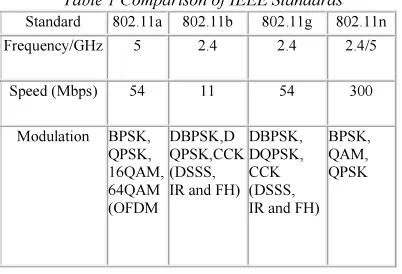
[image:3.595.87.288.483.620.2]IEEE 802.11 defines long range communication standards, which are defined for wireless LAN that establishes network in wider area. The comparison of wireless networks is given in Table 1.
Table 1 Comparison of IEEE Standards
Standard 802.11a 802.11b 802.11g 802.11n
Frequency/GHz 5 2.4 2.4 2.4/5
Speed (Mbps) 54 11 54 300
Modulation BPSK,
QPSK, 16QAM, 64QAM (OFDM
DBPSK,D QPSK,CCK (DSSS, IR and FH)
DBPSK, DQPSK, CCK (DSSS, IR and FH)
BPSK, QAM, QPSK
1.4 Modulation in WLAN
Wireless data exchange is done through any of the following modulation schemes
(i) Infrared (IR) connection is slow.
(ii) FHSS (Frequency hopping spread spectrum) transmit data by switching frequencies.
(iii)DSSS (Direct sequence spread spectrum)multiply data being transmitted
to a pseudo random binary sequence of higher bit rate.
DSSS has simpler MAC protocol and hence, lower overhead on air. FHSS is cheaper than DSSS systems complicated MAC protocol, less cost with more hardware.
2. MAC PROTOCOLS FOR WIRELESS NETWORKS
The communication protocol between the nodes and the base station is organized using CDMA, TDMA and its variants. The collision free TDMA protocol is popular since it allocates every node specific timeslots for communication. The global standard is presently the IEEE 802.15.4 protocol that combines CSMA/CA and GTS slots so that the network can guarantee low latency to a small subset of nodes in a network. Accordingly various publications that provide adaptive GTS allocation methods have been published [10-12]. The overhead in communication in this protocol have also been documented along with the disadvantages of data latency with an increased numbers of nodes. The network established using these short range devices are categorized as PAN (Personal area Network). In this protocol, a beacon message in the form of a super frame is sent from a PAN coordinator. The beacon message is repeated at regular preformed intervals. Figure 1 shows the frame sequence with a short frame, turn-around time delay, acknowledgement (ACK) and short inter-frame space (SIFS). The next frame may begin immediately or with a back-off period based on the beacon message period.
Short-frame
Short-frame ACK
Short-frame Back-off
period
Short-frame SIFS Single frame duration
Turn around
time
Turn around
time
[image:3.595.309.508.521.588.2]ACK ACK
Fig. 1 Short frame sequence in IEEE 802.15.4
B E A C O N
B E A C O N
Contention Access
Period Guaranteed Time Slots
Inactive period Active Period
[image:4.595.88.289.103.192.2]Beacon Interval
Fig. 2 MAC superframe structure in IEEE 802.15.4
The time slots in the second group are called Guaranteed Time Slots (GTS), provided by the PAN coordinator for nodes that need to compulsorily transmit data within a certain time. The nodes access the Contention Access Period using CSMA/CA mechanism wherein each node that wants to access the communication medium will sense the medium after a random number of back-off periods. If the node finds the medium idle, it will start transmission otherwise it will back-off again. During this period there is contention and the nodes have a better chance of accessing the medium when the communication traffic is light. There are seven GTS slots that can be accommodated in one frame.
The packet structure in the frame is shown in Figure 3. The communication packet starts with a five byte synchronization header followed by a 1-byte PHY header. The next two fields belong to the MAC header with a two byte frame control and 1 byte sequence number. The address information that follows is optional and may be up to 20 bytes length. The data payload follows next and the width is variable based on the data to be transmitted. A two byte check sequence terminates the message. The entire packet has an upper limit of 127 bytes.
Synchronisation Header
PHY Header
Frame
Control Address info Payload Frame check sequence MAC Protocol Data Unit (MPDU)
MAC Header
MAC Footer
5 bytes 1 byte 2 bytes 1 byte 0-20 bytes Variable 2 bytes PHY
[image:4.595.316.510.344.396.2]Header
Fig. 3 Frame packet structure
3. DATA PRIORITY BASED MACPROTOCOL
The TDMA scheme is used to form the beacon message in the proposed protocol. The TDMA scheme provides guaranteed data latency for all the nodes in the network. In addition to this proposed an energy aware node map and priority based scheme by which the PAN coordinator controls the nodes in the network to prolong node lifetime and also improve data latency for the high priority messages [15]. The PAN coordinator provides all nodes a fair chance of participating in data transfer until they reach a threshold of energy level [15].
The scheme is partial to nodes that may want to transmit high priority data when their energy levels are lower than a set threshold.
The basic protocol is derived from the IEEE 802.15.4 standard but the contention access slots are eliminated and the GTS slots are expanded so that the MAC super frame structure is as seen in Figure 4. Feng Chen et al., [13] have proposed a modified superframe structure based on the TDMA model. The entire beacon interval is divided into n slots starting with a beacon message and followed by a SIFS interval. The guaranteed time slots with payload follow until the end of the beacon interval. In this mechanism, the PAN coordinator is shown to be communicating with "n" nodes in a TDMA mechanism with no inactive interval. Optional inactive interval may be added but that would contribute to data latency but preserve node lifetime due to longer sleep intervals.
Fig.4 Modified Superframe structure with GTS
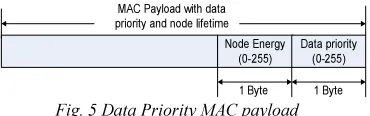
In the proposed scheme based on data priority, the data frame is modified with the following fields of 1-byte PHY header, 1-byte Data Priority, 1 byte Energy data followed by data payload and frame check sequence as shown in Figure 5. The PAN coordinator is therefore informed about the data priority in the node and the lifetime data for the node at regular beacon intervals. The PAN coordinator uses the inter-frame space or the inactive interval to process this information and determine the order in which the data from the nodes need to be received. The PAN coordinator may decide to schedule more than one slot for each node if it decides that the data priority from one particular node belongs to an emergency event that need to be collected with the lowest data latency. Such a flexible system of data collection based on priority and lifetime will contribute to real time events being reported with minimal data latency.
Node Energy (0-255)
Data priority (0-255) MAC Payload with data
priority and node lifetime
[image:4.595.89.285.514.609.2]1 Byte 1 Byte
Fig. 5 Data Priority MAC payload
[image:4.595.319.504.631.689.2]ISSN: 1992-8645 www.jatit.org E-ISSN: 1817-3195
on the type of activity that node performs. A node that is more active will lose the energy level at a faster rate than a node that is called upon to send data rarely. This energy imbalance will cause a non-uniform node lifetime scenario in the target area and certain nodes that may be essential for high priority data exchanges may not be available when the situation demands. The proposed mechanism takes the node lifetime parameter as a variable that is used to influence data priority so that the nodes with low energy level get a fair chance to send in the high priority data. The PAN coordinator is also informed about the depleting node energy status as part of the data exchange. The PAN coordinator then isolates these nodes exclusively for high priority data exchange.
The node lifetime is governed by the battery powering the node and its energy level is governed by the following equations [13,14]. The microcontroller associated with the node is responsible for energy tracking and lifetime calculation of the battery source. The energy available is normalized and expressed as a value from 0 to 255 so that this data can be used for the GTS scheduling mechanism. All the nodes start with a value of 255 and the energy level is decreased based on the node activity over a period of time. Assuming that ER represents the remaining
node energy and PB is the data priority based on the
severity of an event in the target area, the rule base is designed in such a way that the low energy nodes that have data with high priority can pass on the data to the PAN coordinator with minimum latency. The data that has low priority originating from a node with large lifetime energy will not be promoted and will therefore suffer in this scheme. The PAN coordinator decides the order of the schedule for the various nodes using the information of the event data priority and lifetime.
3.1 Advantages of Frame Relay
[image:5.595.307.516.77.248.2]The frame relay is to separate data packets for different users, synchronization of the start and end of a transmission to confirm to the IEEE standards etc. The symbols in different slots are defined are shown in Figure 6.
Fig. 6 Defined symbols in different slots
[image:5.595.309.510.306.384.2]The 802.15.4 allocates 960 symbols within a frame, where the slotting allocation is dynamic which is shown in Figure 7.
Fig. 7 Dynamically slotting allocation
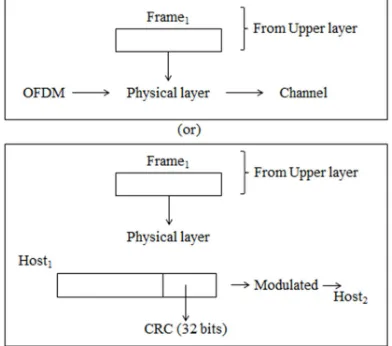
The frame node in the network is using physical layer with node network is shown in Figure 8.
Fig. 8 Frame node using physical layer in network
4. DATA LATENCY ANALYSIS
[image:5.595.309.505.423.596.2]) , , , (f n p l F
DL= (1)
Let us consider a"n"node network with a single PAN co-ordinator communicating using the modified TDMA based super-frame structure [13]. In the beginning, each of the nodes receives a beacon message in order to synchronize in time and receive its GTS slot timing. Then, each of the nodes forward event based data collected to the PAN during its allocated GTS slot in the order in which the data has been acquired. Data sent by each node is acknowledged by PAN. The computation of the data latency when the message or node priority is ignored can be written by the following equation for the pth message from the qth
node.
Data latency (DLpq) =
{(p-1)[ Tbeacon + n(Tdata + T) + (n-1) TXSIFS+ 2 (TSIFS)} + {Tbeacon + TSIFS + q(Tdata + T) + (q-1)
TXSIFS} … (2)
Tbeacon = Transmission time for Beacon frame in
milliseconds,
Tdata= Transmission time for Data frame in
milliseconds,
T= Transmission time for acknowledgment frame,
TXSIFS =Time for XSIFS frame in milliseconds, TSIFS = Time for SIFS frame in milliseconds.
Data latency is calculated as the sum of the time taken to process "(p-1)" messages in n nodes with the time taken to process the pth message in q nodes. The above expression is valid for the special case when the number of GTS slots "m" is equal to the number of nodes "n" in the network. In most networks, the number of nodes may be far beyond the number of GTS slots so that m < n. If there are "r" pending messages in each of the "n" nodes, data latency for the rth message in the nth node is given by the expression,
Data latency (DLnr) =
{[Tbeacon + m(Tdata + T) + (m-1) TXSIFS+ 2 (TSIFS)}(nr/m)
+ {Tbeacon + TSIFS + (nr mod m) (Tdata + T) + ((nr
mod m) -1) TXSIFS} … (3)
In the case study, a land based wireless sensor network which is used to collect traffic related event data due to hazardous road conditions, traffic congestion scenarios, accidents that deter traffic flow etc. The network consists of one PAN co-ordinator and "n" number of sensor nodes. The
[image:6.595.314.501.226.384.2]PAN co-ordinator and the "n" sensor nodes use the IEEE 802.15.4 compliant wireless transceivers. 2.4 GHz band is selected as the frequency range of operation due to high raw data transmission rate needed typically for real-time application like traffic monitoring. The parameters of the network used for data latency analysis are given in Table 2.
Table 2 Network parameters for data latency calculation
Parameters Name Value
Data transmission rate f 250Kbps
Symbol rate fs 62.5Kbps
Beacon Interval (34
symbols) Tbeacon 0.544 ms
Short Interframe interval
(12 symbols) TSIFS 0.192 ms
Data Transmission
Interval (40 symbols) Tdata 0.64 ms
Ack Transmission
Interval (6 symbols) T 0.096 ms
Extended Interframe
Interval (4 symbols) TXSIFS 0.064 ms
Beacon order BO 0
Superframe Order SO 0
Case-1:
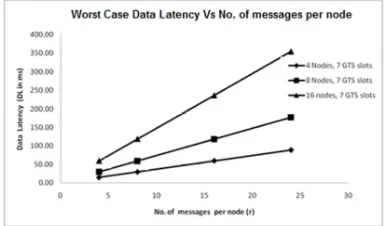
[image:6.595.316.510.465.578.2]Figure 9 and Figure 10 show the data latency when traffic event data collected at the “n” nodes are forwarded to the PAN co-ordinator in the order at which they are received.
Fig. 9 Data Latency as a function of number of messages forwarded from each node; Number of GTS
[image:6.595.307.510.624.718.2]slots < Number of sensor nodes
ISSN: 1992-8645 www.jatit.org E-ISSN: 1817-3195
The graphs show the linear variation in data latency as the 1) number of messages forwarded from each node is increased for given "n" sensor nodes. 2) Number of sensor nodes forwarding the message is increased for a given "p" messages.
Case-2:
[image:7.595.89.290.306.455.2]The data latency of high priority messages when traffic event data collected at the “n” nodes are being forwarded to the PAN co-ordinator (i) without priority based ordering at each node and (ii) with priority based ordering at each node is given in Table 3.
Table 3 Data Latency comparisons for priority based message ordering
Message number
(p)
Node number
Data Latency without priority
(in ms)
Data Latency with priority
(in ms)
3 1 16 1.472
2 2 9.536 2.272
2 3 10.336 3.072
3 4 18.4 3.872
5 5 33.728 4.672
2 6 12.736 5.472
3 7 20.8 6.272
4 8 28.864 7.072
5. CONCLUSION
A low latency energy aware GTS allocation scheme for wireless nodes in road transportation networks is presented in this work. Data latency comparison values for priority and nonpriority based packet/message ordering are presented. The present GTS scheme is modified in such a manner that the node data messages are transmitted with two additional fields that indicate the pending message priority and the energy level of the node. The PAN coordinator uses this information to derive a priority bias so that the messages that have high priority and low energy get scheduled earlier. The data priority is a number that ranges from 0 to 255 with 0 indicating low priority and 255 indicating high priority. The software program in the node will assign a unique value based on the event priority for each message. The lifetime of the node is also a number that ranges from 0 to 255 that indicates the energy level in the node. The PAN uses this information to schedule the GTS slot for the high priority message with the energy bias. The advantage of this scheme in improving data latency for high priority messages is clearly
seen since all the nodes are not treated with equal bias and all the messages transmitted from a node are also not treated with equal priority. The data priority and node energy are appended at the end of every data stream and are indicative of the pending high priority message that the node needs to send to the PAN.
REFERENCES:
[1] S.S., Kulkarni, “TDMA service for Sensor Networks”, Proc. of 24thInt. Conf. Distributed Computing Systems Workshops, pp.604 – 609, 23-24 March 2004.
[2] W. Ye, J. Heidemann, D.Estrin, “Medium Access Control with Coordinated Adaptive Sleeping for Wireless Sensor Networks”, IEEE/ACM Trans. Networking. Vol.12, No. 3, pp.493 – 506. 2004.
[3] A. El-Hoiydi, “Spatial TDMA and CSMA with preamble sampling for low power ad hoc wireless sensor networks”, Proc. of ISCC,pp.685 – 692, July 1-4 2002.
[4] V. Rajendran, K. Obraczka, J.J. Garcia-Luna-Aceves, “Energy-Efficient, Collision-Free Medium Access Control for Wireless Sensor Networks”, Proc. ACM SenSys, Los Angeles, California, pp.181 – 192, 5-7 November 2003.
[5] L. Bao and J.J. Garcia-Luna-Aceves, “A New Approach To Channel Access Scheduling For Ad Hoc Networks”, Seventh Annual Int. Conf. Mobile Computing and Networking, pp.210–221, 2001.
[6] K. Jamieson, H. Balakrishnan, and Y. C. Tay, “Sift: A MAC Protocol for Event-Driven Wireless Sensor Networks”, MIT Laboratory for Computer Science, Tech. Rep. 894, May 2003.
[7] G.M Shafiullah, “Energy-Efficient Wireless MAC Protocols for Railway Monitoring Applications”, IEEE Trans. on Intelligent Transportation Systems, Vol.14, No. 2, pp. 649-659, June 2013.
[8] W.B Heinzelman, A.P Chandrakasan and H. Balakrishnan, “An application specific protocol architecture for wireless microsensor networks”, IEEE Wireless Comm. Trans. Vol.1, No. 4, pp. 660-670, Oct. 2002.
[10] Naoki Hayashi and ShigemasaTakai, “A GTS Scheduling for Consensus Problems over IEEE 802.15.4 Wireless Networks”, European Control Conf., pp.1764-1769, 1-19 July 2013.
[11] M.Takaffoli, “Scheduled Access Using the IEEE 802.15.4 Guaranteed Time Slots”, Proc. IEEE ICC, pp. 1-5, 23-27 May 2010. [12] Feng Xia, “Adaptive GTS Allocation in
IEEE 802.15.4 for Real Time Wireless Sensor Networks”, Journal of System Architecture, Vol. 59, No. 10, pp.1331- 1342, Nov. 2013.
[13] Feng Chen, Reinhard German and Falko Dressler, “Towards IEEE 802.15.4e: A study of Performance Aspects”, Proc. of 8thIEEE International Conference on Pervasive Computing and Communications (PERCOM), pp. 68- 73, Mar 2010.
[14] Eugen Shih, “Physical layer driven Protocol and Algorithm Design for Energy Efficient Wireless Sensor Networks”, Proc. ACM MOBICOM’01, pp. 272-286, 2001.
[15] IEEE “Wireless Medium Access Controland Physical layer (PHY) specifications for low rate Wireless Personal Area Networks (WPANs)”, IEEE Standard 802.15.4 -2006. [16] A. Tiwari, F.L. Lewis and Shuzhi Sam Ge,
“Wireless Sensor Network for machine Condition Maintenance”, Int. Conf. on Control, Automation, Robotics and Vision, pp. 461- 467, Dec 2004.
[17] TifennRault, AbdelmadjidBouabdallah, YacineChallal, “Energy Efficiency in Wireless Sensor Networks: a top-down survey”, Computer Networks Vol. 67, No. 4, pp. 104-122, 2014.
[18] M. Naeem, K. Illanko, A. Karmokar, A. Anpalagan,M. Jaseemuddin, “Energy-Efficient Cognitive Radio Sensor Networks: Parametric and Convex Transformations”, Sensors, Vol. 13, pp. 11032-11050, 2013. [19] P. Nintanavongsa, M. Naderi, K.
Chowdhury, “Medium access control protocol design for sensors powered by wireless energy transfer”, IEEE INFOCOM, Turin, pp. 150-154, 2013.
[20] R. Carrano, D. Passos, L. Magalhaes, C. Albuquerque, “Survey and Taxonomy of Duty Cycling Mechanisms in Wireless Sensor Networks, IEEE Communications Surveys & Tutorials”, Vol. 16, pp. 181-194, 2014.