ISSN: www.jatit.org E-ISSN:
239
CAT SWARM OPTIMIZATION TO SOLVE FLOW SHOP
SCHEDULING PROBLEM
1
ABDELHAMID BOUZIDI, 2 MOHAMMED ESSAID RIFFI
lab. LAROSERI, Depart. of Computer Science. Chouaib Doukkali University, EL JADIDA, MOROCCO E-Mail : 1[email protected] , 2[email protected]
Abstract :
Flow shop problem is a NP-hard combinatorial optimization problem. Its application appears in logistic, industrial and other fields. It aims to find the minimal total time execution called makespan. This research paper propose a novel adaptation never used before to solve this problem, by using computational intelligence based on cats behavior, called Cat Swarm Optimization, which is based on two sub modes, the seeking mode when the cat is at rest, and the tracing mode when the cat is at hunt. These two modes are combined by the mixture ratio. The operations, operators will be defined and adapted to solve this problem. To prove the performance of this adaptation, some real instances of OR-Library are used. The obtained results are compared with the best-known solution found by others methods.
Keyword : Flow shop, scheduling, makespan, computational intelligent, cat swarm optimization.
1. INTRODUCTION
The Flow shop scheduling [1] is one of the known problems in operational research. Given the whole applications fields, and the complexity of the problem, it has been a very active and prolific research area. To resolve this problem we should find the minimal make span by executing n jobs in m machine.
Many optimization algorithms based on computational intelligence had been proposed to solve the flow shop-scheduling problem, such as simulated annealing [2-3], tabu search [3-5], harmony search [6-7], genetic algorithm [8-9], Ant Colony optimization [10-11], bee colony optimization [12], particle swarm optimization [13-15], and others.
The present research paper aims to apply cat swarm algorithm never used before to solve FSSP. The research paper is organized as follows: in section II, a presentation and formulation of flow shop scheduling problem. In section III, a description of cat swarm optimization algorithm. In section VI, Cat swarm optimization applied to FSSP, and the results obtained by using some instance of OR-Library [21]. Finally, the conclusion and discussion.
2. FLOW SHOP SCHEDULING
PROBLEM
2.1 PRESENTATION
The flow shop-scheduling problem (FSSP) is a combinatorial optimization problem in class
NP-HARD [16], simulated first in 1954 by Johnson [17]. FSSP is a set of n unrelated jobs
that should be processed in the same order as m machines. The problem is to find the schedule of jobs that have the best minimal total time of execution of all the process called make span, by respecting some constraints, which are:
−All jobs are independent, and available for
processing at time zero.
−The machines are continuously available from
time zero onwards
−Each machine can process one operation at a
time.
−Each job can be manufactured at a specific
moment on a single machine
−If a machine is not available, all the following
jobs are assigned to a waiting queue.
−The processing of a given job in a machine
cannot be interrupted once started.
A comprehensive list of these constraints, are grouped on categories, can be found in [1].
Setup times are sequence independent and are included in the processing.
2.2 FORMULATION OF PROBLEM:
The FSSP is composed of n job J = {J1, J2 … Jn}, and m machine M = {M1, M2 … Mm},
each job is composed of m distinct operations O
ISSN: www.jatit.org E-ISSN:
240 executed, and ೖ represents the processing time of operation ok.
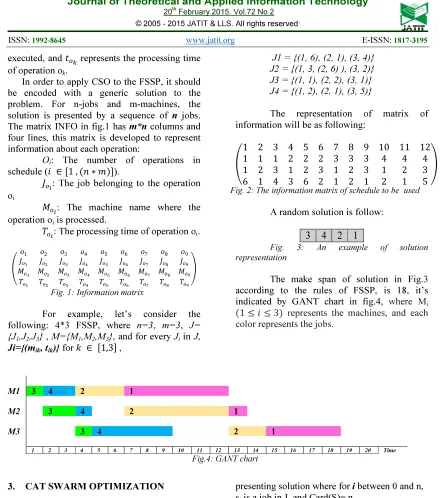
In order to apply CSO to the FSSP, it should be encoded with a generic solution to the problem. For n-jobs and m-machines, the solution is presented by a sequence of n jobs.
The matrix INFO in fig.1 has m*n columns and four lines, this matrix is developed to represent information about each operation:
Oi: The number of operations in schedule ( ∈ 1 , ∗ ).
: The job belonging to the operation oi
: The machine name where the operation oi is processed.
: The processing time of operation oi.
൮
ଵ ଶ ଷ ସ ହ ଼ ଽ
ܬభ ܬమ ܬయ ܬర ܬఱ ܬల ܬళ ܬఴ ܬవ
ܯభ ܯమ ܯయ ܯర ܯఱ ܯల ܯళ ܯఴ ܯవ
ܶభ ܶమ ܶయ ܶర ܶఱ ܶల ܶళ ܶఴ ܶవ
൲
Fig. 1: Information matrix
For example, let’s consider the following: 4*3 FSSP, where n=3, m=3, J= {J1,J2,J3} , M={M1,M2,M3}, and for every Ji in J,
Ji={(mik, tik)} for ∈ 1,3 ,
J1 = {(1, 6), (2, 1), (3, 4)} J2 = {(1, 3, (2, 6) ), (3, 2)} J3 = {(1, 1), (2, 2), (3, 1)} J4 = {(1, 2), (2, 1), (3, 5)}
The representation of matrix of information will be as following:
1 2 3 4 5 6 7 8 9 10 11 12
1 1 1 2 2 2 3 3 3 4 4 4
1 2 3 1 2 3 1 2 3 1 2 3
6 1 4 3 6 2 1 2 1 2 1 5
Fig. 2: The information matrix of schedule to be used
A random solution is follow:
3
4
2
1
Fig. 3: An example of solution
representation
The make span of solution in Fig.3 according to the rules of FSSP, is 18, it’s indicated by GANT chart in fig.4, where Mi
1 3 represents the machines, and each color represents the jobs.
M1 3 4 2 1
M2 3 4 2 1
M3 3 4 2 1
[image:2.595.80.520.75.573.2]1 2 3 4 5 6 7 8 9 10 11 12 13 14 15 16 17 18 19 20 Time
Fig.4: GANT chart
3. CAT SWARM OPTIMIZATION
Cat swarm optimization (CSO) algorithm was first introduced by Chu and Tsai [18] in 2006, and improved in 2011 by M.Orouskhani and Al. [19]. It was applied in combinatorial problem in 2014 [20] .The CSO adapted the natural behavior of cats composed by two modes: the seeking mode when the cat is resting and the tracing mode when the cat is hunting. These two modes are combined by mixture ratio (MR). The name, position, velocity and flag characterize each cat.
4. APPLY DISCRET CSO TO FSSP: In this section, the definition of operators is operations used in CSO algorithm. Let us n jobs J= {J1, J2… Jn}, m machines M = {M1, M2…, Mm}, and S = {s1, s2, …,sn } a schedule
presenting solution where for i between 0 and n, si is a job in J, and Card(S)= n.
Table1: Cat’s Parameters position Is the solution/schedule presented by a
vector of jobs S.
velocity Sets of couples permutation (Ji ,Jj ), Let’s v a velocity, v=(ik,jk)[k:0|v|]. |v| present the number of couples in v.
Flag To know in each mode what are the cat is.
2.3 DEFINITION OF OPERATION:
To use CSO to discrete problem, some rules are recommended to be respected:
•Addition between two velocities v1, v2 is a new
[image:2.595.87.494.456.540.2]ISSN: www.jatit.org E-ISSN:
241
•Addition between position x and velocity v is a
new position x’, obtained by applying all permutation couples of v to x.
•Opposite of a velocity v=(ik,jk)[k:0|v|] is
¬v=(ik,jk)[k : |v| 0] ,and, (v) + (¬v) =
ø
.
•Subtraction between two position x1 and x2, is a
velocity v. this operation is the opposite of addition:
x1- x2 = v x2 + v =x1.
•Multiplication of a real r and a velocity v=
(ik,jk)[k :0 |v|], is a new velocity. The possible
cases according to the real r, are:
If (r=0) then r*v= ø
If r ∈ 0,1 then r * v = (ik,jk)[k : 0 (c*|v|)]
If (r>1) then take the decimal part of r, after do the same two previous step.
If (r<0) then r * v= (-r)*(¬v), with (-r)>0. And do the previous steps.
The CSO algorithm is composed of seeking mode, and tracing mode combined by a mixture ratio. The processing of these two modes in CSO algorithm is as shown below:
1. Seeking mode:
It shows that the cat i is at rest, to observe the best
place to move to. The parameters used in this mode are:
SMP: Seeking memory pool.
CDC: seeking range of the selected dimension. SRD: counts of dimension to change
SPC: self-position consideration.
In a behavior of cats, SMP is the number of observations to consider before deciding the best position where to move. SPC gives to a cat the freedom whether to move or not. If the cat finds its current position as the best, then it will not change it, and stay on the same position. SRD and CDC are both necessary factors in updating the solution.
Seeking mode is as follows:
Step 1: put j copies of the present position of the cat k, with j = SMP. If the value of SPC is true or j = SMP-1, and retains the cat as one of the candidates.
Step 2: Generate a random value of SRD
Step 3: If the fitness (FS) are not equal, calculate the probability of each candidate by equation (a), the default probability value of each candidate is 1. Step 4: Perform mutation and replace the current
position.
ܲ݅ ൌ
| ࢇ࢞|ࢇ࢞
(a)
2. Tracing mode:
This is the cat-hunting mode, where the cat traces its path, according to its own velocity to chase a prey or any moving object. The description of the process of each cat in this mode is as follows:
Step 1: update the velocities of each cat k according
to equation (b).
v’ k = w*v k + r * c * (x best − x k) (b)
Where:
v’ k : The new velocity value w : Inertia weight
x best: is the best position in swarm. v k : the old velocity value (current value). c: a constant.
r:a random value in the range [0, 1].
Step 2: check if the velocities are of the highest order.
Step 3: update the position of k cat according to equation (c).
x’ k = x k + v k (c)
Where:
x’ k: the new position values of the cat k x k: the current position of cat k
v k: the velocity of cat k
2.4 THE COMPLETE CSO ALGORITHM: The full mode is composed of the SM and TM combined by a mixture ratio (MR), the flag is used to determinate the mode of each cat in swarm. The description of the process is:
Begin:
(1) Generate N cats
(2) Initialize flag, velocity, and position every cat.
(3) Initialize gbest with the lowest fitness cat in swarm.
(4) for each cat in swarm
If the flag of the selected cat is TM Apply selected cat into TM process Else
Apply selected cat into TM process EndIf
Update gbest End for
(5) Re-pick number of cats and set them into TM according to MR, and set other cats in SM.
If the condition is to terminate yes then complete the program
ISSN: www.jatit.org E-ISSN:
242
5. EXPERIMENTS AND
COMPUTATIONNAL RESULTS
To prove the performance of discrete CSO to solve FSSP in this paper, this algorithm is applied to solve thirty-one chosen instances of FSSP in OR-LIBRARY [21]. The method is coded by C++ programming language, which runs on an Ultrabook characteristic’s 2.1 GHz 2.59Ghz Intel Core i7 PC with 8G of RAM. Each instance runs for one hour in maximum. Table 2 shows the values of parameters used [20]:
Table 2: Used Parameters Values SMP 5
CDC 0.8 MR 0.3 C 2.05
R [0,1] W 0.729
Table 3 shows the instances name, the job number n and the machine number m, best known solution (BKS) found by others algorithm [22-23], and the best solution obtained by applying CSO (best) to the selected instance in 10 times . The columns T in table 3, show average time execution in seconds to find the BEST, the percentage error (Err %) value is obtained by
!"# $ BKSBKS ( 100 Table 3: Table Of Results
Instanc e
n * m BK S
BES T
Err %
T (s) Carlier
Car1 11×5 7038 7038 0.00 01 Car2 13×4 7166 7166 0.00 01
Car3 12×5 7312 7312 0.00 01 Car4 14×4 8003 8003 0.00 01
Car5 10×6 7720 7720 0.00 01 Car6 8×9 8505 8505 0.00 01
Car7 7×7 6590 6590 0.00 01 Car8 8×8 8366 8366 0.00 01
Heller
Hel1 100×1
0
516 516 0.00 27
Hel2 20×10 136 135 -0.74 06
Reeves
ReC01 20×5 1247 1247 0.00 02
ReC03 20×5 1109 1109 0.00 03 ReC05 20×5 1242 1245 0.24 01
ReC07 20×10 1566 1566 0.00 03 ReC09 20×10 1537 1537 0.00 02 ReC11 20×10 1431 1431 0.00 01
ReC13 20×15 1930 1930 0.00 178
ReC15 20×15 1950 1950 0.00 101
ReC17 20×15 1902 1902 0.00 116 ReC19 30×10 2093 2099 0.29 18
ReC21 30×10 2017 2020 0.15 486 ReC23 30×10 2011 2020 0.45 22
ReC25 30×15 2513 2525 0.48 377 ReC27 30×15 2373 2396 0.97 61
ReC29 30×15 2287 2305 0.79 332 ReC31 50×10 3045 3058 0.43 900
ReC33 50×10 3114 3114 0.00 163 ReC35 50×10 3277 3277 0.00 07
ReC37 75×20 4951 5096 2.93 158 3
ReC39 75×20 5087 5161 1.45 568
ReC41 75×20 4960 5087 2.56 207 1
The table of result demonstrate that CSO can solve numerous instance in OR-library, and it also shows another best solution to instance “Hel2”, minus one than the best known solution [23]. The error percent of the other executed instances is between 0.00 and 2.93.
6. CONCLUSION:
This research paper presents a new adaptation of CSO algorithm to solve the Flow Shop scheduling problem. The obtained results to some benchmark problem instances (of Carlier, Heller and Reeves) prove the performance of CSO algorithm to solve the problem up to 50 jobs, without any error. For up to 50 jobs, it approaches solution with a negligible percentage error. This proves the ability of the CSO algorithm to solve the FSSP. The future work is to extend the application of CSO algorithm for others kinds of scheduling problems, and multi-objective scheduling problem.
REFERENCES
[1] Gupta JND, Stafford Jr. EF., Flowshop scheduling research after five decades, European Journal of Operational Research, 169, pp. 699–711, 2006
[2] Osman, I. H., & Potts, C. N. (1989). Simulated annealing for permutation flow-shop scheduling. Omega, 17(6), 551-557. [3] Ishibuchi, H., Misaki, S., & Tanaka, H.
ISSN: www.jatit.org E-ISSN:
243 problem.European Journal of Operational Research,81(2), 388-398.
[4] Grabowski, J., & Wodecki, M. (2004). A very fast tabu search algorithm for the permutation flow shop problem with makespan criterion.Computers & Operations Research,31(11), 1891-1909. [5] Ben-Daya, M., & Al-Fawzan, M. (1998). A
tabu search approach for the flow shop scheduling problem.European Journal of Operational Research,109(1), 88-95.
[6] Gao, K. Z., Pan, Q. K., & Li, J. Q. (2011). Discrete harmony search algorithm for the no-wait flow shop scheduling problem with total flow time criterion.The International Journal of Advanced Manufacturing Technology,56(5-8), 683-692.
[7] Pan, Q. K., Suganthan, P. N., Liang, J. J., & Tasgetiren, M. F. (2011). A local-best harmony search algorithm with dynamic sub-harmony memories for lot-streaming flow shop scheduling problem.Expert Systems with Applications,38(4), 3252-3259.
[8] Murata, T., Ishibuchi, H., & Tanaka, H. (1996). Genetic algorithms for flowshop scheduling problems.Computers & Industrial Engineering,30(4), 1061-1071.
[9] Reeves, C. R. (1995). A genetic algorithm for flowshop sequencing.Computers & operations research,22(1), 5-13.
[10] Stützle, T. (1998, September). An ant approach to the flow shop problem. InProceedings of the 6th European Congress on Intelligent Techniques & Soft Computing (EUFIT’98)(Vol. 3, pp.
1560-1564).
[11] Rajendran, C., & Ziegler, H. (2004). Ant-colony algorithms for permutation flowshop scheduling to minimize makespan/total flowtime of jobs.European Journal of Operational Research,155(2), 426-438. [12] Tasgetiren, M. F., Pan, Q. K., Suganthan, P.
N., & Chen, A. H. (2011). A discrete artificial bee colony algorithm for the total flowtime minimization in permutation flow shops.Information Sciences,181(16),
3459-3475.
[13] Jarboui, B., Ibrahim, S., Siarry, P., & Rebai, A. (2008). A combinatorial particle swarm optimisation for solving permutation flowshop problems.Computers & Industrial Engineering,54(3), 526-538.
[14] Tasgetiren, M. F., Liang, Y. C., Sevkli, M., & Gencyilmaz, G. (2007). A particle swarm optimization algorithm for makespan and total flowtime minimization in the permutation flowshop sequencing problem.European Journal of Operational Research,177(3), 1930-1947.
[15] Tasgetiren, M. F., Sevkli, M., Liang, Y. C., & Gencyilmaz, G. (2004). Particle swarm optimization algorithm for permutation flowshop sequencing problem. InAnt Colony Optimization and Swarm Intelligence(pp.
382-389). Springer Berlin Heidelberg. [16] Sotskov, Yu N., and N. V. Shakhlevich.
"NP-hardness of shop-scheduling problems with three jobs." Discrete Applied Mathematics 59.3 (1995): 237-266.
[17] Johnson, S. M. (1954):Optimal two- and three-stage production schedules with setup times included,‖ Naval Research Logistics Quarterly, vol. 8, pp. 1-61, [18] Chu, S. C., Tsai, P. W., & Pan, J. S. (2006).
Cat swarm optimization. In PRICAI 2006: Trends in Artificial Intelligence (pp. 854-858). Springer Berlin Heidelberg.
[19] Orouskhani, M., Mansouri, M., & Teshnehlab, M. (2011). Average-inertia weighted cat swarm optimization. InAdvances in Swarm Intelligence(pp. 321-328). Springer Berlin Heidelberg.
[20] Mohammed ESSAID RIFFI and Abdelhamid BOUZIDI (2014),"Discrete Cat Swarm Optimization for Solving the Quadratic Assignment Problem", International Journal of Soft Computing and Software Engineering [JSCSE], Vol. 4, No. 6, pp. 85-92.
[21] Beasley, J. E. (1990). OR-Library: distributing test problems by electronic mail.
Journal of the operational research society,
1069-1072.
[22] Qian, B., Wang, L., Hu, R., Wang, W. L., Huang, D. X., & Wang, X. (2008). A hybrid differential evolution method for permutation flow-shop scheduling.The International Journal of Advanced Manufacturing Technology,38(7-8), 757-777.
[23] Mircea ANCĂU (2012). ON SOLVING FLOWSHOP SCHEDULING PROBLEMS,
PROCEEDINGS OF THE ROMANIAN ACADEMY, Series A, Volume 13, Number